論火中的身體,與人何以不能只是自己
——趙玉燕〈熾烈〉
撰文:王穆提(WANG MUTI)
人最難理解的,不是寒冷,而是火。寒冷尚可使人退,火卻總逼人近;寒冷叫人收縮,火卻使一切邊界都動搖起來。人看見火,總不免同時生出兩種相反的心思:一方面想靠近,因為火有光,有熱,有一種古老而近乎母性的召喚;另一方面又想後退,因為火從不真正屬於人,它一旦過盛,便不再照明,而開始吞噬。故我每見以火為題的作品,總不先問其畫得像不像火,而先問它是否真讓我感到:火不是景象,而是一種存在狀態。 趙玉燕這件〈熾烈〉,於我眼中,正是這樣一件作品。它不是在描繪火焰,而是在描繪被火所佔據的身體;更準確地說,它畫的不是一個在火中的人,而是一個已經與火難分彼此的人形存在。
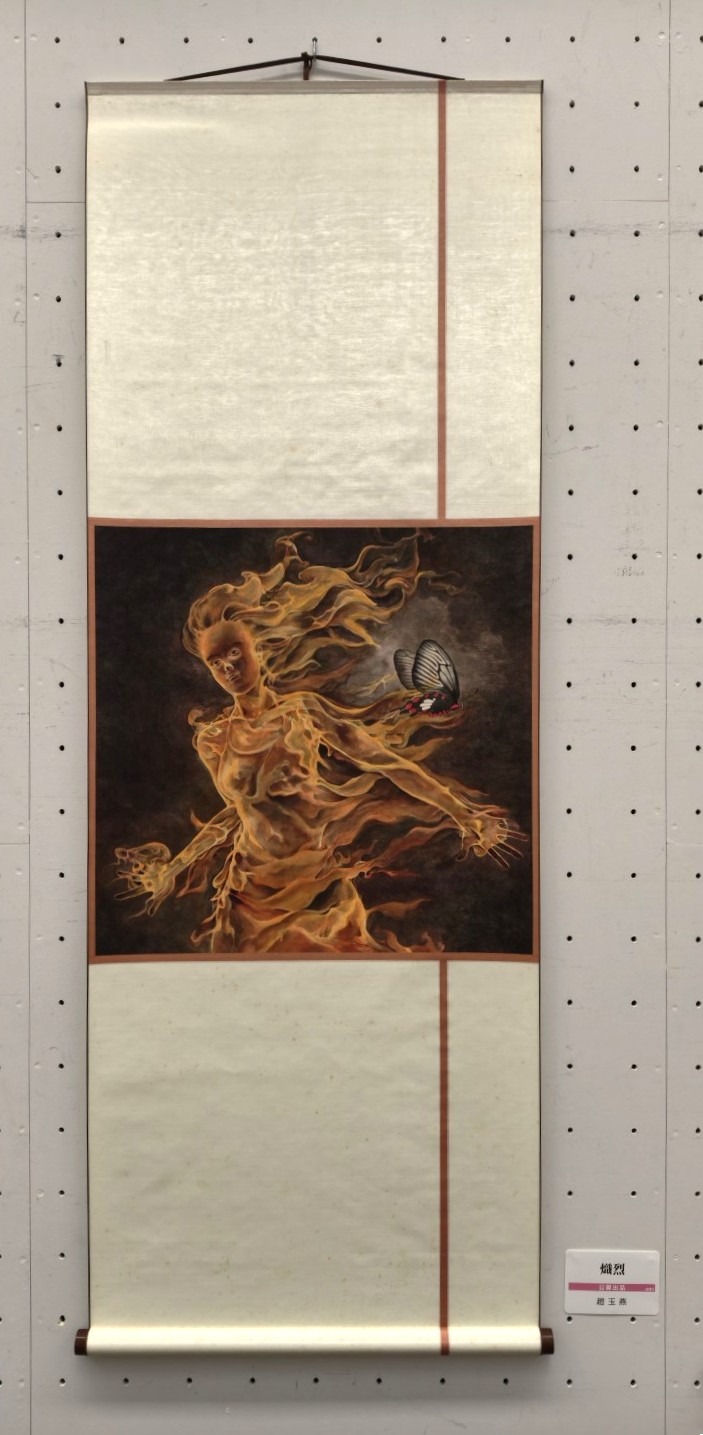
畫面中央是一具近乎等身比例的人體形象,從幽暗背景中浮現,其軀幹、手臂、髮流與輪廓皆如火舌般翻捲、延伸、逸散。這人形並不被穩固地描繪成肉身,反而像由半透明的焰、煙與熱流臨時構成;臉部仍保有可辨識的五官,但其明暗被火的金黃、赭橙與焦褐反覆沖刷,使表情不再屬於日常肖像的穩定範疇,而更像一個面容正在生成,也正在耗損。背景以深灰、墨黑、煙紫層層積染,托出中央發光的身軀;右側一隻黑白翅面的蝴蝶,翅脈清楚,翅下紅點鮮明,與整體焰流形成強烈的異質對照;左下亦有一個較小的蝶形火影,像餘燼,也像另一重生命的轉喻。若只說這是一件「火中人像」作品,終究太淺;因為真正使它迫近人心的,不是火焰效果,而是它讓身體不再是固體,而變成一種被燃燒、被打開、被迫流動化的存在。
赫拉克利特曾以火比喻世界的根本樣態。人們往往只記得他說萬物流變,卻忘了在赫拉克利特那裡,火並不是單純破壞性的元素,而是一種使一切存在都處於交換、轉化、生成之中的原理。若依此來看〈熾烈〉,則畫中的火並非附著在人形表面,而是人形本體的哲學條件。這具身體之所以令人不安,正因它不再允許我們把「人」理解成一個輪廓清楚、內外分明、可以被穩定命名的存在。它像在告訴我們:人不是一塊完成的石,而是一種正在燃燒的過程;不是先有本質,後有表現,而是其所謂的自我,恰恰就在這種燃燒、位移、逸散與重組之中暫時成形。火在這裡不是裝飾性的熱烈,而是生成的暴力:存在若要成其為存在,往往必先承受自己不再穩固的命運。
然而,若只以「流變」理解此作,又嫌太抽象。因為這件作品之所以高明,不在它讓我們知道世界會變,而在它讓我們感到:變化是有溫度的,有痛感的,有誘惑的,也是有代價的。 這裡我不禁想到巴舍拉。巴舍拉談火時,總強調火是最親密、也最危險的元素;火既是爐火,是夢,是童年的光,也是焚毀、狂熱與不可逆的力量。〈熾烈〉恰恰有這種雙重性。畫中的火並不完全像災禍,它也有某種近乎靈光的質感:金黃的邊緣、柔軟的煙流、近透明的焰膜,使整個人形帶有一種幾乎神話性的發亮。這表示火在此不是純然消極的焚燒,而更像一種把肉身從日常中提煉出來的過程;它讓人體失去穩固,也讓人體獲得了某種平常不可見的內在發光。這便是火的悖論:火一面奪走形體,一面也讓形體首次顯出其真正的脆弱與神祕。
而我尤其願意談這件作品作為水墨的意義。以水墨寫火,原就是一個極值得深思的媒材悖論。墨水本屬流、滲、暈、沉之物,傳統上更常與山水、雲煙、夜色、靜觀相連;火則屬躍、燥、裂、噬、升騰之物。趙玉燕選擇以水墨語言去承載火焰與燃燒的人體,實際上已經在媒材層面提出了一個極深的問題:熱能是否可以由流體來書寫?毀滅是否可以藉沉靜的筆法顯現? 正因水墨本身有暈開、滲透、拖曳與留痕的能力,它反而比許多直白的火焰描寫更能表現燃燒的本質。因為真正的燃燒,不是卡通式的火舌,而是邊界被一點點打散、輪廓被一層層鬆動、內裡與外部彼此滲漏的過程。從這個意義上說,〈熾烈〉不只是畫火,而是用水墨說明:火最深的本質,其實不是爆裂,而是滲入。
若進一步看這具身體,我以為作品最深的一刀,其實下在「身體不是容器」這件事上。多數時候,我們習慣把身體想成自我的外殼,以為內部有一個「我」,身體只是其臨時住所;但這件作品讓人難以維持這種想法。因為畫中沒有一個安穩地住在火中之人,反倒像是身體本身已經成了情感、慾望、記憶、創傷與能量的唯一可見形式。尼采一向反對把人理解成被理性統治的安定主體;在他那裡,生命首先是力,是衝動,是超越自身的生成。若借尼采來看,〈熾烈〉中的身體並不是被毀壞的身體,而是一個正在超出自己原有限度的身體。這超出當然不是輕鬆的,甚至帶有痛苦;但正因痛苦,它才不是廉價的昇華。畫中人形臉部的凝視、手指的張開、軀幹的半融解狀態,都使人感到:這不是一個平衡中的存在,而是一個在強度中被迫成為自己的存在。
這裡我又想到巴塔耶。巴塔耶談「耗費」時,從不把生命看成單純保存自身的機制;他反而指出,生命有一種超出功利、超出保全、傾向過剩、傾向燒掉自己的力量。火在此是巴塔耶式的:不節省,不克制,不服從用途。畫中的火焰沒有為任何實際功能服務,它不加熱食物,不照亮房間,不作為文明工具;它是純粹的強度,是一種把形體推向極限的能量。這正是作品所以具有哲學深度之處:它沒有把燃燒處理成英雄主義的勝利,也沒有處理成災難敘事的被害,而是讓燃燒本身成為一個存在問題——若生命本來就包含自我耗費、自我溢出的衝動,那麼人究竟是靠什麼維持為人?又是否正是在某些被燒灼的時刻,人才第一次看見自己不是整齊的?
然而,〈熾烈〉不僅止於火與身體,還有那隻蝶。蝶在畫中的出現極其關鍵,因為它賦予這件作品另一種細緻而致命的哲學對照:火是強度,蝶是脆弱;火是耗散,蝶是形式;火是不可止,蝶是瞬間之美。 但蝶又從來不只是脆弱而已。蝴蝶意味蛻變,意味從蟲到翼的不可逆轉,意味生命經歷某種封閉、瓦解與再組構之後,才擁有新的形態。於是,蝶就不只是畫面的美感平衡物,而更像火的另一個命題:若身體在燃燒中失去自己,那麼會不會也正因此,某種新的形態才得以出現? 這並非廉價的「破繭成蝶」勵志隱喻,而是一個更深、更危險的問題:變形是否必然伴隨損耗?蛻變是否不可避免地帶著毀傷?
我甚至願意在這隻蝶上讀到列維納斯意義上的「他者」痕跡。列維納斯提醒我們,真正的倫理不是從自我開始,而是從他者對我的要求開始。畫中這隻蝶如此輕,卻又如此清楚,像一枚不肯被火吞沒的異質存在。它既沒有融化為火的一部分,也沒有逃離畫面,而是與這具燃燒的人形保持一種極緊張的鄰近。這便使整件作品不只是內在激情的戲劇,也成為一則倫理寓言:在我最熾烈、最逼近自我耗盡的時刻,是否還有什麼異於我的東西,仍然停棲在我身旁,阻止我把世界全燒成我的同類? 那隻蝶像提醒人:火可以把一切轉為同一種顏色,但真正重要的事,往往是那仍保有差異、仍不肯被吞沒的微小存在。
從構圖上看,作品最厲害的地方,在於其整體動勢幾乎全由左下往右上斜向推展,人形與火流形成一個不穩定而持續擴張的力量場;然而這種斜向奔逸,卻被臉部視線與蝶的停棲暫時扣住,於是畫面始終懸在「將散未散、將崩未崩」的臨界點上。這種臨界感正是哲學性的。因為真正觸動存在的,不是完成,而是臨界;不是定型,而是那一刻一切還沒有結束、卻已經不能回頭。柏格森若在此,大概會說:這不是一個被切成空間片段的身體,而是一股持續綿延的生命時長,被強度逼到表面而成為可見。〈熾烈〉於是並非在畫一個事件,而更像在畫一種時間:一種高溫的時間,一種不能靜止、不能退回、只能繼續燃燒的時間。
趙玉燕這件作品之所以使我久久不能放下,正在於它逼我承認:人其實遠比日常所表現得更不穩固,也更熾烈。我們平時說自己冷靜、成熟、理性、完整,那多半是社會生活所需的表面秩序;但在人真正被愛過、被傷過、被召喚過、被迫面對自己時,常常不是如石般穩,而更如火般散。這並不丟臉,甚至也不是病態;它只是說明,生命原本就不是為了靜止而誕生。人有時之所以成為人,不在於能控制自己,而在於敢不敢承認:自己也曾經在某些時刻,被燃燒過,被打開過,被迫離開那個原以為可以長久住下去的「自己」。
所以我看〈熾烈〉,最終讀到的並不只是烈焰之美,而是一種更難承受的真理:人不是在未被燒灼時才最完整,反而常常是在被高熱逼近極限時,才首次顯出自己真正的輪廓。 火在這裡不是單純毀滅,而是揭露;不是只有痛苦,而是使隱藏之物終於露面。趙玉燕的高明,在於沒有把這揭露畫成說教,也沒有畫成宣言,而是用水墨那種本來偏向沉靜、含蓄、滲化的媒材,把熾烈這件事畫成一種既美、又危險,既透明、又不可逆的存在狀態。這樣的作品,便不只是「題目叫熾烈」,而是真正讓觀者在觀看之中,感到自身也被某種無以名狀的熱度微微燒到。
趙玉燕〈熾烈〉以水墨作為媒材,構築出一具介於人體、火焰與煙流之間的半生成性形象,作品最重要的成就,在於它將「火」由視覺效果提升為存在論命題。若依赫拉克利特的流變思想,畫中燃燒的人形不是被火包覆的主體,而是被火重新定義的存在;若從巴舍拉對火的物質想像學來看,火在此兼具親密與危險、照明與吞噬的雙重性,使身體成為一個既被揭露又被耗損的場域。尼采式的生成哲學與巴塔耶對過剩與耗費的思考,則進一步指出,此作所觸及者不是單純的激烈情緒,而是生命如何在高強度中超出自身形式的問題。畫面中蝴蝶的出現,更為整體引入蛻變、脆弱與他者性的層面,使燃燒不只意味毀壞,也意味某種不可逆的轉化。整體而言,〈熾烈〉不是一件描繪火焰之美的作品,而是一件藉水墨媒材悖論性地書寫「身體如何在燃燒中成為事件」的哲學性創作。
其他相關內容:
【現場直擊】【台日交流展】東京都美術館開館100周年記念《第14回東京現展》展場:日本國立東京都美術館
台灣參展藝術家作品藝術評論
東京都美術館開館100周年記念【14回東京現展】廖純沂〈未盡・浮境〉未盡之物何以最能久留人心
東京都美術館開館100周年記念【14回東京現展】廖純沂〈游相〉花何以不止於花,與形相如何在漂游中成立
東京都美術館開館100周年記念【14回東京現展】廖純沂〈思域・沉靜〉沉靜何以不是空,與垂掛之物何以最像思念
東京都美術館開館100周年記念【14回東京現展】王詮富〈八月閑步一色秋〉的季節哲學、門徑意識與水墨的開敞性 在黑暗中閑步:秋色如何不是顏色,而是一種存在的轉身
東京都美術館開館100周年記念【14回東京現展】 王詮富〈一念菩提開翠微〉的開顯、同體、綿延與空性 一念未起,萬根已動
東京都美術館開館100周年記念【14回東京現展】蔡梅芳〈戀戀紫藤〉的痕跡、綿延與生成 花影之遲遲不散,與記憶如何在解構之後重返
東京都美術館開館100周年記念【14回東京現展】 王穆提《聖境・阿里山》蒼翠的紀念碑
東京都美術館開館100周年記念【14回東京現展】王穆提《中道之光》裂隙中的永恆
東京都美術館開館100周年記念【14回東京現展】吳心荷〈散落骨骼(一)〉散落之骨,與人之未能完全集成於自身
東京都美術館開館100周年記念【14回東京現展】陳福祺〈咖啡心音〉的存在寓言 沸點、晶化與心之熔爐
東京都美術館開館100周年記念【14回東京現展】張素蘭〈一棵開花的樹〉的場所哲學、過程生命與靜默中的新生
東京都美術館開館100周年記念【14回東京現展】吳亞倫〈藍與黑的交響詩(雙併)〉論藍何以不只為藍,黑何以不只為黑
東京都美術館開館100周年記念【14回東京現展】張碧鄉〈艷冠群芳〉的器物哲學、生成美學與過剩的顯現
東京都美術館開館100周年記念【14回東京現展】趙玉燕〈熾烈〉論火中的身體,與人何以不能只是自己
東京都美術館開館100周年記念【14回東京現展】許秀珠〈403地震後的太魯閣〉山川之裂,與人如何在震後重新學會自身的位置
東京都美術館開館100周年記念【14回東京現展】江麗香〈秋聲賦〉彩墨中的時間書寫 水痕與秋聲
東京都美術館開館100周年記念【14回東京現展】江麗香〈流轉的歲月〉水之無言,而歲月常藉其形以自見
東京都美術館開館100周年記念【14回東京現展】謝文倩〈驚夢〉的夢之碎片、感覺邏輯與夜的顯現
東京都美術館開館100周年記念【第14回東京現展】黃淑卿〈群鷗處處來(台灣澎湖)〉群鷗之所以來,與人終於學會不把世界全算作自己
東京都美術館開館100周年記念【14回東京現展】黃淑卿〈燕尾與戴勝(台灣金門)〉論屋脊、禽鳥與地方何以不只是地理
東京都美術館開館100周年記念【14回東京現展】謝正瑜〈蓮池映相〉的感知哲學與靈性空間
東京都美術館開館100周年記念【14回東京現展】周若梅〈流光之舞〉,光何以有身,與人如何在流動中暫時成形
On the Body in Fire, and Why One Cannot Simply Be Oneself
— On Chao Yu-yen’s Blazing
Written by WANG MUTI
What is hardest for humans to comprehend is not cold, but fire. Cold allows one to retreat, but fire always forces one to draw near; cold causes contraction, but fire causes all boundaries to waver. Gaze upon fire, and two opposing impulses inevitably arise: on one hand, a desire to approach, for fire possesses light, warmth, and an ancient, almost maternal summons; on the other hand, a urge to recoil, for fire never truly belongs to humanity—once it overpowers, it ceases to illuminate and begins to devour. Therefore, whenever I encounter an artwork themed around fire, I never first ask whether it looks like fire; I ask whether it truly makes me feel that fire is not a mere spectacle, but a state of existence. Chao Yu-yen’s Blazing, in my eyes, is precisely such a work. It does not depict flames; it depicts a body occupied by fire. More accurately, it paints not a person in fire, but a humanoid existence that has become indistinguishable from fire itself.
The Liquefaction of the Solid Body
At the center of the canvas emerges a nearly life-sized human figure from a murky background. Its torso, arms, flowing hair, and contours curl, extend, and dissipate like tongues of fire. This figure is not securely rendered as solid flesh; rather, it appears provisionally composed of translucent flames, smoke, and thermal currents. While the face retains recognizable features, its highlights and shadows are repeatedly washed over by the gold, ochre-orange, and scorched brown of the fire, removing the expression from the stable domain of ordinary portraiture. Instead, it resembles a countenance caught in the simultaneous acts of generation and attrition. The background is built up through layered washes of deep grey, ink black, and smoky purple, anchoring the luminous torso at the center. To the right, a butterfly with black-and-white patterned wings displays distinct veins and vivid red spots beneath, creating a sharp, heterogeneous contrast with the overall volcanic flow. To the bottom left, a smaller butterfly shadow of fire hovers like an ember, serving as a metaphor for another dimension of life. To call this merely a "portrait in fire" is ultimately too superficial; what truly drives this work into the depths of the human heart is not a technical pyrotechnic effect, but how it forces the body to cease being a solid entity, transforming it into an existence burned, opened, and forced into liquefaction.
The Violence of Becoming and the Paradox of Fire
Heraclitus once used fire as a metaphor for the fundamental state of the cosmos. People often remember only his statement that everything flows, forgetting that for Heraclitus, fire is not a purely destructive element, but a principle that places all existence within exchange, transformation, and becoming. Viewed through this lens, the fire in Blazing does not merely cling to the surface of the humanoid form; it is the philosophical condition of the form's ontology. This body disquiets us precisely because it no longer allows us to understand "man" as a cleanly outlined, stable entity with a fixed boundary between interior and exterior. It seems to tell us: man is not a finished stone, but a burning process. It is not that essence comes first and expression follows; rather, the so-called self forms temporarily precisely within this burning, displacement, dissipation, and reassembly. Fire here is not an ornamental passion, but the violence of becoming: for existence to become existence, it must often first endure the fate of its own instability.
Yet, to understand this work solely through "flux" would be too abstract. The brilliance of this piece lies not in merely informing us that the world changes, but in making us feel that change possesses a temperature, a pain, a temptation, and a cost. Here, I cannot help but think of Gaston Bachelard. When discussing fire, Bachelard always emphasized that it is the most intimate yet dangerous element. Fire is the hearth, the dream, and the light of childhood; yet it is also a force of incineration, fanaticism, and irreversibility. Blazing possesses precisely this duality. The fire in the painting does not look entirely like a disaster; it retains a quality akin to an aura—the golden rims, the soft currents of smoke, and the nearly transparent membranes of flame endow the humanoid form with a mythical luminescence. This indicates that fire here is not a purely negative destruction, but a process of refining the flesh out of the everyday. It strips the body of its stability while granting it an otherwise invisible internal radiance. This is the paradox of fire: it takes away form, yet simultaneously allows form to display its true vulnerability and mystery for the first time.
The Paradox of Medium: Ink Infiltrating Fire
I am particularly keen to discuss the significance of this work as an ink wash painting. Writing fire through ink is inherently a profound paradox of medium. Ink is a substance of flowing, permeating, blurring, and settling, traditionally associated with landscapes, mist, night sceneries, and quiet contemplation. Fire, conversely, is an entity of leaping, drying, cracking, devouring, and ascending. By choosing the language of ink and wash to sustain flames and a burning human body, Chao Yu-yen poses a deep question at the material level: Can thermal energy be written by fluid? Can destruction manifest through a serene brushwork?
Precisely because ink wash possesses the capacity to bleed, permeate, drag, and leave traces, it proves far more capable of expressing the essence of burning than many literal depictions of flames. True burning is not a cartoonish tongue of fire; it is a process where boundaries are dismantled piece by piece, contours are loosened layer by layer, and the interior and exterior leak into one another. In this sense, Blazing does not merely paint fire; it uses ink to demonstrate that the deepest nature of fire is not explosion, but infiltration.
Beyond the Container: Nietzsche, Bataille, and Levinas
Looking closer at this body, I believe the sharpest incision made by the work lies in declaring that "the body is not a container." Most of the time, we are accustomed to thinking of the body as a shell for the self, assuming a "me" resides securely within while the body is merely a temporary dwelling. This painting shatters that assumption. There is no individual calmly residing inside the fire; rather, the body itself has become the sole visible manifestation of emotion, desire, memory, trauma, and energy. Friedrich Nietzsche consistently opposed understanding man as a stable subject ruled by reason; for him, life is first and foremost force, impulse, and a self-transcending becoming. Seen through a Nietzschean lens, the body in Blazing is not a ruined body, but a body exceeding its own original limits. This exceeding is by no means easy—it even carries agony—but precisely because of this pain, it avoids becoming a cheap sublimation. The gaze of the humanoid face, the open fingers, and the semi-dissolved state of the torso all make one feel that this is not an existence in equilibrium, but an existence forced to become itself within pure intensity. This brings to mind Georges Bataille. When discussing "expenditure," Bataille never viewed life as a mechanism of mere self-preservation; instead, he pointed out that life possesses a force that transcends utility and preservation, tending toward excess and burning itself out. The fire here is thoroughly Bataillean: it does not economize, it does not restrain, and it does not submit to utility. The flames in the painting serve no practical function—they do not heat food, illuminate a room, or act as a tool of civilization. It is pure intensity, an energy pushing form to its absolute limit. This is where the work achieves its philosophical depth: it does not treat burning as a heroic triumph, nor does it reduce it to a victim narrative of disaster. Instead, it allows burning itself to become an ontological question—if life inherently contains the impulse for self-expenditure and self-overflow, by virtue of what does man remain human? And is it precisely during certain scorched moments that man realizes for the first time that he is not a tidy entity?
Yet, Blazing does not stop at fire and the body; there is also that butterfly. The appearance of the butterfly is critical, for it introduces a delicate yet fatal philosophical counterpoint: fire is intensity, the butterfly is vulnerability; fire is dissipation, the butterfly is form; fire is the unstoppable, the butterfly is transient beauty. But the butterfly is never merely vulnerable. It signifies metamorphosis, the irreversible transition from caterpillar to wings, meaning that life must undergo a certain closure, collapse, and reassembly before acquiring a new form. Thus, the butterfly is not just an aesthetic balancer on the canvas; it is another proposition of fire: if the body loses itself in the burning, could it be that precisely because of this, a new form can emerge? This is no cliché inspirational metaphor of "breaking out of the cocoon"; it is a deeper, more dangerous question: Does transformation necessitate attrition? Does metamorphosis inevitably carry damage?
I am even willing to read the trace of "the Other" in Emmanuel Levinas's sense within this butterfly. Levinas reminds us that true ethics begins not from the self, but from the demands the Other makes upon me. This butterfly is so light yet so distinct, like an element of heterogeneous existence refusing to be swallowed by the fire. It neither melts into the flames nor flees the canvas; instead, it maintains a highly tense proximity to the burning figure. This transforms the work from a mere drama of internal passion into an ethical allegory: at my most blazing moment, closest to self-exhaustion, is there still something different from me that perches by my side, preventing me from burning the entire world into my own likeness? The butterfly serves as a reminder: fire can reduce everything to a single color, but the things that truly matter are often those minuscule existences that retain their difference and refuse to be devoured.
Conclusion
Compositionally, the most brilliant aspect of the work is that its overall momentum pushes diagonally almost entirely from the bottom left to the top right, turning the figure and the fiery flow into an unstable, continuously expanding field of force. Yet, this diagonal escape is temporarily anchored by the gaze of the face and the perch of the butterfly, suspending the canvas permanently at a threshold where it is about to disperse yet remains intact, about to collapse yet stays whole. This sense of liminality is inherently philosophical. What truly touches existence is not completion, but the threshold; not the fixed form, but that exact moment when nothing has ended, yet there is already no turning back. If Henri Bergson were here, he would likely say: this is not a body cut into spatial segments, but a continuous duration of life driven to the surface by intensity, becoming visible. Blazing is thus not painting an event, but a kind of time—a high-temperature time, a time that cannot stand still, cannot retreat, and can only continue to burn.
What prevents me from setting aside Chao Yu-yen’s work for a long time is that it forces me to admit: human beings are actually far less stable and far more blazing than our daily behavior suggests. We usually claim to be calm, mature, rational, and complete—but that is mostly a surface order required by social life. When a person has truly loved, been hurt, been summoned, or been forced to face themselves, they are rarely as stable as stone; they dissipate more like fire. This is not shameful, nor is it pathological; it simply proves that life was never born for stillness. Why humans sometimes become human lies not in the ability to control themselves, but in whether they dare to admit that they too have, at certain moments, been burned, been opened, and been forced to leave that "self" they once thought they could inhabit forever.
Therefore, when I look at Blazing, what I ultimately read is not merely the beauty of fierce flames, but a truth far harder to bear: man is not at his most complete when un-scorched; rather, it is often when forced to the limit by intense heat that he displays his true contour for the first time. Fire here is not pure destruction, but revelation; it does not bring only pain, but forces what is hidden to finally show its face. Chao Yu-yen’s mastery lies in not turning this revelation into a sermon or a manifesto.
Instead, using ink wash—a medium naturally inclined toward stillness, subtlety, and permeation—she paints the act of blazing as a state of existence at once beautiful and dangerous, transparent and irreversible. Such a work does not merely bear the title Blazing; it truly ensures that the viewer, in the act of gazing, feels slightly singed by an unnamable heat.
Summary Note: Chao Yu-yen’s Blazing utilizes ink wash to construct a semi-generative imagery suspended between the human body, flames, and smoke. The work's primary achievement lies in elevating "fire" from a visual effect to an ontological proposition. Drawing upon Heraclitus's philosophy of flux, the burning figure is not a subject enveloped by fire, but an existence redefined by it. From the perspective of Bachelard’s psychoanalysis of fire, it embodies the duality of intimacy and danger, illumination and devouring, transforming the body into a site both revealed and expended. Nietzschean philosophy of becoming and Bataille’s concept of expenditure further indicate that the work touches not upon simple intense emotion, but upon how life exceeds its own form within high intensity. The appearance of the butterfly introduces dimensions of metamorphosis, vulnerability, and alterity, implying that burning signifies not merely destruction, but an irreversible transformation. Overall, Blazing is not a depiction of the beauty of flames, but a philosophical creation that paradoxically uses ink wash to write "how the body becomes an event within burning."
火中の身体、そして人間がいかにして単なる自己に留まれないのかについて
—— 趙玉燕(チャオ・ユーイェン)〈熾烈(しれつ)〉に寄せて
執筆:王穆提(ワン・ムーティ)
人間にとって最も理解しがたいのは、寒さではなく、火である。寒さは人を退却させるが、火は常に人を近づかせる。寒さは人を収縮させるが、火はあらゆる境界を揺るがせる。人は火を前にしたとき、どうしても二つの相反する心理を同時に抱いてしまう。一方では、近づきたいと願う。火には光があり、熱があり、原初的で母性にも似た召喚(呼び声)があるからだ。しかし他方では、後退したいとも思う。火は決して真に人間のものにはならないからだ。それはひとたび過剰になれば、もはや周囲を照らすことをやめ、すべてを貪り喰らい(吞噬)始める。それゆえ、私は火を題材にした作品を見るたび、それが火に似て描かれているかどうかをまず問うことはない。そうではなく、その画が私に「火とは単なる光景ではなく、一つの存在状態なのだ」と真に感じさせてくれるかどうかをまず問うのである。趙玉燕の描いた〈熾烈〉は、私の目に、まさにそのような作品として映る。これは火炎を描写しているのではなく、火によって占拠された身体を描いているのだ。より正確に言えば、火の「中」にいる人間を描いているのではなく、すでに火と判別がつかなくなった「人形(ひとがた)の存在」そのものを描いているのである。
固体たる身体の液状化
画面の中央には、幽暗な背景から浮かび上がる、ほぼ等身大の人体像がある。その躯幹、腕、髪の流れ、そして輪郭は、ことごとく火舌(燃え盛る炎)のように翻転し、延伸し、霧散している。この人形は、確固たる肉体としては描かれていない。むしろ、半透明の炎、煙、そして熱流によって一時的に構成されているかのようだ。顔部にはなお識別可能な五官が残されているものの、その明暗は火の金色、赭橙(赤オレンジ)色、そして焦褐色によって幾度も衝洗(洗い流し)されており、その表情はもはや日常的な肖像画の安定した範疇には属さない。それは、面容が今まさに生成されつつ、同時に耗損(消耗)されつつある瞬間のようである。背景は深い灰色、墨黒、煙紫色によって幾重にも積染(重ね塗り)され、中央で発光する身軀を浮き上がらせている。右側には、白黒の翅(はね)を持つ一羽の蝶が配されており、翅脈はくっきりと、翅の下の赤い斑点は鮮明に描かれ、全体の炎の流れに対して強烈な「異質なる対照」をなしている。左下にもまた、より小さな蝶の形をした火影が、余燼(燃え残りの灰)のように、あるいはもう一重の生命の転喩(メタファー)のように揺らめいている。これを単なる「火の中の人物像」と呼ぶだけでは、結局のところ浅薄に過ぎる。なぜなら、この画が真に人の心に迫る理由は、火炎のエフェクトによるものではなく、それが身体を「固体」であることをやめさせ、燃やされ、切り開かれ、流動化することを強制された存在へと変容させているからである。
生成の暴力と火のパラドックス
ヘラクレイトスはかつて、火を世界の根本的な在り方の比喩として用いた。人々は往々にして彼の「万物は流転する」という言葉だけを記憶しているが、ヘラクレイトスにおける火とは、単なる破壊的な元素ではなく、あらゆる存在を交換、転化、そして「生成」の中へと投げ込む原理であった。この視点から〈熾烈〉を眺めるならば、画中の火は人形の表面に付着しているのではなく、人形という存在そのものの「哲学的条件」なのだと言える。この身体が私たちに不安を与えるのは、まさにそれが「人間」を、輪郭が明瞭で、内と外が分かたれた、安定して命名可能な存在として理解することを最早許さないからである。それは私たちにこう告げているかのようだ。人間とは完成された一個の石ではなく、燃え盛るプロセス(過程)そのものである、と。本質が先にあり、表現が後から来るのではない。いわゆる「自己」とは、まさにこのような燃焼、変位、霧散、そして再組織化の中で、一時的に形を成すものなのだ。ここでの火は、装飾的な熱烈さではなく、「生成の暴力」である。存在が存在として成り立つためには、往々にしてまず、自らがもはや強固ではないという運命を受け入れねばならない。
しかし、この作品をただ「流転」という言葉だけで理解しては、あまりにも抽象的に失するだろう。この作品が優れているのは、世界が変化することを私たちに知識として教えるからではなく、変化には「温度」があり、「痛感」があり、「誘惑」があり、そして「代価」があるのだということを私たちに肌で感じさせるからだ。ここで、私はガストン・バシュラールを思い出さずにはいられない。バシュラールが火を語るとき、常に強調したのは、火が最も親密であり、同時に最も危険な元素であるという点であった。火は炉火であり、夢であり、幼少期の光であると同時に、焚毀(焼き尽くすこと)、狂熱、そして不可逆な力でもある。〈熾烈〉には、まさにこの二重性がある。画中の火は、完全な災禍のようには見えない。そこにはある種、霊光(オーラ)にも似た質感が湛えられている。金色のエッジ、柔らかな煙の流れ、そして半透明の炎の膜は、人形全体にほとんど神話的とも言える発光をもたらしている。これは、ここでの火が純粋に消極的な燃焼ではなく、むしろ肉体を日常から「蒸留(提煉)」するプロセスであることを示している。それは人体から堅固さを奪う一方で、人体に、普段は見ることのできない「内なる発光」を与えている。これこそが火のパラドックスである。火は一面において形体を奪い去りながら、もう一面において、その形体が持つ真の脆弱さと神秘性を、初めて露わにさせるのである。
媒材の逆説:火に滲み入る水墨
私は特に、この作品が「水墨」として描かれたことの意味について語りたい。水墨によって火を描くということは、本来、極めて深く思索されるべき「媒材のパラドックス(逆説)」である。墨水とは本来、流れ、滲み、暈(ぼか)され、沈殿するものであり、伝統的には山水、雲煙、夜色、そして「静観」と結びついてきた。対して火は、跳躍し、乾燥し、裂け、貪り喰らい、昇騰(立ち上る)するものである。趙玉燕が、火炎と燃焼する人体を受け止める言語として水墨を選択したことは、実のところ、材質のレベルにおいて極めて深い問いを突きつけている。「熱エネルギーは、流体(液体)によって書写されうるのか?」「毀滅(滅び)は、沈静なる筆法によって現されうるのか?」という問いである。 水墨そのものが持つ、暈し、滲み、引き摺り(拖曳)、そして痕跡を留める能力ゆえに、それは多くの直白な(ストレートな)火炎描写よりも、むしろ燃焼の「本質」を鮮やかに表現し得ている。なぜなら、真の燃焼とは、アニメ的な火の舌の形をしているのではなく、境界が少しずつ打ち砕かれ、輪郭が一段ずつ緩められ、内側と外側が互いに漏れ出し合うプロセスだからだ。この意味において、〈熾烈〉は単に火を描いているのではなく、水墨を用いて次の一事を証明している。火の最も深い本質とは、爆発ではなく、「滲入(滲み入ること)」なのだ、と。
容器を超えて:ニーチェ、バタイユ、そしてレヴィナス
この身体をさらに一歩踏み込んで見るならば、本作の最も深い一刀は、実のところ「身体は容器ではない」という事実に対して下されている。多くの場合、私たちは身体を自己の外殻として考えがちであり、内部に一個の「私」がいて、身体はその一時的な住処に過ぎないと思い込んでいる。しかし、この作品はそのような思考を維持することを許さない。なぜなら、画の中には火の中に安穏と暮らす人間などおらず、むしろ身体そのものが、感情、欲望、記憶、創傷、そしてエネルギーの「唯一の可視的な形式」となってしまっているからだ。フリードリヒ・ニーチェは、人間を理性に統治された安定した主権者として理解することに一貫して反対した。彼において、生命とは何よりもまず「力」であり、「衝動」であり、自己を超越していく「生成」であった。ニーチェを借りて見るならば、〈熾烈〉における身体は、破壊された身体ではなく、自らの本来の限度を「超え出つつある身体」である。この超克は当然ながら平易なものではなく、苦痛すら伴う。しかし、苦痛を伴うからこそ、それは安易な昇華には堕さない。人形の顔部が見せる凝視、開かれた指先、そして躯幹の半ば融解した状態は、いずれも鑑賞者に次のように感じさせる。これは均衡の中にある存在ではなく、「強度」の中で自己であることを強制された存在なのだ、と。
ここで私はジョルジュ・バタイユを思い出す。バタイユが「耗費(消尽)」を語るとき、生命を単なる自己保存のメカニズムとしては決して捉えなかった。彼はむしろ、生命には功利や保全を超え、過剰へと向かい、自らを燃やし尽くそうとする(焼掉自己)力が備わっていることを指摘した。ここでの火は、まさにバタイユ的である。節約せず、克制せず、用途に服従しない。画中の火炎はいかなる実用的な機能(食べ物を温める、部屋を照らす、文明の道具となる)にも奉仕していない。それは純粋な「強度」であり、形体を極限へと押し進めるエネルギーそのものである。これこそが作品に哲学的深度をもたらしている理由だ。本作は燃焼を英雄主義的な勝利としても、あるいは災難ナラティブの被害としても処理していない。そうではなく、燃焼そのものを一つの存在論的問いとして提示しているのである。——もし生命が本来、自己耗費と自己溢出(溢れ出ること)の衝動を含んでいるとするならば、人間は一体何によって「人間」であり続けられるのか。そして、人間が自らを単一の整然とした存在ではないと初めて気づくのは、まさにこうした「焼灼(焼き焦がされる)の瞬間」においてではないだろうか。
しかし、〈熾烈〉は火と身体だけにとどまらず、あの「蝶」が存在する。蝶の出現は極めて決定キー(關鍵)である。なぜなら、それがこの作品に、もう一つの繊細で致命的な哲学的対照を導入しているからだ。火が「強度」であるなら、蝶は「脆弱さ」である。火が「耗散(霧散)」であるなら、蝶は「形式(フォーム)」である。火が「静止不能」であるなら、蝶は「瞬間の美」である。しかし、蝶は決して単なる弱さではない。蝶は「変態(蛻変)」を意味し、芋虫から羽を持つものへの不可逆な転換を意味し、生命が何らかの閉鎖、瓦解、そして再組織化を経て初めて、新たな形態を獲得することを意味する。したがって、蝶は単なる画面の美学的バランスを取るためのオブジェクトではなく、むしろ火が持つもう一つの命題なのだ。もし身体が燃焼の中で自己を失うとするならば、まさにそれゆえに、ある種の新しき形態が現れ出るのではないか。これは安易な「繭を破って蝶になる」といった励ましの比喩(ナラティブ)ではない。それはさらに深く、危険な問いである。「変形(トランスフォーメーション)には、必ず損耗が伴うのか?」「蛻変には、避けがたく毀傷(傷を負うこと)が伴うのか?」という問いだ。
私はこの蝶の上に、エマニュエル・レヴィナスのいう「他者」の痕跡さえ読み取りたいと思う。レヴィナスは、真の倫理は自己から始まるのではなく、他者が私に対して突きつける要求から始まると教えてくれた。画中のこの蝶はあまりにも軽やかでありながら、あまりにも鮮明であり、火に吞み込まれることを拒む「異質な存在」のようである。それは火の一部として融解することもなく、画面から逃げ出すこともなく、この燃え盛る人形と極めて緊張感のある「隣接(近接性)」を保っている。これにより、作品全体は単なる内面的な情熱のドラマであることを超え、一つの倫理的な寓話となる。私が最も熾烈であり、自己耗尽に最も近づいているその瞬間において、なお私とは異なる何ものかが私の傍らに留まり、世界のすべてを「私という同類」へと焼き尽くすことを食い止めてくれているのではないか。あの蝶は人間に思い出させる。火はすべてを同じ色に変えることができるが、真に重要な事象とは、往々にして、なお差異を保ち続け、吞み込まれることを拒むあの微小な存在の中にこそあるのだ、と。
結論
構図の面から見れば、本作の最も優れた部分は、全体の動勢がほぼすべて左下から右上へと斜めに押し出されており、人形と火流が、不安定でありながら持続的に拡張する「力の場(パワー・フィールド)」を形成している点にある。しかし、この斜めへの奔逸は、顔面の視線と蝶の静止によって一時的に留め置かれている。その結果、画面は常に「散りそうで散らず、崩れそうで崩れない」という臨界点(クリティカル・ポイント)に宙吊りにされている。この臨界感こそがまさに哲学的である。なぜなら、存在を真に揺り動かすものは、完成ではなく「臨界」であり、定型ではなく「その瞬間、一切はまだ終わっていないが、しかしもう後戻りはできない」という感覚だからだ。アンリ・ベルクソンがここにいたならば、おそらく次のように言うだろう。これは空間的に切り刻まれた断片としての身体ではなく、強度によって表面へと突き動かされ、可視化された「持続(デュレ)する生命の持続」そのものである、と。それゆえ、〈熾烈〉は一つのイベントを描いているのではなく、ある種の「時間」を描いているのだ。それは高熱の時間であり、静止することも退くこともできず、ただ燃え続けるしかない時間である。
趙玉燕のこの作品が、私を長い間立ち去らせない理由は、まさにそれが私に次の一事を認めさせるからだ。人間とは、実のところ日常の中で取り繕っている姿よりも、遥かに不確かにであり、遥かに熾烈な存在なのだ、と。私たちは日頃、自分を冷静、成熟、理性的、そして完璧(完整)であると語るが、それは大抵、社会生活が必要とする表面的な秩序に過ぎない。しかし人間が、真に誰かを愛し、傷つき、召喚され、自らと対峙することを強制されたとき、往々にして石のように堅固であることはなく、むしろ火のように散りゆくものである。それは決して恥ずべきことではなく、病的なものですらたい。それはただ、生命というものが本来、静止するために誕生したわけではないことを証明しているだけなのだ。人間が時に人間となる理由は、自己をコントロールできる能力にあるのではなく、「自分もまたかつてある瞬間において、燃やされ、切り開かれ、長年住み続けられると思い込んでいた『自己』から立ち退かされたのだ」と認める勇気があるかどうかにかかっている。
それゆえ、私が〈熾烈〉を観るとき、最終的に読み取るものは単なる激しい炎の美しさではなく、より引き受けがたい(承受しがたい)真理である。人間は、焼き焦がされていないときに最も完璧(完整)なのではない。むしろ、高熱によって極限へと追い詰められたとき、初めて自らの真の輪郭を現すのである。ここでの火は単なる毀滅ではなく、「露呈(開示)」であり、苦痛をもたらすだけでなく、隠されていたものを最終的に白日の下に晒す(露面させる)のだ。趙玉燕の妙なる部分は、この開示を説教臭く描くことも、宣言として描くこともなかった点にある。そうではなく、本来は沈静、含蓄、滲化(滲み)へと傾倒する水墨という媒材を用いて、この「熾烈」という事象を、美しくも危険であり、透明でありながら不可逆な存在状態として描き出した。このような作品は、単に「タイトルが熾烈である」にとどまらず、真に鑑賞者をして、観るという行為の中で、自らもまた名付けがたい熱度によって幽かに焼き焦がされるのを感じさせるのである。
趙玉燕の〈熾烈〉は、水墨を媒材として用い、人体、火炎、そして煙流の狭間に位置する「半生成的」なイメージを構築している。本作の最も重要な達成は、「火」を単なる視覚的エフェクトから存在論的な命題へと高めた点にある。ヘラクレイトスの流変思想に依拠すれば、画中で燃え盛る人形は火に包まれた主客ではなく、火によって再定義された存在そのものである。また、バシュラールによる火の物質想像学から見れば、ここでの火は親密さと危険さ、照明と吞噬という二面性を兼ね備えており、身体を「露呈されつつ耗損される場」へと変容させている。ニーチェ的な生成の哲学や、バタイユにおける過剰と耗費(消尽)への思索は、本作が触れているものが単なる激しい感情ではなく、生命がいかにして高強度の中で自らの形式を超え出していくかという問題であることを示している。画面における蝶の出現は、そこに蛻変(変態)、脆弱さ、そして他者性(オルタリティ)の次元を導入し、燃焼が単なる破壊ではなく、不可逆な転換を意味するものであることを暗示する。総じて、〈熾烈〉は火炎の美しさを描写した作品ではなく、水墨という媒材のパラドックスを逆手に取り、「燃焼の中で身体がいかにしてイベント(事件)となるか」を実証した哲学的創作である。