On the Body in Fire, and Why One Cannot Simply Be Oneself
— On Chao Yu-yen’s Blazing
Written by WANG MUTI
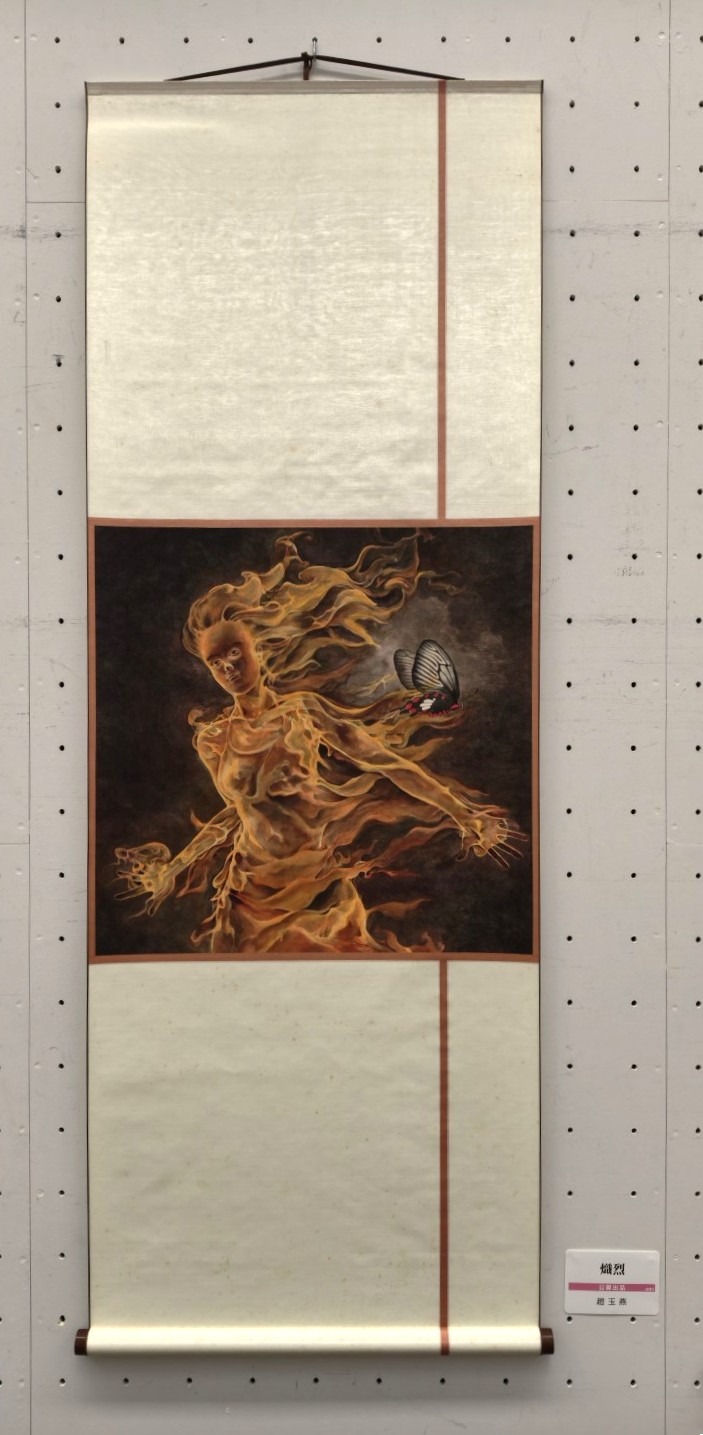
What is hardest for humans to comprehend is not cold, but fire. Cold allows one to retreat, but fire always forces one to draw near; cold causes contraction, but fire causes all boundaries to waver. Gaze upon fire, and two opposing impulses inevitably arise: on one hand, a desire to approach, for fire possesses light, warmth, and an ancient, almost maternal summons; on the other hand, a urge to recoil, for fire never truly belongs to humanity—once it overpowers, it ceases to illuminate and begins to devour. Therefore, whenever I encounter an artwork themed around fire, I never first ask whether it looks like fire; I ask whether it truly makes me feel that fire is not a mere spectacle, but a state of existence. Chao Yu-yen’s Blazing, in my eyes, is precisely such a work. It does not depict flames; it depicts a body occupied by fire. More accurately, it paints not a person in fire, but a humanoid existence that has become indistinguishable from fire itself.
The Liquefaction of the Solid Body
At the center of the canvas emerges a nearly life-sized human figure from a murky background. Its torso, arms, flowing hair, and contours curl, extend, and dissipate like tongues of fire. This figure is not securely rendered as solid flesh; rather, it appears provisionally composed of translucent flames, smoke, and thermal currents. While the face retains recognizable features, its highlights and shadows are repeatedly washed over by the gold, ochre-orange, and scorched brown of the fire, removing the expression from the stable domain of ordinary portraiture. Instead, it resembles a countenance caught in the simultaneous acts of generation and attrition. The background is built up through layered washes of deep grey, ink black, and smoky purple, anchoring the luminous torso at the center. To the right, a butterfly with black-and-white patterned wings displays distinct veins and vivid red spots beneath, creating a sharp, heterogeneous contrast with the overall volcanic flow. To the bottom left, a smaller butterfly shadow of fire hovers like an ember, serving as a metaphor for another dimension of life. To call this merely a "portrait in fire" is ultimately too superficial; what truly drives this work into the depths of the human heart is not a technical pyrotechnic effect, but how it forces the body to cease being a solid entity, transforming it into an existence burned, opened, and forced into liquefaction.
The Violence of Becoming and the Paradox of Fire
Heraclitus once used fire as a metaphor for the fundamental state of the cosmos. People often remember only his statement that everything flows, forgetting that for Heraclitus, fire is not a purely destructive element, but a principle that places all existence within exchange, transformation, and becoming. Viewed through this lens, the fire in Blazing does not merely cling to the surface of the humanoid form; it is the philosophical condition of the form's ontology. This body disquiets us precisely because it no longer allows us to understand "man" as a cleanly outlined, stable entity with a fixed boundary between interior and exterior. It seems to tell us: man is not a finished stone, but a burning process. It is not that essence comes first and expression follows; rather, the so-called self forms temporarily precisely within this burning, displacement, dissipation, and reassembly. Fire here is not an ornamental passion, but the violence of becoming: for existence to become existence, it must often first endure the fate of its own instability.
Yet, to understand this work solely through "flux" would be too abstract. The brilliance of this piece lies not in merely informing us that the world changes, but in making us feel that change possesses a temperature, a pain, a temptation, and a cost. Here, I cannot help but think of Gaston Bachelard. When discussing fire, Bachelard always emphasized that it is the most intimate yet dangerous element. Fire is the hearth, the dream, and the light of childhood; yet it is also a force of incineration, fanaticism, and irreversibility. Blazing possesses precisely this duality. The fire in the painting does not look entirely like a disaster; it retains a quality akin to an aura—the golden rims, the soft currents of smoke, and the nearly transparent membranes of flame endow the humanoid form with a mythical luminescence. This indicates that fire here is not a purely negative destruction, but a process of refining the flesh out of the everyday. It strips the body of its stability while granting it an otherwise invisible internal radiance. This is the paradox of fire: it takes away form, yet simultaneously allows form to display its true vulnerability and mystery for the first time.
The Paradox of Medium: Ink Infiltrating Fire
I am particularly keen to discuss the significance of this work as an ink wash painting. Writing fire through ink is inherently a profound paradox of medium. Ink is a substance of flowing, permeating, blurring, and settling, traditionally associated with landscapes, mist, night sceneries, and quiet contemplation. Fire, conversely, is an entity of leaping, drying, cracking, devouring, and ascending. By choosing the language of ink and wash to sustain flames and a burning human body, Chao Yu-yen poses a deep question at the material level: Can thermal energy be written by fluid? Can destruction manifest through a serene brushwork?
Precisely because ink wash possesses the capacity to bleed, permeate, drag, and leave traces, it proves far more capable of expressing the essence of burning than many literal depictions of flames. True burning is not a cartoonish tongue of fire; it is a process where boundaries are dismantled piece by piece, contours are loosened layer by layer, and the interior and exterior leak into one another. In this sense, Blazing does not merely paint fire; it uses ink to demonstrate that the deepest nature of fire is not explosion, but infiltration.
Beyond the Container: Nietzsche, Bataille, and Levinas
Looking closer at this body, I believe the sharpest incision made by the work lies in declaring that "the body is not a container." Most of the time, we are accustomed to thinking of the body as a shell for the self, assuming a "me" resides securely within while the body is merely a temporary dwelling. This painting shatters that assumption. There is no individual calmly residing inside the fire; rather, the body itself has become the sole visible manifestation of emotion, desire, memory, trauma, and energy. Friedrich Nietzsche consistently opposed understanding man as a stable subject ruled by reason; for him, life is first and foremost force, impulse, and a self-transcending becoming. Seen through a Nietzschean lens, the body in Blazing is not a ruined body, but a body exceeding its own original limits. This exceeding is by no means easy—it even carries agony—but precisely because of this pain, it avoids becoming a cheap sublimation. The gaze of the humanoid face, the open fingers, and the semi-dissolved state of the torso all make one feel that this is not an existence in equilibrium, but an existence forced to become itself within pure intensity. This brings to mind Georges Bataille. When discussing "expenditure," Bataille never viewed life as a mechanism of mere self-preservation; instead, he pointed out that life possesses a force that transcends utility and preservation, tending toward excess and burning itself out. The fire here is thoroughly Bataillean: it does not economize, it does not restrain, and it does not submit to utility. The flames in the painting serve no practical function—they do not heat food, illuminate a room, or act as a tool of civilization. It is pure intensity, an energy pushing form to its absolute limit. This is where the work achieves its philosophical depth: it does not treat burning as a heroic triumph, nor does it reduce it to a victim narrative of disaster. Instead, it allows burning itself to become an ontological question—if life inherently contains the impulse for self-expenditure and self-overflow, by virtue of what does man remain human? And is it precisely during certain scorched moments that man realizes for the first time that he is not a tidy entity?
Yet, Blazing does not stop at fire and the body; there is also that butterfly. The appearance of the butterfly is critical, for it introduces a delicate yet fatal philosophical counterpoint: fire is intensity, the butterfly is vulnerability; fire is dissipation, the butterfly is form; fire is the unstoppable, the butterfly is transient beauty. But the butterfly is never merely vulnerable. It signifies metamorphosis, the irreversible transition from caterpillar to wings, meaning that life must undergo a certain closure, collapse, and reassembly before acquiring a new form. Thus, the butterfly is not just an aesthetic balancer on the canvas; it is another proposition of fire: if the body loses itself in the burning, could it be that precisely because of this, a new form can emerge? This is no cliché inspirational metaphor of "breaking out of the cocoon"; it is a deeper, more dangerous question: Does transformation necessitate attrition? Does metamorphosis inevitably carry damage?
I am even willing to read the trace of "the Other" in Emmanuel Levinas's sense within this butterfly. Levinas reminds us that true ethics begins not from the self, but from the demands the Other makes upon me. This butterfly is so light yet so distinct, like an element of heterogeneous existence refusing to be swallowed by the fire. It neither melts into the flames nor flees the canvas; instead, it maintains a highly tense proximity to the burning figure. This transforms the work from a mere drama of internal passion into an ethical allegory: at my most blazing moment, closest to self-exhaustion, is there still something different from me that perches by my side, preventing me from burning the entire world into my own likeness? The butterfly serves as a reminder: fire can reduce everything to a single color, but the things that truly matter are often those minuscule existences that retain their difference and refuse to be devoured.
Conclusion
Compositionally, the most brilliant aspect of the work is that its overall momentum pushes diagonally almost entirely from the bottom left to the top right, turning the figure and the fiery flow into an unstable, continuously expanding field of force. Yet, this diagonal escape is temporarily anchored by the gaze of the face and the perch of the butterfly, suspending the canvas permanently at a threshold where it is about to disperse yet remains intact, about to collapse yet stays whole. This sense of liminality is inherently philosophical. What truly touches existence is not completion, but the threshold; not the fixed form, but that exact moment when nothing has ended, yet there is already no turning back. If Henri Bergson were here, he would likely say: this is not a body cut into spatial segments, but a continuous duration of life driven to the surface by intensity, becoming visible. Blazing is thus not painting an event, but a kind of time—a high-temperature time, a time that cannot stand still, cannot retreat, and can only continue to burn.
What prevents me from setting aside Chao Yu-yen’s work for a long time is that it forces me to admit: human beings are actually far less stable and far more blazing than our daily behavior suggests. We usually claim to be calm, mature, rational, and complete—but that is mostly a surface order required by social life. When a person has truly loved, been hurt, been summoned, or been forced to face themselves, they are rarely as stable as stone; they dissipate more like fire. This is not shameful, nor is it pathological; it simply proves that life was never born for stillness. Why humans sometimes become human lies not in the ability to control themselves, but in whether they dare to admit that they too have, at certain moments, been burned, been opened, and been forced to leave that "self" they once thought they could inhabit forever.
Therefore, when I look at Blazing, what I ultimately read is not merely the beauty of fierce flames, but a truth far harder to bear: man is not at his most complete when un-scorched; rather, it is often when forced to the limit by intense heat that he displays his true contour for the first time. Fire here is not pure destruction, but revelation; it does not bring only pain, but forces what is hidden to finally show its face. Chao Yu-yen’s mastery lies in not turning this revelation into a sermon or a manifesto.
Instead, using ink wash—a medium naturally inclined toward stillness, subtlety, and permeation—she paints the act of blazing as a state of existence at once beautiful and dangerous, transparent and irreversible. Such a work does not merely bear the title Blazing; it truly ensures that the viewer, in the act of gazing, feels slightly singed by an unnamable heat.
Summary Note: Chao Yu-yen’s Blazing utilizes ink wash to construct a semi-generative imagery suspended between the human body, flames, and smoke. The work's primary achievement lies in elevating "fire" from a visual effect to an ontological proposition. Drawing upon Heraclitus's philosophy of flux, the burning figure is not a subject enveloped by fire, but an existence redefined by it. From the perspective of Bachelard’s psychoanalysis of fire, it embodies the duality of intimacy and danger, illumination and devouring, transforming the body into a site both revealed and expended. Nietzschean philosophy of becoming and Bataille’s concept of expenditure further indicate that the work touches not upon simple intense emotion, but upon how life exceeds its own form within high intensity. The appearance of the butterfly introduces dimensions of metamorphosis, vulnerability, and alterity, implying that burning signifies not merely destruction, but an irreversible transformation. Overall, Blazing is not a depiction of the beauty of flames, but a philosophical creation that paradoxically uses ink wash to write "how the body becomes an event within burning."