花何以不止於花,與形相如何在漂游中成立
——廖純沂〈游相〉
撰文:王穆提(WANG MUTI)
人看花最容易犯的一種錯,便是太快把花當成答案。花一出現,便說美;花一盛放,便說生命;花一繁複,便說富麗。這些說法本不能算錯,卻往往太快,快得像還沒真正站到花前,就已經把花交還給習慣的語言。可是真正好的作品,總不讓人如此輕鬆。它偏偏使花不只像花,使背景不只像背景,使觀看也不僅僅是辨認,而像一次被慢慢拖入某種更深層世界的經驗。廖純沂這件〈游相〉,於我眼中,正是這樣一件作品。
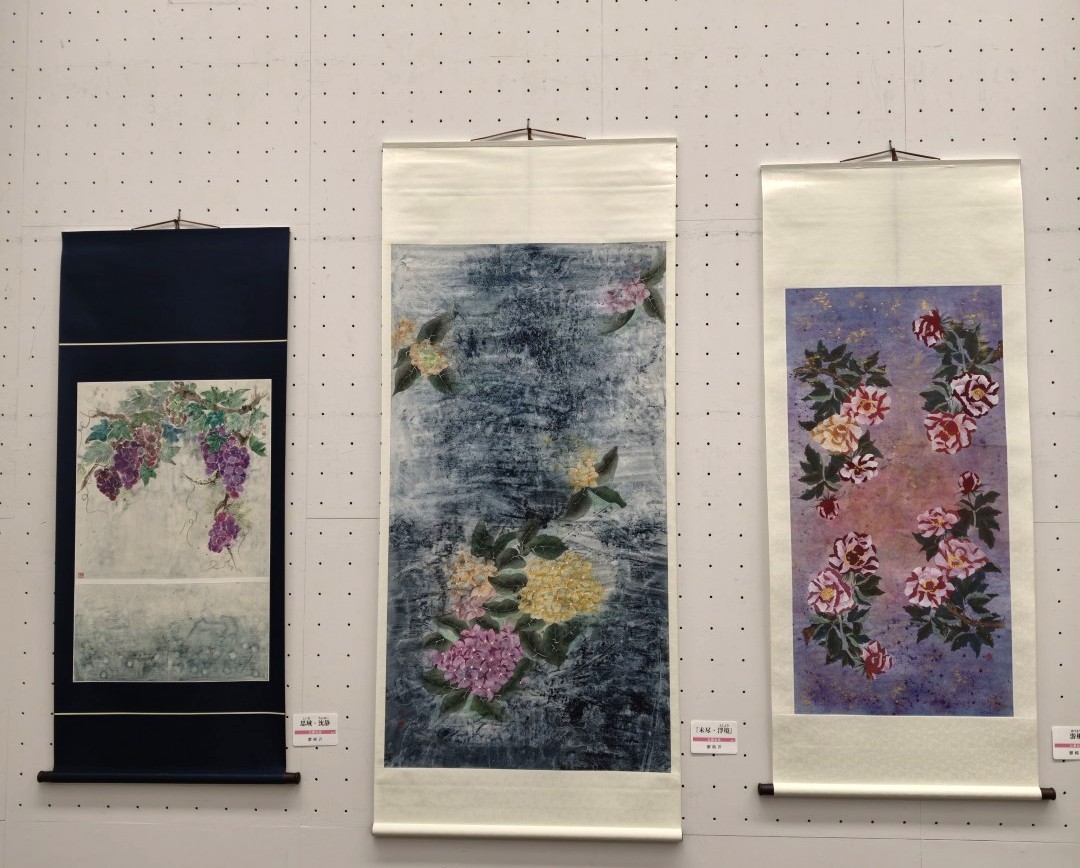
畫中並不是單純的一樹繁花。若只粗略一看,觀者會見到幾枝深綠枝葉承載著紅白相間、粉白、淡杏色的花朵,分布於畫面左右兩側與下方,像從下而上,又像自外向內,輕輕圍出一個中間留空的場域。背景則不是傳統花鳥畫常見的空白或淡設色,而是一片由紫、靛、藍、粉灰與點點金光構成的深柔之境,既像暮色,也像霧中水面,又像某種尚未乾透的夢境底色。這些花枝並未密密實實塞滿畫面,反而故意讓中央保留一道呼吸,像一條看不見的水路,一個沒有實體卻持續牽引視線的虛中之軸。正因如此,這件作品最動人的地方,不在花被畫得多繁,而在於花如何被安排成一種「游」的狀態——既不是完全扎根於地,也不是全然飄離現實,而是在一種介乎停與移、聚與散、現與隱之間的流動感中,被慢慢托起。
我每遇見「游」字,總不由得比遇見「飛」字更為心折。飛太快,容易叫人想到離地與超脫;游則不同,游總還與某種媒介相依——與水、與風、與氣息、與一種看不見卻確實承托著萬物的流動相依。故「游相」之妙,不在它說明了畫裡有哪些形,而在它暗示:這些形,從一開始就不是靜止的。它們不是被釘在紙上的圖樣,而像處在某種漂流中的顯現。這裡的「相」,若作佛學語境觀之,當然可引人想到「相狀」、想到世間萬物之可見之形;但若只停在這裡,又嫌太淺。因為廖純沂的高明,恰在她並不把「相」畫成穩固可持的外貌,反而使它在顯現的同時,始終保有一層仍在流動、仍在遷徙、仍未完全定著的性質。於是,這不只是花之相,而是相本身如何在游動。
若要替這種感覺尋找一條哲學上的路,我首先想到的,不是西方那種急於拆解形式的理論,而是西田幾多郎對「場所」的理解。西田說,真正重要的並不只是物件本身,而是容納物件、使物件得以顯現、得以相遇、得以互相滲透的那個「場所」。若以此來讀〈游相〉,畫中最先被重新理解的,便是那一整片紫藍色背景。那背景不是花枝的襯托物,也不是填滿畫面的色彩方便;它更像一個真正的場所——一個柔軟、深遠、可呼吸、可讓形慢慢浮現又不致過早封閉的場所。
這片紫藍色場,極有意思。它不平,不硬,不乾;其中時有金粉般的閃點,又有淡淡擦痕與雲霧樣的過渡,使它既像天空、也像水面,既像夜色,也像記憶深處一層尚未結晶的情感底。花與葉因此並不是貼在平面上的圖樣,而像從這樣一個場域中慢慢被推出來。若無此場,花便只是花;有了這場,花才有了「游」的能力。於是,畫中的真正主角未必是花,而更可能是這個讓花得以漂浮、得以呼吸、得以彼此不完全相連卻又相互牽引的中間之所。這會使人明白:〈游相〉之所以美,不單是因花朵本身,而是因這些花確實被放在一個足以讓顯現保持流動的場所裡。
然而,若只說場所,又還不足。因為這件作品真正耐人尋味的,還在它的時間感。花本來最容易被畫成「此刻」之物:眼下開著,今日正盛,正適合觀看;但廖純沂畫裡的花,卻不單屬於此刻。那紅白相間的花瓣輪紋、近乎旋渦般的花面,與幾朵淡杏、粉白色花的柔潤過渡,都不只是新鮮的綻放,反而帶著某種被時間浸過之後的柔和。它們不像剛從枝頭折下,倒像已在空氣、水氣、記憶與觀看之中漂流過一段時日。這時候,我便想起柏格森。
柏格森區分鐘錶的時間與生命真正經驗到的綿延。真正的時間,不是一格格均勻流過,而是不同層次的感受、記憶、過去與現在彼此滲透、彼此重疊。〈游相〉中的花便屬於這樣的時間。它們不是「此刻」被拍照定格的花,而更像在綿延中漂浮的花。觀者看它們時,不只看見花的形,也同時感到某種過程:像花曾經更近,如今略遠;曾經更鮮,如今略柔;曾經在風中劇烈擺盪,如今在畫裡只留下那種漂移過後的平衡。這便使「游」不只是空間上的移動,更是時間上的漂流。花不是靜止於眼前,而像帶著先前的運動痕跡、帶著一點尚未完全停歇的時間餘波,慢慢留在紙上。
也正因如此,這件作品裡的留白與中空,尤其值得深究。人若只把那些中央未被花枝填滿的部分視為構圖上的呼吸,仍嫌太淺。那中間的虛境,在我看來反倒像整件作品的靈魂。它不被説明,不被填滿,不被任何一朵花硬生生占領,卻恰恰因此成為一條無形的流路。這使我想到莊子一句常被說得太輕的話:「虛室生白。」世人往往把這句話理解成留白的美學,卻忽略其中更深的一層:不是因為空,所以什麼都沒有;而是因為空,真正能發生的才得以發生。〈游相〉的空,便正是如此。這中間之虛,不是缺,反而是關鍵。花若全然占滿畫面,便只剩艷;正因有此虛,它們才有餘韻,有彼此往返之感,有像在同一條看不見的水流裡互相呼應的節奏。
這樣一來,作品中的枝條也就不只是植物學上的承載物,而更像視覺節奏的導線。你會發現,它們並不硬拗地把花往上撐,而是彎、曲、轉、垂、挑,以一種極有韻律的方式,把每一朵花串進一個更大的流動之中。這種處理讓我想起德勒茲的「生成」概念。德勒茲真正關心的,從不是既定之物如何被穩穩描摹,而是事物如何在成為別的東西之中顯現力量。〈游相〉中的花,正不是固定的物件,而是一種生成中的花:花在成為流,流在成為形,形又在成為彼此的呼應。這幅畫最迷人的,不是「有九朵或十朵花」這樣的客觀數量,而是整體如何形成一種不可斷然切分的運動感。花與葉、色與空、聚與散,彼此都不是最後完成的樣子,而像一直還在成為。
倘若再往深一步說,我甚至覺得這件作品裡有一種極台灣、也極東亞的「相與無相」的辯證。人看這些花,當然可以說:它們是花,而且相當具象,花瓣輪紋清楚,葉形分明,枝條有力;然而你若停久一點,又會發覺這些花之所以動人,並不單因其具象,而因它們始終沒有完全落入「只是花」的穩固分類。這時候,我便不免想到《金剛經》那句人們常背而未必真懂的話:「凡所有相,皆是虛妄。若見諸相非相,即見如來。」我並不想把任何作品粗暴地拉進宗教解釋,但這句話於此,確有其意味。因為廖純沂並不是要觀者停在花的表面,而是讓人經由花,意識到:相之所以動人,不在它多麼被掌握,而在它始終帶著一點將成未成、將散未散的虛。換言之,真正深的顯現,從不靠完全的定型,而總在某種未被說死的狀態中發亮。
而這樣的虛,並不使作品飄空,反而使它更真。因為我們真正記得的事物,本來就很少是全然明確、全然定格、毫無流動的。我們記得一個人,不是因其容貌可被逐項描摹,而是因其氣息、站姿、轉身、說話時留下的節奏;我們記得一段季節,不是因那些細節全都清楚,而是因那種空氣、那種光、那種在心裡不肯沉底的顏色。〈游相〉中的花,便近乎如此:它們讓你記得的,不僅是自身,而是連帶地記起一種漂浮、一種不確定中的安定、一種介於停泊與遠行之間的生命感。
這也使我想起加斯東・巴舍拉。巴舍拉總提醒人,某些圖像之所以有詩性,不是因為它們講了一個故事,而是因為它們喚醒了我們對某種物質狀態的古老感覺。〈游相〉最強的物質感,不是花瓣的柔,而是整體的浮與潤。背景彷彿帶水,色層像有微光在流,金點若沉若浮,熟宣的質地又把顏料與水墨留在一種恰好未乾透的狀態。這使整件作品幾乎不像掛在牆上的畫,而像一個被保存在紙上的氣候。若從巴舍拉的角度看,這些花便不再只是植物,而是屬於一個更廣義的濕性世界:屬於霧、屬於暮色、屬於記憶在水面上慢慢擴散後留下的柔波。這種濕,不使畫面黏滯,反而使它輕。因為真正的漂浮,正來自某種液態的承載。花不靠土地被支撐,而靠整個場域的濕性被溫柔托住。
若依我個人的習性,我總喜歡在觀物之後,重新回到人身上。因為我從不以為觀看只是在判斷作品,而更是在藉作品照見自己。廖純沂這件〈游相〉之所以讓我反覆流連,也許正因它說出了某種我們都懂,卻往往難以承認的事情:人之為人,很多時候也不過是一團團「游相」。今日覺得自己穩定,明日便已微微偏移;曾經相信某些關係牢不可破,後來才知原來皆在一種更大的流中暫時相依;而所謂自我,也並不總是站穩在地上的一塊石,而更像這些花——在某個仍有濕度、仍可承受漂浮的世界裡,暫時地、優雅地、帶著自己的形狀顯現。
所以,我看〈游相〉,最終並不只是在看花,而是在看——相是否非得站穩,才算存在? 這件作品給出的答案,安靜卻清楚:未必。 有些存在,正因不死死扎根,反而更接近它真正的狀態; 有些形象,正因始終帶著一點游移,反而更能留下來; 有些美,也許根本不是「被固定住的美」,而是「仍在流動中的美」。
若要我以一句話收束,我會如此說:
廖純沂〈游相〉所畫的,不只是花之形,而是形如何在未被封死之前,仍以最柔和也最堅定的方式,持續地漂浮於世界之中。
廖純沂〈游相〉以熟宣、水墨、礦物與複合顏料,建構出一個介於花、霧、光與記憶之間的漂浮場域。作品中的花枝並非穩固地依附於自然空間,而是在紫藍色的濕性背景中若即若離,彷彿被某種尚未凝固的氣流與時間溫柔托住。若借西田幾多郎「場所」的概念,可見畫中背景不是次要襯托,而是花之顯現得以成立的深層場所;若從柏格森的綿延時間與德勒茲的生成觀點來看,這些花亦不只是靜止形象,而是仍在時間與流動中持續成為自身的「游相」。整體而言,〈游相〉所觸及的,不只是花卉之美,而是形相如何在未被固定之前,保持其最真切的靈動與呼吸。
其他相關內容:
【現場直擊】【台日交流展】東京都美術館開館100周年記念《第14回東京現展》展場:日本國立東京都美術館
台灣參展藝術家作品藝術評論
東京都美術館開館100周年記念【14回東京現展】廖純沂〈未盡・浮境〉未盡之物何以最能久留人心
東京都美術館開館100周年記念【14回東京現展】廖純沂〈游相〉花何以不止於花,與形相如何在漂游中成立
東京都美術館開館100周年記念【14回東京現展】廖純沂〈思域・沉靜〉沉靜何以不是空,與垂掛之物何以最像思念
東京都美術館開館100周年記念【14回東京現展】王詮富〈八月閑步一色秋〉的季節哲學、門徑意識與水墨的開敞性 在黑暗中閑步:秋色如何不是顏色,而是一種存在的轉身
東京都美術館開館100周年記念【14回東京現展】 王詮富〈一念菩提開翠微〉的開顯、同體、綿延與空性 一念未起,萬根已動
東京都美術館開館100周年記念【14回東京現展】蔡梅芳〈戀戀紫藤〉的痕跡、綿延與生成 花影之遲遲不散,與記憶如何在解構之後重返
東京都美術館開館100周年記念【14回東京現展】 王穆提《聖境・阿里山》蒼翠的紀念碑
東京都美術館開館100周年記念【14回東京現展】王穆提《中道之光》裂隙中的永恆
東京都美術館開館100周年記念【14回東京現展】吳心荷〈散落骨骼(一)〉散落之骨,與人之未能完全集成於自身
東京都美術館開館100周年記念【14回東京現展】陳福祺〈咖啡心音〉的存在寓言 沸點、晶化與心之熔爐
東京都美術館開館100周年記念【14回東京現展】張素蘭〈一棵開花的樹〉的場所哲學、過程生命與靜默中的新生
東京都美術館開館100周年記念【14回東京現展】吳亞倫〈藍與黑的交響詩(雙併)〉論藍何以不只為藍,黑何以不只為黑
東京都美術館開館100周年記念【14回東京現展】張碧鄉〈艷冠群芳〉的器物哲學、生成美學與過剩的顯現
東京都美術館開館100周年記念【14回東京現展】趙玉燕〈熾烈〉論火中的身體,與人何以不能只是自己
東京都美術館開館100周年記念【14回東京現展】許秀珠〈403地震後的太魯閣〉山川之裂,與人如何在震後重新學會自身的位置
東京都美術館開館100周年記念【14回東京現展】江麗香〈秋聲賦〉彩墨中的時間書寫 水痕與秋聲
東京都美術館開館100周年記念【14回東京現展】江麗香〈流轉的歲月〉水之無言,而歲月常藉其形以自見
東京都美術館開館100周年記念【14回東京現展】謝文倩〈驚夢〉的夢之碎片、感覺邏輯與夜的顯現
東京都美術館開館100周年記念【第14回東京現展】黃淑卿〈群鷗處處來(台灣澎湖)〉群鷗之所以來,與人終於學會不把世界全算作自己
東京都美術館開館100周年記念【14回東京現展】黃淑卿〈燕尾與戴勝(台灣金門)〉論屋脊、禽鳥與地方何以不只是地理
東京都美術館開館100周年記念【14回東京現展】謝正瑜〈蓮池映相〉的感知哲學與靈性空間
東京都美術館開館100周年記念【14回東京現展】周若梅〈流光之舞〉,光何以有身,與人如何在流動中暫時成形
How Flowers Are More Than Flowers, and How Form and Manifestation Establish Themselves Within Drifting
— On Liao Chun-yi’s Drifting Manifestations (Youxiang)
Written by WANG MUTI
One of the most common mistakes people make when looking at flowers is treating them too quickly as an answer. The moment a flower appears, we call it "beauty"; when a flower is in full bloom, we call it "life"; when a flower is intricate, we call it "opulence." These descriptions cannot be considered inherently wrong, yet they are often too rapid—so fast that before one has even truly stood before the flower, one has already surrendered it to habitual language. However, truly excellent works of art never let viewers off so easily. They insist that the flower does not merely resemble a flower, the background does not merely resemble a background, and the act of viewing is no longer mere identification, but rather an experience of being slowly dragged into a deeper world. Liao Chun-yi’s Drifting Manifestations (Youxiang), in my eyes, is precisely such a work.
The painting does not simply depict a tree full of blossoms. Upon a cursory glance, the viewer will see several dark green branches bearing flowers of interlaced red-and-white, pale pink, and faint apricot hues, distributed along the left, right, and lower edges of the canvas. They seem to grow from bottom to top, or reach inward from the outside, gently enclosing a void in the center. The background, meanwhile, is not the blankness or pale wash commonly seen in traditional flower-and-bird painting. Instead, it is a deep, tender realm composed of purple, indigo, blue, pink-grey, and scattered golden glimmers. It resembles twilight, a water surface shrouded in mist, or the foundational hue of a dream that has not yet completely dried. These flowering branches do not densely cram the canvas; rather, they deliberately leave a breathing space in the center—like an invisible waterway, an incorporeal yet continuous central axis of the void that guides the gaze. Precisely because of this, the most moving aspect of this work is not how profusely the flowers are painted, but how they are arranged into a state of "drifting" (you). They are neither completely rooted in the earth nor entirely floating away from reality; rather, they are slowly lifted within a fluidity suspended between pausing and moving, gathering and dispersing, manifesting and hiding.
Whenever I encounter the word "drifting" (you), I cannot help but be more captivated by it than the word "flying" (fei). Flying is too fast, easily invoking thoughts of leaving the ground and transcendence. Drifting is different: drifting always remains interdependent with a certain medium—with water, with wind, with breath, with an invisible yet tangible flow that sustains all things. Therefore, the brilliance of Drifting Manifestations lies not in specifying which forms exist within the painting, but in its implication: these forms were never static from the very beginning. They are not patterns pinned to paper, but manifestations residing within a certain drift. If the word "manifestation" (xiang) here is viewed within a Buddhist context, it naturally evokes the idea of "form and appearance" (xiangzhuang), reminding one of the visible shapes of all things in the world. Yet, to stop there would be too superficial. For Liao Chun-yi's mastery lies precisely in the fact that she does not paint "manifestation" as a solid, graspable outward appearance; instead, she ensures that during its manifestation, it perpetually retains a quality of still flowing, still migrating, and not yet completely fixed. Thus, this is not merely the manifestation of flowers, but how manifestation itself drifts.
If one were to seek a philosophical path for this sensation, the first thing that comes to mind is not the Western theories eager to dismantle form, but Kitaro Nishida’s comprehension of "place" (basho). Nishida posited that what is truly important is not just the object itself, but the "place" that accommodates the object, enabling it to manifest, to encounter, and to mutually permeate. Reading Drifting Manifestations through this lens, the first element in the painting to be re-understood is that entire expanse of purple-blue background. That background is not a foil for the flowering branches, nor is it a convenient color to fill the canvas; it functions more like a true "place"—a soft, profound, breathable field that allows form to slowly surface without closing it off too prematurely.
This purple-blue field is exceedingly fascinating. It is not flat, hard, or dry. Within it, there are occasional flashes like gold dust, faint abrasions, and cloud-like transitions, making it resemble the sky, the water’s surface, the night, and the underlying emotional layer deep within memory that has not yet crystallized. Consequently, the flowers and leaves are not patterns pasted onto a flat surface, but appear to be slowly pushed out from such a field. Without this field, a flower is just a flower; with this field, the flower acquires the capacity to "drift." Thus, the true protagonist of the painting may not necessarily be the flowers, but rather this intermediate space that allows the flowers to float, breathe, and remain incompletely connected yet mutually drawn to one another. This makes one realize: the beauty of Drifting Manifestations is not solely due to the flowers themselves, but because these flowers are indeed placed within a field sufficient to keep their manifestation fluid.
However, speaking only of "place" is still insufficient. What makes this work truly thought-provoking is its sense of time. Flowers are inherently prone to be painted as objects of the "present moment": blooming right before our eyes, flourishing today, perfectly suited for viewing right now. Yet, the flowers in Liao Chun-yi’s painting do not belong exclusively to the present moment. Those interlaced red-and-white concentric petal patterns, the nearly vortex-like floral faces, and the soft, lubricated transitions of several pale apricot and pink-white flowers are not merely fresh blossoms; they carry a certain softness as if steeped in time. They do not look as though they were just plucked from the branch; rather, they seem to have already drifted for a period through air, moisture, memory, and viewing. At this moment, I am reminded of Henri Bergson.
Bergson distinguished between clock time and the "duration" (durée) truly experienced by life. True time does not pass in uniform, segmented ticks, but is an internal thickness where different layers of sensation, memory, past, and present mutually permeate and overlap. The flowers in Drifting Manifestations belong to such time. They are not flowers frozen by a camera in the "present moment," but resemble flowers floating within duration. When the viewer looks at them, they see not only the shape of the flower but simultaneously sense a certain process: as if the flower was once closer, and is now slightly farther; once more vivid, and is now slightly softer; once swinging violently in the wind, and now leaving only that post-drift equilibrium on the canvas. This transforms "drifting" from merely spatial movement into a temporal drift. The flowers are not statically stationed before the eyes; they appear to slowly remain on the paper, carrying traces of prior motion and the lingering ripples of time that have not yet fully subsided.
Precisely because of this, the negative space (liubai) and the hollowness in the center of this work deserve special scrutiny. If one views the central area un-filled by flowering branches merely as "breathing space" in composition, it remains too shallow an interpretation. That central realm of emptiness, in my view, acts as the very soul of the entire work. It is not explained, not filled, not forcefully occupied by any single flower, yet precisely because of this, it becomes an invisible waterway. This brings to mind a phrase by Zhuangzi that is often spoken too lightly: "The empty room gives birth to white light" (xushi shengbai). The world frequently interprets this as the aesthetics of negative space, yet overlooks its deeper layer: it is not that because it is empty, there is nothing; rather, because it is empty, that which can truly happen is allowed to happen. The emptiness in Drifting Manifestations is exactly this. This central void is not a lack, but a crucial key. If the flowers completely occupied the canvas, nothing would remain but gaudiness; precisely because of this void, they possess lingering resonance, a sense of back-and-forth movement, and a rhythm of echoing each other as if floating within the same invisible water current.
Consequently, the branches in the work are no longer merely botanical carriers, but function more like conductive wires for visual rhythm. You will notice that they do not rigidly prop the flowers upward; instead, they bend, curve, turn, droop, and lift, threading every single flower into a larger flow in an exceptionally rhythmic manner. This treatment reminds me of Gilles Deleuze’s concept of "becoming" (devenir). What Deleuze truly cared about was never how a fixed object is steadily depicted, but how things manifest force in the process of becoming something else. The flowers in Drifting Manifestations are precisely not fixed objects, but flowers in the state of becoming: the flower is becoming a flow, the flow is becoming a form, and forms are becoming echoes of one another. The most enchanting aspect of this painting is not an objective quantity like "there are nine or ten flowers," but how the entirety forms an indivisible sense of motion. Flower and leaf, color and void, gathering and dispersing—none have reached their final, completed state; they appear to always still be becoming.
To take a step deeper, I even feel a highly Taiwanese, and highly East Asian, dialectic of "manifestation and non-manifestation" (xiang yu wuxiang) within this work. Looking at these flowers, one can certainly say: they are flowers, and quite figurative ones at that; the concentric patterns of the petals are clear, the leaf shapes are distinct, and the branches are vigorous. Yet, if you pause a little longer, you will realize that the reason these flowers are moving is not solely because they are figurative, but because they never completely fall into the secure classification of being "just flowers." At this moment, I cannot help but recall the line from the Diamond Sutra that people often recite but rarely truly understand: "All manifestations are illusions. If one sees that all manifestations are non-manifestations, then one sees the Tathagata." I do not wish to brutally drag any artwork into religious interpretation, but this sentence holds profound meaning here. For Liao Chun-yi does not want the viewer to stop at the surface of the flowers; she wants people, through the flowers, to realize: the reason a manifestation is moving is not because of how completely it can be grasped, but because it perpetually carries a void—a state of being about to form yet not fully formed, about to disperse yet not fully dispersed. In other words, a truly deep manifestation never relies on complete fixation; it always shines within a state that has not been spoken to death.
And such voidness does not make the work float away into emptiness; rather, it makes it truer. Because the things we truly remember are inherently rarely completely clear, entirely frozen, or devoid of flow. We remember a person not because their facial features can be traced item by item, but because of their breath, their posture, their turn, and the rhythm left behind when they speak. We remember a season not because all its details are clear, but because of that air, that light, that color that refuses to sink to the bottom of our hearts. The flowers in Drifting Manifestations are much like this: what they make you remember is not only themselves, but concurrently a sense of drifting, a stability within uncertainty, and a sense of life suspended between anchoring and journeying far away.
This also brings to mind Gaston Bachelard. Bachelard always reminds us that certain images possess poetic quality not because they tell a story, but because they awaken our ancient feelings toward a certain material state. The strongest material sense in Drifting Manifestations is not the softness of the petals, but the overall floating and lubrication. The background seems to contain water, the color layers seem to have a faint flowing light, the gold dots seem to sink and float, and the texture of the sized Xuan paper (shuxuan) retains the pigment and ink in a state just shy of drying completely. This makes the entire work look almost unlike a painting hung on a wall, but like a climate preserved on paper. From Bachelard's perspective, these flowers are no longer just plants, but belong to a broader, wet world: belonging to mist, belonging to twilight, belonging to the soft ripples left behind after memory slowly diffuses over the water's surface. This wetness does not make the canvas sticky; instead, it makes it light. Because true floating originates precisely from a certain liquid buoyancy. The flowers are not supported by the land, but are gently held up by the wetness of the entire field.
Following my personal habits, I always like to return to the human condition after observing objects. For I never believe that viewing is merely judging an artwork; it is far more about using the artwork to reflect upon oneself. The reason Liao Chun-yi’s Drifting Manifestations makes me linger repeatedly is perhaps that it speaks of something we all understand, yet often find hard to admit: being human, much of the time, is nothing more than clusters of "drifting manifestations." Today we feel stable, tomorrow we have already slightly shifted; relationships we once believed unbreakable are later revealed to be mere temporary dependencies within a larger flow; and the so-called self is not always a stone standing firmly on the ground, but resembles these flowers—manifesting temporarily, elegantly, and with its own shape within a world that still holds moisture and can still sustain drifting.
Therefore, when I look at Drifting Manifestations, I am ultimately not just looking at flowers, but asking: Must a manifestation stand firmly to be considered as existing? The answer provided by this work is quiet yet clear: Not necessarily. Certain existences come closer to their true state precisely because they refuse to root themselves rigidly to death; certain images manage to stay behind precisely because they perpetually carry a bit of wandering; and certain beauty is perhaps fundamentally not a "fixed beauty," but a "beauty still in flow."
If I were to conclude with a single sentence, I would say it thus:
What Liao Chun-yi paints in Drifting Manifestations is not merely the shape of flowers, but how form, before being permanently sealed, continues to drift within the world in the softest yet firmest manner.
Summary Note: Liao Chun-yi’s Drifting Manifestations (Youxiang) utilizes sized Xuan paper, ink wash, mineral pigments, and mixed media to construct a floating field situated between flowers, mist, light, and memory. The flowering branches in the work are not solidly anchored to a natural space but maintain an ambivalent, shifting relationship within a wet, purple-blue background, as if gently supported by un-solidified air currents and time. Drawing upon Kitaro Nishida’s concept of "place" (basho), the background is not a secondary foil, but a deep foundational place that enables the flowers' manifestation. Viewed through Henri Bergson’s duration of time and Gilles Deleuze’s philosophy of becoming, these flowers are not static images, but "drifting manifestations" that continue to become themselves within time and flow. Overall, Drifting Manifestations touches upon not only the beauty of flora, but how form and manifestation, before being permanently fixed, retain their truest spiritual vitality and breath.
花はいかにして単なる花にとどまらず、形相はいかにして漂流の中で成立するかについて
—— 廖純沂(リャオ・チュンイー)『游相(ゆうそう)』に寄せて
執筆:王穆提(ワン・ムーティ)
人間が花を観るときに最も犯しやすい間違いの一つは、あまりにも早く花を「答え」として受け取ってしまうことだ。花が現れれば「美しい」と言い、花が咲き誇れば「命だ」と言い、花が複雑であれば「華麗だ」と言う。これらの表現は決して間違っているとは言えないが、往々にして早すぎる。まるで、本当に花の前に立つ前に、すでに花を「習慣化された言語」へと手渡して(還元して)しまっているかのように早い。しかし、真に優れた作品というものは、人間をそれほど楽にはさせてくれない。それはあえて、花を単なる花に見せず、背景を単なる背景に見せず、観照(観ること)を単なる「識別」に終わらせない。むしろ、ある深層の世界へとゆっくりと引きずり込まれるような経験を人間に与えるのである。廖純沂のこの『游相(ゆうそう)』は、私の目に、まさにそのような作品として映る。
画中に描かれているものは、単なる「一樹の繁花」ではない。少し大まかに見るならば、鑑賞者は、紅白が入り交じり、ピンクがかった白、あるいは淡い杏色の花々を乗せた数本の深緑の枝葉が、画面の左右両側と下方に分布しているのに気づくだろう。それらは下から上へ、あるいは外から内へと向かっているように見え、中央に「空白の磁場」をそっと囲い込んでいる。背景は、伝統的な花鳥画によく見られるような余白や淡い彩色ではない。それは紫、インディゴ(藍)、青、ピンクグレー、そして点々とした金色の光によって構成された、深く柔らかな境地である。それは夕暮れのようでもあり、霧の中の水面のようでもあり、あるいはある種の、まだ完全に乾ききっていない「夢のベースカラー(底色)」のようでもある。これらの花の枝は画面を隙間なく埋め尽くすことはせず、むしろ意図的に中央に一つの呼吸(ブレス)を残している。それは見えない水路のようであり、実体はないものの、視線を絶えず牽引し続ける「虚なる中軸」である。まさにそれゆえに、この作品の最も人の心を動かす部分は、花がどれほど繁密に描かれているかではなく、花がいかにして一種の「游(ゆう/たゆたうこと)」の状態として配置されているかにある。——それは完全に地に根を下ろしているわけでもなく、完全に現実から離脱して漂い去るわけでもない。それは「停滞」と「移動」、「集合」と「離散」、「顕現」と「隠匿」の狭間にある流動感の中で、緩やかに高く掲げられている(托起されている)のである。
私は「游」という文字に出会うたび、いつも「飛」という文字に出会うよりも心を奪われずにはいられない。「飛(とぶ)」はあまりにも速く、容易に人間に大地からの離脱や超脱(超越)を連想させる。しかし「游(たゆたう・泳ぐ)」は違う。游は常に、ある種の「媒介(メディア)」と互いに依存し合っている。——水と、風と、息吹と、そして見えないながらも確かに万物を支えている「流動」と依存し合っているのだ。それゆえ、『游相』の妙なる部分は、画の中にどのような「形」があるかを説明している点にあるのではなく、それが次の一事を暗示している点にある。「これらの形は、最初から静止していたわけではない」と。それらは紙の上に釘付けにされた図案(パターン)ではなく、ある種の漂流の中に置かれた「顕現(現れ)」のようである。ここでの「相」を仏教の文脈で見るならば、当然のことながら「相状(目に見える姿)」や、世の万物の可視的な形を連想させるだろう。しかし、思考をそこに留めてしまうならば、あまりにも浅薄に過ぎる。なぜなら廖純沂の非凡さは、まさに彼女が「相」を強固で保持可能な外貌としては描かず、むしろそれが顕現すると同時に、常に「まだ流動しており、まだ移ろっており、まだ完全には定着していない」という性質を保持させている点にあるからだ。したがって、これは単なる花の「相」ではなく、「相」そのものがいかにして游動(たゆたっている)かを示しているのである。
もしこのような感覚のために哲学的な道筋を探し出すとするならば、私が最初に思い浮かべるのは、形式(フォルム)を急いで解体しようとする西洋の理論ではなく、西田幾多郎による「場所(basho)」への理解である。西田は、真に重要なのは物件(オブジェクト)そのものだけではなく、物件を容納し(受け入れ)、物件をして顕現させ、出会わせ、相互に浸透させるあの「場所」なのだと言った。この視点で『游相』を読み解くならば、画の中で最初に再理解されるべきは、あの一面の紫青色(パープルブルー)の背景である。あの背景は花の枝の引き立て役ではなく、画面を埋めるための色彩の便宜的手段でもない。それはむしろ、一つの真の「場所」——柔らかく、深遠で、呼吸が可能であり、形をゆっくりと浮かび上がらせながらも、早すぎる閉鎖(完結)をさせない場所として機能している。
この紫青色の磁場(フィールド)は極めて興味深い。それは平坦ではなく、硬くもなく、乾いてもいない。その中には時折、金粉のようなきらめく点があり、また淡い擦痕(スクラッチ)や雲霧のようなグラデーション(過渡)がある。これにより、それは天空のようでもあり、水面のようでもあり、夜の色のようでもあって、記憶の深部にある、まだ結晶化していない「感情の底(ベース)」のようでもある。それゆえ、花と葉は平面に貼り付けられた図案ではなく、このような磁場の中からゆっくりと押し出されてきたかのように見える。もしこの場所がなければ、花はただの花に過ぎない。この場所があるからこそ、花は「游(たゆたう)」能力を獲得したのだ。したがって、画の中の真の主人公は必ずしも花ではなく、むしろ花を漂わせ、呼吸させ、完全に繋がり合うことはなくとも互いに牽引し合うことを可能にしている、この「中間の場所」である可能性が高い。このことは人間に次のように理解させる。——『游相』が美しいのは、単に花そのもののゆえではなく、これらの花が、「顕現」を流動したままに保つに十分な「場所」の中に確かに置かれているからなのだ、と。
しかし、場所だけを語るのではなお不十分である。なぜなら、この作品の真に味わい深い部分は、その「時間感覚」にあるからだ。花というものは本来、最も「今この瞬間(此刻)」の事物として描かれやすい。目の前で咲いており、今日がまさに盛りであり、今観るのに最も適している、と。しかし、廖純沂の画の中の花は、単に「今この瞬間」だけに属してはいない。あの紅白が交錯する花びらの輪紋、ほとんど渦のようにも見える花面、そして数輪の淡い杏色やピンクがかった白色の花の柔らかなグラデーションは、単なる新鮮な開花であるだけでなく、むしろある種の「時間に浸された後の柔和さ」を帯びている。それらは枝から折り取られたばかりというよりは、空気、水気、記憶、そして観照の中で、すでに一定の時間を漂流してきたかのようである。このとき、私はアンリ・ベルクソンを思い出す。
ベルクソンは、時計の時間と、生命が真に経験する「持続(綿延/durée)」を区別した。真の時間とは、一コマ一コマ均等に流れていくものではなく、異なる次元の感受、記憶、過去、そして現在が互いに浸透し合い、重なり合うものである。『游相』の中の花は、まさにこのような時間に属している。それらは「今この瞬間」に写真で定着させられた(フリーズされた)花ではなく、むしろ持続の中で漂浮する花に近い。鑑賞者がそれらを観るとき、単に花の形を観るだけでなく、同時にある種の「過程(プロセス)」を感じ取る。——かつて花はより近くにあり、今はわずかに遠ざかっているかのよう。かつてはより鮮やかであり、今はわずかに柔らかくなったかのよう。かつては風の中で激しく揺れていたが、今は画の中で、その漂流の後に残された「均衡(バランス)」だけを留めているかのよう。このことは、「游」を単なる空間的な移動ではなく、時間的な漂流へと変容させる。花は目の前に静止しているのではなく、以前の運動の痕跡を帯び、まだ完全には鳴り止んでいない時間の余波をわずかに携えながら、ゆっくりと紙の上に残されているかのように見えるのだ。
まさにそれゆえに、この作品における「留白(余白)」と中央の空虚(中空)は、特に深く探求する価値がある。もしあの、花枝によって埋め尽くされていない中央の部分を、単なる「構図上の呼吸(息継ぎ)」としてしか見なさないのであれば、それはなお浅薄に過ぎる。あの中心の「虚境」は、私から見れば、むしろ作品全体の「魂」のようである。それは説明されず、埋め尽くされず、いかなる一輪の花によっても強引に占領されることはない。しかし、まさにそれゆえに、それは一筋の「無形の流路」となるのである。これは、莊子の、しばしばあまりにも軽く語られがちな次の一節を思い起こさせる。——「虚室生白(虚室白を生ず)」。世の人は往々にしてこの言葉を「余白の美学」としてのみ理解しがちだが、その中にあるさらに深い階層を見落としている。それは「空(から)だから、何もない」のではない。「空(から)だからこそ、真に発生すべきことが発生できる」のである。『游相』における空(くう)は、まさにこれに他ならない。この中間の虚(きょ)は、欠落ではなく、むしろ鍵(キー)なのだ。もし花が画面を完全に占領してしまえば、そこには単なる「艶やかさ(艷)」しか残らない。この虚があるからこそ、それらには余韻があり、互いが行き交う感覚があり、まるで見えない同一の水流の中で互いに呼応し合うようなリズムが生まれるのである。
そうなると、作品の中の枝もまた、単なる植物学的な支持体(キャリア)であることをやめ、視覚的リズムの「導線」のようになる。お気づきだろうか。それらは強引に花を上へと支え上げているのではなく、曲がり、うねり、転じ、垂れ、跳ね上がりながら、極めてリズミカルな方式で、一輪一輪の花をより大きな流動の中へと串刺しに(繋ぎ合わせて)いるのだ。このような処理は、ジル・ドゥルーズの「生成(devenir)」の概念を私に思い出させる。ドゥルーズが真に関心を寄せていたのは、既定の事物がいかにして安定して描写されるかではなく、事物がいかにして「別のものへと成っていく」中で力を顕現させるかであった。『游相』の中の花は、まさに固定された物件ではなく、生成の途上にある花である。花は流れと成り、流れは形と成り、形はまた互いの呼応と成っていく。この画の最も魅力的な部分は、「花が九輪あるいは十輪ある」といった客観的な数量にあるのではなく、全体がいかにして「断固として切り離すことのできない運動感」を形成しているかにある。花と葉、色と空、聚(集まること)と散(散ること)。それらのどれ一つとして最終的に完成された姿ではなく、常に「いまだ成りつつある」ように見えるのである。
もしさらに一歩踏み込んで語るならば、私はこの作品の中に、極めて台湾的であり、また極めて東アジア的な「相と無相」の弁証法が存在しているとさえ感じる。人間がこれらの花を観て、当然次のように言うことはできる。「これらは花であり、しかも極めて具象的だ。花びらの輪紋は鮮明であり、葉の形ははっきりとしており、枝には力強さがある。」しかし、もしもう少し長くそこに留まるならば、これらの花が人の心を動かす理由は、単にそれが具象的だからではなく、それらが終始「ただの花である」という確固たる分類(カテゴリー)に完全に堕ちていないからなのだと気づくはずだ。このとき、私は『金剛経』の、人々がよく暗唱するものの、必ずしも真に理解しているとは限らない次の一文を思い起こさずにはいられない。——「凡そ所有る相は、皆是れ虚妄なり。若し諸相の非相なるを見れば、即ち如来を見る。」私はいかなる作品であれ、それを乱暴に宗教的解釈の中へと引きずり込むことは望まない。しかし、この言葉はここにおいて確かにその意味(ニュアンス)を持っている。なぜなら廖純沂は、鑑賞者を花の表面に留まらせようとしているのではなく、花を経由して、人間に次のように意識させようとしているからだ。——相(現れ)が人の心を動かす理由は、それがいかに掌握可能であるかにあるのではなく、それが終始、ある種の「成りかけては成らず、散りかけては散らない」虚(ボイド)を帯びている点にあるのだ、と。言い換えるならば、真に深い顕現(現れ)というものは、決して完全な定型に頼ることはなく、常に「まだ完全に語り尽くされていない状態」において発光するものなのである。
そしてこのような虚(ボイド)は、作品を空虚に漂わせるのではなく、むしろそれをより「真実(リアル)」なものにする。なぜなら、私たちが真に記憶している事物というものは、本来、完全に明確で、完全に静止し、少しの流動性もないものであることは極めて稀だからだ。私たちが一人の人を記憶するとき、それはその容貌が一つ一つ正確に描写できるからではなく、その気配(息吹)、立ち姿、振り返り方、話すときに残したリズムのゆえである。私たちが一つの季節を記憶するとき、それはそれらのディテールがすべて鮮明だからではなく、あの空気、あの光、あの心の中で決して底に沈み切らない「色彩」のゆえである。『游相』の中の花は、まさにこれに近い。それらがあなたに記憶させるものは、花自身であるだけでなく、それに連帯して思い出される「漂浮(漂うこと)」であり、不確実さの中にある「安定」であり、停泊と遠行(遠くへ旅すること)の狭間にある「生命感」なのである。
これはまた、ガストン・バシュラールをも思い出させる。バシュラールは常に人間に注意を促した。ある種の図像が詩性(ポエジー)を持つ理由は、それが物語(ストーリー)を語ったからではなく、それが私たちが持つある種の「物質状態」に対する古き感覚を喚起したからである、と。『游相』の最も強い物質感は、花びらの柔らかさではなく、全体が持つ「浮遊」と「潤い」である。背景は水を帯びているかのようであり、色層には微光が流れているかのようであり、金色の点は沈んでいるようでもあり浮いているようでもある。そして熟宣(ドーサ引きの画仙紙)の質感が、顔料と水墨を、まさに「完全に乾ききっていない」状態へと留め置いている。これにより、作品全体は壁に掛けられた絵というよりは、「紙の上に保存された気候」のように見える。バシュラールの視点から見れば、これらの花はもはや単なる植物ではなく、より広義の「湿性(湿り気を帯びた)の世界」に属しているのである。霧に属し、夕暮れに属し、記憶が水面上で緩やかに拡散した後に残した「柔らかな波」に属しているのだ。このような「湿」は画面を粘着させることはなく、むしろ画面を「軽く」する。なぜなら、真の漂浮(漂うこと)とは、まさにそのような液態(リキッド)の浮力(承載)から来るものだからだ。花は大地によって支えられているのではなく、磁場全体の湿性によって優しく托(持ち上げ)されているのである。
もし私個人の習性に従うならば、私は常に、物を観た後に、再び「人間」へと立ち戻ることを好む。なぜなら、私は観照という行為が単に作品を判断することであるとは決して信じておらず、むしろ作品を借りて「自己を照らし出す」ことだと考えているからだ。廖純沂のこの『游相』が、私を幾度も立ち去りがたくさせる(流連させる)理由は、おそらくそれが、私たちが皆知っていながら、往々にして認めるのが難しい「ある事実」を語っているからに他ならない。人間が人間であるということ、それは多くの場合、ただの「游相(漂流する顕現)」の集まりに過ぎないのだ。今日は自分が安定していると感じても、明日にはすでに微かに横へズレている(偏移している)。かつてはある関係が堅牢で破れないと信じていたが、後になって、それらがすべてより大きな「流れ」の中で一時的に寄り添っていただけだと知る。そしていわゆる「自己」もまた、常に大地の上にどっしりと立った一つの石であるとは限らない。それはむしろこれらの花のように——まだ湿度があり、まだ漂浮を受け止めることのできる世界の中で、一時的に、優雅に、自らの形状を伴って顕現している存在に近いのである。
それゆえ、私が『游相』を観るとき、最終的にただ花を観ているだけではなく、次のように問いかけているのだ。——相(現れ)は、しっかりと地に足を着けて(站穩して)いなければ「存在する」とは言えないのだろうか? この作品が提示する答えは、静かであるが明確である。——必ずしもそうではない。ある種の存在は、死に物狂いで根を下ろさないからこそ、かえってその真の状態に近づく。ある種の形象は、常にわずかな「游移(漂い・移ろい)」を帯びているからこそ、かえって残ることができる。ある種の美は、おそらく根本において「固定された美」などではなく、「未だ流動の中にある美」なのである。
もし一言で締めくくるとするならば、私はこう言いたい。
廖純沂の『游相』が描いたものは、単なる花の形ではなく、形がいかにして完全に封印される(固定される)前に、最も柔和で、かつ最も確固たる方式をもって、世界の中で持続的に漂浮(漂流)し続けるかという、その姿そのものなのである。
要約の分析: 廖純沂の『游相(ゆうそう)』は、熟宣(ドーサ引きの画仙紙)、水墨、鉱物顔料、および複合顔料を用いて、花、霧、光、そして記憶の狭間に位置する「漂浮する磁場(フィールド)」を構築している。作品中の花の枝は、自然の空間に強固に依存しているのではなく、紫青色の湿性を帯びた背景の中でつかず離れず(若即若離)の関係にあり、まるでまだ凝固していない気流と時間によって優しく托(持ち上げ)されているかのようである。西田幾多郎の「場所(basho)」の概念を借りるならば、画中の背景は二次的な引き立て役ではなく、花の顕現が成立するための深層の「場所」として機能していることがわかる。また、ベルクソンの持続する時間(綿延)とドゥルーズの生成の視点から見るならば、これらの花は単なる静止した形象ではなく、時間と流動の中で持続的に自らへと成っていく「游相(漂流する顕現)」なのである。総じて、『游相』が触れているものは、単なる花卉の美しさにとどまらず、形相がいかにして完全に固定される前に、その最も真実で霊動的な(生き生きとした)呼吸を保ち続けるかという哲学的な命題である。