一念未起,萬根已動
——王詮富〈一念菩提開翠微〉的開顯、同體、綿延與空性
撰文:王穆提(WANG MUTI)
前言:這不是一幅宗教圖像,而是一個存在如何從黑暗中慢慢開出的事件
人看有佛像的畫,最容易犯的一個錯誤,便是太快地知道那是「佛」,於是就以為自己也知道了畫。可真正有力量的作品,從不讓象徵只是象徵。真正有力量的作品,總會在你以為自己已經辨識完成的那一刻,反過來問你:你所看見的,果真只是一位佛、一棵樹、一輪月、一片根系嗎?還是其實你眼前所遭遇的,是一種更難說盡的東西——一種存在如何在黑暗、枯槁、時間與纏結中,慢慢把自己開顯出來的過程?
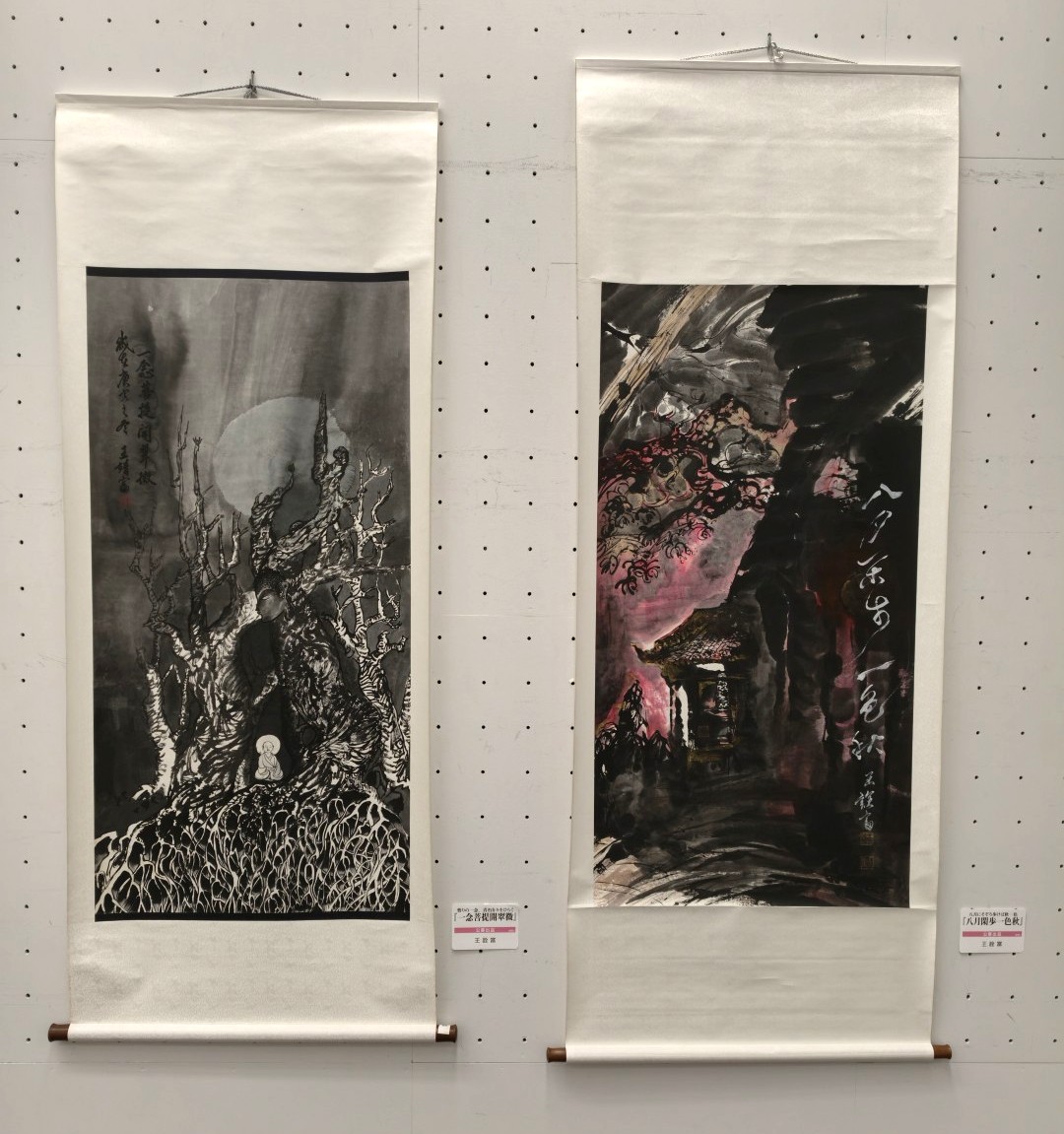
王詮富的〈一念菩提開翠微〉正是這樣的作品。畫面中最醒目的,並不是一個獨立、尊貴、從樹下分離出來的佛者,而是一個幾乎已與古木融為一體的身形:佛身沉於黑,樹幹裂於白,枝枒上舉如焰,根網下垂如流。中央背後有淡白圓輪,如月、如光、如一個尚未被言說的內在空場;樹梢頂端有一點極小的綠葉,像在整幅黑白世界中留下最節制的一點生機;佛身下方又可見一尊更小的白色坐像,像回聲、像因中之果,也像大身之內仍另有一座微型道場。整體構圖垂直而深,恰好藉由捲軸形式,把視線從上方的光輪與枯枝,一路引到中段佛樹同體,再墜入下方密不透風的根網世界。這種由上而下的垂直性,並不只是構圖安排,而是一種精神拓撲:上有開顯,下有糾結,中間有安坐。
海德格:菩提作為開顯
海德格對「真理」的理解,與日常所謂正確描述完全不同。對海德格來說,真理不是把事情講對,而是讓原本被遮蔽的東西得以開顯(aletheia)。這種「開顯」不是全盤透明,而是事物從黑暗與遮蔽中被慢慢打開,進入可被感知的狀態。若從這一觀點來看〈一念菩提開翠微〉,題名中的「開」就變得至關重要。
「菩提」在此不是教條性的名詞,也不只是佛教語境中的既有概念;它首先是一個動詞性的事件——從不明到明、從遮蔽到開敞、從纏結到片刻透明。作品中的圓形淡月或光輪,並不明亮到壓倒一切,反而極其內斂,像從濃墨與灰氣之間慢慢浮出的空處。這一點非常關鍵。因為這說明了畫中的「明」不是暴烈的,不是神蹟式的,而是一種極中國式、也極存在論式的顯現:它不消滅黑暗,反而正因黑暗夠深,才讓開顯成為可能。
你若仔細看這幅畫,便會發現,真正的視覺力量不是來自任何一個燦爛色塊,而是來自黑如何讓光變得必要。四周厚重的墨色、樹幹的裂白、枝條的陰影、下方根系如網的密度,都是遮蔽;而中央佛身與背後圓輪的靜定,便是去蔽。這使作品極接近海德格式的世界結構:世界不是一開始就敞開,而總是在遮與顯之間成立。佛性於是也不再是某種懸在世界之外的超越物,而是從遮蔽最深處被打開的存在狀態。
在這個意義上,「一念菩提開翠微」不是「佛理降臨於景」,而是景自身被轉化成開顯的場所。枯木、暗月、根網、坐像,全部都不是宗教圖像的配件,而是同一個開顯事件的不同側面。這件作品最成熟的地方,正在於它沒有把菩提畫成教條性的光明,而是畫成一種在沉黑裡漸漸被打開的靜域。這種靜域不高聲、不宣告、不誇飾,卻比直接的明亮更有力量。
斯賓諾莎與佛樹同體
這件作品最驚人的視覺決定,是佛與樹幾乎不再能被完全分開。佛不只是坐在樹下,樹也不只是提供佛的背景。相反地,佛像像是從樹幹內部長出來,樹身又像披著佛衣的古老身體。樹幹的裂紋與佛衣的重量互相交疊,枝杈像手臂或神經向上伸展,根部又形成一個幾乎可吞噬一切的地下生命網絡。如此一來,「佛在樹下」這一扁平的觀看方式就被打破了,取而代之的,是更複雜的狀態:佛與樹互為身體。
斯賓諾莎的哲學,在此尤其有用。斯賓諾莎否定精神與身體作為兩種截然分離實體的古老二元論,而提出:精神與身體是同一存在的兩種樣態。若借這一思路來看畫面,佛與樹便不再是兩個彼此相鄰的對象,而可能是同一個存在事件的兩種顯現方式。佛是其靜,樹是其形;佛是其內在收攝,樹是其外部時間;佛是意識之凝,樹是物質之延。二者既不相互取代,也不相互從屬,而是共同構成一個「覺」如何在世界中有身體可見的問題。
作品中尤其耐人尋味的是:畫家並沒有將佛畫得特別華麗,也沒有以金彩、朱紅或高光將其推向視覺中心;相反地,佛身偏暗,甚至幾乎隱沒在木紋與陰影之中。這使佛的存在更接近斯賓諾莎意義上的「內在性」:不是一個超越性的主宰,而是一種深埋於世界之內、與世界同時成立的秩序。樹不再是佛悟道的附庸,佛也不再是樹的外來靈魂;兩者共同顯示出一種更深的命題:精神不是逃離物質,而是物質之中那股使自己得以安住的內在形式。
這讓作品大大超越一般佛教題材畫作的「崇高」模式。它不靠神聖光環把佛從自然中拔高,而是反過來讓自然——特別是這棵枯裂、蒼老、近乎扭曲的古木——成為佛性的肉身。佛性因此不是懸空的,而是木化的、時間化的、根系化的。這種處理極其成熟,因為它把覺悟從神學式的高空,重新放回存在的縱深裡。
柏格森:一念與時間壓縮
題名中的「一念」,若從日常理解,似乎只是「一個念頭」、「一瞬之悟」;但若真正進入這件作品,便會知道它所處理的絕不是簡單的瞬間主義。因為畫中的一切——樹幹的扭曲、枯枝的斷裂、樹皮的皺裂、下方根網的盤纏——都在強烈地告訴觀者:這不是一朝一夕形成的世界。這是一個經歷了極長時間之後,才緩慢凝結出來的形體。那麼,題名何以偏偏說「一念」?
柏格森對時間的理解,正能解開這個看似矛盾的結構。柏格森區分機械式的鐘錶時間與真正活的時間——綿延(durée)。在綿延中,時間不是一個個可以分割的點,而是不同層次的過去持續壓入當下,形成濃縮的內在厚度。這正是〈一念菩提開翠微〉的時間特質:畫中的佛樹不是「快速頓悟」的插圖,而是一個極長時間的壓縮體。
枯木證明了歲月,根系證明了累積,枝幹證明了受創與存活,而那一點極小的綠葉,則像是在這漫長歷史中忽然出現的一瞬透明。於是「一念」不再是與時間對立的閃現,反而是時間被壓縮到幾近透明的那個點:無數年的風霜、無數層的生命痕跡,在一個不能再分割的當下,忽然被看見了。
這裡最動人的,不是覺悟來得多快,而是它來得多慢。因為真正的一念,從來不是沒來由的閃電,而是長久暗蘊之後的突然明白。畫中那一點綠,正因此具有驚人的哲學重量。它不是裝飾性的生機,而是整個畫面時間邏輯的結晶:經歷了如此之久的枯黑之後,何以仍有一念能綠? 這不只是生命力的問題,更是柏格式的時間問題:過去沒有消失,而是全都壓在此刻之中,直到此刻真正被照見。
因此,作品中的「一念」與其說是瞬間,不如說是「整體時間在瞬間中的可見化」。這種時間壓縮,使畫面具有一種宗教之外的普遍性:我們每一個人真正的轉變,往往也不是無中生有,而是在漫長黑暗、纏結與沉積之後,忽然於某一點明白:原來此前一切,都已指向這一念。
龍樹:空與相依的美學
若說海德格讓我們看見「開顯」,斯賓諾莎讓我們看見「同體」,柏格森讓我們看見「時間壓縮」,那麼龍樹則可以幫助我們理解這件作品最深的美學結構:空與相依。
龍樹所說的「空」,從來不是什麼都沒有,而是說一切法都無自性,皆依因緣而起。事物之所以能顯現,正在於它們不是封閉自足的;它們總在與他者、與條件、與因果、與時間的關聯中成立。這個觀念放到〈一念菩提開翠微〉,幾乎是天然契合的。因為畫中沒有任何一個元素是獨立存在的:
- 佛依樹而顯,
- 樹依月而成其清寒,
- 月依黑暗而得其淡光,
- 綠葉依枯幹而顯其新生,
- 小坐像依大佛身而成另一層映照,
- 根系依地下的糾纏而構成全部的支撐。
這不是一個由單一主角支配的圖像,而是一個極其複雜的相依網絡。也正因如此,作品才有那麼強的整體性:不是因為它統一,而是因為它沒有人為地割裂任何事物。所有元素都在互相生成、互相映照、互相成就。
龍樹會提醒我們:若執著於佛是佛、樹是樹、月是月,那麼反而失去其真正的空性。王詮富這件作品高明之處,正在於它在視覺上把這些執著悄悄解除掉了。觀者起初也許以為看見佛、看見樹、看見根、看見光;但愈看愈會發現,這些名相之間其實並没有絕對邊界。樹可以成佛,佛可以成木;光既是月也是心,根既是地下之網也是念流之網。這便是空性的美學:不以固著之名把事物釘死,而讓它們在關聯中自由顯現。
尤其下方那一大片密密交織的白色根網,極具龍樹意味。表面看,它像自然之根;更深看,它也像無數念頭、業力、因果與生命纏結的視覺圖像。佛並未遠離這些根,恰恰安坐其上。這正是空性的成熟:覺悟不是把纏結消滅,而是在纏結中不再被纏結所困。若說覺悟仍有形象,那麼王詮富給出的答案並不是金光燦爛,而是在最複雜的相依之網上,竟仍能有一處安坐。
王詮富〈一念菩提開翠微〉若只被當作一件佛教題材水墨畫來看,實在太可惜。它真正重要的地方,不只是圖像中的佛、月、樹與根,而是它如何透過這些元素,提出了一個極深的哲學問題:精神如何在物質中顯現?覺悟如何在時間中成形?清明如何不否定黑暗,反而從黑暗最深處慢慢長出? 海德格告訴我們,菩提在此是開顯; 斯賓諾莎告訴我們,佛與樹是同體的兩種樣態; 柏格森告訴我們,一念不是瞬間,而是整體時間壓縮後的透明; 龍樹則提醒我們,一切之所以得以成立,正因一切都不是孤立的。
於是,這件作品的精神深度便不只在於「禪意」,而在於它把禪這件事從抽象氣氛拉回到存在的縱深中: 枯木不是障礙,而是肉身; 黑暗不是對立,而是條件; 根系不是束縛,而是相依的網; 而那一點微綠,之所以如此動人,不是因它顏色鮮明,而是因它在如此龐大的枯、黑、重、久之中,仍然不退。 若要我用一句話總結,我會這樣說:
〈一念菩提開翠微〉所畫的,不是佛在樹下悟道,而是萬根纏結之中,一念如何終於學會發光。
王詮富〈一念菩提開翠微〉以寫意水墨將佛身、古木、月輪與根系構築成一個高度凝聚的精神場域。作品最重要的特質,在於佛與樹不再維持主從關係,而呈現為同一存在事件的兩種顯現:佛身如自木心中生出,古木亦如覺悟的肉身。若借海德格的「開顯」概念,可見題名中的「開」並非修辭,而是畫面從沉黑到靜明的核心結構;柏格森的綿延時間,則使「一念」成為長久歲月壓縮後的透明時刻。畫面中極小的一點綠與下方密集根網尤具哲學強度:前者是新生,後者是相依,兩者共同指向龍樹所說的空性——一切不自足,皆在關聯中成立。整體而言,〈一念菩提開翠微〉不是單純的宗教圖像,而是一件關於覺悟如何從最深的纏結、最老的木心、最暗的時間中緩緩長出的哲學性創作。
其他相關內容:
【現場直擊】【台日交流展】東京都美術館開館100周年記念《第14回東京現展》展場:日本國立東京都美術館
台灣參展藝術家作品藝術評論
東京都美術館開館100周年記念【14回東京現展】廖純沂〈未盡・浮境〉未盡之物何以最能久留人心
東京都美術館開館100周年記念【14回東京現展】廖純沂〈游相〉花何以不止於花,與形相如何在漂游中成立
東京都美術館開館100周年記念【14回東京現展】廖純沂〈思域・沉靜〉沉靜何以不是空,與垂掛之物何以最像思念
東京都美術館開館100周年記念【14回東京現展】王詮富〈八月閑步一色秋〉的季節哲學、門徑意識與水墨的開敞性 在黑暗中閑步:秋色如何不是顏色,而是一種存在的轉身
東京都美術館開館100周年記念【14回東京現展】 王詮富〈一念菩提開翠微〉的開顯、同體、綿延與空性 一念未起,萬根已動
東京都美術館開館100周年記念【14回東京現展】蔡梅芳〈戀戀紫藤〉的痕跡、綿延與生成 花影之遲遲不散,與記憶如何在解構之後重返
東京都美術館開館100周年記念【14回東京現展】 王穆提《聖境・阿里山》蒼翠的紀念碑
東京都美術館開館100周年記念【14回東京現展】王穆提《中道之光》裂隙中的永恆
東京都美術館開館100周年記念【14回東京現展】吳心荷〈散落骨骼(一)〉散落之骨,與人之未能完全集成於自身
東京都美術館開館100周年記念【14回東京現展】陳福祺〈咖啡心音〉的存在寓言 沸點、晶化與心之熔爐
東京都美術館開館100周年記念【14回東京現展】張素蘭〈一棵開花的樹〉的場所哲學、過程生命與靜默中的新生
東京都美術館開館100周年記念【14回東京現展】吳亞倫〈藍與黑的交響詩(雙併)〉論藍何以不只為藍,黑何以不只為黑
東京都美術館開館100周年記念【14回東京現展】張碧鄉〈艷冠群芳〉的器物哲學、生成美學與過剩的顯現
東京都美術館開館100周年記念【14回東京現展】趙玉燕〈熾烈〉論火中的身體,與人何以不能只是自己
東京都美術館開館100周年記念【14回東京現展】許秀珠〈403地震後的太魯閣〉山川之裂,與人如何在震後重新學會自身的位置
東京都美術館開館100周年記念【14回東京現展】江麗香〈秋聲賦〉彩墨中的時間書寫 水痕與秋聲
東京都美術館開館100周年記念【14回東京現展】江麗香〈流轉的歲月〉水之無言,而歲月常藉其形以自見
東京都美術館開館100周年記念【14回東京現展】謝文倩〈驚夢〉的夢之碎片、感覺邏輯與夜的顯現
東京都美術館開館100周年記念【第14回東京現展】黃淑卿〈群鷗處處來(台灣澎湖)〉群鷗之所以來,與人終於學會不把世界全算作自己
東京都美術館開館100周年記念【14回東京現展】黃淑卿〈燕尾與戴勝(台灣金門)〉論屋脊、禽鳥與地方何以不只是地理
東京都美術館開館100周年記念【14回東京現展】謝正瑜〈蓮池映相〉的感知哲學與靈性空間
東京都美術館開館100周年記念【14回東京現展】周若梅〈流光之舞〉,光何以有身,與人如何在流動中暫時成形
Not a Single Thought Has Arisen, Yet Ten Thousand Roots Have Stirred
—Disclosure, Consubstantiality, Duration, and Emptiness in Wang Quan-Fu’s A Single Thought of Bodhi Opens the Verdant Mist
By: WANG MUTI
Preface: This is not a religious image, but an event of how existence slowly unfolds from the darkness
When looking at a painting featuring a Buddha statue, the most common mistake one makes is recognizing it as a "Buddha" too quickly, thus assuming one has already understood the painting. However, truly powerful works never allow symbols to remain merely symbols. Truly powerful works will always, at the very moment you think you have finished identifying them, turn around and ask you: Is what you see truly just a Buddha, a tree, a moon, and a root system? Or is what you are encountering actually something much harder to articulate—a process of how existence slowly discloses itself amidst darkness, wither, time, and entanglement?
Wang Quan-Fu's A Single Thought of Bodhi Opens the Verdant Mist is precisely such a work. The most striking element in the frame is not an independent, majestic Buddha detached from the tree beneath him, but a figure that has almost merged with the ancient wood into a single body: the Buddha's body sinks into blackness, the tree trunk splinters in white, the branches reach upward like flames, and the root network droops downward like a flowing stream. Behind the center sits a pale, circular halo—like a moon, like light, like an inner void yet to be spoken; at the very top of the branches rests a minuscule green leaf, as if leaving the most restrained touch of vitality in this entirely black-and-white world. Below the Buddha, a smaller, white seated figure is visible—like an echo, like the fruit within a cause, or like a miniature dojo still contained within the larger body.
The overall composition is vertically profound, utilizing the scroll format perfectly to guide the gaze from the halo and withered branches at the top, down to the consubstantiality of Buddha and tree in the middle, before plunging into the impenetrable world of root networks at the bottom. This top-down verticality is not merely a compositional arrangement, but a spiritual topology: disclosure at the top, entanglement at the bottom, and peaceful abiding in the middle.
Heidegger: Bodhi as Disclosure
Martin Heidegger’s understanding of "truth" is entirely different from the everyday notion of a correct description. To Heidegger, truth is not about stating things correctly, but allowing that which is originally concealed to be disclosed (aletheia). This "disclosure" is not absolute transparency; rather, it is a process where things are slowly opened up from darkness and concealment into a perceivable state. Viewed from this perspective, the word "Opens" (開) in the title of A Single Thought of Bodhi Opens the Verdant Mist becomes paramount.
Here, "Bodhi" is not a dogmatic noun, nor is it merely a pre-existing concept within a Buddhist context; primarily, it is a verbal event—moving from obscurity to clarity, from concealment to openness, from entanglement to a moment of transparency. The pale moon or halo in the artwork is not bright enough to overpower everything; instead, it is exceedingly restrained, like an empty space slowly surfacing from thick ink and gray mist. This is crucial. It illustrates that the "light" in the painting is not violent or miraculous, but an emergence that is profoundly Chinese and highly ontological: it does not annihilate the darkness; rather, precisely because the darkness is deep enough, disclosure becomes possible.
If you look closely at this painting, you will find that its true visual power does not stem from any radiant block of color, but from how the black makes the light necessary. The surrounding heavy ink, the splintered white of the trunk, the shadows of the branches, and the density of the net-like roots below are all concealments; meanwhile, the stillness of the central Buddha and the halo behind him is the unconcealment (clearing). This brings the work incredibly close to a Heideggerian structure of the world: the world is not laid open from the start, but is always established in the oscillation between concealing and revealing. Consequently, Buddha-nature is no longer some transcendent entity suspended outside the world, but a state of existence opened up from the deepest layer of concealment.
In this sense, A Single Thought of Bodhi Opens the Verdant Mist is not "Buddhist doctrine descending upon a landscape," but the landscape itself being transformed into a site of disclosure. The withered tree, the dim moon, the root network, and the seated figure—none are mere accessories of a religious image; they are different facets of the exact same event of disclosure. The most mature aspect of this artwork lies in how it does not paint Bodhi as dogmatic brightness, but as a realm of stillness gradually opened up within the heavy darkness. This stillness is not loud, declaratory, or exaggerated, yet it carries far more power than direct illumination.
Spinoza and the Consubstantiality of Buddha and Tree
The most astonishing visual decision in this piece is that the Buddha and the tree can almost no longer be completely separated. The Buddha does not merely sit beneath the tree, nor does the tree merely provide a backdrop for the Buddha. Conversely, the Buddha seems to grow from within the tree trunk, and the tree appears as an ancient body draped in the Buddha's robes. The cracks of the trunk and the weight of the robes overlap; the branches extend upward like arms or nerves, while the roots form a subterranean network of life that could seemingly swallow everything. Thus, the flat perspective of "the Buddha under the tree" is shattered, replaced by a much more complex state: the Buddha and the tree serve as each other's bodies.
Baruch Spinoza’s philosophy is particularly applicable here. Spinoza rejected the ancient dualism that treated mind and body as two distinct, separate substances, proposing instead that mind and body are two modes of the same existence. If we view the painting through this lens, the Buddha and the tree are no longer two adjacent objects, but perhaps two ways the identical existential event manifests. The Buddha is its stillness, the tree is its form; the Buddha is its internal gathering, the tree is its external time; the Buddha is the condensation of consciousness, the tree is the extension of matter. The two neither replace nor subordinate one another; they jointly pose the question of how "Awakening" can possess a visible body in the world.
What is particularly intriguing in the work is that the artist did not paint the Buddha to be exceptionally magnificent, nor did he push it to the visual center using gold leaf, vermilion, or highlights. On the contrary, the Buddha’s body is quite dark, almost fading into the wood grain and shadows. This brings the Buddha's presence closer to "immanence" in the Spinozan sense: not a transcendent ruler, but an order buried deep within the world, established simultaneously with the world. The tree is no longer a vassal to the Buddha’s enlightenment, and the Buddha is no longer an alien soul to the tree; together, they reveal a deeper proposition: spirit is not an escape from matter, but the inherent form within matter that allows it to abide peacefully.
This allows the work to vastly surpass the "sublime" mode of typical Buddhist-themed paintings. It does not elevate the Buddha out of nature using a divine halo; instead, it turns nature—specifically this cracked, aged, almost distorted ancient tree—into the very flesh of Buddha-nature. Buddha-nature, therefore, is not suspended in the void; it is woodified, temporalized, and rooted. This handling is exceptionally mature because it pulls enlightenment down from theological heights and places it back into the depths of existence.
Bergson: A Single Thought and Time Compression
Understood in an everyday sense, "A Single Thought" (一念) in the title might seem to simply mean "a passing idea" or "an instant of realization." But if one truly enters this artwork, they will realize it deals with anything but simple instantaneism. Because everything in the painting—the twisting of the trunk, the snapping of withered branches, the wrinkling of the bark, the coiling of the root network below—strongly signals to the viewer: this is not a world formed overnight. This is a physical form that has slowly congealed only after enduring a vast expanse of time. Why, then, does the title insist on saying "A Single Thought"?
Henri Bergson’s understanding of time flawlessly unravels this seemingly contradictory structure. Bergson distinguishes between mechanical clock time and true, lived time—duration (durée). In duration, time is not a series of divisible points; rather, different layers of the past continuously press into the present, forming a concentrated inner thickness. This is precisely the temporal quality of A Single Thought of Bodhi Opens the Verdant Mist: the Buddha-tree in the painting is not an illustration of "rapid, sudden enlightenment," but a compressed entity of immense time.
The withered wood proves the passage of years, the root system proves accumulation, the branches prove trauma and survival; and that minuscule green leaf feels like a momentary transparency suddenly appearing in this drawn-out history. Consequently, "a single thought" is no longer a flash opposed to time, but rather the point where time is compressed to the brink of transparency: countless years of weathering and countless layers of life traces are abruptly seen in an indivisible present.
The most moving part here is not how quickly awakening arrives, but how slowly it does. Because a true "single thought" is never an unprovoked lightning strike, but a sudden clarity following a long, dark incubation. That single touch of green in the painting carries astonishing philosophical weight for this very reason. It is not decorative vitality, but the crystallization of the entire painting's temporal logic: after enduring such a long period of withered blackness, how is it that a single thought can still turn green?
This is not just a question of vitality, but a Bergsonian question of time: the past has not disappeared; it is all pressed into this very moment, until this moment is truly illuminated.
Therefore, the "single thought" in the artwork is less an instant and more "the visualization of total time within an instant." This time compression endows the painting with a universality outside of religion: for each of us, true transformation rarely comes out of nowhere. It usually happens when, after a long period of darkness, entanglement, and sedimentation, we suddenly realize at a specific point: everything before this had already been pointing toward this single thought.
Nagarjuna: The Aesthetics of Emptiness and Interdependence
If Heidegger allows us to see "disclosure," Spinoza allows us to see "consubstantiality," and Bergson allows us to see "time compression," then Nagarjuna can help us understand the deepest aesthetic structure of this artwork: emptiness and interdependence.
The "emptiness" (Sunyata) spoken of by Nagarjuna never means that nothing exists. It means that all phenomena lack intrinsic, independent nature, and all arise due to causes and conditions. Things can manifest precisely because they are not closed and self-sufficient; they are always established in relation to others, conditions, causality, and time. Applying this concept to A Single Thought of Bodhi Opens the Verdant Mist is almost a natural fit. Because no single element in the painting exists independently:
- The Buddha manifests by relying on the tree.
- The tree achieves its stark chill by relying on the moon.
- The moon attains its pale light by relying on the darkness.
- The green leaf reveals its new life by relying on the withered trunk.
- The small seated figure forms another layer of reflection by relying on the large Buddha body.
- The root system constitutes the entire foundational support by relying on its underground entanglement.
This is not an image dominated by a single protagonist, but an extraordinarily complex network of interdependence. It is precisely because of this that the work possesses such strong cohesiveness: not because it is uniform, but because it does not artificially sever any entity. All elements are mutually generating, mutually reflecting, and mutually fulfilling.
Nagarjuna would remind us: if one stubbornly clings to the idea that the Buddha is a Buddha, the tree is a tree, and the moon is a moon, they instead lose their true emptiness. The brilliance of Wang Quan-Fu's piece is that it visually and quietly dismantles these attachments. Viewers might initially think they see a Buddha, a tree, roots, and light; but the longer they look, the more they realize there are no absolute boundaries between these named forms. The tree can become the Buddha, the Buddha can become wood; the light is both the moon and the mind; the roots are both an underground web and a web of streaming thoughts. This is the aesthetics of emptiness: not pinning things down with rigid names, but allowing them to manifest freely within their interconnectedness.
The dense, interwoven white root network at the bottom is particularly redolent of Nagarjuna. On the surface, it looks like natural roots; looking deeper, it also resembles a visual map of countless thoughts, karma, causality, and the entanglements of life. The Buddha does not distance himself from these roots; he sits squarely upon them. This is the maturity of emptiness: awakening does not mean annihilating entanglement, but no longer being trapped by entanglement while amidst it. If awakening still holds a form, then Wang Quan-Fu’s answer is not a radiant golden light, but the ability to find a place to sit peacefully even upon the most complex web of interdependence.
Conclusion
It would be a great pity to view Wang Quan-Fu’s A Single Thought of Bodhi Opens the Verdant Mist merely as a Buddhist-themed ink painting. Its true significance lies not just in the images of the Buddha, moon, tree, and roots, but in how it utilizes these elements to pose a profound philosophical question: How does spirit manifest in matter? How does awakening take shape in time? How does clarity avoid negating darkness, instead slowly growing from its very depths?
- Heidegger tells us that Bodhi here is disclosure;
- Spinoza tells us that the Buddha and the tree are two modes of one consubstantiality;
- Bergson tells us that a single thought is not an instant, but the transparency of compressed total time;
- Nagarjuna reminds us that everything is able to be established precisely because nothing is isolated.
Consequently, the spiritual depth of this artwork goes beyond "Zen atmosphere"; it pulls the concept of Zen back from an abstract vibe into the profound depths of existence: The withered wood is not an obstacle, but the flesh; the darkness is not the opposition, but the condition; the root system is not a fetter, but a web of interdependence. And the reason that tiny touch of green is so moving is not its vibrant color, but its refusal to retreat despite the overwhelming presence of wither, blackness, weight, and age.
If I were to summarize it in one sentence, I would say:
What A Single Thought of Bodhi Opens the Verdant Mist paints is not a Buddha attaining enlightenment under a tree, but how, amidst the entanglement of ten thousand roots, a single thought finally learns to shine.
Summary
Wang Quan-Fu’s A Single Thought of Bodhi Opens the Verdant Mist constructs a highly condensed spiritual field of the Buddha’s body, ancient wood, lunar halo, and root systems through freehand ink wash. The most vital trait of the work is that the Buddha and the tree no longer maintain a master-subordinate relationship, but present themselves as two manifestations of the same existential event: the Buddha's body seems to grow from the heart of the wood, and the ancient tree acts as the flesh of awakening. Borrowing Heidegger's concept of "disclosure," it is evident that the word "Opens" in the title is not mere rhetoric, but the core structure of the image moving from heavy darkness to tranquil light; Bergson's duration turns "a single thought" into a moment of transparency compressed from long spans of time. The minuscule touch of green in the frame and the dense root network below carry specific philosophical intensity: the former is new life, the latter is interdependence, both jointly pointing to the emptiness spoken of by Nagarjuna—that nothing is self-sufficient, and all is established in relation. Overall, A Single Thought of Bodhi Opens the Verdant Mist is not a simple religious image, but a philosophical creation about how awakening slowly grows from the deepest entanglements, the oldest heartwood, and the darkest time.
一念未だ起こらず、万根すでに動く
——王詮富〈一念菩提開翠微(一念の菩提、翠微を開く)〉における開け、同体、純粋持続と空性
文:王穆提(WANG MUTI)
はじめに:これは宗教的図像ではなく、ある存在がいかに暗闇からゆっくりと開かれていくかの出来事である
仏像が描かれた絵を見る時、人が最も犯しやすい過ちは、あまりにも早くそれが「仏」であると認識してしまい、絵そのものを理解したと思い込むことである。しかし、真に力のある作品は、象徴を単なる象徴のままでは終わらせない。真に力のある作品は、あなたが「もう識別できた」と思ったまさにその瞬間、逆にこう問いかけてくる。あなたが見ているものは、果たしてただの仏、一本の木、一つの月、一面の根の網に過ぎないのだろうか?それとも実は、あなたの目の前にあるのは、もっと言葉にし難いもの——ある存在が暗闇、枯渇、時間、そして絡み合いの中で、いかにしてゆっくりと自らを「開け(顕わに)」ていくのかというプロセスなのだろうか?
王詮富の〈一念菩提開翠微〉はまさにそのような作品である。画面の中で最も目を引くのは、木の下から切り離された独立的で尊厳ある仏の姿ではなく、ほとんど古木と一体化したかのような身体である。仏の体は黒の中に沈み、幹は白く裂け、枝は炎のように上に伸び、根の網は流れのように垂れ下がっている。中央の背後には淡く白い円輪があり、月のように、光のように、あるいは未だ語られざる内なる空の場(ヴォイド)のようである。梢の頂にはごく小さな緑の葉が一枚あり、この完全な白黒の世界に、最も抑制された一つの生命力を残しているかのようだ。仏の下方にはさらに小さな白い坐像が見え、こだまのようでもあり、原因の中にある結果のようでもあり、また大きな体の中にさらにもう一つの小さな道場があるかのようでもある。
全体の構図は垂直で深く、掛け軸という形式を活かして、視線を上部の光輪と枯れ枝から、中段の仏と木の同体へと導き、そして下方の隙間のない根の網の世界へと墜落させていく。このような上から下への垂直性は、単なる構図の配置ではなく、一種の精神的トポロジーである。上には開け(開顕)があり、下にはもつれがあり、その中間に安座があるのだ。
ハイデガー:開け(顕現)としての菩提
マルティン・ハイデガーの「真理」に対する理解は、日常的に言うところの「正確な描写」とは全く異なる。ハイデガーにとって真理とは、物事を正しく語ることではなく、本来隠蔽されていたものを顕わにする(開け:aletheia)ことである。この「開け」とは全般的な透明さではなく、事物が暗闇と隠蔽の中からゆっくりと開かれ、感知できる状態へと入っていくことである。この観点から〈一念菩提開翠微〉を見ると、タイトルにある「開」という文字が極めて重要になってくる。
ここでの「菩提」は教条的な名詞ではなく、仏教的な文脈における既存の概念にとどまらない。それはまず何よりも動詞的な出来事である——不明から明へ、隠蔽から開けへ、もつれから束の間の透明へと向かう出来事だ。作品の中の丸く淡い月あるいは光輪は、すべてを圧倒するほど明るくはなく、むしろ極めて内省的であり、濃墨と灰色の空気の間からゆっくりと浮かび上がる空白のようである。この点は非常に重要だ。なぜなら、これは絵の中の「明」が暴力的でも奇跡的でもなく、極めて中国的であり、かつ極めて存在論的な顕現であることを説明しているからだ。それは暗闇を消滅させるのではなく、むしろ暗闇が十分に深いからこそ、開けを可能にするのである。
この絵を注意深く見れば、真の視覚的力は、いかなる燦爛たる色面から来るものでもなく、「黒がいかにして光を必要不可欠なものにするか」から来ていることに気づくだろう。周囲の重厚な墨色、幹の白い裂け目、枝の影、下方の網のような根の密度は、すべて隠蔽である。そして中央の仏と背後の円輪の静けさこそが、脱隠蔽である。これにより、作品はハイデガー的な世界構造に極めて近づく。世界は最初から開け放たれているのではなく、常に隠蔽と顕現の間に成立しているのだ。したがって仏性もまた、世界の外に宙吊りにされた超越的な何かではなく、最も深い隠蔽の底から開かれた存在のあり方となる。
この意味において、「一念菩提開翠微」とは、「仏の理(ことわり)が風景に降臨する」ことではなく、風景そのものが開けの場所へと転化することである。枯れ木、暗い月、根の網、坐像——それらはすべて宗教図像の付属品ではなく、同一の開けの出来事の異なる側面なのだ。この作品が最も成熟している点は、菩提を教条的な光明として描くのではなく、深い黒の中で徐々に開かれていく静寂の領域として描いているところにある。この静寂の領域は、声を荒げることも、宣言することも、誇張することもないが、直接的な明るさよりも遥かに強い力を持っている。
スピノザと仏樹同体
この作品における最も驚くべき視覚的決定は、仏と木がもはや完全には切り離せなくなっていることである。仏はただ木の下に座っているだけでなく、木もまた仏の背景を提供しているだけではない。逆に、仏像は木の幹の内側から生え出ているかのようであり、木もまた仏の衣を羽織った古い身体のようである。幹の裂け目と仏衣の重みが互いに重なり合い、枝は腕や神経のように上へ伸び、根はすべてを飲み込むような地下の生命のネットワークを形成している。こうして「木の下に仏がいる」という平板な見方は打ち砕かれ、より複雑な状態がそれに取って代わる。仏と木は互いの身体なのである。
ここで、バールーフ・デ・スピノザの哲学が特に役立つ。スピノザは、精神と身体を全く別々の実体とする古い二元論を否定し、「精神と身体は同一の存在の二つの様態である」と提唱した。この思考の筋道を借りて画面を見ると、仏と木はもはや互いに隣り合う二つの対象ではなく、同一の存在の出来事が持つ二つの顕現の仕方であると言える。仏はその「静」であり、木はその「形」である。仏はその内的な収束であり、木はその外的な時間である。仏は意識の凝縮であり、木は物質の延長である。両者は互いに取って代わることも、従属することもなく、「覚り(目覚め)」がいかにして世界の中で目に見える身体を持ち得るのかという問題を共に構成している。
作品の中で特に興味深いのは、画家が仏を特別に華麗に描くこともなく、金彩や朱赤、ハイライトを用いて視覚的な中心へと押し出すこともしていない点である。それどころか、仏の身体は暗く、木目や影の中にほとんど埋没しそうにすら見える。これにより、仏の存在はスピノザ的な意味での「内在性」にさらに近づく。すなわち、超越的な支配者ではなく、世界の内側に深く埋め込まれ、世界と同時に成立する秩序である。木はもはや仏の悟りの従属物ではなく、仏もまた木に外部からやってきた魂ではない。両者は共により深い命題を示している。精神とは物質からの逃避ではなく、物質の中にあって自らを安住させる内在的形式なのだと。
このことは、作品を一般的な仏教を題材とした絵画の「崇高」のパターンから大きく逸脱させている。神聖な光背によって仏を自然から引き上げるのではなく、逆に自然——特にこのひび割れ、老い、ほとんどねじ曲がったような古木——を仏性の肉体としているのだ。したがって仏性は宙に浮いているのではなく、木化し、時間化し、根底化している。このような処理は極めて成熟している。なぜなら、それは覚りを神学的な高空から、存在の深みへと再び引き下ろしているからである。
ベルクソン:一念と時間の圧縮
タイトルにある「一念」は、日常的な理解からすれば、単なる「一つの思い」や「一瞬の悟り」のように思えるかもしれない。しかし、この作品に真に入り込めば、それが扱っているのが決して単純な瞬間主義ではないことが分かるはずだ。なぜなら、絵の中のすべて——幹のねじれ、枯れ枝の折れ、樹皮のしわ、下方の根の絡み合い——が、鑑賞者に向かって強烈に語りかけているからだ。「これは一朝一夕に形成された世界ではない」と。これは極めて長い時間を経た後、ゆっくりと凝結してできた形体なのだ。では、なぜタイトルはあえて「一念」と言っているのか?
アンリ・ベルクソンの時間に対する理解こそが、この一見矛盾した構造を解き明かしてくれる。ベルクソンは、機械的な時計の時間と、真に生きられた時間——純粋持続(durée)——を区別した。持続の中において、時間は一つ一つ分割できる点ではなく、異なる層の過去が現在に向かって押し寄せ続け、濃縮された内的な厚みを形成する。これこそが〈一念菩提開翠微〉の時間的特質である。絵の中の仏と木は「素早い頓悟」の挿絵ではなく、極めて長い時間が圧縮された集合体なのだ。
枯れ木は歳月を証明し、根の網は蓄積を証明し、枝は傷つき生き延びたことを証明している。そしてあの極めて小さな一枚の緑の葉は、この果てしない歴史の中に突然現れた一瞬の透明さのようである。こうして「一念」は時間と対立する閃きではなく、むしろ時間が透明に近いところまで圧縮されたその一点となる。無数の年の風雪、無数の層の生命の痕跡が、これ以上分割できない現在において、突然目に見えるものとなったのだ。
ここで最も心を打つのは、覚りがどれほど早く訪れたかではなく、どれほどゆっくりとやって来たかである。なぜなら、真の一念は決して理由のない稲妻ではなく、長い間ひそかに育まれた後に訪れる突然の理解だからだ。絵の中のあの緑の一点が、これほどまでに驚くべき哲学的重みを持っているのはそのためである。それは装飾的な生命力ではなく、画面全体の時間論理の結晶である。これほどまでに長く枯れ果てた黒の時間を経て、なぜ未だ緑になり得る一念が存在するのか?
これは単なる生命力の問題ではなく、まさにベルクソン的な時間の問題である。過去は消滅したのではなく、今この瞬間に真に照らし出されるまで、すべてがこの瞬間に押し込められていたのだ。
したがって、作品の中の「一念」は瞬間というより、「瞬間の中における全体時間の可視化」と言った方がよい。この時間の圧縮が、画面に宗教の枠を超えた普遍性を与えている。私たち一人一人の真の変化も、往々にして無から生じるのではなく、長い暗闇、絡み合い、沈殿の後に、ある一点において突然理解するのだ。「これまでのすべては、最初からこの一念を指し示していたのだ」と。
龍樹(ナーガールジュナ):空と縁起の美学
もしハイデガーが私たちに「開け」を、スピノザが「同体」を、ベルクソンが「時間の圧縮」を見せてくれたとするなら、龍樹(ナーガールジュナ)は、この作品の最も深い美学的構造、すなわち「空」と「相依(縁起)」を理解する助けとなるだろう。
龍樹の言う「空」とは、決して何もないということではない。すべての存在(法)には固定的な実体(自性)がなく、すべては因縁によって生起しているということを意味している。事物が現れ得る理由は、まさにそれが閉鎖的で自己完結したものではないからだ。それらは常に他者、条件、因果、そして時間との関係性の中で成立している。この概念を〈一念菩提開翠微〉に当てはめると、信じられないほどぴったりと符号する。なぜなら、絵の中に独立して存在している要素は一つもないからだ。
- 仏は木に依存して現れる。
- 木は月に依存してその清寒さを成す。
- 月は暗闇に依存してその淡い光を得る。
- 緑の葉は枯れた幹に依存してその新生を顕わにする。
- 小さな坐像は大きな仏の体に依存してもう一つの対照を成す。
- 根の網は地下の絡み合いに依存して全体の支えを構成する。
これは単一の主人公に支配された図像ではなく、極めて複雑な相依のネットワークである。だからこそ、この作品にはあれほど強い全体性があるのだ。それは統一されているからではなく、人為的にいかなる事物も切り離していないからだ。すべての要素が互いに生成し、互いに照らし出し、互いに成就し合っている。
龍樹は私たちにこう忠告するだろう。もし仏は仏、木は木、月は月だと執着すれば、逆にその真の空性を失ってしまう、と。王詮富のこの作品の秀逸な点は、視覚的にこれらの執着を密かに解除しているところにある。鑑賞者は最初、仏を見、木を見、根を見、光を見たと思うかもしれない。しかし見れば見るほど、これらの名と形(名相)の間に絶対的な境界などないことに気づく。木は仏になり得り、仏は木になり得る。光は月でもあり心でもあり、根は地下の網であると同時に念流(思考の流れ)の網でもある。これこそが空性の美学である。固定された名前で事物を釘付けにするのではなく、関係性の中で自由に顕現させるのだ。
特に下方に広がる密に交差した白い根の網は、極めて龍樹的である。表面上は自然の根のように見えるが、深く見れば、無数の思考、業(カルマ)、因果、そして生命の絡み合いの視覚的図像のようでもある。仏はこれらの根から遠ざかるのではなく、まさにその上に安座している。これこそが空性の成熟である。覚りとは絡み合いを消滅させることではなく、絡み合いの中にいながら、もはやその絡み合いに囚われないことである。もし覚りにまだ形があるとするなら、王詮富が提示した答えは、光り輝く黄金色ではなく、最も複雑な相依の網の上にあってなお、安座できる一つの場所があるということである。
結論
王詮富の〈一念菩提開翠微〉を、単なる仏教を題材にした水墨画としてのみ見るのは、あまりにも惜しい。この作品の本当に重要な点は、図像の中の仏、月、木、根だけではなく、これらの要素を通じて、いかにして極めて深い哲学的な問いを投げかけているかにある。精神はいかにして物質の中に顕現するのか?覚りはいかにして時間の中で形を成すのか?清明さはいかにして暗闇を否定することなく、むしろ暗闇の最も深いところからゆっくりと成長するのか?
- ハイデガーは、ここでの菩提が「開け」であることを教えてくれる。
- スピノザは、仏と木が同体の二つの様態であることを教えてくれる。
- ベルクソンは、一念が瞬間ではなく、全体時間が圧縮された後の透明さであることを教えてくれる。
- 龍樹は、すべてが成立し得るのは、すべてが孤立していないからに他ならないことを教えてくれる。
したがって、この作品の精神的な深みは単なる「禅の趣」にあるのではなく、禅というものを抽象的な雰囲気から存在の深みへと引き戻したことにある。枯れ木は障害ではなく肉体であり、暗闇は対立ではなく条件であり、根の網は束縛ではなく相依の網である。そして、あのわずかな緑がこれほどまでに心を打つのは、その色が鮮やかだからではなく、これほどまでに巨大な枯死、黒、重さ、長さの中にあって、なおも退かないからである。
もし一言で要約するならば、私はこう言うだろう。
〈一念菩提開翠微〉が描いているのは、木の下で悟りを開く仏ではなく、万根の絡み合いの中で、一念がいかにしてついに光を放つことを学んだか、である。
要約:
王詮富の〈一念菩提開翠微〉は、写意水墨の手法により、仏の身体、古木、月輪、そして根の網を高度に凝集された精神的場として構築している。作品の最も重要な特質は、仏と木がもはや主従関係を維持せず、同一の存在の出来事の二つの顕現として現れている点にある。仏の身体は木の中心から生え出たかのようであり、古木もまた覚りの肉体であるかのようだ。ハイデガーの「開け」の概念を借りれば、タイトルにある「開」は修辞ではなく、深い黒から静かな明るさへと向かう画面の核心的な構造であることが分かる。ベルクソンの純粋持続(持続する時間)は、「一念」を長い歳月が圧縮された後の透明な瞬間としている。画面の中にある極めて小さな緑の一点と、下方の密集した根の網は、特に哲学的な強度を持っている。前者は新生であり、後者は相依(相互依存)であり、その両者が龍樹の言う空性——すべては自己完結しておらず、関係性の中で成立する——を指し示している。全体として、〈一念菩提開翠微〉は単なる宗教的な図像ではなく、覚りが最も深いつもれ、最も古い木心、最も暗い時間の中から、いかにしてゆっくりと成長していくかを描いた哲学的な創作である。