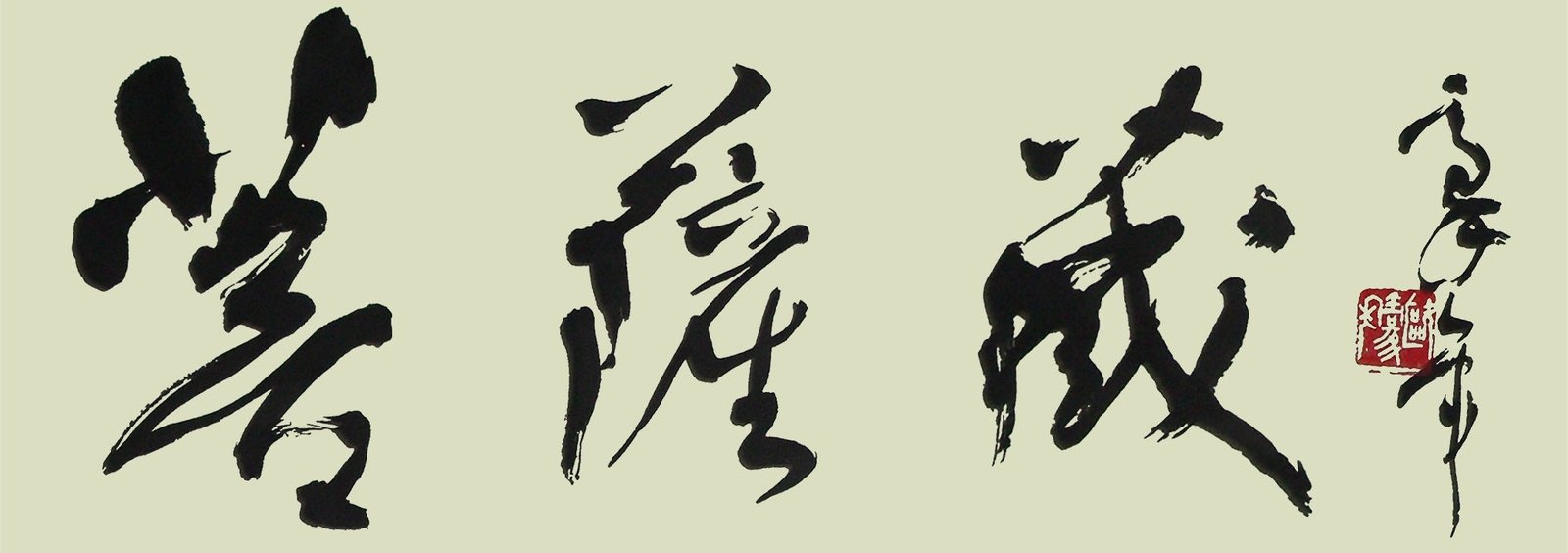
Not a Single Thought Has Arisen, Yet Ten Thousand Roots Have Stirred
—Disclosure, Consubstantiality, Duration, and Emptiness in Wang Quan-Fu’s A Single Thought of Bodhi Opens the Verdant Mist
By: WANG MUTI
Preface: This is not a religious image, but an event of how existence slowly unfolds from the darkness
When looking at a painting featuring a Buddha statue, the most common mistake one makes is recognizing it as a "Buddha" too quickly, thus assuming one has already understood the painting. However, truly powerful works never allow symbols to remain merely symbols. Truly powerful works will always, at the very moment you think you have finished identifying them, turn around and ask you: Is what you see truly just a Buddha, a tree, a moon, and a root system? Or is what you are encountering actually something much harder to articulate—a process of how existence slowly discloses itself amidst darkness, wither, time, and entanglement?
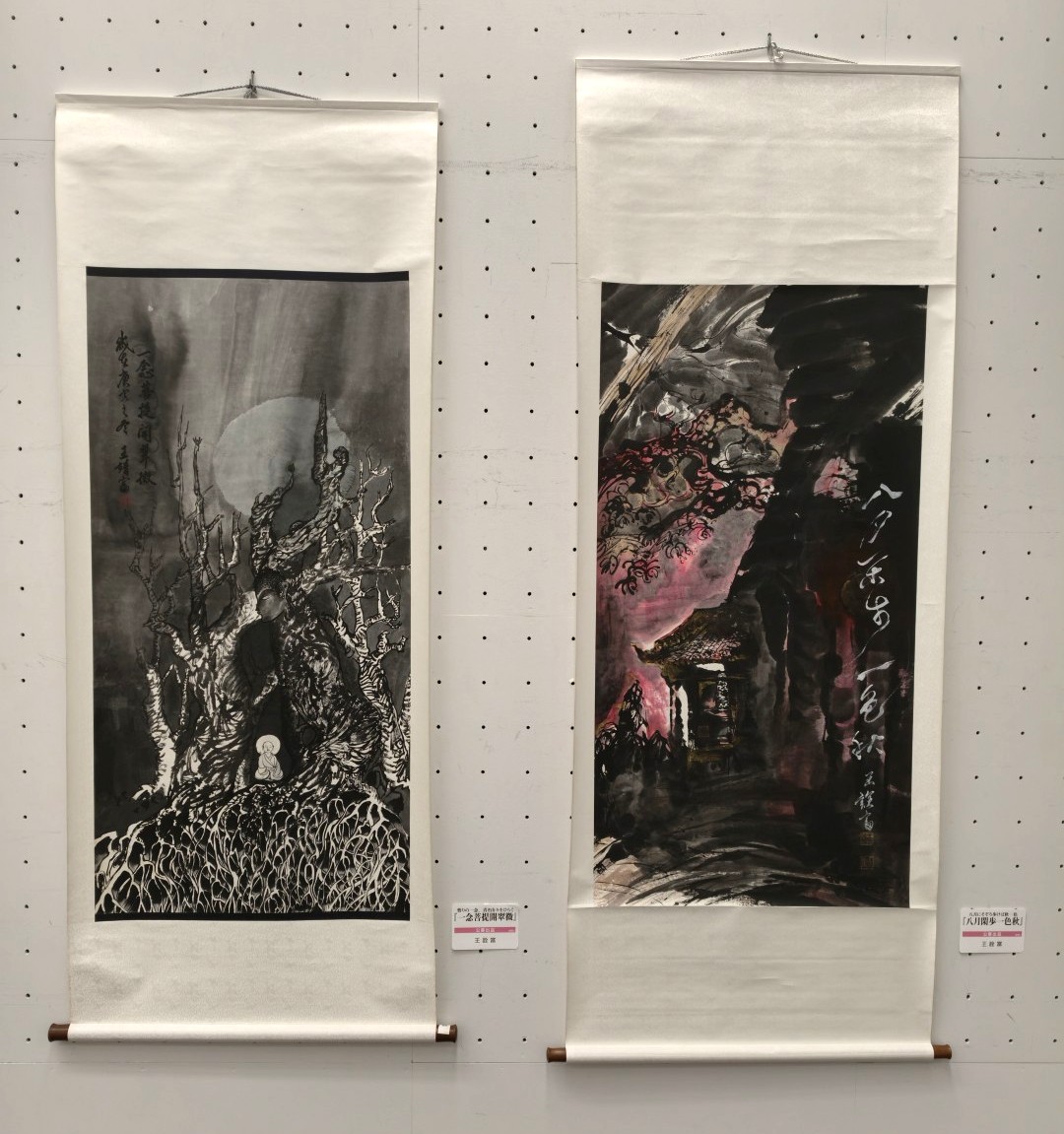
Wang Quan-Fu's A Single Thought of Bodhi Opens the Verdant Mist is precisely such a work. The most striking element in the frame is not an independent, majestic Buddha detached from the tree beneath him, but a figure that has almost merged with the ancient wood into a single body: the Buddha's body sinks into blackness, the tree trunk splinters in white, the branches reach upward like flames, and the root network droops downward like a flowing stream. Behind the center sits a pale, circular halo—like a moon, like light, like an inner void yet to be spoken; at the very top of the branches rests a minuscule green leaf, as if leaving the most restrained touch of vitality in this entirely black-and-white world. Below the Buddha, a smaller, white seated figure is visible—like an echo, like the fruit within a cause, or like a miniature dojo still contained within the larger body.
The overall composition is vertically profound, utilizing the scroll format perfectly to guide the gaze from the halo and withered branches at the top, down to the consubstantiality of Buddha and tree in the middle, before plunging into the impenetrable world of root networks at the bottom. This top-down verticality is not merely a compositional arrangement, but a spiritual topology: disclosure at the top, entanglement at the bottom, and peaceful abiding in the middle.
Heidegger: Bodhi as Disclosure
Martin Heidegger’s understanding of "truth" is entirely different from the everyday notion of a correct description. To Heidegger, truth is not about stating things correctly, but allowing that which is originally concealed to be disclosed (aletheia). This "disclosure" is not absolute transparency; rather, it is a process where things are slowly opened up from darkness and concealment into a perceivable state. Viewed from this perspective, the word "Opens" (開) in the title of A Single Thought of Bodhi Opens the Verdant Mist becomes paramount.
Here, "Bodhi" is not a dogmatic noun, nor is it merely a pre-existing concept within a Buddhist context; primarily, it is a verbal event—moving from obscurity to clarity, from concealment to openness, from entanglement to a moment of transparency. The pale moon or halo in the artwork is not bright enough to overpower everything; instead, it is exceedingly restrained, like an empty space slowly surfacing from thick ink and gray mist. This is crucial. It illustrates that the "light" in the painting is not violent or miraculous, but an emergence that is profoundly Chinese and highly ontological: it does not annihilate the darkness; rather, precisely because the darkness is deep enough, disclosure becomes possible.
If you look closely at this painting, you will find that its true visual power does not stem from any radiant block of color, but from how the black makes the light necessary. The surrounding heavy ink, the splintered white of the trunk, the shadows of the branches, and the density of the net-like roots below are all concealments; meanwhile, the stillness of the central Buddha and the halo behind him is the unconcealment (clearing). This brings the work incredibly close to a Heideggerian structure of the world: the world is not laid open from the start, but is always established in the oscillation between concealing and revealing. Consequently, Buddha-nature is no longer some transcendent entity suspended outside the world, but a state of existence opened up from the deepest layer of concealment.
In this sense, A Single Thought of Bodhi Opens the Verdant Mist is not "Buddhist doctrine descending upon a landscape," but the landscape itself being transformed into a site of disclosure. The withered tree, the dim moon, the root network, and the seated figure—none are mere accessories of a religious image; they are different facets of the exact same event of disclosure. The most mature aspect of this artwork lies in how it does not paint Bodhi as dogmatic brightness, but as a realm of stillness gradually opened up within the heavy darkness. This stillness is not loud, declaratory, or exaggerated, yet it carries far more power than direct illumination.
Spinoza and the Consubstantiality of Buddha and Tree
The most astonishing visual decision in this piece is that the Buddha and the tree can almost no longer be completely separated. The Buddha does not merely sit beneath the tree, nor does the tree merely provide a backdrop for the Buddha. Conversely, the Buddha seems to grow from within the tree trunk, and the tree appears as an ancient body draped in the Buddha's robes. The cracks of the trunk and the weight of the robes overlap; the branches extend upward like arms or nerves, while the roots form a subterranean network of life that could seemingly swallow everything. Thus, the flat perspective of "the Buddha under the tree" is shattered, replaced by a much more complex state: the Buddha and the tree serve as each other's bodies.
Baruch Spinoza’s philosophy is particularly applicable here. Spinoza rejected the ancient dualism that treated mind and body as two distinct, separate substances, proposing instead that mind and body are two modes of the same existence. If we view the painting through this lens, the Buddha and the tree are no longer two adjacent objects, but perhaps two ways the identical existential event manifests. The Buddha is its stillness, the tree is its form; the Buddha is its internal gathering, the tree is its external time; the Buddha is the condensation of consciousness, the tree is the extension of matter. The two neither replace nor subordinate one another; they jointly pose the question of how "Awakening" can possess a visible body in the world.
What is particularly intriguing in the work is that the artist did not paint the Buddha to be exceptionally magnificent, nor did he push it to the visual center using gold leaf, vermilion, or highlights. On the contrary, the Buddha’s body is quite dark, almost fading into the wood grain and shadows. This brings the Buddha's presence closer to "immanence" in the Spinozan sense: not a transcendent ruler, but an order buried deep within the world, established simultaneously with the world. The tree is no longer a vassal to the Buddha’s enlightenment, and the Buddha is no longer an alien soul to the tree; together, they reveal a deeper proposition: spirit is not an escape from matter, but the inherent form within matter that allows it to abide peacefully.
This allows the work to vastly surpass the "sublime" mode of typical Buddhist-themed paintings. It does not elevate the Buddha out of nature using a divine halo; instead, it turns nature—specifically this cracked, aged, almost distorted ancient tree—into the very flesh of Buddha-nature. Buddha-nature, therefore, is not suspended in the void; it is woodified, temporalized, and rooted. This handling is exceptionally mature because it pulls enlightenment down from theological heights and places it back into the depths of existence.
Bergson: A Single Thought and Time Compression
Understood in an everyday sense, "A Single Thought" (一念) in the title might seem to simply mean "a passing idea" or "an instant of realization." But if one truly enters this artwork, they will realize it deals with anything but simple instantaneism. Because everything in the painting—the twisting of the trunk, the snapping of withered branches, the wrinkling of the bark, the coiling of the root network below—strongly signals to the viewer: this is not a world formed overnight. This is a physical form that has slowly congealed only after enduring a vast expanse of time. Why, then, does the title insist on saying "A Single Thought"?
Henri Bergson’s understanding of time flawlessly unravels this seemingly contradictory structure. Bergson distinguishes between mechanical clock time and true, lived time—duration (durée). In duration, time is not a series of divisible points; rather, different layers of the past continuously press into the present, forming a concentrated inner thickness. This is precisely the temporal quality of A Single Thought of Bodhi Opens the Verdant Mist: the Buddha-tree in the painting is not an illustration of "rapid, sudden enlightenment," but a compressed entity of immense time.
The withered wood proves the passage of years, the root system proves accumulation, the branches prove trauma and survival; and that minuscule green leaf feels like a momentary transparency suddenly appearing in this drawn-out history. Consequently, "a single thought" is no longer a flash opposed to time, but rather the point where time is compressed to the brink of transparency: countless years of weathering and countless layers of life traces are abruptly seen in an indivisible present.
The most moving part here is not how quickly awakening arrives, but how slowly it does. Because a true "single thought" is never an unprovoked lightning strike, but a sudden clarity following a long, dark incubation. That single touch of green in the painting carries astonishing philosophical weight for this very reason. It is not decorative vitality, but the crystallization of the entire painting's temporal logic: after enduring such a long period of withered blackness, how is it that a single thought can still turn green?
This is not just a question of vitality, but a Bergsonian question of time: the past has not disappeared; it is all pressed into this very moment, until this moment is truly illuminated.
Therefore, the "single thought" in the artwork is less an instant and more "the visualization of total time within an instant." This time compression endows the painting with a universality outside of religion: for each of us, true transformation rarely comes out of nowhere. It usually happens when, after a long period of darkness, entanglement, and sedimentation, we suddenly realize at a specific point: everything before this had already been pointing toward this single thought.
Nagarjuna: The Aesthetics of Emptiness and Interdependence
If Heidegger allows us to see "disclosure," Spinoza allows us to see "consubstantiality," and Bergson allows us to see "time compression," then Nagarjuna can help us understand the deepest aesthetic structure of this artwork: emptiness and interdependence.
The "emptiness" (Sunyata) spoken of by Nagarjuna never means that nothing exists. It means that all phenomena lack intrinsic, independent nature, and all arise due to causes and conditions. Things can manifest precisely because they are not closed and self-sufficient; they are always established in relation to others, conditions, causality, and time. Applying this concept to A Single Thought of Bodhi Opens the Verdant Mist is almost a natural fit. Because no single element in the painting exists independently:
- The Buddha manifests by relying on the tree.
- The tree achieves its stark chill by relying on the moon.
- The moon attains its pale light by relying on the darkness.
- The green leaf reveals its new life by relying on the withered trunk.
- The small seated figure forms another layer of reflection by relying on the large Buddha body.
- The root system constitutes the entire foundational support by relying on its underground entanglement.
This is not an image dominated by a single protagonist, but an extraordinarily complex network of interdependence. It is precisely because of this that the work possesses such strong cohesiveness: not because it is uniform, but because it does not artificially sever any entity. All elements are mutually generating, mutually reflecting, and mutually fulfilling.
Nagarjuna would remind us: if one stubbornly clings to the idea that the Buddha is a Buddha, the tree is a tree, and the moon is a moon, they instead lose their true emptiness. The brilliance of Wang Quan-Fu's piece is that it visually and quietly dismantles these attachments. Viewers might initially think they see a Buddha, a tree, roots, and light; but the longer they look, the more they realize there are no absolute boundaries between these named forms. The tree can become the Buddha, the Buddha can become wood; the light is both the moon and the mind; the roots are both an underground web and a web of streaming thoughts. This is the aesthetics of emptiness: not pinning things down with rigid names, but allowing them to manifest freely within their interconnectedness.
The dense, interwoven white root network at the bottom is particularly redolent of Nagarjuna. On the surface, it looks like natural roots; looking deeper, it also resembles a visual map of countless thoughts, karma, causality, and the entanglements of life. The Buddha does not distance himself from these roots; he sits squarely upon them. This is the maturity of emptiness: awakening does not mean annihilating entanglement, but no longer being trapped by entanglement while amidst it. If awakening still holds a form, then Wang Quan-Fu’s answer is not a radiant golden light, but the ability to find a place to sit peacefully even upon the most complex web of interdependence.
Conclusion
It would be a great pity to view Wang Quan-Fu’s A Single Thought of Bodhi Opens the Verdant Mist merely as a Buddhist-themed ink painting. Its true significance lies not just in the images of the Buddha, moon, tree, and roots, but in how it utilizes these elements to pose a profound philosophical question: How does spirit manifest in matter? How does awakening take shape in time? How does clarity avoid negating darkness, instead slowly growing from its very depths?
- Heidegger tells us that Bodhi here is disclosure;
- Spinoza tells us that the Buddha and the tree are two modes of one consubstantiality;
- Bergson tells us that a single thought is not an instant, but the transparency of compressed total time;
- Nagarjuna reminds us that everything is able to be established precisely because nothing is isolated.
Consequently, the spiritual depth of this artwork goes beyond "Zen atmosphere"; it pulls the concept of Zen back from an abstract vibe into the profound depths of existence: The withered wood is not an obstacle, but the flesh; the darkness is not the opposition, but the condition; the root system is not a fetter, but a web of interdependence. And the reason that tiny touch of green is so moving is not its vibrant color, but its refusal to retreat despite the overwhelming presence of wither, blackness, weight, and age.
If I were to summarize it in one sentence, I would say:
What A Single Thought of Bodhi Opens the Verdant Mist paints is not a Buddha attaining enlightenment under a tree, but how, amidst the entanglement of ten thousand roots, a single thought finally learns to shine.
Summary
Wang Quan-Fu’s A Single Thought of Bodhi Opens the Verdant Mist constructs a highly condensed spiritual field of the Buddha’s body, ancient wood, lunar halo, and root systems through freehand ink wash. The most vital trait of the work is that the Buddha and the tree no longer maintain a master-subordinate relationship, but present themselves as two manifestations of the same existential event: the Buddha's body seems to grow from the heart of the wood, and the ancient tree acts as the flesh of awakening. Borrowing Heidegger's concept of "disclosure," it is evident that the word "Opens" in the title is not mere rhetoric, but the core structure of the image moving from heavy darkness to tranquil light; Bergson's duration turns "a single thought" into a moment of transparency compressed from long spans of time. The minuscule touch of green in the frame and the dense root network below carry specific philosophical intensity: the former is new life, the latter is interdependence, both jointly pointing to the emptiness spoken of by Nagarjuna—that nothing is self-sufficient, and all is established in relation. Overall, A Single Thought of Bodhi Opens the Verdant Mist is not a simple religious image, but a philosophical creation about how awakening slowly grows from the deepest entanglements, the oldest heartwood, and the darkest time.