花影之遲遲不散,與記憶如何在解構之後重返
——蔡梅芳〈戀戀紫藤〉的痕跡、綿延與生成
撰文:王穆提(WANG MUTI)
引言:當花不再只是花
人對某些事物的眷戀,並不在它們盛開之時,而反在它們被拆散、被移開、被迫離開原位之後,才真正顯出分量。當一串紫藤仍垂掛在眼前,人或許只說它美;可一旦你想離開它、改寫它、拆解它,使它不再按照原本的秩序出現,那原來自以為熟悉的形象,反而會以更幽深、更難拒絕的方式回來。它不必全然現身,只需在一團墨痕裡留下一點花串的傾勢,在一片褐赭暈染裡保留一絲花瓣相依的節律,在一處淡紫色的邊緣裡露出原貌的回聲,便足以使人知道:原來所謂解構,從來不是遺忘;真正不能離開的東西,恰恰最容易在我們以為已經離開時重返。
蔡梅芳的〈戀戀紫藤〉,正是這樣一件作品。這件作品表面上處理的是紫藤,且是經過解構與再建構之後的紫藤;然而其真正觸及的,並不只是花之形式的改造,而是一種更深的內在事件:原貌為何不肯離去?記憶為何總在重組中回返?而創作,是否其實正是一種與失去之物長久協商的過程?
解構與原貌的幽靈
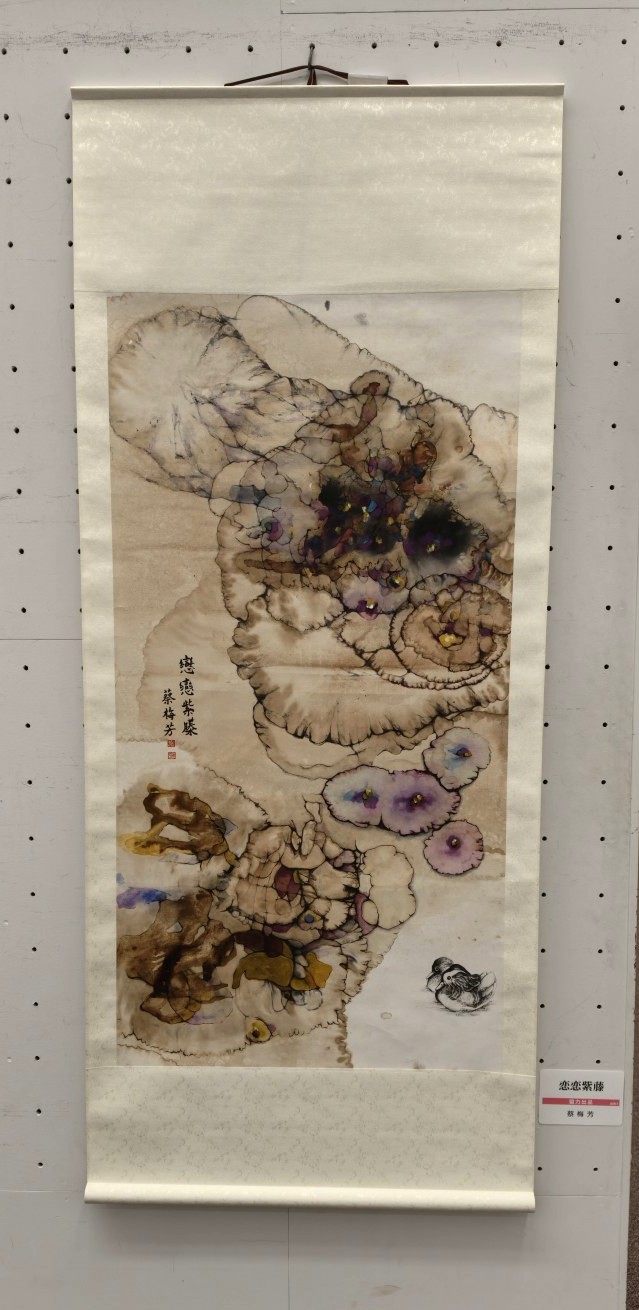
若只從形式上說,〈戀戀紫藤〉顯然已經不再是傳統意義上的花卉寫生。畫面中的形體並不按照紫藤原有的垂掛結構去再現,沒有完整串穗、沒有枝藤明確的節點,也沒有那種可供辨識的寫實花序。取而代之的,是一大片彼此漫漶、互相吞吐、邊界模糊卻又隱約有節律的彩墨團塊:褐赭、茶棕、淡紫、藍灰與局部金黃交織,構成一種介於花影、地層、雲氣與生物組織之間的暧昧圖像。這種處理,使「紫藤」不再被看作一個可以被忠實複製的對象,而成了一種被拆解之後仍不斷要求重聚的形態記憶。
然而,真正值得注意的,並不是作品已經解構到何種程度,而是:即便被解構,原貌仍在。 它不再以完整姿態出現,卻以幽靈般的方式留在畫面裡。那一層層相依、相疊、相互牽扯的圓斑與花狀邊緣,使人始終無法徹底忘記「紫藤曾經是串串相連」這件事。換言之,解構並未摧毀原貌,反而使原貌以更隱微、更深層的方式被感知。它像一個消失後反而更佔據心思的身影,一個不在場、卻比在場更有力量的形象。
這裡最可玩味之處,在於創作與記憶的衝突並不是二選一的:不是作者想解構,而記憶反對;更像是解構本身就喚醒了記憶。原本完整的紫藤之形,可能在寫生時只是一種熟悉;但一旦拆散它、扭轉它、試圖改造它,那原來深埋在視覺經驗中的依附關係反而越發明顯。於是,作品便不只是形式探索,而同時是一場精神上的證詞:真正難以告別的東西,從來不在它原樣存在時,而在它被迫離場之後。
在這層意義上,〈戀戀紫藤〉其實帶著一種近乎「分手哲學」的氣息。你提到那首《思念總在分手後開始》,這個聯想並非偶然,而是深刻地揭示了作品的情感機制:當紫藤不再被原樣維持時,思念才真正成形;當花被重新建構時,原來那串串相依的姿態,反而比從前更清楚地在心裡浮現。這種「失去之後才真正開始看見」的機制,正是此作的情感底色。
德希達:痕跡與延異
若要為這種「原貌不在而仍作用」的狀態尋找哲學語言,德希達無疑提供了一條極其精準的路徑。德希達所謂的「痕跡」(trace),從來不是簡單殘餘,而是一種深刻的悖論:某物雖已不在場,卻仍以其不在場的方式構成當下。換言之,所有意義都不是由一個純然在場的中心穩固支撐,而是在延宕、差異與殘留之中成立。
若以這一觀點來看〈戀戀紫藤〉,則畫中的紫藤原貌正是以「痕跡」形式存在。它不再以完整花串之形現身,卻遍佈在整個畫面裡:
- 在層疊團塊的依附關係中,
- 在圓弧般的外緣中,
- 在局部淡紫與金點形成的花心暗示中,
- 在上下構圖如垂墜般的視覺運動中。
紫藤不在,卻又無處不在。它像一個已被拆除的結構,卻仍以輪廓的餘震支配著新的構圖。也就是說,作者越是嘗試讓作品走向另一種風格,原貌越是以不可直接控制的方式滲入其中。這正是德希達所說的延異(différance):意義從不在當下被完全交付,而總是在差異中推遲,在推遲中顯形。
因此,〈戀戀紫藤〉的解構並不是毀壞,而是一種揭示。它揭示出: 原來紫藤從來不是一個純外在的視覺對象,而是一套已進入身體記憶與創作手勢的結構。 它被拆散,但不能被取消;它被抽離,但並未退出。這意味著「解構」在此並非一種否定,而是一種更誠實的承認——承認我們和某些形象之間的關係,遠比我們以為的更深。
德希達式的閱讀,也使這件作品脫離了單純「抽象化花卉」的層次。因為它讓我們看見,抽象並非把具象消去,而是使具象以痕跡形式繼續在場。如此一來,作品中的每一處褐色暈邊、每一個不完整的花狀構形,都不只是形式,而是原貌的延異:它既不是原來那串紫藤,卻又沒有一刻真正停止指向它。
柏格森與普魯斯特:記憶的綿延
如果德希達幫助我們理解「原貌如何作為痕跡存在」,那麼柏格森與普魯斯特則更能讓我們理解:這痕跡為何如此有時間厚度。
柏格森所區分的「機械時間」與「綿延時間」(durée),為這件作品提供了極好的解釋框架。紫藤原本的形態——花開、花落、垂掛、凋零——若從自然時間看,或許只是植物生命史中的階段;然而在創作與記憶之中,紫藤不再屬於鐘錶時間,而進入綿延時間。它不再是一個已經過去的視覺對象,而是一種不斷在意識中滲透、疊加、回返的經驗。這種時間並不「過去」,而是被帶著走、被反覆感受、被一次次重新召回。
〈戀戀紫藤〉正是這種綿延時間的圖像化。畫面中的花影不像正在眼前發生,更像是在記憶裡慢慢沉積出來。它們不是新鮮的、立刻可被辨識的花,而是帶著時間氧化後的色澤:褐赭、煙棕、微紫、暗藍——像花被歲月浸過之後留下的色層。這些顏色使作品具有一種非常重要的時間感:它不是盛放的時間,而是回憶中的時間;不是花本身的當下,而是花已經離開之後仍持續作用的內在時間。
在這裡,普魯斯特尤為貼切。普魯斯特讓人明白,某些最深的記憶並不是透過主動回想得到,而是透過某種感官觸發——一種味道、一段旋律、一團光影、一個形狀的重逢——忽然重新開啟。紫藤對蔡梅芳而言,顯然不再只是花,而是一種能夠召喚整個感情結構的記憶核心。當作者在解構中重新操作那串串相依的節律時,那首歌的旋律浮現,情感便不再只是形式的附屬,而成為結構的內核。也就是說,這件作品不是先有形式,再附上情感;恰恰相反,形式的變形本身,就是情感重新被召喚的條件。
因此,〈戀戀紫藤〉所畫出的,不只是紫藤,而是記憶如何在分離後仍然持續自我擴張。思念之所以晚來,不是因為晚了,而是因為只有在原貌不再可得之後,意識才真正開始意識到自己曾與那形象有多深的依附。這使作品中的「戀戀」不只是抒情題目,而是一個極為精確的時間形容詞:它形容的不是當下的愛,而是離開之後仍不斷延續的時間黏性。
彩墨、偶然與生成的共同場
如果說前面幾節主要在處理記憶與哲學,那麼最後必須回到彩墨本身。因為〈戀戀紫藤〉之所以成立,並非只因它「有一個可以被哲學解釋的主題」,而更因它在媒材上真正完成了一種生成性的書寫。
作品中大量的暈染、邊緣起毛、水痕自然推擠出的輪廓,以及色層彼此侵入、共存、滯留的效果,都顯示出這幅畫不是被單一意志嚴密控制的結果,而是一個由作者、顏料、紙張、水分、時間、偶然與手勢共同形成的場。這一點極其重要。因為當作者宣稱自己要解構紫藤、重建紫藤時,實際參與這場重建的並不只有主觀意圖,還包括彩墨材料自身的行動性。
德勒茲談生成時,常強調生成不是從 A 變成 B 那種簡單替代,而是一種在中間地帶發生的持續變化:不是「成為某物」,而是「處於成為之中」。蔡梅芳的彩墨正是這種中間地帶。花沒有被穩定地呈現為花,抽象也沒有徹底切斷與花的聯繫;色塊不是純粹的塊,線也不是清楚的線,它們總在生成中互相轉換。這使整件作品不只是「表現紫藤」,而是把紫藤引入一個更根本的狀態: 花不再是對象,而是事件。
而巴舍拉所謂物質想像力,也在這裡發揮作用。巴舍拉提醒我們,材料並不是被動承載觀念的空器,材料本身就帶著引導想像的力量。蔡梅芳的彩墨之所以如此適合處理「戀戀」與「回返」,正因彩墨的本性不是鋼鐵般清楚,而是滲、流、暈、留、沉、浮。這些材料特質本身,就比任何僵硬輪廓更接近記憶的運作方式。記憶從來不是平直、完整、可被精準控制的線,而常常像彩墨一樣:在你以為要停住的地方仍繼續滲開,在你以為已經乾去的地方又留下一圈深色邊痕,在你打算描繪某物時,順帶喚回另一種更久遠的影子。
因此,〈戀戀紫藤〉的真正高明,不只是畫家主觀上想做解構,而是在作品客觀上成立了一個「共同場」:一個由記憶、媒材、偶然與手勢共同生成的場。這使作品避免落入純然觀念化的形式實驗,也避免只是抒情地懷舊。它既是生成,也是見證;既是創造,也是被召喚。換言之,作品並不是作者單方面說「我要怎麼畫紫藤」,而更像在創作過程裡,作者與紫藤的記憶、與彩墨的性情、與偶然的水痕,共同協商出這個最後的樣子。
真正難忘的,不是仍在眼前之物
蔡梅芳〈戀戀紫藤〉最終之所以動人,不在它是否保留了紫藤的典型形態,而在它誠實地揭示了一件事:真正難忘的東西,不會在你決定離開它時就離開,它只會改變回來的方式。 原貌也許不再完整,卻會以痕跡的形式散佈在整個新的結構之中;記憶也許無法原封重現,卻會在顏色、節奏與暈染的邊緣裡重新發光。於是,解構便不再只是拆解,而成為一種更深的觀看:觀看失去之物如何在形式中續命,觀看思念如何在分離之後才獲得語言,觀看一朵花如何不再只是花,而成為時間、痕跡與重返本身。
若要用一句話總結,此作所描寫的其實不是紫藤,而是: 一個人如何在試圖離開所愛之物時,才真正開始看見自己與它之間的深層關係。
蔡梅芳〈戀戀紫藤〉不是對紫藤原貌的再現,而是一件關於「解構之後,原貌如何仍以痕跡回返」的彩墨作品。畫面以褐赭、煙墨、淡紫與局部藍灰交織出暈染而有機的結構,使紫藤由具體花串轉化為記憶與思念的流動形態。從德希達的「痕跡」與「延異」觀點來看,原貌雖被拆散,卻並未消失,而是以不在場的方式支配新的構圖;而柏格森與普魯斯特所揭示的綿延時間與記憶回返,也使此作超越了花卉形式實驗,而成為一種關於失去、重返與內在時間的視覺書寫。整體而言,〈戀戀紫藤〉真正描繪的不是花之盛開,而是那些在解構之後仍不肯離去的情感形狀。
其他相關內容:
【現場直擊】【台日交流展】東京都美術館開館100周年記念《第14回東京現展》展場:日本國立東京都美術館
台灣參展藝術家作品藝術評論
東京都美術館開館100周年記念【14回東京現展】廖純沂〈未盡・浮境〉未盡之物何以最能久留人心
東京都美術館開館100周年記念【14回東京現展】廖純沂〈游相〉花何以不止於花,與形相如何在漂游中成立
東京都美術館開館100周年記念【14回東京現展】廖純沂〈思域・沉靜〉沉靜何以不是空,與垂掛之物何以最像思念
東京都美術館開館100周年記念【14回東京現展】王詮富〈八月閑步一色秋〉的季節哲學、門徑意識與水墨的開敞性 在黑暗中閑步:秋色如何不是顏色,而是一種存在的轉身
東京都美術館開館100周年記念【14回東京現展】 王詮富〈一念菩提開翠微〉的開顯、同體、綿延與空性 一念未起,萬根已動
東京都美術館開館100周年記念【14回東京現展】蔡梅芳〈戀戀紫藤〉的痕跡、綿延與生成 花影之遲遲不散,與記憶如何在解構之後重返
東京都美術館開館100周年記念【14回東京現展】 王穆提《聖境・阿里山》蒼翠的紀念碑
東京都美術館開館100周年記念【14回東京現展】王穆提《中道之光》裂隙中的永恆
東京都美術館開館100周年記念【14回東京現展】吳心荷〈散落骨骼(一)〉散落之骨,與人之未能完全集成於自身
東京都美術館開館100周年記念【14回東京現展】陳福祺〈咖啡心音〉的存在寓言 沸點、晶化與心之熔爐
東京都美術館開館100周年記念【14回東京現展】張素蘭〈一棵開花的樹〉的場所哲學、過程生命與靜默中的新生
東京都美術館開館100周年記念【14回東京現展】吳亞倫〈藍與黑的交響詩(雙併)〉論藍何以不只為藍,黑何以不只為黑
東京都美術館開館100周年記念【14回東京現展】張碧鄉〈艷冠群芳〉的器物哲學、生成美學與過剩的顯現
東京都美術館開館100周年記念【14回東京現展】趙玉燕〈熾烈〉論火中的身體,與人何以不能只是自己
東京都美術館開館100周年記念【14回東京現展】許秀珠〈403地震後的太魯閣〉山川之裂,與人如何在震後重新學會自身的位置
東京都美術館開館100周年記念【14回東京現展】江麗香〈秋聲賦〉彩墨中的時間書寫 水痕與秋聲
東京都美術館開館100周年記念【14回東京現展】江麗香〈流轉的歲月〉水之無言,而歲月常藉其形以自見
東京都美術館開館100周年記念【14回東京現展】謝文倩〈驚夢〉的夢之碎片、感覺邏輯與夜的顯現
東京都美術館開館100周年記念【第14回東京現展】黃淑卿〈群鷗處處來(台灣澎湖)〉群鷗之所以來,與人終於學會不把世界全算作自己
東京都美術館開館100周年記念【14回東京現展】黃淑卿〈燕尾與戴勝(台灣金門)〉論屋脊、禽鳥與地方何以不只是地理
東京都美術館開館100周年記念【14回東京現展】謝正瑜〈蓮池映相〉的感知哲學與靈性空間
東京都美術館開館100周年記念【14回東京現展】周若梅〈流光之舞〉,光何以有身,與人如何在流動中暫時成形
The Lingering Shadows of Flowers, and How Memory Returns After Deconstruction—The Traces, Duration, and Becoming in Tsai Mei-Fang's Longing for Wisteria
By: WANG MUTI
Introduction:
When a Flower is No Longer Just a Flower
One's deep attachment to certain things does not emerge when they are in full bloom, but rather reveals its true weight only after they are dismantled, removed, and forced out of their original places. When a cluster of wisteria hangs before our eyes, we might simply say it is beautiful; however, once you try to leave it, rewrite it, or deconstruct it so that it no longer appears in its original order, the supposedly familiar image will return in a deeper, more irresistible manner. It does not need to manifest entirely; leaving just a hint of the drooping cluster in a patch of ink, retaining the rhythm of clinging petals in a wash of brown and ochre, or revealing an echo of its original form in a pale purple edge is enough to make one realize: deconstruction is never about forgetting. The things we truly cannot leave behind are precisely those most prone to return just when we think we have moved on.
Tsai Mei-Fang's Longing for Wisteria is exactly such a work. On the surface, this piece deals with wisteria—specifically, wisteria that has undergone deconstruction and reconstruction. Yet, what it truly touches upon is not merely the transformation of floral forms, but a deeper internal event: Why does the original form refuse to depart? Why does memory always return during reorganization? And is creation, in fact, a prolonged process of negotiating with what has been lost?
The Ghost of Deconstruction and Original Form Speaking purely in terms of form, Longing for Wisteria is clearly no longer a traditional floral sketch. The forms within the frame do not reproduce the original hanging structure of wisteria; there are no complete floral spikes, no clear nodes of vines, and no recognizable realistic inflorescences. Instead, there is a large, spreading mass of color ink—smudged, engulfing one another, with blurred boundaries yet containing a subtle rhythm. The interweaving of brown, ochre, tea brown, pale purple, blue-gray, and localized gold forms an ambiguous image that hovers between floral shadows, geological strata, atmospheric clouds, and biological tissues. This treatment ensures that the "wisteria" is no longer viewed as an object to be faithfully copied, but rather as a morphological memory that constantly demands to be reunited even after being dismantled.
However, what is truly noteworthy is not the extent to which the work has been deconstructed, but rather: even when deconstructed, the original form remains. It no longer appears in its complete state but lingers in the painting like a ghost. The layers of interdependent, overlapping, and intertwining circular spots and flower-like edges make it impossible to completely forget that "the wisteria was once connected in clusters." In other words, deconstruction has not destroyed the original form; rather, it allows the original form to be perceived in a subtler, deeper way. It is like a figure that occupies the mind even more intensely after it disappears—an absent image that wields more power than a present one.
The most intriguing aspect here is that the conflict between creation and memory is not an either/or choice: it is not that the author wants to deconstruct while memory opposes it. Rather, the act of deconstruction itself awakens the memory. The original, complete form of the wisteria might simply have been a familiarity during sketch painting; but once it is dismantled, twisted, and targeted for alteration, the attachment deeply buried in visual experience becomes all the more apparent. Thus, the artwork is not only a formal exploration but also a spiritual testimony: the things that are truly difficult to bid farewell to are never felt when they exist in their original state, but rather after they are forced to leave the stage.
In this sense, Longing for Wisteria carries an aura akin to a "philosophy of parting." Your association with the song "Yearning Always Begins After Parting" is no coincidence; it profoundly reveals the emotional mechanism of the work: yearning truly takes shape only when the wisteria is no longer maintained in its original state. When the flower is reconstructed, that posture of tightly knit clusters emerges in the heart much more clearly than before. This mechanism of "truly seeing only after losing" is the emotional undertone of this work.
Derrida: Trace and Différance To find philosophical language for this state of "the original form being absent yet still active," Jacques Derrida undoubtedly offers a highly precise pathway. Derrida's concept of the "trace" is never a simple residue, but a profound paradox: although something is no longer present, it still constitutes the present through its very absence. In other words, meaning is not solidly supported by a purely present center, but is established through delay, difference, and residue.
Viewed from this perspective, the original form of the wisteria in Longing for Wisteria exists exactly as a "trace." It no longer appears as a complete floral cluster, yet it permeates the entire canvas:
- In the interdependent relationships of the layered masses,
- In the arc-like outer edges,
- In the hints of a flower core formed by pale purple and gold dots,
- In the vertical visual movement that suggests a downward droop.
The wisteria is absent, yet it is everywhere. It is like a demolished structure whose residual tremors still govern the new composition. That is to say, the more the artist tries to push the work toward a different style, the more the original form seeps in through ways that cannot be directly controlled. This is exactly what Derrida calls différance: meaning is never fully delivered in the present; it is always deferred through difference, and manifests within that deferral.
Therefore, the deconstruction in Longing for Wisteria is not a destruction, but a revelation. It reveals that the wisteria was never merely an external visual object, but a structure that has entered somatic memory and creative gestures. It has been dismantled, but cannot be canceled; it has been abstracted, but has not withdrawn. This implies that "deconstruction" here is not a negation, but a more honest acknowledgment—an acknowledgment that our relationship with certain images is far deeper than we realized.
A Derridean reading also elevates this work beyond the level of a mere "abstract flower." It allows us to see that abstraction is not the erasure of the figurative, but rather allowing the figurative to remain present as a trace. In this way, every brown haloed edge and incomplete floral shape in the artwork is not just form, but the différance of the original form: it is not the original wisteria cluster, yet it never truly stops pointing toward it for a single moment.
Bergson and Proust: The Duration of Memory If Derrida helps us understand "how the original form exists as a trace," then Henri Bergson and Marcel Proust better help us understand why this trace possesses such temporal depth.
Bergson's distinction between "mechanical time" and "duration" (durée) provides an excellent explanatory framework for this work. The original morphology of the wisteria—blooming, falling, hanging, withering—might just be stages in a plant’s life cycle if viewed through natural time; however, in creation and memory, the wisteria no longer belongs to clock time but enters duration. It is no longer a past visual object, but an experience that continuously permeates, superimposes, and returns within consciousness. This kind of time does not "pass"; it is carried along, repeatedly felt, and summoned back time and again.
Longing for Wisteria is exactly the visualization of this duration. The floral shadows in the image do not look like they are happening right before our eyes, but rather seem to have slowly precipitated within memory. They are not fresh, immediately recognizable flowers, but bear the oxidized hues of time: brown, ochre, smoky brown, subtle purple, dark blue—like layers of color left behind after the flowers have been steeped in the passage of years. These colors give the artwork a crucial sense of time: it is not the time of full bloom, but the time of recollection; not the present moment of the flower itself, but the internal time that continues to operate after the flower has gone.
Here, Proust is particularly relevant. Proust makes us understand that some of the deepest memories are not retrieved through active recall, but are suddenly reopened through a sensory trigger—a scent, a melody, a patch of light, the reunion with a shape. For Tsai Mei-Fang, the wisteria is clearly no longer just a flower, but a mnemonic core capable of summoning an entire emotional structure. When the author manipulates those rhythms of clinging clusters anew during deconstruction, the melody of that song surfaces, and emotion is no longer just an appendage of form, but becomes the core of the structure. That is to say, this work does not start with form and then attach emotion to it; quite the opposite, the deformation of form itself is the condition for emotion to be summoned back.
Therefore, what Longing for Wisteria paints is not just wisteria, but how memory continues to expand itself even after separation. The reason yearning arrives late is not because it is tardy, but because it is only after the original form is no longer attainable that consciousness truly begins to realize how deeply attached it was to that image. This makes the "longing" (戀戀) in the title not just a lyrical theme, but a highly precise temporal adjective: it describes not the love of the present moment, but the temporal viscosity that continuously extends even after departure.
Color Ink, Contingency, and the Shared Field of Becoming If the previous sections primarily dealt with memory and philosophy, the final section must return to the medium of color ink itself. Longing for Wisteria succeeds not merely because it "has a theme that can be philosophically explained," but more so because it genuinely achieves a generative writing through its medium.
The extensive washes, feathery edges, contours naturally pushed by watermarks, and the effects of color layers invading, coexisting, and stagnating with one another all demonstrate that this painting is not the result of a single will exercising strict control. Rather, it is a field jointly formed by the artist, pigment, paper, water, time, contingency, and gesture. This point is crucial. When the artist claims she wants to deconstruct and rebuild the wisteria, what actually participates in this rebuilding is not only subjective intention but also the agency of the color ink materials themselves.
When Deleuze speaks of "becoming," he often emphasizes that becoming is not a simple substitution of A for B, but a continuous transformation occurring in a middle zone: it is not "becoming something," but "being in the process of becoming." Tsai Mei-Fang's color ink is exactly this middle zone. The flower is not stably presented as a flower, nor does the abstraction completely sever ties with the flower; color blocks are not pure blocks, lines are not distinct lines—they are always mutually transforming within a state of becoming. This elevates the entire work from merely "expressing wisteria" to ushering the wisteria into a more fundamental state: the flower is no longer an object, but an event.
Gaston Bachelard's concept of the material imagination also comes into play here. Bachelard reminds us that materials are not passive, empty vessels carrying concepts; the materials themselves possess the power to guide the imagination. The reason Tsai Mei-Fang's color ink is so suited for addressing "longing" and "return" is precisely because the nature of color ink is not steely clarity, but seeping, flowing, bleeding, retaining, sinking, and floating. These material characteristics are inherently closer to the workings of memory than any rigid outline. Memory is never a straight, complete, and precisely controllable line; it often behaves like color ink: it continues to seep where you thought it would stop, it leaves a dark edge where you thought it had dried, and when you intend to depict one thing, it inadvertently calls back a much older shadow.
Thus, the true brilliance of Longing for Wisteria lies not just in the painter's subjective desire to deconstruct, but in the objective establishment of a "shared field" within the work: a field co-generated by memory, medium, contingency, and gesture. This prevents the work from falling into purely conceptual formal experimentation, and also prevents it from being merely nostalgically lyrical. It is both a becoming and a testimony; a creation and a summoning. In other words, the artwork is not the author unilaterally saying "This is how I will paint the wisteria," but rather, during the creative process, the author, the memory of the wisteria, the temperament of the color ink, and the accidental watermarks collectively negotiate to achieve this final appearance.
What is Truly Unforgettable is Not What Remains Before Our Eyes Ultimately, the reason Tsai Mei-Fang's Longing for Wisteria is so moving is not whether it retains the typical morphology of wisteria, but that it honestly reveals one thing: truly unforgettable things do not leave when you decide to leave them; they merely change the way they return. The original form may no longer be complete, but it will scatter throughout the new structure in the form of traces; memory may not be replicated intact, but it will glow anew in the edges of colors, rhythms, and ink washes. Thus, deconstruction is no longer merely dismantling, but becomes a deeper way of seeing: seeing how lost things continue their lives in forms, seeing how yearning acquires its language only after separation, and seeing how a flower is no longer just a flower, but becomes time, trace, and the return itself.
To summarize in one sentence, what this work depicts is not actually wisteria, but rather: how a person only truly begins to see the deep relationship between themselves and a beloved object when attempting to leave it.
Tsai Mei-Fang's Longing for Wisteria is not a representation of the wisteria's original form, but a color ink artwork about "how the original form returns as a trace after deconstruction." Woven with brown, ochre, smoky ink, pale purple, and localized blue-gray, the image forms a smudged and organic structure, transforming the wisteria from a concrete floral cluster into a fluid morphology of memory and yearning. Viewed through Derrida's "trace" and "différance," the original form, though dismantled, has not disappeared, but governs the new composition through its absence. The duration and the return of memory revealed by Bergson and Proust further propel this work beyond floral formal experimentation, turning it into a visual writing about loss, return, and internal time. Overall, what Longing for Wisteria truly depicts is not a flower in full bloom, but the shapes of emotion that refuse to depart even after deconstruction.
遅々として散らぬ花影、そして解体後の記憶はいかにして回帰するのか——蔡梅芳〈恋恋紫藤〉の痕跡、持続、そして生成
文:王穆提(WANG MUTI)
序言:花がもはや単なる花ではなくなるとき
人が特定の事物に抱く愛着は、それらが満開の時に生じるのではなく、解体され、移され、本来の場所から強制的に離された後にこそ、その本当の重みを現します。目の前に藤の房が垂れ下がっているとき、人はただ「美しい」と言うだけかもしれません。しかし、ひとたびそこから離れ、書き換え、解体し、元の秩序通りに現れないようにしようとすると、慣れ親しんだはずのそのイメージは、かえってより深く、抗いがたい形で戻ってきます。それは完全な姿を現す必要はありません。墨の滲みの中に藤の房の傾きを少し残し、褐色と黄土色の暈かしの中に花びらが寄り添うリズムを微かに保ち、淡い紫色の縁に元の姿の残響を覗かせるだけで、人に気づかせるには十分なのです。いわゆる「解体」とは決して「忘却」ではないこと、そして、私たちが本当に離れられないものは、まさに「もう離れた」と思い込んだ時にこそ最も回帰しやすいということを。
蔡梅芳(ツァイ・メイファン)の〈恋恋紫藤(藤への思い)〉は、まさにそのような作品です。表面上、この作品が扱っているのは藤であり、解体と再構築を経た藤です。しかし、これが真に触れているのは、単なる花の形態の改造ではなく、より深い内面的な出来事なのです。なぜ原形は立ち去ろうとしないのか? なぜ記憶は常に再構築の過程で戻ってくるのか? そして創作とは、実は失われたものと長期にわたって交渉し続けるプロセスなのではないか?
解体と原形の幽霊 形式の面だけで言えば、〈恋恋紫藤〉は明らかに、もはや伝統的な意味での花の写生ではありません。画面の中の形体は、藤本来の垂れ下がる構造に従って再現されておらず、完全な房も、蔓の明確な節も、識別可能な写実的な花序もありません。その代わりに存在するのは、互いに滲み合い、飲み込み合い、境界が曖昧でありながらも微かなリズムを持つ彩墨の塊です。褐色、茶色、淡い紫、ブルーグレー、そして部分的な黄金色が交錯し、花の影、地層、雲の気配、あるいは生物の組織の間にあるような曖昧な図像を構成しています。この処理により、「藤」は忠実に複製される対象ではなく、解体された後もなお再集合を求め続ける形態的記憶となります。
しかし、真に注目すべきは、作品がどの程度まで解体されたかではなく、「解体されてもなお、原形が存在している」という事実です。それはもはや完全な姿では現れませんが、幽霊のように画面内に留まっています。寄り添い、重なり、互いに引っ張り合うような円形の斑点と花のような輪郭は、「藤はかつて房として連なっていた」という事実を、決して完全に忘れさせることはありません。言い換えれば、解体は原形を破壊したのではなく、むしろ原形をより密かに、より深い方法で感知させたのです。それは姿を消した後にかえって心を占拠する影のように、不在でありながら、存在している時よりも強い力を持つイメージなのです。
ここで最も興味深いのは、創作と記憶の対立が二者択一ではないということです。作者が解体したいのに記憶が反対しているというより、むしろ「解体そのものが記憶を呼び覚ました」と言えます。本来の完全な藤の形は、写生している時は単なる「見慣れたもの」に過ぎなかったかもしれません。しかし、それを解体し、ねじ曲げ、改造しようと試みた途端、視覚経験の奥底に埋もれていた依存関係がかえって明白になります。したがって、この作品は単なる形式の探求にとどまらず、精神的な証言でもあります。真に別れ難いものは、それが元のまま存在している時ではなく、退場を余儀なくされた後にこそ現れるのです。
この意味で、〈恋恋紫藤〉は一種の「別れの哲学」に近い気配を帯びています。あなたが『思念総在分手後開始(想いはいつも別れた後に始まる)』という歌に言及したことは偶然ではなく、この作品の感情的メカニズムを深く見抜いています。藤がそのままの姿で維持されなくなった時、想いは初めて形を成します。花が再構築された時、かつてのあの房が寄り添う姿は、以前よりも鮮明に心に浮かび上がるのです。この「失った後にこそ本当に見え始める」というメカニズムこそが、この作品の感情の底色です。
デリダ:痕跡と差延 この「原形は不在でありながらも作用し続ける」状態を探求するための哲学的な言語を求めるなら、ジャック・デリダは間違いなく極めて正確な道筋を提供してくれます。デリダの言う「痕跡(trace)」とは、決して単純な残骸ではなく、深いパラドックスです。すなわち、ある事物はすでに不在であるにもかかわらず、その不在のあり方を通して現在を構成しているということです。言い換えれば、すべての意味は純粋に現前する中心によって強固に支えられているのではなく、遅延、差異、そして残留の中で成立するのです。
この視点から〈恋恋紫藤〉を見ると、絵の中の藤の原形はまさに「痕跡」の形式で存在しています。それはもはや完全な花の房の形としては現れませんが、画面全体に遍在しています。
- 層状に重なる塊の依存関係の中に、
- 円弧のような外縁の中に、
- 淡い紫と金色の点が形成する花芯の暗示の中に、
- 垂れ下がるような上下の構図の視覚的運動の中に。
藤は不在でありながら、どこにでも存在しています。それは、すでに解体された構造物でありながら、輪郭の余震によって新たな構図を支配しているかのようです。つまり、作者が作品を別のスタイルへと向かわせようと試みれば試みるほど、原形は直接コントロールできない方法でその中に浸透してくるのです。これこそがデリダの言う「差延(différance)」です。意味は決して現在において完全に与えられることはなく、常に差異の中で遅延され、その遅延の中で姿を現します。
したがって、〈恋恋紫藤〉における解体は破壊ではなく、一種の「開示」です。それは、藤が決して純粋な外的な視覚対象ではなく、すでに身体的記憶と創作の身振りに入り込んだ構造であることを明らかにしています。それは解体されましたが、取り消すことはできません。抽出されましたが、退場はしていません。これは、ここでの「解体」が否定ではなく、より誠実な承認であることを意味します。私たちが特定のイメージとの間に持っている関係は、私たちが思っているよりもはるかに深いという承認です。
デリダ的な読解はまた、この作品を単なる「花の抽象化」というレベルから脱却させます。なぜなら、抽象とは具象を消し去ることではなく、具象を痕跡の形式として留まらせ続けることだと気づかせてくれるからです。その結果、作品における褐色の滲みの縁や、不完全な花のような構図のすべては、単なる形式ではなく、原形の差延となります。それは元の藤の房ではありませんが、一瞬たりともそれを指し示すことをやめてはいないのです。
ベルクソンとプルースト:記憶の持続 もしデリダが「原形がいかにして痕跡として存在するのか」を理解する助けになるとすれば、アンリ・ベルクソンとマルセル・プルーストは、この痕跡がなぜこれほどの時間的厚みを持っているのかを理解させてくれます。
ベルクソンが区別した「機械的時間」と「持続(durée)」は、この作品に対する優れた解釈の枠組みを提供します。藤の本来の形態——開花、落花、垂れ下がり、枯死——は、自然の時間から見れば植物の生命史における段階に過ぎないかもしれません。しかし、創作と記憶の中では、藤はもはや時計の時間には属さず、持続の領域に入ります。それはもはや過去の視覚対象ではなく、意識の中で絶えず浸透し、重なり、回帰する経験なのです。この時間は「過ぎ去る」ものではなく、持ち運ばれ、繰り返し感じられ、何度も呼び戻されるものです。
〈恋恋紫藤〉はまさにこの持続の視覚化です。画面の花影は、今目の前で起こっていることというよりも、記憶の中でゆっくりと沈殿してできたように見えます。それらは新鮮ですぐに識別できる花ではなく、時間が酸化させたような色合いを帯びています。褐色、黄土色、煙るような茶色、微かな紫、暗い青——まるで花が歳月に浸された後に残った色の層のようです。これらの色が作品に極めて重要な時間感覚を与えています。それは満開の時間ではなく、回想の中の時間であり、花そのものの現在ではなく、花が去った後も作用し続ける内なる時間なのです。
ここではプルーストが特に適切です。プルーストは、最も深い記憶のいくつかは能動的に思い出すことで得られるのではなく、感覚的な引き金——匂い、旋律、光と影の塊、形の再会——を通じて突然再起動されるものだと教えてくれます。蔡梅芳にとって、藤はもはや単なる花ではなく、感情の構造全体を呼び起こすことのできる記憶の核であることは明らかです。作者が解体の中で、あの房が連なるリズムを再操作した時、あの歌の旋律が浮かび上がり、感情はもはや形式の附属物ではなく、構造の核心となります。つまり、この作品は先に形式があってそれに感情を付加したのではなく、全く逆に、形式の変形そのものが、感情が再び呼び覚まされるための条件なのです。
したがって、〈恋恋紫藤〉が描いているのは藤だけでなく、記憶が分離した後もいかに自己拡張を続けるかということです。想いの到来が遅いのは、単に遅れたからではなく、原形がもはや手に入らなくなって初めて、意識がそのイメージとどれほど深く結びついていたかを本当に認識し始めるからです。これにより、作品における「恋恋(切ない想い)」は単なる抒情的なタイトルではなく、極めて正確な時間の形容詞となります。それが形容しているのは現在の愛ではなく、離れた後も絶えず延び続ける時間の粘性なのです。
彩墨、偶然、そして生成の共有場 ここまでのセクションが主に記憶と哲学を扱ってきたとすれば、最後は彩墨そのものに戻らなければなりません。なぜなら、〈恋恋紫藤〉が成立しているのは、単に「哲学的に解釈できるテーマがある」からではなく、メディアにおいて真に生成的な記述を完成させているからです。
作品における大量の滲み、毛羽立った縁、水痕が自然に押し出した輪郭、そして色の層が互いに侵入し、共存し、滞留する効果は、この絵が単一の意志によって厳密に制御された結果ではなく、作者、顔料、紙、水分、時間、偶然、そして身振りが共同で形成した「場」であることを示しています。この点は極めて重要です。作者が藤を解体し再構築すると宣言する時、この再構築に実際に参加しているのは主観的な意図だけでなく、彩墨という素材そのものの能動性も含まれているからです。
ジル・ドゥルーズが「生成」について語る時、生成とはAがBになるような単純な代替ではなく、中間地帯で発生する持続的な変化であるとよく強調します。「何者かになる」のではなく、「なりつつある状態にある」ということです。蔡梅芳の彩墨はまさにこの中間地帯です。花は安定して花として提示されておらず、抽象化も花とのつながりを完全に断ち切ってはいません。色面は純粋な面ではなく、線も明確な線ではなく、それらは常に生成の中で互いに変換し合っています。これにより、作品全体は「藤を表現する」ことにとどまらず、藤をより根本的な状態へと導きます。花はもはや対象ではなく、出来事となるのです。
そして、ガストン・バシュラールの言う物質的想像力もここで作用しています。バシュラールは、素材は観念を受動的に運ぶ空の器ではなく、素材そのものが想像力を導く力を持っていることを思い出させてくれます。蔡梅芳の彩墨が「恋恋」や「回帰」を扱うのにこれほど適しているのは、彩墨の本質が鋼鉄のような明晰さではなく、滲み、流れ、暈かし、留まり、沈み、浮かぶことにあるからです。これらの素材の特性そのものが、硬直した輪郭よりも記憶の働き方に近いのです。記憶は決して平直で完全な、正確にコントロールできる線ではありません。それはしばしば彩墨のように振る舞います。止まると思った所で滲み続け、乾いたと思った所に濃い輪郭を残し、何かを描こうとした時に、別のより古い影をついでに呼び戻すのです。
したがって、〈恋恋紫藤〉の真の優れた点は、画家が主観的に解体を行おうとしたことだけでなく、作品において客観的に「共有場」を成立させたことにあります。それは、記憶、メディア、偶然、そして身振りが共同で生成する場です。これにより、作品は純粋に観念的な形式実験に陥ることを避け、単なる抒情的な郷愁に終わることも防いでいます。それは生成であると同時に証言であり、創造であると同時に呼び寄せられることでもあります。言い換えれば、作品は作者が一方的に「藤をこう描く」と宣言したものではなく、むしろ創作過程の中で、作者と、藤の記憶と、彩墨の性質と、偶然の水痕が共同で交渉し合い、この最終的な姿にたどり着いたと言えるのです。
真に忘れがたいものは、まだ目の前にあるものではない 最終的に、蔡梅芳の〈恋恋紫藤〉がこれほどまでに心を打つのは、それが藤の典型的な形態を保持しているかどうかではなく、一つの事実を誠実に明らかにしているからです。真に忘れがたいものは、あなたがそこから離れようと決めた時に去っていくのではなく、戻ってくる方法を変えるだけなのです。原形はもはや完全ではないかもしれませんが、痕跡という形で新たな構造全体に散らばります。記憶はそのまま再現されないかもしれませんが、色やリズム、滲みの縁の中で再び輝きを放ちます。こうして、解体はもはや単なるバラバラにすることではなく、より深い観察のあり方となります。失われたものがいかにして形式の中で命をつなぐのかを観察し、想いがいかにして分離の後に初めて言語を獲得するのかを観察し、一輪の花がいかにしてもはや単なる花ではなく、時間、痕跡、そして回帰そのものとなるのかを観察することです。
一言でまとめるなら、この作品が描いているのは実は藤ではなく、「人が愛するものから離れようと試みた時に、いかにして初めて自分とそれとの深い関係を本当に見え始めるか」ということなのです。
蔡梅芳の〈恋恋紫藤〉は、藤の原形の再現ではなく、「解体された後、原形はいかにして痕跡として回帰するか」を描いた彩墨作品です。画面は褐色、煤竹色、淡い紫、部分的なブルーグレーが交錯して滲みのある有機的な構造を作り出し、藤を具体的な花の房から記憶と想いの流動的な形態へと転化させています。デリダの「痕跡」と「差延」の視点から見れば、原形は解体されても消滅したわけではなく、不在のあり方で新たな構図を支配しています。また、ベルクソンとプルーストが示した時間の持続と記憶の回帰も、この作品を花卉の形式実験から超越させ、喪失、回帰、そして内なる時間に関する視覚的な記述としています。全体として、〈恋恋紫藤〉が真に描いているのは花の満開ではなく、解体された後もなお立ち去ろうとしない感情の形なのです。