The Lingering Shadows of Flowers, and How Memory Returns After Deconstruction—The Traces, Duration, and Becoming in Tsai Mei-Fang's Longing for Wisteria
By: WANG MUTI
Introduction:
When a Flower is No Longer Just a Flower
One's deep attachment to certain things does not emerge when they are in full bloom, but rather reveals its true weight only after they are dismantled, removed, and forced out of their original places. When a cluster of wisteria hangs before our eyes, we might simply say it is beautiful; however, once you try to leave it, rewrite it, or deconstruct it so that it no longer appears in its original order, the supposedly familiar image will return in a deeper, more irresistible manner. It does not need to manifest entirely; leaving just a hint of the drooping cluster in a patch of ink, retaining the rhythm of clinging petals in a wash of brown and ochre, or revealing an echo of its original form in a pale purple edge is enough to make one realize: deconstruction is never about forgetting. The things we truly cannot leave behind are precisely those most prone to return just when we think we have moved on.
Tsai Mei-Fang's Longing for Wisteria is exactly such a work. On the surface, this piece deals with wisteria—specifically, wisteria that has undergone deconstruction and reconstruction. Yet, what it truly touches upon is not merely the transformation of floral forms, but a deeper internal event: Why does the original form refuse to depart? Why does memory always return during reorganization? And is creation, in fact, a prolonged process of negotiating with what has been lost?
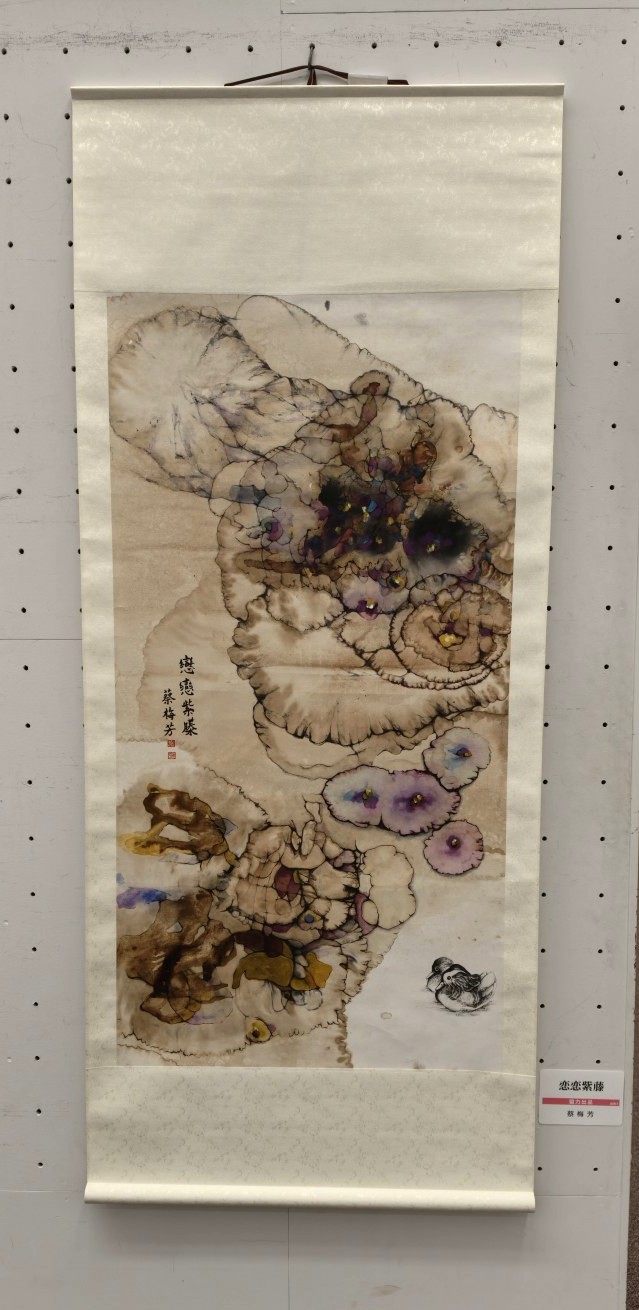
The Ghost of Deconstruction and Original Form Speaking purely in terms of form, Longing for Wisteria is clearly no longer a traditional floral sketch. The forms within the frame do not reproduce the original hanging structure of wisteria; there are no complete floral spikes, no clear nodes of vines, and no recognizable realistic inflorescences. Instead, there is a large, spreading mass of color ink—smudged, engulfing one another, with blurred boundaries yet containing a subtle rhythm. The interweaving of brown, ochre, tea brown, pale purple, blue-gray, and localized gold forms an ambiguous image that hovers between floral shadows, geological strata, atmospheric clouds, and biological tissues. This treatment ensures that the "wisteria" is no longer viewed as an object to be faithfully copied, but rather as a morphological memory that constantly demands to be reunited even after being dismantled.
However, what is truly noteworthy is not the extent to which the work has been deconstructed, but rather: even when deconstructed, the original form remains. It no longer appears in its complete state but lingers in the painting like a ghost. The layers of interdependent, overlapping, and intertwining circular spots and flower-like edges make it impossible to completely forget that "the wisteria was once connected in clusters." In other words, deconstruction has not destroyed the original form; rather, it allows the original form to be perceived in a subtler, deeper way. It is like a figure that occupies the mind even more intensely after it disappears—an absent image that wields more power than a present one.
The most intriguing aspect here is that the conflict between creation and memory is not an either/or choice: it is not that the author wants to deconstruct while memory opposes it. Rather, the act of deconstruction itself awakens the memory. The original, complete form of the wisteria might simply have been a familiarity during sketch painting; but once it is dismantled, twisted, and targeted for alteration, the attachment deeply buried in visual experience becomes all the more apparent. Thus, the artwork is not only a formal exploration but also a spiritual testimony: the things that are truly difficult to bid farewell to are never felt when they exist in their original state, but rather after they are forced to leave the stage.
In this sense, Longing for Wisteria carries an aura akin to a "philosophy of parting." Your association with the song "Yearning Always Begins After Parting" is no coincidence; it profoundly reveals the emotional mechanism of the work: yearning truly takes shape only when the wisteria is no longer maintained in its original state. When the flower is reconstructed, that posture of tightly knit clusters emerges in the heart much more clearly than before. This mechanism of "truly seeing only after losing" is the emotional undertone of this work.
Derrida: Trace and Différance To find philosophical language for this state of "the original form being absent yet still active," Jacques Derrida undoubtedly offers a highly precise pathway. Derrida's concept of the "trace" is never a simple residue, but a profound paradox: although something is no longer present, it still constitutes the present through its very absence. In other words, meaning is not solidly supported by a purely present center, but is established through delay, difference, and residue.
Viewed from this perspective, the original form of the wisteria in Longing for Wisteria exists exactly as a "trace." It no longer appears as a complete floral cluster, yet it permeates the entire canvas:
- In the interdependent relationships of the layered masses,
- In the arc-like outer edges,
- In the hints of a flower core formed by pale purple and gold dots,
- In the vertical visual movement that suggests a downward droop.
The wisteria is absent, yet it is everywhere. It is like a demolished structure whose residual tremors still govern the new composition. That is to say, the more the artist tries to push the work toward a different style, the more the original form seeps in through ways that cannot be directly controlled. This is exactly what Derrida calls différance: meaning is never fully delivered in the present; it is always deferred through difference, and manifests within that deferral.
Therefore, the deconstruction in Longing for Wisteria is not a destruction, but a revelation. It reveals that the wisteria was never merely an external visual object, but a structure that has entered somatic memory and creative gestures. It has been dismantled, but cannot be canceled; it has been abstracted, but has not withdrawn. This implies that "deconstruction" here is not a negation, but a more honest acknowledgment—an acknowledgment that our relationship with certain images is far deeper than we realized.
A Derridean reading also elevates this work beyond the level of a mere "abstract flower." It allows us to see that abstraction is not the erasure of the figurative, but rather allowing the figurative to remain present as a trace. In this way, every brown haloed edge and incomplete floral shape in the artwork is not just form, but the différance of the original form: it is not the original wisteria cluster, yet it never truly stops pointing toward it for a single moment.
Bergson and Proust: The Duration of Memory If Derrida helps us understand "how the original form exists as a trace," then Henri Bergson and Marcel Proust better help us understand why this trace possesses such temporal depth.
Bergson's distinction between "mechanical time" and "duration" (durée) provides an excellent explanatory framework for this work. The original morphology of the wisteria—blooming, falling, hanging, withering—might just be stages in a plant’s life cycle if viewed through natural time; however, in creation and memory, the wisteria no longer belongs to clock time but enters duration. It is no longer a past visual object, but an experience that continuously permeates, superimposes, and returns within consciousness. This kind of time does not "pass"; it is carried along, repeatedly felt, and summoned back time and again.
Longing for Wisteria is exactly the visualization of this duration. The floral shadows in the image do not look like they are happening right before our eyes, but rather seem to have slowly precipitated within memory. They are not fresh, immediately recognizable flowers, but bear the oxidized hues of time: brown, ochre, smoky brown, subtle purple, dark blue—like layers of color left behind after the flowers have been steeped in the passage of years. These colors give the artwork a crucial sense of time: it is not the time of full bloom, but the time of recollection; not the present moment of the flower itself, but the internal time that continues to operate after the flower has gone.
Here, Proust is particularly relevant. Proust makes us understand that some of the deepest memories are not retrieved through active recall, but are suddenly reopened through a sensory trigger—a scent, a melody, a patch of light, the reunion with a shape. For Tsai Mei-Fang, the wisteria is clearly no longer just a flower, but a mnemonic core capable of summoning an entire emotional structure. When the author manipulates those rhythms of clinging clusters anew during deconstruction, the melody of that song surfaces, and emotion is no longer just an appendage of form, but becomes the core of the structure. That is to say, this work does not start with form and then attach emotion to it; quite the opposite, the deformation of form itself is the condition for emotion to be summoned back.
Therefore, what Longing for Wisteria paints is not just wisteria, but how memory continues to expand itself even after separation. The reason yearning arrives late is not because it is tardy, but because it is only after the original form is no longer attainable that consciousness truly begins to realize how deeply attached it was to that image. This makes the "longing" (戀戀) in the title not just a lyrical theme, but a highly precise temporal adjective: it describes not the love of the present moment, but the temporal viscosity that continuously extends even after departure.
Color Ink, Contingency, and the Shared Field of Becoming If the previous sections primarily dealt with memory and philosophy, the final section must return to the medium of color ink itself. Longing for Wisteria succeeds not merely because it "has a theme that can be philosophically explained," but more so because it genuinely achieves a generative writing through its medium.
The extensive washes, feathery edges, contours naturally pushed by watermarks, and the effects of color layers invading, coexisting, and stagnating with one another all demonstrate that this painting is not the result of a single will exercising strict control. Rather, it is a field jointly formed by the artist, pigment, paper, water, time, contingency, and gesture. This point is crucial. When the artist claims she wants to deconstruct and rebuild the wisteria, what actually participates in this rebuilding is not only subjective intention but also the agency of the color ink materials themselves.
When Deleuze speaks of "becoming," he often emphasizes that becoming is not a simple substitution of A for B, but a continuous transformation occurring in a middle zone: it is not "becoming something," but "being in the process of becoming." Tsai Mei-Fang's color ink is exactly this middle zone. The flower is not stably presented as a flower, nor does the abstraction completely sever ties with the flower; color blocks are not pure blocks, lines are not distinct lines—they are always mutually transforming within a state of becoming. This elevates the entire work from merely "expressing wisteria" to ushering the wisteria into a more fundamental state: the flower is no longer an object, but an event.
Gaston Bachelard's concept of the material imagination also comes into play here. Bachelard reminds us that materials are not passive, empty vessels carrying concepts; the materials themselves possess the power to guide the imagination. The reason Tsai Mei-Fang's color ink is so suited for addressing "longing" and "return" is precisely because the nature of color ink is not steely clarity, but seeping, flowing, bleeding, retaining, sinking, and floating. These material characteristics are inherently closer to the workings of memory than any rigid outline. Memory is never a straight, complete, and precisely controllable line; it often behaves like color ink: it continues to seep where you thought it would stop, it leaves a dark edge where you thought it had dried, and when you intend to depict one thing, it inadvertently calls back a much older shadow.
Thus, the true brilliance of Longing for Wisteria lies not just in the painter's subjective desire to deconstruct, but in the objective establishment of a "shared field" within the work: a field co-generated by memory, medium, contingency, and gesture. This prevents the work from falling into purely conceptual formal experimentation, and also prevents it from being merely nostalgically lyrical. It is both a becoming and a testimony; a creation and a summoning. In other words, the artwork is not the author unilaterally saying "This is how I will paint the wisteria," but rather, during the creative process, the author, the memory of the wisteria, the temperament of the color ink, and the accidental watermarks collectively negotiate to achieve this final appearance.
What is Truly Unforgettable is Not What Remains Before Our Eyes Ultimately, the reason Tsai Mei-Fang's Longing for Wisteria is so moving is not whether it retains the typical morphology of wisteria, but that it honestly reveals one thing: truly unforgettable things do not leave when you decide to leave them; they merely change the way they return. The original form may no longer be complete, but it will scatter throughout the new structure in the form of traces; memory may not be replicated intact, but it will glow anew in the edges of colors, rhythms, and ink washes. Thus, deconstruction is no longer merely dismantling, but becomes a deeper way of seeing: seeing how lost things continue their lives in forms, seeing how yearning acquires its language only after separation, and seeing how a flower is no longer just a flower, but becomes time, trace, and the return itself.
To summarize in one sentence, what this work depicts is not actually wisteria, but rather: how a person only truly begins to see the deep relationship between themselves and a beloved object when attempting to leave it.
Tsai Mei-Fang's Longing for Wisteria is not a representation of the wisteria's original form, but a color ink artwork about "how the original form returns as a trace after deconstruction." Woven with brown, ochre, smoky ink, pale purple, and localized blue-gray, the image forms a smudged and organic structure, transforming the wisteria from a concrete floral cluster into a fluid morphology of memory and yearning. Viewed through Derrida's "trace" and "différance," the original form, though dismantled, has not disappeared, but governs the new composition through its absence. The duration and the return of memory revealed by Bergson and Proust further propel this work beyond floral formal experimentation, turning it into a visual writing about loss, return, and internal time. Overall, what Longing for Wisteria truly depicts is not a flower in full bloom, but the shapes of emotion that refuse to depart even after deconstruction.