蒼翠的紀念碑:評王穆提《聖境・阿里山》
摘要
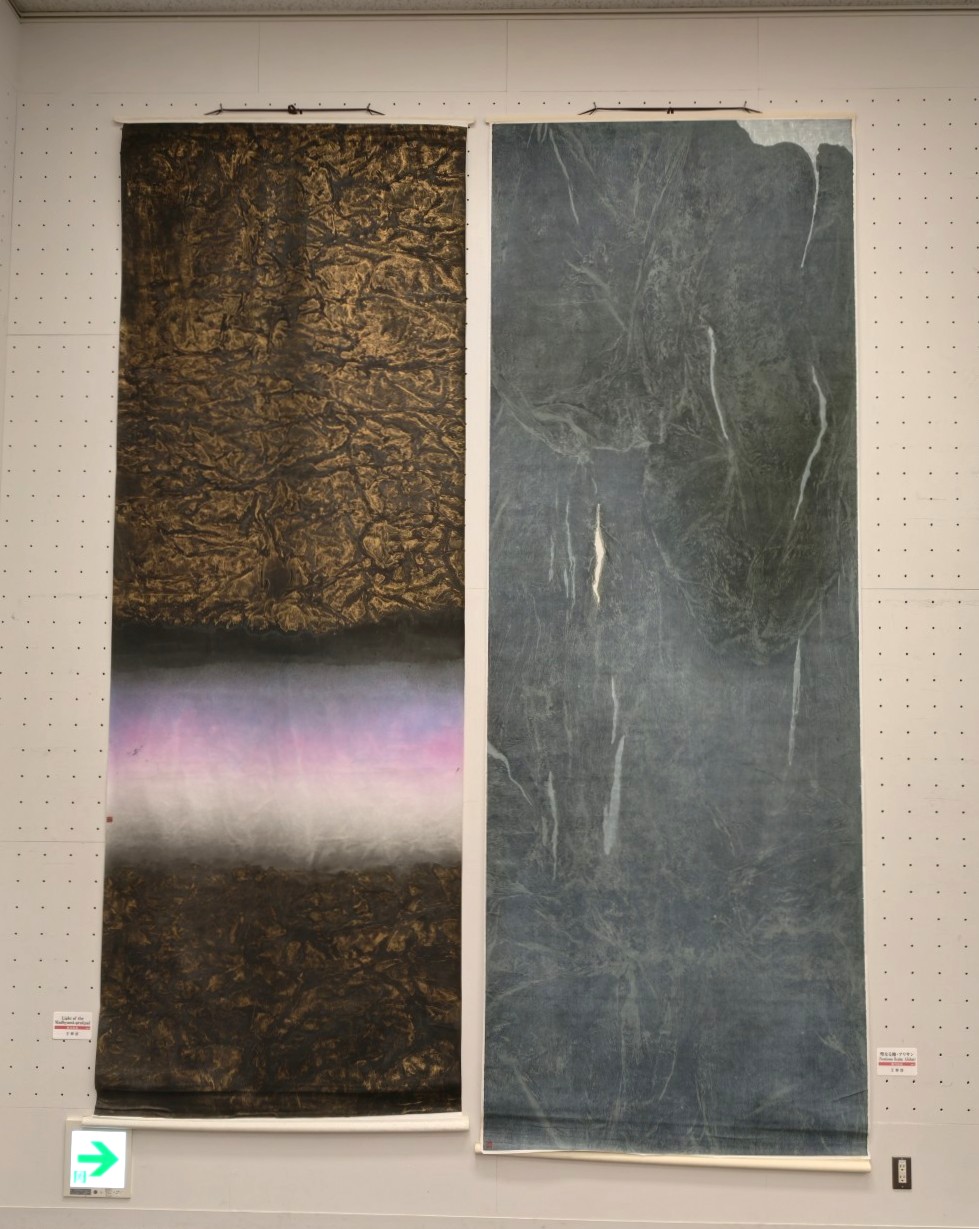
王穆提的《聖境・阿里山》是一件體量巨大的當代水墨裝置繪畫。藝術家在長達399公分的日本大畫仙紙上,運用水墨與壓克力顏料的交融,重塑了台灣阿里山的森林意象。不同於傳統山水畫對「景」的描繪,本作更傾向於對「境」的提煉。畫面中深邃的礦物綠與墨色交織,如同千年的苔蘚或神木的樹皮,白色的裂紋則如閃電般貫穿其中。本文將探討該作如何透過材質的滲透與堆疊、色彩的心理暗示,以及巨大的垂直尺度,重新定義山水畫中的「崇高感」(The Sublime),並將阿里山轉化為一個精神性的朝聖符號。
作品名稱:〈聖境・阿里山〉
作品規格:寬度142x長度399cm
媒材:大畫仙紙(小津和紙出品)、水墨、壓克力顏料
年代:2025/11/17
垂直的在場——尺幅與身體現象學
面對《聖境・阿里山》,觀者首先感受到的並非圖像的內容,而是其物理尺度的壓迫感。寬142公分、長399公分的垂直卷軸,這是一個超越了常規室內展示極限的尺寸。
仰望的現象學
399公分的高度意味著這件作品是一個需要「仰望」的對象。在人類的視覺經驗中,仰望通常與「神聖」、「高不可攀」或「敬畏」相關聯(如仰望大教堂的穹頂或高聳的神木)。王穆提利用這個尺度,迫使觀者在作品前調整身體姿態。我們無法像閱讀手卷那樣俯視與把玩,只能謙卑地站在這面巨大的「綠色牆壁」面前。
這種觀看方式讓繪畫具有了建築性。它不再是掛在牆上的一幅畫,而是成為了空間中的一根支柱,或者說,一棵在展廳中生長的「神木」。這種「頂天立地」的構圖,直接呼應了阿里山神木群的物理特徵,將自然的偉大轉化為藝術展場中的崇高體驗。
無盡的垂直性
與傳統立軸山水通常包含「高遠、深遠、平遠」三種視角不同,本作呈現出一種「絕對的垂直性」。畫面上沒有明顯的地平線,也沒有透視的消失點。它像是一個從無限高處截取的切片,或者是一個無限延伸的特寫。觀者的視線被迫沿著那些白色的紋理上下游移,這種視覺運動模擬了攀登或墜落的動態感受,強化了自然的不可掌控性。
紙的呼吸——大畫仙紙與媒材的交響
媒材的選擇是本作的靈魂所在。藝術家特意選用了「大畫仙紙(小津和紙出品)」,這顯示了其對底材物性的極致追求。
纖維的記憶與承載
小津和紙(Ozu Washi)以其纖維的韌性與吸水性聞名。在《聖境・阿里山》中,這張巨大的紙張承受了水墨的滲透與壓克力的覆蓋,卻依然保持了「呼吸感」。
畫面中的肌理並非簡單的筆觸描繪,更像是經過了「揉、折、染、拓」等物理介入手段。紙張在藝術家的操作下,形成了一種如同岩石表面或老樹皮般的褶皺。這些褶皺不是畫出來的,而是紙張纖維在吸收了顏料與水分後,乾燥收縮形成的物理記憶。這種處理方式讓二維的繪畫產生了三維的微觀地形,觀者彷彿能觸摸到阿里山那潮濕、粗糙的質地。
墨與壓克力的共生
王穆提在這裡進行了一場關於「水與膠」的實驗。水墨代表著東方的靈動與滲透,壓克力則代表著西方的覆蓋與物質感。在畫面中,深沉的墨色作為底色,奠定了厚重的基調;而帶有礦物感的綠色壓克力則在表面形成了斑駁的色層。
兩者在特製的畫仙紙上產生了奇妙的反應:壓克力沒有完全覆蓋水墨,水墨也沒有完全吞噬壓克力。它們相互交融,形成了一種渾濁卻深邃的質感,極好地模擬了森林中那種光線難以穿透、充滿水氣與苔蘚的複雜生態。
時間的顏色——礦物綠與深淵黑
色彩是《聖境・阿里山》最直接的情感載體。藝術家摒棄了明信片式的藍天白雲,轉而挖掘阿里山深處的色彩基因。
蒼古之綠(Archaic Green)
佔據畫面主體的是一種難以定義的綠色。它不是春天的嫩綠,也不是夏天的翠綠,而是一種混合了青灰、深藍與墨黑的「蒼綠」。
這種色彩讓人聯想到孔雀石、青銅器上的銅鏽,或是深山中終年不見陽光的苔蘚。這是一種代表「時間」的顏色。它暗示了古老、沈寂與緩慢的生長。在心理學上,這種深邃的綠色能引發觀者內心的平靜,同時也帶有一絲對於未知深淵的恐懼。王穆提精準地捕捉到了阿里山神木林那種「時間凝固」的色彩氛圍。
白色的裂隙(The White Fissures)
在深沈的綠黑色調中,分布著幾條醒目的白色線條。它們或垂直、或傾斜,如同閃電劃過夜空,又如同老樹表皮的裂紋,甚至是山體滑坡後的痕跡。
這些白色線條在形式上起到了「破」的作用,打破了整塊深色的沈悶,為畫面引入了光線與動勢。在符號學上,它們可以被解讀為自然的能量流動(氣),或者是神性的顯現。正如標題「聖境」所示,這些光痕或許象徵著靈性之光穿透了物質的重重包裹。
微觀與宏觀的辯證——肌理即風景
觀看《聖境・阿里山》存在著一種有趣的視距悖論:遠看是山,近看是壁。
宏觀的崇高
當我們站在遠處觀看這幅近四米的作品時,它呈現為一座巍峨的山體,或者一棵參天的巨木。其整體氣勢展現了北宋山水畫中「巨碑式」(Monumental)的傳統——山水不是可遊可居的園林,而是令人敬畏的宇宙秩序。
微觀的宇宙
然而,當我們走近作品,宏觀的形象解體了,取而代之的是豐富的微觀細節。我們會看到紙張纖維的糾結、顏料的沉積、水痕的邊緣。這些微小的肌理本身就構成了一個個獨立的抽象世界。
藝術家通過這種處理,暗示了「一沙一世界,一葉一菩提」的東方哲學。阿里山的聖境不僅在於其巨大的山體,更在於每一寸苔蘚、每一塊樹皮的微觀紋理之中。
精神地理學——從風景到聖境
作品標題為《聖境・阿里山》,這表明藝術家的意圖不在於寫生,而在於造境。
去地標化的風景
畫面上沒有阿里山小火車,沒有雲海日出的具象描繪,也沒有明顯的姐妹潭或神木標識。王穆提剝離了所有旅遊明信片式的符號,只保留了阿里山的「氣質」。
這是一種「去地標化」的處理。通過抽象化,藝術家將具體的阿里山昇華為一個普遍的「聖境」符號。這個聖境是關於自然的原始力量,關於生命的堅韌,以及人類面對偉大自然時的謙卑。
萬物有靈的碑石
這幅畫本身就像是一塊立在展廳中的碑石。它沈默、厚重、充滿歷史感。在台灣的文化語境中,阿里山的神木往往被賦予神格。王穆提的這件作品,就像是為這些神木立像。他用繪畫的方式,重現了那種走入千年檜木林時,空氣突然凝結、聲音消失、只剩下心跳與呼吸的宗教般體驗。
藝術史的坐標——物質性水墨的探索
將王穆提的《聖境・阿里山》置於當代藝術的脈絡中,我們可以清晰地看到其座標。
後水墨的物質轉向
傳統水墨重「寫意」,強調筆墨的書法性趣味。而王穆提的作品則屬於「後水墨」或「物質性水墨」。他更關注媒材本身的物質屬性(Materiality)。他讓紙張說話,讓顏料堆疊,讓肌理成為主角。這種做法與西方二戰後的物質繪畫(Matter Painting,如塔皮埃斯)有異曲同工之妙,但其內核依然是東方的自然觀。
抽象表現主義的回響
畫面中那種滿幅(All-over)的構圖,以及強烈的情感張力,也讓人聯想到抽象表現主義(如克里夫·斯蒂的色域繪畫)。但不同於西方藝術家強調個人的爆發與宣洩,王穆提的畫面更多了一份東方式的「含蓄」與「積澱」。他的激情是內斂的,被封存在厚重的肌理之下。
凝固的自然史
總結而言,王穆提的《聖境・阿里山》是一件極具震撼力的傑作。
藝術家以399公分的宏大尺幅,挑戰了觀者的視覺極限與身體經驗。他透過對大畫仙紙特性的精準掌握,以及水墨與壓克力顏料的創新結合,成功地將阿里山的自然景觀轉化為一種純粹的精神體驗。
畫面中那深邃的蒼綠色調與斑駁的肌理,彷彿是阿里山地質與植被的拓片,記錄了千萬年的風雨與生長。這不是一幅關於風景的畫,而是一座關於時間與生命的紀念碑。面對這件作品,我們彷彿能聽到森林深處的呼吸,感受到大地的脈搏。
王穆提以《聖境・阿里山》證明了,當代水墨依然具有處理宏大敘事與崇高美學的能力。他為我們提供了一個通道,讓我們在喧囂的現代生活中,得以瞬間穿越,回到那個古老、靜謐且充滿神性的自然聖境。
其他相關內容:
【現場直擊】【台日交流展】東京都美術館開館100周年記念《第14回東京現展》展場:日本國立東京都美術館
台灣參展藝術家作品藝術評論
東京都美術館開館100周年記念【14回東京現展】廖純沂〈未盡・浮境〉未盡之物何以最能久留人心
東京都美術館開館100周年記念【14回東京現展】廖純沂〈游相〉花何以不止於花,與形相如何在漂游中成立
東京都美術館開館100周年記念【14回東京現展】廖純沂〈思域・沉靜〉沉靜何以不是空,與垂掛之物何以最像思念
東京都美術館開館100周年記念【14回東京現展】王詮富〈八月閑步一色秋〉的季節哲學、門徑意識與水墨的開敞性 在黑暗中閑步:秋色如何不是顏色,而是一種存在的轉身
東京都美術館開館100周年記念【14回東京現展】 王詮富〈一念菩提開翠微〉的開顯、同體、綿延與空性 一念未起,萬根已動
東京都美術館開館100周年記念【14回東京現展】蔡梅芳〈戀戀紫藤〉的痕跡、綿延與生成 花影之遲遲不散,與記憶如何在解構之後重返
東京都美術館開館100周年記念【14回東京現展】 王穆提《聖境・阿里山》蒼翠的紀念碑
東京都美術館開館100周年記念【14回東京現展】王穆提《中道之光》裂隙中的永恆
東京都美術館開館100周年記念【14回東京現展】吳心荷〈散落骨骼(一)〉散落之骨,與人之未能完全集成於自身
東京都美術館開館100周年記念【14回東京現展】陳福祺〈咖啡心音〉的存在寓言 沸點、晶化與心之熔爐
東京都美術館開館100周年記念【14回東京現展】張素蘭〈一棵開花的樹〉的場所哲學、過程生命與靜默中的新生
東京都美術館開館100周年記念【14回東京現展】吳亞倫〈藍與黑的交響詩(雙併)〉論藍何以不只為藍,黑何以不只為黑
東京都美術館開館100周年記念【14回東京現展】張碧鄉〈艷冠群芳〉的器物哲學、生成美學與過剩的顯現
東京都美術館開館100周年記念【14回東京現展】趙玉燕〈熾烈〉論火中的身體,與人何以不能只是自己
東京都美術館開館100周年記念【14回東京現展】許秀珠〈403地震後的太魯閣〉山川之裂,與人如何在震後重新學會自身的位置
東京都美術館開館100周年記念【14回東京現展】江麗香〈秋聲賦〉彩墨中的時間書寫 水痕與秋聲
東京都美術館開館100周年記念【14回東京現展】江麗香〈流轉的歲月〉水之無言,而歲月常藉其形以自見
東京都美術館開館100周年記念【14回東京現展】謝文倩〈驚夢〉的夢之碎片、感覺邏輯與夜的顯現
東京都美術館開館100周年記念【第14回東京現展】黃淑卿〈群鷗處處來(台灣澎湖)〉群鷗之所以來,與人終於學會不把世界全算作自己
東京都美術館開館100周年記念【14回東京現展】黃淑卿〈燕尾與戴勝(台灣金門)〉論屋脊、禽鳥與地方何以不只是地理
東京都美術館開館100周年記念【14回東京現展】謝正瑜〈蓮池映相〉的感知哲學與靈性空間
東京都美術館開館100周年記念【14回東京現展】周若梅〈流光之舞〉,光何以有身,與人如何在流動中暫時成形
Written by WANG MUTI
Artwork Information
Title: Numinous Realm: Alishan
Dimensions: 142 (W) × 399 (L) cm
Medium: Daisen paper (produced by Ozu Washi), ink, acrylic paint
Year: November 17, 2025
Abstract
Wang Muti’s Numinous Realm: Alishan is a contemporary ink installation painting of colossal volume. On a sheet of Japanese Daisen paper measuring 399 centimeters in length, the artist utilizes the fusion of ink and acrylic paint to reconstruct the forest imagery of Alishan, Taiwan. Unlike traditional landscape painting, which focuses on depicting "scenery" (景, jing), this work leans heavily toward the distillation of a "realm" (境, jing). The interweaving of profound mineral green and ink black on the canvas resembles millennia-old moss or the bark of sacred trees, while white fissures cut through it like lightning. This essay will explore how the artwork redefines the "Sublime" in landscape painting and transforms Alishan into a spiritual symbol of pilgrimage through the permeation and accumulation of materials, the psychological suggestion of color, and its staggering vertical scale.
Vertical Presence: Scale and Bodily Phenomenology
Facing Numinous Realm: Alishan, what the viewer first experiences is not the content of the image, but the oppressive weight of its physical scale. A vertical scroll measuring 142 centimeters in width and 399 centimeters in length—this is a dimension that transcends the limits of conventional indoor display.
The Phenomenology of Looking Up
A height of 399 centimeters signifies that this artwork is an object that demands to be "looked up to." In human visual experience, looking upward is typically associated with the "sacred," the "unattainable," or "reverence" (such as gazing up at the dome of a cathedral or a towering ancient tree). Wang Muti utilizes this scale to force viewers to adjust their bodily posture before the artwork. We cannot look down and examine it playfully as we would a handscroll; we can only stand humbly before this massive "green wall."
This mode of viewing endows the painting with an architectural quality. It is no longer merely a painting hung on a wall; it has become a supporting pillar within the space, or rather, a "sacred tree" growing inside the exhibition hall. This "heaven-reaching and earth-standing" composition directly echoes the physical characteristics of Alishan's sacred tree clusters, translating the grandeur of nature into an experience of the sublime within an art space.
Endless Verticality
Unlike traditional vertical scroll landscapes, which typically encompass the three perspectives of "high distance, deep distance, and level distance" (gaoyuan, shenyuan, pingyuan), this work presents an "absolute verticality." There is no obvious horizon on the canvas, nor is there a vanishing point of perspective. It resembles a cross-section extracted from an infinite height, or an infinitely extending close-up. The viewer’s gaze is forced to wander up and down along those white textures; this visual movement simulates the dynamic sensation of climbing or falling, intensifying the uncontrollability of nature.
The Breathing of Paper: A Symphony of Daisen Paper and Medium
The choice of medium is the very soul of this work. The artist deliberately selected "Daisen paper (produced by Ozu Washi)," demonstrating his ultimate pursuit of the physical properties of the substrate.
The Memory and Bearing of Fibers
Ozu Washi is renowned for the resilience and absorbency of its fibers. In Numinous Realm: Alishan, this massive sheet of paper endures the permeation of ink and the covering of acrylic, yet it still maintains a "sense of breathing."
The textures on the canvas are not simple brushstrokes; they appear more like the results of physical interventions such as "crumpling, folding, dyeing, and rubbing" (拓, tuo). Under the artist's manipulation, the paper forms folds resembling the surface of rocks or the bark of old trees. These folds are not painted on; they are the physical memory formed by the drying and shrinking of the paper's fibers after absorbing pigment and moisture. This treatment generates a three-dimensional microscopic topography upon a two-dimensional painting, making the viewer feel as though they can reach out and touch the damp, coarse texture of Alishan.
The Symbiosis of Ink and Acrylic
Here, Wang Muti conducts an experiment concerning "water and polymer." Ink represents Eastern fluidity and permeation, while acrylic represents Western covering and materiality. In the painting, the profound black of the ink serves as the base color, establishing a heavy, solemn tone; meanwhile, the mineral-like green acrylic forms mottled color layers on the surface.
The two produce a marvelous reaction on the specially crafted Daisen paper: the acrylic does not entirely cover the ink, and the ink does not completely swallow the acrylic. They intermingle to form a turbid yet profound texture, perfectly simulating the complex ecology of a forest where light struggles to penetrate—a realm saturated with moisture and moss.
The Colors of Time: Mineral Green and Abyssal Black
Color is the most direct emotional carrier in Numinous Realm: Alishan. The artist abandons postcard-like blue skies and white clouds, opting instead to unearth the chromatic DNA hidden deep within Alishan.
Archaic Green
Occupying the main body of the canvas is an undefinable green. It is not the tender green of spring, nor the emerald green of summer, but an "archaic green" that mixes cyan-grey, deep blue, and ink black.
This color evokes malachite, the patina on ancient bronze vessels, or the moss deep in the mountains that never sees the sun year-round. It is a color that represents "time." It implies antiquity, profound silence, and slow growth. Psychologically, this abyssal green induces a sense of inner peace in the viewer, while simultaneously carrying a trace of fear toward the unknown abyss. Wang Muti has accurately captured the "time-frozen" chromatic atmosphere of Alishan's sacred forests.
The White Fissures
Scattered across the deep green-black tones are several striking white lines. They run vertically or diagonally, like lightning slashing through the night sky, like cracks in the bark of ancient trees, or even like the scars left by a landslide.
Formally, these white lines play the role of "breaking" (破, po), shattering the oppressiveness of the solid dark mass and introducing light and kinetic momentum to the canvas. Semiologically, they can be interpreted as the flow of natural energy (qi), or as a manifestation of the divine. Just as the title "Numinous Realm" suggests, these traces of light perhaps symbolize spiritual illumination piercing through the heavy wrappings of matter.
The Dialectic of Micro and Macro: Texture as Landscape
There exists an intriguing paradox of viewing distance when observing Numinous Realm: Alishan: from afar it is a mountain; up close it is a wall.
The Macroscopic Sublime
When we stand at a distance to view this nearly four-meter-tall work, it presents itself as a towering mountain mass or a giant tree touching the sky. Its overall momentum displays the "Monumental" tradition of Northern Song landscape painting—where mountains and rivers are not merely gardens for wandering and dwelling, but an awe-inspiring cosmic order.
The Microscopic Universe
However, as we approach the artwork, the macroscopic image disintegrates, replaced by a wealth of microscopic details. We see the tangling of paper fibers, the sedimentation of pigments, and the edges of watermarks. These minuscule textures inherently constitute independent abstract worlds of their own.
Through this treatment, the artist alludes to the Eastern philosophy of "To see a world in a grain of sand, and a Bodhi in a single leaf." The numinous realm of Alishan lies not only in its massive mountain body, but also within the microscopic textures of every inch of moss and every piece of bark.
Spiritual Geography: From Landscape to Numinous Realm
The artwork is titled Numinous Realm: Alishan, indicating that the artist's intention is not to sketch a physical location, but to forge a spiritual realm.
A De-landmarkized Landscape
There is no Alishan forest railway on the canvas, no figurative depiction of the sea of clouds or the sunrise, and no obvious markers of the Sister Ponds or the sacred trees. Wang Muti strips away all the tourist-postcard symbols, retaining only the "temperament" of Alishan.
This is a "de-landmarkized" treatment. Through abstraction, the artist sublimates the concrete Alishan into a universal symbol of a "numinous realm." This sacred space speaks of the primordial power of nature, the resilience of life, and the humility of humanity in the face of nature's grandeur.
An Animistic Stele
The painting itself resembles a stone stele erected in the exhibition hall. It is silent, heavy, and full of historical weight. Within the cultural context of Taiwan, the sacred trees of Alishan are often endowed with divine personhood. Wang Muti’s work acts as a monument to these sacred trees. Through painting, he recreates that religious-like experience of walking into a thousand-year-old cypress forest: where the air suddenly congeals, sound vanishes, and nothing remains but the heartbeat and breath.
Coordinates in Art History: The Exploration of Material Ink Art
By placing Wang Muti’s Numinous Realm: Alishan within the lineage of contemporary art, we can clearly identify its coordinates.
The Material Turn of Post-Ink Art
Traditional ink painting emphasizes "expressing the spirit" (xieyi), focusing on the calligraphic flavor of brush and ink. Wang Muti’s work, however, belongs to "Post-Ink" or "Material Ink Art." He focuses far more on the "Materiality" of the medium itself. He lets the paper speak, lets the pigments accumulate, and makes texture the protagonist. This approach shares a similar underlying concept with post-WWII Western Matter Painting (such as Antoni Tàpies), yet its inner core remains firmly rooted in an Eastern view of nature.
Echoes of Abstract Expressionism
The "All-over" composition of the canvas and its intense emotional tension also bring Abstract Expressionism to mind (such as the color-field paintings of Clyfford Still). But unlike Western artists who emphasize personal explosion and catharsis, Wang Muti’s canvas carries an additional layer of Eastern "subtlety" and "sedimentation." His passion is introverted, sealed beneath heavy textures.
Conclusion: A Frozen Natural History
In summary, Wang Muti’s Numinous Realm: Alishan is a masterpiece of profound impact.
With a grand scale of 399 centimeters, the artist challenges the viewer's visual limits and bodily experience. Through his precise mastery of the characteristics of Daisen paper and the innovative integration of ink and acrylic paint, he successfully translates the natural landscape of Alishan into a purely spiritual experience.
The deep, archaic green tones and mottled textures in the painting seem like rubbings of Alishan's geology and vegetation, recording millions of years of wind, rain, and growth. This is not a painting about a landscape; it is a monument to time and life. Facing this artwork, it is as if we can hear the breathing deep within the forest and feel the pulse of the earth.
With Numinous Realm: Alishan, Wang Muti proves that contemporary ink art still possesses the capacity to handle grand narratives and sublime aesthetics. He provides us with a portal, allowing us, amidst the clamor of modern life, to instantaneously traverse time and return to that ancient, tranquil, and deeply divine natural sanctuary.
蒼翠のモニュメント(記念碑):王穆提(ワン・ムーティ)《聖境・阿里山》に寄せて
執筆:王穆提(ワン・ムーティ)
作品情報
作品名:〈聖境・阿里山〉(Numinous Realm: Alishan)
サイズ:幅 142 × 長さ 399 cm
素材:大画仙紙(小津和紙製)、水墨、アクリル絵具
制作年:2025年11月17日
摘要(アブストラクト)
王穆提の《聖境・阿里山》は、巨大なボリューム(体積感)を持つ現代水墨インスタレーション絵画である。芸術家は、長さ399センチにも及ぶ日本産の大画仙紙の上に、水墨とアクリル絵具の交融を駆使して、台湾・阿里山(ありさん)の森のイマージュを再構築した。伝統的な山水画における「景(風景)」の描写とは異なり、本作は「境(精神的な世界観)」の抽出(蒸留)へと強く傾倒している。画面の中で深く沈み込むような鉱物緑(ミネラルグリーン)と墨色が交織し、それは千年の苔、あるいは神木(ご神木)の樹皮のようであり、その中を稲妻のように貫く白色の裂け目が存在する。本稿では、本作が材質の浸透と堆積、色彩の心理的暗示、そして巨大な垂直のスケールを通じて、山水画における「崇高感(The Sublime)」をいかに再定義し、阿里山を精神的な巡礼のシンボル(聖境)へと転化させているかを探求する。
垂直の現前(プレゼンス)——スケールと身体の現象学
《聖境・阿里山》を前にして、鑑賞者が最初に感じるのは図像の内容ではなく、その物理的スケールがもたらす圧迫感である。幅142センチ、長さ399センチの垂直の巻物(ロール)。これは通常の室内展示の限界を超越したサイズである。
仰ぎ見る現象学
399センチという高さは、この作品が「仰ぎ見る」ことを要求する対象であることを意味している。人間の視覚経験において、上方を見上げることは通常、「神聖さ」「手の届かない高み」あるいは「畏敬の念」(例えば、大聖堂のドームやそびえ立つ神木を見上げるような感覚)と結びついている。王穆提はこのスケールを利用し、作品の前に立つ鑑賞者に身体の姿勢を調整するよう強制する。私たちは画巻(絵巻物)を読むように見下ろして玩味することはできず、ただこの巨大な「緑の壁」の前に謙虚に立つことしかできないのだ。
このような観照の在り方は、絵画に建築的な性質をもたらしている。それはもはや壁に掛けられた一枚の絵ではなく、空間の中の「支柱」となり、あるいは展示室の中で成長する「一本の神木」となったのである。この「天地を突く(頂天立地)」構図は、阿里山の神木群の物理的特徴と直接的に呼応し、自然の偉大さをアートスペースにおける崇高な体験へと転化させている。
終わりのない垂直性
伝統的な立軸(掛け軸)の山水画が通常「高遠・深遠・平遠」という三つの視点(三遠法)を包含するのとは異なり、本作は一種の「絶対的な垂直性」を提示している。画面には明確な地平線もなければ、透視図法(パースペクティブ)の消失点も存在しない。それは無限の高さから切り取られた断層(スライス)のようであり、あるいは無限に延長されたクローズアップのようでもある。鑑賞者の視線は、それらの白いテクスチャに沿って上下に遊動(彷徨うこと)を強いられる。この視覚的運動は、登攀(よじ登ること)や墜落のダイナミックな感覚をシミュレートし、自然の制御不可能性(アンコントローラビリティ)を強調しているのである。
紙の呼吸——大画仙紙と媒材(メディア)の交響
媒材の選択こそが、本作の魂の所在である。芸術家は意図的に「大画仙紙(小津和紙製)」を選用した。これは、支持体(ベース)となる素材の物理的特性(物性)に対する彼の極限の追求を示している。
繊維の記憶と受容(承載)
小津和紙(Ozu Washi)は、その繊維の靭性(しなやかさ)と吸水性の高さで知られている。《聖境・阿里山》において、この巨大な紙は水墨の浸透とアクリルの被覆(カバー)を受け止めながらも、依然として「呼吸感」を保ち続けている。
画面の中のテクスチャ(肌理)は、単純な筆のストロークによる描写ではなく、「揉む、折る、染める、拓本をとる(拓)」といった物理的介入手段を経た結果である。紙は芸術家の操作の下で、岩石の表面や古い樹皮のような褶曲(ひだ)を形成した。これらの褶曲は「描かれた」ものではなく、紙の繊維が顔料と水分を吸収した後、乾燥・収縮することによって形成された「物理的な記憶」なのだ。このような処理方式により、二次元の絵画に三次元のミクロな地形(トポグラフィ)が生まれ、鑑賞者はまるで阿里山のあの湿って粗々しい質感を直に触れられるかのように感じるのである。
墨とアクリルの共生
王穆提はここで、「水と膠(ポリマー)」に関する実験を行っている。水墨は東洋の霊動(生き生きとした動き)と浸透性を代表し、アクリルは西洋の被覆力と物質感を代表している。画面において、深く沈んだ墨色が下地として重厚な基調を定め、その一方で、鉱物的な感覚を帯びた緑色のアクリルが表面に斑(まだら)な色層を形成している。
この二つは、特製の大画仙紙の上で奇妙な化学反応を起こした。アクリルは水墨を完全に覆い隠すことはなく、水墨もアクリルを完全に呑み込むことはない。それらは互いに交じり合い(交融し)、混濁しながらも深遠な質感(テクスチャ)を形成し、光が透過しにくく、水気と苔に満ちた森の複雑な生態系を見事にシミュレートしているのである。
時間の色彩——鉱物緑と深淵の黒
色彩は、《聖境・阿里山》における最も直接的な感情のキャリア(器)である。芸術家は絵葉書的な青空と白雲を排し、代わりに阿里山の深部に隠された「色彩のDNA(遺伝子)」を発掘することへと向かった。
蒼古の緑(Archaic Green)
画面の主体を占めているのは、定義困難な緑色である。それは春の若緑でも、夏の翠緑でもなく、青灰、深藍(ディープブルー)、そして墨黒が混合された「蒼緑」なのだ。
このような色彩は、孔雀石(マラカイト)、青銅器の緑青(パティナ)、あるいは深山において一年中太陽の光を見ることのない苔を連想させる。これは「時間」を代表する色である。それは古(いにしえ)、静寂、そして緩慢な成長を暗示している。心理学的に言えば、この深遠な緑色は鑑賞者の内面に平穏をもたらすと同時に、未知の深淵に対する一抹の恐怖(畏れ)をも引き起こす。王穆提は、阿里山の神木林が持つあの「時間が凝固したような」色彩の空気感を、極めて正確に捉えているのである。
白色の裂け目(The White Fissures)
深く沈んだ緑黒色のトーンの中に、幾本かの目を引く白い線が分布している。それらは垂直に、あるいは斜めに走り、夜空を切り裂く稲妻のようでもあり、老樹の表皮の亀裂のようでもあり、さらには山崩れの後の傷痕のようでもある。
これらの白い線は、形式上「破(打ち破ること)」の役割を果たし、暗色の塊の重苦しさを打ち破って、画面に光と動勢(ダイナミズム)を導入している。記号学的に言えば、それらは自然のエネルギーの流動(「気」)、あるいは神性の顕現として解読することができる。「聖境(神聖なる領域)」というタイトルが示す通り、これらの光の痕跡は、霊的な光が物質の重厚な包囲を貫通したことを象徴しているのかもしれない。
微視と巨視の弁証法——テクスチャ(肌理)としての風景
《聖境・阿里山》を観る際、そこには視距離に関する興味深いパラドックスが存在する。——遠くから見れば山であり、近くから見れば壁である。
巨視的な崇高
私たちが離れた場所からこの4メートル近い作品を観るとき、それは巍然(ぎぜん)とそびえ立つ山体、あるいは天を突く巨木として立ち現れる。その全体的な気勢(ダイナミズム)は、北宋の山水画における「巨碑式(Monumental)」の伝統——山水は遊覧し居住するための庭園ではなく、畏敬の念を起こさせる宇宙の秩序であるという思想——を提示している。
微視的な宇宙
しかし、私たちが作品に近づくと、巨視的なイメージは解体され、代わりに豊かな微視的(ミクロ)なディテールが立ち現れる。私たちは紙の繊維の絡み合い、顔料の沈殿、そして水痕の境界(エッジ)を目にするだろう。これらの微小なテクスチャそれ自体が、一つ一つの独立した抽象的な世界を構成しているのである。
芸術家はこのような処理を通じて、「一砂一世界、一葉一菩提(一粒の砂に世界を見、一枚の葉に悟りを見る)」という東洋哲学を暗示している。阿里山の聖境は、その巨大な山体だけにあるのではなく、一寸の苔、一片の樹皮のミクロな紋理(テクスチャ)の中にこそ存在しているのだ。
精神地理学——風景から聖境へ
作品のタイトルは《聖境・阿里山》である。これは、芸術家の意図が「写生(風景を写し取ること)」にあるのではなく、「造境(精神的境地を創出すること)」にあることを明確に示している。
脱ランドマーク化された風景
画面には阿里山森林鉄道(小火車)もなく、雲海や日の出の具象的な描写もなく、姐妹潭(姉妹池)や神木の明確なシンボルもない。王穆提はすべての観光絵葉書的な記号を剥ぎ取り、阿里山の「気質」だけを保留したのである。
これは「脱ランドマーク化」の処理である。抽象化を通じて、芸術家は具体的な阿里山を、普遍的な「聖境」のシンボルへと昇華させた。この聖境は、自然の原始的な力について、生命の強靭さについて、そして偉大なる自然に直面した時の人間の謙虚さについて語りかけている。
アニミズム(万物有霊)の石碑
この画自体が、展示室の中に立てられた一つの石碑のようである。それは沈黙し、重厚で、歴史感に満ちている。台湾の文化的な文脈(コンテクスト)において、阿里山の神木にはしばしば神格が与えられる。王穆提のこの作品は、まるでこれらの神木のために立てられた偶像(肖像)のようである。彼は絵画という手法を用いて、千年のヒノキの森に足を踏み入れたとき、空気が突如として凝結し、音が消え、ただ自分の心音と呼吸だけが残されるような、あの宗教的な体験を再現したのである。
美術史の座標——物質的水墨の探求
王穆提の《聖境・阿里山》を現代アートの脈絡に置くことで、私たちはその座標を明確に確認することができる。
ポスト水墨の物質的転回(マテリアル・ターン)
伝統的な水墨画は「写意(精神性を写すこと)」を重んじ、筆墨の書法的な趣(筆致)を強調する。対して王穆提の作品は、「ポスト水墨」あるいは「物質的水墨」に属している。彼は媒材そのものの物質的属性(マテリアリティ)にさらに関心を向けている。彼は紙に語らせ、顔料を堆積させ、テクスチャを主人公にする。このアプローチは、第二次世界大戦後の西洋のアンフォルメルや物質の絵画(Matter Painting、例えばアントニ・タピエスなど)と通底する(異曲同工の)妙を持っているが、その内なる核(コア)は依然として東洋の自然観に根ざしている。
抽象表現主義の反響(エコー)
画面におけるオールオーバー(All-over/画面全体を均質に覆う)な構図と、強烈な感情的張力は、抽象表現主義(例えばクリフォード・スティルのカラーフィールド・ペインティングなど)をも連想させる。しかし、個人的な爆発や感情の吐露(カタルシス)を強調する西洋の芸術家とは異なり、王穆提の画面には東洋的な「含蓄」と「沈殿」が多く備わっている。彼の情熱は内向的であり、重厚なテクスチャの下に封印されているのである。
結論:凝固した自然史
総結するならば、王穆提の《聖境・阿里山》は極めて強い衝撃力を持つ傑作である。
芸術家は399センチという壮大なスケールをもって、鑑賞者の視覚の限界と身体経験に挑戦した。彼は大画仙紙の特性に対する精確な掌握と、水墨とアクリル絵具の革新的な結合を通じて、阿里山の自然景観を純粋な精神的体験へと転化させることに成功した。
画面におけるあの深遠な蒼緑色のトーンと斑(まだら)なテクスチャは、さながら阿里山の地質と植生の拓本(フロッタージュ)のようであり、千万年の風雨と成長を記録している。これは風景に関する画ではなく、時間と生命に関する「記念碑(モニュメント)」なのだ。この作品の前に立つと、私たちはまるで森の奥深くの呼吸を聴き、大地の脈動(パルス)を感じ取れるかのようである。
王穆提は《聖境・阿里山》によって、現代水墨が今なお壮大な物語(グランド・ナラティブ)と崇高の美学を処理する能力を備えていることを証明した。彼は私たちに一つの通路(ポータル)を提供し、喧騒に満ちた現代生活の中で、瞬時に時空を超え、あの古(いにしえ)の、静謐で、神性に満ちた自然の聖境へと帰還することを可能にしたのである。