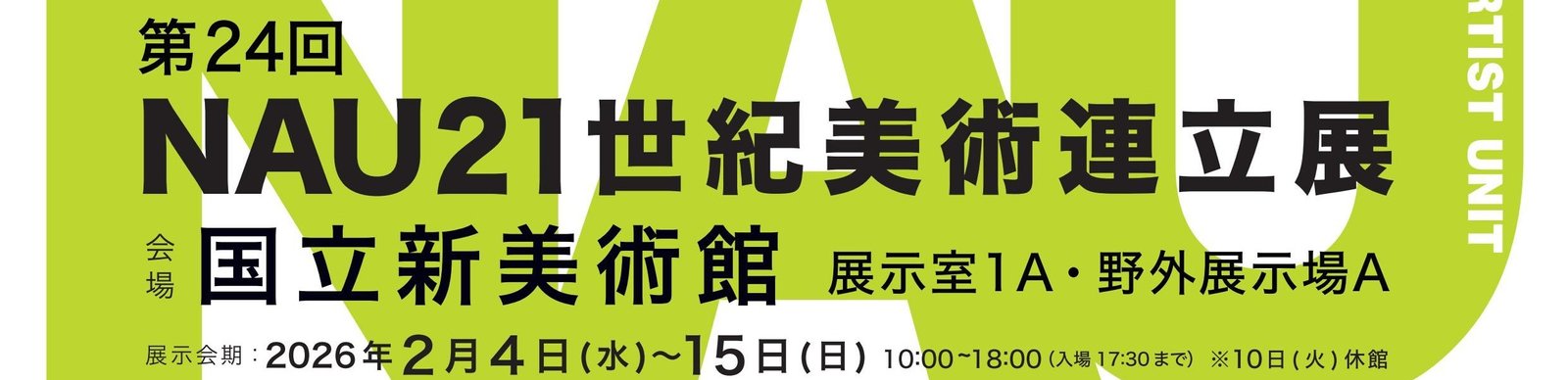
The 24th NAU 21st Century Art Joint Exhibition: Introduction of Participating Members and Affiliated Art Groups
【I. Curatorial Statement & Philosophy】
NAU History & Philosophy: From Atomized Individuals to Rhizomatic Unity
Entering the 21st century, art is no longer an isolated ivory tower but an organic network of lateral connections. Since its inception, NAU (New Art Unite / 21st Century Art Joint Exhibition) has attempted to respond to the "Vertical Society" structure that has long ossified the Japanese post-war art scene. Traditional public exhibition systems are often trapped in master-apprentice hierarchies and strict review classes, which limit the most precious qualities of contemporary art—free will and heterogeneous dialogue1.
The concept of "Unite / Renritsu" proposed by NAU is a radical ecological experiment that echoes Gilles Deleuze's theory of the "Rhizome." It advocates for "horizontal connection" across disciplines, borders, and generations while retaining the artist's "Ontological Independence." Here, the spirituality of avant-garde calligraphy, the materiality of Fauvist painting, and the virtuality of digital video are no longer mutually exclusive schools, but organic components that jointly constitute the visual landscape of the 21st century2.
The 24th exhibition marks NAU's transformation from a "domestic group exhibition in Japan" to a "Pan-Asian Art Nexus." Through structural alliances with Taiwanese and Korean art groups, NAU is redefining the boundaries of East Asian contemporary art, proving that art can maintain differences within "unity" and generate new meaning within "dialogue"3.
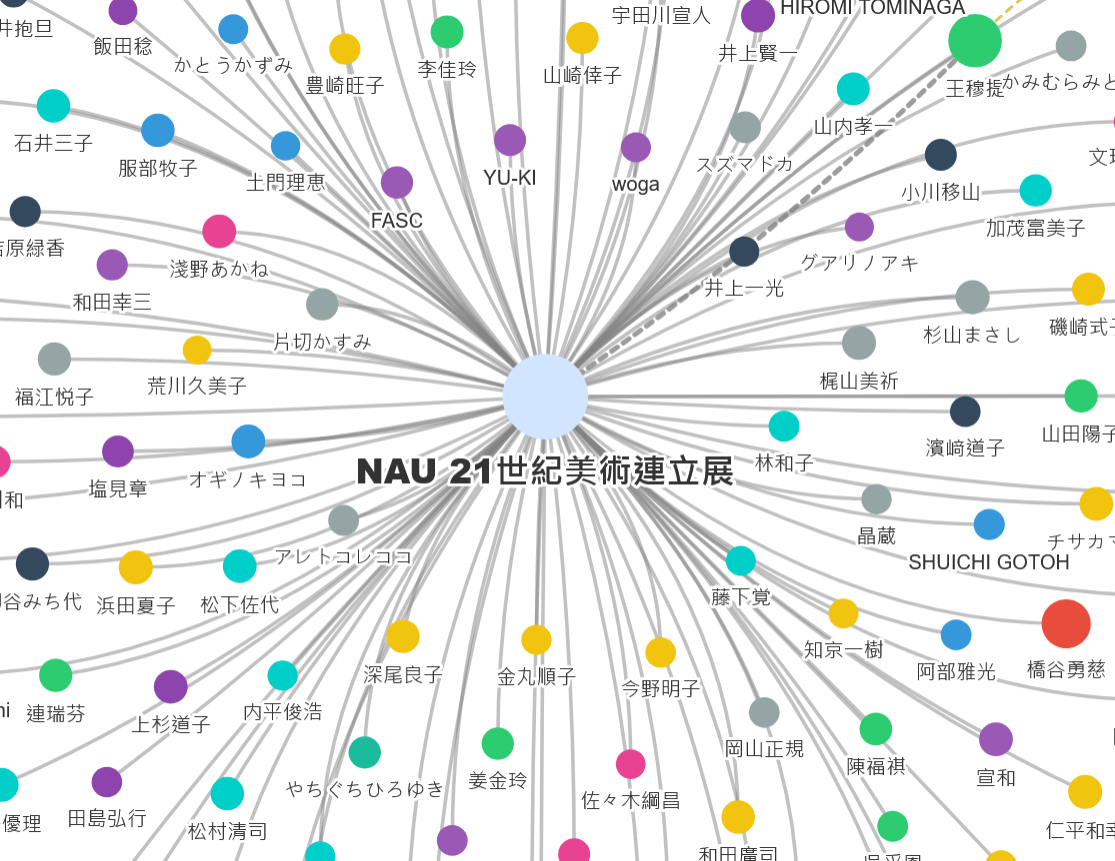
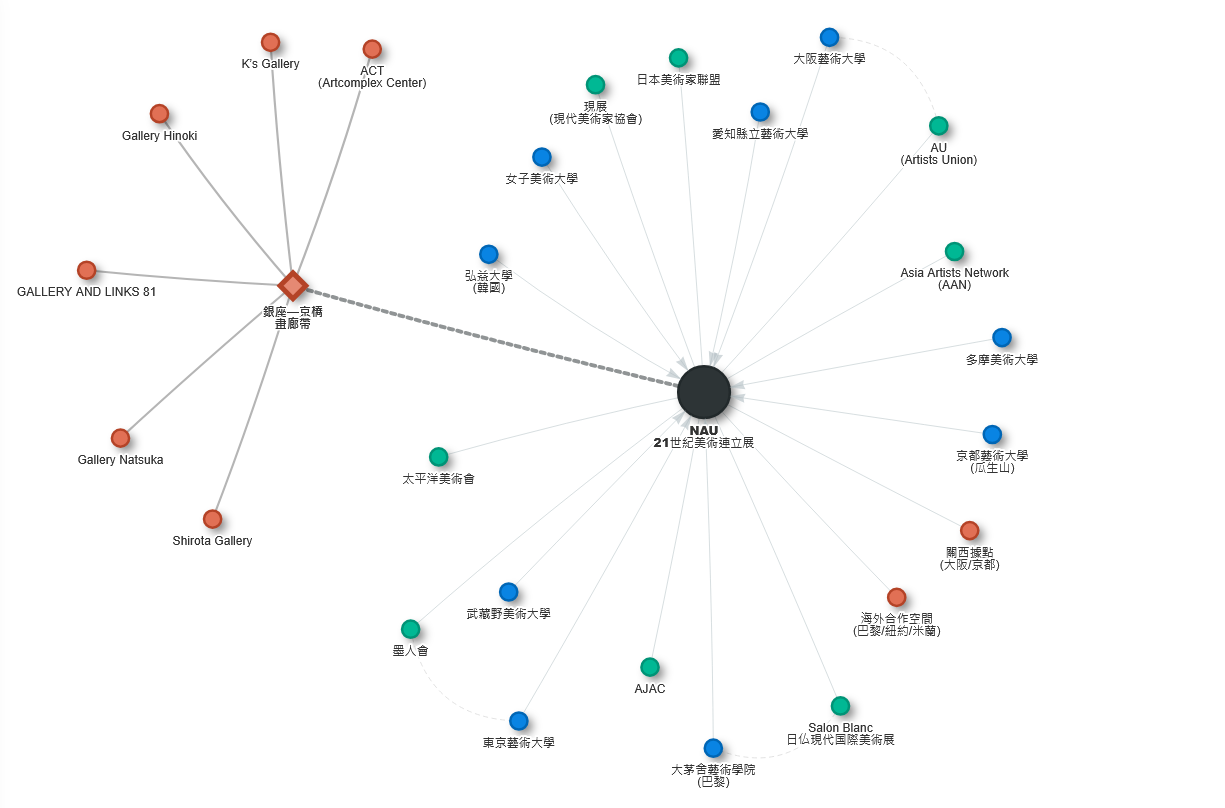
【Web View】The 24th NAU 21st Century Art Joint Exhibition: Interactive Artist Network Map
【II. Venue Significance】
The National Art Center, Tokyo: The Wall-less Cathedral of Dialogue
This exhibition is held at the supreme hall of Japanese art—The National Art Center, Tokyo (NACT)—which carries extremely high symbolic significance4.
Designed by the architectural master Kisho Kurokawa, this art center itself is an embodiment of the philosophy of "Symbiosis." It has no Permanent Collection, meaning it rejects the fixation of history and remains forever open to the "now" of artistic expression. Its immense wavy glass curtain wall and column-free exhibition space provide the perfect stage for NAU's large-scale installations and spatial calligraphy. Exhibiting here means that the participating artists have passed rigorous academic review and entered the formal vision of Japanese contemporary art history. This is not just a display space, but a sacred field that transforms individual creation into "public memory"5.
Analysis and Connection of "Art Groups / Exhibiting Galleries / Academic Spheres" of Participating Artists
I. Methodology and Reading Guide
1) Three-Layer Structure Network Analysis Framework
- Group Layer (G): Centered on NAU (21st Century Art Joint Exhibition), extending outward to Salon Blanc (Japan-France Modern International Art Exhibition), Taiheiyo Art Society, Bokujin-kai, AJAC, Japan Artists Association, Asia Artists Network, AU (Artists Union), GENZAN (Contemporary Art Association), etc.
- Gallery Layer (A): With the Tokyo Ginza-Kyobashi gallery belt as the core node (such as Gallery Hinoki, K’s Gallery, Shirota Gallery, Artcomplex Center of Tokyo (ACT), Gallery Natsuka, GALLERY AND LINKS 81, etc.), extending to cooperative spaces in Yokohama, Nagoya, Kyoto, Osaka, and overseas (Paris, New York, Milan, etc.).
- Academic Layer (S): Centered on Tokyo University of the Arts, Tama Art University, Musashino Art University, Joshibi University of Art and Design, Kyoto University of the Arts, Aichi Prefectural University of the Arts, Osaka University of Arts, Hongik University (Korea), Académie de la Grande Chaumière (France), etc., connecting lineages of mentorship (master-apprentice systems, laboratories) and inter-school interactions (visiting scholars, joint programs, exchange exhibitions).
2) Nodes & Edges
- Nodes: Artists, Groups (Associations/Exhibition Organizations), Galleries (including Museums), Academic Institutions.
- Edges:
- Member/Participating/Awarded (Artist ↔ Group);
- Solo/Joint Exhibition Cooperation (Artist ↔ Gallery/Museum);
- Degree/Mentorship/Research/Lecturer (Artist ↔ Academic Institution);
- Curation/Judging (Artist/Group ↔ Gallery/Museum);
- Cross-national Exchange (Group ↔ Overseas Gallery/Museum/School).
3) How to Read the Network
- Concentric Circles: NAU is the first circle; outward are galleries with high-frequency interaction with NAU (e.g., Hinoki, K’s); the outer circle consists of other groups overlapping with NAU participating artists (e.g., Salon Blanc, Taiheiyo Art Society, Bokujin-kai, GENZAN) and overseas nodes (Paris, New York, Milan).
- Bridge Nodes: Artists capable of connecting multiple layers (e.g., those with NAU membership who are also active in other major groups or overseas platforms), or curator-type artists with strong connections at both academic and exhibition ends.
- Media Communities: Communities of Calligraphy/Ink, Fiber Art, Printmaking, Oil Painting/Abstraction, Ceramics/Sculpture, and Photography forming "Media Networks" at the intersection of galleries and academia.
II. Overview of Core Nodes
(G) Groups and Joint Exhibition Platforms
- NAU (21st Century Art Joint Exhibition): The center of this analysis; a large number of artists participate as NAU members or recommended entrants.
- Salon Blanc (Japan-France Modern International Art Exhibition): Related to French institutions and French Embassy awards; Kuniko Aoki, Hiroko Kuboki, Kiyoshi Monjugawa, Ryokka Yoshihara, etc., intersect with this platform6666666666.
- +3
- Taiheiyo Art Society: One of the origins of Japan's earliest Western-style painting groups; Hiroko Kuboki is an Operating Committee Member/Member/Tokyo Branch Member777.
- +1
- Bokujin-kai: An important source of Japanese post-war modern calligraphy; Hosui and Sawako Watanabe are closely linked to this lineage8888888.
- +2
- GENZAN (Contemporary Art Association): Wang Muti is the Director of the Taiwan Liaison Office; Wu Tsai En was selected for the 81st GENZAN exhibition in 20259.
- Asia Artists Network (AAN): Yoko Yamada is the President; horizontally connecting cooperation within the Asian sphere10.
- AU (Artists Union): Intersects with the projects of Gutai Art founder Shozo Shimamoto; Shigeyoshi Yuzawa, Mayumi Kuwayama, etc., are involved11.
- AJAC, Japan Artists Association: Sasaki Tsunamasa is an AJAC member; multiple artists also interact with the Japan Artists Association1212.
- +1
(A) Galleries and Museums
- Gallery Hinoki (Kyobashi): A core Tokyo gallery node where NAU artists appear with high frequency13.
- K’s Gallery (Ginza): Multiple artists hold annual solo exhibitions here, overlapping with the NAU community14.
- Shirota Gallery (Ginza): Michiko Uesugi, Natsuko Hamada, etc., are active here15.
- Artcomplex Center of Tokyo (ACT): woga, Kengo Watanabe, YU-KI, etc., have exhibited or won awards here1616161616.
- +2
- Gallery Natsuka / GALLERY AND LINKS 81 / Gallery KINGYO / Kosugi Gallery: Typical cooperative nodes between NAU and the metropolitan gallery belt.
- The National Art Center, Tokyo (Roppongi): The main venue for NAU exhibitions; multiple artists also participate in other large public exhibitions or exchange exhibitions here17.
- Overseas Nodes: Paris Galerie Métanoïa, Espace Sorbonne 4; New York The Nippon Gallery, The Nippon Club; Milan M.A.D.S. ART GALLERY; multiple museums and cultural centers in Seoul, etc.181818181818181818.
- +4
(S) Academic Institutions
- Tokyo University of the Arts: Rie Tabata (Lecturer experience/Research), Hajime Tajima/Hiroyuki Tajima/Akira Shiomi (Oil Painting/Printmaking backgrounds); Nobuhito Udagawa (Master's in Art Research)1919191919.
- +2
- Tama Art University: Akiko SIACCA, HIROMI TOMINAGA, Saka Mitsuhiro, etc.202020.
- +2
- Musashino Art University: Hiroko Kuboki, Kobayashi Tetsuro, Rie Tabata, Mana Yamane, etc.212121.
- +1
- Joshibi University of Art and Design: Noriko Isozaki, Ryoko Fukao, etc.2222.
- +1
- Kyoto University of the Arts (formerly Kyoto University of Art and Design): Akane Asano, Shozo, etc.2323.
- +1
- Aichi Prefectural University of the Arts: YUKIKO (Watercolor League exhibition history), Tomoko Hariya (Seto Ceramics major) related backgrounds24.
- Osaka University of Arts: Rintaro Sekino (Doctoral program in Art Production), etc.25.
- Hongik University (Korea), Ewha Womans University: HOLEE, Hyun-suk Ryu, etc.2626.
- +1
- Académie de la Grande Chaumière (Paris): Hyun-suk Ryu's study abroad background; connecting to the French art education tradition27.
III. Network Structure: "Concentric Circles" and "Bridge Nodes" Departing from NAU
1) Central Circle (NAU Direct Affiliates and High-Frequency Interactors)
- Toshiaki Takahashi (NAU President): As the core figure of the system and exhibition affairs, he is the central hub of the NAU network, extending to the Tokyo Ginza gallery belt, The National Art Center, Tokyo, and other large platforms like NICAF/Taro Okamoto Award for Contemporary Art28.
- Yuji Hashiya (NAU Secretary General): The bridge for gallery cooperation (Hinoki, Natsuka, Seiko Gallery) and overseas exchange (Spain, Japan-Europe)29.
- Junko Kanemaru, Kazuyuki Nihira, Fuka Kanda, Taimaru Suemoto, Noboru Taira, Shiori Takahashi, Makiko Tonuma, Masaya Iwasaki, Sayo Matsushita, Kiyoshi Matsumura, Maho Laplante, Masashi Sugiyama, Rintaro Sekino, Kengo Watanabe, Sawako Watanabe, Nobuyoshi Watanabe, Hiroyuki Yachiguchi, Masami Nomura, Senwa, Yuko Nishida, Chitose Ninomiya, Yoko Yamada etc.: Forming a high-frequency interaction "community core" between NAU and the Ginza-Kyobashi gallery cluster30303030303030303030303030303030303030303030303030303030303030303030303030303030303030.
- +4
2) Bridge Nodes (Key Connectors Across Groups/Transnational Platforms)
- Kuniko Aoki: Linked via Salon Blanc (Japan-France Modern International Art Exhibition) awards (French Embassy Prize, Minister of Education, Culture, Sports, Science and Technology Prize), closely connecting NAU with French platforms31.
- Hiroko Kuboki: Taiheiyo Art Society Operating Committee Member + NAU; and continues to participate in the Tokyo Metropolitan Art Museum and Salon Blanc, connecting the "Japanese Western Painting Tradition Lineage—NAU—France Exchange"32.
- Sawako Watanabe: Former NAU President + Bokujin-kai member; joins NAU with the post-war modern calligraphy source33.
- Mayumi Kuwayama: Osaka University of Arts Fiber + AU/Gutai-related project participation; connecting Kansai Fiber—Gutai Art—Overseas (Milan) Design Week34.
- Shigeyoshi Yuzawa: OBARA Art Institute background + AU participation; connecting NAU with Gutai Art projects and regional institute networks35.
- Hyun-suk Ryu (Korea) / HOLEE (Korea): Korean academic background + Seoul museum cluster + Paris galleries; connecting NAU with both ends of Korea and France3636.
- +1
- Wang Muti (Taiwan): Director of GENZAN Taiwan Liaison Office + NAU's first Taiwanese member; connecting NAU—GENZAN—Taiwanese universities and cultural institutions—Beijing 798 and other media platforms, and strengthening cross-national data and publicity flow through curation and database construction (2,000+ artists)3737.
- +1
- Kiyoshi Monjugawa: Salon Blanc Executive Committee Chairman + Japan Artists Association member; stringing together the institutional and review levels of NAU and Japan-France platforms38.
- Maho Laplante: Art Students League of New York Scholarship + Paris, Tokyo exhibition history; connecting NAU with the US—France education and exhibition chain39.
- Akiko SIACCA: Ginza Gallery President + Contemporary Artist; coupling NAU with the Ginza gallery management network40.
IV. The "Resonance" between the Gallery Belt (Ginza-Kyobashi) and NAU
- Gallery Hinoki (Kyobashi) as a Typical Hub
Many NAU exhibitors have held solo/selection exhibitions at Hinoki for many years (e.g., Taimaru Suemoto, Junko Kanemaru, Fuka Kanda, Tokyo Takashi, Yuji Hashiya, Masaya Iwasaki, Kengo Watanabe, etc.)414141.
Hinoki's curatorial rhythm often resonates before and after the NAU annual exhibition period, forming a dual-track node of "The National Art Center, Tokyo (Joint Exhibition) ↔ Ginza-Kyobashi (Solo/Duo Exhibition)".+2
- K’s Gallery (Ginza)—Annual Solo Exhibition Habit
The stable solo exhibition rhythm of Makiko Tonuma, Hitoshi Suzuki, Ryoko Fukao, Natsuko Hamada at K’s Gallery allows NAU artists to accumulate "continuity of artistic vocabulary" and "familiarity with the collector community" within the same gallery network42.
- Shirota Gallery (Ginza)—Connecting Modern to Contemporary
Long-term interaction of Michiko Uesugi, Natsuko Hamada, Akiko SIACCA, etc., with Shirota contrasts "Ginza's traditional gallery operation methods" with "NAU's contemporary practice"43.
- ACT (Artcomplex Center of Tokyo)—Emerging and Competition Oriented
The exhibition and grand prize mechanisms of woga, YU-KI, Kengo Watanabe, etc., at ACT release an upgrade path of new blood flow (Competition—Joint Exhibition—Solo Exhibition—The National Art Center, Tokyo) for the NAU community444444.+2
V. Academic Sphere—Mutual Amplification of Mentorship Lineages and Exhibition Actions
1) Tokyo University of the Arts (Art Research, Oil Painting, Printmaking)
- Nobuhito Udagawa (Master's in Art Research, Professor Emeritus at Kyushu Sangyo University): Academic duties + International exchange (Visiting at U. Penn), connecting NAU with "Academic Review—International Exhibition Affairs"45.
- Akira Shiomi (Oil Painting Dept; Art Director of MMG Printmaking Workshop): Forming a bridge of "Technical Resources—Exhibition Resources" between the academic technical side (printmaking workshop) and galleries (Kaneko Art Gallery)46.
- Hiroyuki Tajima (Tokyo Geidai Oil Painting—Printmaking Lab): Dual tracks in printmaking and oil painting, providing a case study for NAU's "multi-media coexistence"47.
2) Tama Art University / Musashino Art University—Academic Twin Peaks of the Metropolitan Area
- Akiko SIACCA, HIROMI TOMINAGA, Saka Mitsuhiro, Kobayashi Tetsuro, Rie Tabata, Mana Yamane, etc., closely connect NAU with the "Academic Reproduction Mechanism" through mentorships, alumni exhibitions, and graduate school systems of the two major metropolitan art school systems48484848.
- +1
- Rie Tabata: Doctor of Education + Cross-disciplinary mentorship in calligraphy and abstraction (Seikaku Yonejima, Takuyoshi Kaneko / Steven Cushner), providing a demonstration path for "East-West Media Language Fusion"49494949.
- +1
3) Kyoto School (Kyoto University of the Arts / Kyoto University of Art and Design)—Regional Contemporary Vocabulary
- Akane Asano, Shozo, Aretokorekoko, etc., form a cross-regional gravitational pull of "Regional Art Scene—The National Art Center, Tokyo" between Kyoto-style training and gallery actions (Kyoto Dohjidai, etc.)505050.
- +2
4) Aichi / Osaka School—Reinforcement of Chubu and Kansai
- Rintaro Sekino (Osaka University of Arts Doctoral Program; Shell Art Award Student Special Prize; Art Gate Program Collection), etc., linking paths to corporate collections, auctions, and art fairs (ART OSAKA)51.
- Tomoko Hariya (Seto Ceramics major): Connecting the ceramic workshop system with London and Paris solo exhibitions52.
5) Overseas Academics and Exchange
- Hyun-suk Ryu (Hongik University / Paris La Grande Chaumière): Korea—France—Japan triangular network53.
- HOLEE (Ewha Womans University Western Painting): Crossing lines between the National Museum of Modern and Contemporary Art, Seoul, the French Cultural Center, and Japanese exhibition affairs; directly connecting NAU with Korean institutions54.
- Maho Laplante (Art Students League of New York): US educational resources + interlinked art exhibitions in Tokyo and Paris55.
VI. Media Communities and Cross-Disciplinary Connection
Calligraphy / Ink (Modern Calligraphy)
- Hotan Ishii (Avant-garde Calligrapher; Mainichi Calligraphy Exhibition Judge): Transforming the brush-and-ink aesthetics of "Kanji Calligraphy" into transnational abstract visuals; exporting the modernity of Japanese ink culture to the international stage through exhibition experiences in Italy, Germany, and France56.
- Sawako Watanabe (Bokujin-kai member; Former NAU President): The organizational hub of post-war modern calligraphy sources and NAU, linking the Kyoto—Tokyo ink art circles57.
- Hosui (Bokujin-kai, Bokujin Award): The "Brush and Ink Renewal" of Kyoto Bokujin tradition and NAU contemporary joint exhibitions58.
- Michiyo Yanagiya, Sachiko Yamazaki: Connecting gallery duo exhibitions and regional group exhibitions with brush-and-ink linear aesthetics, forming a "Small Exhibition—Large Exhibition" stepped path5959.
- +1
- Michiko Hamasaki (Calligraphy Dept; Director of Yokohama Museum of Ink): Transnational connection of Calligraphy Museum—Ginza—Overseas cities (Paris, Cannes, London, Warsaw, Spain)60.
- Kazuko Hayashi (BKS Member; Kaleidoscope Art mentorship): Connecting calligraphy, craft aesthetics, and public space display via a "media expansion" interface61.
Fiber / Craft
- Kiyoko Ogino, Naoe Okamoto, Mayumi Kuwayama: Joining "Lifestyle Aesthetics—Contemporary Vocabulary" from university group exhibitions (Yokinami Exhibition) to Taiwan-Japan exchange exhibitions, and then to Milan Design Week, art festivals, and art spaces in large commercial facilities (Takashimaya, Art Galleries)626262.
- +2
- Tomoko Hariya (Seto Ceramics): Connecting ceramic mentorship with London and Paris solo exhibitions, highlighting "Workshop—Gallery—Internationalization"63.
Printmaking / Oil Painting / Abstraction
- Akira Shiomi (Director of Printmaking Workshop): Technical resource center; exhibitions with Kosugi Gallery and Kaneko Art Gallery64.
- Hiroyuki Tajima (Printmaking Lab): Dual-wielding oil painting and printmaking; exhibition practices at Keio Print Salon, Chikyu-do, KINGYO, etc.65.
- Junko Kanemaru, Kazuyuki Nihira, Toshiyo Sato, Kei Shibatani: Aggregating through galleries like Hinoki, AND LINKS 81, Yamate (Yokohama) within abstract vocabulary, forming an "Abstract Community—Ginza Belt"66666666666666.
- +3
Photography / Video
- Tokyo Takashi: International photography competitions such as PX3, IPA, FAPA, London International Creative Competition, Budapest International Foto Awards; connecting NAU with global photography platforms67.
- Masami Nomura: Shaping "Liveness—Abstraction" video aesthetics through cross-media actions of Music—Painting—Live Painting68.
- YU-KI: Photo Communication® Association; exhibitions at Tokyo Daikanyama Space K, RDECO, etc., connecting the photography community with Ginza galleries69.
VII. Prototypes of Transnational Paths
- Paris Axis: Salon Blanc (French Embassy Prize) — Galerie Métanoïa — Espace Sorbonne 4 — La Grande Chaumière (Education)7070707070.
- +2
- New York Axis: The Nippon Gallery / The Nippon Club — Lincoln Center Cork Gallery — Watercolor system of Emerson Umbrella (YUKIKO) — US Jury Scholarship (Maho Laplante)71717171.
- +3
- Seoul Axis: National Museum of Modern and Contemporary Art—French Cultural Center—Multiple Museums (HOLEE, Hyun-suk Ryu)7272.
- +1
- Milan / European Design Week Axis: Mayumi Kuwayama (MILANO GENIUS), M.A.D.S. (Milan, Italy) 7373.
- +1
- Eastern Europe—Central Europe Axis: Masaki Okayama (National Museum in Kraków, Poland; Centre for Contemporary Art Ujazdowski Castle, Warsaw collections)74.
- Hokuriku—Toyama—Hokkaido Regional Axis: Junko Sugano (Toyama exchange) / Aki Guarino (Toyama residency and Etchu Art Festa) / Etsuko Fukue (Hokkaido Art Association—Sapporo, Otaru exhibition affairs)757575.
- +2
VIII. Advanced Insights
- NAU is a structured hub for "Group Exhibition—Solo Exhibition—Academia—Overseas": Through the annual exhibition period at The National Art Center, Tokyo, and the solo exhibition rhythm of the Ginza-Kyobashi gallery belt, it forms "continuity" of artistic vocabulary and "predictability" for audience and collector communities.
- Bridge-type artists determine the extension radius of the network: Kuniko Aoki (French awards), Hiroko Kuboki (Taiheiyo Art Society), Sawako Watanabe (Bokujin-kai), Mayumi Kuwayama (Gutai x Milan), Hyun-suk Ryu/HOLEE (Korea x Paris), and Wang Muti (Taiwan x GENZAN x Media x Database), etc., significantly expand NAU's transnational tentacles.
- Academic systems provide "reproduction" of methods and languages: Tokyo Geidai / Tama / Musashino / Joshibi / Kyoto School / Osaka Geidai etc., allow media and methodologies to be continuously updated at the exhibition site; mentorship chains and workshop systems (such as MMG Printmaking Workshop, OBARA Art Institute) are stable supports for technical resources.
- The intersection of media communities is the future direction: The cross-languages of Calligraphy—Abstraction, Fiber—Gutai, Printmaking—Oil Painting, Photography—Installation are more easily identified and resonated with on overseas platforms, forming expandable narratives.
【IV. Prologue: The Foundations】
2. Toshiaki Takahashi
- Academic Positioning: NAU President / Educator of Spatial Composition 76
- Career Summary: Tokyo Gakugei University Graduate School Painting Laboratory / Taro Okamoto Award for Contemporary Art Exhibition77.
- [Academic Critique]:
- As the helmsman of NAU, Toshiaki Takahashi's work embodies the "rationality" and "structure" unique to the Tokyo Gakugei University lineage. His paintings transcend mere flat decoration, demonstrating an architectural consciousness of spatial composition. He excels at using Color Progression and geometric segmentation to construct deep 3D fields in installation art. His work is not only a visual enjoyment but also a serious academic response to the topic of "how to intervene in space"78.
3. Yuji Hashiya
- Academic Positioning: Integration of Scientific Rationality and Abstract Aesthetics 79
- Career Summary: NAU Secretary General / Nagoya University (Member of Nobel Prize winner Isamu Akasaki's Lab)80.
- [Academic Critique]:
- Yuji Hashiya is a rare "scientist artist" in the contemporary art world. His research background in a Nobel Prize-winning physics team grants his abstract paintings a unique "Algorithmic Aesthetics." His lines and color blocks do not stem from emotional catharsis but follow some internal cosmic order, like crystal structures or circuit matrices. He is the representative of the "Rational Eye" in the NAU exhibition81.
4. Yoko Mitsuyuki
- Academic Positioning: Academic Matriarch of the Kyushu Art Scene 82
- Career Summary: Professor Emeritus, Kyushu Sangyo University / Deputy Representative, Asian International Art Exhibition83.
- [Academic Critique]:
- Holding the exalted academic title of "Professor Emeritus," Yoko Mitsuyuki represents the orthodoxy and heritage of the Japanese Western painting world. Her work demonstrates master-level control—colors are heavy but not stagnant, compositions are grand yet rich in detail. As a leader in art education in the Kyushu region, her paintings reveal deep humanistic care and historical undertones, stabilizing the academic center of gravity of the exhibition84.
5. Nobuhito Udagawa
- Academic Positioning: Local Deepening under International Vision 85
- Career Summary: Professor Emeritus, Kyushu Sangyo University / Director, Fukuoka City Art League / Visiting Scholar, University of Pennsylvania86.
- [Academic Critique]:
- Nobuhito Udagawa's artistic practice crosses the boundaries of East and West. As an administrative core and educator in the Fukuoka art world, his work blends the solid foundation of Japanese Western painting with the compositional logic of Euro-American contemporary art. He is an important pillar for NAU's promotion of the AAN (Asian Artists Network), and his work itself is a medium for cross-cultural communication87.
6. Hiroko Kuboki
- Academic Positioning: Guardian of Century-old Western Painting History 88
- Career Summary: Operating Committee Member, Taiheiyo Art Society / Salon Blanc Exhibitor89.
- [Academic Critique]:
- The Taiheiyo Art Society is Japan's oldest Western painting group (founded in the Meiji era). As its operating committee member, Hiroko Kuboki carries the historical weight of a century of Japanese Western painting. Her work adheres to the "Painterliness" of traditional oil painting, emphasizing the temperature of brushstrokes and the texture of pigments, displaying a classical resilience that transcends trends90.
【Chapter I】 Dialectics of Ink: Space, Gesture, and Deconstruction
Dialectics of Ink: Space, Gesture, and Deconstruction
[Curator's Guide]
This chapter explores the dual paths of "Ink" in contemporary art: one end is Japanese avant-garde calligraphy's "stripping of textual meaning" and "spatial explosion"; the other is Taiwanese contemporary Han ink's "modernization of literati spirit" and "continuity of Qi-Rhyme (cosmic consonance)"91.
【Section 1: Dialogue of the Matriarchs】
7. Sawako Watanabe
- Academic Positioning: Avant-garde Calligraphy Orthodoxy / Cutter of Space 92
- Career Summary: Former NAU President / Bokujin-kai Member / Studied under Nankoku Hidai, Shiryu Morita93.
- [Academic Critique]:
- Sawako Watanabe is a living witness to post-war Japanese avant-garde art history. As a direct descendant of "Bokujin-kai," the core of her creation lies in "Brush Erosion"—the traces of life left after the brush tip fiercely rubs against paper fibers. In her work, the form of Kanji has been thoroughly deconstructed, transformed into pure blocks of black and white energy. Her treatment of space has extreme aggressiveness and architectural sense; ink traces are like lightning striking in the void. This is not static writing, but "Solidified Time" after an instantaneous burst of bodily energy94.
8. LIEN Jui-Fen
- Academic Positioning: Taiwan Calligraphy Leader / Modern Literati Qi-Rhyme 95
- Career Summary: Chairperson, Taiwan Women Calligraphers Association / Chairperson, Danlu Cultural and Educational Foundation96.
- [Academic Critique]:
- If Japanese calligraphy pursues instantaneous explosion, Lien Jui-Fen exhibits "Temporal Duration." As an important leader in the Taiwan calligraphy scene, Lien Jui-Fen has deeply mastered the essence of "Calligraphy Zen" from the Cao Qiu-pu lineage (Danlu); her lines are vigorous and elastic. However, she does not stop at traditional vertical scrolls but boldly introduces the "All-over Composition" and "Aesthetics of Blank Space" of modern painting into calligraphy. Her work demonstrates a unique "Unifying Power"—containing rigorous structural order within seemingly free-spirited running-cursive lines, a perfect fusion of classical cultivation and modern visual language97.
【Section 2: Structure, Dimension & Experiment】
9. Hotan Ishii
- Academic Positioning: 3D Calligraphy / Internationalized Writing Language 98
- Career Summary: Mainichi Calligraphy Exhibition Judge / Active in Italy, Germany, France99.
- [Academic Critique]:
- Hotan Ishii is dedicated to solving a core problem: How to move Western audiences who do not read Kanji with calligraphy? His answer is "Dimensionalization" and "Architecturalization." He views calligraphy lines as beams and columns of architecture, constructing 3D spatial depth on 2D paper. His works have a strong sculptural sense and are a successful model of calligraphy moving towards global contemporary art100.
10. WANG-CHUAN FU
- Academic Positioning: Materiality Experiment of Ink / Academic Newcomer 101
- Career Summary: MFA, Taipei National University of the Arts (TNUA)102.
- [Academic Critique]:
- Wang-Chuan Fu represents the innovative perspective on ink by the young academic generation in Taiwan. He views water and ink as "Material" equal to acrylics and oil paints, rather than just writing tools. He piles, washes, and creates textures on the surface, blurring the boundary between "Calligraphy" and "Painting," exhibiting a visual tension with experimental nature103.
11. CHEN FU-CHI
- Academic Positioning: Crossover of Image and Ink Phenomenon / Writing with the Eye of Photography 104
- Career Summary: President, Taiwan Native Photography Association / President, Wide Angle Photography Association105.
- [Academic Critique]:
- As an important leader in Taiwan's photography world, Chen Fu-Chi is exhibiting "Modern Calligraphy" as a crossover. His writing carries strong image logic: his layout of Kanji structures is like "Framing" and "Composition" in photography, extremely particular about spatial cutting and the contrast between void and solid. This is a unique practice of "moving the brush with the shutter's eye," proving the high interoperability of visual art principles106.
12. Michiko Hamasaki
- Academic Positioning: Cultural Translator of Ink 107
- Career Summary: Director, Yokohama Museum of Ink108.
- [Academic Critique]:
- Michiko Hamasaki's work possesses an elegant "Fluidity." She knows deeply how to translate Eastern "Linear Aesthetics" for the Western world. Her creation focuses on the rich variations within a single stroke—from the scorching of thick ink to the haloing of pale ink, revealing a microcosmic universe where water and ink blend on paper109.
13. Hosui
- Academic Positioning: Osmology of Paper and Ink 110
- Career Summary: Member of Bokujin-kai111.
- [Academic Critique]:
- As a member of Bokujin-kai, Hosui focuses on the process of "Osmosis." The work presents how ink slowly erodes and blooms into the paper fibers over time. This is an extremely introspective creation, inviting the audience to experience a quiet Eastern meditation112.
14. Chun-Yi Liau
- Academic Positioning: Modern Literati Painting of Confucian Doctor Tradition / Healing Ink 113
- Career Summary: PhD, Chung Shan Medical University / Active in International Calligraphy and Painting Exhibitions114.
- [Academic Critique]:
- Chun-Yi Liau continues the "Confucian Doctor" tradition, choosing figurative "Ink Painting" as a medium for self-cultivation. Between the brush and ink flows the benevolence and peace unique to a healer. He does not pursue strange compositions but constructs landscape imagery full of humanistic breath through the gradations of ink, providing a classical and stabilizing force in the exhibition hall115.
15. Jinling Jiang
- Academic Positioning: Fusion of Gouache and Ink 116
- Career Summary: Major in Gouache Painting, Tunghai University / Studied under Chiang I-Han117.
- [Academic Critique]:
- Jinling Jiang's work integrates the agility of Taiwanese ink with the heaviness of Japanese Gouache (Mineral Pigment). With the background of studying under modern ink master Chiang I-Han, her work adds a shimmering texture of mineral pigments and color layers beyond the charm of ink, displaying a modern literati style that transcends media118.
16. Michiyo Yanagiya
- Academic Positioning: Musicality of Lines 119
- Career Summary: Contemporary Ink and Writing120.
- [Academic Critique]:
- Yanagiya's work emphasizes the rhythm and musicality of lines. She breaks the structural constraints of Kanji, letting lines dance freely in space. Her works often carry a light rhythm, like a solidified musical melody, displaying the pure formal beauty of contemporary writing after shedding its semantic function121.
17. Koho Kurihara
- Academic Positioning: Calligraphy Diplomat 122
- Career Summary: JIAS Member / Belgium-Netherlands Art Award Exhibition Excellence Award123.
- [Academic Critique]:
- Committed to the "Internationalization" of calligraphy. Kurihara knows how to adjust the visual language of brush and ink to transcend the semantic barriers of text, transforming it into abstract line art understandable to Western audiences, a highly communicative modern calligraphic art124.
18. Ikko Inoue
- Academic Positioning: Artistic Transformation of Philology 125
- Career Summary: Director, Jito Character Research Institute / Fukuoka Culture Award126.
- [Academic Critique]:
- Ikko Inoue is not only a calligrapher but also a philologist. He restores "Oracle Bone Script/Bronze Script" to primitive magical symbols; his work possesses strong pictographic nature and mystery, a "Scholar's Calligraphy" of extreme academic depth127.
19. Izan Ogawa
- Academic Positioning: Performance Calligraphy and Expression Education 128
- Career Summary: Peninsula Hotel Collection129.
- [Academic Critique]:
- Izan Ogawa defines calligraphy as "Expression Education" and "Performance Art." His work emphasizes the performative nature and bodily intervention during the writing process, attempting to radiate the energy of calligraphy into public space, with majestic momentum130.
20. Ryokka Yoshihara
- Academic Positioning: Eclectic Japanese-Western Calligraphy and Painting 131
- Career Summary: Japan-France Modern Art World Exhibition Excellence Award132.
- [Academic Critique]:
- Ryokka Yoshihara successfully harmonizes Eastern brush lines with Western color composition on canvas, creating a cross-cultural visual language and displaying the aesthetic height of "Japanese-Western Eclecticism"133.
21. Rie Tabata
- Academic Positioning: Unity of Theory and Practice 134
- Career Summary: Doctor of Education135.
- [Academic Critique]:
- Combining Eastern calligraphy and American abstract painting, Rie Tabata's work is the practice of her aesthetic theory, conducting rational East-West fusion on canvas, demonstrating the rigor and cross-cultural vision of an academic researcher136.
【Chapter II】 The Materiality of Painting: From Impasto Passion to Rational Abstraction
The Materiality of Painting: From Impasto Passion to Rational Abstraction
[Curator's Guide]
In the contemporary era flooded with Screen Images, what is the ontological significance of painting? NAU's answer is: "The Restoration of Materiality"137.
This chapter presents two extremes of painting as a material practice. One end is the "Expressionist Lineage" inheriting Japanese Western painting history, emphasizing Fauvist color explosions and bodily brushstrokes; the other end is the "Rational Abstraction Lineage" active in Tokyo contemporary galleries, emphasizing the accumulation of time, physical thickness of pigment, and calm construction of geometric structures138.
【Section 1: Passion & Life —— The Expressionist Lineage】
22. Hiromi Tsuten Sakurai
- Academic Positioning: The Flame of Japanese Fauvism / Haptic Visuality 139
- Career Summary: Independent Art Association Associate Member / Studied under Kanjiro Ikeshima140.
- [Academic Critique]:
- Since its founding in the 1930s, the "Independent Art Association" has been the bastion of Japanese "Fauvism." Hiromi Tsuten Sakurai's work perfectly inherits this bloodline. She rejects naturalistic reproduction of color, pursuing instead the "Emotional Truth" of color. On her canvas, paint is not applied flatly but piled up and impacted. Those burning reds and deep blacks constitute a strong visual contrast. This "Impasto" grants the image powerful sculptural sense, as if to break through the limitations of the 2D plane, striking the viewer's retina directly and evoking a "Haptic Visuality"141.
23. Noriko Isozaki
- Academic Positioning: Weaver of Light and Color / Visual Pleasure 142
- Career Summary: Ichiyo-kai Painting Department Committee Member / Joshibi University of Art and Design / Ichiyo Prize143.
- [Academic Critique]:
- Noriko Isozaki's work demonstrates the aesthetic tradition unique to "Ichiyo-kai"—the ultimate pursuit of harmony between light, shadow, and color. She excels at using fragmented brushstrokes to weave countless tones into a flowing spectrum, like the Impressionist capture of light, but with more modern decorativeness. Her images often overflow with a warm "Visual Pleasure," without abstruse conceptual preaching, only pure color rhythmically moving in space, an antidote to contemporary indifference and alienation144.
24. Kazuyuki Nihira
- Academic Positioning: Geology of Time / Material Accumulation 145
- Career Summary: NAU Full Member / Gallery Hinoki Annual Selection Exhibition146.
- [Academic Critique]:
- Kazuyuki Nihira's painting is a physical presentation of "time." He does not depict figurations on canvas but performs endless piling and scraping of pigment. Viewing his work up close reveals a surface full of textures and cracks like geological faults. This "Materiality" is the most powerful weapon against the flattening of digital images, inviting the viewer to engage in an archaeological gaze147.
25. Junko Kanemaru
- Academic Positioning: Translation of Inner Landscapes 148
- Career Summary: NAU Full Member / Regular at The National Art Center, Tokyo149.
- [Academic Critique]:
- Junko Kanemaru's creation has long focused on "Inner Landscapes" and "Rhythm of Light and Shadow." She is a representative figure in the contemporary Japanese abstract art scene who can elegantly combine materiality and spirituality. Her works exhibited at The National Art Center, Tokyo, often trigger deep resonance in viewers with delicate color layers, displaying extremely high visual completion and poetic atmosphere150.
26. Tetsuro Kobayashi
- Academic Positioning: Social Expressionism 151
- Career Summary: Musashino Art University / Dokuritsu Bijutsu / JAALA International Exchange Exhibition152.
- [Academic Critique]:
- Tetsuro Kobayashi's brushstrokes carry a coarse primitive power. Combined with his JAALA (Japan Asia Africa Latin America Solidarity) background, his works often imply concern for social reality or the human condition. He does not embellish the roughness of his strokes; this "Non-finito" (unfinished quality) instead enhances the authenticity and force of the image, a practice of painting as a tool for social voice153.
27. Maho Laplante
- Academic Positioning: Direct Descendant of the New York School / Action Painting 154
- Career Summary: Art Students League of New York Scholarship / Lincoln Center Exhibition155.
- [Academic Critique]:
- Maho Laplante’s work brings viewers back to the golden age of New York Abstract Expressionism.
Her paintings emphasize “action,” with the canvas serving as a field that records the movements of her body.
The drips, splashes, and scratches of paint preserve the sense of speed and chance present at the very moment of creation.
This distinctly American spirit of freedom and exuberance forms a compelling contrast with the reserved aesthetics of traditional Japanese art.
28. Ryoko Fukao
- Academic Positioning: Layers of Mental Landscapes 157
- Career Summary: Joshibi University of Art and Design / Ibaraki Prefectural Exhibition Special Prize / Shinsho Exhibition Association Prize158.
- [Academic Critique]:
- Ryoko Fukao is a powerhouse from Joshibi University of Art and Design. Her work displays the sensibility and resilience unique to female artists. Rich in color layers, she excels at capturing fleeting changes of light and shadow in nature and transforming them into inner mental landscapes. Her award history at "Shinsho Exhibition" proves her modeling ability to navigate effortlessly between figurative and semi-abstract159.
29. Okiko Toyosaki
- Academic Positioning: Purity of Painting 160
- Career Summary: Member of Japan Artists Association / Solo Exhibition at Ginza O Gallery161.
- [Academic Critique]:
- Okiko Toyosaki is active in spaces like Ginza O Gallery that value "Painterliness." Her work does not rely on spectacle but returns to the basic elements of painting—balance of color, composition, and brushstroke. Her paintings often carry layers of accumulated thickness, displaying the solid foundation of mid-career Japanese painters and persistence in the ontology of painting162.
【Section 2: Reason & Sediment —— The Material Abstraction Lineage】
30. Hiroshi Wada
- Academic Positioning: Geometric Order of the City / Cold Abstraction 163
- Career Summary: Active at Gallery Hinoki / Contemporary Artist164.
- [Academic Critique]:
- Hiroshi Wada's work is an abstraction of modern urban experience. He utilizes horizontal and vertical lines to construct a rigorous "Grid System." This calm geometric composition eliminates superfluous emotional release, leaving only pure structure and order. His paintings are like blueprints of modernist architecture, displaying the intellectual beauty of "Cool Abstraction," a projection of scientific thinking onto art165.
31. Noboru Taira
- Academic Positioning: Organic Forms of the Microscopic World 166
- Career Summary: Collected by The National Art Center, Tokyo / Ginza Kobayashi Gallery167.
- [Academic Critique]:
- Noboru Taira is a powerhouse painter receiving attention from the National Art Center system. The feature of his work lies in extremely high completion and a delicate microscopic perspective. He often creates a bewildering sense of space on the canvas, with rich and subtle color layers, as if exploring the cellular structures of organic beings or cosmic nebulas. The quiet temperament of his work gives it extremely high collection value, belonging to the "enduring" class of classic contemporary painting168.
32. HOLEE
- Academic Positioning: Spirituality of Dansaekhwa / Korean-French Hybrid Aesthetics 169
- Career Summary: Ewha Womans University (Korea) / La Grande Chaumière (France) / Solo Exhibition at The National Art Center, Tokyo170.
- [Academic Critique]:
- HOLEE's work is a contemporary continuation of the spirit of Korean "Dansaekhwa" (Monochrome Painting). She achieves a state of asceticism through the repetitive application of a single color. However, her background studying in France gives her a more layered sense of color, not as austere as traditional monochrome painting, but carrying the poetry of lyrical abstraction. Her work provides a quiet "Breathing Space" in the exhibition hall, allowing the audience's vision to rest amidst the noise171.
33. Natsuko Hamada
- Academic Positioning: Inheritor of Lyrical Abstraction 172
- Career Summary: Tokyo University of the Arts (Studied under Kazu Wakita) / Tsubaki Modern Gallery173.
- [Academic Critique]:
- Natsuko Hamada studied under lyrical abstraction master Kazu Wakita, inheriting that warmth and poetry. Her color usage is soft and musical, demonstrating the deep color cultivation of the Oil Painting Department at Tokyo Geidai. The blurred boundaries and haloing in the image are like afterimages of memory, evoking nostalgia for lost time in the viewer174.
34. Yoko Kozai
- Academic Positioning: Cross-disciplinary Dialogue of Contemporary Art 175
- Career Summary: Active in Roppongi Art Circle / Gallery Hinoki176.
- [Academic Critique]:
- Yoko Kozai has long promoted cross-disciplinary dialogue in contemporary art. Her work forms are flexible, not adhering to a single style, focusing on the rhythm of color, form, and composition. In exhibitions at Gallery Hinoki, she displays a delicate and introspective visual language, emphasizing the perceptual resonance between viewer and work177.
35. Fuka Kanda
- Academic Positioning: Exploration of Linear Aesthetics 178
- Career Summary: Calligraphy Education Society background / Exhibited at The National Art Center, Tokyo179.
- [Academic Critique]:
- Although Fuka Kanda's background originates in calligraphy, her work has transformed into pure contemporary abstraction. She focuses on the expressive power of "lines" in space, exploring how calligraphic lines can detach from text to become independent visual elements. Her work receives attention from cross-cultural critics for its unique "Linear Aesthetics"180.
36. Kumiko Arakawa
- Academic Positioning: Layers of Printmaking Thinking 181
- Career Summary: Tokyo Zokei University Printmaking Course / Gallery Hinoki182.
- [Academic Critique]:
- Arakawa's work carries the "Layering" thinking unique to printmaking. Even in painting works, she uses stacking and scraping techniques to create a texture of "Indirectness" like printmaking. Her experience in Japan-Korea exchange art exhibitions shows her work's maturity in abstract composition and international vision183.
【Section 3: Inner Landscapes & Narrative】
37. Toshiyo Sato
- Academic Positioning: Poetry of Microscopic Perception 184
- Career Summary: Contemporary Artist / Contemplative Temperament185.
- [Academic Critique]:
- Toshiyo Sato's work focuses on daily perception and layers of time. She presents a quiet, contemplative temperament with delicate and restrained visual vocabulary. In the clamor of contemporary art, her work is like a short poem, reminding the audience to pay attention to minute existence186.
38. Akiko Konno
- Academic Positioning: Capture of Memory Afterimages 187
- Career Summary: Contemporary Female Artist / Presence and Memory188.
- [Academic Critique]:
- Akiko Konno's creation revolves around "Presence" and "Afterimages of Memory." With a perspective unique to women, she captures fragments ignored in daily life. The images often carry a hazy beauty, as if trying to retain moments about to disappear189.
39. Shigetada Okada
- Academic Positioning: Modernity of Free Expression 190
- Career Summary: Contemporary Artist191.
- [Academic Critique]:
- Shigetada Okada's work breaks away from the constraints of traditional public exhibitions, leaning towards free expression. He may combine abstract painting with collage techniques, exploring the relationship between matter and picture space, demonstrating the modern artist's free exploration of form192.
40. Kazuki Chikyo
- Academic Positioning: Boundary between Abstraction and Figuration 193
- Career Summary: Contemporary Artist194.
- [Academic Critique]:
- Kazuki Chikyo's creation wanders between figurative symbols and abstract backgrounds. He attempts to establish a new order on the canvas, guiding the audience into a surreal visual experience through the deconstruction and reorganization of form, enriching the visual spectrum of the NAU exhibition195.
41. Maki Chisaka
- Academic Positioning: Weaving of Sensible Color Fields 196
- Career Summary: Contemporary Artist197.
- [Academic Critique]:
- Maki Chisaka has a unique personal vocabulary in color usage. She tends to use soft or strongly contrasting color fields to construct images, exploring the subtle fluctuations of personal emotion in contemporary life, demonstrating the persistence of the "Painterliness" of the mid-level contemporary art scene198.
42. Sachiko Yamazaki
- Academic Positioning: Abstraction of Modern Ink 199
- Career Summary: Studied under Yuzan Ihara / Solo Exhibition at Fukuoka Art Museum200.
- [Academic Critique]:
- Although Sachiko Yamazaki inherits modern ink painting, her work has transcended traditional categories, moving towards abstraction. Her multiple solo exhibition experiences at the Fukuoka Art Museum show her profound skill in handling black and white void/solid and spatial white space, demonstrating the modern transformation of the ink spirit201.
【Chapter III】 Material Transgression: Craft as Spatial Sculpture
Material Transgression: Craft as Spatial Sculpture
[Curator's Guide]
In Japanese art history, "Kogei (Craft)" has long been seen as an appendage to practical function. However, the 24th NAU Exhibition declares the "Transgression" of craft202.
The artists in this chapter no longer make items for desktop appreciation but view clay, silk threads, and metal as weapons to wrestle with space. They strip away the "utility" of the material and release its "conceptuality." From Tomoko Tsuda's awakening of the primitive power of earth to Hakuran Nakamura's deconstruction of sumo rituals, these works prove that: in the digital virtual age, only the weight and touch of matter can awaken human dormant senses203.
【Section 1: Architecture of Clay —— Contemporary Ceramic Installation】
43. Tomoko Tsuda
- Academic Positioning: Spatial Sculptor / Resistance of Matter 204
- Career Summary: NAU Member / Contemporary Artist / Active in Contemporary Ceramic Installation205.
- [Academic Critique]:
- Tomoko Tsuda completely subverts the traditional definition of ceramics as "craft vessels." For her, clay is a weapon to wrestle with space. She utilizes the shrinkage, cracks, and collapse after firing to display the most primitive violence and vitality of matter. In the high-ceilinged space of The National Art Center, Tokyo, her works often present an architectural sense like ancient ruins or geological structures. She lets the clay retain its own weight and rough texture; this material "resistance" forces the audience not just to scan with eyes, but to perceive the oppressive power of the work in space with their bodies. She is an important practitioner elevating "Craft" to "Spatial Art"206.
44. Lee, Jia-Ling
- Academic Positioning: Crossover of Ceramics, Acrylics & Industry 207
- Career Summary: Chairperson, Huang Mo Yi Art / National Student Art Exhibition Excellent Work Award208.
- [Academic Critique]:
-
Lee, Jia-Ling’s work demonstrates a free crossing of material boundaries. She is not satisfied with a single form, instead combining the three-dimensional shapes of ceramics with the contemporary colors of acrylic paint. Li chooses to directly intervene in her creations using acrylics, which gives her pieces a stronger painterly quality and more saturated colors.
As the Chairperson of Huang Mo Yi Art, her vision extends beyond creation to the industrial application of art. At the NAU exhibition, her works present an attempt to abstract contemporary art and give color a fashionable sensibility, showcasing how contemporary art can engage with both lifestyle aesthetics and commercial spaces.
45. Hajime Tajima
- Academic Positioning: Modern Turn of Living National Treasures / The Ultimate Glaze 210
- Career Summary: Studied under Akira Takeuchi (Lineage of Kenkichi Tomimoto, Yuzo Kondo) / Exhibited at The National Art Center, Tokyo211.
- [Academic Critique]:
- Behind Hajime Tajima stand the giants of Japanese ceramic history. Kenkichi Tomimoto (Overglaze Enamel) and Yuzo Kondo (Blue and White) are both Japanese "Living National Treasures," representing the peak of folk art and modern ceramics. Hajime Tajima inherits this orthodox bloodline but is not bound by tradition. His works are more concise and abstract in form, focusing on the subtle changes of glaze color during firing. His work displays a "Controlled Chance"—letting the glaze flow naturally under rigorous formal logic. This is the perfect combination of traditional craft techniques and modern formal aesthetics212.
46. Makiko Hattori
- Academic Positioning: Biomorphism / Magnification of the Microscopic World 213
- Career Summary: Founding member of ceramic design group "The Earth" / Tajimi City Art Exhibition Mayor's Award214.
- [Academic Critique]:
- Different from Tomoko Tsuda's architectural sense, Makiko Hattori's ceramics are "Biomorphic." Her works are like coral in the deep sea, spores under a microscope, or some unknown organic life form. She processes the surface texture of the clay extremely delicately, creating countless holes and protrusions. This obsession with complex details gives hard ceramics the illusion of being soft and breathing. Her work explores the rhythm of life growth, injecting organic vitality into the cold, hard museum space215.
47. Tomoko Hariya
- Academic Positioning: Internationalization of Seto Tradition 216
- Career Summary: Seto Ceramics Major / Studied under Shigeo Shiga / Solo Exhibitions in London, Paris217.
- [Academic Critique]:
- Born in "Seto," one of Japan's six ancient kilns, yet active in London, the center of contemporary art. Tomoko Hariya's work is a hybrid of two ceramic traditions. She retains Seto ware's exquisite glaze technology but absorbs the conceptuality and sculptural sense of European contemporary ceramics in form. She is a successful case of "International Translation" of Japanese traditional craft vocabulary218.
48. Mana Yamane
- Academic Positioning: Fusion of Folklore and Design 219
- Career Summary: Musashino Art University Craft & Industrial Design / Yokai Object Contest Winner220.
- [Academic Critique]:
- Mana Yamane brings "Design Thinking" into ceramics and combines it with Japan's deep "Folklore" foundation. Her participation in "Yokai" (monster/spirit) themed contests shows she excels at modernly transforming mythical symbols from traditional culture. Her works are not just objects but characters with narrative functions, demonstrating new possibilities for contemporary craft narrative221.
【Section 2: Deconstruction of Fiber —— Soft Sculpture】
49. Hakuran Nakamura
- Academic Positioning: Deconstructor of Cultural Symbols / Reorganization of Ritual 222
- Key Media: Silk threads of Sumo Kesho-mawashi223.
- [Academic Critique]:
- Hakuran Nakamura conducts a high-difficulty cultural experiment. She chose a medium with extreme Japanese cultural load—the rare silk threads of "Kesho-mawashi" (embroidered aprons) worn by sumo wrestlers in sacred rituals. She "Deconstructs" these textiles that originally symbolize power and class into countless free-floating threads, reweaving them in space into installations like cosmic fetal movement or neural networks. This is a process of sublimating "Figurative Ritual" into "Abstract Spirituality," the installation work with the most cultural impact in this exhibition224.
50. Naoe Okamoto
- Academic Positioning: Industrial Structure and Soft Sculpture 225
- Career Summary: Musashino Art University Master's / Former Nissan Car Designer / Antonio Ratti Award226.
- [Academic Critique]:
- 17 years of experience as a car designer have deeply influenced Naoe Okamoto's artistic vocabulary. She sees through the "Structure" of matter. Unlike the woven feel of traditional fiber art, her works are more like architectural models made of fiber. She utilizes the tension and elasticity of fibers to construct precise 3D grids. Winning the international textile award Antonio Ratti Award proves her international status in exploring the structural possibilities of "Soft Sculpture"227.
51. Mayumi Kuwayama
- Academic Positioning: Tech Crossover of Light and Fiber 228
- Career Summary: Osaka University of Arts / Milan Design Week (MILANO GENIUS) Award229.
- [Academic Critique]:
- Mayumi Kuwayama is a crossover artist of "Art" and "Tech." She not only uses fiber but also introduces "Light." Her installation works often use optical fibers or special reflective materials to create glowing virtual bodies in the dark. This creation blurs the boundaries of matter, turning fiber into a carrier of light. Her success at Milan Design Week shows her work possesses a strong sense of contemporary design and futurism230.
52. Kiyoko Ogino
- Academic Positioning: Planar Painterliness of Fiber 231
- Career Summary: Contemporary Fiber Artist / Taiwan-Japan Exchange Exhibition232.
- [Academic Critique]:
- Kiyoko Ogino views fiber as paint for painting. Affirming her place in abstract painting and planar art, she uses fiber texture differences (rough, smooth, tangled) to replace brushstrokes. Her works present a rich sense of layering visually, demonstrating the expressive power of fiber art in "Tableau" (wall-hanging) form233.
53. Mizuho Tanaka
- Academic Positioning: Modernity of Geometric Collage 234
- Career Summary: Quilt Japan Jury Award / Gifu Prefecture Governor's Award235.
- [Academic Critique]:
- Mizuho Tanaka elevates "Quilt" from handicraft to modern geometric art. She has extremely high sensitivity to the composition of color and shape, creating visual illusions and rhythmic sensations like "Op Art" through the splicing of fabrics. This is a warm rationalism236.
【Section 3: Alchemy & Cross-over】
54. Rie Domon
- Academic Positioning: Metal Painting / Ruins Aesthetics 237
- Career Summary: Mixed Media and Metal Carving / Taiwan-Japan Cultural Exchange Exhibition238.
- [Academic Critique]:
- Rie Domon is an "Alchemist" in the field of painting. She introduces "Corrosion" and "Forging" techniques from metal crafts into planar creation. Her canvas surface is full of mottled rust and metallic luster after chemical reactions, presenting a decadent aesthetic like "Industrial Decay." She successfully captures the process of material decay over time, endowing the image with a heavy sense of history239.
55. SHUICHI GOTOH
- Academic Positioning: Refraction of Gemology and Painting 240
- Career Summary: FAAP Art University, Brazil / Jewelry Designer / Colored Stone Expert241.
- [Academic Critique]:
- SHUICHI GOTOH's background is extremely special—combining the passion of Brazilian art education with the precision of jewelry design. He brings the perspective of "Gemology" into painting. His works capture the refracted light and crystal facets unique to gems, with vivid colors and South American uninhibitedness. This is a visual experiment crossing the boundaries of decorative art and fine art242.
56. Kazumi Kato
- Academic Positioning: Poetry of Metal 243
- Career Summary: Aichi Prefectural University of the Arts Graduate School / Metal Art Museum Exhibition244.
- [Academic Critique]:
- Kazumi Kato's works have footprints in over a hundred places worldwide, showing her metal art has cross-cultural infectiousness. She does not emphasize the hardness and coldness of metal, but rather excavates its flexibility and ductility. Works often present unexpected lightness, as if metal can be folded and shaped like paper or cloth, displaying superb craft skills and poetic transformation245.
57. Masamitsu Abe
- Academic Positioning: Material Dialogue of Washi 246
- Career Summary: Awa Washi Hall Award / Printmaker247.
- [Academic Critique]:
- Masamitsu Abe focuses on the combination of "Washi" (Japanese paper) and printmaking. Having won the Awa Washi Hall Award, he deeply understands the characteristics of paper fibers. His work is not just printed on paper, but lets ink penetrate into the paper's texture. This is a deep dialogue with material, demonstrating the delicate application of Japanese craft aesthetics in planar art248.
58. Masami Ozawa
- Academic Positioning: Authenticity of Material 249
- Career Summary: Handmade Washi Artist / Natural Materials250.
- [Academic Critique]:
- Masami Ozawa returns to the source of paper. Creating handmade paper using plant fibers like Kozo and Mitsumata. This is "Subtractive Aesthetics"; she does not impose excessive color, but lets the paper's own texture, thickness, and luster speak, echoing contemporary art's return to natural materials and environmental issues251.
【Chapter IV】 Future Horizons: Digital Sublime, The Body & Hybridity
Future Horizons: Digital Sublime, The Body & Hybridity
[Curator's Guide]
Where are the boundaries of art? After painting and craft explored the limits of "matter," this chapter will lead the audience into the realms of "immateriality" and "flux"252.
From Tokyo Takashi's gaze on digital landscapes to Gutai heir Shigeyoshi Yuzawa's performance art impacting space with his physical body, to Aretokorekoko's strange sculptures fusing subculture. Displayed here is the "Expanded Field" of 21st-century art—art is no longer just objects hanging on walls; it is optical illusions, instantaneous movements, and symbol reorganization crossing the virtual and real253.
【Section 1: The Digital Sublime & Imaging】
This section exhibits how photography and digital art capture the visual experience of contemporary society.
59. Tokyo Takashi
- Academic Positioning: Sublime Aesthetics of the Digital Age 254
- Career Summary: Prix de la Photographie Paris (PX3) / International Photography Awards (IPA) / London International Creative Competition Honorable Mention255.
- [Academic Critique]:
- Tokyo Takashi's work is a digital response to Kant's concept of the "Sublime." The cities and nature under his lens, after high-degree digital reconstruction and color enhancement, present a perfection and magnificence beyond what the naked eye can see. This high-saturation, surreal visual language accurately captures the characteristics of our era surrounded by screens and big data. His sweeping records in international competitions like PX3 and IPA prove his visual vocabulary has universal attraction across cultures, making him a benchmark figure in contemporary digital photography collection256.
60. YU-KI
- Academic Positioning: Photography Psychology / Relational Aesthetics 257
- Career Summary: Photo Communication® Association Master / PCA Award / M84 Award258.
- [Academic Critique]:
- Different from Tokyo Takashi's formal aesthetics, YU-KI views photography as a tool of "Relational Aesthetics." The core of his work lies not in precise composition but in establishing an emotional connection between viewer and subject through the lens. This is an image practice with warmth and psychological depth, reminding us of the communication and healing functions photography originally possessed in a cold technological age259.
61. Yuko Nishida
- Academic Positioning: Suspension of Time 260
- Career Summary: Contemporary Artist / Video and Planar Creation261.
- [Academic Critique]:
- Yuko Nishida's theme is "Suspension." In the age of accelerationism, she captures ignored static moments through video or painting. The works carry a faint sorrow and poetry, inviting the audience to slow down their sensory rhythm and engage in internal gaze262.
62. Senwa
- Academic Positioning: Dynamics of Landscape 263
- Career Summary: Contemporary Artist / NAU Regular Exhibitor264.
- [Academic Critique]:
- Senwa Sakamoto focuses on the "Dynamics of Landscape." He captures not static scenery but the flow of wind and the progression of light. His works are colorful and full of rhythm, with brushstrokes carrying speed, displaying a vivid modern landscape painting style265.
【Section 2: Echoes of History & The Body】
This section connects Japan's strongest post-war avant-garde movement "Gutai" with performance art.
63. Shigeyoshi Yuzawa
- Academic Positioning: Inheritor of Gutai Spirit / Action of Matter 266
- Career Summary: AU (Artists Union) / Participated in Shozo Shimamoto (Gutai Founder) Projects267.
- [Academic Critique]:
- Shigeyoshi Yuzawa is the umbilical cord connecting the 1950s Japanese avant-garde movement to the present. As a member of "AU," he directly inherits the spirit of "Gutai"—"Do not imitate others, create what has never existed before." His work lies not in depicting beautiful images but in presenting traces left by pigment and matter in instantaneous action. This is a living fossil of "Action Painting," emphasizing bodily intervention at the moment of creation268.
64. Jun Manjome
- Academic Positioning: Body Politics / Butoh Aesthetics 269
- Career Summary: International Film Festival Rotterdam / MHKA Museum (Antwerp)270.
- [Academic Critique]:
- Deeply influenced by the dark aesthetics of Japanese "Butoh," Jun Manjome transforms the body into a sculpture. His performance art or video works in the exhibition hall often explore the repression, distortion, and release of the body in social space. His presence gives the NAU exhibition "Liveness," transforming static display into dynamic ritual271.
65. Kozo Wada
- Academic Positioning: The Hard Bone of Kodo Art 272
- Career Summary: Kodo Exhibition (1977-1985) / Shinsho Exhibition / Passed away in 2025273.
- [Academic Critique]:
- As a veteran of the Kodo Bijutsu Association, Kozo Wada's posthumous exhibition is a tribute to a period of history. His works retain the rough, simple, and vitality-filled spirit of post-war Japanese art. His long-term cultivation in the Ginza gallery circle witnessed the changes in Japanese contemporary art. His paintings are the final testimony of that generation's persistence in "Painting Purity"274.
【Section 3: New Sculpture & Hybrid Aesthetics】
This section shows how the young generation combines subculture, street art, and traditional art.
66. Aretokorekoko
- Academic Positioning: Subculture Hybrid / New Wave of Contemporary Sculpture 275
- Career Summary: Kyoto City University of Arts / SICF23 Jury Award / Independent Tokyo Special Award276.
- [Academic Critique]:
- As an up-and-coming artist who won awards at gateways for young artists like SICF (Spiral Independent Creators Festival), Aretokorekoko represents the future of Japanese contemporary sculpture. His work mixes anime subculture, consumer society symbols, and traditional sculpture techniques, presenting a "Hybrid" strange beauty. This is precisely the Digital Natives' unique interpretation of the material world277.
67. Kengo Watanabe
- Academic Positioning: Pop Sensibility and Urban Symbols 278
- Career Summary: International Art Grand Prize Exhibition Runner-up / New York Nippon Gallery279.
- [Academic Critique]:
- Active in New York and Tokyo, Kengo Watanabe represents the "Pop Sensibility" of the young generation. His works are bright in color, possibly incorporating street graffiti or anime aesthetics, reflecting visual experiences under globalized consumer culture. His winning at the ACT Art Grand Prize exhibition shows his work achieves balance between commerce and art280.
68. woga
- Academic Positioning: Subconscious Automatic Writing / Boundary of Art Brut 281
- Career Summary: Shinjuku Ophthalmologist Gallery / The Artcomplex Center of Tokyo / ACT282.
- [Academic Critique]:
- woga's work touches the boundary of "Art Brut." Through compulsive repetitive depiction like "Automatic Writing," he attempts to excavate deep subconscious imagery. On his picture plane, natural landscapes and psychological phenomena entangle; dense lines and totems seem like visualized records of neural transmission. This creation method transcends simple illustration narrative, carrying a ritualistic focus and spiritual tension283.
69. FASC
- Academic Positioning: Anonymity and Symbols 284
- Career Summary: Contemporary Artist285.
- [Academic Critique]:
- FASC, named with an English abbreviation, represents the side of "Anonymity" and "Symbolization" in the exhibition. Their work may carry tendencies of street art, pop art, or minimalism, bringing a mysterious and modern atmosphere to the exhibition hall286.
【Section 4: Global Nomads & Residency】
70. Minori Warabisako
- Academic Positioning: Moving Landscapes / Global Nomad 287
- Career Summary: Cruise Ship Resident Artist / New York St. Augustine Church Permanent Collection / Saatchi Gallery288.
- [Academic Critique]:
- Minori Warabisako demonstrates an ultimate "Nomadism" perspective. Her studio is a moving cruise ship; recorded on canvas are constantly changing horizons and cultural spectra. She uses non-traditional media like coffee for creation; this painting implying smell and taste breaks the restrictions of regionalism, presenting a truly "Globalized" visual experience289.
71. Aki Guarino
- Academic Positioning: Dual Vision of the Returnee 290
- Career Summary: Studied in France / Toyama Prefecture Resident Artist / Etchu Art Festa Excellence Award291.
- [Academic Critique]:
- Possessing a French art education background but choosing to create in residence in Toyama Prefecture. Aki Guarino's work is a product of "Cultural Hybridity." She uses European contemporary art vocabulary to reinterpret the spatial memory of Japanese vernacular architecture (like earthen storehouses, closed schools), demonstrating the unique dual perspective of a "U-Turn Artist"292.
【Chapter V】 The Spectrum of Unite: Diversity & Micro-Narratives (Part A)
The Spectrum of Unite: Diversity & Micro-Narratives (Part A)
[Curator's Guide]
This chapter complements the most solid grassroots power in the exhibition, including the technical backbone of the academic school, network weavers promoting international exchange, and mid-career artists active in museums everywhere293.
【Section 1: Academic Backbone & Printmaking】
Artists in this block mostly come from top institutions like Tokyo University of the Arts or focus on the indirect aesthetics of Printmaking.
72. Akira Shiomi
- Academic Positioning: Director of Printmaking Workshop / Technique and Theory 294
- Career Summary: Tokyo University of the Arts Oil Painting Dept / Art Director of MMG Printmaking Workshop295.
- [Academic Critique]:
- As the director of MMG Printmaking Workshop, Akira Shiomi has a profound understanding of "Imprints." His work transcends simple print reproduction functions, exploring the dialectical relationship between "Plate" and "Image." His work style is rigorous, demonstrating the Tokyo Geidai system's ultimate pursuit of media technology and theoretical height296.
73. Hiroyuki Tajima
- Academic Positioning: Duet of Oil Painting and Printmaking 297
- Career Summary: Tokyo University of the Arts Oil Painting Dept & Printmaking Lab / Print Association Exhibition298.
- [Academic Critique]:
- Hiroyuki Tajima wanders between the directness of oil painting and the indirectness of printmaking. Dual training at Tokyo Geidai allows him to bring layer thinking of printmaking into oil painting, or brushstrokes of painting into printmaking. Works are often seen in professional spaces like Chikyudo Gallery, showing precise control over color layers and planar composition299.
74. Kenichi Inoue
- Academic Positioning: Environment and Imprints 300
- Career Summary: Sokei Academy of Fine Art & Design Printmaking Dept / Naguri Lake Outdoor Art Exhibition301.
- [Academic Critique]:
- Kenichi Inoue conducts experiments of "Printmaking Intervening in Environment." He brings prints usually displayed indoors to outdoor venues like Lake Naguri, exploring how man-made imprints interact with natural wind, light, and water, challenging the boundaries of print display302.
75. Michiko Uesugi
- Academic Positioning: Quietude of Black and White 303
- Career Summary: Solo Exhibition at Shirota Gallery (Mecca of Modern Printmaking)304.
- [Academic Critique]:
- Exhibiting long-term at Shirota Gallery represents Michiko Uesugi's status in the printmaking circle. Her work style is introverted, presenting a quiet monochrome world through traces of corrosion or carving. In the subtle modulation of black and white, she demonstrates extremely high technical completion and spiritual depth305.
76. Junko Sugano
- Academic Positioning: Vision of the Pan-Sea of Japan 306
- Career Summary: Musashino Art Junior College / Shunyo Exhibition Newcomer Award / Russia Biennale307.
- [Academic Critique]:
- As a winner of the Shunyo Exhibition Newcomer Award, Junko Sugano inherits the "Opposition Spirit" tradition of Shunyo-kai. She is active in Pan-Sea of Japan (Toyama-Russia) art exchange; her work style is simple and powerful, focusing on cultural connections under geopolitics and local climate308.
【Section 2: Global Networks & Korean Perspectives】
This block connects Asia and the world through AAN (Asian Artists Network) and international gallery networks.
77. Yoko Yamada
- Academic Positioning: Network Weaver / Asian Connection 309
- Career Summary: President, Asian Artists Network (AAN)310.
- [Academic Critique]:
- Yoko Yamada is a key promoter of the "Unite" concept in this exhibition. As AAN President, her artistic practice lies not only in personal creation but in "Connecting." She is dedicated to building dialogue platforms for artists from Japan and Asian countries; her works often carry cross-cultural symbols and are visual embodiments of art diplomacy311.
78. Hyun-suk Ryu
- Academic Positioning: Korean-French Hybrid Mainstream Elite 312
- Career Summary: Hongik University / Académie de la Grande Chaumière / Collections by Samsung, Hyundai Motors313.
- [Academic Critique]:
- Hyun-suk Ryu's resume represents the elite path of the Korean art world. Backgrounds at Hongik University and Grande Chaumière make her works possess both the spirituality of Korean monochrome painting and the compositional sense of European abstract painting. Being collected by giants like Samsung and Hyundai Motors proves her work's dual success in commerce and academia, displaying a grand, steady international style314.
79. YUKIKO
- Academic Positioning: Contemporaneity of Watercolor 315
- Career Summary: Emerson Umbrella Center, USA / M.A.D.S Gallery, Milan316.
- [Academic Critique]:
- YUKIKO brings traditional watercolor painting into the realm of contemporary art. Exhibition experiences in the US and Milan enable her watercolor works to shed the small-piece format, possessing the thickness and spatial tension of oil paintings. She explores the accidental flow of water and pigment on paper, demonstrating the modern translation of Eastern media in a Western context317.
80. Akiko SIACCA
- Academic Positioning: Dual Dweller of Market and Creation 318
- Career Summary: Tama Art University / Ginza Gallery President / 700 Exhibition Experiences319.
- [Academic Critique]:
- As a painter and also a Ginza gallery president, Akiko SIACCA possesses a unique dual perspective. Her work style is usually brightly colored, possessing high decorativeness and market affinity. The amazing record of 700 exhibitions shows her profound understanding of art ecosystem operations and abundant creative energy320.
81. HIROMI TOMINAGA
- Academic Positioning: Enveloping Sense of Large Scale 321
- Career Summary: Tama Art University / Major Galleries in Ginza322.
- [Academic Critique]:
- HIROMI TOMINAGA's creation focuses on "Large-scale" painting. She attempts to envelop the audience's bodily perception with "Color Fields." Her works are bold and concise in composition, emphasizing the emotional power of color itself, possessing a strong visual presence in the exhibition hall323.
【Chapter V】 The Spectrum of Unite: Diversity & Micro-Narratives (Part B)
The Spectrum of Unite: Diversity & Micro-Narratives (Part B)
【Section 3: Sculpture, Space & Nature】
This block focuses on the occupation of 3D space and dialogue with natural materials.
82. Satoru Fujishita
- Academic Positioning: Volume of Outdoor Sculpture 324
- Career Summary: The Hakone Open-Air Museum Award / Independent Art Association Newcomer Award325.
- [Academic Critique]:
- Winning "The Hakone Open-Air Museum Award" is an extremely high honor, usually given to large sculptures capable of dialogue with great nature. Satoru Fujishita's work possesses strong constructiveness and "Volume"; he is adept at utilizing material weight and balance to create monumental visual focal points in space326.
83. Toshihiro Uchihira
- Academic Positioning: Craft Spirit of Sculpture 327
- Career Summary: Nagoya University of the Arts Sculpture Dept / KOBATAKE Workshop / Hands Grand Prize328.
- [Academic Critique]:
- Toshihiro Uchihira's work combines the modeling power of sculpture with the precision of craft. Graduating from KOBATAKE Workshop gives him a craftsman-like dedication to materials (possibly wood, stone, or metal). The Hands Grand Prize winning experience shows his work possesses unique creativity and handmade warmth329.
84. Fumiko Kamo
- Academic Positioning: Modeling Vocabulary of an Educator 330
- Career Summary: Musashino Art University Sculpture Dept / Art Teacher331.
- [Academic Critique]:
- Fumiko Kamo's work style is steady, demonstrating academic sculpture's rigorous exploration of form, volume, and spatial relationships. Her background as an art teacher often gives her works an inspiring quality, attempting to convey concern for nature or humanity through modeling332.
85. Hitoshi Suzuki
- Academic Positioning: Cycle of Earth and Life 333
- Career Summary: Tokyo Gakugei University (Ceramics) / Inspired by Michio Hoshino334.
- [Academic Critique]:
- Inspired by ecological photography master Michio Hoshino's "The Long Journey," Hitoshi Suzuki's work focuses on "Life Cycles." Using ceramics as a medium, his works are full of the temperature of soil and natural texture. He attempts to awaken urban people's awe for the natural environment through art; his works have strong "Ecological Ethics" colors335.
【Section 4: Modern Painting & Salon Aesthetics】
This block contains figurative, semi-abstract painters and those deeply influenced by Japanese-French salon culture.
86. Kuniko Aoki
- Academic Positioning: Elegance of French Salon 336
- Career Summary: Studied under Yuji Shirao / Japan-France Modern Art Exhibition Minister of Education Award337.
- [Academic Critique]:
- Kuniko Aoki's work exudes a pure "Japan-France Salon" temperament. She is extremely particular about color usage, pursuing harmony and elegance in the image. She does not pursue radical deformation but injects modernist light and shadow layers into figurative depiction, demonstrating the Japanese Western painting world's localized transformation of "French Taste"338.
87. Kiyoshi Monjugawa
- Academic Positioning: Visual Form of Cultural Diplomacy 339
- Career Summary: Japan-France Modern Art Exhibition Executive Committee Chairman / Nihon University College of Art340.
- [Academic Critique]:
- As the Executive Committee Chairman of the Japan-France Modern Art Exhibition, Kiyoshi Monjugawa's work style is grand and steady, emphasizing narrative and humanistic spirit. His paintings aim to transcend language barriers and convey universal aesthetic values, being standard international salon-style masterpieces341.
88. Akane Asano
- Academic Positioning: Echo of the New Leipzig School 342
- Career Summary: Kyoto University of Art and Design / Exhibited in Leipzig, Germany343.
- [Academic Critique]:
- Experience active in Leipzig, Germany, deeply influenced Asano's visual language. Her painting carries characteristics of the "New Leipzig School"—combining figurative narrative with surreal scenes. The image carries a cool alienation, with faint light shining through grayscale, a collision of Kyoto techniques and European concepts344.
89. Tsunamasa Sasaki
- Academic Positioning: Decorativeness and Universal Beauty 345
- Career Summary: AJAC Member / Sompo Japan Art Award / Awards in Europe and US346.
- [Academic Critique]:
- Tsunamasa Sasaki's frequent winning experience in Europe and the US shows his work style has strong decorativeness and cross-cultural communication power. He excels at using color contrast and composition to create visual totems that are both modern and possess Eastern foundations347.
90. Yoshiko Oda
- Academic Positioning: Poetry of Semi-Abstraction 348
- Career Summary: Musashino Art University Master's / Shinsho Exhibition349.
- [Academic Critique]:
- Yoshiko Oda attempts to find balance between figurative and abstract. She symbolizes objects in reality, retaining recognizable forms but endowing them with subjective colors, displaying a semi-abstract modern poetry350.
91. Makoto Anazawa
- Academic Positioning: Structural Realism 351
- Career Summary: Niki Exhibition / Chiba Prefecture Governor's Award352.
- [Academic Critique]:
- As a regular of "Niki-kai," Makoto Anazawa sticks to the baseline of "Structural Realism." Even when dealing with landscapes or still lifes, his works show rigorous geometric skeletons and solid volume, a visual declaration against the era of thin images353.
92. Rieko Ito
- Academic Positioning: Exploration of Free Art 354
- Career Summary: Musashino Art Gakuen / Jiyu Bijutsu Exhibition355.
- [Academic Critique]:
- Early experience participating in the Jiyu Bijutsu (Free Art) Exhibition established Rieko Ito's eclectic creative attitude. Her works may involve experiments with multiple media, demonstrating continuous exploration of formal freedom356.
【Section 5: Conceptual, Emerging & Cross-Over】
This block contains conceptual art, music crossovers, and emerging forces in the gallery circle.
93. Shozo
- Academic Positioning: Phenomenological Art / Genesis of Perception 357
- Career Summary: Kyoto University of the Arts Master's / Kameyama Triennale358.
- [Academic Critique]:
- Shozo's research field is "Genesis of Perception." This means his art is not just making objects, but making "Experiences." Through installation or video, he explores how humans perceive time and space; works have strong philosophical speculative colors359.
94. Masaki Okayama
- Academic Positioning: Concept Architecture / Ontology 360
- Career Summary: Kyoto University of the Arts / Studied under Takeshi Umehara (Philosopher) / Collected by Polish Museums361.
- [Academic Critique]:
- Studying under philosopher Takeshi Umehara, Masaki Okayama's work is "Visualized Philosophy." His proposed concept of "Concept Architecture" views painting as a framework of thought. Works collected by the National Museum in Poland prove his academic value in exploring art ontology362.
95. Masami Nomura
- Academic Positioning: Visualization of Hearing 363
- Career Summary: Improvisational Guitarist / Abstract Painter364.
- [Academic Critique]:
- Masami Nomura's painting is "Visible Sound." As an improvisational guitarist, his brushstrokes are like played notes, full of speed and broken rhythm. Viewing his paintings is like hearing the sound of colors colliding on canvas365.
96. Miki Kajiyama
- Academic Positioning: Installation of Memory and Time 366
- Career Summary: Kyoto Seika University Doctoral Program / KUNST ARZT Gallery367.
- [Academic Critique]:
- Active at Kyoto experimental gallery KUNST ARZT, Miki Kajiyama excels at handling "Site-specific" installations. She focuses on spatial memory and the passage of time; works often carry an archaeology-like poetry368.
97. Kasumi Katagiri
- Academic Positioning: Modern Composition of Graphic Design Sense 369
- Career Summary: Contemporary Artist Exhibition Newcomer Award / Beauty of Origin Osugi Award370.
- [Academic Critique]:
- Kasumi Katagiri successfully combines avant-garde nature with commercial potential. Her works carry a strong sense of graphic design, utilizing hard-edge geometry and bright colors to construct a rhythmic visual maze, an emerging talent attracting much attention in NAU371.
98. Rintaro Sekino
- Academic Positioning: Figurative New Path of Academic Elite 372
- Career Summary: Osaka University of Arts PhD / Shell Art Award373.
- [Academic Critique]:
- Supported by the Shell Art Award and Mitsubishi Corporation Art Gate Program, Rintaro Sekino is a typical academic elite. His works inject contemporary alienation and materiality into figurative painting, demonstrating the young generation's inheritance and rebellion against painting traditions374.
99. Midori Kamimura
- Academic Positioning: Illustration Narrative of Sociological Perspective 375
- Career Summary: Kinjo Gakuin University Sociology / 3331 Chiyoda Arts Festival Tomoko Konoike Prize376.
- [Academic Critique]:
- Sociology background gives her a unique observational perspective. Work style is light, often carrying illustrative narrative features, exploring alienation in interpersonal relationships or tiny daily miracles in modern society377.
100. Taimaru Suemoto
- Academic Positioning: Temperature of Time 378
- Career Summary: Gallery Hinoki Selection Exhibition379.
- [Academic Critique]:
- Taimaru Suemoto's work retains a warm humanistic texture amidst the cold trend of contemporary art. He does not pursue visual violence but invites the viewer to discover the weight of time and memory in layers of superimposed color380.
101. Masaya Iwasaki
- Academic Positioning: Roamer of International Metropolises 381
- Career Summary: Ginza Modern Art / New York The Nippon Club / Paris382.
- [Academic Critique]:
- His exhibition resume shows a typical "Contemporary Japanese Artist Overseas Path." Works possess high universality, leaning towards modernist abstraction or semi-figuration in style, facilitating cross-cultural visual communication383.
102. Takeshi Tamura
- Academic Positioning: Practice of Socially Engaged Art 384
- Career Summary: Sapporo International Art Festival (SIAF) 2017 Participant / Tenjinyama Art Studio Residency385.
- [Academic Critique]:
- The core of Takeshi Tamura's creation lies in "Site" and "Relation." As a participant in the Sapporo International Art Festival, his art practice often leaves the gallery's white box and enters communities and public spaces. He focuses on the interaction between people, environment, and art action; works have strong social engagement nature, an important case of "Art Intervening in Society" in the NAU exhibition386.
103. Masashi Sugiyama
- Academic Positioning: Call of Primitive Energy 387
- Career Summary: African Art Museum Related Artist / Solo Exhibition "Cracked Earth and Cry of the Cow"388.
- [Academic Critique]:
- Masashi Sugiyama's work is associated with the "African Art Museum," which is extremely rare among contemporary Japanese artists. His creative themes like "Cracked Earth" show he is deeply influenced by "Primitivism" and earth energy. Brushstrokes are rough, colors heavy, attempting to awaken a wild, root vitality within modern civilization389.
104. Etsuko Fukue
- Academic Positioning: Resonance of Zen and Contemporary 390
- Career Summary: Monk of Shinshu Otani-ha / PESCARART International Contemporary Art Award (Italy)391.
- [Academic Critique]:
- As a monk, Etsuko Fukue's art is "Practice." She explores Buddhist philosophies like "Emptiness" and "Impermanence," but not using traditional Buddhist painting forms, instead transforming them into contemporary abstract vocabulary. Her work winning an award in Italy proves this Eastern spirituality transcending religious barriers can conduct deep spiritual dialogue with Western contemporary art392.
105. Wu, Tsai En
- Academic Positioning: Academic Newcomer Crossing the Strait 393
- Career Summary: Master's, National Kaohsiung Normal University, Taiwan / Selected for 81st GENZAN Exhibition, Japan / Recommended at China Academy of Art394.
- [Academic Critique]:
- As one of the youngest newcomers in the Taiwan delegation, Wu Tsai En demonstrates the solid foundation of Taiwan's academic art education. Her successful selection into Japan's long-established "GENZAN" proves her work possesses the strength to dialogue with Japanese contemporary art. Her creation is rigorous in form but open in concept, a potential stock for the future of Taiwan-Japan art exchange395.
106. Maki Chisaka
- Academic Positioning: Weaving of Sensibility and Color 396
- Career Summary: Contemporary Artist397.
- [Academic Critique]:
- Maki Chisaka's work has a unique personal vocabulary in color usage. She may tend to use soft or strongly contrasting color tones to construct images, exploring the subtle fluctuations of personal emotion in contemporary life, demonstrating the persistence of the "Painterliness" of the mid-level contemporary art scene398.
107. Kazuki Chikyo
- Academic Positioning: Boundary between Abstraction and Figuration 399
- Career Summary: Contemporary Artist400.
- [Academic Critique]:
- Kazuki Chikyo's creation wanders between figurative symbols and abstract backgrounds. He attempts to establish a new order on the canvas, guiding the audience into a surreal visual experience through the deconstruction and reorganization of form401.
108. Chitose Ninomiya
- Academic Positioning: Diversity of Visual Vocabulary 402
- Career Summary: Active in Contemporary Art Group Exhibitions403.
- [Academic Critique]:
- Chitose Ninomiya's works frequently appear on important group exhibition lists, showing her creation has stable quality and sustained exhibition vitality. Her work style may explore material texture and spatial composition, faithfully reflecting the diverse aspects of media exploration by Japanese contemporary artists404.
109. Suzumadoka
- Academic Positioning: Semiology of the Subconscious 405
- Career Summary: Contemporary Artist406.
- [Academic Critique]:
- As a mysterious presence in the exhibition, Suzumadoka's work may carry strong symbolic features. Whether through tangled lines or flat coating of color, she attempts to excavate scenes deep in the subconscious, bringing an unpredictable fresh atmosphere to the exhibition407.
110. NIL
- Academic Positioning: Pulse of the Urban Underground 408
- Career Summary: Active at Shibuya No.12 Gallery, Bar SiSi Tsukiji409.
- [Academic Critique]:
- NIL's activity bases (Shibuya, Tsukiji bar gallery) show their work is deeply rooted in Tokyo's "Urban Underground" culture. Their creation may involve graffiti, collage, or appropriation of ready-mades, directly reflecting the survival state and visual experience of the young generation in the urban jungle, carrying a strong street atmosphere410.
【Chapter VI】 The Final Spectrum
111. Mitsuko Ishii
- Academic Positioning: Lifestyle Aesthetics of an Art Family 411
- Career Summary: Daughter of Sculptor Tsuruzo Ishii / Life Design Research412.
- [Academic Critique]:
- Born into a prominent art family, Mitsuko Ishii's creation crosses the fence between fine art and lifestyle design. She inherits the family's deep aesthetic cultivation, viewing art as part of life; works reveal an elegant, refined classical temperament while possessing the practical rationality of modern design413.
112. Minoru Iida
- Academic Positioning: Spatial Narrative of Stage Art 414
- Career Summary: Tokyo Geidai / Kisaku Ito Award (Master of Stage Art Award)415.
- [Academic Critique]:
- Minoru Iida's painting has a strong "Theatrical Sense." The background of winning the highest honor in stage art, "Kisaku Ito Award," makes him handle canvas space like directing a stage. His works have grand narrative and dramatic light and shadow, guiding the audience into carefully laid-out visual stories416.
113. Shiori Takahashi
- Academic Positioning: Combination of Academic Research and Creation 417
- Career Summary: Kyushu Sangyo University Doctoral Program418.
- [Academic Critique]:
- As a young scholar-artist, Shiori Takahashi represents the new generation force of the Kyushu School. Her activity in AAN (Asian Artists Network) shows she possesses international vision. Her works often explore theoretical problems of contemporary art, demonstrating a balance between academic research and perceptual creation419.
114. Yuri Nakajima
- Academic Positioning: Symphony of Fashion and Lines 420
- Career Summary: Bunka Fashion College / Exhibited at The Ueno Royal Museum421.
- [Academic Critique]:
- Coming from Japan's highest institution of fashion, Yuri Nakajima's work carries a strong "Texturality." She has a unique understanding of fabric drape, cutting, and human structure; her paintings often reveal smooth lines like fashion illustrations, transforming the aesthetics of fashion design into expression of fine art422.
115. Kazuko Hayashi
- Academic Positioning: Optical Mandala 423
- Career Summary: Studied under Kaleidoscope Master Koji Yamami / Optical Art424.
- [Academic Critique]:
- Kazuko Hayashi brings the optical principles of the "Kaleidoscope" into planar creation. She utilizes mirror refraction and symmetric geometry to create brilliant psychedelic mandala totems. This is visual magic based on precise calculation, exploring the infinite possibilities of light and color in geometric structures425.
116. Mizue Fukuda
- Academic Positioning: Visualization of Ghost Story Literature 426
- Career Summary: Illustrations for "Collection of Japanese Mysterious Stories" / Gendai Shichosha427.
- [Academic Critique]:
- Mizue Fukuda's work has strong "Literariness." Her participation in ghost story literature illustration makes her adept at creating dark, mysterious atmospheres with narrative tension. Her paintings are like windows to another world, exploring the fear and curiosity deep in human psychology towards the unknown428.
117. Kiyoshi Matsumura
- Academic Positioning: Dialectic of Nature and Artificiality 429
- Career Summary: Contemporary Artist / Installation and Painting430.
- [Academic Critique]:
- Kiyoshi Matsumura explores the boundary between "Nature and Artificiality" in fine depiction. His work combines painting and installation, presenting a calm observational perspective, attempting to find visual order and balance between chaotic urban landscapes and organic natural forms431.
118. Sayo Matsushita
- Academic Positioning: Darling of International Art Fairs 432
- Career Summary: Zurich Art International / New York Pangea Exhibition433.
- [Academic Critique]:
- Frequently participating in international art fairs in Zurich, New York, etc., Sayo Matsushita's work has strong "Market Orientation" and internationality. Her style is brightly colored and strongly decorative, demonstrating the universal beauty in Japanese contemporary art that can cross cultural barriers and appeal directly to visual pleasure434.
119. Koichi Yamauchi
- Academic Positioning: Recorder of Shinshu Climate 435
- Career Summary: Wako University / Exhibited at Major Museums in Nagano Prefecture436.
- [Academic Critique]:
- Koichi Yamauchi is active in Nagano Prefecture (Shinshu); his creation is deeply rooted in the high mountains and valleys there. Different from the indifference of urban artists, his work carries a thickness of "Fudo" (Climate/Terroir). His activities in Iida City Museum of Art and other places demonstrate the deep humanistic foundation in Japan's regional museum system437.
120. Hiroyuki Yachiguchi
- Academic Positioning: Slice of Tokyo Gallery Ecology 438
- Career Summary: The National Art Center, Tokyo / GALERIE SOL439.
- [Academic Critique]:
- Yachiguchi is an active participant in contemporary galleries in the Ginza/Kyobashi area of Tokyo. His exhibition resume shows he is a backbone force in the Tokyo gallery ecosystem. His works possess the ability to command large exhibition spaces, leaning towards modern paintings with bright colors or strong visual symbols440.
【III. Special Feature: The Asian Nexus】
WANG MUTI
- Academic Positioning: The Strategist & Archivist of Asian Contemporary Art 441
- Career Summary: Director of Japan Contemporary Art Association (GENZAN) Taiwan Liaison Office / NAU Taiwan’s first member / Curator 442.
- [Academic Critique]:As an artist, his work continues the lineage of his awards at Japan's "GENZAN," demonstrating high sensitivity to space and material. He excels at "coding" and "reconstructing" personal memories and historical archives; his works often carry a sense of calm order, attempting to establish a visual index in the chaotic era of information explosion444.
- However, his more important contribution lies in "Connecting." As a key node (Nexus) of the Taiwan and Japan art ecosystems, He assisted more than 2,000 artists in establishing independent digital database platforms and curated multiple high-standard Taiwan-Japan exchange exhibitions. His creation itself is a practice of "Relational Aesthetics." Wang Muti's existence proves that contemporary artists are not just producers of works, but weavers of the art ecosystem445.
- Wang Muti's role in this exhibition is dual: he is both a creator and a "Strategist" with a macro vision443.