On the Fracturing of Mountains and Rivers, and How Human Beings Learn Their Place Anew After an Earthquake
— On Hsu Hsiu-Chu’s Taroko After the 403 Earthquake
Written by Wang Muti(王穆提)
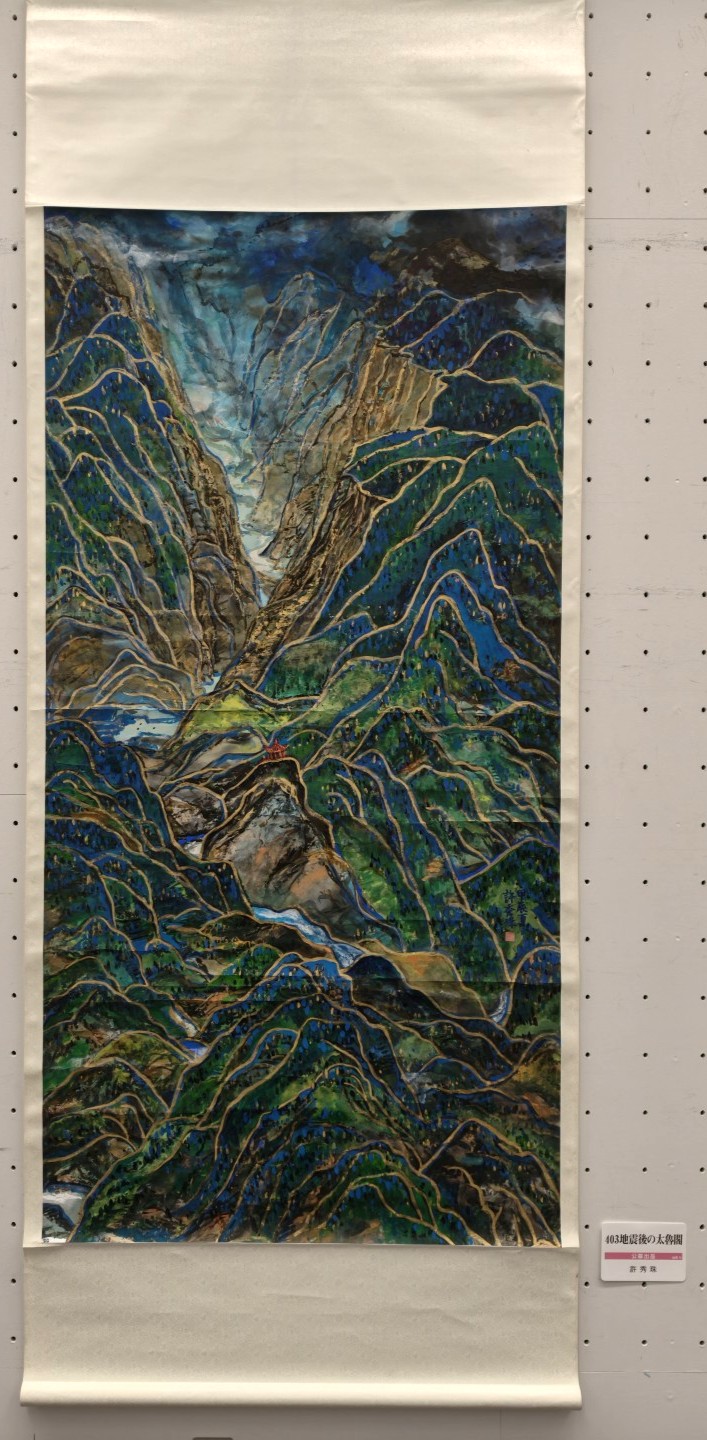
Artist: Hsu Hsiu-Chu Work: Taroko After the 403 Earthquake Dimensions: 179 cm long × 89 cm wide Medium: Mixed media
I often feel that human understanding of mountains and rivers begins, more often than not, with an illusion. After standing before mountains for a long time, people come to believe that mountains are merely still things; after walking through valleys for a long time, they come to believe that roads can always pass through danger; after looking at scenery for a long time, they easily forget that scenery itself does not exist in order to be seen. Mountains have their own time, stones their own sense of pain, streams their own memory; it is only that they do not ordinarily explain themselves to human beings. Only when an earthquake arrives—when the earth suddenly interrupts humanity’s overly secure imagination through fissure, collapse, movement, and unpredictable force—does one realize with astonishment: we have always been standing upon a world that can change, split open, and rewrite itself.
To my eyes, Hsu Hsiu-Chu’s Taroko After the 403 Earthquake is not merely a depiction of post-disaster landscape, nor does it simply re-present Taroko as a magnificent scenic site. Rather, it seems to paint a kind of post-earthquake recognition. The composition is tall and narrow, drawing the gaze vertically into the depth of the gorge. Heavy cloud-like atmosphere gathers above; blue-black, grey-white, and deep cyan merge together like mountain air that has not yet fully settled after the earthquake. The mountain bodies on both sides rise high and press inward, composed of interwoven emerald green, deep blue, ink-black, ochre brown, and grey-white. The mountains are no longer merely mountains; they resemble a body that has been pierced by immense force and yet continues to breathe. At the center, the deep valley narrows toward the distance, while streams and white glimmers of water appear intermittently, like time that continues after disaster and refuses to stop.
What draws the eye most strongly are the gold-white lines that cover the mountain bodies. These lines twist, branch, slope, and turn back upon themselves. They resemble mountain paths, yet also fissures in rock strata; they resemble wrinkles on the earth’s surface, yet also nerves revealed after the earth has been shaken. They are not merely decorative outlines, but a form of post-earthquake writing. The mountain bodies are cut, connected, and marked by these lines, so that the entire painting is no longer a flat landscape, but a map of geology, trauma, and time. After looking for a long while, one begins to feel that these gold-white lines are not patterns added to the mountains by the artist, but internal textures that the mountains themselves have been forced to reveal after the disaster.
Slightly below the middle of the painting, there is a very small reddish-ochre pavilion. This pavilion is not a bridge, nor does it carry the function of passage. It is placed among mountains and ravines, like a small flame of the human world, or like a tiny punctuation mark. Its presence is extremely important, because it brings the scale of the human into this vast field of mountains and rivers. Without this pavilion, the whole painting might move closer to a purely geological landscape; with it, however, the viewer suddenly becomes aware of how small human beings truly are within mountains and rivers. The reddish-ochre color of the pavilion forms a clear contrast with the surrounding blue-green mountains, allowing it to remain visible despite its smallness. It appears like the trace of people once stopping here, looking, taking shelter from rain, or resting briefly. Yet in post-earthquake Taroko, this human trace appears especially fragile, and therefore especially precious. I appreciate that this work does not paint the earthquake as a direct scene of collapse. There is no exaggerated disaster narrative in the painting, nor are wounds turned into dramatic cries. Hsu Hsiu-Chu chooses another way: she allows the mountains to speak for themselves. The fissures of the mountains, the turns of the water, the weight of the clouds, the density of the lines, and the piling of color layers together form a post-earthquake silence. This silence is more powerful than noise. For the truly profound post-disaster experience is often not immediate crying out, but the long recognition that the world has changed, and that the way we look at the world must change with it.
I have always wanted to draw external scenery back toward the human self. To look at mountains and rivers after an earthquake is, in fact, to look at one’s own finitude. In ordinary times, we too easily believe in stability, in roads, in maps, and in the idea that nature—once marked, developed, and named—has already been grasped by human beings. Yet Taroko After the 403 Earthquake reminds us: nature is not an appendage of humanity, and mountains and rivers are not background images in a travel brochure. Taroko is magnificent precisely because it is not entirely docile; it inspires reverence precisely because it contains beauty and force, light and fracture, places that can be approached and depths that cannot be possessed.
The mixed-media quality of this work further strengthens its theme. The surface is not a single flat application of color; instead, there are layers of varying thickness, raised or emphasized gold-white lines, and mutual staining between blue-green and ochre-brown. This materiality makes the mountain bodies appear not as something merely depicted, but as something generated layer by layer. Mixed media here is not simply a technique, but a response to the “post-earthquake terrain” itself. After an earthquake, mountains and rivers are inherently composite: rock strata, soil, vegetation, streams, fissures, clouds, memory, and trauma overlap with one another. Hsu Hsiu-Chu allows the medium itself to become a geological language, giving the image a thickness repeatedly inscribed by time.
The deepest quality of the painting lies in the fact that it does not equate rupture with ending. There are fractures, collapses, and the darkness of deep valleys in the picture; but there are also streams, greenery, gold lines, and that reddish-ochre pavilion still existing silently among the mountains. This makes the work not merely a sadness after disaster, but more like a moment in which the post-disaster world begins to take shape again. The mountains have split, but the mountains remain; the water has changed course, but the water continues to flow; the position of human beings has become smaller, yet people still leave behind traces of looking, pausing, and remembering. This complexity is precisely the maturity of the work.
Thus, when I look at Taroko After the 403 Earthquake, what I finally read is not simply “earthquake,” but a reeducation in reverence. Reverence is not fear, nor is it retreat; it is the understanding of one’s own place. Human beings may look at mountains and rivers, but should not assume that mountains and rivers exist only for human beings. Human beings may enter nature, but should not forget that nature possesses a time far longer and deeper than our own. That small reddish-ochre pavilion is exactly like the place of human beings within the vast world: small, temporary, and yet still trying to situate itself.
Therefore, I would like to conclude with one sentence:
Hsu Hsiu-Chu’s Taroko After the 403 Earthquake does not merely depict mountains and rivers after an earthquake. Through fractured mountain bodies, flowing streams, dense gold-white lines, and a small reddish-ochre pavilion, it reminds human beings to understand anew: we are not the masters of nature, but only viewers temporarily dwelling within the folds of the earth.