論山川之裂,與人如何在震後重新學會自身的位置
——許秀珠〈403地震後的太魯閣〉
撰文:王穆提(WANG MUTI)
我常覺得,人對山川的理解,多半始於錯覺。人在山前站久了,便以為山只是靜止之物;人在谷中行久了,便以為道路總能穿過危險;人看風景看久了,便容易忘記風景本身並不是為了被觀看而存在。山有山的時間,石有石的痛感,溪流有溪流的記憶,只是它們平日不向人說明。直到一次地震來臨,大地忽然以裂、以崩、以移動、以不可預測的力量,打斷人類那些過分安穩的想像,人才驚覺:原來我們一直站在一個會變動、會開裂、會重新書寫自身的世界之上。
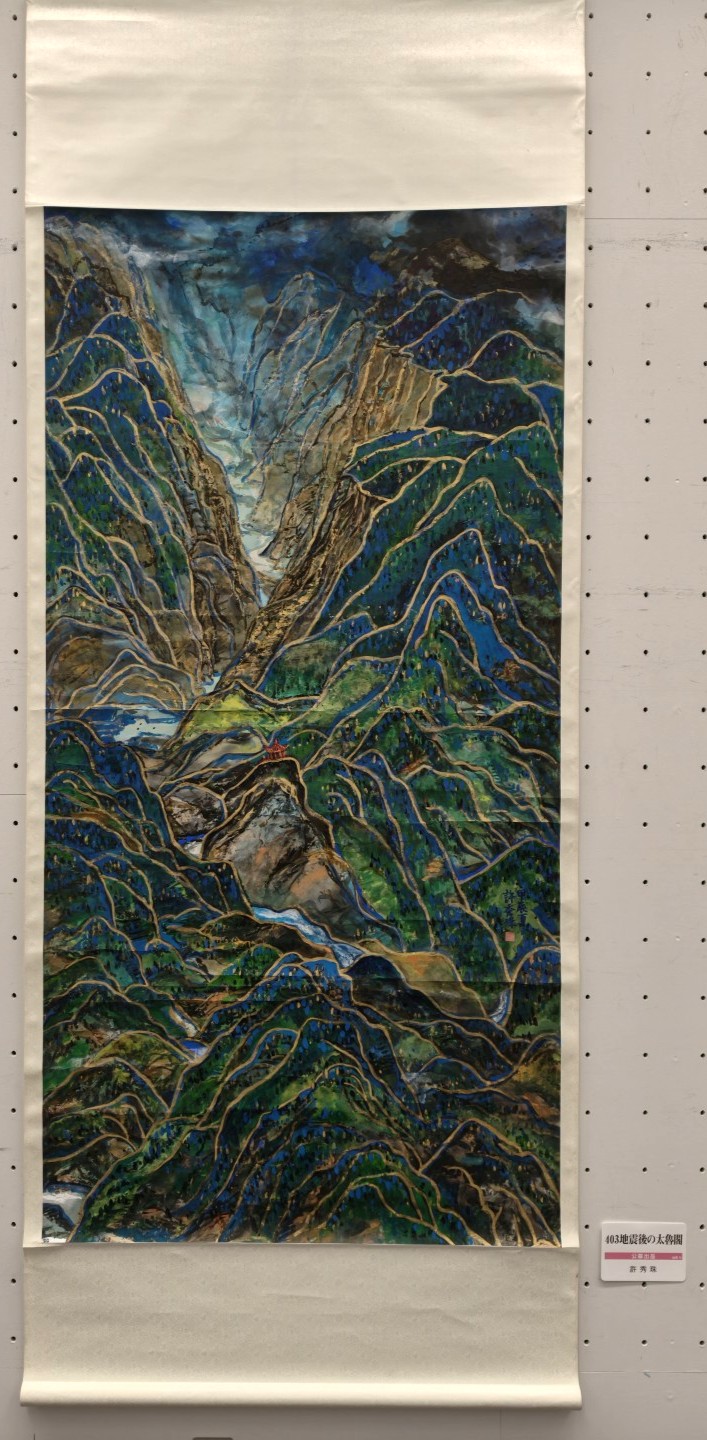
許秀珠這件〈403地震後的太魯閣〉,在我看來,並不是單純描繪災後山水,也不是把太魯閣作為壯麗景點重新呈現;它更像是在畫一種震後的認識。畫面高而狹長,視線被垂直地拉入深谷之中。上方雲氣沉重,藍黑、灰白與深青交融,如同山區震後尚未完全沉定的空氣。兩側山體高聳而壓迫,翠綠、深藍、墨黑、赭褐與灰白交錯,使山不只是山,而像一個被巨大力量穿過之後仍在呼吸的身體。畫面中央深谷向遠處收束,溪流與白色水光斷續出現,如同災變之後仍未停止的時間。
最引人注意的,是遍布山體的金白色線條。這些線條蜿蜒、分岔、斜走、回旋,既像山路,又像岩層裂隙;既像地表的皺褶,也像大地被震動之後顯露出的神經。它們並不只是裝飾性的輪廓,而像一種震後的書寫。山體被這些線條切開、連接、標示,於是整幅畫不再是平面的風景,而成為一張關於地質、創傷與時間的圖。人看久了,會覺得這些金白線條不是畫家替山加上的花紋,而是山自身在災後不得不露出的內部紋理。
畫面中段偏下,有一座極小的赭紅色涼亭。這座涼亭並不是橋,也不承擔通行的功能;它安置在群山與溪谷之間,像一點人間的火光,也像一枚微小的標點。它的存在極為重要,因為它把人的尺度帶入了這個龐大的山川場域之中。若沒有這座涼亭,整幅畫或許會更接近純粹的地質景觀;然而有了它,觀者便忽然意識到:人在山川之中,其實如此之小。涼亭的赭紅色與周圍的藍綠山體形成明顯對比,使它在畫面中雖小,卻不會被完全吞沒。它像是人曾經在此停留、觀看、避雨、稍歇的痕跡;但在震後的太魯閣中,這種人間痕跡顯得尤其脆弱,也尤其珍貴。
我喜歡這件作品沒有把地震畫成直接的崩塌現場。畫中沒有誇張的災難敘事,也沒有把傷痕變成戲劇性的叫喊。許秀珠採取的是另一種方式:她讓山自己說話。山的裂紋、水的轉折、雲氣的凝重、線條的密集、色層的堆疊,共同構成一種震後的沉默。這種沉默比喧嘩更有力量。因為真正深刻的災後經驗,往往不是立刻哭喊,而是長久地意識到:世界已經不一樣了,而我們觀看世界的方式也必須跟著改變。
我總願意把外在之景牽回人自身。人在震後觀看山川,其實也是在觀看自己的有限。平日我們太容易相信穩定,相信道路,相信地圖,相信被標示、被開發、被命名的自然已經可以被人掌握。然而〈403地震後的太魯閣〉提醒我們:自然不是人的附屬物,山川也不是旅遊手冊中的背景。太魯閣之所以壯麗,正因它並不完全溫順;它之所以使人敬畏,正因它有美,也有力,有光,也有裂,有可親近之處,也有不可佔有之深。
這件作品的複合媒材特質,也使其主題更為成立。畫面並非單一平塗,而有厚薄不一的色層、金白線條的凸顯、藍綠與赭褐之間的互相滲染。這種材質感使山體看起來不是被描摹出來,而像是被層層生成出來。複合媒材在此不只是技法,而是與「震後地貌」本身相呼應:震後的山川本來就是複合的——岩層、泥土、植被、溪水、裂痕、雲氣、記憶與創傷彼此疊加。許秀珠讓媒材本身也成為一種地質性的語言,使畫面具有被時間反覆刻寫的厚度。
整幅畫最深的地方,在於它並不把破裂等同於終結。畫面中有裂,有崩,有深谷的幽暗,但也有溪流,有綠意,有金線,有那座仍在山間靜默存在的赭紅色涼亭。這使作品不只是災難之後的哀傷,而更像是災後世界重新成形的片刻。山裂開了,但山仍在;水改道了,但水仍流;人的位置變得更小了,但人仍留下觀看、停留與記憶的痕跡。這種複雜性,正是此作成熟之處。
所以我看〈403地震後的太魯閣〉,最終讀到的不是單純的「地震」,而是一種關於敬畏的重新教育。敬畏並不是恐懼,也不是退縮,而是懂得自己的位置。人可以觀看山川,卻不應以為山川只為人而存在;人可以進入自然,卻不應忘記自然擁有遠比人更長久、更深沉的時間。那座小小的赭紅色涼亭,正像是人在巨大世界中的位置:微小,短暫,卻仍試圖安放自身。
故我願以一句話作結:
許秀珠〈403地震後的太魯閣〉並非只是描繪震後山川,而是藉由裂開的山體、流動的溪水、密布的金白線條與一座微小的赭紅色涼亭,提醒人重新理解:我們不是自然的主人,而只是暫時棲身於大地皺褶之中的觀看者。
其他相關內容:
【現場直擊】【台日交流展】東京都美術館開館100周年記念《第14回東京現展》展場:日本國立東京都美術館
On the Fracturing of Mountains and Rivers, and How Human Beings Learn Their Place Anew After an Earthquake
— On Hsu Hsiu-Chu’s Taroko After the 403 Earthquake
Written by Wang Muti(王穆提)
Artist: Hsu Hsiu-Chu Work: Taroko After the 403 Earthquake Dimensions: 179 cm long × 89 cm wide Medium: Mixed media
I often feel that human understanding of mountains and rivers begins, more often than not, with an illusion. After standing before mountains for a long time, people come to believe that mountains are merely still things; after walking through valleys for a long time, they come to believe that roads can always pass through danger; after looking at scenery for a long time, they easily forget that scenery itself does not exist in order to be seen. Mountains have their own time, stones their own sense of pain, streams their own memory; it is only that they do not ordinarily explain themselves to human beings. Only when an earthquake arrives—when the earth suddenly interrupts humanity’s overly secure imagination through fissure, collapse, movement, and unpredictable force—does one realize with astonishment: we have always been standing upon a world that can change, split open, and rewrite itself.
To my eyes, Hsu Hsiu-Chu’s Taroko After the 403 Earthquake is not merely a depiction of post-disaster landscape, nor does it simply re-present Taroko as a magnificent scenic site. Rather, it seems to paint a kind of post-earthquake recognition. The composition is tall and narrow, drawing the gaze vertically into the depth of the gorge. Heavy cloud-like atmosphere gathers above; blue-black, grey-white, and deep cyan merge together like mountain air that has not yet fully settled after the earthquake. The mountain bodies on both sides rise high and press inward, composed of interwoven emerald green, deep blue, ink-black, ochre brown, and grey-white. The mountains are no longer merely mountains; they resemble a body that has been pierced by immense force and yet continues to breathe. At the center, the deep valley narrows toward the distance, while streams and white glimmers of water appear intermittently, like time that continues after disaster and refuses to stop.
What draws the eye most strongly are the gold-white lines that cover the mountain bodies. These lines twist, branch, slope, and turn back upon themselves. They resemble mountain paths, yet also fissures in rock strata; they resemble wrinkles on the earth’s surface, yet also nerves revealed after the earth has been shaken. They are not merely decorative outlines, but a form of post-earthquake writing. The mountain bodies are cut, connected, and marked by these lines, so that the entire painting is no longer a flat landscape, but a map of geology, trauma, and time. After looking for a long while, one begins to feel that these gold-white lines are not patterns added to the mountains by the artist, but internal textures that the mountains themselves have been forced to reveal after the disaster.
Slightly below the middle of the painting, there is a very small reddish-ochre pavilion. This pavilion is not a bridge, nor does it carry the function of passage. It is placed among mountains and ravines, like a small flame of the human world, or like a tiny punctuation mark. Its presence is extremely important, because it brings the scale of the human into this vast field of mountains and rivers. Without this pavilion, the whole painting might move closer to a purely geological landscape; with it, however, the viewer suddenly becomes aware of how small human beings truly are within mountains and rivers. The reddish-ochre color of the pavilion forms a clear contrast with the surrounding blue-green mountains, allowing it to remain visible despite its smallness. It appears like the trace of people once stopping here, looking, taking shelter from rain, or resting briefly. Yet in post-earthquake Taroko, this human trace appears especially fragile, and therefore especially precious. I appreciate that this work does not paint the earthquake as a direct scene of collapse. There is no exaggerated disaster narrative in the painting, nor are wounds turned into dramatic cries. Hsu Hsiu-Chu chooses another way: she allows the mountains to speak for themselves. The fissures of the mountains, the turns of the water, the weight of the clouds, the density of the lines, and the piling of color layers together form a post-earthquake silence. This silence is more powerful than noise. For the truly profound post-disaster experience is often not immediate crying out, but the long recognition that the world has changed, and that the way we look at the world must change with it.
I have always wanted to draw external scenery back toward the human self. To look at mountains and rivers after an earthquake is, in fact, to look at one’s own finitude. In ordinary times, we too easily believe in stability, in roads, in maps, and in the idea that nature—once marked, developed, and named—has already been grasped by human beings. Yet Taroko After the 403 Earthquake reminds us: nature is not an appendage of humanity, and mountains and rivers are not background images in a travel brochure. Taroko is magnificent precisely because it is not entirely docile; it inspires reverence precisely because it contains beauty and force, light and fracture, places that can be approached and depths that cannot be possessed.
The mixed-media quality of this work further strengthens its theme. The surface is not a single flat application of color; instead, there are layers of varying thickness, raised or emphasized gold-white lines, and mutual staining between blue-green and ochre-brown. This materiality makes the mountain bodies appear not as something merely depicted, but as something generated layer by layer. Mixed media here is not simply a technique, but a response to the “post-earthquake terrain” itself. After an earthquake, mountains and rivers are inherently composite: rock strata, soil, vegetation, streams, fissures, clouds, memory, and trauma overlap with one another. Hsu Hsiu-Chu allows the medium itself to become a geological language, giving the image a thickness repeatedly inscribed by time.
The deepest quality of the painting lies in the fact that it does not equate rupture with ending. There are fractures, collapses, and the darkness of deep valleys in the picture; but there are also streams, greenery, gold lines, and that reddish-ochre pavilion still existing silently among the mountains. This makes the work not merely a sadness after disaster, but more like a moment in which the post-disaster world begins to take shape again. The mountains have split, but the mountains remain; the water has changed course, but the water continues to flow; the position of human beings has become smaller, yet people still leave behind traces of looking, pausing, and remembering. This complexity is precisely the maturity of the work.
Thus, when I look at Taroko After the 403 Earthquake, what I finally read is not simply “earthquake,” but a reeducation in reverence. Reverence is not fear, nor is it retreat; it is the understanding of one’s own place. Human beings may look at mountains and rivers, but should not assume that mountains and rivers exist only for human beings. Human beings may enter nature, but should not forget that nature possesses a time far longer and deeper than our own. That small reddish-ochre pavilion is exactly like the place of human beings within the vast world: small, temporary, and yet still trying to situate itself.
Therefore, I would like to conclude with one sentence:
Hsu Hsiu-Chu’s Taroko After the 403 Earthquake does not merely depict mountains and rivers after an earthquake. Through fractured mountain bodies, flowing streams, dense gold-white lines, and a small reddish-ochre pavilion, it reminds human beings to understand anew: we are not the masters of nature, but only viewers temporarily dwelling within the folds of the earth.
山川の裂け目について、そして人が震後に自らの位置をいかに学び直すか
——許秀珠 Hsu Hsiu-Chu《403地震後の太魯閣》を観る
文:王穆提(WANG MUTI)
許秀珠 Hsu Hsiu-Chu 作品:《403地震後の太魯閣》 サイズ:長さ179 cm × 幅89 cm 媒材:複合媒材
私はよく思う。人間の山川に対する理解は、多くの場合、錯覚から始まっているのではないか、と。人は山の前に長く立っていると、山はただ静止したものだと思い込む。谷の中を長く歩いていると、道はいつも危険を通り抜けられるものだと思い込む。風景を長く見慣れていると、風景そのものが見られるために存在しているわけではないことを、つい忘れてしまう。山には山の時間があり、石には石の痛みがあり、渓流には渓流の記憶がある。ただ、それらはふだん人間に向かって説明しないだけである。地震が訪れ、大地が裂け、崩れ、動き、予測不能な力によって、人間のあまりにも安定した想像を断ち切ったとき、人は初めて驚いて知る。私たちは、変動し、裂け開き、自らを書き換える世界の上に、ずっと立っていたのだ、と。
許秀珠の《403地震後の太魯閣》は、私の目には、単に災後の山水を描いた作品ではなく、また太魯閣を壮麗な景勝地として再提示したものでもない。むしろそれは、震後の一つの認識を描いているように見える。画面は高く細長く、視線は垂直に深い谷へと引き込まれていく。上方には重い雲気が漂い、藍黒、灰白、深い青緑が混ざり合い、地震後の山地にまだ完全には沈静していない空気のようである。左右の山体は高くそびえ、圧迫感を持ち、翠緑、深藍、墨黒、赭褐、灰白が交錯している。そのため山はもはや単なる山ではなく、巨大な力に貫かれた後もなお呼吸している身体のように見える。画面中央の深い谷は遠方へと収束し、渓流と白い水光が断続的に現れる。それは災変の後にもなお止まることのない時間のようである。
最も目を引くのは、山体全体に張り巡らされた金白色の線である。これらの線は曲がり、分岐し、斜めに走り、また回り込む。山道のようでもあり、岩層の裂け目のようでもある。地表の皺のようでもあり、地震によって大地が揺さぶられた後に露わになった神経のようでもある。それらは単なる装飾的な輪郭線ではなく、震後の書き込みのように見える。山体はこれらの線によって切られ、結ばれ、標示される。こうして画面全体は、平面的な風景ではなく、地質、創傷、時間に関する一枚の図となる。長く見ていると、これらの金白色の線は、画家が山に加えた模様ではなく、山そのものが災後に露わにせざるをえなかった内部の肌理であるように思えてくる。
画面中段よりやや下には、きわめて小さな赭紅色の涼亭がある。この涼亭は橋ではなく、通行の機能を担っているわけでもない。群山と渓谷のあいだに置かれ、人間界の小さな火のようでもあり、微小な句読点のようでもある。その存在は非常に重要である。なぜなら、この広大な山川の場に、人間の尺度を持ち込んでいるからである。もしこの涼亭がなければ、画面全体はより純粋な地質景観に近づいたかもしれない。しかし、この涼亭があることによって、観者はふと気づく。山川の中において、人間は実に小さいのだ、と。涼亭の赭紅色は周囲の青緑の山体と明瞭な対比をなし、画面の中では小さいにもかかわらず、完全には呑み込まれない。それは、かつて人がここに立ち止まり、眺め、雨を避け、しばし休んだ痕跡のようである。しかし震後の太魯閣において、このような人間の痕跡はとりわけ脆く、そしてとりわけ貴重に見える。
私は、この作品が地震を直接的な崩落現場として描いていない点を好ましく思う。画面には誇張された災害の物語もなく、傷痕を劇的な叫びに変えることもない。許秀珠が選んだのは、別の方法である。彼女は山そのものに語らせている。山の裂け目、水の折れ曲がり、雲気の重さ、線の密度、色層の堆積がともに、震後の沈黙を構成している。この沈黙は、喧騒よりも力を持つ。なぜなら、真に深い災後の経験とは、多くの場合、すぐに泣き叫ぶことではなく、世界がすでに変わってしまったこと、そして私たちの世界の見方もそれに続いて変わらねばならないことを、長く意識し続けることだからである。 私は常に、外なる景を人間自身へと引き戻したいと思っている。震後に山川を見るということは、実は自らの有限性を見ることでもある。ふだん私たちはあまりにも容易に、安定を信じ、道を信じ、地図を信じ、標示され、開発され、名づけられた自然はすでに人間によって把握されたものだと信じてしまう。しかし《403地震後の太魯閣》は私たちに告げる。自然は人間の付属物ではなく、山川は旅行案内書の背景でもない。太魯閣が壮麗であるのは、それが完全には従順ではないからである。太魯閣が人に敬畏を抱かせるのは、そこに美もあり、力もあり、光もあり、裂け目もあり、近づける場所もあれば、所有しえない深みもあるからである。
この作品における複合媒材の性質もまた、主題をより確かなものにしている。画面は単一の平塗りではなく、厚薄の異なる色層、強調された金白色の線、青緑と赭褐の相互浸透によって成り立っている。この材質感によって、山体は描写されたものというより、層を重ねて生成されたもののように見える。ここで複合媒材は単なる技法ではなく、「震後地貌」そのものに呼応している。震後の山川はそもそも複合的である。岩層、土、植生、渓流、裂け目、雲気、記憶、創傷が互いに重なり合っている。許秀珠は媒材そのものを一種の地質的言語に変え、画面に時間によって繰り返し刻まれた厚みを与えている。
この絵の最も深いところは、破裂を終結と同一視していない点にある。画面には裂け目があり、崩れがあり、深谷の暗さがある。しかし同時に、渓流があり、緑があり、金色の線があり、そして山間に静かに存在し続けるあの赭紅色の涼亭がある。そのため、この作品は災害後の悲しみだけではなく、災後の世界が再び形を取り始める一瞬のように見える。山は裂けた。しかし山はなお在る。水は流路を変えた。しかし水はなお流れる。人間の位置はより小さくなった。しかし人間はなお、見ること、立ち止まること、記憶することの痕跡を残している。この複雑さこそ、この作品の成熟である。
したがって、私が《403地震後の太魯閣》を見るとき、最終的に読み取るのは、単なる「地震」ではなく、敬畏についての再教育である。敬畏とは恐怖ではなく、退却でもない。それは自らの位置を知ることである。人は山川を見ることができる。しかし山川がただ人間のために存在していると思ってはならない。人は自然に入ることができる。しかし自然が人間よりもはるかに長く、はるかに深い時間を持っていることを忘れてはならない。あの小さな赭紅色の涼亭は、巨大な世界の中における人間の位置そのもののようである。小さく、短く、それでもなお自らを置こうとしている。
ゆえに、私は次の一文をもって結びたい。
許秀珠《403地震後の太魯閣》は、単に震後の山川を描いているのではない。裂けた山体、流れる渓水、密に張り巡らされた金白色の線、そして小さな赭紅色の涼亭を通じて、人間にあらためて理解させるのである。私たちは自然の主人ではなく、大地の襞の中に一時的に身を置く観者にすぎないのだ、と。