Strolling in the Dark: How Autumn is Not a Color, but a Turn of Existence
—The Seasonal Philosophy, Threshold Consciousness, and Ink-Wash Openness in Wang Quan-Fu’s August Stroll in a Single Autumn Hue
By: WANG MUTI
Introduction: Why is August Already Autumn?
When one truly feels the change of seasons, it is not the moment the calendar flips to a new page, but rather when a certain atmosphere abruptly shifts. The light is no longer relentlessly saturated, colors begin to recede, sounds seem absorbed by a more distant air, and even familiar paths appear retraced by an unspeakable shadow. At that moment, one might not yet dare to say "autumn has arrived," but the body already knows: a certain yielding, a certain tranquility, a mutual exchange of light and dark is slowly taking over the world.
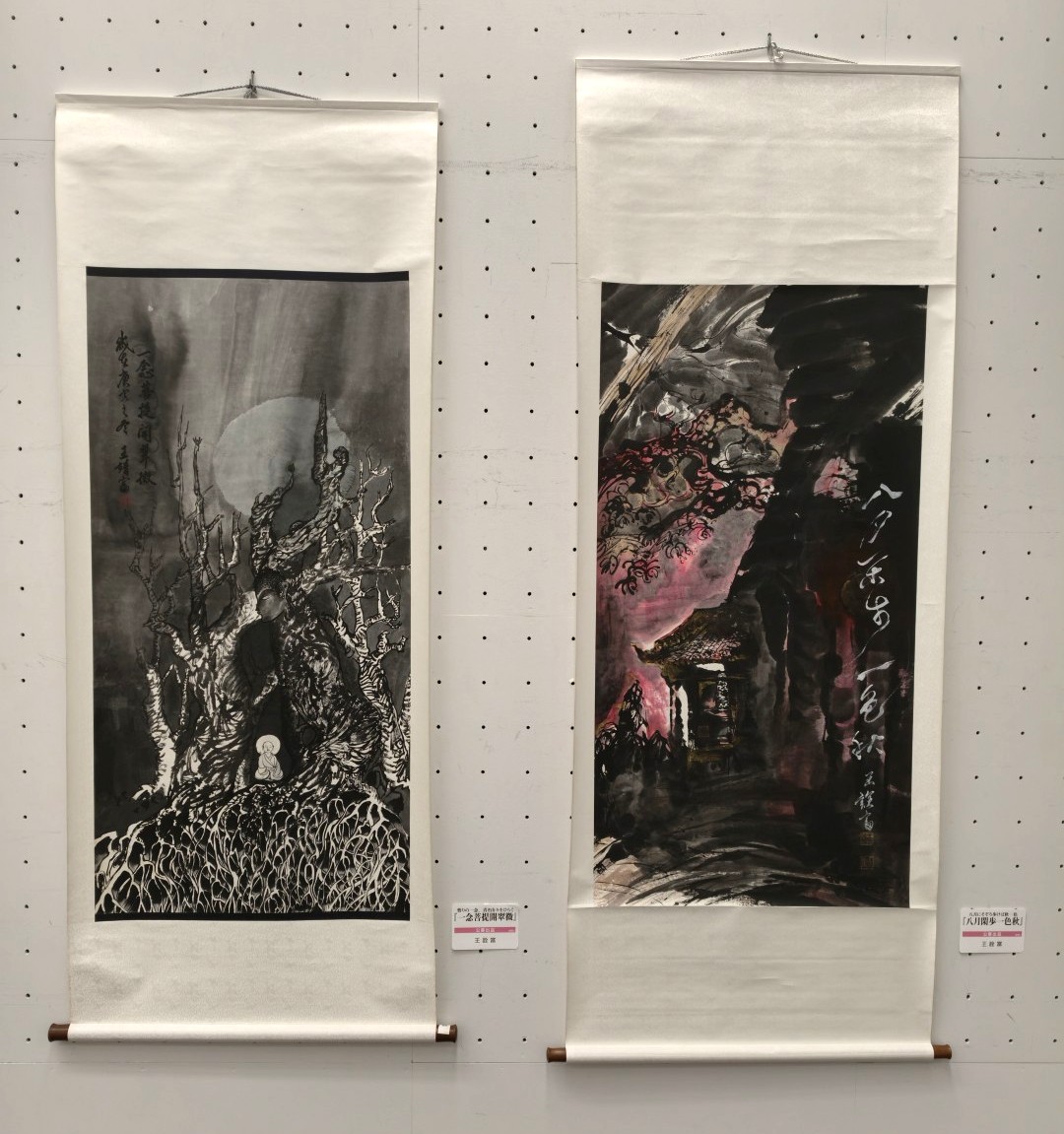
To my eyes, Wang Quan-Fu’s August Stroll in a Single Autumn Hue is precisely a work about this condition of "not having fully arrived, yet already enveloping everything." The most intriguing part of the title is not merely "Autumn," but "August" and "Stroll." August is supposed to still carry the summer heat, yet in the painting, it has already been commandeered by autumn hues; a stroll is meant to be a relaxing walk, yet within the frame, one steps into a space that is almost shadowy, profound, and laden with spiritual density. Thus, the more I look, the more I feel this artwork is not simply depicting a path, a courtyard, or a corner of a landscape. Instead, it addresses a deeper question: how humans re-learn to perceive the world from the darkness at the turning point of the seasons.
Xieyi (Freehand Expression) is Not Omission, but Allowing the World to Retain Its Unsaid Parts
What first strikes the viewer about this work is its highly uncompromising approach to being seen. The picture is not bright; it does not fully explain the scene, nor does it allow the viewer to instantly identify a "landmark" or a "story." Large areas of black and gray ink press in from the edges, forming an almost encompassing shadow; slightly inward from the center, a brighter path or passage is left bare, carrying hints of pale pink, ochre-red, and a subtle warm light. It resembles the ground in the twilight, or the residue of the setting sun on stone paths, moisture, or walls. In the midground, there seems to be a door, a courtyard, an opening; on the left, fine, fragmented ink lines resembling vines or floral clusters appear—like plants, but also like the textures of memory breeding in the corner of a wall. If viewed horizontally like a photograph, the painting possesses a scrolling sense of progression; but understood through the spatial consciousness inherent in its title and composition, it compresses the walking experience of late summer fading into a visual field that is both enterable and impenetrable.
Such Xieyi (freehand brushwork) is not a simplification of technique, but a higher level of reservation. Shitao once said, "Ink and brush should follow the times." True Xieyi has never been about painting fewer strokes, but knowing what should not be painted too fully. The preciousness of Wang Quan-Fu’s work lies exactly in its refusal to let the scenery take a definitive shape prematurely, thus allowing the world to retain its incompleteness. A wall is a wall, but it need not look exactly like a wall; the shadow of flowers is just that, but it can also be ink wash, memory, or the frayed edges left by the friction between light, shadow, and ink. Therefore, viewers cannot merely adopt an attitude of identification; they must let their senses slowly enter the rhythm of darkness, hesitation, and twilight coexisting within the painting.
It is precisely here that the work acquires its philosophical significance: it does not explain the world clearly, but allows the world to maintain its polysemy. When a person truly encounters the world, it is rarely when seeing it most clearly, but in this half-lit, half-dark, semi-distinguishable state. Because only when things do not entirely belong to our naming do they truly open themselves to us as the "Other."
Heidegger: Paths, the Clearing, and Manifestation in Darkness
If asked what the core imagery of this work is, I would say it is a path slowly opened up in the darkness. This path does not simply lead forward; rather, it feels as if it is being summoned bit by bit by the light within the frame. The heavy ink surrounding it is not merely the background, but the very condition that allows the path to exist: without such darkness, the path would not manifest; without the enclosure, passage would lack meaning.
Martin Heidegger’s contemplation on the "Clearing" (Lichtung) in the forest perfectly illustrates the inner structure of this piece. Heidegger believed that truth is not just an accurate description of things, but an unconcealment—bringing things out of obscurity into the open. The world is not always transparently laid out before us; it constantly oscillates between manifestation and concealment. August Stroll in a Single Autumn Hue is established in exactly this sense: the brightest part of the painting is not a panoramic view, but a partially illuminated passage; the deepest black ink is not a void, but the concealment itself. The entire work seems to say: autumn does not make us see the world more clearly; it makes the world manifest in a different way.
Particularly, the chiaroscuro effect in the center—resembling a doorway, a courtyard, or the depths of a building—makes it almost impossible not to read this work as an experience of "traversing." It feels as though the viewer is not standing outside looking in, but is already walking within it. The "stroll" here is therefore not just a walk, but closer to a state of being: we are not rushing to arrive, but in the process of walking, we are slowly altered by the surrounding light and dark, warmth and coldness, proximity and distance. Heidegger once said that a path is not merely a tool connecting two points; a true path teaches one how to dwell in the world. Wang Quan-Fu’s autumn path is not just a scenic composition, but a metaphor for being-in-the-world: one is walking, and the act of walking itself is already a way of coexisting with the season.
Walter Benjamin: Threshold, Twilight, and the Persistence of Aura
Another deeply significant layer of this artwork is its intense sense of a threshold. It is neither a daytime scene nor a pure nightscape, but a state suspended between late summer and early autumn, daylight and dusk, exterior and interior. The floral shadows, paths, walls, and the architectural structures/doorframes in the depths all seem to exist in a time that is about to vanish yet hasn't completely faded. This time is not clock time, but the twilight time intrinsic to the place itself.
Walter Benjamin had an acute sensitivity to the "threshold." To Benjamin, a threshold is not a simple boundary, but a site with the utmost density of experience: it connects the inside and outside, waking and dreaming, the everyday and the mysterious. August Stroll in a Single Autumn Hue is precisely a threshold artwork. What the viewer sees is not a complete world, but a world in transition; not an autumn that has settled, but the very instant autumn is taking over August. This makes the black more than black, the pink more than pink, and the ochre-red more than just strokes of color—they all carry the implication of "imminently becoming another kind of time."
This also endows the work with a nearly Benjamin-esque Aura. The so-called aura is not about mystical obscurity; rather, it is a mode of presence where an object retains its distance and refuses to be immediately consumed, seen through, or exhausted. Today, many paintings rush to clarify a landscape, resulting in them being quickly consumed by the eye. Wang Quan-Fu’s work does the opposite. It leaves vast spaces that defy immediate judgment, forcing the viewer to slow down, and even adapt their gaze and breath to the pace of a "stroll." This slowness is exactly the condition that allows the aura to survive. Standing before the painting, one does not immediately master it, but is slowly drawn into it.
Gaston Bachelard: House, Corners, and the Inner Space of Autumn
I am particularly fond of the atmosphere in this work that feels akin to "an alleyway" or "deep within a courtyard." Although the image may not figuratively detail a specific building, the structure of walls, doors, passageways, shadows, shrubbery, and faint light in the depths forms a space that can be read through Gaston Bachelard’s lens. In The Poetics of Space, Bachelard repeatedly reminds us that spaces like houses, corners, doors, drawers, and eaves are moving not just because of their function, but because they correspond deeply to human inner experience: they accommodate secrets, memory, hesitation, solitude, and dreams.
The space in August Stroll in a Single Autumn Hue possesses this tendency toward "internalization." It does not stretch endlessly outward like grand mountains and rivers; instead, it draws the viewer into a place with depth, turns, corners, and pauses. The fine ink lines on the left, resembling bushes or vines, interact with the brighter path in the center, creating an internal-external dialogue that gives the painting a sense of both nature and dwelling, both vegetation and human traces. This is not a deserted wilderness, but a place where someone has walked, paused, and perhaps is still lingering.
Therefore, the autumn in the painting is not a macro-seasonal phenomenon, but an autumn intimate with the body. It is not the autumn of distant trees against a high sky, but an autumn slowly unfolding in the corners of walls, on the ground, in the dampness, and deep within the courtyard. Were Bachelard here, he might say this is not an "autumn landscape," but an internal room formed once autumn colors enter a space. People do not go out to look at autumn; rather, autumn quietly moves into them. This explains why the title is "August Stroll" and not "Viewing Autumn in August": because true autumn does not necessarily need to be looked at; it is more likely to be felt while walking.
Paul Ricoeur and Memory: Why Does This Path Seem Familiar?
One of the most moving aspects of this artwork is its strange sense of familiarity. Even if the viewer has never been to the place depicted, they easily feel: as if they themselves had once experienced a similar air on a certain evening, in a certain alley, a certain courtyard, or along a path where floral shadows and wall light intersected. This familiarity does not equate to realism; rather, it stems from the work’s restraint regarding concrete details. It does not fixate everything in objective description, thus leaving greater room for memory to enter.
When Paul Ricoeur discussed memory, he specifically emphasized that memory is not a replica, but a regeneration through traces and re-narration. August Stroll in a Single Autumn Hue possesses exactly this structure: it feels like a place, but not one that can be pinpointed on a map; it feels like an experience, but not an illustration of a single story. Because of this, the viewer's own life experiences are inevitably drawn in. The path in the painting, therefore, is simultaneously the artist's path and the path in the viewer's heart that they once walked alone on the edge of the seasons.
This mnemonic quality is crucial. It elevates the artwork from a "beautiful ink painting" into a field capable of holding life experiences. Truly mature art never seals off the author’s private circumstances; instead, it finds a form that allows the memories of others to reside within it. Wang Quan-Fu accomplishes just that here: he painted a specific autumn path, but ultimately it becomes a more universal inner realm—what one remembers within it may not be his August, but their own August.
Ink Wash and Autumn: Not Describing Color, but the Way of Exit
I would venture to say that the deepest subject of this artwork is actually not "autumn colors," but how autumn arrives. Autumn here is not a ground covered in gold, nor mountains full of red leaves, nor the traditional symbolic markers of the season; instead, it arrives darkly, deeply, and slowly. It does not announce itself with saturated colors, but establishes itself through the deepening of black, the dimming of pink, the retraction of light, and the inward folding of space.
This is exactly the seasonal philosophy that ink wash (Shuimo) is best suited to handle. If spring leans toward bursting forth and summer toward overflowing, autumn is closer to gathering, retracting, turning, and retreating. Ink wash is particularly suitable for depicting autumn because it portrays not just the exterior of things, but how things retreat from the light into the dark, from noise into silence, from outward expression into inward concealment. Wang Quan-Fu’s application of ink does not strive for neatness, but allows brushstrokes, washes, rubs, and negative space to form a rhythm akin to breathing and pacing. This makes autumn no longer just a visual hue, but a mode of exiting: not suddenly disappearing, but slowly turning away.
In this sense, the phrase "a single hue" in the title is exceptionally brilliant. The so-called "single hue" is not a monotone color, but an overall envelopment. It is not that a certain part of the frame turns autumnal, but that the entire space, the whole atmosphere, and the very way of seeing are autumnized. This is a level deeper than the visual: it is not seeing autumn, but being surrounded by autumn.
True Strolling is Not Walking Slowly, but Letting the World Slowly Enter
If I were to offer a final judgment on August Stroll in a Single Autumn Hue, I would say: what this work truly addresses is not just scenery and seasons, but how a person is quietly rewritten by the season while walking. It paints not an objective autumn landscape, but the experience of a path opening up in the dark; not a record of nature, but a turn of existence. Wang Quan-Fu makes the ink both a concealment and a clearing; he makes the path both a spatial structure and a spiritual one; he makes August not an extension of summer, but the herald of autumn; he makes the "stroll" not an aimless wander, but a re-learning of how to read the world with the body.
I always feel that true strolling is not about walking slowly, but allowing oneself not to rush to explain what is in front of the eyes. It is the willingness to let darkness remain darkness, to let floral shadows remain indistinct, and to let a path light up only partially. If one can walk like this, they will discover: autumn has never been just a season; it is a way of looking at the world. It is knowing that some light only reveals its truth in the dark, some paths must be walked in uncertainty to go deep, and some landscapes truly open up to people only when they no longer rush to possess them.
To summarize this work in one sentence, I would say: What Wang Quan-Fu’s August Stroll in a Single Autumn Hue paints is not an autumn scene, but the exact moment on the threshold of seasons when the world re-teaches a person how to "slowly enter."
Summary:
Wang Quan-Fu’s August Stroll in a Single Autumn Hue constructs a threshold space between late summer and early autumn, light and dark, interior and exterior, using freehand ink wash. The work does not triumph through explicit scenery; instead, through the envelopment of large areas of ink and the localized manifestation of ochre-pink and faint light, the paths, floral shadows, and deep architecture gradually emerge from concealment. Viewed through Heidegger's concept of the "Clearing," the path in the painting is not merely a spatial structure, but an existential site where things manifest from darkness. Benjamin’s threshold and aura help us understand its twilight temporal density and a sense of presence that resists rapid consumption. From the perspective of Bachelard’s poetics of space, the work transforms autumn hues into a habitable inner space, making the season not just an external landscape, but a spiritual climate jointly formed by wall corners, floral shadows, the ground, and footsteps. Overall, August Stroll in a Single Autumn Hue does not depict an autumn landscape per se, but rather how, at the turning of the seasons, humans re-learn to enter the world through walking and feeling.