On Why Rooftops, Birds, and Places Are More Than Geography: On Huang Shu-ching’s Swallowtails and Hoopoes (Kinmen, Taiwan)
Written by WANG MUTI
If one truly wishes to understand a place, relying solely on a map is profoundly insufficient. A map offers boundaries, roads, orientations, and names of administrative districts, yet it fails to convey how a place takes shape within the wind, how it settles within the human heart, how it is remembered along the flight paths of birds, or how, through the lines of architecture and the turns of tiled ridges, it slowly transforms into an existence that can be recognized and yearned for. If a place is reduced to mere coordinates, it is nothing but space. A place becomes a place because memory clings to it, because life deposits itself there layer by layer, and because certain things—such as a specific rooftop ridge, a certain species of bird, a particular twilight, or a collective sense of direction within a settlement—ensure that it is no longer just "there," but becomes an irreplaceable "here."
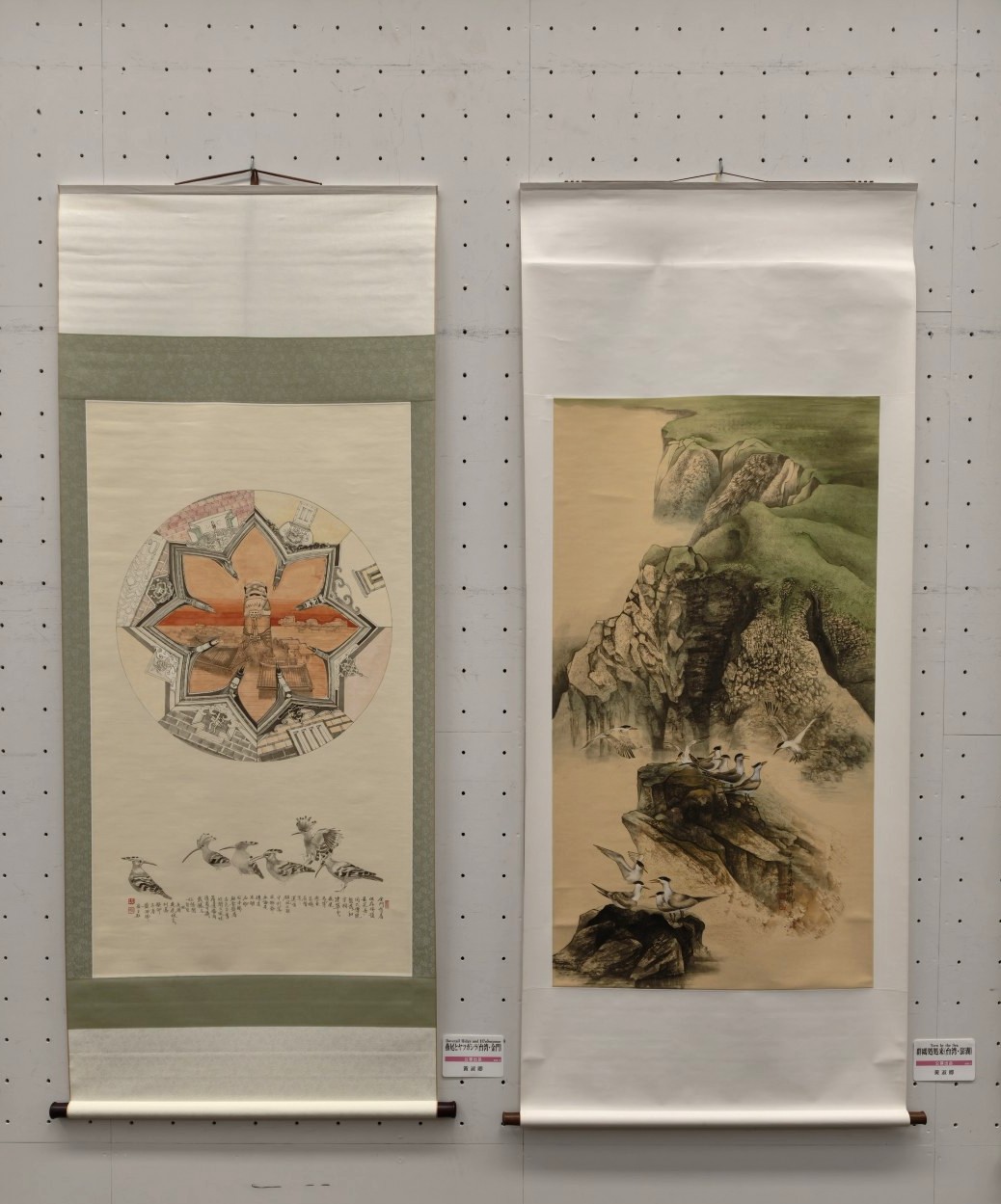
Huang Shu-ching’s Swallowtails and Hoopoes (Kinmen, Taiwan), in my eyes, is precisely a work about how a place is preserved, gazed upon, and translated into a spiritual structure. It does not merely paint Kinmen; it illustrates how Kinmen, as a cultural landscape, is collectively constituted by architecture, avian life, memory, and empty space.
The Architecture of Memory and the Non-Human Inhabitant
What first touches the viewer in this artwork is not an abundance of color, but precisely its restraint. Across this grand sheet of paper, an exceptionally large amount of negative space is left blank. In the upper center lies a near-circular structure—resembling an emblem, a ceiling well, a window, a mirror, or a vessel of memory that has been polished by time yet retains its boundary. Within this circle, the traditional "swallowtail" roof ridges of Minnan architecture are deconstructed, rotated, and reassembled to form a geometric structure akin to a blooming flower. Those sharply upturned ridges resemble the fingertips of the architecture, or an ancient form posing silent questions to the sky.
Within the central field of vision, one discerns a reddish-orange horizon, village rooftops, and a vertical, pillar-like form—resembling a Wind Lion God (Fengshiye), a guardian, or the central axis of the local spirit. In the lower portion of the canvas, several hoopoes stand amidst a vast expanse of white negative space, each in a different posture: some lifting their heads, some turning around, one slightly raising a foot, and another unfolding its crest, as if echoing one another or waiting for a specific moment in time known only to them. Inscribed text and seals grace the bottom edge, pulling the entire work back into the traditional lineage of paper and ink calligraphy.
I have always harbored a partiality for works that refuse to exhaust their meaning all at once, for the more mature an image is, the more it understands how to reserve certain dimensions that defy immediate translation. Huang Shu-ching’s work is precisely of this caliber. If you ask what it depicts, the answer seems simple enough: the swallowtail ridges of traditional Minnan architecture in Kinmen, a symbol of local culture, and the hoopoes that inhabit the land. Yet, if you stop at this layer, you have essentially not begun to read it. The swallowtails in the painting are not merely architectural details, nor are the hoopoes just a local bird species. The two are placed on the same canvas—not juxtaposed realistically as a casual sketch of a scene, but responding to each other through a methodology akin to symbology, spatial philosophy, and a cartography of memory. In other words, this is not an image of "architecture plus birds," but a conceptual composition demonstrating how dwelling, guarding, returning, locality, and cultural forms entangle.
Heideggerian Dwelling and the Organ of Remembrance
Martin Heidegger once wrote a profoundly critical phrase:
"...poetically man dwells upon this earth."
This line is frequently cited, yet it is often uttered too lightly. Most people comprehend "poetical dwelling" as merely living elegantly or moving through life with ease; in truth, Heidegger’s meaning runs far deeper, for his concern was never decorative beauty, but how humanity truly settles itself within the world. Dwelling is not the simple occupation of a residence; it is the establishment of a non-frivolous, non-violent relationship between the sky, the earth, the divinities, and the mortals.
Viewed through this lens, the swallowtail ridges in Swallowtails and Hoopoes are not merely ornamental features of local architecture; they serve as a formal testimony of how humanity once established order, prayed for stability, marked identity, and consolidated a sense of community upon the land. That upturned ridge line inherently carries a posture that transcends pure utility: it does not exist solely to ward off wind and rain, but declares that habitation can possess dignity, direction, and a spiritual line that lifts upward. By extracting, magnifying, and circularly reconstructing these roof ridges, Huang Shu-ching seems to remind the viewer: what truly escapes vanishing in a local civilization is perhaps not the entire house, but that spiritual stroke of the brush that once ensured a house was more than a house.
Conversely, the hoopoes situated opposite the rooftops push the question of dwelling from human construction back to the existential mode of non-human life. The hoopoe is not a caged bird, nor a domesticated fowl within an auspicious decorative motif; it is a life form that knows how to operate between the ground, the forest edge, the periphery of villages, and ancient structures. It possesses a distinct crest and a slender bill, appearing both eccentric and elegant, naturally carrying an air poised between the whimsical and the mysterious. Huang Shu-ching does not render the hoopoes as mere background, nor does she reduce them to mere illustrations for a local gazetteer. On the contrary, placing these hoopoes within the vast empty space below endows them with an ontological weight. Standing in the blankness, they do not appear "arranged" there by the artist; rather, they look as if they have walked in step-by-step from outside the canvas, claiming their own positions upon the paper.
Consequently, the artwork forms a highly fascinating contrast: above is the formal crystalized essence of human civilization—swallowtail ridges, window frames, brick ornaments, and guardian figures; below are the birds, serving as another form of life that does not follow architectural rules yet deeply understands how to live within the locality. This makes me realize that a true place is preserved not only by humans, but also by birds; it resides not only in historical archives, but also in the seasonally returning silhouettes, the foraging along the edges of alleys, and those life experiences that knew long before humans where it was still suitable to stay.
Here, Gaston Bachelard’s reflections on the "house" immensely assist our understanding. In The Poetics of Space, Bachelard does not view a house merely as a physical building; he argues that a house is both a shelter and an organ of memory, the prototype of how humanity constructs an interior space within the world. If we shift this line of thought slightly, we will realize that the reason the swallowtail ridge in Huang's painting is moving lies not in the "realistic precision of the architecture," but in its depiction as a spiritual organ of local memory. It acts as an entrance and a vessel; a window and a pupil; a fragment of a clan ancestral hall's facade, and a flower of form opened by time upon the locality. More subtly, this structure is enclosed within a circle. The circle, as one of the most ancient cosmic shapes, frequently signifies cycle, return, inner wholeness, celestial bodies, mirrors, and protection. Thus, the upper circular construction ceases to be a mere compositional technique; it becomes a symbolic interface that transforms a place from pure geography into an "interior view" (内景) that can be looked back upon, preserved, and re-organized into a spiritual space.
Benjamin’s Aura and Ricoeur’s Memory Traces
While Bachelard permits us to comprehend the internal spatiality of this work, Walter Benjamin allows us to perceive its historical atmosphere. When Benjamin discusses "aura," he speaks of a presence within a distance, a thickness of time that defies complete reproduction. Today, discussions regarding local culture easily devolve into tourist vocabulary: characteristics, preservation, revitalization, adaptive reuse, and scenic highlights. While these terms possess social utility, they frequently reduce a place to a consumable label, stripping away its true temporal weight.
Huang Shu-ching’s brilliance lies in her refusal to directly paint Kinmen as a browseable landscape; instead, she paints Kinmen as a field carrying distance, looking back, and cultural aura. The red-orange sky and settlement at the center are not rendered through naturalism; they resemble a distilled block of time excavated from memory. The roof ridges and decorative components are not measured blueprints; they are the essences and echoes remaining after the washing of history. The place in this painting is not the place found in travel brochures; it is a place "still bearing its aura" in the Benjaminian sense—one that has not been completely co-opted by the modern visual apparatus, still retaining a cultural air that cannot be immediately flattened or institutionalized into raw information.
I am further reminded of Paul Ricoeur’s reflections on memory and traces. Ricoeur repeatedly reminded us that memory does not bring back the past completely unaltered; rather, through traces, re-narration, and reconstruction, it re-settles that which has passed within the present. From this perspective, Huang Shu-ching’s work bears a powerful characteristic of "memory engineering," yet this engineering is not a cold restoration. It is a re-creation packed with emotion and formal wisdom. She does not copy the swallowtail ridges exactly; she reassembles them. She does not place the hoopoes within a concrete scene; she extracts them into a void. She does not paint Kinmen in a realistic perspective; she compresses it into a construction resembling an interior view, an emblem, or a spiritual model. This methodology itself declares: a place does not preserve itself by rigidly clinging to its original appearance, but through continuous re-narration. True preservation does not merely keep old items; it grants them the capacity to continue speaking within new forms.
The Traces of Force and the Climate of Blankness
The hoopoes below actually push this work an entire layer further into a deeper philosophical direction. When discussing a place, many are accustomed only to talking about how humans belong to it, yet they rarely ask: Do other life forms also belong here in their own ways? The convergence of birds and architecture here is crucial not only because they are identifiable, but because together they pose a question: Is a place purely a human product, or is it a residential network co-woven by the human and the non-human?
Hoopoes do not comprehend humanity’s historical narratives, yet they likely knew long before humans where to find suitable tree hollows, brick crevices, wild lands, and quiet sanctuaries. They do not write local history as humans do, but through the coming and going of their bodies, their perching, and their breeding, they live out the place on an alternative scale. This elevates the work beyond the mere recollection of local culture, bringing it closer to a multi-species ontology of place: a place is not solely the ancestral home, settlement, or memory of humans; it is also the territory of birds, the seasons of vegetation, and a site where non-human life and human civilization overlap accidentally yet profoundly.
Gilles Deleuze once noted that form is not a static contour, but the trace left behind by forces. This statement is exceptionally resonant when applied to this artwork. The swallowtail ridge achieves its form not merely through craftsmanship; it condenses lineage ethics, local aesthetics, architectural techniques, wind-and-earth adaptations, and a sense of cultural honor. The hoopoe being a hoopoe is not just a classification in a biological guidebook, but a mode of perching formed after long-term symbiosis with local boundaries, fields, and settlements. In other words, behind every form in this work lies not a hollow pattern, but forces: the force of history, the collective human force that shapes local culture, the force of the monsoon and the coastal environment, and the force of biological adaptation to the landscape. Huang Shu-ching gathers them upon a single sheet of paper not to create an exhibition of knowledge, but to allow the viewer to see that a place is not composed of a singular narrative; it is formed by multiple times, diverse life forms, and layered cultural forces entangling with one another.
I particularly admire the massive area of blankness in this work. Today, too many paintings fear the void, terrified that the viewer might find the canvas insufficiently full, rich, or bustling, and thus they rush to pack everything tightly. Yet, truly philosophical works always know how to reserve areas that refuse to be immediately occupied. The blankness in Huang Shu-ching’s painting, in my view, is not a vacancy; it is a locus for thought, the un-exhausted portion of the place, a deliberate silence when history is halfway through its speech, and a paper climate where birds can stand, viewers can linger, and words can slowly settle. This grants the entire piece a stillness akin to a ritual: the upper circle resembles an inner sanctuary, a holy shrine, or a cross-section of a local soul; the birds and words below resemble the everyday and speech, still breathing slowly under the radiation of this sacredness. Consequently, the canvas is no longer just a visual configuration, but a spiritual order: cultural forms above, the movement of life below, and a vast expanse of negative space in between, left for time and viewing to complete the final connection on their own.
Conclusion
To me, Huang Shu-ching’s work acts as a quiet yet unignorable reminder: if one truly loves a place, one cannot love it merely as a background for one's own memory, nor can one love only those parts easily articulated as cultural heritage. One must also learn to comprehend that the establishment of a place is frequently due to the mutual fulfillment of too many things that are not decided by personal will—there are the ridge lines of ancestral homes, the hands of craftsmen, the light and color brought by the monsoon, the living rhythms left by birds between broken tiles and fields, and the patience of generations translating habitation into meaning. Without such patience, a place rapidly degenerates into a tourist spot, culture degenerates into a mere pattern, and birds are reduced to mere names in a natural education manual.
Therefore, when I look at Swallowtails and Hoopoes, what I ultimately read is not nostalgia, but something far more precious: the metaphysics of place. What is a place? It is not a simple plot of land, nor a simple set of human symbols. A place is the spiritual density left behind after forms are repeatedly used by time; it is an internal order slowly constituted by civilization, relying not entirely on words, but also on rooftops, flight feathers, blank spaces, and relics left behind. That Huang Shu-ching paints Kinmen with such absolute stillness is precisely because what she wishes to speak of is not surface bustling, but those things that are truly durable: how rooftops lift upward, how birds come to a halt, how the evening light ensures a settlement appears simultaneously present yet distant, and how a single sheet of paper can accommodate so many layers of time moving at different speeds.
Summary Note: Huang Shu-ching’s Swallowtails and Hoopoes (Kinmen, Taiwan) constructs a complex field through ink and color on paper, uniting local memory, architectural symbolism, and the existential presence of non-human life. The upper portion of the composition utilizes a circular structure to contain swallowtail ridges, brick decorations, settlements, and guardian images, forming a visual interface akin to a window, a mirror, an emblem, or a spiritual vessel. Below, several hoopoes are positioned within a vast expanse of negative space, ensuring that the birds are no longer mere background accoutrements to local scenery, but distinct existences dwelling in the locality. Drawing upon Heidegger’s concept of "poetical dwelling," the swallowtail roof ridges are not mere decorations, but a formal testimony of how local civilization establishes order and dignity upon the land. Gaston Bachelard’s discourse on the house and internal space elucidates how the circular structure acquires a spirituality akin to an organ of local memory. Walter Benjamin’s "aura" and Paul Ricoeur’s reflections on memory traces further reveal that the work is not a realistic reproduction of Kinmen, but a preservation of its cultural-temporal thickness through reassembly. On the whole, Swallowtails and Hoopoes transcends the mere depiction of a locality, elevating it into a metaphysical space where architecture, life, memory, and existence are profoundly intertwined.