論屋脊、禽鳥與地方何以不只是地理
——黃淑卿〈燕尾與戴勝(台灣金門)〉
撰文:王穆提(WANG MUTI)
人若真正要理解一個地方,單靠地圖實在是不夠的。地圖給人邊界、道路、方位、行政區名,卻不告訴人一個地方是如何在風裡成形,在人心裡沉澱,在鳥的飛行路徑裡被記住,又在建築的線條與瓦脊的轉折中,慢慢變成可以被辨認、也可以被懷念的存在。地方若只剩座標,便只是空間;地方之所以成為地方,乃因有記憶附著其上,有生活在其間層層沉積,有一些事物——譬如一種屋脊、一種鳥、一種晚霞、一種聚落的方向感——使它不再只是「那裡」,而成為某種不能任意替換的「此地」。黃淑卿這件〈燕尾與戴勝(台灣金門)〉,在我眼中,正是一件關於地方如何被保存、被凝視、被轉化為精神結構的作品;它不是單純畫了金門,而是畫出了金門作為一種文化地景,如何由建築、鳥類、記憶與空白共同構成。
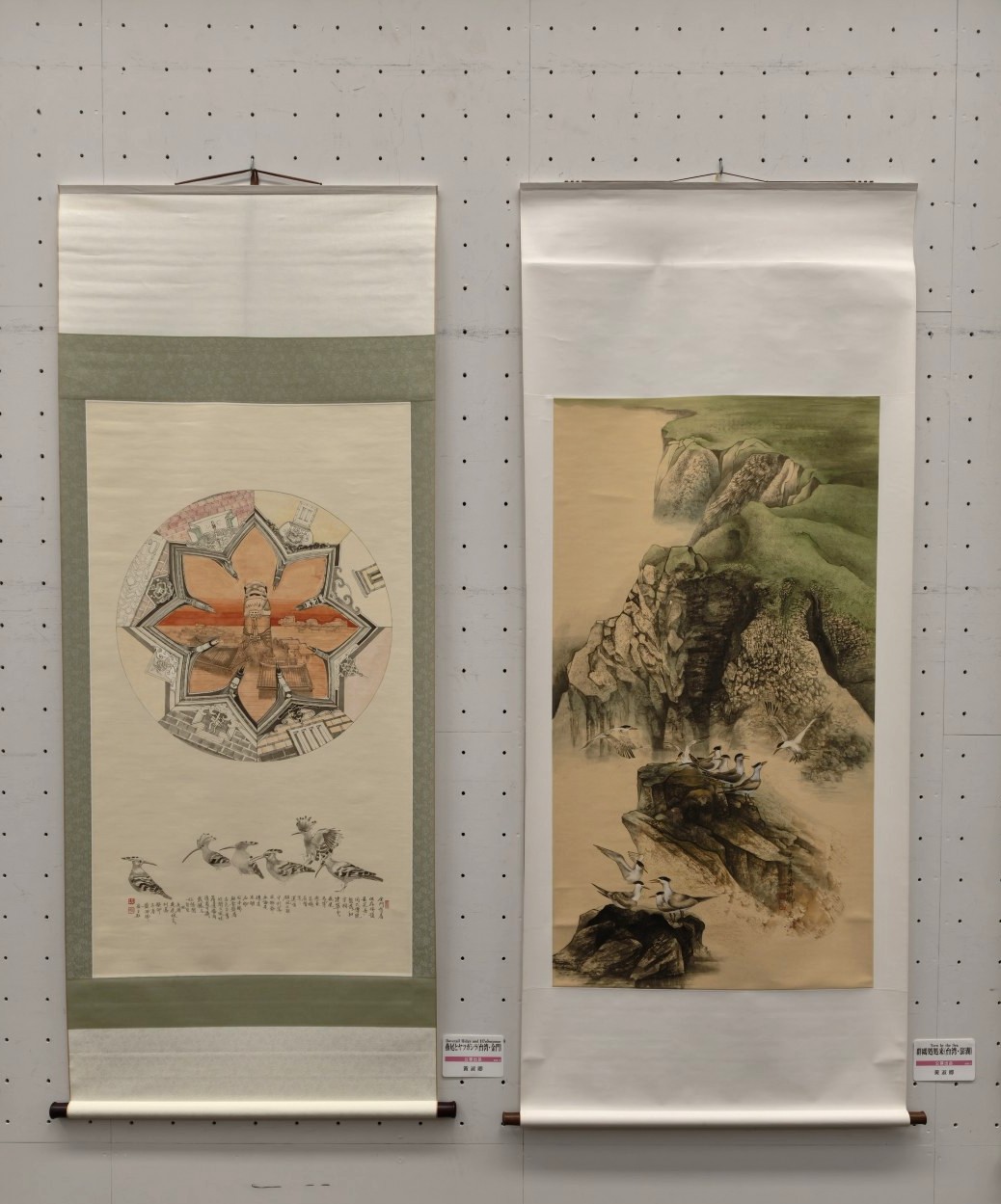
這件作品最先觸動人的,並不是色彩之繁,而恰恰是其節制。整幅大幅紙本之上,留下極大量的空白,中央偏上是一個近圓形的構造,如徽章、如天井、如窗、如鏡,又如一枚被時間磨亮而仍保有邊界的記憶器皿。這圓形之中,燕尾脊被拆解、旋轉、重組,構成一朵近似花形的幾何結構;那尖翹上揚的屋脊,像建築的指尖,又像某種古老形式在向天空提出無聲的發問。中央視野之內,則有偏紅橘色的地平、村落屋頂、以及一根直立的柱狀形體,像風獅爺、像守護者,也像地方精神的中軸。畫面下方,幾隻戴勝鳥立於大面積留白之中,姿勢各異,有的昂首,有的轉身,有的一足微抬,有的羽冠展開,像在彼此呼應,又像在等待某種只有牠們知道的時間。下緣並有題字與印章,將整幅作品重新拉回紙本書寫的傳統脈絡之中。
我向來偏愛那些不急於把意義一次說盡的作品,因為越是成熟的圖像,越懂得保留一些不肯立刻被翻譯的部分。黃淑卿這件作品正是如此。你若問它畫的是什麼,答案似乎並不難:金門傳統閩南建築的燕尾脊,地方文化象徵,與棲息其地的戴勝鳥。然而你若只停在這一層,便幾乎等於沒有開始閱讀它。因為畫中的燕尾,不只是建築細部;戴勝,也不只是地方鳥種。二者被放在同一畫面之中,且不是自然寫生式地同置一景,而是以一種近乎象徵學、空間哲學與記憶圖譜的方式彼此回應。換言之,這並不是「建築加鳥」的圖像,而是一個關於棲居、守護、回返、地方性與文化形式如何交纏的思想性構圖。 海德格說過一句極重要的話:
「人詩意地棲居於大地之上。」
這句話常被引述,卻也常被說得太輕。多數人理解「詩意地棲居」,彷彿只是住得優雅、過得從容;其實海德格的意思更深,因為他關心的從來不是裝飾性的美,而是人如何在世界之中真正安頓自己。棲居並非單純占有一個住所,而是與天、地、神聖、凡俗之間建立某種不輕率、不粗暴的關係。若依此來看〈燕尾與戴勝〉,我們便會發現,畫中的燕尾脊不只是地方建築的裝飾特色,而是人曾經如何在土地上建立秩序、祈願安穩、標示身份與凝聚共同感的一種形式證詞。那上揚的脊線,本身就帶著一種超越純功能的姿態:它不是只為遮風避雨,而是在說,居住也可以有尊嚴,有方向,有向上抬升的精神線條。黃淑卿把這些屋脊拆出來、放大、環狀重構,像是在提醒觀者:地方文明真正不會消失的,也許不是整座房子,而是那一筆曾經使房子不只是房子的精神筆勢。
而與屋脊相對的戴勝鳥,則把棲居的問題從人的建造,推回非人生命的存在方式。戴勝不是籠中鳥,不是祥瑞圖式裡被馴化的禽鳥,而是一種懂得在地面、林緣、村落周邊與老建築之間活動的生命。牠有明顯的羽冠,有細長的喙,樣貌既古怪又優雅,幾乎自帶一種介於滑稽與神祕之間的氣質。黃淑卿沒有把戴勝畫成陪襯,也沒有使牠們僅僅成為地方風物誌的插圖;相反地,這幾隻戴勝被放在下方大片留白裡,反而具有某種存在論上的重量。牠們站在空白中,不像被畫家「安置」上去,倒像從畫外一步一步走進來,自己在紙上佔據了位置。於是,整件作品便形成一種極有意思的對照:上方是人類文明濃縮後的形式結晶——燕尾脊、窗框、磚飾、守護形象;下方則是鳥,作為另一種不依照建築學、卻同樣深知如何住在地方上的生命。這使我想到,真正的地方並不只由人保存,也由鳥保存;不只存於文史資料,也存於季節性返來的身影、巷弄邊緣的覓食,以及那些比人更早知道哪裡仍然適合停留的生命經驗裡。
在這一點上,巴舍拉對「家屋」的思考極能幫助我們理解此作。巴舍拉在《空間詩學》中並不把房子只當作物質建築,他說房子既是庇護,也是記憶的器官,是人如何在世界中形成內在空間的原型。若我們把這個思路稍作轉移,便會明白黃淑卿畫中的燕尾脊之所以動人,並不在於「建築畫得真」,而在於它被畫成了一種地方記憶的精神器官。它像一個入口,也像一個盛器;像窗,也像瞳孔;像宗祠門面的一部分,也像時間對地方開出的一朵形之花。更微妙的是,這個結構被置於圓形之中。圓,本是最古老的宇宙形之一,常意味循環、回返、內在完整、天體、鏡面、護持。於是,上方的圓形構造便不再只是構圖技巧,而像一種象徵性的界面:它把地方從單純地理轉化為一個可被回望、可被保存、可被重新組織成精神空間的「內景」。
若說巴舍拉讓我們理解此作的內在空間性,那麼班雅明則使我們看見它的歷史氣息。班雅明談「靈光」(aura)時,說的是一種距離中的在場,一種不可完全被複製的時間厚度。今日談地方文化,往往容易變成觀光語彙:特色、保存、活化、再利用、觀光亮點。這些詞當然有其社會實用性,卻也常把地方變成可消費的標籤,而失去真正的時間重量。黃淑卿之所以高明,在於她並不直接把金門畫成可瀏覽的景觀,而是把金門畫成一種帶著距離、帶著回望、帶著文化靈光的場域。中央那紅橘色的天空與聚落,並非自然主義地描繪,而像記憶中被提煉過的一塊時間;屋脊與裝飾構件亦並非實測圖,而像在歷史淘洗之後剩下的精華與殘響。畫中之地方,不是旅遊手冊裡的地方,而是班雅明意義上「仍帶著靈光」的地方:它未完全被現代視覺制度所收編,仍保有一些不能被立即平面化、資訊化的文化氣息。
我又不禁想到利科關於記憶與痕跡的思考。利科曾一再提醒我們,記憶不是把過去原封不動地帶回來,而是以痕跡、重述、再構的方式,把已逝之物重新安置於當下。從這個角度看,黃淑卿的作品具有很強的「記憶工程」性質,但這工程不是冷冰冰的修復,而是一種帶著情感與形式智慧的再建。她沒有把燕尾脊照樣複製,而是重組;沒有把戴勝放入具體場景,而是抽離到空白當中;沒有把金門畫成實景透視,而是把它壓縮進一種像內景、像徽章、像精神模型的構造裡。這種作法本身便在說:地方不是死守原貌,而是在不斷的再敘述中保存自己。真正的保存,不只是把舊物留著,而是讓它有能力在新的形式裡繼續說話。
至於下方的戴勝,其實把這件作品往更深的哲學方向又推了一層。很多人談地方,總習慣只談人如何屬於某地,卻很少問:其他生命是否也以牠們自己的方式屬於此地?鳥與建築在這裡之所以重要,不僅因為它們都具有識別性,更因為它們一起提出了一個問題:地方究竟是人的產物,還是人與非人共同編織出來的居住網絡? 戴勝並不懂人類的歷史敘事,卻可能比人更早知道,哪裡有合適的樹洞、磚縫、荒地與靜處。牠們不像人那樣書寫地方史,但牠們用身體的往返、棲止與繁殖,在另一種尺度上把地方活出來。這使作品超越了僅僅追憶地方文化的層面,而更接近一種多物種的地方存在論:地方不只是人的祖厝、人的聚落、人的記憶;地方也是鳥的領域、草木的節令、非人生命與人類文明偶然卻深刻地重疊之所。
德勒茲曾說,形式不是靜止的輪廓,而是力量留下的痕跡。此語放在這件作品上,格外耐人咀嚼。燕尾脊之所以成其形,並不只是工匠手藝;它其實凝聚了宗族倫理、地方審美、建築技術、風土因應與文化榮譽感。戴勝之為戴勝,也不只是生物圖鑑上的分類,而是一種長期與地方邊界、田野、聚落共生後所形成的棲止樣式。換言之,這件作品中的每一種形式背後,都不是空洞的圖樣,而是力量:歷史的力量、作為地方文化形塑者的人類集體力量、季風與沿海環境的力量、以及生物適應地景的力量。黃淑卿把它們聚在一張紙上,不是為了做知識陳列,而是使觀者看到,原來地方並不是由單一敘事構成,而是由多重時間、多種生命形式、多層文化力量互相纏繞而成。
我尤其欣賞這件作品的大面積空白。今天太多畫怕空,怕觀者覺得不夠滿、不夠豐富、不夠熱鬧,於是急著把一切填滿;然而真正有哲學性的作品,往往懂得留下那些不可被立即占滿的區域。黃淑卿這件畫裡的空白,在我看來,並非空缺,而是思考的場所,是地方仍未被說盡的部分,是歷史說到一半刻意沉默之處,也是鳥得以站立、觀者得以停留、文字得以慢慢沉澱的紙上氣候。這使整件作品頗有一種近乎儀式的靜度:上方的圓形像內殿、像聖龕、像一枚地方靈魂的剖面;下方的鳥與文字,則像日常與言說,仍在這種聖性的輻射下緩慢呼吸。如此一來,畫面不再只是視覺配置,而更像一種精神秩序:上有文化之形,下有生命之行,中間大片留白,留給時間與觀看自行完成最後的連接。
黃淑卿這件作品之於我,便像一次安靜卻不容忽視的提醒:人若要真正愛一個地方,便不能只愛它作為自己的記憶背景,也不能只愛它那些方便被說成文化資產的部分;人還應學會去理解,一個地方之所以成立,常常是因為有太多不是由我個人意志所決定的事物在彼此成全——有祖屋的脊線,有工匠的手,有季風帶來的光色,有鳥在殘瓦與田野間留下的生活節律,也有一代代人把地方從居住轉化為意義的耐心。若無此等耐心,地方便會迅速淪為景點,文化便淪為樣式,而鳥也只剩下自然教育圖鑑上的名字。
所以我看〈燕尾與戴勝〉,最終讀到的不是鄉愁,而是一種更難得的東西:地方的形上學。何謂地方?它不是單純一塊地,也不是單純一組人文符號。地方是形式被時間反覆使用之後留下的精神密度;是文明不全靠文字、而也靠屋脊、飛羽、空白與遺留之物慢慢構成的內在秩序。黃淑卿把金門畫得如此安靜,正因她要說的不是表面的熱鬧,而是那些真正耐久的東西:屋脊如何向上,鳥如何停下,夕光如何使聚落既像在場又像遠去,而一張紙如何可以容納如此多層不同速度的時間。
黃淑卿〈燕尾與戴勝(台灣金門)〉以紙本彩墨構築出一個兼具地方記憶、建築象徵與非人生命存在感的複合場域。作品上方以圓形結構收納燕尾脊、磚飾、聚落與守護形象,形成近似窗、鏡、徽章與精神器皿的視覺界面;下方數隻戴勝則被置於大片留白之中,使鳥不再只是地方風物的陪襯,而成為另一種棲居此地的存在者。若借海德格「詩意地棲居」的觀點,可見作品中的燕尾脊並非單純裝飾,而是地方文明如何在土地上建立秩序與尊嚴的形式證詞;巴舍拉對家屋與內在空間的論述,則說明了圓形結構何以具有地方記憶器官般的精神性。班雅明的「靈光」與利科對記憶痕跡的思考,進一步揭示出作品並非寫實再現金門,而是在重組中保存其文化時間厚度。整體而言,〈燕尾與戴勝〉不只是描繪地方,而是將地方提升為一種建築、生命、記憶與存在彼此交纏的形上學空間。
其他相關內容:
【現場直擊】【台日交流展】東京都美術館開館100周年記念《第14回東京現展》展場:日本國立東京都美術館
On Why Rooftops, Birds, and Places Are More Than Geography: On Huang Shu-ching’s Swallowtails and Hoopoes (Kinmen, Taiwan)
Written by WANG MUTI
If one truly wishes to understand a place, relying solely on a map is profoundly insufficient. A map offers boundaries, roads, orientations, and names of administrative districts, yet it fails to convey how a place takes shape within the wind, how it settles within the human heart, how it is remembered along the flight paths of birds, or how, through the lines of architecture and the turns of tiled ridges, it slowly transforms into an existence that can be recognized and yearned for. If a place is reduced to mere coordinates, it is nothing but space. A place becomes a place because memory clings to it, because life deposits itself there layer by layer, and because certain things—such as a specific rooftop ridge, a certain species of bird, a particular twilight, or a collective sense of direction within a settlement—ensure that it is no longer just "there," but becomes an irreplaceable "here."
Huang Shu-ching’s Swallowtails and Hoopoes (Kinmen, Taiwan), in my eyes, is precisely a work about how a place is preserved, gazed upon, and translated into a spiritual structure. It does not merely paint Kinmen; it illustrates how Kinmen, as a cultural landscape, is collectively constituted by architecture, avian life, memory, and empty space.
The Architecture of Memory and the Non-Human Inhabitant
What first touches the viewer in this artwork is not an abundance of color, but precisely its restraint. Across this grand sheet of paper, an exceptionally large amount of negative space is left blank. In the upper center lies a near-circular structure—resembling an emblem, a ceiling well, a window, a mirror, or a vessel of memory that has been polished by time yet retains its boundary. Within this circle, the traditional "swallowtail" roof ridges of Minnan architecture are deconstructed, rotated, and reassembled to form a geometric structure akin to a blooming flower. Those sharply upturned ridges resemble the fingertips of the architecture, or an ancient form posing silent questions to the sky.
Within the central field of vision, one discerns a reddish-orange horizon, village rooftops, and a vertical, pillar-like form—resembling a Wind Lion God (Fengshiye), a guardian, or the central axis of the local spirit. In the lower portion of the canvas, several hoopoes stand amidst a vast expanse of white negative space, each in a different posture: some lifting their heads, some turning around, one slightly raising a foot, and another unfolding its crest, as if echoing one another or waiting for a specific moment in time known only to them. Inscribed text and seals grace the bottom edge, pulling the entire work back into the traditional lineage of paper and ink calligraphy.
I have always harbored a partiality for works that refuse to exhaust their meaning all at once, for the more mature an image is, the more it understands how to reserve certain dimensions that defy immediate translation. Huang Shu-ching’s work is precisely of this caliber. If you ask what it depicts, the answer seems simple enough: the swallowtail ridges of traditional Minnan architecture in Kinmen, a symbol of local culture, and the hoopoes that inhabit the land. Yet, if you stop at this layer, you have essentially not begun to read it. The swallowtails in the painting are not merely architectural details, nor are the hoopoes just a local bird species. The two are placed on the same canvas—not juxtaposed realistically as a casual sketch of a scene, but responding to each other through a methodology akin to symbology, spatial philosophy, and a cartography of memory. In other words, this is not an image of "architecture plus birds," but a conceptual composition demonstrating how dwelling, guarding, returning, locality, and cultural forms entangle.
Heideggerian Dwelling and the Organ of Remembrance
Martin Heidegger once wrote a profoundly critical phrase:
"...poetically man dwells upon this earth."
This line is frequently cited, yet it is often uttered too lightly. Most people comprehend "poetical dwelling" as merely living elegantly or moving through life with ease; in truth, Heidegger’s meaning runs far deeper, for his concern was never decorative beauty, but how humanity truly settles itself within the world. Dwelling is not the simple occupation of a residence; it is the establishment of a non-frivolous, non-violent relationship between the sky, the earth, the divinities, and the mortals.
Viewed through this lens, the swallowtail ridges in Swallowtails and Hoopoes are not merely ornamental features of local architecture; they serve as a formal testimony of how humanity once established order, prayed for stability, marked identity, and consolidated a sense of community upon the land. That upturned ridge line inherently carries a posture that transcends pure utility: it does not exist solely to ward off wind and rain, but declares that habitation can possess dignity, direction, and a spiritual line that lifts upward. By extracting, magnifying, and circularly reconstructing these roof ridges, Huang Shu-ching seems to remind the viewer: what truly escapes vanishing in a local civilization is perhaps not the entire house, but that spiritual stroke of the brush that once ensured a house was more than a house.
Conversely, the hoopoes situated opposite the rooftops push the question of dwelling from human construction back to the existential mode of non-human life. The hoopoe is not a caged bird, nor a domesticated fowl within an auspicious decorative motif; it is a life form that knows how to operate between the ground, the forest edge, the periphery of villages, and ancient structures. It possesses a distinct crest and a slender bill, appearing both eccentric and elegant, naturally carrying an air poised between the whimsical and the mysterious. Huang Shu-ching does not render the hoopoes as mere background, nor does she reduce them to mere illustrations for a local gazetteer. On the contrary, placing these hoopoes within the vast empty space below endows them with an ontological weight. Standing in the blankness, they do not appear "arranged" there by the artist; rather, they look as if they have walked in step-by-step from outside the canvas, claiming their own positions upon the paper.
Consequently, the artwork forms a highly fascinating contrast: above is the formal crystalized essence of human civilization—swallowtail ridges, window frames, brick ornaments, and guardian figures; below are the birds, serving as another form of life that does not follow architectural rules yet deeply understands how to live within the locality. This makes me realize that a true place is preserved not only by humans, but also by birds; it resides not only in historical archives, but also in the seasonally returning silhouettes, the foraging along the edges of alleys, and those life experiences that knew long before humans where it was still suitable to stay.
Here, Gaston Bachelard’s reflections on the "house" immensely assist our understanding. In The Poetics of Space, Bachelard does not view a house merely as a physical building; he argues that a house is both a shelter and an organ of memory, the prototype of how humanity constructs an interior space within the world. If we shift this line of thought slightly, we will realize that the reason the swallowtail ridge in Huang's painting is moving lies not in the "realistic precision of the architecture," but in its depiction as a spiritual organ of local memory. It acts as an entrance and a vessel; a window and a pupil; a fragment of a clan ancestral hall's facade, and a flower of form opened by time upon the locality. More subtly, this structure is enclosed within a circle. The circle, as one of the most ancient cosmic shapes, frequently signifies cycle, return, inner wholeness, celestial bodies, mirrors, and protection. Thus, the upper circular construction ceases to be a mere compositional technique; it becomes a symbolic interface that transforms a place from pure geography into an "interior view" (内景) that can be looked back upon, preserved, and re-organized into a spiritual space.
Benjamin’s Aura and Ricoeur’s Memory Traces
While Bachelard permits us to comprehend the internal spatiality of this work, Walter Benjamin allows us to perceive its historical atmosphere. When Benjamin discusses "aura," he speaks of a presence within a distance, a thickness of time that defies complete reproduction. Today, discussions regarding local culture easily devolve into tourist vocabulary: characteristics, preservation, revitalization, adaptive reuse, and scenic highlights. While these terms possess social utility, they frequently reduce a place to a consumable label, stripping away its true temporal weight.
Huang Shu-ching’s brilliance lies in her refusal to directly paint Kinmen as a browseable landscape; instead, she paints Kinmen as a field carrying distance, looking back, and cultural aura. The red-orange sky and settlement at the center are not rendered through naturalism; they resemble a distilled block of time excavated from memory. The roof ridges and decorative components are not measured blueprints; they are the essences and echoes remaining after the washing of history. The place in this painting is not the place found in travel brochures; it is a place "still bearing its aura" in the Benjaminian sense—one that has not been completely co-opted by the modern visual apparatus, still retaining a cultural air that cannot be immediately flattened or institutionalized into raw information.
I am further reminded of Paul Ricoeur’s reflections on memory and traces. Ricoeur repeatedly reminded us that memory does not bring back the past completely unaltered; rather, through traces, re-narration, and reconstruction, it re-settles that which has passed within the present. From this perspective, Huang Shu-ching’s work bears a powerful characteristic of "memory engineering," yet this engineering is not a cold restoration. It is a re-creation packed with emotion and formal wisdom. She does not copy the swallowtail ridges exactly; she reassembles them. She does not place the hoopoes within a concrete scene; she extracts them into a void. She does not paint Kinmen in a realistic perspective; she compresses it into a construction resembling an interior view, an emblem, or a spiritual model. This methodology itself declares: a place does not preserve itself by rigidly clinging to its original appearance, but through continuous re-narration. True preservation does not merely keep old items; it grants them the capacity to continue speaking within new forms.
The Traces of Force and the Climate of Blankness
The hoopoes below actually push this work an entire layer further into a deeper philosophical direction. When discussing a place, many are accustomed only to talking about how humans belong to it, yet they rarely ask: Do other life forms also belong here in their own ways? The convergence of birds and architecture here is crucial not only because they are identifiable, but because together they pose a question: Is a place purely a human product, or is it a residential network co-woven by the human and the non-human?
Hoopoes do not comprehend humanity’s historical narratives, yet they likely knew long before humans where to find suitable tree hollows, brick crevices, wild lands, and quiet sanctuaries. They do not write local history as humans do, but through the coming and going of their bodies, their perching, and their breeding, they live out the place on an alternative scale. This elevates the work beyond the mere recollection of local culture, bringing it closer to a multi-species ontology of place: a place is not solely the ancestral home, settlement, or memory of humans; it is also the territory of birds, the seasons of vegetation, and a site where non-human life and human civilization overlap accidentally yet profoundly.
Gilles Deleuze once noted that form is not a static contour, but the trace left behind by forces. This statement is exceptionally resonant when applied to this artwork. The swallowtail ridge achieves its form not merely through craftsmanship; it condenses lineage ethics, local aesthetics, architectural techniques, wind-and-earth adaptations, and a sense of cultural honor. The hoopoe being a hoopoe is not just a classification in a biological guidebook, but a mode of perching formed after long-term symbiosis with local boundaries, fields, and settlements. In other words, behind every form in this work lies not a hollow pattern, but forces: the force of history, the collective human force that shapes local culture, the force of the monsoon and the coastal environment, and the force of biological adaptation to the landscape. Huang Shu-ching gathers them upon a single sheet of paper not to create an exhibition of knowledge, but to allow the viewer to see that a place is not composed of a singular narrative; it is formed by multiple times, diverse life forms, and layered cultural forces entangling with one another.
I particularly admire the massive area of blankness in this work. Today, too many paintings fear the void, terrified that the viewer might find the canvas insufficiently full, rich, or bustling, and thus they rush to pack everything tightly. Yet, truly philosophical works always know how to reserve areas that refuse to be immediately occupied. The blankness in Huang Shu-ching’s painting, in my view, is not a vacancy; it is a locus for thought, the un-exhausted portion of the place, a deliberate silence when history is halfway through its speech, and a paper climate where birds can stand, viewers can linger, and words can slowly settle. This grants the entire piece a stillness akin to a ritual: the upper circle resembles an inner sanctuary, a holy shrine, or a cross-section of a local soul; the birds and words below resemble the everyday and speech, still breathing slowly under the radiation of this sacredness. Consequently, the canvas is no longer just a visual configuration, but a spiritual order: cultural forms above, the movement of life below, and a vast expanse of negative space in between, left for time and viewing to complete the final connection on their own.
Conclusion
To me, Huang Shu-ching’s work acts as a quiet yet unignorable reminder: if one truly loves a place, one cannot love it merely as a background for one's own memory, nor can one love only those parts easily articulated as cultural heritage. One must also learn to comprehend that the establishment of a place is frequently due to the mutual fulfillment of too many things that are not decided by personal will—there are the ridge lines of ancestral homes, the hands of craftsmen, the light and color brought by the monsoon, the living rhythms left by birds between broken tiles and fields, and the patience of generations translating habitation into meaning. Without such patience, a place rapidly degenerates into a tourist spot, culture degenerates into a mere pattern, and birds are reduced to mere names in a natural education manual.
Therefore, when I look at Swallowtails and Hoopoes, what I ultimately read is not nostalgia, but something far more precious: the metaphysics of place. What is a place? It is not a simple plot of land, nor a simple set of human symbols. A place is the spiritual density left behind after forms are repeatedly used by time; it is an internal order slowly constituted by civilization, relying not entirely on words, but also on rooftops, flight feathers, blank spaces, and relics left behind. That Huang Shu-ching paints Kinmen with such absolute stillness is precisely because what she wishes to speak of is not surface bustling, but those things that are truly durable: how rooftops lift upward, how birds come to a halt, how the evening light ensures a settlement appears simultaneously present yet distant, and how a single sheet of paper can accommodate so many layers of time moving at different speeds.
Summary Note: Huang Shu-ching’s Swallowtails and Hoopoes (Kinmen, Taiwan) constructs a complex field through ink and color on paper, uniting local memory, architectural symbolism, and the existential presence of non-human life. The upper portion of the composition utilizes a circular structure to contain swallowtail ridges, brick decorations, settlements, and guardian images, forming a visual interface akin to a window, a mirror, an emblem, or a spiritual vessel. Below, several hoopoes are positioned within a vast expanse of negative space, ensuring that the birds are no longer mere background accoutrements to local scenery, but distinct existences dwelling in the locality. Drawing upon Heidegger’s concept of "poetical dwelling," the swallowtail roof ridges are not mere decorations, but a formal testimony of how local civilization establishes order and dignity upon the land. Gaston Bachelard’s discourse on the house and internal space elucidates how the circular structure acquires a spirituality akin to an organ of local memory. Walter Benjamin’s "aura" and Paul Ricoeur’s reflections on memory traces further reveal that the work is not a realistic reproduction of Kinmen, but a preservation of its cultural-temporal thickness through reassembly. On the whole, Swallowtails and Hoopoes transcends the mere depiction of a locality, elevating it into a metaphysical space where architecture, life, memory, and existence are profoundly intertwined.
屋根、鳥、そして場所がいかに単なる地理にとどまらないかについて――黃淑卿(ファン・シューチン)『燕尾とヤツガシラ(台湾・金門)』に寄せて
執筆:王穆提(ワン・ムーティ)
人間が真に一つの場所を理解しようとするならば、地図だけに頼るのでは到底不十分である。地図は境界、道路、方位、行政区名を与えてくれるが、その場所がいかにして風の中で形を成し、人の心の中に沈殿し、鳥の飛行ルートの中で記憶され、そして建築の線条や瓦の屋根の曲折の中で、いかにして識別可能であり、また懐かしむことのできる「存在」へと緩やかに変わっていったのかを教えてはくれない。場所がもし単なる座標へと縮小されてしまえば、それはただの空間に過ぎない。場所が場所となるのは、そこに記憶が付着し、生活が幾重にも堆積し、いくつかの事象――たとえば、ある特有の屋根、ある種の鳥、ある独特の夕映え、ある聚落(集落)の方向感覚――が、そこを単なる「あそこ」ではなく、いかなるものにも代えがたい「ここ(此地)」たらしめるからである。
黃淑卿の描いた***『燕尾とヤツガシラ(台湾・金門)』***は、私の目に、場所がいかにして保存され、凝視され、精神の構造へと転化されるかを示す傑作として映る。それは単に金門を描いたのではなく、金門という一つの「文化的地景(ランドスケープ)」が、建築、鳥類、記憶、そして余白によっていかに共同で構成されているかを描き出しているのである。
記憶の建築学と非人間的棲息者
この作品が最初に人の心を揺さぶるのは、色彩の華やかさではなく、まさにその「節制」にある。広大な紙面の上には、極めて大胆な余白(留白)が残されており、中央の上寄りには、ほぼ円形に近い構造が配されている。それは徽章(エンブレム)のようでもあり、天井(あるいは伝統建築の井戸)のようでもあり、窓や鏡のようでもあって、さながら時間によって磨き上げられながらもなお自らの境界を保ち続ける「記憶の器」のようである。この円形の中で、伝統的な閩南(びんなん)建築の「燕尾脊(えんびせき=ツバメの尾のように反り返った屋根の尖端)」が解体され、回転され、再組織化され、一輪の花に似た幾何学的構造を形成している。あの鋭く上方を指す屋根は、建築の指先のようでもあり、あるいはある古き形式が天空に向かって無声の問いを投げかけているかのようでもある。
中央の視野の中には、かすかに赤オレンジ色を帯びた地平線、聚落の屋根、そして垂直に立つ柱状の形体が見て取れる。それは「風獅爺(フーシエ=金門の魔除けの獅子像)」のようでもあり、守護者のようでもあり、その土地の精神の中軸(センター・アクシス)のようでもある。画面の下方では、数羽の戴勝(ヤツガシラ)が広大な白い余白の中に佇んでおり、その姿勢はそれぞれ異なっている。あるものは首を掲げ、あるものは身を翻し、あるものは片足を幽かに上げ、あるものは羽冠(冠羽)を広げている。それは互いに呼応し合っているようでもあり、あるいは彼らだけが知っている「ある時間」をじっと待っているかのようでもある。下縁には題字と印章が配され、作品全体を再び紙本書寫(伝統的な書画)の文脈へと引き戻している。
私はかねてより、意味を一度にすべて語り尽くそうと急がない作品を偏愛している。なぜなら、成熟した図像であればあるほど、すぐには翻訳されることを拒む「いくつかの領域」をあえて保留することを知っているからだ。黃淑卿のこの作品は、まさにそのような格調を備えている。もしこれが「何を描いたのか」と問うならば、答えはそれほど難しくないように思える。金門の伝統的な閩南建築の燕尾脊という地方文化の象徴と、その地に棲息する戴勝(ヤツガシラ)である。しかし、もし思考がこの表層に留まってしまうならば、それはこの画を読み始めたことには全くならない。なぜなら、画中の燕尾は単なる建築のディテールではなく、ヤツガシラもまた単なる地方の鳥類ではないからだ。二者は同一の画面に配されているが、それは自然主義的な写生のように同じ景色の中に偶発的に置かれているのではない。そうではなく、ある種の象徴学、空間哲学、そして記憶の図譜(トポロジー)とも言うべき方式において、互いに応答し合っているのである。言い換えるならば、これは「建築プラス鳥」の図像ではなく、棲居、守護、帰還、地方性、そして文化的形式がいかにしてもつれ合う(交纏する)かを示す「思想的な構図」なのだ。
ハイデッガー的棲居と記憶の器官
マルティン・ハイデッガーは極めて重要な次の一節を遺している。
「人は詩的に大地の上に棲まう」
この言葉はしばしば引用されるが、往々にしてあまりにも軽々しく語られがちである。多くの人は「詩的に棲まう」ということを、単に優雅に暮らし、余裕を持って生活することであるかのように理解している。しかし、ハイデッガーの意図はさらに深い。なぜなら彼が関心を持っていたのは、装飾的な美などではなく、人間がいかにして世界の中に「真に自らを安頓(落ち着かせる)させるか」という問題だったからだ。棲居(住まうこと)とは、単にある住処を所有することではなく、天、地、神聖なるもの、凡俗なるものとの間に、軽率ならざる、そして粗暴ならざる関係を構築することに他ならない。
この視点から〈燕尾與戴勝〉を眺めるならば、画中の燕尾脊は単なる地方建築の装飾的特徴ではなく、人間がかつていかにして土地の上に秩序を築き、安穏を祈り、身分を標示し、そして共同体感覚(コモン・センス)を凝聚させていったかを示す、形式の証言(エビデンス)なのだと気づくだろう。あの反り返り立ち上る屋根の線は、それ自体が純粋な実用性を超越した姿勢を宿している。それは単に風雨を遮るためだけに存在するのではなく、「住まうという営みもまた、尊厳を持ち、方向を持ち、上方へと引き上げられる精神の線条を持ちうるのだ」と語っている。黃淑卿はこれらの屋根を抜き出し、拡大し、環状に再構成した。それは鑑賞者に対して次のように注意を促しているかのようである。——地方の文明において真に消失しないものは、おそらく建物全体ではなく、かつてその建物を単なる建物以上のものたらしめた「精神の筆勢」なのだ、と。
一方で、屋根と相対するように配されたヤツガシラは、棲居という問いを、人間の建造物から「非人間生命(ノン・ヒューマン・ライフ)の存在方式」へと押し戻す。ヤツガシラは籠の鳥ではなく、吉祥図案の中で飼いならされた禽鳥でもない。それは地面、林の縁、聚落の周辺、そして古い建築の隙間の間を縦横に活動する術を知っている生命である。それには明瞭な羽冠があり、細長く伸びた嘴があり、その姿は奇妙でありながら優雅で、コミカルさと神秘性の狭間に位置する独特の気品を自ずから湛えている。黃淑卿はヤツガシラを単なる引き立て役(背景)としては描かなかったし、地方の風物誌の挿絵に格下げすることもしなかった。逆に、これらのヤツガシラを下方の広大な余白の中に配置したことで、それらにある種の存在論的な重量(オントロジカル・ウェイト)を与えたのである。
彼らは空白の中に立っているが、それは画家の手によってそこに「配置」されたようには見えず、むしろ画面の外から一歩一歩歩みを進めてきて、自らの意志で紙の上の位置を占拠したかのように見える。こうして、作品全体には極めて興味深い対照が形成される。上方は人間の文明が濃縮された形式の結晶――燕尾脊、窓枠、レンガの装飾、守護の形象であり、下方は鳥という、建築学には従わないものの、その場所に住まう術を同じように深く知っているもう一つの生命なのだ。このことは、真の場所というものは人間だけによって保存されるのではなく、鳥によっても保存されるのだということを私に気づかせる。それは単に文史資料の中にだけ存在するのではなく、季節ごとに帰ってくるそのシルエットの中に、路地の片隅での採餌の中に、そして人間よりも早く「どこがなお留まるにふさわしい場所であるか」を知っている生命経験の中にこそ存在しているのである。
この点において、ガストン・バシュラールによる「家(家屋)」への思考は、本作を理解する上で極めて強力な助けとなる。バシュラールは『空間の詩学』において、家を単なる物質的な建築物としては捉えない。彼は、家とは庇護(シェルター)であると同時に「記憶の器官」であり、人間がいかにして世界の中に内在的な空間を形成していくかというプロトタイプ(原型)なのだと言った。この思考の回路を少しだけスライドさせるなら、黃淑卿の画における燕尾脊がなぜこれほどまでに人の心を動かすのかが理解できるだろう。それは「建築がリアルに描かれているから」ではなく、それが「地方の記憶の精神的器官」として描かれているからだ。それは一つの入口のようであり、一つの器のようでもある。窓のようであり、瞳孔のようでもある。宗祠(祠堂)の門構えの一部であると同時に、時間がその場所に対して咲かせた「形式の花」のようでもある。さらに絶妙なのは、この構造が「円」の中に配置されている点だ。円とは、本来最も古き宇宙の形状の一つであり、循環、帰還、内包的な完全性、天体、鏡面、そして護持(プロテクション)を意味する。したがって、上方の円形構造は単なる構図のテクニックであることをやめ、一種の象徵的なインターフェース(界面)となる。それは場所を単なる地理から、回顧され、保存され、精神の空間へと再組織化されうる「内景」へと転化させているのである。
ベンヤミンのアウラとリクールの記憶の痕跡
バシュラールがこの作品の内在的な空間性を理解させてくれるとすれば、ヴァルター・ベンヤミンは私たちにその「歴史の気配」を感じさせてくれる。ベンヤミンが「アウラ」を語るとき、それは距離における存在の現れ(一回性の現れ)であり、完全には複製不可能な時間の厚みを指していた。今日、地方の文化を語るとき、往々にしてそれは観光のボキャブラリーへと回収されがちである。――特色、保存、活性化、コンバージョン(再利用)、観光のハイライト。これらの言葉には確かに社会的実用性があるが、それは往々にして場所を消費可能な「ラベル」へと変質させ、真の時間の重量を奪ってしまう。
黃淑卿の優れている点は、彼女が金門を単にブラウズ(消費)可能な景観として直接描くのではなく、金門を、ある種の距離を持ち、回顧をはらみ、文化的なアウラを湛えた磁場として描き出した点にある。中央の赤オレンジ色の空と聚落は、自然主義的に描写されているのではなく、記憶の中から蒸留された「時間の一片」のように見える。屋根や装飾の部材もまた、単なる測量図ではなく、歴史の淘汰(淘洗)の後に残されたエッセンスと残響なのだ。画の中の場所は、旅行パンフレットの中の場所ではない。それはベンヤミンのいう意味における「なおアウラをまとった場所」である。現代の視覚制度に完全には回収されず、すぐには平面化・情報化されることのない文化の気配を、なおその内に保ち続けているのである。
私はまた、ポール・リクールによる記憶と痕跡への思考を思い出さずにはいられない。リクールは、記憶とは過去をそのままの形で持ち帰ることではなく、痕跡、再述、そして再構成という方式において、過ぎ去ったものを現在のなかに新しく安頓させることなのだと反復して思い出させてくれた。この観点から見れば、黃淑卿の作品は極めて強い「記憶のエンジニアリング(記憶工程)」の性質を帯びている。しかし、このエンジニアリングは冷徹な修復ではない。それは感情と形式の知恵を伴った「再建」なのだ。彼女は燕尾脊をそのままコピーするのではなく、重組(再構築)した。ヤツガシラを具体的な背景の中に置くのではなく、空白の中へと抽離(デコンテクスト化)した。金門を実景のパース(透視図法)で描くのではなく、内景のようであり、徽章のようであり、精神の模型(モデル)のようでもある構造の中へと圧縮したのである。このアプローチ自体がこう物語っている。——場所とは、元の姿を死守することによってではなく、絶え間ない「再叙述(リ・ナラティブ)」の中でこそ自らを保存するのだ、と。真の保存とは、単に古いものを残しておくことではなく、それが新しい形式の中で「語り続ける能力」を持たせることなのである。
力の痕跡と余白の気候
下方に描かれたヤツガシラは、実のところ、この作品をさらに深い哲学の方向へと一重押し進めている。多くの人が場所を語るとき、往々にして「人間がいかにしてその場所に属しているか」だけを語りがちであり、次のような問いを立てることは滅多にない。——「他の生命もまた、彼ら自身の方式においてこの場所に属しているのではないか」という問いである。鳥と建築がここで交錯することが重要である理由は、それらが単に識別可能だからというだけでなく、それらが共同である一つの問いを突きつけているからだ。すなわち、「場所とは果たして人間の産物なのか、それとも人間と非人間(ノン・ヒューマン)が共同で編み上げた棲居のネットワークなのか」という問いである。
ヤツガシラは人間の歴史のナラティブを理解してはいないが、人間よりも早く、どこに適切な樹洞があり、レンガの隙間があり、荒地があり、静かな場所があるかを知っている。彼らは人間のように地方史を書くことはないが、自らの身体の往来、棲止、そして繁殖を通じて、もう一つの尺度の上でその場所を「生きて」いる。このことは、作品を単に地方文化を追憶するレベルから超越させ、複数種(マルチ・スピーシーズ)の「場所の存在論」へと近づける。場所とは、単に人間の祖先から受け継いだ家(祖厝)であり、人間の聚落であり、人間の記憶であるだけではない。場所とは鳥の領域であり、草木の節候であり、非人間の生命と人間の文明が、偶然でありながらも深く重なり合う場所なのである。
ジル・ドゥルーズはかつて、形式(形式)とは静止した輪郭ではなく、力が残した痕跡であると言った。この言葉をこの作品の上に置くとき、それは格別に深い余韻(耐人尋味)を伴って響く。燕尾脊がその形を成した理由は、単なる職人の技術によるものではない。それは実のところ、宗族(一族)の倫理、地方の審美、建築の技術、風土への適応、そして文化的名誉心を凝聚させたものなのだ。ヤツガシラがヤツガシラであるということも、単なる生物図鑑の上の分類ではなく、長きにわたり地方の境界、田野、聚落と共生した後に形成された棲止のスタイル(様式)なのである。言い換えるならば、この作品におけるあらゆる形式の背後にあるものは、空虚な図案などではなく、すべて「力」なのだ。歴史の力であり、地方文化の形成者としての人間集団の集団的な力であり、季節風と沿岸環境の力であり、そして生物が地景に適応していく力である。黃淑卿はそれらを一枚の紙の上に集めた。それは知識を陳列するためではなく、鑑賞者をして「場所とは単一のナラティブによって構成されているのではなく、多重の時間、多様な生命形式、そして幾重もの文化の力が互いにもつれ合うことで形成されているのだ」という事実を目撃させるためなのである。
私は特に、この作品の広大な面積を占める空白(留白)を賞賛したい。今日の多くの画は「空(くう)」を恐れる。鑑賞者に「物足りない」「豊かさがない」「賑やかさがない」と思われるのを恐れるあまり、急いですべてを埋め尽くそうとする。しかし、真に哲学的な作品というものは、往々にして、すぐには占有されることのない領域をあえて残しておく術を知っている。黃淑卿のこの画における空白は、私の目に、空虚としては映らない。それは思考の場所であり、場所がなお語り尽くされていない部分であり、歴史が半ばまで語られた後に意図的に沈黙した場所であり、鳥が佇み、鑑賞者が留まり、文字が緩やかに沈殿していくための「紙の上の気候」なのだ。これにより、作品全体には一種の儀式にも似た静度が自ずから生まれる。上方の円形は内殿のようであり、聖龕(せいがん)のようであり、地方の魂の断面(プロファイル)のようである。一方で下方の鳥と文字は、日常と言説のように、この聖性(サクレッド)の放射の下でなお緩やかに呼吸している。こうして、画面は単なる視覚的な配置であることをやめ、精神の秩序となる。上に文化の形があり、下に生命の行いがあり、その中間の広大な余白が、時間と観照が自ずから最後の連結を完成させるために残されているのである。
結論
黃淑卿のこの作品は、私にとって、静かでありながら無視することのできない警告のように響く。人間がもし真にある場所を愛そうとするならば、そこを単に自分自身の記憶の背景としてのみ愛するのでは不十分であり、文化資産として語りやすい部分だけを愛するのも不十分である。人間は、一つの場所が成立している理由は、往々にして自分自身の個人的な意志では決定できないあまりにも多くの事象が、互いに引き立て合っている(成全し合っている)からなのだと理解せねばならない。――祖先の家の屋根の線があり、職人の手があり、季節風がもたらす光色があり、鳥たちが瓦の残骸や田野の間に残した生活のリズムがあり、そして何世代にもわたる人々が「住まうこと」を「意味」へと転化させていったあの忍耐がある。もしこのような忍耐がなければ、場所は瞬く間に単なる観光地へと転落し、文化は単なるパターン(様式)へと縮小され、鳥もまた自然教育図鑑の上の名前に過ぎなくなってしまうだろう。
それゆえ、私が〈燕尾與戴勝〉を観るとき、最終的に読み取るものは郷愁(ノスタルジー)ではなく、さらに得難い価値、すなわち「場所の形而上学」である。場所とは何か。それは単なる一枚の土地ではなく、単なる一組の人文的記号でもない。場所とは、形式が時間によって反復して使用された後に残された「精神の密度」である。文明がすべてを文字に頼るのではなく、屋根、飛羽、余白、そして遺された物たちを通じて緩やかに構成していった「内在的な秩序」なのだ。黃淑卿が金門をこれほどまでに静かに描いた理由は、まさに彼女が語ろうとしたものが表面的な賑やかさではなく、それらの「真に耐久性のあるもの」だったからである。屋根がいかにして上方へと向かうか、鳥がいかにして足を止めるか、夕光がいかにして聚落をそこに在るようでありながら同時に遠ざかっていくようでもあるものに変容させるか、そして一枚の紙がいかにしてこれほど幾重もの、異なる速度の時間を包容しうるのか。本作は、そのすべてを実証しているのである。
黃淑卿の『燕尾とヤツガシラ(台湾・金門)』は、紙本彩墨の媒材を用いて、地方の記憶、建築の象徴性、そして非人間生命の存在感が交錯する複合的な磁場を構築している。作品の上方は、円形構造の中に燕尾脊、レンガの装飾、聚落、そして守護の形象を収めることで、窓、鏡、徽章、精神の器にも似た視覚的インターフェースを形成している。下方の数羽のヤツガシラは、広大な余白の中に配置されることで、単なる地方の風物の背景であることをやめ、その場所に棲まうもう一つの主体(存在者)として立ち現れる。ハイデッガーの「詩的に棲まう」という観点を借りるならば、画中の燕尾脊は単なる装飾ではなく、地方の文明がいかにして土地の上に秩序と尊厳を築き上げたかを示す「形式の証言」に他ならない。また、バシュラールによる家屋と内在空間の論述は、この円形構造がいかにして地方の記憶の器官のような精神性を獲得し得たかを説明している。ベンヤミンの「アウラ」やリクールによる記憶の痕跡への思考は、本作が金門を単に写実的に再現したのではなく、再構築(重組)の中でその文化的・時間的な厚みを保存したものであることをさらに露わにしている。総じて、『燕尾とヤツガシラ』は単に場所を描写した作品にとどまらず、場所という概念を、建築、生命、記憶、そして存在が互いにもつれ合う「形而上学的な空間」へと高めた成熟の傑作である。
黃淑卿簡歷
臺灣新北市汐止人
畢生致力於藝術教育與生態藝術的耕耘,以鳥類做為水墨創作的核心元素,結合自然人文景觀、民俗文化及原住民傳統藝術的內涵,以多元視野的藝術觀,實踐文化融合的理想。
學歷/國立台灣師範大學美術系創作理論組(水墨畫)博士。
個展/國立國父紀念館、凱達格蘭文化館、大同大學、桃園第一航廈、高雄市文化中心、桃園文化中心、台東生活美學館、娜路彎藝廊、台中市大墩文化中心、北科藝文中心等多次。
聯展/「再現原始-國際交流展」、台灣海洋畫會聯展、「傳承與衝擊—台灣中青水墨學術展」、香港「全球水墨畫大展」及「新北市藝術家聯展」「新北市土城桐花祭邀請展」、「台灣美術院院士聯展」、「巴黎大皇宮的首都藝術展」等多次。
獲獎/第57屆全省美展國畫類第二名;第51、52屆南美展永都獎;56、59屆全省美展優選等。