CHEN FU-CHI
Digital Simulacra, Imitation Xuan Paper, and Posthuman Freedom in The Pleasure of Fish
I. The Artist’s Position: A Turn of Medium in the Special Project Exhibition Area
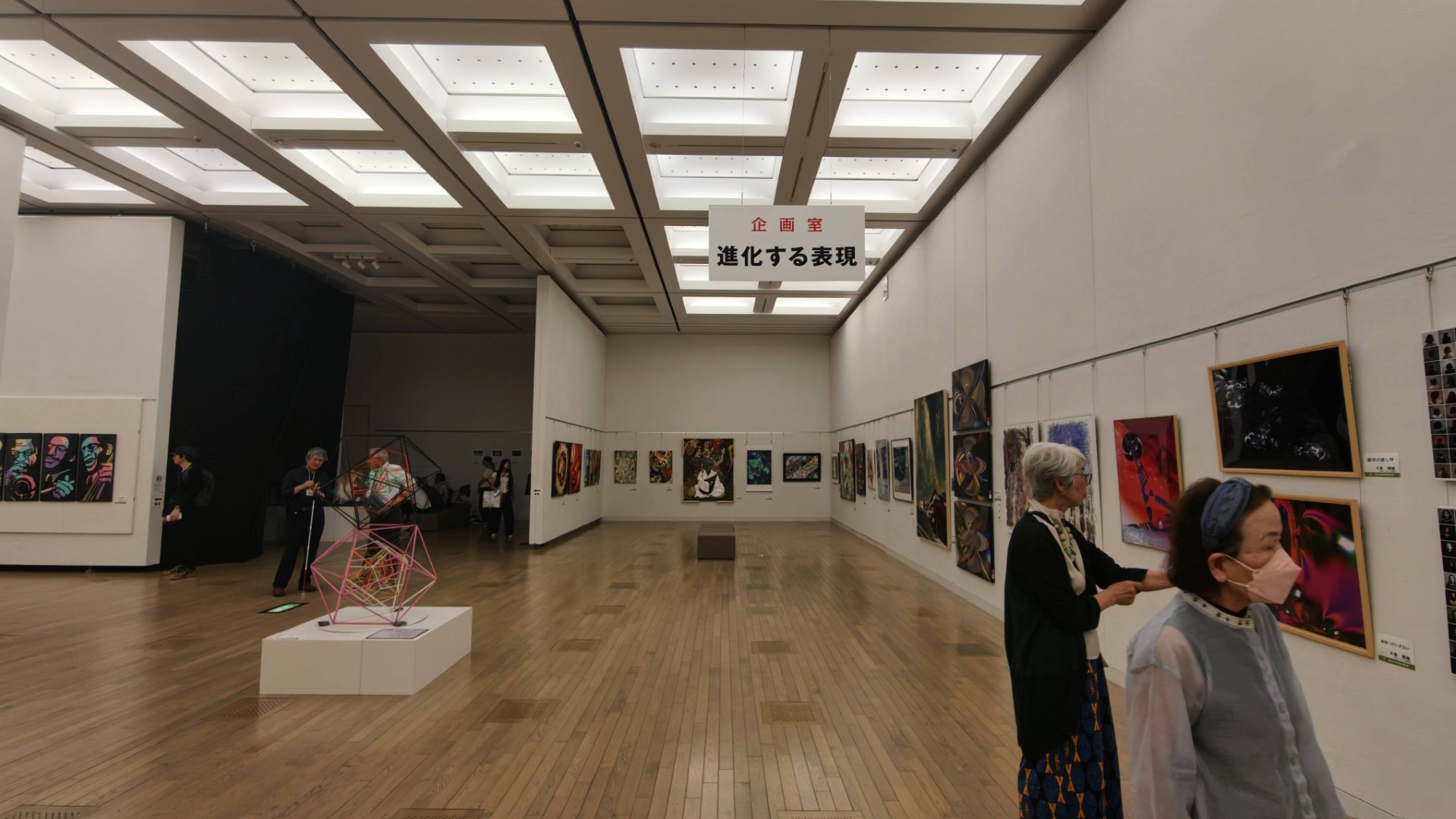
Among the portraits of Taiwanese artists in the 82nd Japan “Genten” Exhibition, Chen Fu-Chi occupies a position of special significance. His work The Pleasure of Fish “魚の楽しみ” was listed as selected for the Special Project Exhibition Area. This is not merely a difference in exhibition placement, but also indicates that Genten, as an art institution with a postwar public-entry tradition, accepts digital art, image-based art, and cross-media creation.
If the preceding artists mainly responded to the possibilities of East Asian paper-based painting in the contemporary exhibition site through color ink, ink wash, heavy color, processed xuan paper, and hanging-scroll formats, then Chen Fu-Chi pushes the question in another direction: when artistic creation no longer relies entirely on handmade brushstrokes, but is completed through digital generation, image output, imitation xuan-paper supports, and contemporary printing technologies, how can the work still preserve Eastern philosophy, viewing experience, and emotional depth?
Therefore, Chen Fu-Chi’s importance in this special topic lies not only in the fact that he presents a digital artwork, but in the way he prevents “digital media” from being understood as cold technical tools, transforming them instead into an artistic language capable of rewriting classical thought, life perception, and posthuman aesthetics.
His The Pleasure of Fish is not simply “an image made by computer,” nor merely the transformation of a traditional fish subject into a new medium. More importantly, he places the classical philosophical proposition of Zhuangzi’s “pleasure of fish” within the mediating structure of contemporary digital imagery and imitation xuan paper, allowing the work to face three levels simultaneously: classical thought, digital simulacra, and contemporary perception.
II. The Title of The Pleasure of Fish: From Zhuangzi’s Proposition to Digital Perception
The title The Pleasure of Fish directly calls to mind the famous debate between Zhuangzi and Huizi on the bridge over the Hao River: “You are not a fish; how do you know the pleasure of fish?” This proposition has long been more than a philosophical anecdote; it also involves questions of perception, empathy, subjectivity, and the experience of the other.
In the classical context, the “pleasure of fish” is not simply a discussion of whether fish are happy, but a question of how human beings understand the feelings of nonhuman life. Zhuangzi affirms the pleasure of fish through intuition and freedom, while Huizi raises objections through logical argument. Behind this debate are two ways of understanding the world: one is rational analysis, and the other is sympathetic resonance with all things.
When Chen Fu-Chi transforms this proposition into The Pleasure of Fish and places it within digital art, the question becomes even more complex. Today’s viewers no longer face real fish swimming in water, but fish generated through digital processing, color translation, image output, and imitation xuan-paper support. At this point, “How do we know the pleasure of fish?” is no longer merely a question between human and fish, but also a question among human beings, images, algorithms, media, and the perception of life.
In other words, Chen Fu-Chi’s work does not retell Zhuangzi’s story, but pushes Zhuangzi’s proposition into the posthuman age: when fish are no longer merely natural lives but luminous bodies within digital images; when water is no longer merely a natural liquid but a virtual environment composed of fluorescent color and pixels; when xuan paper is no longer true handmade paper but a modern output material with the texture of xuan paper, where exactly does “the pleasure of fish” exist?
This question allows the work to move beyond simple image appreciation and enter the level of philosophy and media criticism.
III. The Mediating Significance of Imitation Xuan Paper: The Intersection of Classical Memory and Digital Output
One of the important keys to The Pleasure of Fish lies in the fact that its medium has the quality of “imitation xuan paper.” Imitation xuan paper is not the same as traditional xuan paper. It may possess fiber-like texture, visual grain, or an East Asian paper-based impression similar to xuan paper, yet in essence it exists as a support for modern image output, digital giclée printing, or related technologies.
This medium itself has critical value. Traditional xuan paper is closely connected to Eastern ink wash, carrying the immediate reactions among brush, ink, water, and paper; when a brushstroke falls, ink penetrates the fibers and leaves irreversible traces. The value of xuan paper lies in its material sensitivity, and also in its relationship with the bodily nature of calligraphy and painting.
Imitation xuan paper, however, occupies another state. It preserves the cultural memory of xuan paper, yet serves the output of digital images. It appears traditional, yet is in fact modern; it appears paper-based, yet carries the logic of industrial production and image media. This contradiction gives The Pleasure of Fish very distinct media tension.
Chen Fu-Chi chooses imitation xuan paper rather than ordinary photographic paper, aluminum panels, acrylic, or screens, showing that he does not wish the work to completely detach from the Eastern paper-based tradition. On the contrary, he allows the digital image to wear a skin with classical memory, making the work seem as if it came from traditional ink wash while also clearly belonging to the digital age.
Therefore, imitation xuan paper is not a neutral support, but part of the work’s meaning. It places The Pleasure of Fish simultaneously between “resembling ink wash” and “not being ink wash,” and also makes viewers constantly aware of the instability of the medium’s identity while viewing.
IV. Digital Simulacrum: The Fish after the Disappearance of Reality
If observed through postmodern media theory, The Pleasure of Fish may be regarded as a work about “simulacra.” A simulacrum refers to an image that no longer merely represents reality, but replaces reality with its own system of signs, even producing a “hyperreal” effect more vivid and more intense than reality itself.
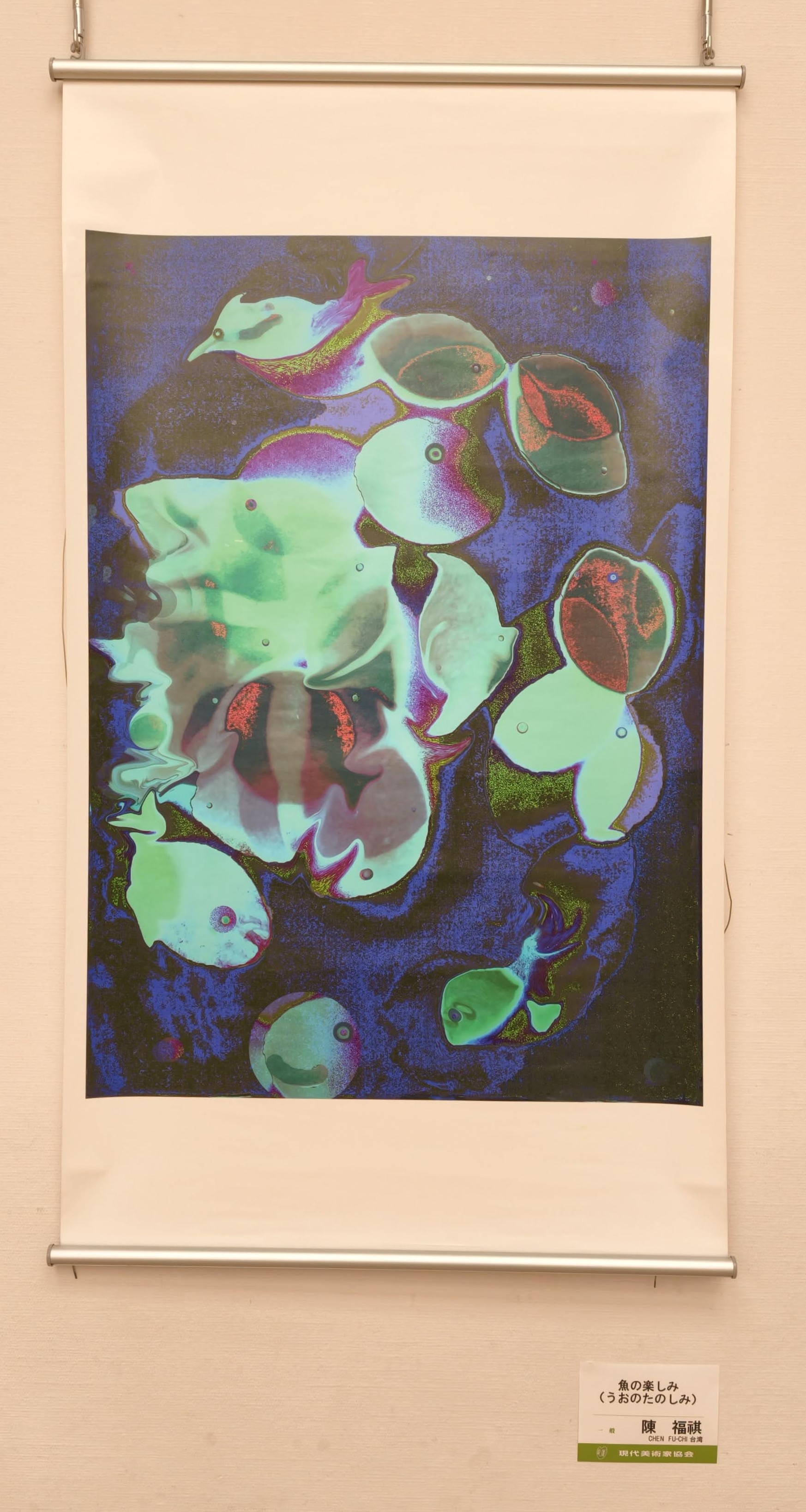
The fish painted by Chen Fu-Chi does not pursue naturalistic realism. It is not a fish from an aquarium guide, nor is it a fish leisurely swimming in the voided water space of traditional ink wash. The fish in the work is more like a digital life-form: surrounded by fluorescent colors, spectral effects, a deep blue background, and a virtual water domain, its form seems to lie between organism, sign, and energy cluster.
This kind of fish no longer needs to obey the light, volume, and anatomical structure of the natural world, but obeys the color logic of digital imagery. Its body can glow, can be cut by color, and can present an almost science-fictional life-state within a non-natural water domain.
Therefore, the fish in The Pleasure of Fish is not a substitute for a “real fish,” but a digital simulacrum. It no longer asks what a fish originally looks like, but asks: in the digital age, how do we reimagine life? When life is transformed into images, data, colors, and pixels, can it still communicate happiness, freedom, and free wandering?
The reason Chen Fu-Chi’s work is worth discussing is precisely that he does not treat digital images as technical spectacle, but uses digital simulacra to reopen classical philosophical questions.
V. Fluorescent Color and Spectral Aesthetics: Fish as Luminous Life-Forms
The Pleasure of Fish has a strong spectral quality visually. The work may use fluorescent cyan-green, deep blue, bright bubbles, and high-contrast colors, forming effects similar to the deep sea, sonar, thermal imaging, or digital scanning. This color language is completely different from traditional fish subjects.
Fish in traditional ink wash are often expressed through concise lines, pale ink diffusion, and the void of water, conveying a sense of agility. The pleasure of fish often comes from the flow between blank space and brush-and-ink. Chen Fu-Chi’s pleasure of fish, however, comes from glowing, flickering, floating, and spectralization. The fish does not swim leisurely in blankness, but shines in a digital deep sea.
This spectral aesthetics has a double meaning.
First, it removes fish from natural representation and transforms them into energetic existence. Fish are not merely tangible bodies, but resemble masses of light with emotional and vital intensity. Their pleasure is no longer expressed through posture or facial expression, but through color intensity and visual rhythm.
Second, it turns the water domain into a virtual environment. The deep blue background and fluorescent colors together construct a non-natural yet highly immersive space. Viewers seem not to see fish in water, but to enter a digital field of perception and feel life swimming, flickering, and breathing within it.
Therefore, the color of The Pleasure of Fish is not decoration, but a contemporary view of life. Through spectral color, Chen Fu-Chi proposes that in the digital age, life does not necessarily have to be understood only through the flesh; it may also be re-perceived in the forms of light, signals, energy, and images.
VI. Fish and Bubbles: A Digital Life-Field of Dissolving Boundaries
In The Pleasure of Fish, the boundaries among fish, bubbles, and water may not be stable. Bubbles are not merely background elements, nor merely decorative signs, but seem to share the same digital substance as the fish. They are all composed of color, points of light, pixels, and transparency, jointly forming a virtual field of life.
This dissolution of boundaries allows the work to respond again to Zhuangzi’s thought of “the equality of all things.” In traditional philosophy, Zhuangzi emphasizes that human beings and all things should not be divided by rigid boundaries; true free wandering comes from loosening distinctions, oppositions, and fixed identities.
Chen Fu-Chi translates this thought into digital imagery. In his work, fish and water are not completely separate subject and environment, but seem like different manifestations within the same set of digital energies. The contour of the fish may echo the bubbles, the deep blue of the water may seep into the fish’s body, and points of light may simultaneously belong to fish, bubbles, and background.
Therefore, life in The Pleasure of Fish is not a closed individual, but a relational existence. The fish’s happiness does not come only from itself, but from its co-generation with water, bubbles, light, color, and virtual space.
This gives the work posthuman aesthetic significance. The posthuman perspective no longer treats human beings as the sole center, nor does it limit life to traditional bodily forms; it is concerned with how life is reconstituted within technology, environment, media, and perceptual systems. Chen Fu-Chi’s fish is precisely a subject within such a posthuman field of life.
VII. The Contemporary Translation of Zhuangzi’s Free Wandering
The deepest artistic value of The Pleasure of Fish lies in its contemporary translation of Zhuangzi’s thought of free wandering. Zhuangzi’s pleasure of fish originally pointed toward a realm beyond logical opposition, in which all things are understood through sympathetic resonance. Chen Fu-Chi places this realm within the digital world, making free wandering no longer merely carefree movement in nature, but free transformation within virtual media.
In traditional literati painting, fish are often depicted within ink-wash blankness, representing natural agility, freedom, and leisure. In Chen Fu-Chi’s work, however, free wandering does not occur in classical mountains and waters or ponds, but in a digital deep sea. The fish’s freedom does not come from natural space, but from virtual possibilities created by images, colors, and algorithms.
This does not mean that Chen Fu-Chi departs from Zhuangzi. On the contrary, he may be closer to the core of Zhuangzi’s spirit: free wandering does not remain in any fixed form, but can continuously change, turn, transform, and move among different states. If there are “becoming butterfly” and “pleasure of fish” in Zhuangzi’s world, then in the digital age, fish becoming light, becoming pixels, and becoming simulacra may also be regarded as another form of contemporary free wandering.
Therefore, The Pleasure of Fish is not an illustration of classical philosophy, but the rebirth of classical philosophy in a new medium. It makes Zhuangzi no longer merely a thought within texts, but a contemporary image that can be viewed, perceived, and digitally re-experienced.
VIII. Digital Media and the Question of Hand Feel: Without Brushstrokes, Is There Still Spirituality?
When discussing digital art, one common question is: when a work no longer directly presents handmade brushstrokes, does it lose the bodily and spiritual qualities of traditional art? Chen Fu-Chi’s The Pleasure of Fish provides precisely a case worth discussing.
In traditional ink wash, brushstrokes directly connect to the artist’s body: wrist, breath, speed, force, pauses, and ink tone all remain on the paper. Digital art, by contrast, is often completed through software, parameters, image processing, and output devices, so bodily traces no longer appear in the same way.
However, this does not mean that digital art lacks spirituality. Spirituality does not necessarily exist only in brushstrokes; it may also exist in the choice of medium, image structure, color intensity, philosophical propositions, and viewing experience. Chen Fu-Chi’s spirituality does not come from traditional brush-and-ink traces, but from how he reconstructs the question of the “pleasure of fish” within digital imagery.
In other words, the spirituality of The Pleasure of Fish is not calligraphic, but medial. Through the contradiction between imitation xuan paper and digital imagery, through the dissolution of boundaries between fish and bubbles, and through the connection between spectral color and Zhuangzi’s thought, it forms a spiritual space belonging to the digital age.
This also reminds us that contemporary art criticism cannot evaluate digital works only by the standards of traditional media. If we still ask only “whether there is hand feel” or “whether there is brush-and-ink,” we may ignore the aesthetic logic of digital art itself. Chen Fu-Chi’s work asks us to change our way of viewing: from the bodily nature of brushstrokes to the spirituality of media relations.
IX. The Institutional Significance of the Special Project Exhibition Area
Chen Fu-Chi’s work being selected for the Special Project Exhibition Area also has significance at the level of exhibition institution. As a modern art public-entry exhibition with a postwar history, Genten has long accepted different media and forms, yet digital art still often faces questions of classification and positioning in traditional art association exhibitions.
When The Pleasure of Fish enters the Special Project Exhibition Area, it indicates that Genten does not confine modern art to traditional painting, sculpture, or craft, but is willing to reserve space for digital media, image-based art, and cross-media creation. This is especially important for Taiwanese artists, because Taiwanese contemporary art itself is already highly diverse, developing from ink wash, glue-color painting, oil painting, and installation to digital imagery.
Chen Fu-Chi’s selection prevents this year’s Taiwanese artist portrait from being understood as a single group of paper-based painters, and instead displays a span of media. From color ink, processed xuan heavy color, and ink-wash voids to digital imitation xuan paper and image output, this diversity is precisely an important aspect of Taiwanese contemporary art being seen in Japan’s Genten Exhibition.
Therefore, Chen Fu-Chi’s work is not only an individual work, but also an institutional signal: the contemporaneity of Taiwanese artists comes not only from subject matter and content, but also from the expansion of media boundaries.
X. Comparison with the Previous Artists: From Paper-Based Life to Digital Life
If Chen Fu-Chi is placed alongside the previous artists, his uniqueness becomes clearer.
Tsai Mei-Fang’s Lingering Wisteria uses the aqueous flow of color ink to present natural sublimity and emotional attachment; Liau Chun-Yi’s Unfinished・Floating Realm uses processed xuan heavy color and suspended flowers to present the psychological space of liquid modernity; Jiang Jinling’s Emotional Journey in the Lotus Pond and Shell Ginger in Full Bloom Attracts Birds release subtropical life impulse through impasto color and botanical abundance.
Chen Fu-Chi also addresses life, but his life no longer primarily depends on plants, flowers, birds, or ink-wash materials, but becomes fish within digital imagery. This shifts his work from “natural life” toward “digital life,” and from “material generation” toward “media generation.”
However, he does not completely sever his relationship with Eastern tradition. Through imitation xuan paper and the proposition of Zhuangzi, he allows digital life still to connect with classical thought. This combination makes the work neither merely technological aesthetics nor merely the reuse of traditional symbols, but a media experiment spanning the classical and the posthuman.
Therefore, within the Taiwanese portrait, Chen Fu-Chi plays the role of a “media translator.” He connects Eastern philosophy, paper-based memory, and digital imagery, allowing viewers to see that Taiwanese contemporary art can not only look back to tradition, but can also reproduce tradition through new media.
XI. Posthuman Perception: When Fish Become Our Mirror Image
The Pleasure of Fish appears on the surface to be a work about fish, but ultimately returns to the question of human beings. The reason Zhuangzi’s “pleasure of fish” is moving lies in the way it makes people think: Can we perceive the other? Can we transcend our own position? Can we understand the world without taking human beings as the center?
After Chen Fu-Chi transforms fish into digital luminous bodies, this question becomes even sharper. Human life today has already been surrounded by screens, images, algorithms, and data flows. When we view nature, we often already do so through photographs, images, social platforms, and digital interfaces. In other words, our perception of the world is being reshaped by media.
Therefore, the fish in The Pleasure of Fish may also be regarded as a mirror image of human beings. Fish swim in a digital water domain, just as modern people live in digital environments; the fish’s body is spectralized, and human bodies and emotions are also gradually being datafied, imagized, and networked. Whether the fish’s happiness is real corresponds to whether human happiness is also being rewritten by media.
This gives the work a gentle yet profound criticality. It does not directly accuse technology, nor does it pessimistically reject the digital age, but raises an open question: within digital media, can we still preserve free wandering? Can we still feel the other? Can we find new freedom within the world of simulacra?
XII. The Poetic Quality of the Work: Technology Does Not Exclude Sensibility
Digital art is sometimes easily misunderstood as cold, technical, or lacking emotion. Yet Chen Fu-Chi’s The Pleasure of Fish shows that technological media do not necessarily exclude poetic quality. On the contrary, digital media can create light effects, transparency, virtual depth, and chromatic intensity that traditional media find difficult to achieve, giving the work a new poetry.
This poetry is not the pale distance of traditional literati art, but is closer to the dreamscape of the digital age: luminous, floating, deep blue, transparent, immaterial, between reality and virtuality. The fish within it is not merely a living creature, but like a floating poem, a metaphor about freedom and perception.
Chen Fu-Chi’s contribution lies precisely in the fact that he does not make digital art into a mere display of technique, but allows digital imagery to carry philosophy and poetry. He proves that digital art can also possess Eastern poetic resonance; only this resonance no longer relies on the blankness of mountains and waters, but on spectra, pixels, virtual water domains, and media memory.
XIII. Professional Critical Perspective: The Fourfold Value of Chen Fu-Chi’s The Pleasure of Fish
In summary, Chen Fu-Chi’s The Pleasure of Fish possesses the following fourfold value within the portraits of Taiwanese artists in the 82nd Genten Exhibition.
First, Media Value
Through the combination of imitation xuan paper and digital art, the work establishes tension between traditional paper-based memory and contemporary image output. It makes xuan paper no longer merely a support for ink wash, but the cultural skin of digital simulacra.
Second, Philosophical Value
The work reinterprets Zhuangzi’s proposition of the “pleasure of fish,” shifting classical thought from a natural scene into digital space, and allowing “free wandering,” “sympathetic resonance,” and “the experience of the other” to acquire new meanings in a posthuman context.
Third, Visual Value
Through fluorescent color, deep blue water domains, spectral effects, and dissolving boundaries, the work creates a strong sense of digital life, transforming fish from natural objects into luminous energy subjects.
Fourth, Institutional Value
As a work selected for the Special Project Exhibition Area, The Pleasure of Fish expands the range of media within the Taiwanese participating portrait, showing that Taiwanese artists do not only speak through traditional paper-based and ink-wash fields, but can also enter the public platform of Japanese modern art through digital media.
XIV. Chapter Summary: Re-understanding Free Wandering in the Digital Deep Sea
Chen Fu-Chi’s The Pleasure of Fish is a work that reopens a classical philosophical proposition through digital media. It is not satisfied with depicting fish, nor does it stop at displaying digital technology; rather, through imitation xuan paper, spectral color, virtual water domains, and the translation of Zhuangzi’s thought of the “pleasure of fish,” it raises contemporary questions about life, perception, the other, and freedom.
The fish in the work are no longer merely natural beings, but luminous life-forms of the digital age; water is no longer merely a flowing natural element, but a perceptual field composed of images, colors, and virtual space; xuan paper is no longer merely the material foundation of classical ink wash, but becomes an interface where traditional memory and digital simulacra intersect.
Within the portraits of Taiwanese artists in the 82nd Genten Exhibition, Chen Fu-Chi’s importance lies in the way he makes the media map of Taiwanese contemporary art more complete. From Tsai Mei-Fang’s color ink, Liau Chun-Yi’s processed xuan heavy color, and Jiang Jinling’s impasto color to Chen Fu-Chi’s digital imitation xuan paper, Taiwanese art is no longer defined by a single medium or style, but displays multiple possibilities spanning the classical, the contemporary, and the posthuman.
The Pleasure of Fish ultimately allows us to re-understand “free wandering”: today, free wandering does not necessarily exist only among natural mountains and waters, but may also appear in digital deep seas, luminous images, and media translation. As long as the work can still open perception, loosen boundaries, and summon us to understand the other anew, the pleasure of fish is not only the fish’s pleasure, but also a possible way for viewers to recover a sense of freedom in the digital age.