【專題評論】日本第82回「現展」台灣藝術家群像
撰文:王 穆提(WANG MUTI)
總論:從台灣到東京六本木的跨國觀看現場
摘要
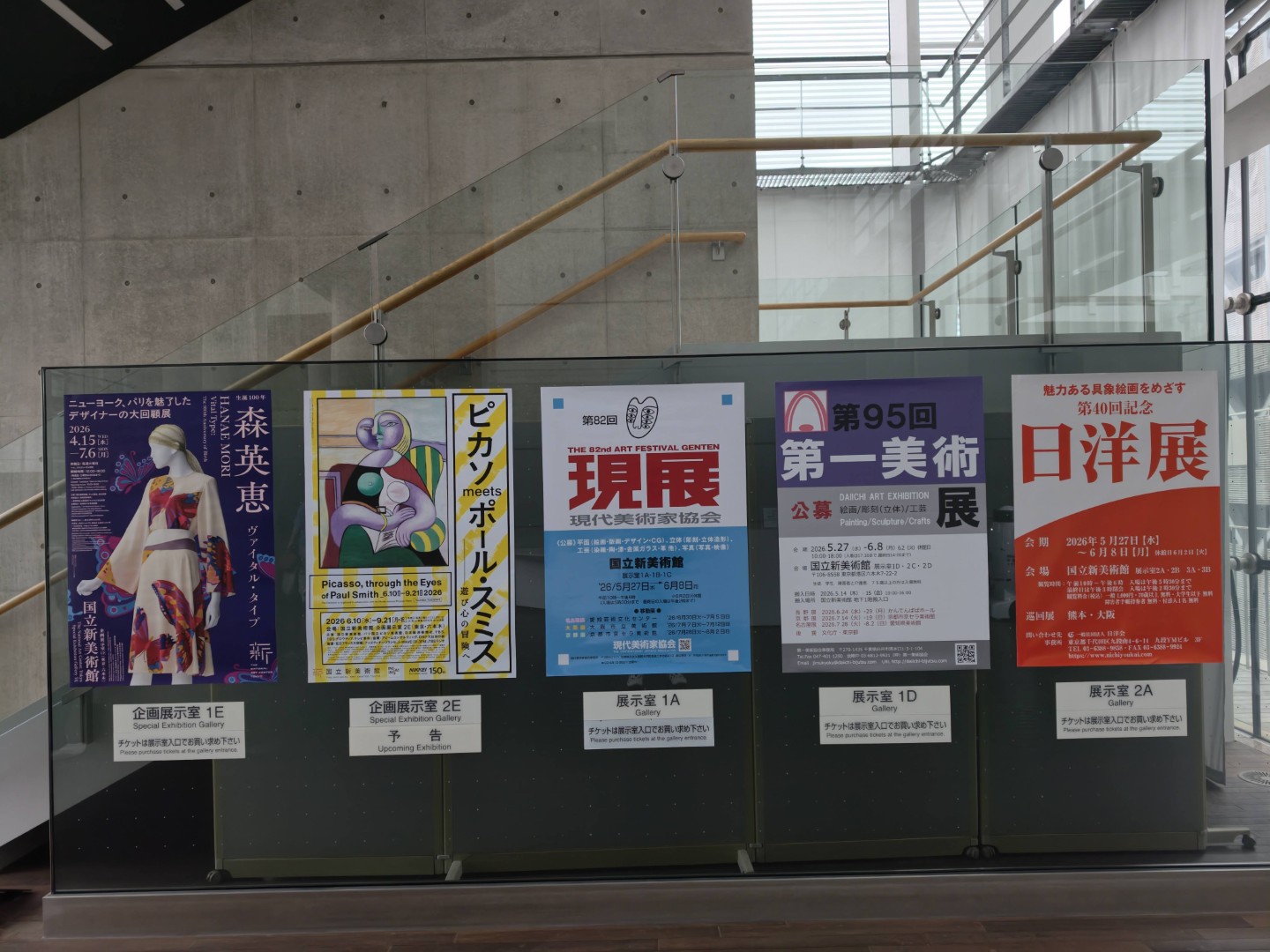
第82回日本「現展」中的台灣藝術家參展,不宜僅被理解為一次海外聯展或藝術家個人履歷的累積,而應視為一個由公募制度、國家級展場、跨語言評論、掛軸展示策略與數位檔案保存共同構成的跨國藝術事件。本屆現展於2026年5月27日至6月8日在東京六本木的國立新美術館舉行,並由日本1948年成立的現代美術家協會主辦;台灣藝術家的作品透過台灣連絡所、評論書寫、日文翻譯、現場紀錄與數位發布,進入日本現代美術公募體系之中。
本文將以藝術評論專題報告的形式,重新檢視蔡梅芳、廖純沂、姜金玲、陳福祺、王詮富、吳智勇與王穆提七位台灣藝術家的作品與制度位置。報告的核心問題不只是「台灣藝術家如何在日本被看見」,而是進一步追問:作品如何被展覽制度接納?如何透過評論與翻譯被理解?如何在國立新美術館的場域中產生新的觀看意義?又如何透過數位檔案延長展覽的生命?
關鍵詞
第82回現展、台灣當代藝術、國立新美術館、日本現代美術家協會、公募展、掛軸展示、藝術評論、台日藝術交流、數位檔案、跨文化策展
一、專題定位:這不是單純的海外參展,而是一個藝術制度事件
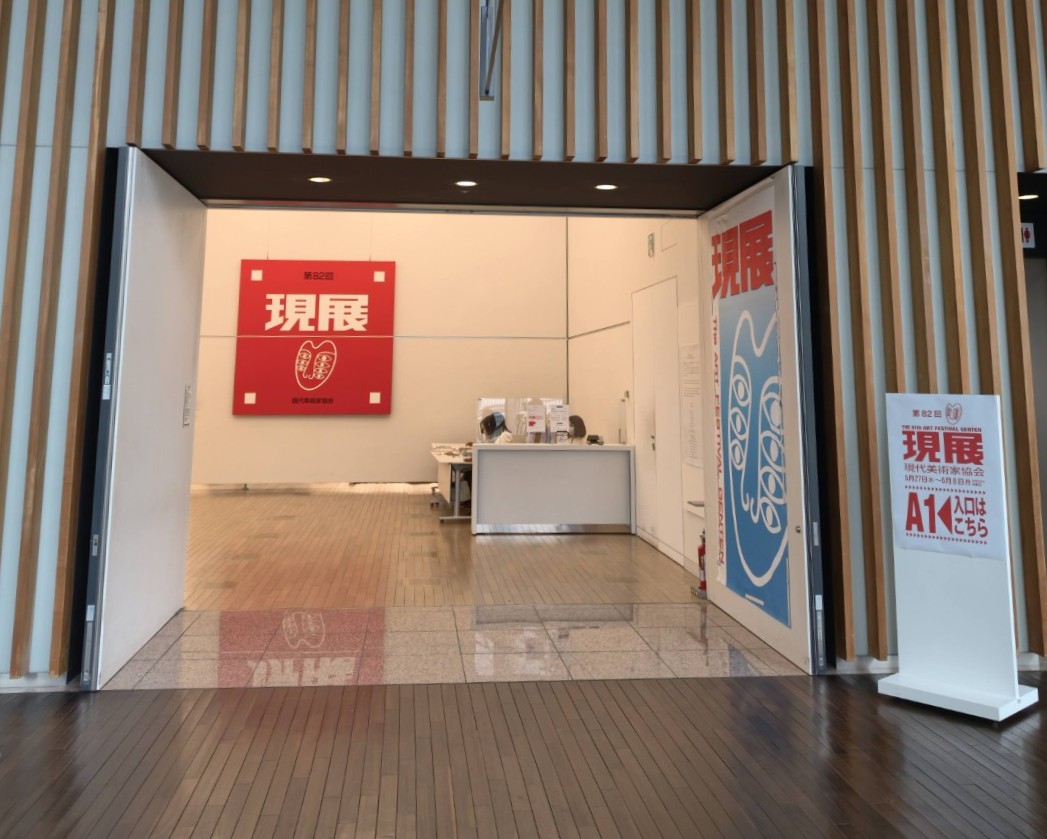
第82回「現展」中的台灣藝術家群像,首先應被放在一個制度性的框架中理解。日本「現展」並非臨時性的國際聯展,而是由日本現代美術家協會長期推動的公募型現代美術展;其制度脈絡包含公開徵件、作品審查、入選、受賞、推舉、巡迴展與團體內部身分階梯等多重機制。日本現代美術家協會成立於1948年,長年接受平面、立體、工藝、攝影、影像等不同媒材作品,並以東京國立新美術館本展及名古屋、大阪、京都等地巡迴展延續其展覽生命。
因此,台灣藝術家參與第82回現展的意義,不只是「作品被送到日本展出」,而是作品進入了一套已有歷史厚度與評價機制的日本現代美術制度。對藝術家而言,這代表其作品必須面對日本公募展的審查標準、展場尺度、作品規格與觀眾語境;對台灣當代藝術而言,則意味著台灣創作者不再只是透過私人畫廊、國際博覽會或友好交流進入海外,而是以公開徵件與制度評價的方式,進入日本現代美術的公共場域。
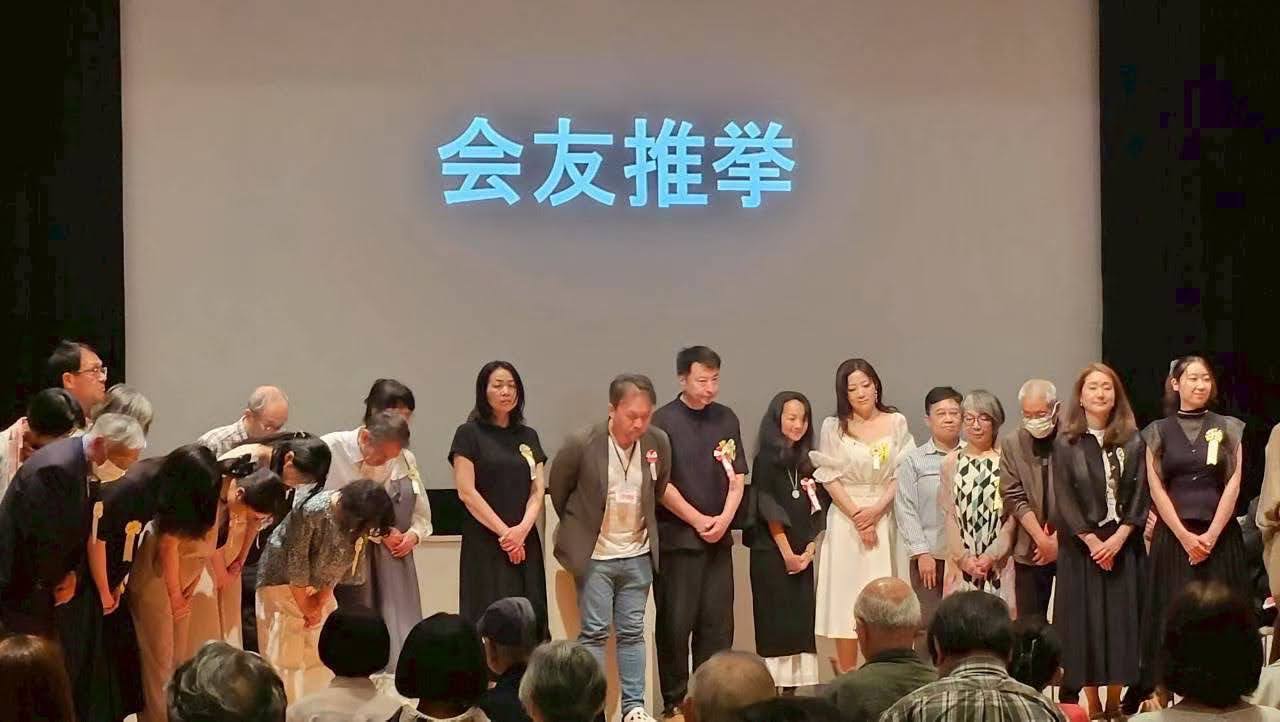
現展制度包含「入選者、受賞者、推舉者」等分類,且藝術家可能透過參展與受賞累積制度位置,例如會友、準會員或會員。這使得「參展」本身不只是一次性的展出結果,而是藝術家在日本藝術場域中逐步取得象徵資本的過程。蔡梅芳為「現展會友,2025年推舉」,姜金玲則是在本次被推舉成為「現展會友」,王穆提則為「現展準會員,參展兩次即被推舉、曾入選俊英作家展等賞」,都在顯示台灣藝術家在此制度中已不只是外部來賓,而是開始進入現展內部評價結構。
二、展覽場域:國立新美術館作為「無典藏」的當代平台
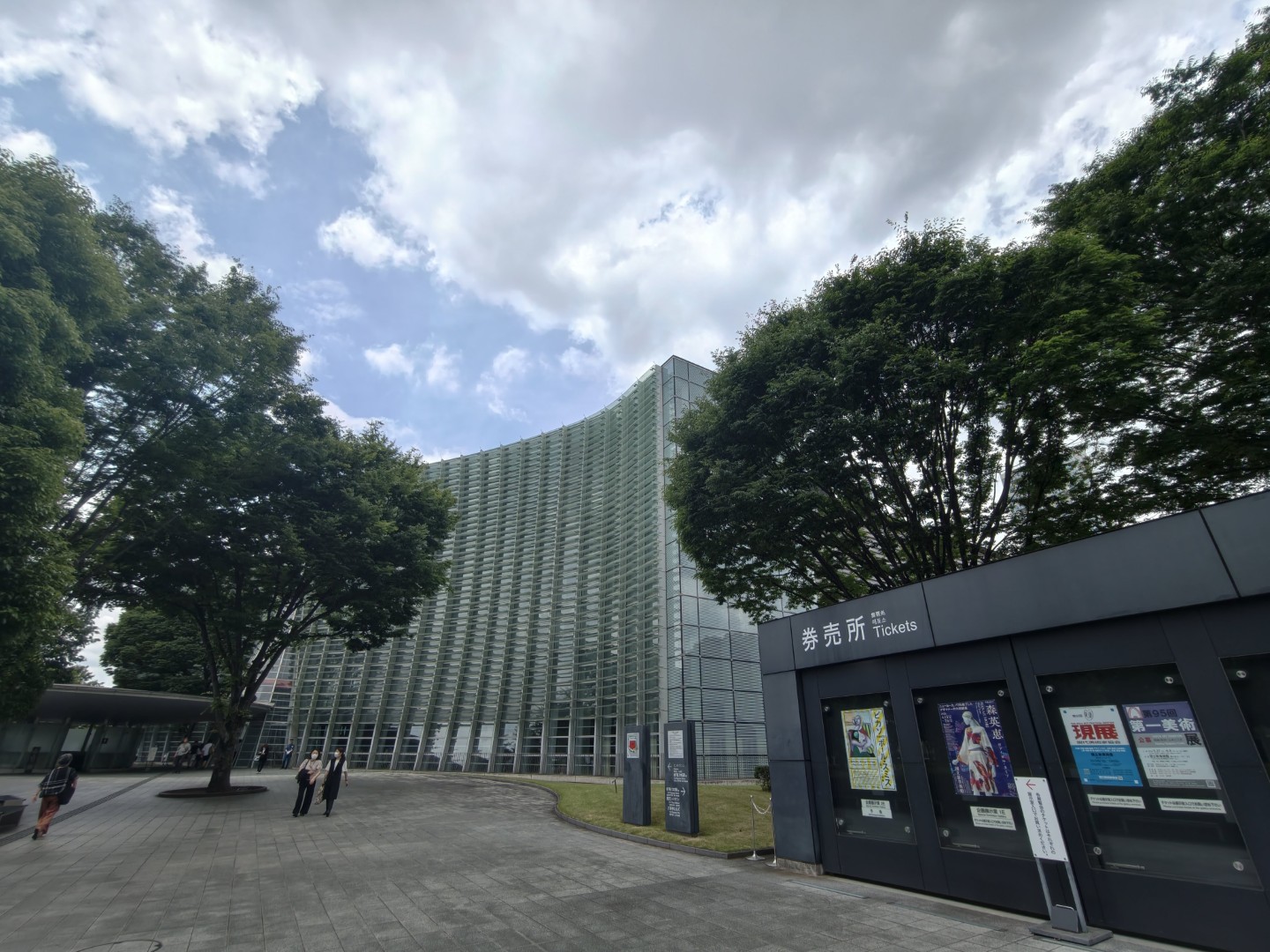
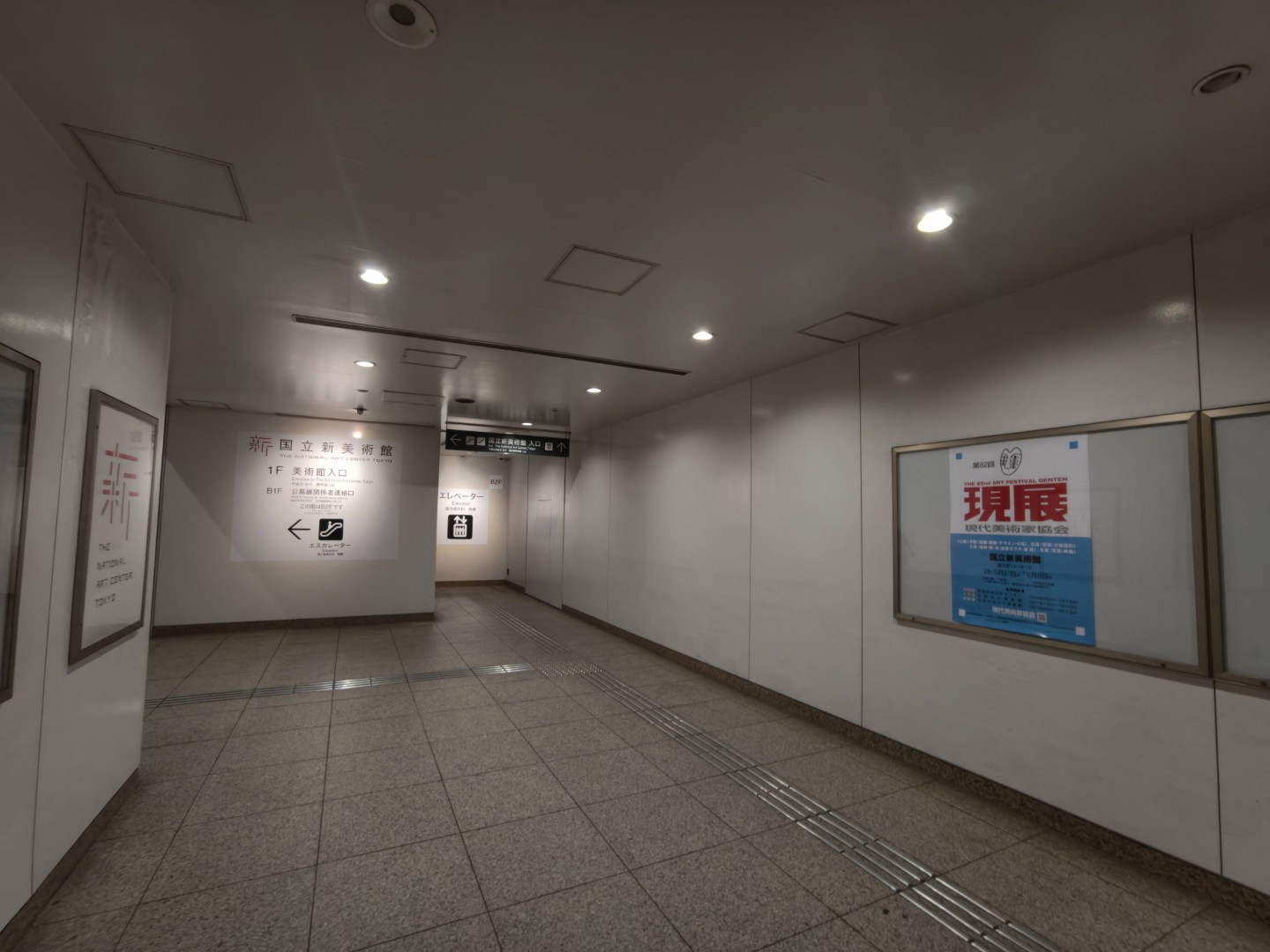
本屆展覽的重要性,也來自其展場——東京六本木的國立新美術館。國立新美術館位於東京都港區六本木7-22-2,於2007年開館,是日本國立美術館體系中的重要館舍之一;與典藏型美術館不同,國立新美術館不設常設典藏,而是以大型展示空間、多樣展覽、藝術資訊公開與教育推廣作為核心任務。
這一點對台灣藝術家的作品具有關鍵意義。傳統典藏型美術館往往以其館藏建立歷史權威,作品進入其中時,常被迫與既有藝術史敘事產生比較或從屬關係。然而,國立新美術館的特殊性在於它不以永久館藏作為權力核心,而以不斷更替的展覽作為公共平台。換言之,它不是一座用過去定義現在的美術館,而是一座以「當下展覽事件」為核心的開放性場域。
我們可以用「無典藏異托邦」形容國立新美術館,指出這座美術館是一個不斷清空、又不斷被展覽填滿的過渡性容器。就台灣藝術家的參展而言,這種空間特質具有雙重效果:一方面,作品不必被置於日本古典藝術或西方現代主義館藏的固定敘事下;另一方面,作品必須在短暫展期內,透過自身的形式強度、媒材語言與文本輔助,迅速建立被觀看與被理解的條件。
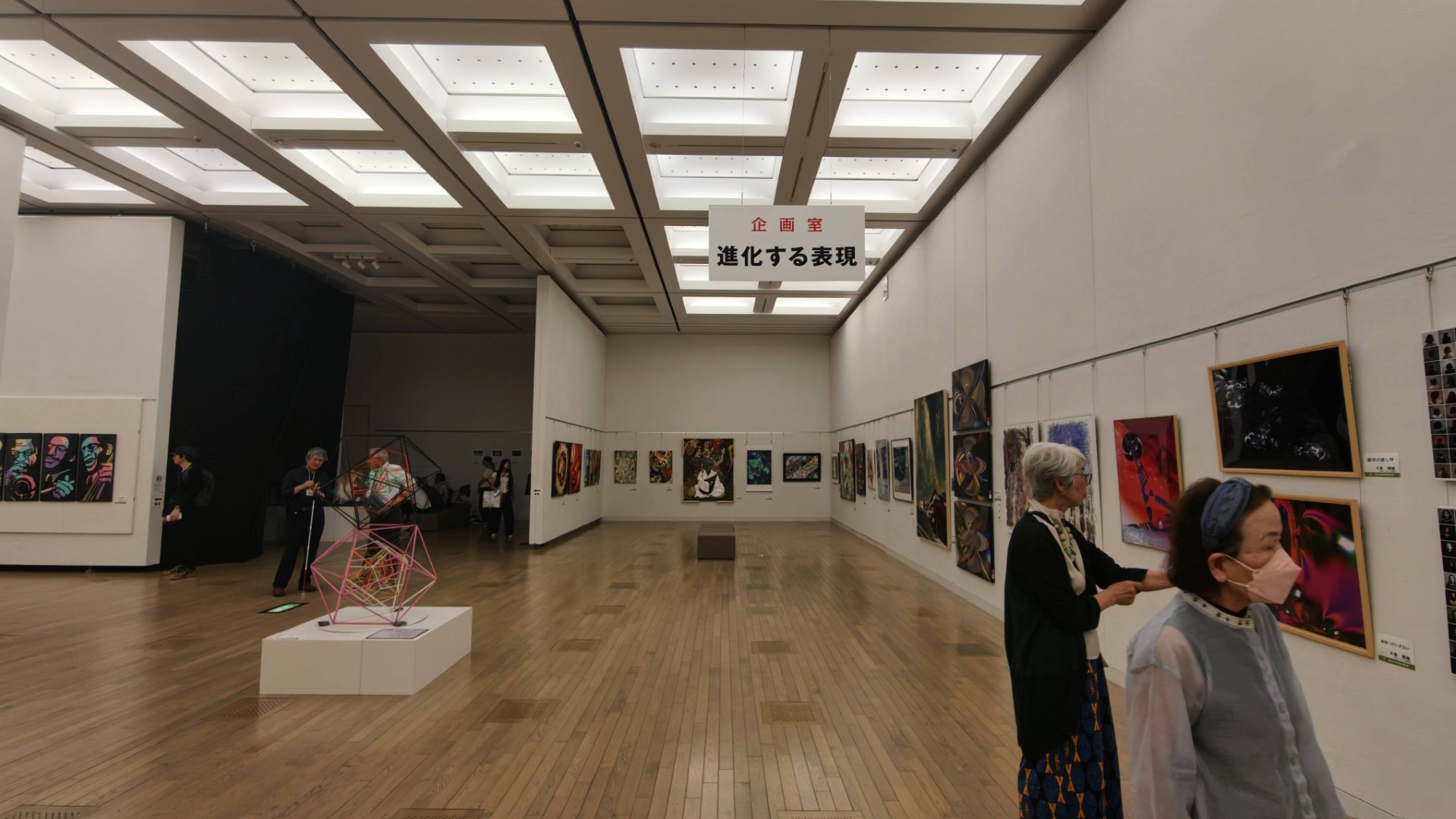
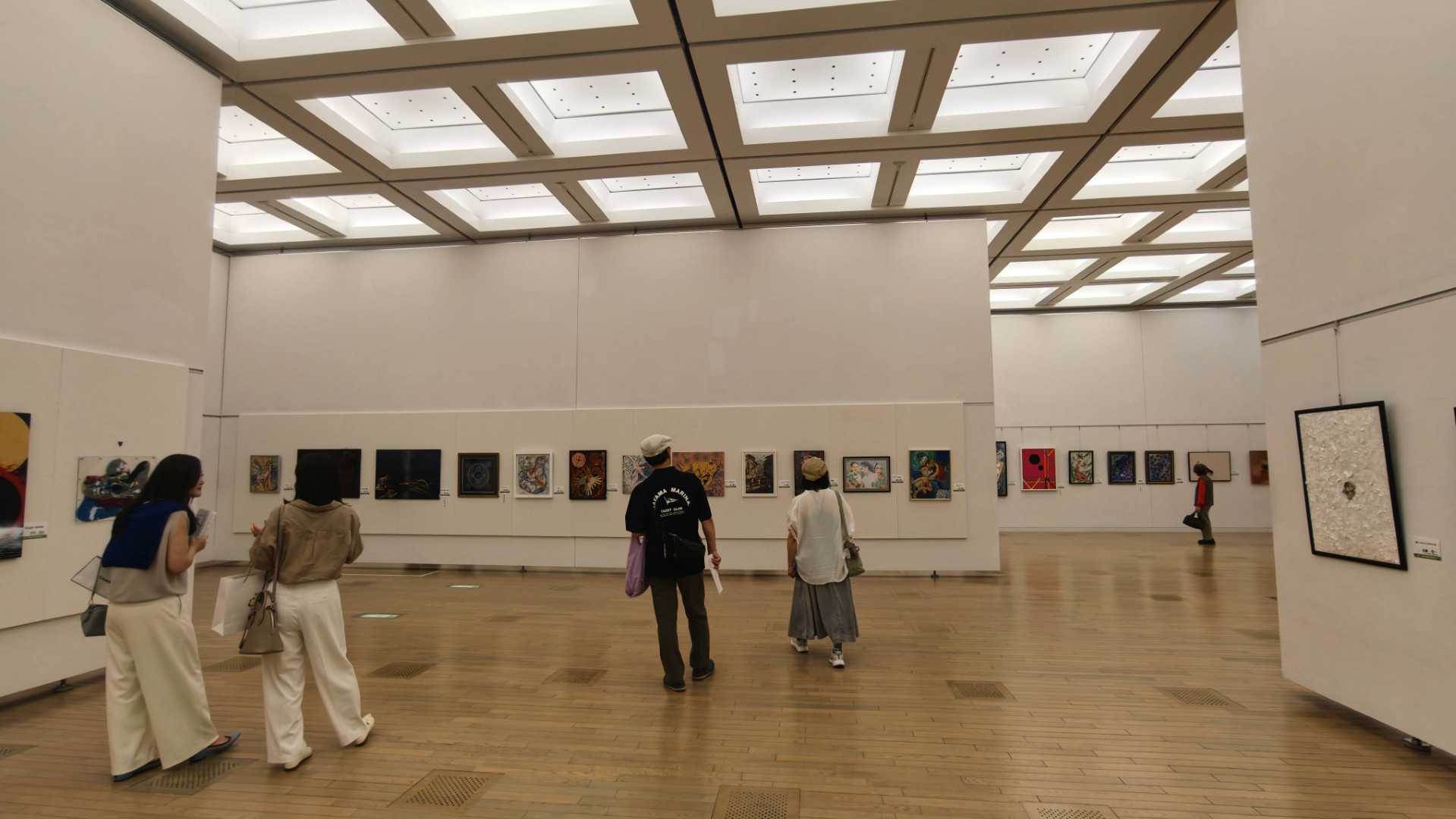
因此,國立新美術館並非中性的背景,而是積極參與了作品意義的生成。蔡梅芳《戀戀紫藤》的彩墨風暴、廖純沂《未盡・浮境》的失重花卉、姜金玲《荷塘情旅》與《月桃盛開引禽来》的亞熱帶色彩、陳福祺《魚的樂趣》的數位擬像、王詮富《一念菩提開翠微》的水墨留白、吳智勇《鄉愁之秋》的水彩都市,以及王穆提《 Unbounded》作品中的水墨幾何與哲學結構,都不是孤立地被懸掛於牆面,而是在六本木國家級美術館的展覽制度與空間尺度中,重新獲得其公共性。
三、公募展制度:開放性與階梯性的雙重結構
「現展」作為日本戰後現代美術公募展的一環,其制度精神具有明顯的開放性。現展徵件範圍涵蓋平面繪畫、版畫、雕塑、工藝、攝影、CG影像等類別,且不限定抽象或具象;這使不同媒材、風格與世代的藝術家得以在同一展覽制度中被審查與展出。
然而,開放性並不代表制度沒有層級。現展同時存在入選、受賞、會友、準會員、會員等推舉與身分階梯。這種結構使藝術家能透過反覆參展、受賞與被推舉,逐步累積制度內的認可。換言之,現展既提供一條開放的入口,也建立一套可累積的藝術履歷機制。
對台灣藝術家而言,這種制度具有特殊吸引力。許多海外展覽雖可提供曝光,但展覽結束後,藝術家的作品往往只留下簡短履歷;相較之下,現展制度中的入選、受賞與推舉,能夠形成更明確的紀錄。當這些紀錄再透過藝術評論、日文翻譯、個人頁面與數位發布被保存時,參展便不只是一次活動,而可能成為藝術家進入日本藝術網絡的長期資源。
這種制度稱為「跨國象徵資本」的累積。此說法可以理解為:台灣藝術家透過現展取得的不是單純展出機會,而是被日本現代美術制度承認、記錄與傳播的可能性。蔡梅芳於2025年由入選者晉升為會友、姜金玲在2026年由入選者晉升為會友、王穆提由短期參展迅速被推舉為準會員,皆是這種象徵資本轉換的具體案例。
四、台灣參展者的特殊性:從「被看見」到「被閱讀」
本專題報告的核心觀點之一,是台灣藝術家在第82回現展中的位置,不只是展覽名單上的「海外參展者」,而是透過評論與翻譯被建立為可閱讀的藝術主體。本屆現展台灣相關資訊中特別設有「台灣參展者藝術評論」欄位,並包含藝術家個人專頁、網路新聞發布、文件與作品日文翻譯、現場中日文口譯、展覽攝影與錄影等內容。
這一點極為重要。海外展覽中,作品被看見並不等於被理解。觀眾可能看見色彩、構圖、材料與標籤,卻未必能理解作品背後的文化語境、創作方法、藝術家生命經驗或媒材選擇。尤其在大型公募展中,作品數量眾多,觀眾觀看節奏快速,若缺乏評論文字與語言轉譯,作品很容易停留在表層視覺印象。
因此,藝術評論在此扮演「第二現場」的角色。展牆是作品的第一現場,評論則是作品被重新組織、解釋與傳播的第二現場。它不取代作品,而是為作品建立觀看入口。對蔡梅芳而言,評論讓《戀戀紫藤》不只是花鳥題材,而被理解為彩墨、自動性技法、動態崇高與情感錨點的交會;對廖純沂而言,評論讓《未盡・浮境》不只是花卉構圖,而被理解為液態現代性中的懸浮心理場域;對陳福祺而言,評論則使《魚的樂趣》不只是數位圖像,而是關於擬像、仿宣紙與後人類感知的思辨。
換言之,評論使作品從「被觀看」進一步走向「被討論」。這也正是本報告將採取專業藝術評論形式的原因:本文不只是重新整理作品資訊,而是希望為每位藝術家建立清楚的作品分析框架,使其形式語言、媒材邏輯、文化語境與展覽制度位置能夠被完整呈現。
五、掛軸展示:從運輸策略到視覺方法
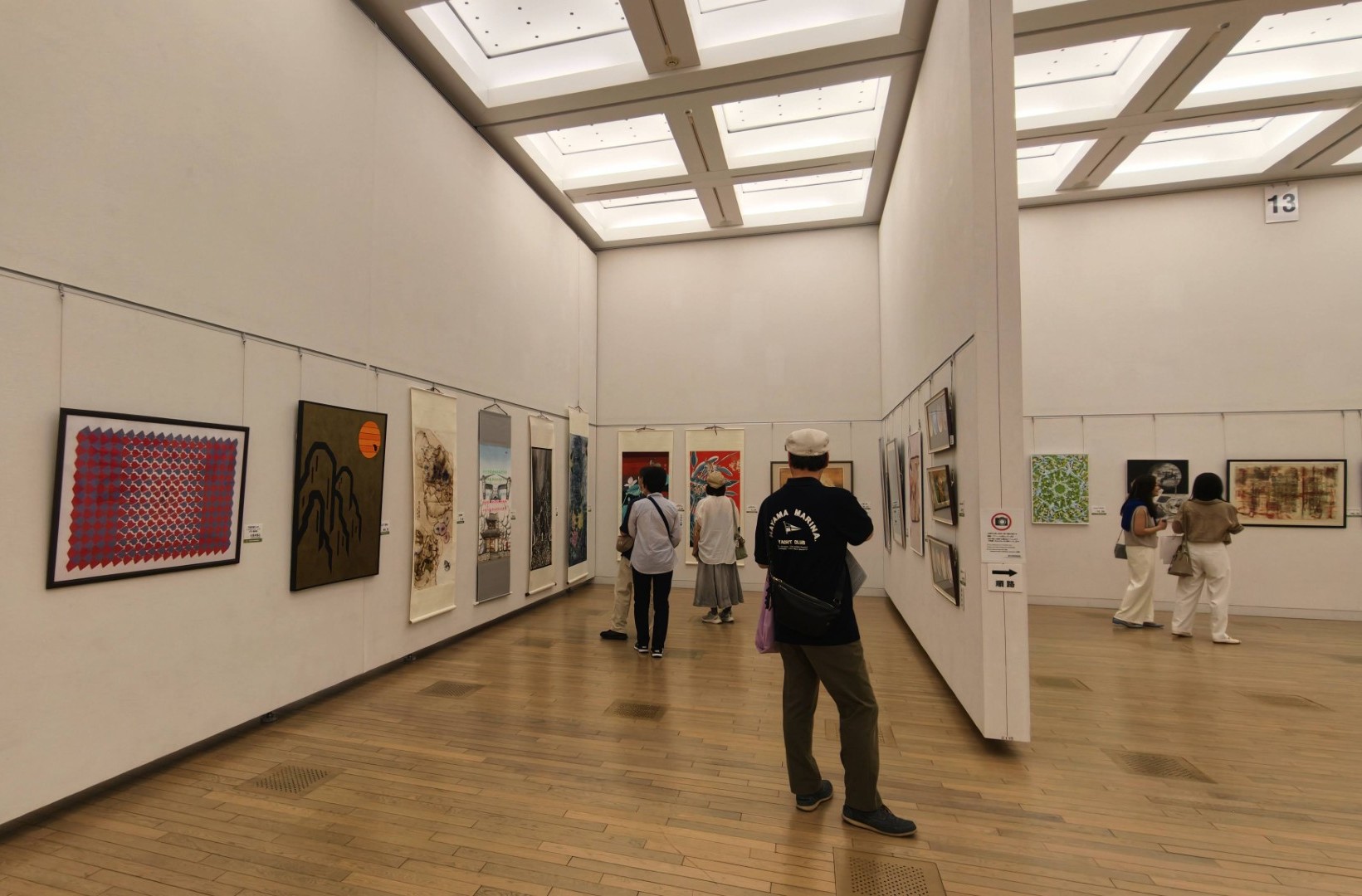
本屆台灣參展作品多採「掛軸」形式展示。這一安排首先具有實務意義:跨國展覽涉及作品運輸、包裝、保管、安裝與撤展,掛軸形式相較於厚重畫框或大型板件,具有更高的運輸彈性。現展台灣相關資訊列出四尺全開、六尺全開及更大型尺寸,並說明此方式是為了讓台灣參展者能在海外展示大型作品。
然而,掛軸不只是展務技術,也是一種觀看方法。掛軸在東亞書畫傳統中具有悠久歷史,其特徵包括垂直展開、可收納、可移動、紙本或布面材質的柔軟性,以及觀者由上而下、由局部至整體的觀看節奏。當台灣當代藝術作品以掛軸形式進入日本現代美術公募展場時,作品便同時連接兩種語境:一方面,它進入現代美術展覽制度;另一方面,它又與東亞書畫、紙本、卷軸與懸掛傳統產生視覺上的對話。
這種展示形式對不同藝術家的作品產生不同效果。王詮富《一念菩提開翠微》中的留白與水墨氣韻,因掛軸的垂直性而更顯精神性的下沉與開展;王穆提《 Unbounded》中的水墨積層與幾何結界,也因長幅掛軸的尺度而具有類似地質剖面的閱讀感;蔡梅芳《戀戀紫藤》的彩墨流動,則在掛軸柔性載體上呈現一種非框限、非固定的視覺能量。
因此,本報告將掛軸視為本屆台灣參展的重要策展條件。它既是跨國展覽的行政解法,也是台灣作品在日本展場中形成共同視覺語法的方式。掛軸使這些不同風格、不同媒材的作品,在國立新美術館中形成一種可被辨識的台灣展示群像。
六、數位檔案:展覽之後的第二生命
傳統展覽具有明確的時間邊界:開幕、展出、閉幕、撤展。第82回現展的東京本展時間為2026年5月27日至6月8日,展期結束後,作品在物理空間中的共同呈現即告終止。
然而,本屆台灣參展並不止於物理展場,而是透過RUMOTAN等網路平台建立展覽資訊、參展名單、藝術評論、現場展示與相關紀錄。這使展覽不再只是短暫事件,而是被轉化為可搜尋、可引用、可延續的數位檔案。
對台灣藝術家而言,數位檔案的重要性不容忽視。海外展覽若沒有文字、影像與網路紀錄,常常在展期結束後迅速淡出公共記憶;但若作品圖像、展場照片、評論文字與藝術家個人頁面被完整保存,這些資料便可能在日後被策展人、研究者、媒體、藏家或其他藝術機構重新發現。
因此,本屆台灣參展的完整意義,應包括三個時間層次:第一是展前的報名、審查、翻譯與準備;第二是展中的現場觀看、評價與交流;第三則是展後透過數位檔案持續發生的閱讀與傳播。藝術家的作品不只在國立新美術館被看見,也在文字、影像與網路資料庫中取得延續生命。
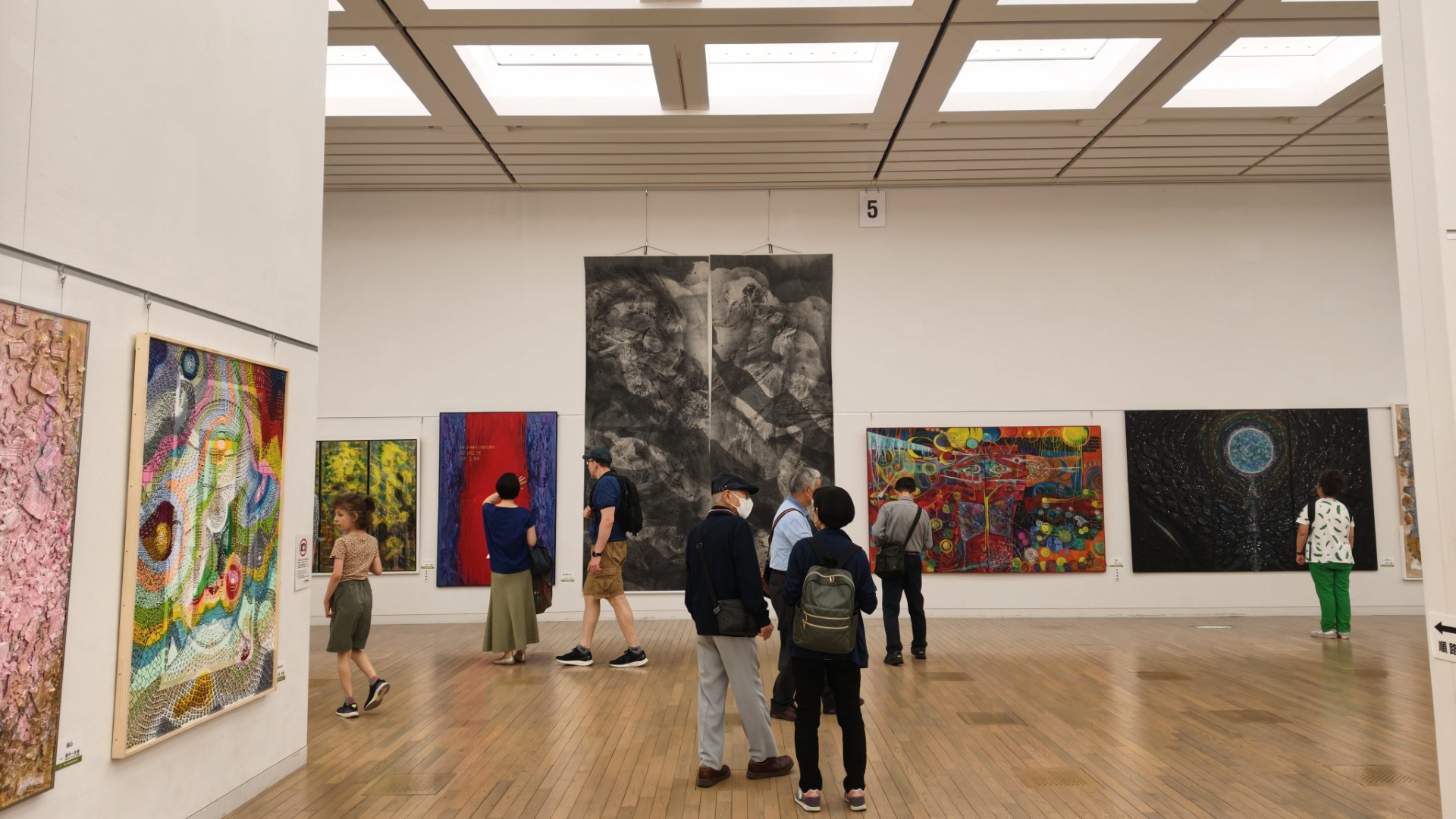
七、七位藝術家的評論路徑
本報告後續將依照指定順序,逐一分析七位台灣藝術家及其作品:
1. 蔡梅芳 Tsai Mei-Fang
現展會友,2025年推舉。作品:《戀戀紫藤》。
其作品將從彩墨自動性、物質流動、康德式動態崇高,以及畫面中鴛鴦所形成的情感錨點進行分析。
2. 廖純沂 Liau, Chun-Yi
入選內定。作品:《未盡・浮境》。
評論將聚焦其熟宣重彩、空間斷裂、懸浮花卉與液態現代性的心理拓撲。
3. 姜金玲 Jiang Jinling
現展會友,2026年推舉。作品:《荷塘情旅》、《月桃盛開引禽来》。**
分析將圍繞亞熱帶色彩、厚塗肌理、斯賓諾莎式生命衝動,以及愛欲生態學的視覺表現。
4. 陳福祺 CHEN FU-CHI
入選內定。入選特別企劃展示區。作品:《魚的樂趣》。
評論將從數位藝術、仿宣紙、擬像理論、莊子「魚之樂」與後人類感知切入。
5. 王詮富 WANG CHUAN FU
入選內定。作品:《一念菩提開翠微》。
其作品將從水墨留白、現象學還原、禽鳥意象、澄明與一念菩提的精神結構進行分析。
6. 吳智勇 Wu Zhiyong
入選內定。作品:《鄉愁之秋》「ノスタルジックな秋」。
評論將討論水彩濕中濕技法、都市溶解感、班雅明式漫遊者,以及現代鄉愁的視覺化。
7. 王穆提 WANG MUTI
現展準會員,參展兩次即被推舉,曾獲得俊英作家展等賞。
分析將聚焦其水墨幾何、五蘊相續、《俱舍論》思想、制度晉升與跨國象徵資本。
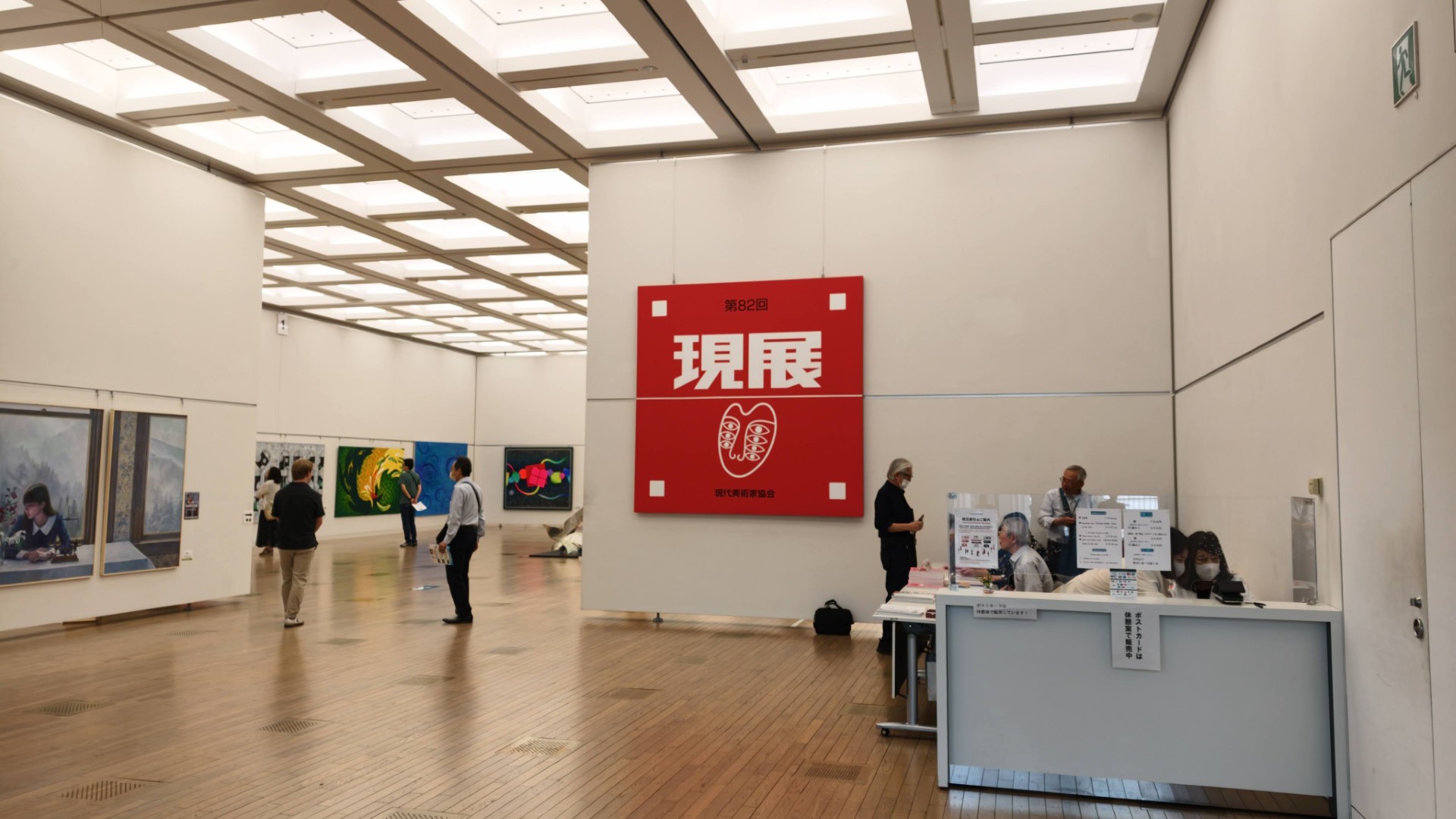
八、台灣群像的觀看框架
總結本回,若要以專業藝術評論方式重新撰寫第82回現展台灣藝術家群像,必須先建立四個觀看框架。
第一,制度框架。現展不是一般聯展,而是一套具有歷史、審查、受賞、推舉與巡迴結構的日本現代美術公募制度。台灣藝術家的參與,意味著他們進入此制度並開始累積可被記錄的藝術位置。
第二,場域框架。國立新美術館的無典藏特質,使它成為一個以當下展覽事件為核心的公共平台。台灣作品在此被觀看,不是被納入固定館藏敘事,而是在臨時展覽的強度中建立自身的當代性。
第三,展示框架。掛軸展示既是跨國運輸策略,也是東亞視覺傳統與當代展覽方法的結合。它讓不同媒材作品在同一展場中形成垂直、柔性、可移動的共同語法。
第四,評論與檔案框架。藝術評論、日文翻譯、影像紀錄與數位平台,使作品不只在展場被觀看,也在展後被閱讀、引用與保存。這是台灣藝術家從「被看見」走向「被討論」的關鍵。
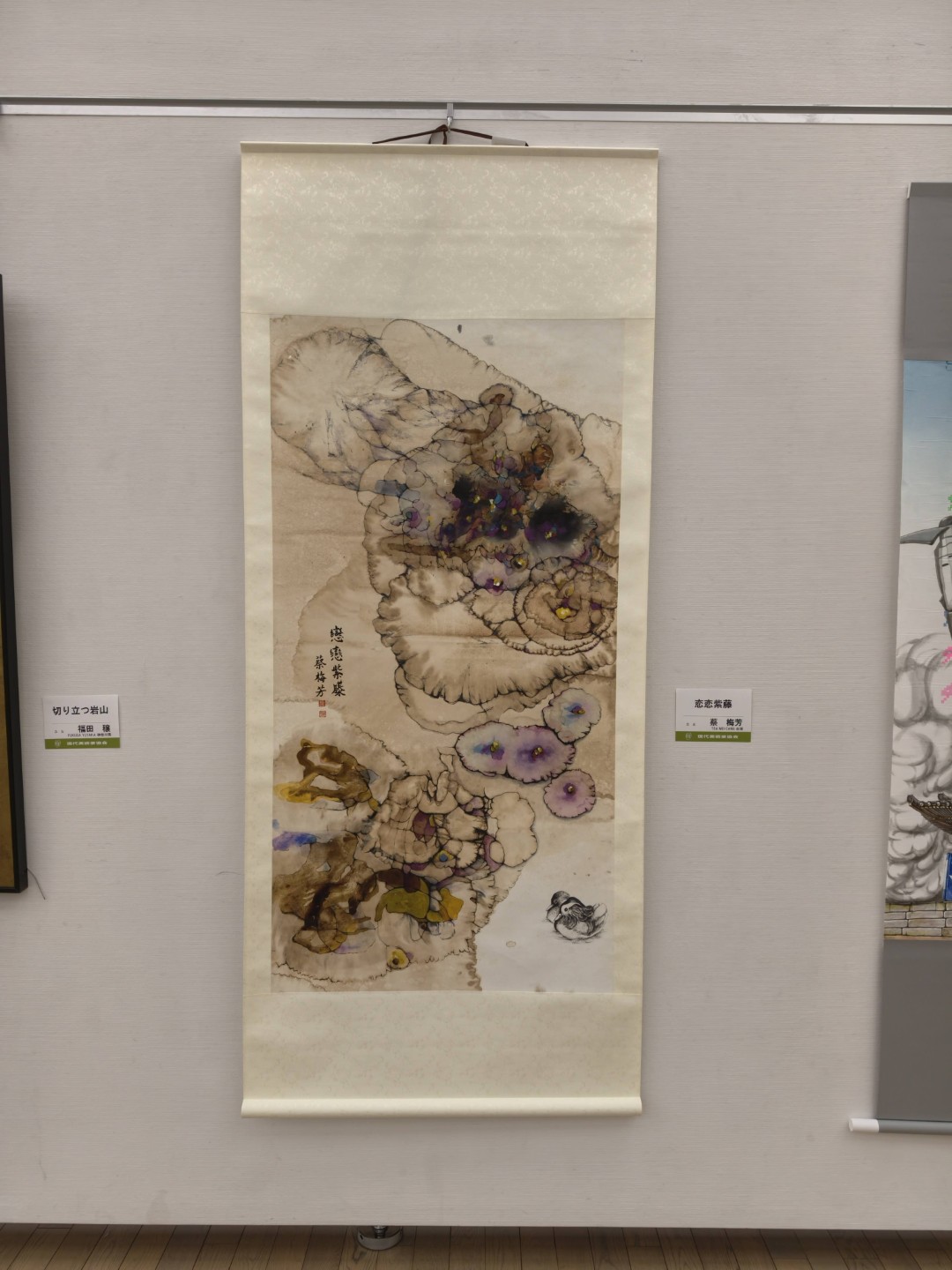
蔡梅芳 Tsai Mei-Fang
從《戀戀紫藤》觀看彩墨風暴、動態崇高與情感錨點
一、藝術家位置:從參展者到現展會友的制度意義
在第82回日本「現展」台灣藝術家群像之中,蔡梅芳的位置具有明確的制度意義。她為「現展會友,2025年推舉」,這表示其作品並非僅止於單次入選或偶然展出,而已進入日本現代美術家協會的推舉階梯之中。對一位來自台灣的藝術家而言,「會友」身分不只是行政分類,更是一種在日本公募展場域中取得持續性認可的象徵。
若從展覽制度角度觀察,現展的價值不只在於提供展示牆面,而在於它具有審查、入選、受賞、推舉與巡迴展等完整機制。藝術家在此制度中所獲得的身分,會轉化為其跨國藝術履歷的一部分。蔡梅芳於2025年獲推舉為現展會友,意味著她的創作語言已在日本現代美術場域中建立一定辨識度,也顯示其作品能夠跨越台日之間的語言、媒材與觀看差異,被納入現展的評價系統之中。
這一制度背景,是理解《戀戀紫藤》的重要前提。因為《戀戀紫藤》並非單純作為一件花卉題材作品出現,而是以彩墨、自然意象、抽象流動與具象生命的並置,進入一個強調現代性、多媒材開放與公共審查的日本展覽制度。換言之,蔡梅芳所面對的不只是「如何畫紫藤」,而是如何讓紫藤這一傳統自然題材,在現代美術公募展中重新獲得當代性。
二、《戀戀紫藤》的題名結構:從植物意象到情感命題
《戀戀紫藤》這一題名,表面上指向紫藤花的自然景象,但其中的「戀戀」二字,使作品從單純植物描寫轉入情感與存在的層面。「戀戀」包含眷戀、依依不捨、反覆回望與情感牽繫等語義。它使紫藤不再只是花卉,而成為一種與時間、記憶、親密關係相關的象徵物。
在東亞繪畫傳統中,花卉經常承載品格、季節、情緒與文人寄託。梅、蘭、竹、菊各有其文化寓意;荷花可指涉潔淨與出塵;牡丹象徵富貴;紫藤則常與垂掛、繁盛、柔韌、季節流轉與庭園記憶相連。然而,蔡梅芳並未將紫藤處理為溫婉抒情的庭園花卉,而是將它推入一個更劇烈、更接近宇宙性流動的彩墨場域。《戀戀紫藤》顛覆了傳統花鳥畫「狀物寫形、溫婉內斂」的格局,強調水、墨與顏料在紙張纖維中的自然流動、排斥與融合。
因此,題名中的「紫藤」提供的是自然入口,而「戀戀」則開啟情感維度。作品真正要處理的,並不是紫藤的植物學形貌,而是人在面對自然、時間與無常時,如何仍然維持情感的依附與生命的連結。
三、彩墨語言:自動性技法與物質流動
蔡梅芳《戀戀紫藤》最具視覺衝擊力之處,在於畫面並不依賴傳統工筆花鳥的精密勾勒,而是大量運用彩墨的流動性、暈染性與不可完全控制的物質反應。這種方法稱為「自動性技法」,並指出畫面中巨大茶褐色區塊並非由畫筆刻意描摹,而是依賴水、墨與顏料在紙張纖維上的自然滲透、排斥與融合而生成。
這種創作方法使作品具有強烈的物質性。所謂物質性,並非只指作品由顏料、紙張與墨構成,而是指材料本身在畫面中具有主動性。水會滲開,墨會沉澱,顏料會在纖維中留下邊界、痕跡與層次。藝術家並非完全支配材料,而是在控制與失控之間,與材料共同完成畫面。
這一點對《戀戀紫藤》尤其重要。若紫藤被完全以工筆方式描繪,它將主要呈現植物的形貌;但當紫藤被置入彩墨流動之中,它便不再只是可辨識的花,而是自然能量、時間沉積與情感波動的綜合體。畫面中的茶褐色、紫色、黃色與墨色不是單純填色,而是彼此碰撞、覆蓋、滲透與沉積,形成一種接近地質、雲氣或宇宙星雲般的視覺效果。
因此,《戀戀紫藤》的當代性不在於題材新穎,而在於它讓傳統花卉題材脫離「再現自然」的框架,轉而進入「生成自然」的狀態。畫面不是描繪一株紫藤,而是讓紫藤在水、墨、紙與顏料的相互作用中重新生成。
四、從花鳥畫到當代抽象:傳統題材的重構
若將《戀戀紫藤》放回東亞花鳥畫的脈絡中觀察,便能看見蔡梅芳的轉化策略。傳統花鳥畫重視物象的姿態、線條、筆墨節奏與象徵寓意。花與鳥常被置於可辨識的自然環境中,並透過構圖安排呈現季節感、情緒與品格。
然而,《戀戀紫藤》雖保留花鳥畫元素,卻不服從傳統花鳥畫的空間秩序。畫面中,紫藤不再是被清楚安排於枝葉之間的花串,而是被拆解為色彩、光點與流動痕跡。自然不再是安靜的庭園,而像是一個正在劇烈變動的能量場。這使作品從傳統花鳥畫的「狀物」轉向當代繪畫的「造境」。
所謂「造境」,並不是簡單地創造背景,而是建立一種觀看者可以進入的心理與感官場域。《戀戀紫藤》的背景並非中性的襯托,而是作品最主要的力量來源。茶褐色的大片流動區域構成一種壓迫性的空間;紫與黃則如光斑、花影或記憶碎片,在其中閃爍。這種空間關係,使觀者不再只是站在花前觀看花,而是被帶入一個正在變動、吞吐、擴張的自然內部。
因此,蔡梅芳對花鳥畫的重構,不是完全拋棄傳統,而是將傳統花鳥題材推向當代抽象。她仍然保留紫藤與鴛鴦等可辨識元素,但將其置於高度流動、近乎抽象表現的彩墨環境中,使具象與抽象形成張力。
五、動態崇高:自然力量的壓迫與震撼
我們可以用康德美學中的「動態崇高」來理解《戀戀紫藤》。所謂動態崇高,指的是人面對龐大、強烈、不可完全掌控的自然力量時,所產生的震撼、敬畏與自我意識提升。蔡梅芳剝除田園濾鏡,使紫藤被還原為幽紫與明黃色彩符號,並鑲嵌在狂暴的茶褐色底色中,如同宇宙深淵中的光斑。
這一解讀相當適合《戀戀紫藤》。因為作品並未以柔美、抒情、雅緻的方式處理紫藤,而是讓紫藤出現在一個巨大而不穩定的視覺場中。觀者面對的不是一片安靜花景,而是一個接近風暴、深淵、雲層或時間沉積的彩墨場域。花朵在其中既美麗又脆弱,既明亮又被包圍,既是生命的證明,也像是即將被吞沒的短暫光點。
這種美感不同於傳統花卉畫的優雅,而更接近崇高經驗。優美使人感到和諧、親近、可把握;崇高則使人感到震撼、超越、不可完全掌控。《戀戀紫藤》中的紫藤之所以動人,正是因為它不在安穩的庭園中開放,而是在龐大的彩墨風暴中浮現。它的美,不是安靜的美,而是與混沌對抗之後仍然顯現的美。
因此,蔡梅芳的紫藤不只是植物,而是一種生命在無常與壓力中仍然開放的象徵。它面對的是巨大背景、流動物質與不可預測的色墨反應;但正是在這樣的背景中,它的存在才更顯珍貴。
六、鴛鴦意象:微小生命的情感錨點
如果說彩墨背景構成《戀戀紫藤》的宏觀力量,那麼畫面中的鴛鴦則提供了微觀的情感焦點。在充滿壓迫感的宏大混沌邊緣,蔡梅芳安置了一對以極度寫實工筆繪製的鴛鴦;這種宏大抽象風暴與微觀具象描繪形成極端並置,並可被理解為「我與你」關係的視覺化。
這一對鴛鴦在作品中具有關鍵作用。若沒有牠們,畫面可能主要被理解為自然能量或彩墨抽象;但有了鴛鴦,作品便被引入親密關係、陪伴與存在依附的層面。鴛鴦在東亞文化中常被視為伴侶、忠貞與成雙成對的象徵。蔡梅芳在此使用這一意象,並非流於民俗吉祥圖式,而是將其置於強烈的視覺壓力之下,使其成為面對巨大世界時的情感支點。
畫面中的鴛鴦與背景形成鮮明對比。背景是流動、混沌、不可控的;鴛鴦則是具象、細緻、可辨識的。背景代表自然力量、時間流變與存在不確定性;鴛鴦代表親密、依偎與生命之間的相互確認。這種對比使作品具有存在主義式的深度:人在龐大世界中或許無法掌控命運,但仍能透過與他者的關係,建立自身存在的重量。
因此,鴛鴦不是裝飾性元素,而是整件作品的情感核心。它們讓《戀戀紫藤》不只是自然崇高的畫面,而成為一件關於「在無常中如何相依」的作品。
七、「戀戀」的深層意義:眷戀不是軟弱,而是抵抗虛無
《戀戀紫藤》的題名若與鴛鴦意象相互對照,便能看出蔡梅芳對「戀」的理解並非單純浪漫。此處的「戀戀」不是輕盈的愛情修辭,而是面對龐大世界時,人與人、生命與生命之間仍然不願斷裂的情感韌性。
在現代社會中,個體常被置於快速變動、關係不穩、價值流動的處境。我們分析其他藝術家時多次提到「液態現代性」與失去確定性的現代經驗;若將此背景帶回蔡梅芳作品,便可理解《戀戀紫藤》中的「戀戀」不是逃避現代不安,而是在不安之中建立連結。
畫面中的鴛鴦並不位於安穩中心,而在混沌邊緣相依。這使牠們的存在更具張力。牠們不是在太平世界中象徵幸福,而是在不確定、壓迫與流動的視覺場中,仍然維持彼此的靠近。於是,「戀戀」成為一種抵抗虛無的方式:不是用宏大的宣言對抗世界,而是用微小而堅定的陪伴,抵抗孤立與消散。
從這個角度看,《戀戀紫藤》真正動人的地方,不在於紫藤開得如何美,而在於作品讓觀者看見:美與愛都不是存在於無風無浪的環境中,而是在混沌、壓力與無常之中被重新確認。
八、色彩結構:茶褐、幽紫與明黃的心理張力
《戀戀紫藤》的色彩結構可分為三個主要層次:茶褐色背景、幽紫色花影與明黃色光點。這三種色彩並非平面地並置,而是在彩墨流動中形成深淺、濃淡、聚散與滲透的關係。
茶褐色佔據畫面主導位置,帶有泥土、枯葉、時間沉積與深層記憶的意味。它不是明亮的背景,而像是經歷沉澱後的厚重場域。這種茶褐色使作品具有某種時間性:觀者彷彿看見顏料一層層滲入紙中,留下水痕、邊界與斑駁痕跡。它既像土地,也像風暴過後的殘雲;既有自然感,也有歷史感。
幽紫色則直接連接紫藤意象。紫色在此不是甜美或裝飾性的,而是在茶褐色壓力中浮現的冷光。它使紫藤帶有一種不穩定的幽微感,好像花朵不是被照亮,而是自己從陰影中發光。明黃色則提供視覺跳動,如同花蕊、光斑或瞬間記憶,使畫面在厚重中仍有亮點。
這種色彩關係使《戀戀紫藤》不陷入單純沉重。茶褐色提供壓力,幽紫色提供深情,明黃色提供生命亮度。三者交錯,使作品在沉鬱與明亮、混沌與溫柔、壓迫與希望之間取得平衡。
九、構圖邏輯:宏觀背景與微觀敘事的並置
《戀戀紫藤》的構圖可被理解為宏觀與微觀的雙重結構。宏觀層次由大面積彩墨流動構成,形成壓倒性的視覺場;微觀層次則由紫藤與鴛鴦構成,提供具體的觀看焦點。這種結構使作品同時具有抽象性與敘事性。
抽象性來自背景。觀者一開始可能被大片色墨吸引,感受到流動、暈染、壓迫與空間深度。這一部分不提供明確故事,而是先讓身體感受到畫面的重量。敘事性則來自鴛鴦。當觀者發現畫面中的生命形象,作品便從純粹視覺經驗轉入情感閱讀。
這種構圖策略使觀者的觀看路徑具有層次:先被整體氣氛包圍,再尋找到具體生命;先感受到自然與時間的巨大,再看見微小生命的相依。也正因如此,鴛鴦雖小,卻能成為畫面的重心。它們不是靠尺寸取得重要性,而是靠情感密度取得視覺重量。
十、媒材與精神性:彩墨作為現代情感的載體
蔡梅芳使用彩墨,並非只是延續傳統水墨媒材,而是將彩墨轉化為現代情感的載體。水墨具有滲透、暈染、不可逆與時間沉澱的特質;彩墨則加入更強烈的色彩能量,使傳統墨韻不再侷限於黑白灰的文人雅趣,而能表現更高強度的心理與感官經驗。
《戀戀紫藤》中,彩墨不是為了裝飾自然,而是為了表現自然與情感的內部壓力。顏料的流動像情緒的擴散,墨色的沉澱像記憶的累積,水痕的邊界像時間留下的不可逆痕跡。這些物質效果共同構成作品的精神性。
所謂精神性,在此並非宗教圖像或明確信仰,而是作品讓觀者感受到某種超越日常表象的深層經驗。當紫藤、鴛鴦、彩墨與流動背景結合時,畫面不只是再現自然,而是在提示生命如何在巨大時間與無常之中尋找依靠。這正是《戀戀紫藤》作為藝術評論對象的重要性:它以花鳥題材為入口,實際處理的是現代人面對不確定世界時的情感存在問題。
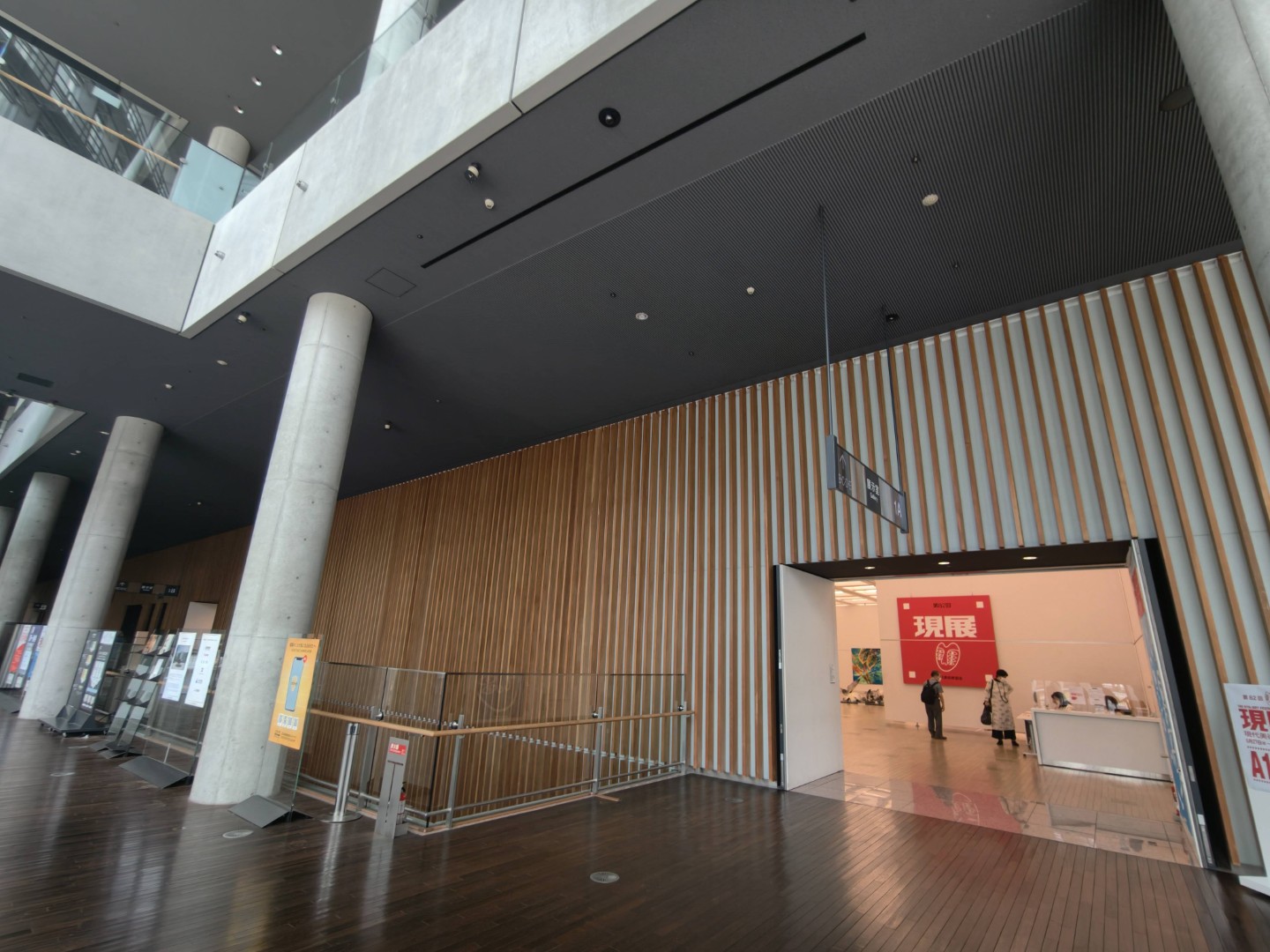
十一、與國立新美術館場域的關係
《戀戀紫藤》在第82回現展中的意義,也必須與國立新美術館的展場特質連結。國立新美術館不設常設典藏,以大型展覽空間與多樣展覽為核心,這使作品在展場中必須直接與其他媒材、風格與尺度的作品並置。
在這樣的空間中,《戀戀紫藤》的彩墨風暴具有相當強的視覺辨識度。它既不像純粹西方抽象畫,也不完全服從傳統花鳥畫,而是在東亞媒材與當代抽象之間建立自己的位置。當作品以掛軸形式懸掛於國立新美術館時,其柔性紙本、垂直展開與色墨流動,與美術館的現代展場形成對比:一方面是白盒子空間的理性與中性,另一方面是彩墨在紙上滲透出的情感與物質痕跡。
這種對比使《戀戀紫藤》在展場中不只是單件作品,而成為台灣藝術家如何將東方媒材帶入日本現代美術平台的具體案例。它不以傳統符號取悅觀眾,也不完全模仿西方當代藝術語彙,而是透過彩墨的物質性與情感性,建立一種具有台灣當代特質的視覺表述。
十二、與台灣當代藝術語境的關係
從台灣當代藝術角度看,蔡梅芳《戀戀紫藤》具有一種介於傳統與當代之間的過渡性。台灣藝術長期處於多重文化交會之中:一方面承接水墨、膠彩、書畫與民間視覺傳統;另一方面也受到西方現代主義、抽象表現、當代媒材實驗與全球展覽制度的影響。《戀戀紫藤》正是在這些脈絡中形成。
作品的題材與媒材連接東亞傳統,但其畫面處理則明顯具有當代意識。它不以再現準確性為目標,而以材料流動、心理張力與視覺能量為核心。這使它不同於傳統花鳥,也不同於純粹裝飾性的彩墨作品。它所呈現的是台灣當代彩墨的一種可能方向:不再將水墨視為單純古典媒材,而是讓水墨與色彩共同承載當代人的情緒、記憶與存在不安。
此外,《戀戀紫藤》中對親密關係的強調,也可視為對現代個體孤立處境的回應。當代藝術常處理斷裂、異化、身體、記憶與身份問題;蔡梅芳並不以激烈政治符號進入這些議題,而是透過自然與情感意象,以較含蓄但有力的方式回應現代人的精神困境。
十三、專業評論觀點:蔡梅芳作品的三重價值
綜合而言,蔡梅芳《戀戀紫藤》在本專題報告中可被歸納為三重價值。
第一,媒材價值
作品展現彩墨在當代語境中的開放性。水、墨、顏料與紙張並非被動媒材,而是共同參與畫面生成。蔡梅芳讓材料的流動性成為作品核心,使彩墨不只是傳統技法,而是具有當代抽象表現力的媒介。
第二,圖像價值
作品重構了花鳥畫語言。紫藤與鴛鴦仍具有可辨識性,但它們不再服務於傳統祥瑞或抒情圖式,而是進入自然崇高、情感依附與存在焦慮的場域。這使作品在具象與抽象之間取得平衡。
第三,情感價值
作品將「戀戀」轉化為一種精神命題。在巨大、混沌、不可掌控的彩墨背景中,鴛鴦的相依象徵生命之間的連結。這種連結不是逃避現實,而是在無常中建立抵抗虛無的力量。
十四、本章小結:在彩墨風暴中確認生命的相依
蔡梅芳《戀戀紫藤》之所以能在第82回現展台灣藝術家群像中具有代表性,正在於它成功把一個看似傳統的花鳥題材,轉化為具有當代精神深度的藝術命題。作品中的紫藤不只是花,彩墨不只是技法,鴛鴦也不只是象徵愛情的圖像。它們共同構成一個關於自然、時間、無常與親密關係的視覺場。
在形式上,作品以彩墨自動性與物質流動建立強烈視覺張力;在美學上,它從優美轉向崇高,使自然不再只是可賞玩的景物,而是充滿壓迫與震撼的存在力量;在情感上,它以鴛鴦的微小相依,回答人在巨大世界中如何尋找精神錨點的問題。
因此,《戀戀紫藤》不是一件單純描繪紫藤與鴛鴦的作品,而是一件關於「如何在不可掌控的世界中維持眷戀」的當代彩墨作品。它以柔軟的花卉題材進入強烈的存在命題,以東方媒材進入現代展場,以個人情感回應跨國藝術制度。這也使蔡梅芳的會友身分不只是制度標籤,而與其作品本身的成熟度、辨識度與跨文化可讀性相互呼應。
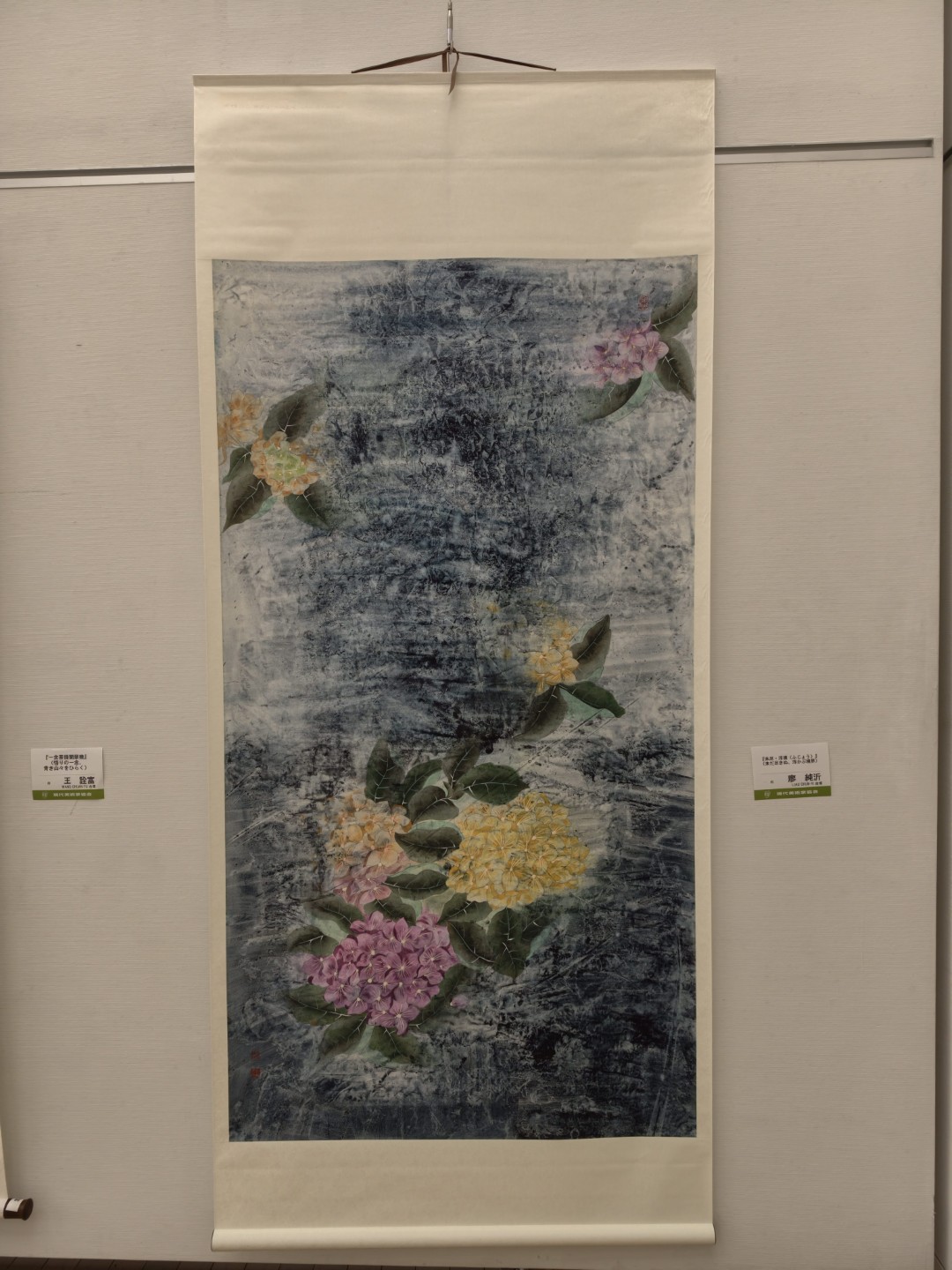
廖純沂 Liau, Chun-Yi
《未盡・浮境》中的液態現代性、懸浮花卉與心理拓撲
一、藝術家位置:在冷靜與斷裂之間建構心理空間
在第82回日本「現展」台灣藝術家群像中,廖純沂的作品提供了一種與蔡梅芳截然不同的觀看經驗。若說蔡梅芳《戀戀紫藤》以彩墨風暴、自然崇高與情感依附形成強烈的視覺張力,那麼廖純沂的《未盡・浮境》則更接近一種冷靜、懸浮、帶有心理斷裂感的內在風景。她的作品並不以劇烈色彩直接壓迫觀者,而是以不穩定的空間、失去重力的花卉與幽微的肌理,將觀者帶入一個介於現實、記憶與意識之間的浮動場域。
廖純沂利用熟宣不吸水的特性,結合重彩、刮擦、拓印與自動性技法,形成一種極具現代主義冷峻感與心理斷裂性的視覺拓撲;其《未盡・浮境》尤其被描述為一個失去地平線與重力座標的畫面,花卉在其中呈現無根而懸浮的狀態。
這樣的作品特質,使廖純沂在本次台灣參展群像中扮演一個重要角色:她並不以外在敘事或明確象徵取勝,而是透過空間感、材質感與心理氣氛,表現當代人內在深處的失重經驗。她的作品看似靜謐,實則充滿不穩定性;看似描繪花卉,實則處理的是現代主體在流動社會中的心理狀態。
二、《未盡・浮境》的題名:尚未完成的邊界與漂浮的場域
《未盡・浮境》這一題名,本身即包含豐富的評論線索。「未盡」意味著尚未結束、尚未抵達、尚未完成;它指向一種開放狀態,也暗示作品中的時間並非封閉、確定或已完成的敘事。作品不是一個已經被整理好的風景,而像是一個仍在生成、仍在流動、仍未落定的心理片段。
「浮境」則更具關鍵性。「浮」包含漂浮、懸浮、浮現、浮動、不穩定等意義;「境」既可指空間,也可指心境、境界或意識狀態。兩字結合後,「浮境」便不只是漂浮的景象,而是一種不穩定的心理空間。它既不是完全真實的自然環境,也不是純粹抽象的精神圖像,而是在兩者之間擺盪。亦即「未曾窮盡、浮動的邊界」。這進一步強化了作品對邊界、未完成與漂浮狀態的關注。
因此,《未盡・浮境》的題名並不是單純描述畫面內容,而是先行建立一種觀看方法:觀者不應把作品看作固定風景,而應理解為一個介於成形與消散、記憶與現實、花卉與抽象、存在與失重之間的心理場域。
三、熟宣與重彩:從水墨流動到表面肌理的控制
廖純沂的作品之所以與傳統水墨或彩墨有所不同,關鍵之一在於其對媒材表面的處理。她利用「熟宣」較不吸水的物理特性,結合「礦物重彩」與多層肌理,建立出具有冷峻感與心理斷裂性的畫面。
熟宣與生宣不同。生宣吸水性強,適合墨色暈染、滲化與氣韻流動;熟宣則因經過加工,吸水性較低,能讓顏料停留於表層,便於反覆堆疊、描繪、刮擦與控制。廖純沂對熟宣的使用,使畫面不像傳統水墨那樣追求一氣呵成的流動,而更像在紙面上建立一種冷靜、密集、反覆加工的表層結構。
這種表層結構使《未盡・浮境》具有特殊的視覺心理效果。畫面不是透明的,也不是一眼可穿透的;它有層次、有覆蓋、有摩擦痕跡,也有近似霧面、砂質或微粒般的肌理。觀者在觀看時,會感受到畫面並非單一空間,而是由多重時間與多重動作累積而成。
重彩的加入,則使作品擺脫水墨單純墨韻的範圍。花卉的色彩在灰藍、幽暗或混沌背景中顯得明亮,卻並非甜美;它們像是被放置在一個不穩定的氣候或心理層中,既浮現又被包圍,既清晰又孤立。這正是廖純沂作品最值得注意的地方:她不是讓媒材服務於花卉再現,而是讓媒材本身成為心理狀態的表面。
四、失去地平線的空間:漂浮感如何被建立
《未盡・浮境》最明顯的空間特徵,是畫面缺乏穩定地平線。傳統風景畫通常透過地平線、前景、中景、遠景等安排,讓觀者知道自己站在哪裡、看向何方。然而在廖純沂的畫面中,這種座標被有意地削弱。《未盡・浮境》創造了一個失去地平線與重力座標的背景,其藍灰色肌理猶如暴風雨下的海面,也像充滿靜電干擾的螢幕。
這種空間處理,使畫面不再是一個可步入的自然場景,而更像一個漂浮中的心理區域。觀者無法判斷花卉是在空中、水面、記憶裡,還是在某種抽象的意識場中。花朵不是長在地上,而像是從畫面深處浮現;它們沒有可見的根系,也沒有明確支撐點。
這種無根感,是作品心理意義的核心。當花卉失去土地,便不再只是自然物,而成為現代主體的象徵:美麗、脆弱、仍然開放,卻無法確定自身所在。這種漂浮不是輕盈的,而帶有焦慮;不是自由飛翔,而是失去依靠後的懸置。
廖純沂並未用激烈姿態表現焦慮,而是以空間的不確定性讓焦慮慢慢浮現。這種處理方式使作品具有一種冷靜而深層的情緒力量。
五、液態現代性:無根花卉與當代人的心理狀態
我們可以用齊格蒙・鮑曼的「液態現代性」來理解《未盡・浮境》。液態現代性指涉當代社會中穩定結構的鬆動:身份、關係、價值、工作與生活形式不再固定,而是在快速流動中持續變化。廖純沂筆下的花卉沒有根系連結大地,精準視覺化了現代人的「無根性焦慮」;然而,這些花卉儘管懸浮,仍然熱烈盛開,呈現一種在絕境中依然優雅的英雄主義。
我們可作為理解《未盡・浮境》的核心。作品中的花卉並非衰敗或枯萎,而是仍然保持色彩與形態。它們沒有穩定位置,卻沒有放棄開放;它們被置於混沌背景之中,卻沒有完全被吞沒。這種狀態與當代人的生命處境極為相似:在失去穩定價值與固定歸屬的時代,人仍然必須生活、感受、創造與維持自我。
因此,《未盡・浮境》並不是單純表現焦慮,而是表現焦慮中的生命姿態。花卉的美並非來自安穩,而是來自其在不安中仍然顯現自身。這種美不是田園式的,也不是裝飾性的,而是一種帶有抵抗意味的存在美學。
廖純沂的作品因此具有重要的當代性。她沒有直接描繪都市、科技或社會景觀,卻透過花卉與空間關係,精準表達了現代人內在深處的流動、不確定與自我維持。
六、花卉意象:從自然物到心理主體
在《未盡・浮境》中,花卉雖然仍可被辨識,但其意義已經超出自然物範圍。它們不再只是植物,而更像心理主體的替身。花卉之所以適合承載這一意義,是因為它本身兼具脆弱與生命力:花容易凋落,卻在開放瞬間呈現極高的視覺強度;它依賴環境,卻又能以顏色與形態宣示自身存在。
廖純沂將花卉置於漂浮狀態,使其脆弱性被放大。沒有土地、沒有花瓶、沒有枝幹支撐,花卉彷彿只剩下自身的形象與色彩。這使它們看起來既孤立又堅定。畫面中的花朵不是被環境供養,而是像在不穩定空間中自行發光。
此處的花卉可被視為當代主體的隱喻。人在現代社會中,也常失去傳統共同體、固定身份或穩定歸屬的支撐;然而,人仍然必須在流動環境中建立自身形式。廖純沂筆下的花卉,正是這種現代主體的視覺化:無根,但仍開放;漂浮,但不消失;孤立,但保有形象。
七、背景肌理:心理噪音與感知屏幕
《未盡・浮境》的背景並非空白,也不是單純襯托花朵的色面。我們將其形容為充滿刮擦、拓印與自動性技法的藍灰色肌理,像暴風雨下的海面,也像佈滿靜電干擾的螢幕。
這一描述非常關鍵,因為它揭示了背景的雙重性。一方面,背景像自然:水面、風暴、雲氣、海潮;另一方面,背景又像媒介:螢幕、訊號、噪音、干擾。自然與科技在此交錯,使作品不再只是自然風景,而更像當代感知狀態的隱喻。
若將背景視為「心理噪音」,則花卉便是從噪音中浮現的意識片段。這些噪音不是明確事件,而是由記憶、焦慮、感覺與外界訊息交織而成。當代人的內在世界並不安靜,而是充滿資訊流、情緒殘響與感知干擾。廖純沂的背景肌理正好捕捉了這種狀態。
若將背景視為「感知屏幕」,則作品也可被理解為數位時代的心理圖像。花朵像是在訊號干擾中顯影,既真實又不穩定。它們可能是記憶中的花,也可能是被媒介化後的自然影像。這使《未盡・浮境》在傳統花卉題材之外,具有一種現代視覺文化的深層意味。
八、冷色調與心理距離:廖純沂的抒情不是溫暖,而是懸置
廖純沂作品中的抒情性,並非溫暖、甜美或感傷,而是一種冷色調中的懸置。相較於姜金玲作品中高飽和度的生命衝動,廖純沂更傾向以灰藍、幽暗、霧化與局部明亮來建立畫面情緒。這種色彩語言使作品具有距離感。
距離感並不意味作品冷漠,而是讓觀者無法立即以情緒消費它。畫面不直接訴說悲傷,也不明確給出慰藉;它只是讓花卉漂浮在不穩定空間中,讓觀者逐漸意識到一種難以命名的失重狀態。
這種抒情方式相當成熟。它避免過度敘事,也避免把花卉變成廉價情緒符號。花朵不是被用來表現「美麗」或「哀愁」的簡單符號,而是透過其位置、色彩與背景關係,構成一種心理事件。
因此,廖純沂的抒情是一種冷抒情。它不靠溫度,而靠距離;不靠直接情節,而靠空間張力;不靠明確象徵,而靠觀看者在畫面中慢慢感受到自身的不安。
九、「未盡」的時間性:作品如何拒絕結論
《未盡・浮境》中的「未盡」也可被理解為一種時間結構。作品沒有明確開始與結束,畫面中的花卉既不像剛剛開放,也不像即將凋謝;它們處在一種被懸置的時間中。背景也不像特定天氣或特定時刻,而像持續流動的時間層。
這使作品拒絕結論。它不告訴觀者這些花從何而來,也不說明它們將往何處去。它只呈現一個中間狀態:尚未完成、尚未落定、尚未消散。
這種時間性非常符合現代人的心理經驗。當代生活中,許多事情並不以明確結局出現,而是長期處於過渡、等待、延宕與不確定之中。個人的身份、關係、職涯與情感常常都處在「未盡」狀態。廖純沂以花卉漂浮的畫面,將這種未完成感轉化為可見形式。
因此,《未盡・浮境》並非描繪某一瞬間,而是描繪一種持續狀態。它的力量不在於戲劇性高潮,而在於讓觀者停留於無法抵達結論的時間之中。
十、與蔡梅芳的對照:從自然崇高到心理懸浮
若將廖純沂《未盡・浮境》與前一回分析的蔡梅芳《戀戀紫藤》並置,可更清楚看見兩位藝術家的差異與互補。
蔡梅芳的畫面具有外向的能量。彩墨流動形成風暴般的視覺場,紫藤與鴛鴦在其中呈現自然崇高與情感相依。她的作品面對的是宏大的自然力量,並以微小生命的相依作為回應。
廖純沂的作品則較為內向。她不以風暴壓迫觀者,而是讓觀者進入一個失去座標的心理空間。花卉沒有與另一個生命相依,而是孤立地漂浮;作品的重點不在情感關係,而在主體如何在無根狀態中維持自身形象。
兩者同樣處理不確定性,但方式不同。蔡梅芳面對的是宇宙式、自然式的不確定;廖純沂面對的是心理式、社會式的不確定。蔡梅芳以「戀戀」回應虛無;廖純沂以「浮境」呈現失重。這也使第82回現展台灣藝術家群像更加多聲部:同樣是花卉題材,卻能展開完全不同的精神向度。
十一、與掛軸展示的關係:垂直性中的失重矛盾
本屆台灣參展作品多採掛軸形式展示,這一點對廖純沂作品同樣重要。掛軸本身具有明確的垂直性:作品由上而下展開,受重力牽引,形成東亞書畫傳統中常見的觀看節奏。
然而,《未盡・浮境》的畫面內容卻是失重的。花卉在畫面中漂浮,缺乏地面與支撐點。於是,展示形式的垂直性與畫面內容的失重感形成矛盾:掛軸提醒觀者重力存在,而畫面卻讓花卉逃離重力。
這種矛盾反而強化了作品張力。觀者站在掛軸前,身體感受到作品的垂直尺度,但眼睛卻進入一個無法定位上下、前後與深淺的空間。這使《未盡・浮境》不只是畫面中的浮動,也成為展場中的浮動經驗。
換言之,掛軸沒有削弱廖純沂作品的當代性,反而讓其失重感更加明顯。當東亞傳統形式承載現代心理空間,作品便在傳統與當代之間形成細緻的張力。
十二、與國立新美術館場域的關係:白盒子中的心理防空洞
國立新美術館作為大型公募展場,具有開放、明亮、規模宏大與作品眾多的特徵。 在這樣的展場中,廖純沂作品的靜謐與冷調,反而可能形成一種特殊的停頓效果。它不像高飽和作品那樣立即抓住觀者視線,而是以一種較慢的節奏要求觀看。
廖純沂以冰霜般的重彩與深邃肌理,為觀者構築一座不受外界流轉干擾的精神防空洞。 這一說法可轉化為更深一層的語言:廖純沂的作品在展場中提供了一個心理緩衝區。當觀者穿行於大量作品與多種媒材之間,《未盡・浮境》的冷靜、漂浮與未完成感,使觀看節奏被迫放慢。
在公募展的複雜環境中,這樣的作品具有難得的沉思性。它不以強烈敘事要求觀者立即理解,也不以誇張形式追求視覺競爭,而是讓觀者在不確定空間中停留。這正是其專業價值所在:它以安靜方式抵抗展覽現場的資訊過量。
十三、廖純沂作品的當代性:不描繪時代,卻呈現時代感
廖純沂《未盡・浮境》的當代性並不來自明顯的時代符號。作品沒有直接描繪都市、機械、科技、政治或社會事件;它使用的仍是花卉、色彩、紙本與繪畫肌理。然而,它卻非常準確地呈現了當代人的心理狀態。
這說明當代性並不一定依賴題材的現代化。畫一座城市不必然當代,畫一朵花也不必然傳統。關鍵在於藝術家如何處理觀看、空間、主體與時代感。廖純沂以花卉表現無根,以背景肌理表現干擾,以冷色調表現距離,以未完成的漂浮狀態表現現代生活的長期懸置。這些都使作品具有鮮明的當代感。
因此,《未盡・浮境》可被理解為一種「心理當代性」的作品。它不在表面上標示時代,而是在感受結構上回應時代。觀者之所以能與作品產生共鳴,不是因為作品說明了某個社會議題,而是因為它讓人看見自己在流動世界中的不安、孤立與仍然努力盛開的狀態。
十四、專業評論觀點:廖純沂《未盡・浮境》的四重價值
綜合以上分析,廖純沂《未盡・浮境》在第82回現展台灣藝術家群像中具有以下四重評論價值。
第一,媒材價值
作品展現熟宣與重彩在當代繪畫中的表面控制力。廖純沂不追求水墨自然暈染的傳統氣韻,而是透過堆疊、刮擦、拓印與冷色肌理,建立一種具有心理密度的畫面表面。
第二,空間價值
作品創造一個失去地平線與重力座標的空間。這種空間不是自然風景,而是心理場域;它使花卉脫離土地,進入漂浮、懸置與未完成的狀態。
第三,象徵價值
花卉不再只是自然物,而成為現代主體的象徵。它們無根卻仍然開放,孤立卻不消失,正好回應當代人在流動社會中的生存姿態。
第四,展場價值
在國立新美術館的大型公募展場中,《未盡・浮境》以冷靜、緩慢、沉思性的方式,提供一種與視覺過載相反的觀看節奏。它不是大聲宣告,而是讓觀者在漂浮中感受到內在不安。
十五、本章小結:在無根狀態中仍然盛開
廖純沂《未盡・浮境》是一件關於「漂浮」的作品,但它的漂浮並不輕盈。它呈現的是一種無根、未完成、缺乏確定座標的現代心理狀態。畫面中的花卉不再是穩定自然的一部分,而是在藍灰肌理、視覺噪音與失重空間中浮現的生命形象。
這些花卉沒有土地,卻仍然盛開;沒有明確歸屬,卻仍維持形象;沒有穩定背景,卻未被混沌吞沒。正因如此,《未盡・浮境》不只是描繪焦慮,也表現一種在焦慮中仍然維持自身的生命力量。
廖純沂的專業價值,在於她能以冷靜的形式語言,處理極為不穩定的心理經驗。她不是用激烈筆觸喊出焦慮,而是讓焦慮沉入空間、肌理與花卉的懸浮狀態中。這使作品具有一種耐看的深度,也使其在第82回現展台灣藝術家群像中,成為表現現代心理拓撲的重要篇章。
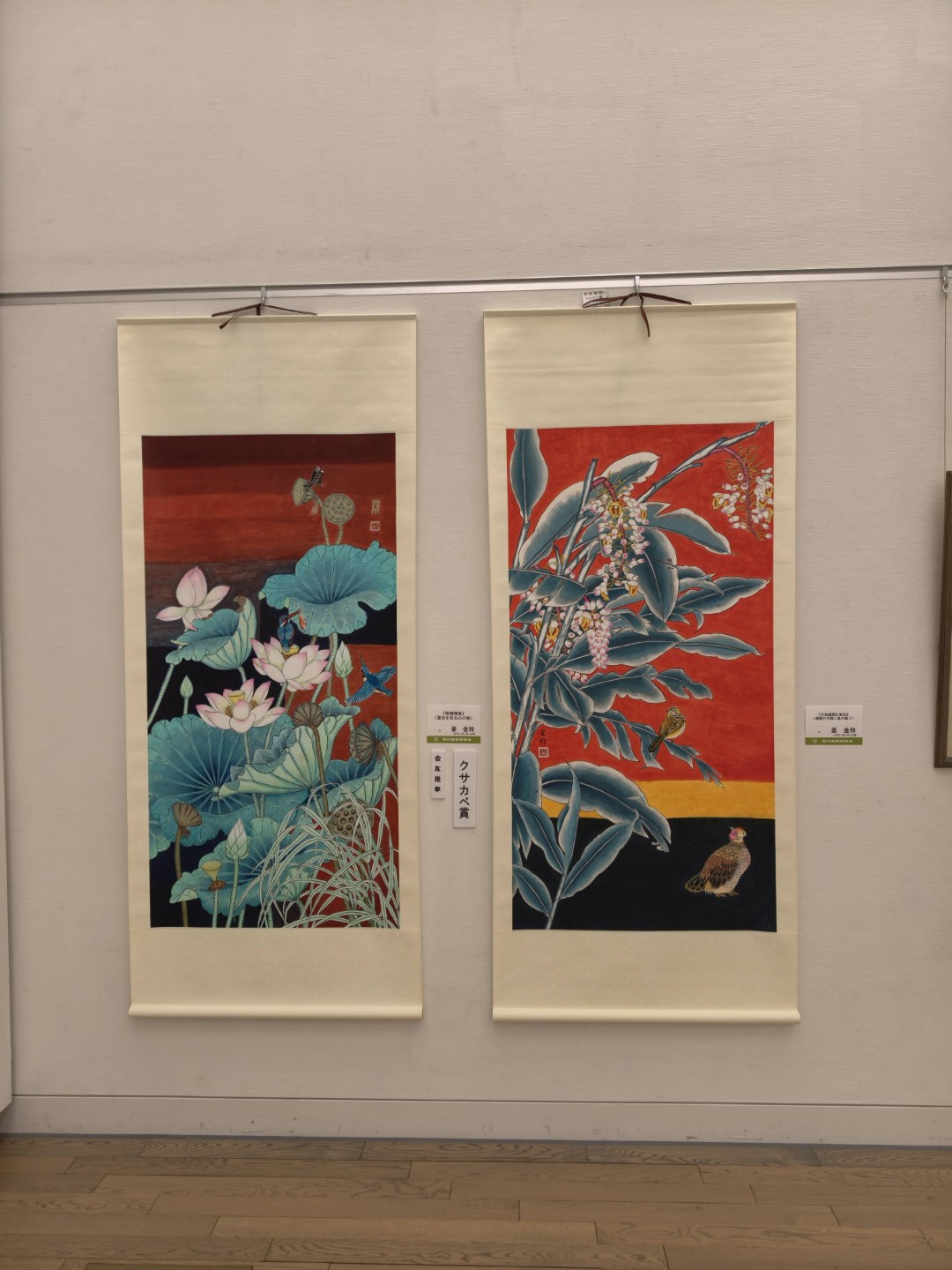
姜金玲 Jiang Jinling
《荷塘情旅》與《月桃盛開引禽来》中的亞熱帶生命衝力、厚塗色彩與愛欲生態學
一、藝術家位置:在台灣群像中釋放感性色彩的高峰
在第82回日本「現展」台灣藝術家群像中,姜金玲的作品呈現出極為鮮明的感性力量。若蔡梅芳《戀戀紫藤》以彩墨風暴與情感依附展現自然崇高,廖純沂《未盡・浮境》則以冷色懸浮與心理拓撲呈現現代人的無根狀態,那麼姜金玲的《荷塘情旅》與《月桃盛開引禽来》則將觀看帶入一個充滿色彩、植物、身體感與生命衝動的亞熱帶場域。姜金玲的作品為「全面粉碎理性鐵籠、釋放細胞底層生命衝動的感性暴動」,並指出她以高度飽和的色相與厚重肌理,在六本木的白盒子空間中開闢出一處愛欲生態學的庇護所。
姜金玲作品的關鍵,不在於她描繪了荷花、月桃、禽鳥或情侶這些具象題材,而在於她如何使這些題材擺脫傳統花鳥畫、文人荷花或田園抒情的框架。她筆下的植物不是被觀賞的客體,而是具有強烈擴張性、侵入性與生命能量的主體。她的色彩也不是為了再現自然,而是將自然內部的熱力、慾望與生長衝動直接推到畫面表層。
因此,姜金玲在本專題中的位置,並不只是「自然題材藝術家」或「花卉畫家」,而是一位透過亞熱帶植物與高飽和色彩,重構自然、身體與情感關係的創作者。她的作品提供了台灣當代藝術中極具感官密度的一條路徑:不以冷靜分析取勝,而以色彩、肌理、植物與愛欲的交互生成,讓觀者重新感受生命的原始力量。
二、雙作品結構:《荷塘情旅》與《月桃盛開引禽来》的互補關係
姜金玲此次被討論的兩件作品——《荷塘情旅》與《月桃盛開引禽来》——可以視為一組彼此呼應的雙重結構。前者側重情感、旅程、親密關係與內在庇護;後者則強調植物繁盛、禽鳥吸引、自然擴張與生命場域的外放《月桃盛開引禽来》展現自然本體的狂飆,而《荷塘情旅》則將這股狂飆能量溫柔地收束於人類個體的情感經驗之中。
這種雙作品結構相當重要。若只觀看《月桃盛開引禽来》,我們會看見姜金玲如何將亞熱帶植物處理為高強度的生命事件:月桃不再只是植物,而像是一種向外擴張的自然意志。若只觀看《荷塘情旅》,我們則會看見自然如何成為情感與愛欲的庇護空間:荷塘不是背景,而是承接人類親密關係的感性場域。
兩件作品共同構成一個由外向內、由自然到情感、由植物擴張到人類依偎的視覺系統。《月桃盛開引禽来》是自然生命力的爆發,《荷塘情旅》是生命力在情感空間中的收束;前者接近生命本體的宣告,後者則接近愛與庇護的詩學。正因如此,姜金玲的作品不能被簡單歸類為花卉畫,而應被理解為一種「生命生態」與「情感生態」交織的當代彩墨實踐。
三、《月桃盛開引禽来》:亞熱帶植物的擴張性生命
《月桃盛開引禽来》這一題名,本身即具有敘事性與動態感。「月桃盛開」指向植物繁茂、花開至極盛狀態;「引禽来」則暗示植物不只是靜態存在,而具有吸引、召喚與牽引他者的能力。換言之,月桃不是孤立植物,而是整個生態關係的中心。
姜金玲在《月桃盛開引禽来》中摒棄傳統水墨的克制,採用帶有野獸派特質的厚塗肌理,並以燃燒般的洋紅、耀眼金黃、深邃普魯士藍等高飽和色彩,徹底粉碎植物的固有色。 這說明她並不追求植物學式的準確再現,而是以主觀色彩呈現植物內部的生命強度。
月桃在台灣亞熱帶環境中具有鮮明的地方性與感官特徵。其葉片寬大,花序飽滿,常與濕熱氣候、山林邊界、民間植物使用與島嶼自然經驗相關。姜金玲並未把月桃處理成地方風情符號,而是進一步將其變成一種具有主體性的生命力量。作品中的月桃像是向外伸展、膨脹、發光,甚至具有某種近乎侵略性的生長意志。
這使《月桃盛開引禽来》具備強烈的亞熱帶性。這裡的亞熱帶不是旅遊式的風景,也不是民俗式的地方色彩,而是一種濕潤、濃烈、難以被理性框限的生命狀態。姜金玲以色彩與肌理讓觀者感受到:自然不是溫順地等待觀看,而是主動向外生長、吸引、包圍並改變觀看者。
四、厚塗與重彩:媒材作為生命衝力的表面
姜金玲作品最具辨識度的特徵之一,是厚重而高能量的色彩表面。她的繪畫具有「厚塗(Impasto)」與「色彩的主觀解放」特質,畫面由大筆觸與濃烈顏料堆疊而成,讓畫布或紙面本身成為正在發生熱力學反應的有機體。
厚塗在這裡不只是技法,而是作品意義的一部分。當顏料不再只是薄薄覆蓋表面,而是以堆疊、擠壓、覆蓋、碰撞的方式形成物理厚度時,畫面便具有一種近似身體的存在感。觀者不只是「看見」色彩,也會感受到色彩的重量、溫度與觸覺。
這種媒材處理與姜金玲的主題高度一致。若她要表現的是植物生命的擴張與感性爆發,那麼輕薄、透明、克制的媒材處理便不足以承載此一力量。厚塗使植物不再是被描繪的圖像,而像是從畫面表面長出來。色彩不只是視覺效果,而成為生命衝動的痕跡。
因此,姜金玲的厚塗重彩可以被理解為一種「物質化的生命力」。它讓看不見的生長、慾望、吸引、繁殖與能量,轉化為可見、可感、近乎可觸摸的表面。這正是她作品區別於傳統花鳥畫的重要之處:傳統花鳥常透過線條與留白表現氣韻,而姜金玲則透過顏料厚度與色彩衝撞表現生命的熱度。
五、野獸派色彩與主觀自然
姜金玲作品中的色彩並非自然主義。她不依照植物的固有色描繪月桃或荷塘,而是使用高度主觀化、高飽和度與對比強烈的色彩,使自然從可辨識物象轉化為情緒與能量場。《月桃盛開引禽来》中的洋紅、金黃與普魯士藍,徹底粉碎了植物的固有色,呈現出近似野獸派的色彩解放。
野獸派色彩的核心,不在於顏色鮮豔本身,而在於色彩不再服從自然再現,而服從藝術家的感覺與內在強度。姜金玲的色彩正具有這樣的特徵。她不問「月桃原本是什麼顏色」,而是問「月桃內在的生命力應該如何被看見」。於是,色彩成為生命力的語言,而非物象的外衣。
這種主觀自然觀,讓姜金玲的植物具有強烈的情緒性。月桃不只是月桃,而像是生命自身的燃燒;荷塘不只是池水與花葉,而像是情感、記憶與身體感交織的場域。色彩在此不再附屬於形體,而是與形體共同生成作品的精神狀態。
因此,姜金玲的作品可被視為一種「情感化的自然」。自然不是被冷靜觀察,而是被身體感受;不是被理性分類,而是被色彩重新點燃。
六、斯賓諾莎式生命衝動:自然不是背景,而是主體
我們可以用斯賓諾莎的「生命衝動(Conatus)」理解姜金玲作品,指出其高飽和度色彩是萬物內在生命衝動的視覺證成。 這一理論視角有助於說明姜金玲作品中自然的主體性。
所謂生命衝動,可簡要理解為每一存在者維持自身、擴張自身、持續存在的內在力量。若以此觀看《月桃盛開引禽来》,月桃便不是被動植物,而是正在展現自身存在強度的生命主體。它盛開、伸展、吸引禽鳥,並將周圍空間轉化為自身生命場的一部分。
這也解釋了為何作品中的植物帶有某種壓迫性。觀者並不是從安全距離觀看植物,而像是被植物的色彩、葉片、花朵與能量包圍。自然不再是人類凝視下的景物,而是具有反向凝視與主動生成能力的存在。
姜金玲在此顛覆了傳統自然畫中常見的人類中心視角。她筆下的自然不是等待人類詮釋的客體,而是自我擴張、自我肯定、自我顯現的力量。這種自然觀與當代生態意識亦有呼應:人類不再位居世界中心,而必須重新感受植物、動物、氣候與環境所構成的共同生命網絡。
七、《荷塘情旅》:從自然狂飆到情感庇護
相較於《月桃盛開引禽来》的外放與擴張,《荷塘情旅》更偏向內在、情感與庇護。題名中的「荷塘」指向水域、植物與自然空間;「情旅」則使作品帶有旅程、情感、相伴與心理移動的意味,即「巡遊蓮池的心靈之旅」,顯示作品不是單純描繪荷塘景色,而是將荷塘轉化為情感與心靈的旅程空間。
在《荷塘情旅》中,自然不再只是生命力的爆發,而成為人類情感得以暫時安放的場所。畫面中一對極其微小的情侶依偎在龐大如超新星爆發般的荷花與深藍水波之間;這種比例失衡使人類個體顯得渺小,但也正因為渺小,其依偎姿態更具意義。
荷塘在此不是傳統文人畫中的出世象徵,也不是單純的清淨意象。它更像是一個包覆情感、承接身體與記憶的母體空間。情侶在荷塘中不是觀看自然,而是被自然包圍;他們不是凌駕於自然之上,而是融入其中。這使《荷塘情旅》具有一種明顯的愛欲生態學特質:愛不是孤立的人際事件,而是發生在水、花、葉、色彩與空間共同構成的生命環境之中。
八、荷塘意象的轉化:從清淨象徵到愛欲生態
荷花在東亞藝術中具有深厚傳統,常被視為潔淨、出淤泥而不染、清雅、禪意與文人品格的象徵。然而,姜金玲並不重複這一傳統詮釋。她的荷塘不是冷靜、疏離或出世的,而是充滿色彩、肌理、愛欲與身體感的。
這種轉化具有重要意義。傳統荷花圖像常強調「淨」與「遠」,藝術家與觀者在精神上保持一種超然距離;姜金玲的荷塘則強調「近」與「入」,觀者彷彿被帶入濃烈的色彩與水波之中。荷花不再只是道德象徵,而成為感性生命的一部分。
姜金玲在《荷塘情旅》中模糊了情侶與周遭荷塘的輪廓線,呈現自我邊界的消融,使愛欲超越世俗算計,進入與宇宙母體相融合的狀態。 這可被理解為姜金玲對荷花傳統的當代改寫:純潔不是遠離紅塵,而是在最濃烈的生命經驗中重新生成。
因此,《荷塘情旅》不是出世的荷塘,而是入世的荷塘;不是拒絕身體,而是讓身體、情感與自然彼此滲透。姜金玲讓荷塘從文人清賞轉向感性庇護,從道德象徵轉向生命共同體。
九、情侶意象:微小人物與巨大自然的比例辯證
《荷塘情旅》中若有一對情侶形象,其重要性不在於敘事情節,而在於比例關係。畫面中情侶極其微小,依偎於龐大的荷花與深藍水波之間,形成強烈的比例失衡。
這種比例失衡使人類不再是畫面中心的支配者。傳統人物畫或敘事畫常以人物作為視覺焦點,自然則成為背景;但在姜金玲作品中,自然巨大,人類微小。這並不是貶低人,而是重新調整人與自然的關係。人類的情感並非脫離環境而存在,而是在龐大生命場中找到短暫而珍貴的位置。
情侶的依偎姿態,使作品中的愛不只是個人情感,也是一種存在方式。當兩個微小人物置身於龐大的自然色域中,他們的相依便具有抵抗孤立的意味。與蔡梅芳《戀戀紫藤》中鴛鴦的情感錨點相似,姜金玲的情侶也象徵生命之間的靠近;但兩者氛圍不同。蔡梅芳是在宇宙風暴中確認眷戀,姜金玲則是在濃烈自然母體中讓愛欲與生命交融。
因此,《荷塘情旅》中的人物不是敘事主角,而是情感密度的凝結點。他們使整個荷塘不再只是植物空間,而成為一個能容納愛、身體與心靈旅程的場所。
十、色彩作為愛欲語言
姜金玲的色彩在《荷塘情旅》中不只是自然色彩,也是一種愛欲語言。若《月桃盛開引禽来》的色彩偏向擴張、燃燒與召喚,那麼《荷塘情旅》的色彩則更偏向包覆、滲透與融合。紫紅、深藍、墨色與亮色花葉共同形成一種介於夢境與身體感之間的色域。
愛欲在此並不被表現為具體情節,而是被轉化為空間氣氛。色彩的濃烈,使荷塘不再透明;水波的深藍,使情感具有深度;花葉的擴張,使人物被自然包圍。觀者感受到的不是外在事件,而是情感在空間中蔓延。
這種處理方式使《荷塘情旅》避免了直白敘事。姜金玲不需要描繪明確故事,也能讓觀者感受到親密、依偎、沉浸與庇護。她以色彩替代敘事,以色域替代心理描寫,使愛欲成為整個畫面的感官結構。
十一、邊界消融:人物、植物與水域的相互滲透
《荷塘情旅》最值得注意之處,在於邊界的消融。藝術家模糊了情侶與周遭荷塘的輪廓線,深藍水波與洋紅荷花光暈彷彿侵入人物身體,使自我邊界被鬆動。
這種邊界消融,是姜金玲作品的重要美學特徵。她不讓人物與背景保持清楚分離,而是讓人物、植物、水域、色彩互相滲透。這意味著個體不是封閉的,而是與環境、情感與自然共同生成。
在當代社會中,個體常被制度、科技與社會分工切割成孤立單位;姜金玲的畫面則提出另一種生命想像:人可以不再與自然對立,也不必把愛視為純粹私人事件,而可在與環境的交融中重新獲得整體感。
因此,《荷塘情旅》的邊界消融並非形式上的模糊,而是作品思想的核心。它使人與自然不再是主體與客體的關係,而是共同參與一個情感生態場。
十二、與傳統文人荷花的差異
若將姜金玲的荷塘與傳統文人荷花相比,差異會非常明顯。傳統文人荷花常重視線條節制、墨色清雅、留白與精神品格;畫面通常追求一種簡淡、清遠、出塵的美感。姜金玲則完全反其道而行。她的荷塘不清淡,而是濃烈;不疏遠,而是沉浸;不強調出世,而強調入世;不追求自我淨化,而追求情感與生命的交融。
對比傳統文人荷花與姜金玲現代彩墨,前者偏向生宣留白、出世禪觀與書房隱逸,後者則偏向熟宣或混合媒材厚塗、斯賓諾莎式生命衝動與六本木液態空間中的感性突圍。
這個差異說明姜金玲並不是在延續荷花題材,而是在重新身體化與當代化荷花。她使荷花不再只屬於文人精神潔癖,而回到泥土、水、身體、愛欲與色彩的混合狀態。她提醒觀者:真正的生命不在於遠離混濁,而在於能夠從混濁中吸收養分並盛開。
這種觀點使姜金玲作品具有強烈的當代意義。她不否定傳統,但拒絕被傳統的清雅範式限制。她讓荷花重新變得潮濕、熱烈、世俗而有生命。
十三、與台灣亞熱帶經驗的關係
姜金玲作品中強烈的植物性與色彩感,也可被放入台灣亞熱帶環境中理解。台灣的氣候濕潤、植物繁盛,山林、河流、濕地與農村邊界常充滿濃密的自然生命。這種環境經驗不同於乾燥、冷冽或高度人工化的自然景觀,也不同於日本傳統美學中常被強調的季節性節制、物哀與幽玄。
姜金玲的作品以濃烈色彩與厚重肌理,將台灣亞熱帶自然的濕熱、繁密與生長感帶入東京六本木的國立新美術館。這並不是簡單展示「台灣風景」,而是將一種來自島嶼環境的生命感轉化為當代藝術語言。
在翻譯姜金玲《月桃盛開引禽来》時,應讓日本觀眾感受到這股野獸派色彩有別於日本傳統「物哀」那種感傷、消極的凋零美學,而是一種具有擴張性與侵略性的亞熱帶能量。
這一點非常重要。姜金玲作品中的自然並不哀傷,也不以凋零為美;它是盛開、擴張、吸引、包圍與燃燒。這種自然觀讓台灣藝術在日本展場中呈現出鮮明的差異性:不是以異國情調被觀看,而是以強烈生命力與感官能量與日本觀眾發生碰撞。
十四、與國立新美術館場域的關係:白盒子中的色彩暴動
國立新美術館作為第82回現展本展場域,具有大型展覽空間、現代建築尺度與白盒子展場特徵。該館不設常設典藏,而以大型展示空間、多樣展覽與藝術資訊公開為主要功能。 在這樣的場域中,姜金玲作品的色彩與肌理必然產生強烈的空間效果。
白盒子展場常被視為中性、理性、去脈絡化的展示空間;而姜金玲的畫面則充滿濕度、熱度、植物性與身體感。當她的《荷塘情旅》與《月桃盛開引禽来》進入六本木國立新美術館時,作品本身便像是一股亞熱帶生命能量闖入現代展覽制度的冷靜空間。
這種對比強化了作品的存在感。觀者在現代美術館的白牆前,不只是觀看一幅植物畫,而是遭遇一種難以被白盒子完全馴化的色彩生命。姜金玲的畫面彷彿拒絕安靜地掛在牆上,而是向外蔓延,試圖以色彩與肌理重新佔領觀看空間。
因此,姜金玲作品與國立新美術館場域之間形成一種辯證關係:美術館提供制度性與公共性,作品則以感性色彩挑戰空間的理性秩序。這也正是她在本屆台灣群像中的重要性——她使台灣藝術不只是被納入日本展場,而是在展場中發出強烈的感官聲音。
十五、與掛軸展示的關係:柔性載體上的生命膨脹
本屆台灣參展作品多採掛軸形式展示,姜金玲作品亦可在此脈絡中重新理解。掛軸具有柔性、垂直性與可移動性,其源於東亞書畫傳統,也回應跨國運輸與大型作品展示的實務需要。
姜金玲的色彩與厚塗若置於掛軸形式中,會產生一種特殊張力。掛軸本身是柔軟、可收納、可懸垂的載體;而姜金玲的畫面卻充滿膨脹、擴張與色彩重量。柔性載體與強烈內容形成對比,使作品像是在輕盈形式中承載過量生命力。
這種對比也使觀看經驗更具動態性。觀者面對掛軸時,視線自然沿垂直方向移動;而姜金玲的植物與色彩則不斷向四周擴張,形成垂直觀看與橫向蔓延之間的拉扯。這種拉扯非常符合她作品的生命主題:植物不被邊界限制,色彩也不願被框住,而是在掛軸的柔性空間中持續生長。
十六、姜金玲作品的女性感性與生命政治
姜金玲作品中的感性力量,也可以從女性創作者的身體視角加以理解。這裡所謂女性感性,不是將作品簡化為性別本質,而是指出她對植物、情感、身體與庇護空間的處理,帶有一種不同於冷峻理性或英雄敘事的生命政治。
她的作品不以征服自然為目標,也不以抽象秩序控制畫面,而是讓自然與情感共同擴張。她不把愛欲排除在藝術之外,也不把色彩壓抑成純形式,而是讓愛欲、植物、色彩與身體感共同形成作品的中心。這種創作方式使她的作品具有一種對抗性:它對抗的是現代社會中對身體、感性與自然的壓抑。
《荷塘情旅》中的情侶依偎、《月桃盛開引禽来》中的植物召喚,都指向關係性的生命觀。生命不是孤立單位,而是透過吸引、靠近、庇護、滲透與共生而存在。這種關係性,正是姜金玲作品最深層的倫理意義。
十七、專業評論觀點:姜金玲作品的四重價值
綜合以上分析,姜金玲《荷塘情旅》與《月桃盛開引禽来》在本專題報告中具有以下四重價值。
第一,媒材價值
姜金玲以厚塗、重彩與高飽和色彩,突破傳統花鳥畫與文人荷花的克制美學。她讓顏料厚度、筆觸痕跡與色彩衝突成為生命力的可見形式。
第二,植物價值
月桃與荷塘在她筆下不再是自然背景,而是具有主體性的生命場。植物不只是被觀看,而是盛開、吸引、包圍並改變觀看者。
第三,情感價值
《荷塘情旅》將自然轉化為愛欲與情感庇護所。情侶在龐大荷塘中依偎,使愛不再只是人際事件,而成為發生於自然生態中的生命關係。
第四,跨文化價值
姜金玲將台灣亞熱帶的濕熱、繁盛與色彩能量帶入日本現展場域,與日本傳統美學中較為節制、感傷的自然觀形成差異。這使其作品在台日藝術交流中具有鮮明辨識度。
十八、本章小結:在濃烈色彩中重建生命共同體
姜金玲的《荷塘情旅》與《月桃盛開引禽来》並不是單純的自然題材作品,而是以亞熱帶植物為入口,重新建構自然、身體、情感與生命衝動之間的關係。《月桃盛開引禽来》展現自然向外擴張、自我肯定與召喚他者的力量;《荷塘情旅》則將這股力量轉化為愛欲、庇護與情感交融的空間。
她的作品以厚塗與重彩反抗過度理性化的觀看,以高飽和色彩釋放被壓抑的感性生命,以植物與人物的邊界消融重申生命之間的相互依存。與蔡梅芳的動態崇高、廖純沂的心理懸浮不同,姜金玲帶來的是一種濃烈、潮濕、燃燒而具有生態感的藝術語言。
在第82回現展的台灣藝術家群像中,姜金玲的重要性正在於:她使台灣當代藝術的亞熱帶生命力,以不可忽視的色彩強度進入東京六本木的國家級展場。她的作品提醒觀者,生命並不總是冷靜、清雅、理性或可控制;生命也可能是盛開、蔓延、吸引、沉浸與交融。真正的藝術力量,往往正來自這種無法被完全馴服的感性過剩。
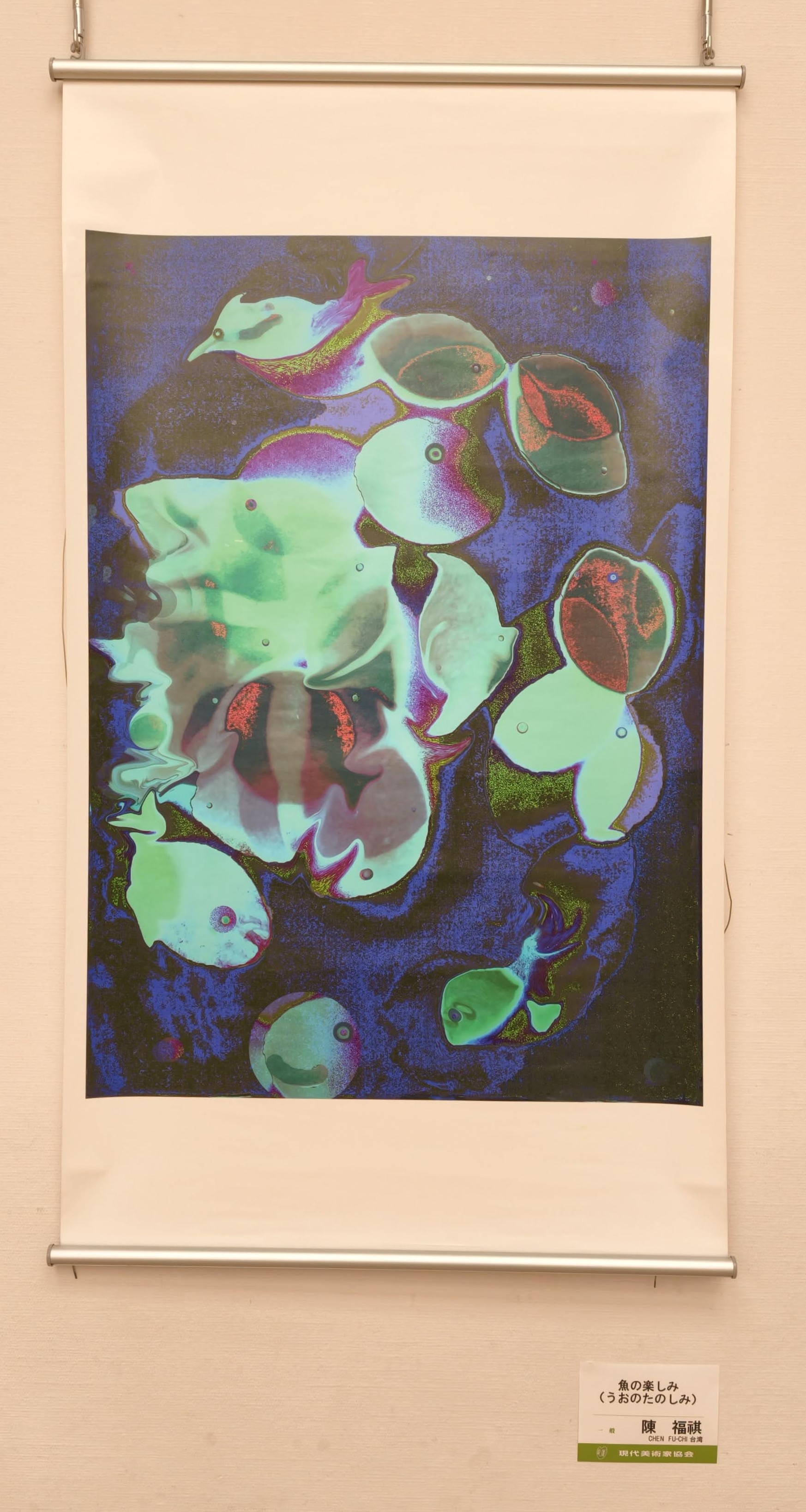
陳福祺 CHEN FU-CHI
《魚的樂趣》中的數位擬像、仿宣紙與後人類逍遙
一、藝術家位置:特別企劃展示區中的媒材轉向
在第82回日本「現展」台灣藝術家群像中,陳福祺的位置具有特殊意義。他的作品《魚的樂趣》「魚の楽しみ」被列為入選特別企劃展示區,這不只是作品展出位置的差異,也意味著現展這一具有戰後公募傳統的美術制度,對數位藝術、影像藝術與跨媒介創作的接納。
若前幾位藝術家主要透過彩墨、水墨、重彩、熟宣與掛軸形式,回應東亞紙本繪畫在當代展場中的可能性,那麼陳福祺則把問題推向另一個方向:當藝術創作不再完全依賴手工筆觸,而是透過數位生成、影像輸出、仿宣紙載體與當代印刷技術完成時,作品如何仍然保有東方哲學、觀看經驗與情感深度?
因此,陳福祺在本專題中的重要性,不只在於他提供了一件數位藝術作品,而在於他使「數位媒材」不再被理解為冰冷的技術工具,而是成為一種能夠重新書寫古典思想、生命感知與後人類美學的藝術語言。
他的《魚的樂趣》並不只是「用電腦做出的圖像」,也不只是把傳統魚題材轉換成新媒材;更重要的是,他將莊子「魚之樂」的古典哲學命題,置入當代數位圖像與仿宣紙的媒介結構之中,使作品同時面向三個層次:古典思想、數位擬像與當代感知。
二、《魚的樂趣》的題名:從莊子命題到數位感知
《魚的樂趣》這一題名,直接讓人聯想到莊子與惠子在濠梁上的著名辯論:「子非魚,安知魚之樂?」這一命題長久以來不只是哲學故事,也牽涉到感知、同理、主體性與他者經驗的問題。
在古典語境中,「魚之樂」不是單純討論魚是否快樂,而是討論人如何理解非人生命的感受。莊子以直覺與逍遙的方式肯定魚之樂,惠子則以邏輯辯證提出質疑。這一爭辯背後,是兩種理解世界的方法:一種是理性分析,一種是感通萬物。
陳福祺將此命題轉化為《魚的樂趣》,並置入數位藝術之中,便使問題變得更加複雜。今日的觀看者面對的不再是真實水中游魚,而是經由數位處理、色彩轉譯、影像輸出與仿宣紙載體生成的魚。此時,「我們如何知道魚之樂?」不再只是人與魚之間的問題,也成為人、圖像、演算法、媒介與生命感知之間的問題。
換言之,陳福祺的作品並不是重述莊子故事,而是將莊子的命題推入後人類時代:當魚不再只是自然生命,而成為數位圖像中的發光體;當水不再只是自然液體,而成為螢光色彩與圖元構成的虛擬環境;當宣紙不再是真正的手工紙,而是具有宣紙質感的現代輸出材,那麼「魚的樂趣」究竟存在於何處?
這一提問,使作品超越單純圖像欣賞,進入哲學與媒介批評的層次。
三、仿宣紙的媒介意義:古典記憶與數位輸出的交會
《魚的樂趣》的重要關鍵之一,在於其媒材具有「仿宣紙」特性。仿宣紙並不等同於傳統宣紙。它可能具有類似宣紙的纖維質感、視覺紋理或東方紙本印象,但本質上卻是為了現代影像輸出、數位微噴或相關技術而存在的載體。
這種媒材本身就具有評論價值。傳統宣紙與東方水墨緊密相關,承載的是筆、墨、水與紙之間的即時反應;一筆落下,墨色滲入纖維,留下不可逆的痕跡。宣紙的價值在於它的物質敏感性,也在於它與書畫身體性之間的關係。
然而,仿宣紙則處於另一種狀態。它保留了宣紙的文化記憶,卻服務於數位圖像的輸出。它看似傳統,實則現代;看似紙本,實則帶有工業製程與影像媒介的邏輯。這種矛盾使《魚的樂趣》具有非常鮮明的媒介張力。
陳福祺選擇仿宣紙,而不是一般相紙、鋁板、壓克力或螢幕,顯示他並不希望作品完全脫離東方紙本傳統。相反地,他讓數位圖像穿上一層具有古典記憶的皮膚,使作品既像從傳統水墨而來,又明顯屬於數位時代。
因此,仿宣紙不是中性載體,而是作品意義的一部分。它讓《魚的樂趣》同時處於「像水墨」與「不是水墨」之間,也使觀者在觀看時不斷意識到媒材身份的不穩定性。
四、數位擬像:真實消失後的魚
若從後現代媒介理論觀察,《魚的樂趣》可被視為一件關於「擬像」的作品。所謂擬像,指的是圖像不再只是再現真實,而是以自身的符號系統取代真實,甚至產生比真實更鮮明、更強烈的「超真實」效果。
陳福祺筆下的魚,並不追求自然主義的寫實。它不是水族圖鑑中的魚,也不是傳統水墨中悠游於留白水域的魚。作品中的魚更像是一種數位生命體:牠被螢光色彩、光譜效果、深藍背景與虛擬水域包圍,形體似乎介於生物、符號與能量團之間。
這種魚不再需要服從自然界的光線、體積與解剖結構,而是服從數位圖像的色彩邏輯。牠的身體可以發光,可以被色彩切割,可以在非自然的水域中呈現近乎科幻的生命狀態。
因此,《魚的樂趣》中的魚並不是「真實魚」的替代品,而是一種數位擬像。它不再問魚原本長什麼樣,而是問:在數位時代,我們如何重新想像生命?當生命被轉化為影像、數據、色彩與圖元時,它是否仍然能夠傳達快樂、自由與逍遙?
陳福祺的作品之所以值得討論,正在於他沒有把數位圖像當作炫技手段,而是透過數位擬像重新打開古典哲學問題。
五、螢光色彩與光譜美學:魚作為發光生命體
《魚的樂趣》在視覺上具有強烈的光譜感。作品可能使用螢光青綠、深藍、亮色水泡與高對比色彩,形成近似深海、聲納、熱成像或數位掃描的效果。這種色彩語言與傳統魚題材完全不同。
傳統水墨中的魚,常以簡潔線條、淡墨暈染與水的留白表現靈動感。魚之樂往往來自空白與筆墨之間的流動。然而,陳福祺的魚之樂則來自發光、閃爍、浮動與光譜化。牠不是在留白中悠游,而是在數位深海中發亮。
這種光譜美學具有雙重意義。
第一,它使魚脫離自然再現,轉為能量化存在。魚不只是有形身體,而像是一團具有情感與生命強度的光。其快樂不再透過姿態或表情表現,而透過色彩強度與視覺節奏展現。
第二,它使水域成為虛擬環境。深藍背景與螢光色彩共同構成一個非自然但極具沉浸感的空間。觀者彷彿不是看見水中魚,而是進入一個數位感知場,感受生命在其中游動、閃爍與呼吸。
因此,《魚的樂趣》的色彩並非裝飾,而是一種當代生命觀。陳福祺以光譜色彩提出:在數位時代,生命不一定只能透過肉身被理解,也可能以光、訊號、能量與影像形式被重新感知。
六、魚與水泡:邊界消融的數位生命場
在《魚的樂趣》中,魚、水泡與水域之間的邊界可能並不穩定。水泡不只是背景元素,也不只是裝飾性符號,而像是與魚共享同一種數位物質。牠們都由色彩、光點、圖元與透明度構成,共同形成一個虛擬生命場。
這種邊界消融,使作品重新回應莊子「萬物齊一」的思想。傳統哲學中,莊子強調人與萬物之間不應被僵硬界線切割;真正的逍遙,來自對分別、對立與固定身份的鬆動。
陳福祺將這一思想轉譯為數位圖像。在他的作品中,魚與水不是截然分離的主體與環境,而像是同一套數位能量中的不同顯現。魚的輪廓可能與水泡互相呼應,水域的深藍可能滲入魚身,光點也可能同時屬於魚、氣泡與背景。
因此,《魚的樂趣》中的生命不是封閉個體,而是關係性的存在。魚的快樂不只來自自身,而來自牠與水、氣泡、光、色彩與虛擬空間之間的共同生成。
這一點使作品具有後人類美學意義。後人類視角不再將人類視為唯一中心,也不再把生命限定於傳統肉身形態;它關心的是生命如何在技術、環境、媒介與感知系統中被重新構成。陳福祺的魚,正是這種後人類生命場中的主體。
七、莊子逍遙的當代轉譯
《魚的樂趣》最深層的藝術價值,在於它對莊子逍遙思想的當代轉譯。莊子的魚之樂,原本指向一種超越邏輯對立、以感通方式理解萬物的境界。陳福祺則將這種境界放入數位世界,使逍遙不再只是自然中的自在遊動,而成為虛擬媒介中的自由轉化。
在傳統文人畫中,魚常被描繪於水墨留白之中,代表自然靈動、自由與閒適。但在陳福祺作品中,逍遙並不發生於古典山水或池塘,而發生於數位深海。魚的自由不是來自自然空間,而是來自圖像、色彩與演算法所創造出的虛擬可能性。
這並不表示陳福祺背離莊子。相反地,他可能更接近莊子精神的核心:逍遙不是停留在某種固定形式,而是能夠不斷變化、轉身、化身、游移於不同狀態之間。若莊子的世界中有「化蝶」與「魚樂」,那麼在數位時代,魚化為光、化為圖元、化為擬像,也可被視為另一種當代逍遙。
因此,《魚的樂趣》不是古典哲學的插圖,而是古典哲學在新媒介中的再生。它讓莊子不再只是文本中的思想,而成為一種可被觀看、可被感知、可被數位化重新經驗的當代圖像。
八、數位媒材與手感問題:沒有筆觸,是否仍有精神性?
談論數位藝術時,常見問題之一是:當作品不再直接呈現手工筆觸,是否會失去傳統藝術中的身體性與精神性?陳福祺的《魚的樂趣》正好提供了一個值得討論的案例。
在傳統水墨中,筆觸直接連接藝術家的身體:手腕、呼吸、速度、力度、停頓與墨色都會留在紙上。數位藝術則經常經由軟體、參數、影像處理與輸出設備完成,身體痕跡不再以同樣方式顯現。
然而,這不代表數位藝術沒有精神性。精神性不必然只存在於筆觸,也可以存在於媒介選擇、圖像結構、色彩強度、哲學命題與觀看經驗之中。陳福祺的精神性不來自傳統筆墨痕跡,而來自他如何在數位圖像中重構「魚之樂」的問題。
換言之,《魚的樂趣》的精神性不是書寫性的,而是媒介性的。它透過仿宣紙與數位影像的矛盾,透過魚與水泡的邊界消融,透過光譜色彩與莊子思想的連結,形成一種屬於數位時代的精神空間。
這也提醒我們,當代藝術評論不能只以傳統媒材標準評價數位作品。若仍然只問「是否有手感」「是否有筆墨」,便可能忽略數位藝術自身的美學邏輯。陳福祺的作品要求我們改變觀看方式:從筆觸的身體性,轉向媒介關係的精神性。
九、特別企劃展示區的制度意義
陳福祺作品入選特別企劃展示區,也具有展覽制度層面的意義。現展作為具有戰後歷史的現代美術公募展,長期接納不同媒材與形式,但數位藝術在傳統美術團體展中仍常面臨分類與定位問題。
當《魚的樂趣》進入特別企劃展示區,代表現展並未把現代美術侷限於傳統繪畫、雕塑或工藝,而願意為數位媒材、影像藝術與跨媒介創作保留空間。這對台灣藝術家而言尤其重要,因為台灣當代藝術本身已高度多元,從水墨、膠彩、油畫、裝置到數位影像皆有發展。
陳福祺的入選,使本屆台灣藝術家群像不至於被理解為單一紙本繪畫群體,而展現出媒材跨度。前有彩墨、熟宣重彩、水墨留白,後有數位仿宣紙與影像輸出;這種多樣性正是台灣當代藝術在日本現展中被看見的重要面向。
因此,陳福祺的作品不只是一件個別作品,也是一個制度訊號:台灣藝術家的當代性不只來自題材與內容,也來自媒材邊界的拓展。
十、與前幾位藝術家的對照:從紙本生命到數位生命
若將陳福祺與前幾位藝術家並置,可以更清楚看見他的獨特性。
蔡梅芳《戀戀紫藤》以彩墨的水性流動,呈現自然崇高與情感依附;廖純沂《未盡・浮境》以熟宣重彩與懸浮花卉,呈現液態現代性的心理空間;姜金玲《荷塘情旅》與《月桃盛開引禽来》則以厚塗色彩與植物繁盛,釋放亞熱帶生命衝動。
陳福祺同樣處理生命,但他的生命不再主要依附於植物、花卉、鳥禽或水墨材料,而是化為數位圖像中的魚。這使他的作品從「自然生命」轉向「數位生命」,從「材料生成」轉向「媒介生成」。
然而,他並未完全切斷與東方傳統的關係。透過仿宣紙與莊子命題,他讓數位生命仍然與古典思想發生連結。這種結合,使作品既不只是科技美學,也不只是傳統符號再利用,而是一種橫跨古典與後人類的媒介實驗。
因此,在台灣群像中,陳福祺扮演的是「媒介轉譯者」的角色。他把東方哲學、紙本記憶與數位圖像連接起來,使觀者看見台灣當代藝術不只可以回望傳統,也可以透過新媒材重新生產傳統。
十一、後人類感知:當魚成為我們的鏡像
《魚的樂趣》表面上是魚的作品,但它最終仍然回到人的問題。莊子的「魚之樂」之所以動人,是因為它讓人思考:我們能否感知他者?能否超越自身位置?能否不以人類中心來理解世界?
陳福祺將魚轉化為數位發光體後,這一問題更加尖銳。今日的人類生活早已被螢幕、影像、演算法與資料流包圍。我們觀看自然時,常常已經透過照片、影像、社群平台與數位介面。換言之,我們對世界的感知正在被媒介重塑。
因此,《魚的樂趣》中的魚也可被視為人的鏡像。魚在數位水域中游動,正如現代人在數位環境中生活;魚的身體被光譜化,人的身體與情感也逐漸被資料化、影像化與網路化。魚的快樂是否真實,對應到人的快樂是否也正在被媒介改寫。
這使作品帶有某種溫柔而深刻的批判性。它沒有直接控訴科技,也沒有悲觀地否定數位時代,而是提出一個開放問題:在數位媒介中,我們是否仍能保有逍遙?我們是否仍能感受他者?我們是否能在擬像世界中找到新的自由?
十二、作品的詩性:科技並不排斥感性
數位藝術有時容易被誤解為冷硬、技術化或缺乏情感。但陳福祺的《魚的樂趣》顯示,科技媒材並不必然排斥詩性。相反地,數位媒材可以創造傳統媒材難以達到的光感、透明度、虛擬深度與色彩強度,使作品產生新的詩意。
這種詩意不是傳統文人式的淡遠,而是更接近數位時代的夢境:發光、漂浮、幽藍、透明、非物質、介於真實與虛擬之間。魚在其中不只是生物,而像是一句漂浮的詩,一個關於自由與感知的隱喻。
陳福祺的貢獻正在於,他沒有把數位藝術做成單純技術展示,而是讓數位圖像承載哲學與詩性。他證明數位藝術同樣可以有東方意境,只是這種意境不再依靠山水留白,而依靠光譜、圖元、虛擬水域與媒介記憶。
十三、專業評論觀點:陳福祺《魚的樂趣》的四重價值
綜合而言,陳福祺《魚的樂趣》在第82回現展台灣藝術家群像中具有以下四重價值。
第一,媒介價值
作品透過仿宣紙與數位藝術的結合,建立傳統紙本記憶與當代影像輸出之間的張力。它讓宣紙不再只是水墨載體,而成為數位擬像的文化皮膚。
第二,哲學價值
作品重新詮釋莊子「魚之樂」命題,將古典思想從自然場景轉入數位空間,使「逍遙」「感通」與「他者經驗」在後人類語境中獲得新的意義。
第三,視覺價值
作品以螢光色彩、深藍水域、光譜效果與邊界消融,創造強烈的數位生命感,使魚從自然物轉化為發光的能量主體。
第四,制度價值
作為入選特別企劃展示區的作品,《魚的樂趣》拓展了台灣參展群像的媒材範圍,顯示台灣藝術家不只在傳統紙本與水墨領域發聲,也能以數位媒材進入日本現代美術的公共平台。
十四、本章小結:在數位深海中重新理解逍遙
陳福祺的《魚的樂趣》是一件以數位媒材重新開啟古典哲學命題的作品。它並不滿足於描繪魚,也不僅止於展示數位技術,而是透過仿宣紙、光譜色彩、虛擬水域與莊子「魚之樂」的思想轉譯,提出關於生命、感知、他者與自由的當代問題。
作品中的魚不再只是自然生物,而是數位時代的發光生命體;水不再只是流動的自然元素,而是由圖像、色彩與虛擬空間構成的感知場;宣紙也不再只是古典水墨的物質基礎,而成為傳統記憶與數位擬像交會的界面。
在第82回現展台灣藝術家群像中,陳福祺的重要性在於,他讓台灣當代藝術的媒材版圖更為完整。從蔡梅芳的彩墨、廖純沂的熟宣重彩、姜金玲的厚塗色彩,到陳福祺的數位仿宣紙,台灣藝術不再被單一媒材或單一風格定義,而展現出跨越古典、當代與後人類的多重可能。
《魚的樂趣》最終讓我們重新理解「逍遙」:在今天,逍遙不一定只存在於自然山水之間,也可能出現在數位深海、發光圖像與媒介轉譯之中。只要作品仍能打開感知、鬆動邊界、召喚我們重新理解他者,魚的樂趣便不只是魚的,也是觀看者在數位時代重新尋回自由感的一種可能。
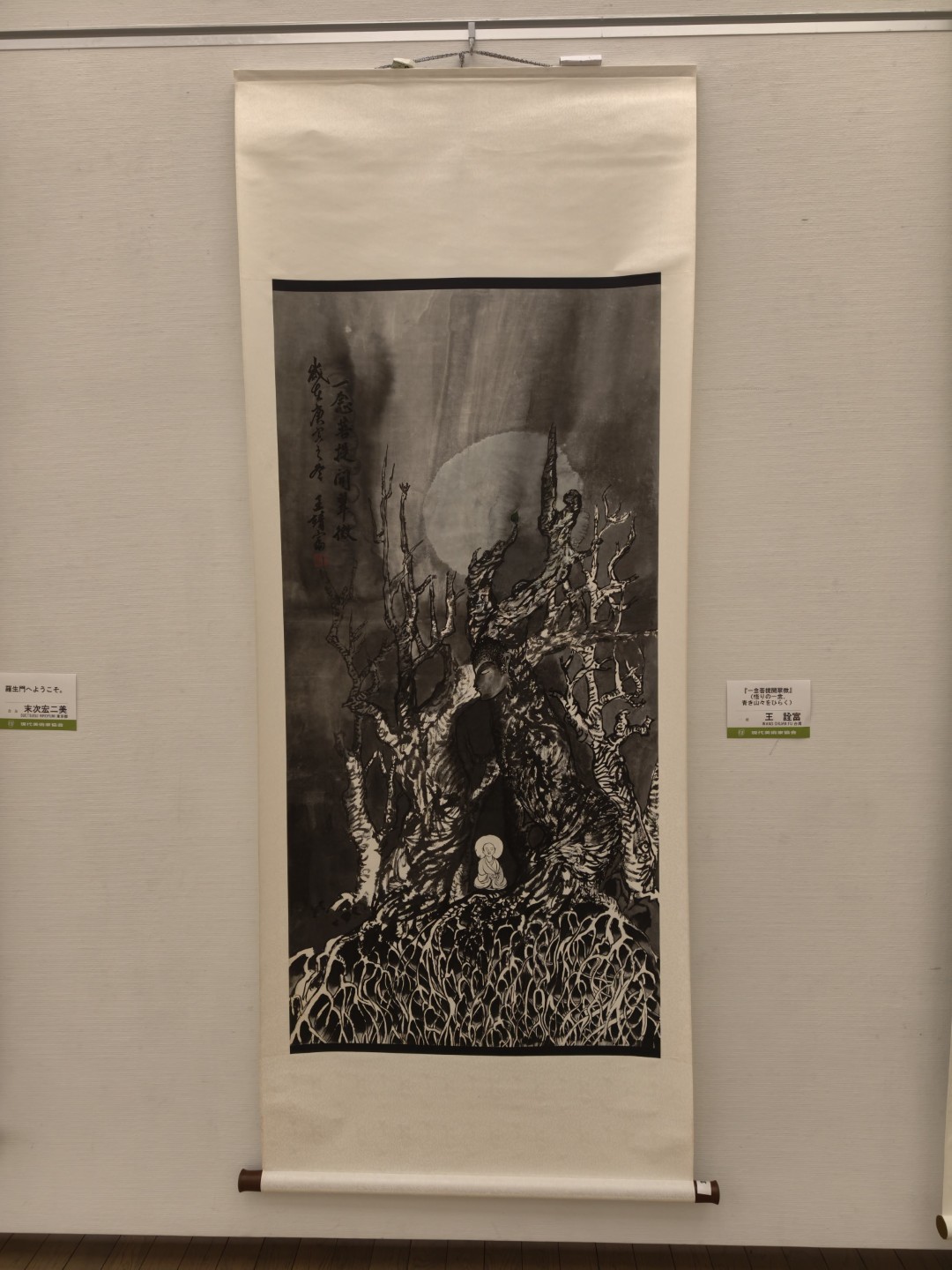
王詮富 WANG CHUAN FU
《一念菩提開翠微》中的水墨留白、現象學還原與精神澄明
一、藝術家位置:在視覺過載時代中的靜觀者
在第82回日本「現展」台灣藝術家群像之中,王詮富的作品提供了一種極為安靜卻深具力量的觀看方式。若蔡梅芳《戀戀紫藤》以彩墨風暴回應自然崇高,廖純沂《未盡・浮境》以失重花卉呈現現代心理懸浮,姜金玲以《荷塘情旅》與《月桃盛開引禽来》釋放亞熱帶生命衝力,陳福祺則以《魚的樂趣》將莊子命題轉譯為數位擬像,那麼王詮富的《一念菩提開翠微》則是一種截然不同的藝術路徑:他以水墨、留白、微小禽鳥與簡約構圖,在喧囂的當代展場中建立一處精神性的停頓。
王詮富的寫意水墨作品在第82回現展充滿強烈視覺衝擊與多元媒材的展場中,猶如一記清脆的休止符,透過極致的視覺減法直逼存在本體;其《一念菩提開翠微》尤其以潑墨、留白與禽鳥意象,提供觀者一個超越時間、安住當下的精神錨點。
因此,王詮富在本專題中的位置,不是以強烈色彩或新媒體語言爭奪視覺注意,而是反向地以「少」對抗「多」、以「靜」對抗「躁」、以「空」對抗「滿」。他的作品提醒我們:當代藝術的力量,不一定來自媒材的擴張與視覺刺激的增加,也可能來自對觀看欲望的節制,以及對精神深處的緩慢召喚。
二、《一念菩提開翠微》的題名結構:時間、覺悟與山氣
《一念菩提開翠微》這一題名具有高度詩性與哲學性。「一念」指涉極短的心念瞬間,也可理解為意識生成、轉向或覺察的最小單位;「菩提」意為覺悟、覺知或覺醒;「開翠微」則使題名帶入山林、青翠、雲氣與幽微之境。整個題名並非描述一個外在景觀,而是將心理、佛學與自然意象結合為一個精神事件。
若將題名拆解來看,「一念」是時間性的;「菩提」是精神性的;「翠微」則是空間性與自然性的。三者交會,使作品不只是描繪山林禽鳥,而是描繪一個心念在自然與空寂之中開啟覺悟的瞬間。
這一題名也暗示作品的觀看方式。觀者不應把畫面理解為普通山水、花鳥或禽鳥小品,而應把它看作一種精神過程:由混沌到澄明,由流動到安住,由外在景物到內在覺知。作品中的微小禽鳥在「一念」之間穿透焦慮,完全契合於當下,成為現代觀者安住於當下的精神錨點。
因此,《一念菩提開翠微》的題名已經設定了一個重要方向:作品關注的不是自然物象本身,而是觀者能否透過自然物象,進入一種更清明、更安定、更接近覺悟的觀看狀態。
三、寫意水墨的當代性:不是復古,而是減法
王詮富使用寫意水墨,容易使人聯想到傳統文人畫或古典山水花鳥。然而,他的作品並非單純復古,也不是以傳統形式對抗當代,而是讓水墨中的留白、墨色、筆勢與精神性,重新回應現代人的視覺疲勞與心理焦慮。
當代社會是高度視覺化的社會。螢幕、影像、廣告、社群平台與短影音不斷提高視覺刺激強度,觀者的注意力被快速消耗。藝術展場亦常面臨類似問題:作品越來越大、色彩越來越強、媒材越來越複雜,觀看有時不再是沉思,而變成感官競賽。
在這樣的背景下,王詮富選擇水墨的「減法」具有當代批判意義。他不以滿幅色彩佔有視網膜,也不以繁複圖像堆疊訊息,而是讓畫面保留空白、呼吸與停頓。他的作品與胡塞爾的「現象學還原」連結,指出他將色彩與世俗喧囂懸置,引導觀者直視事物的本真。
這裡的「減法」並不是簡化,也不是貧乏,而是一種主動的選擇。王詮富刪除多餘視覺噪音,讓墨、白、鳥與氣韻成為作品的核心元素。這種減法使作品在當代展場中具有反向力量:它不跟隨視覺過載的邏輯,而要求觀者放慢,重新學會觀看。
四、留白的拓撲:空不是沒有,而是能量場
《一念菩提開翠微》中最重要的形式語言之一,是留白。留白在東亞水墨中具有悠久傳統,但在王詮富作品中,留白並非形式習慣,而是作品精神性的核心。
在西方古典繪畫中,畫布常被理解為需要被填滿的空間;空白若過多,可能被視為未完成。但在東亞水墨中,白不只是空缺,而是雲氣、水氣、時間、光、虛無與想像空間。王詮富對留白的運用打破了西方古典繪畫中「空間恐懼」的執念,使未被筆墨觸及的紙面成為充滿生命勢能的「無」。
這一點對《一念菩提開翠微》尤其重要。畫面中的留白不是背景,而是主體的一部分。墨色所在之處提供形,留白所在之處提供氣;墨是可見的,白是不可見但可感的。觀者在白中感受到空氣、距離、靜默與心念的開展。
因此,留白可被理解為一種拓撲空間。它不是平面的「沒有」,而是使各元素發生關係的場。禽鳥因留白而顯得孤寂而安定,墨色因留白而具有流動與重量,觀者也因留白而有進入作品的精神空間。
王詮富的留白提醒我們:藝術不必填滿一切。真正深遠的觀看,有時正來自未說完、未畫滿、未被完全佔有的地方。
五、潑墨與混沌:自然力量的另一種呈現
雖然王詮富作品整體給人安靜感,但《一念菩提開翠微》並非完全平和。畫面中仍可見潑墨、破墨或較為濃重的墨色塊面,形成一種原初混沌感。在此作中,畫面左側或下方有狂放的潑墨與破墨,如巨浪般翻湧,宛如宇宙太初混沌或現代社會不可預測的命運洪流。
這使作品不流於單純清雅。王詮富並非描繪一個完全無憂的世界,而是在混沌邊緣建立定靜。濃墨與留白之間的張力,使畫面同時包含不安與安住;潑墨提供動勢,禽鳥提供定點;墨色代表不可控的外在世界,禽鳥與一念則代表主體在其中尋得的覺知。
這種結構使作品具有深刻的現代性。當代人的處境並不是完全平穩,而是面對資訊洪流、社會變動、情感不確定與存在焦慮。王詮富沒有否認這些混沌,而是將其轉化為墨色的翻湧。真正的重點不在於消除混沌,而是在混沌邊緣找到一念清明。
因此,《一念菩提開翠微》的潑墨不是純粹技巧,也不是裝飾性墨韻,而是作品精神辯證的必要部分。若沒有混沌,菩提便失去意義;若沒有濃墨,留白也不會如此澄明。
六、禽鳥意象:微小存在的精神錨點
在《一念菩提開翠微》中,微小禽鳥是畫面的關鍵。王詮富在混沌墨海邊緣安排一隻低頭凝神的禽鳥;這隻鳥微小卻清晰,成為現代漫遊者安住當下的精神錨點。
禽鳥在東亞繪畫中常具有多重意義。它可以是自然生命,可以是季節標誌,也可以象徵孤高、閒逸、自由或靜觀。王詮富筆下的禽鳥並非飛翔中的鳥,而是低頭、凝神、安住於一處的鳥。這一姿態非常重要:它不是逃離,而是停留;不是激烈行動,而是內在凝定。
在構圖上,禽鳥的微小使其與大片留白和濃墨形成比例差異。牠像被拋擲到巨大世界中的小生命,卻沒有顯得驚慌。相反地,牠的低頭姿態呈現出一種自足與覺察。這使牠不只是自然物象,而成為人類主體的投影。
觀者看見這隻鳥時,也看見自己:在龐大世界中微小、有限、脆弱,卻仍可透過一念覺知找到安住之地。這正是王詮富作品最動人的地方。他沒有以宏大敘事安慰觀者,而是以一隻小鳥提示:真正的安定,可能來自最微小的心念轉向。
七、現象學還原:把觀看帶回事物本身
我們以胡塞爾「現象學還原」來理解王詮富作品,指出他透過色彩減法與留白,使觀者懸置世俗喧囂,直視事物本真。
若將這一觀點應用於《一念菩提開翠微》,可以說王詮富的畫面進行了一種視覺上的還原。所謂還原,並不是把事物變簡單,而是把外在附著物暫時放下,讓事物以更原初的方式顯現。
在作品中,山林、鳥、空氣、墨色與紙面都被高度簡化。觀者不會看到複雜景物,也不會被敘事細節分散注意,而是直接面對幾個基本元素:墨、白、鳥、氣。這些元素看似簡單,卻足以建立一個完整的精神場。
這種還原也要求觀者改變觀看方式。面對濃烈色彩或敘事作品時,觀者常透過辨認圖像與解讀故事進入作品;但面對王詮富,觀者必須進入一種更慢、更接近冥想的觀看。他必須感受墨的呼吸、白的深度、鳥的停頓與整體空間的安靜。
因此,王詮富作品不只是畫出靜,而是訓練觀看者進入靜。這正是其藝術價值所在。
八、「一念」作為時間的最小轉折
《一念菩提開翠微》中,「一念」是作品最核心的時間概念。一念極短,卻可以改變整個精神方向。它不是漫長修行的結果描述,而是覺知發生的瞬間。
王詮富以水墨表現一念,並不是畫一個具體事件,而是建立一種瞬間的凝定感。畫面中的鳥低頭凝神,濃墨暫停於邊緣,留白展開如氣,整個畫面彷彿都停在一個即將開悟或已然開悟的臨界點。
這種時間不同於敘事時間。敘事時間有前因後果,有發展與結局;王詮富的時間則是凝縮的、當下的、內在的。一念之中,過去的紛擾與未來的焦慮被暫時放下,只剩當下的覺察。
這也是作品對現代人的重要提醒。現代生活往往被加速時間支配:行程、通知、訊息、效率、焦慮不斷推動我們向前。王詮富則以「一念」讓時間暫停,使觀者重新回到當下。菩提不是遙遠彼岸,而可能發生於一念之間。
九、「菩提」的視覺化:覺悟不是宗教圖像,而是觀看狀態
「菩提」一詞帶有佛學意涵,但王詮富並未以宗教圖像或明確符號表現覺悟。畫面中沒有佛像、經文或法器,而只有墨、白與禽鳥。這使「菩提」不被具象化為宗教標誌,而轉化為觀看狀態。
這是一種成熟的處理方式。若作品直接描繪宗教符號,觀者可能迅速將其歸類為宗教藝術;但王詮富讓菩提存在於畫面的氣息、留白與安定之中,使覺悟成為一種可感但不可完全言說的狀態。
在此,菩提不是被看見的物件,而是觀看本身的轉化。當觀者在畫面前放慢,當視線從濃墨進入留白,當心念跟隨禽鳥停下,作品便在觀看過程中開啟其菩提意涵。
因此,《一念菩提開翠微》並非「畫出覺悟」,而是「使觀看者接近覺悟的狀態」。這種作品不是宣教,而是引導;不是說明,而是開啟。
十、「翠微」的自然詩學:山氣、青色與幽微之境
題名中的「翠微」使作品保留了山水詩學的氣息。翠微可指青翠山色、山間微茫之處、遠山與雲氣交會的幽深境界。它不是明確可測量的地理位置,而是一種介於可見與不可見之間的自然氛圍。
在作品中,翠微未必被具體描繪為青山綠林,而可能透過墨色、留白與空間氣韻被暗示。這種處理方式比直接畫山更接近水墨精神:山不必完全顯形,山氣可以透過墨與白之間的關係浮現。
「開翠微」則具有開啟之意。菩提一念使翠微展開,或心念清明使幽微山氣顯現。此處的自然不是外在風景,而是心境與世界互相開啟的結果。當心念澄明,山色也隨之開展;當觀看安定,世界便重新顯現其幽微。
這使《一念菩提開翠微》同時具有山水性與禪意,但它的山水性不在景物描寫,而在氣韻與空間感;它的禪意也不在宗教符號,而在心念轉化。
十一、與掛軸展示的關係:垂直觀看中的精神下沉
本屆台灣參展作品多採掛軸形式展示,王詮富的水墨作品與掛軸形式具有高度契合性。掛軸的垂直性、柔性與東亞書畫傳統,使台灣作品在國立新美術館中形成一種特殊的空間修辭。
對《一念菩提開翠微》而言,掛軸的垂直性會強化其精神下沉與氣韻流動。觀者的視線沿著畫面由上而下移動,在留白、墨色與禽鳥之間游走。這種觀看不是快速掃描,而更像閱讀一段氣息。
掛軸也使作品避免厚重畫框帶來的封閉感。王詮富的留白需要呼吸,墨色需要與周圍空間相互滲透;掛軸的柔性與紙本感,使作品更能保有東亞水墨的開放性。當它懸掛於現代美術館白牆上時,作品不僅呈現自身,也與空間形成呼應。
因此,掛軸對王詮富而言不是單純裝裱形式,而是作品精神性的延伸。它使水墨不被固定為封閉物件,而像一段可以展開、收起、移動與再度展開的精神經驗。
十二、與國立新美術館場域的關係:在大型公募展中製造安靜
國立新美術館作為第82回現展的展場,具有大型展示空間與多元作品並置的特徵。該館不設常設典藏,而以大型展覽、多樣展示與藝術資訊公開為主要任務。
在如此龐大的公募展環境中,王詮富作品的安靜反而是一種力量。大型公募展往往作品眾多,媒材繁複,觀者在短時間內面對大量視覺訊息,容易產生疲勞。《一念菩提開翠微》以留白與水墨減法,為展場製造一個停頓點。
這種停頓不是消極的,而是積極的觀看調節。它讓觀者從快速瀏覽轉向凝視,從外在刺激轉向內在感受。若說姜金玲以色彩使白盒子展場被亞熱帶生命力衝撞,陳福祺以數位光譜使展場進入後人類感知,那麼王詮富則以水墨留白在展場中打開一個安靜的精神空間。
這種作品在展場中的作用非常珍貴。它證明藝術不必以聲量取勝,也可以以靜默建立強度。
十三、與前幾位藝術家的對照:從擴張到收斂
王詮富的作品與前幾位藝術家形成清楚對照。蔡梅芳的彩墨具有動態崇高,姜金玲的重彩具有生命擴張,陳福祺的數位圖像具有光譜化與虛擬感,廖純沂則在冷調浮境中建立心理懸置。王詮富則將所有這些外向或複雜的力量收斂為一念、一鳥、一片墨與大量留白。
這種收斂不是退縮,而是另一種強度。擴張的藝術使人感受世界的龐大,收斂的藝術則使人感受心念的深度。王詮富不試圖填滿世界,而是讓世界退後,使一念得以顯現。
在台灣藝術家群像中,他代表的是東方水墨精神在當代展場中的一種可能:不是復興古典風格,也不是模仿當代潮流,而是以水墨的減法、空性與氣韻,回應現代人的精神需求。
十四、專業評論觀點:王詮富《一念菩提開翠微》的四重價值
綜合以上分析,王詮富《一念菩提開翠微》在第82回現展台灣藝術家群像中具有以下四重價值。
第一,媒材價值
作品以寫意水墨、潑墨與留白,展現水墨在當代展場中的精神可能。王詮富沒有將水墨作為懷舊媒材,而是透過其減法特質,回應視覺過載時代的觀看困境。
第二,空間價值
作品中的留白不是空缺,而是充滿氣韻與精神勢能的空間。墨與白、動與靜、混沌與澄明之間形成高度凝練的空間辯證。
第三,象徵價值
微小禽鳥是作品的精神錨點。牠象徵在巨大世界中仍能安住當下的主體,也使「一念菩提」從抽象概念轉化為可見姿態。
第四,展場價值
在國立新美術館的大型公募展環境中,作品以安靜與留白製造觀看停頓,為觀者提供從視覺刺激回到內在凝視的可能。
十五、本章小結:在一念之間開啟澄明
王詮富《一念菩提開翠微》是一件以極簡水墨語言處理深層精神命題的作品。它不以繁複圖像取勝,也不以強烈色彩壓迫觀者,而是透過留白、潑墨與微小禽鳥,建立一個關於當下、覺知與安住的視覺空間。
作品中的「一念」使時間凝縮,「菩提」使觀看轉化,「翠微」使自然幽微地展開。墨色代表混沌與世界的不可測,留白代表空性與精神呼吸,禽鳥則代表在混沌邊緣仍能凝神安住的生命主體。
在第82回現展的台灣藝術家群像中,王詮富的重要性正在於,他讓觀者看見另一種當代性:不是越新越當代,不是越滿越有力,也不是越強烈越深刻。真正的當代性,有時恰恰來自對過度刺激的節制,來自對空白的信任,來自於讓一隻小鳥在一片墨色與留白之間,重新教會我們如何觀看、如何停下、如何在一念之間開啟澄明。
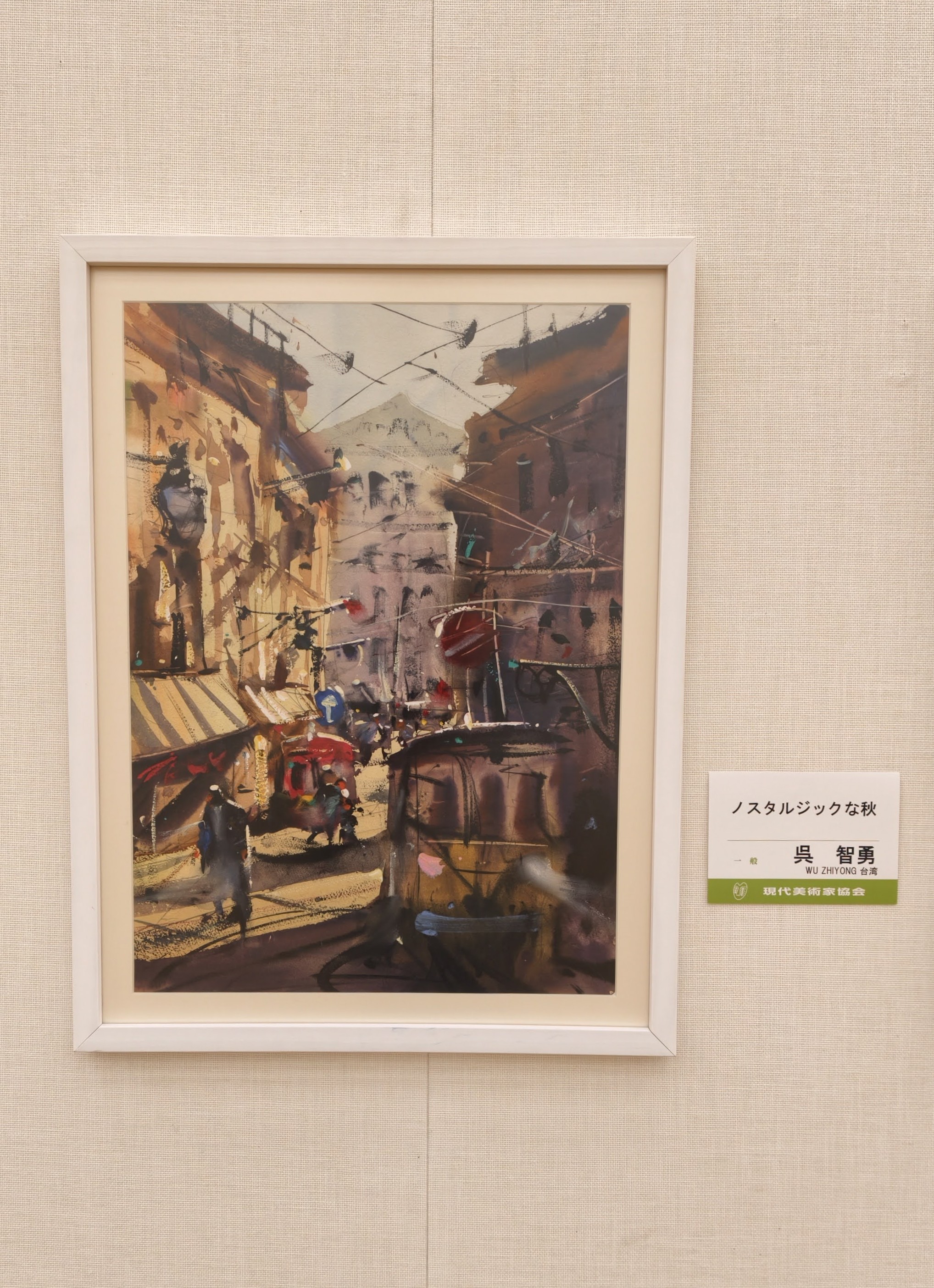
吳智勇 Wu Zhiyong
《鄉愁之秋》中的水彩流動、液態都市與漫遊者輓歌
一、藝術家位置:入選內定與都市水彩的當代性
在第82回日本「現展」台灣藝術家群像中,吳智勇的《鄉愁之秋》「ノスタルジックな秋」被標示為入選內定。這一制度位置顯示,其作品在正式展出前已獲得評審體系的肯定,也意味著他的水彩語言與都市敘事具備足以進入日本現代美術公募展場的表現力。吳智勇《鄉愁之秋》在正式展出前即獲得入選內定,顯示其水彩技法與當代都市敘事的結合,精準擊中了現展評審團的審美共鳴。
相較於前幾位藝術家,吳智勇的作品將台灣藝術家群像的觀看焦點轉向都市空間。蔡梅芳面對自然崇高,廖純沂處理心理懸浮,姜金玲釋放亞熱帶生命力,陳福祺進入數位擬像,王詮富回到水墨靜觀;而吳智勇則以水彩描繪現代城市中的移動、模糊、記憶與孤獨。他的作品不以巨大哲學符號或強烈色彩衝擊取勝,而是透過水彩的透明性、濕潤感與邊界溶解,使都市景觀變成一種可感的心理狀態。
《鄉愁之秋》之所以值得作為專題評論對象,正在於它將看似日常的街景轉化為現代人精神處境的隱喻。作品中的都市不是堅硬、冷酷、確定的空間,而是一個在水分、光線與記憶中逐漸溶解的場域。電車、街道、建築、光影與模糊人影共同構成一種秋日的心理地景,使「鄉愁」不再只指向故鄉,而指向現代人在流動世界中對真實連結的渴望。
二、《鄉愁之秋》的題名:秋日不是季節,而是記憶的濾鏡
《鄉愁之秋》這一題名由兩個關鍵詞構成:「鄉愁」與「秋」。若從字面理解,它似乎指向秋季中的思鄉情緒;但在吳智勇的作品中,這種鄉愁並不必然指涉某個明確地理故鄉。作品題名為《鄉愁之秋》,但畫中並沒有傳統意義上的田園故土,反而引出一個更深層的問題:現代人的鄉愁究竟指向何方?
這一問題是理解本作的核心。傳統鄉愁常與故鄉、家園、童年、土地或親族記憶相關;然而在現代都市經驗中,許多人生活於移動、通勤、租居、遷徙與資訊流動之中,故鄉不再是一個穩定可回返的地點。於是,鄉愁不再只是「想回到某地」,而成為「想回到某種確定感」——一種曾經相信世界具有穩定連結、身體有所歸屬、記憶能被安放的狀態。
「秋」則在作品中扮演情緒濾鏡的角色。秋天不只是季節變化,也常與時間流逝、光線轉弱、生命沉澱與情感回望有關。吳智勇以秋日命名作品,使畫面中的都市景觀被一層回憶與衰微感覆蓋。街道不只是街道,電車不只是交通工具,模糊人影也不只是路人;它們都被秋天轉化為記憶中的殘影。
因此,《鄉愁之秋》不是一件單純描繪秋天城市的水彩作品,而是一件關於現代人如何在城市中感受到失落、懷念與尋找歸屬的作品。它將季節轉化為心理色調,將都市轉化為記憶容器。
三、水彩的媒材特性:透明、流動與不可完全控制
吳智勇選擇水彩作為媒材,與作品主題高度契合。水彩的特性在於透明、流動、滲化與不可完全控制。顏料與水在紙面上相遇後,會隨著濕度、紙張吸水性、筆觸速度與時間推移而產生變化;藝術家可以引導水分,但無法完全支配它。這種半控制、半偶發的特質,使水彩特別適合表現記憶、天氣、霧氣、光線與情緒。
吳智勇在《鄉愁之秋》中大量運用「濕中濕(Wet-on-wet)」渲染技法,使電車與建築輪廓邊界模糊,彷彿正在被空氣與水分溶解。
這種技法不只是水彩技巧,而是作品意義的一部分。城市在濕中濕技法中失去硬邊,建築不再堅固,電車不再銳利,街景也不再清楚分層。整個都市景觀像被潮濕空氣、雨後光線或回憶的水氣包覆。這種溶解感使畫面中的都市從物理空間轉化為心理空間。
水彩的透明性也使作品具有時間感。不同色層相互疊加,卻不完全遮蔽;底層仍隱約透出,如同記憶中的過去經驗仍在當下浮現。吳智勇並不是用水彩描摹都市表面,而是讓水彩本身成為記憶沉澱與時間流動的媒介。
四、濕中濕技法:都市輪廓的溶解
《鄉愁之秋》中最重要的視覺效果,是都市輪廓的溶解。水彩濕中濕技法使形體邊界變得鬆動,街景不像攝影般精準,也不像建築圖般理性,而是呈現一種被水氣軟化的狀態。我們將此理解為對「液態現代性」的視覺化:這座邊界消融的城市,正是失去固態結構社會的縮影。
這一點十分關鍵。現代都市通常被視為堅固、鋼筋水泥、交通系統與資本秩序的集合;然而在吳智勇畫中,城市並不堅硬。它被水彩溶解,被秋日光線暈開,被空氣透視推遠。電車可能正在駛來,但其輪廓並不銳利;建築可能位於街道兩側,卻像霧中記憶;道路延伸向遠方,卻沒有給予明確方向。
這種溶解不是單純的浪漫化,而是對現代生活不確定性的視覺表達。在當代城市中,人們看似擁有清楚的交通路線、工作地點與生活規律,但心理上卻常處於漂移狀態。關係不穩定,歸屬感薄弱,生活節奏被外在系統牽引。吳智勇讓城市輪廓溶解,正是在呈現這種外在秩序與內在失重之間的矛盾。
因此,濕中濕技法不只是營造美感,而是使城市失去確定性,讓觀者感受到現代生活的液態化。
五、電車意象:移動、通勤與現代時間
《鄉愁之秋》中若出現電車,它便具有重要象徵意義。電車是現代城市中最具代表性的移動裝置之一,連接不同地點,也規訓日常時間。它承載通勤、工作、等待、錯過、抵達與離開。對許多現代人而言,電車不只是交通工具,而是生活節奏的框架。
在吳智勇的水彩中,電車並未被描繪成冷硬機械,而是與濕潤空氣、街道色彩和秋日光影相互滲透。這使它不再只是現代性符號,也成為記憶與情感的載體。它可能代表一段旅程,也可能代表日復一日的通勤;可能指向離家,也可能指向歸途。
電車的移動性與題名中的鄉愁形成張力。鄉愁通常意味著回望、停留與想返回;電車則意味著移動、前進與不斷被運送到他處。吳智勇把這兩者放在同一畫面中,使現代人的情感處境變得可見:我們在不斷移動中懷念穩定,在城市交通中尋找歸屬,在被系統推動的日常裡渴望某種真正屬於自己的地方。
因此,電車不是背景物,而是現代時間的象徵。它使《鄉愁之秋》不只是都市風景,而成為關於移動生活與情感失落的作品。
六、街道與空氣透視:記憶通道的形成
吳智勇作品中的街道並不只是空間通道,也可被理解為記憶通道。當道路、建築、電纜與電車在水彩中逐漸模糊時,街道便不再只是城市的物理結構,而像是一條通往過去、內心或未明方向的心理長廊。
《鄉愁之秋》中的街道被空氣透視與迷霧吞噬,像是一條通往記憶深處的心理長廊。 這一描述可作為本作的關鍵理解。街道向畫面深處延伸,觀者的視線也被帶往遠方;但那個遠方並不清楚,反而被光、霧、水彩暈染與色層遮蔽。這使觀看成為一種追憶:我們看見方向,卻看不清終點。
這種空間處理與鄉愁的心理結構相互呼應。鄉愁往往不是對清楚記憶的再現,而是對模糊而不可完全返回之物的追尋。記憶中的故鄉或過去,並不會以完整形貌出現,而總是帶著霧氣、缺口、變形與情感濾鏡。吳智勇以水彩呈現的街道,正是這種追憶狀態的視覺化。
七、模糊人影:班雅明式漫遊者的現代孤獨
在《鄉愁之秋》中,模糊人影具有極高的評論價值。畫面中的模糊黑色人影可被理解為瓦爾特・班雅明筆下的「漫遊者(Flâneur)」,他身處喧囂街頭,卻與世界保持疏離的美學距離。
漫遊者原本是現代都市中的觀察者。他行走於街道、人群與商品景觀之間,看似閒逛,實則以敏銳目光感受城市的變化。他既在城市之中,又與城市保持距離;既是參與者,也是旁觀者。
吳智勇畫中的模糊人影,正延續了這種現代都市主體的特質。此人影可能只是街角行人,也可能是藝術家自身、觀者自身或所有在城市中徘徊的人。其模糊性使他不具特定身份,反而成為一種普遍象徵:在現代城市中,我們都可能是那個被水氣與光影吞沒的孤獨身影。
這一人物不以清楚臉孔出現,也沒有明確動作,因而更具心理投射性。觀者可以將自己的經驗放入其中:等車、回家、離開、路過、想念某地、或只是站在街頭感到一種難以言說的失落。
因此,模糊人影是作品中的情感樞紐。它使城市不只是景觀,而成為人的精神處境;也使鄉愁不再抽象,而凝聚於一個孤獨、沉默、正在城市中行走或停留的身體。
八、現代鄉愁:不是思念故鄉,而是哀悼失去的確定性
《鄉愁之秋》最具當代性的地方,在於它重新定義了鄉愁。作品中的鄉愁並非對具體故土的思念,而是對現代社會中「失去的真實連結與確定性」的無盡哀悼。
這一點使作品超越傳統懷舊。傳統懷舊常指向過去某個時間或地點;吳智勇的鄉愁則更抽象,也更普遍。它指向現代人在高度流動社會中的精神缺口:我們居住在城市,卻未必感到歸屬;我們與許多人擦肩而過,卻未必建立真正連結;我們每天移動,卻未必知道自己要回到哪裡。
因此,《鄉愁之秋》中的鄉愁是一種存在狀態。它不是簡單的懷舊情緒,而是現代主體對安定、真實、親密與歸屬的渴望。作品沒有把這種渴望說破,而是讓它散布在水彩的濕潤邊界、秋日光線、電車軌跡與模糊人影之中。
吳智勇的高明之處在於,他沒有用直接敘事表現悲傷,而是透過整個城市氣氛讓觀者感受到某種柔軟的失落。這種失落不是劇烈的,而是持續、低聲、像秋雨或薄霧一樣包圍著人。
九、秋日光線:溫柔而衰微的時間感
《鄉愁之秋》的情感力量也來自秋日光線。秋天的光不同於夏日強光,也不同於冬日冷光;它常帶有傾斜、柔和、金黃、灰暗與時間沉澱的特質。吳智勇透過水彩透明層次,使光線像被濕氣稀釋,散布於街道與建築之間。
這種光線使城市不再是純粹功能空間,而成為記憶空間。日常街景在秋日光中顯得更柔軟,也更脆弱。建築與交通不再只是現代秩序的象徵,而被一層時間感覆蓋。觀者感覺到的不是「現在」的清晰,而是「正在逝去」的現在。
秋日光線也使鄉愁不至於沉重。吳智勇的作品不是陰暗絕望的都市批判,而是一首溫柔的輓歌。他沒有用批判眼光描繪城市的冷酷與異化,而是以溫柔、濕潤的水彩筆觸,為鋼筋水泥叢林披上一層充滿記憶與溫度的秋日濾鏡。
這正是作品的特點:它不是否定城市,而是用水彩為城市找回情感溫度。即使城市使人孤獨,城市仍然可以被記憶、被懷念、被溫柔地觀看。
十、液態都市:城市如何失去硬邊
我們可以用「液態都市」形容吳智勇的作品,這一概念非常貼切。液態都市並不是指城市真的變成液體,而是指城市在現代生活中不再提供穩固歸屬。它的空間、關係與身份都處於流動狀態。
在《鄉愁之秋》中,液態性首先表現在水彩技法上:顏料流動、邊界暈散、形體鬆動。其次表現在城市結構上:電車移動、街道延伸、人影不定。最後表現在情感層面:鄉愁沒有明確對象,記憶沒有清楚輪廓,歸屬感也無法被固定。
這三個層次共同構成作品的液態美學。吳智勇不是用理論說明現代性,而是讓城市在紙上失去硬邊,使觀者以身體感受到液態現代性的狀態。
這種處理方式使作品具有很強的當代性。它不依靠科技題材或社會標語,而是透過水彩媒材本身,把現代生活的流動感、失重感與不確定性轉化為視覺經驗。
十一、與王詮富的對照:靜觀與漫遊
若將吳智勇與前一回的王詮富相對照,可看出兩人皆以相對安靜的方式回應現代焦慮,但方向不同。
王詮富《一念菩提開翠微》以水墨留白、禽鳥與一念覺知,引導觀者從世界喧囂回到內在澄明;吳智勇《鄉愁之秋》則不讓觀者離開城市,而是在城市中尋找柔軟的記憶與失落的歸屬。
王詮富的鳥停下來,吳智勇的人影則在街道中徘徊;王詮富的空白指向心念的安住,吳智勇的水彩暈染則指向記憶與城市的溶解。兩人都不是激烈批判型藝術家,但都以靜默方式處理當代人精神處境。
這種對照使第82回現展台灣群像更具層次。台灣藝術家並非只有強烈色彩或哲學宏論,也有對日常城市、孤獨身影與微弱情緒的細膩觀察。
十二、與國立新美術館場域的關係:在東京觀看都市鄉愁
《鄉愁之秋》在東京六本木國立新美術館展出時,具有特殊的場域意義。六本木本身是東京高度都市化、國際化與文化機構密集的區域。當一件描繪都市鄉愁的水彩作品進入這樣的展場,它並不只是再現城市,而是在城市核心中反觀城市經驗。
第82回現展本展於國立新美術館舉行,該館位於東京都港區六本木,並作為大型公募展與多樣藝術活動的重要平台。 在這樣的場域中,吳智勇的作品會與東京觀眾的日常經驗產生直接關係。觀者或許剛從地鐵、電車、街道與人群中抵達美術館,再於展場中看見一幅關於電車、街道與孤獨人影的作品,於是畫面不再只是異地風景,而可能觸動他們自身的城市記憶。
這使《鄉愁之秋》的跨文化性不同於以台灣地方風景吸引日本觀眾的方式。它呈現的是現代都市人共同經驗:在交通系統與街道網絡中移動,在人群中孤獨,在秋日光線中突然想起某種失去的連結。這種情感跨越國界,也使作品在日本展場中具有普遍可讀性。
十三、與掛軸展示的關係:水彩街景的垂直記憶
本屆台灣參展作品多採掛軸形式展示,而吳智勇的水彩作品若以掛軸呈現,將產生特殊效果。掛軸通常與東亞書畫、山水與紙本傳統相關;吳智勇則將都市街景、水彩與現代交通帶入這一形式。
這種結合使作品具有跨時代感。傳統掛軸常讓觀者沿垂直方向閱讀山水、雲氣、樹石與人物;吳智勇則可能讓觀者沿著垂直畫面閱讀街道、建築、電車與光影。城市取代山水,電車取代舟楫,模糊人影取代隱士或旅人。掛軸形式因此被現代都市內容重新活化。
水彩的流動性與掛軸的垂直性也會互相呼應。濕潤色彩在紙面上的下滲感,與掛軸的自然垂墜形成微妙關係,使畫面更具時間流動感。觀者面對的不是被框住的城市,而是一段垂直懸掛、如記憶般展開的都市片段。
十四、專業評論觀點:吳智勇《鄉愁之秋》的四重價值
吳智勇《鄉愁之秋》在第82回現展台灣藝術家群像中具有以下四重價值。
第一,媒材價值
作品充分發揮水彩透明、流動、滲化與不可完全控制的特質。濕中濕技法不只是形式技巧,而成為都市記憶與現代不確定性的視覺語言。
第二,都市價值
作品將城市從堅硬建築與交通系統轉化為柔軟的心理空間。電車、街道、建築與光影不再只是都市物件,而成為現代生活流動性的象徵。
第三,情感價值
《鄉愁之秋》重新定義鄉愁,使其不再只指向故鄉,而指向現代人對真實連結、穩定歸屬與確定感的追尋。
第四,跨文化價值
在東京六本木展場中,作品以都市經驗連接台灣藝術家與日本觀眾。它不依賴地方符號,而以現代都市人的共同孤獨與記憶感產生共鳴。
十五、本章小結:在溶解的城市中尋找歸屬
吳智勇《鄉愁之秋》是一件以水彩表現現代都市心理的作品。它看似描繪街景,實則處理移動、記憶、孤獨與鄉愁。畫面中的電車、街道、建築與人影,都在水彩的濕潤流動中失去硬邊,形成一座正在溶解的液態都市。
在這座城市中,鄉愁不再只是對故土的思念,而是對失去確定性的溫柔哀悼。模糊人影像現代漫遊者,在光影與水氣中徘徊;秋日濾鏡則讓城市不再冰冷,而帶有記憶的溫度。吳智勇沒有用激烈批判描繪都市異化,而是以柔軟水彩為城市唱出一首低聲的輓歌。
在第82回現展台灣藝術家群像中,吳智勇的重要性正在於,他使台灣當代藝術的視野進入現代都市日常。他證明日常街景並不平凡,只要透過精準媒材與深層感受,電車、街道與秋日光線也能成為現代人精神狀態的肖像。其《鄉愁之秋》最終讓我們看見:即使城市不再堅固,即使歸屬不再明確,人仍會在溶解的光影中尋找回家的方向。
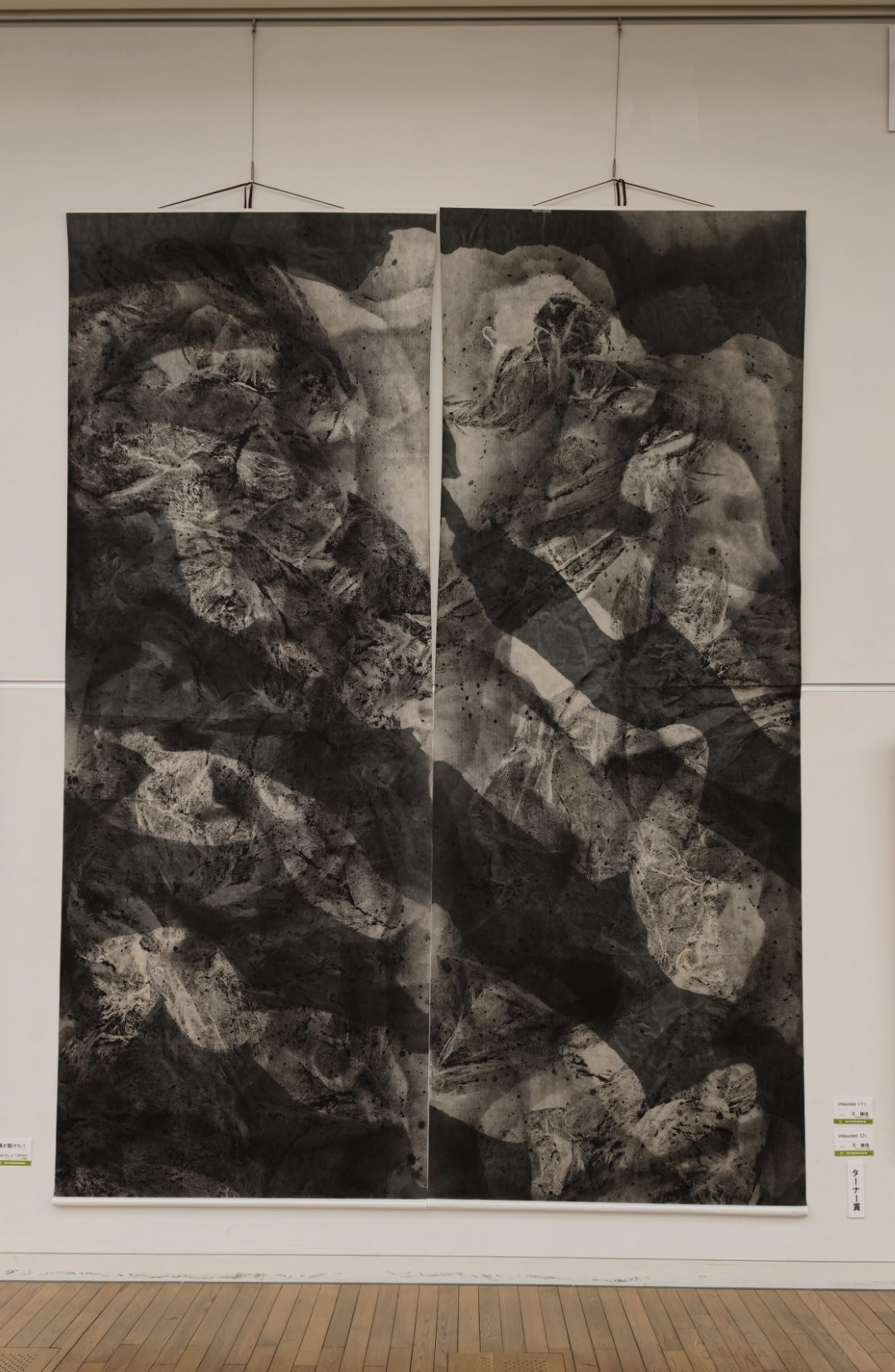
王穆提 WANG MUTI
現展準會員的制度奇點與水墨幾何中的五蘊相續
一、藝術家位置:從參展者到現展準會員的制度奇點
在第82回日本「現展」台灣藝術家群像中,王穆提的位置具有壓軸性的制度意義。他被標示為「現展準會員,參展兩次即被推舉、曾入選俊英作家展等賞」,這不僅是個人履歷上的亮點,更是台灣藝術家進入日本現代美術家協會制度結構後,快速取得評價位置的代表案例。現展制度中存在入選、受賞、會友、準會員、會員等階梯,而王穆提參展兩次即被推舉為準會員,顯示其作品在日本現展場域中取得了高度辨識與制度認可。
若從現展制度本身來看,準會員並非單純稱號,而是一種象徵性位置。它意味著藝術家不再只是外部投稿者或一次性入選者,而是被納入現展內部評價與推舉系統之中。對台灣藝術家而言,這種推舉尤其具有跨國意義:作品必須跨越語言、媒材、文化脈絡與評審制度的差異,仍能被日本現代美術場域辨識為具有持續發展價值的創作。
王穆提的案例因此可被稱為「制度奇點」。所謂奇點,並非神話化個人成就,而是指出一個制度轉折點:台灣藝術家的參與不再只是展覽交流,而開始進入日本現展的內部身分結構。這種轉變,使台灣作品在現展中不只是「被看見」,也開始「被評價」「被推舉」與「被累積」。我們可以將這種過程描述為跨國象徵資本的累積,亦即藝術家透過入選、受賞、評論與推舉,將個人創作轉化為可被國際藝術場域承認的履歷資源。
因此,王穆提在本專題中的重要性,不只在於其作品具有哲學深度,也在於他體現了台灣藝術家如何透過現展制度取得更高層級的文化位置。他的作品與身分共同構成一個問題:當台灣當代水墨進入日本現代美術公募體系時,它如何不被視為傳統媒材的延續,而是被理解為具有當代思想強度與國際流通性的視覺語言?
二、作品作為哲學結構:王穆提並非單純畫水墨
王穆提作品最值得注意之處,在於它不能僅以「水墨作品」來概括。雖然作品使用宣紙、水墨、天然染料或類似東方紙本媒材,但其真正的核心並不在於傳統筆墨趣味,而在於將水墨的滲透、層疊、邊界、幾何與空間組織,轉化為一套高度哲學化的視覺結構。
我們以《 Unbounded》為例,指出王穆提的作品表面上是東方水墨與西方硬邊抽象的形式對話,但在更深層處,則牽涉世親菩薩《俱舍論・破執我品》中關於「假名我執」「五蘊相續」「因果繼承」與「無我」的問題。
王穆提作品不是在畫山水,也不是在重現傳統水墨意境,而是在視覺層面處理認識論與存在論問題。他關心的是:邊界如何形成?自我如何被建構?流動的身心現象如何被誤認為穩定主體?因果如何在沒有永恆實體的情況下延續?這些問題原本屬於佛教哲學與形上學討論,但王穆提將其轉化為可觀看的形式關係。
因此,在評析王穆提時,不能只問作品是否有墨韻、是否有構圖、是否有色彩,而應進一步追問:墨的層次如何成為時間的痕跡?幾何邊界如何成為認知框架?宣紙的滲透如何呈現因果相續?作品的「界」與「無界」如何讓觀者重新思考自我的生成?
這也是他在本次台灣群像中作為壓軸藝術家的原因:他的作品不只具有視覺強度,也具有高度理論負載,能夠把台灣當代水墨推向哲學思辨的層面。
三、幾何邊界:理性秩序與「假名我執」
王穆提作品中最具辨識度的形式語彙之一,是畫面上的幾何邊界。這些幾何形體往往帶有銳利斜角、硬邊結構、灰階層次或半透明色塊。它們與水墨在宣紙上的自然滲化形成明顯對比:一者冷靜、理性、界定;一者流動、暈散、不可完全控制。
在宣紙這種極具吸水性與毛細現象的材質上,王穆提以近乎精密的控制力徒手勒出邊界,使流動的液體被暫時約束,形成幾何學式的「界」。此處的界,可被理解為《俱舍論》中「假名我執」的視覺化。
「假名我執」可簡要理解為:人將不斷流動、剎那生滅的身心現象,誤認為背後存在一個穩定、獨立、永恆的「我」。這個「我」並非實體,而是由語言、概念、習慣與認知框架建構出的假名。王穆提的幾何邊界,正像是人類意識強加於流動現象之上的框架。
在作品中,幾何不是單純裝飾,也不是現代主義形式語言的引用而已。它象徵理性對混沌的切割,象徵意識對流動生命的框限,也象徵人為了獲得安全感而建立的自我邊界。這些邊界看似清楚,卻建立在流動的水墨之上;看似穩固,卻依賴材料瞬間的滲透、乾燥與凝固。
因此,王穆提的幾何邊界具有雙重性:它一方面展現藝術家的控制力,另一方面也暴露控制本身的虛妄。它讓觀者看見「界」如何被建立,也讓觀者意識到「界」其實只是暫時的、條件性的、被建構出來的。
四、宣紙物性:無法完全支配的流動場
若幾何邊界代表理性與控制,那麼宣紙與水墨則代表流動、滲透與不可完全支配的物質場。宣紙不是光滑封閉的表面,而是具有纖維、吸水性、滲化速度與毛細作用的活性媒介。水墨落在宣紙上後,不會像在塑膠或金屬表面那樣停留於表層,而會滲入、擴散、沉積並與紙張產生不可逆關係。
王穆提正是利用這種不可逆性建立作品深度。作品底層厚重沉積的黑色水墨塊面,是經由無數次墨水澆灌、滲透、乾燥與再積染形成;每一層墨痕都代表五蘊的剎那生滅,前一層雖已乾涸消失,卻改變紙張質地並影響下一層墨水的軌跡。
這一描述非常關鍵,因為它將作品的物質過程與哲學思想緊密連接。水墨的每一次滲透都不是孤立事件,而會改變後續可能性;紙張吸收過一次墨後,便不再是原來的紙。下一次墨水進入時,會受到之前痕跡、濕度、厚度與纖維狀態的影響。這正像因果相續:過去不以實體方式留存,但以條件方式影響現在。
因此,王穆提的宣紙不是被動背景,而是時間與因果的承載體。它記錄每一次水墨行動,也保存每一次行動所造成的條件改變。作品表面上是一幅靜止圖像,實際上卻是多重時間積累後的結果。
五、五蘊相續:沒有永恆自我,但因果不失
王穆提作品最具思想深度之處,在於它可被理解為「五蘊相續」的視覺演繹。佛教思想中的五蘊,指色、受、想、行、識五種構成身心經驗的聚合。五蘊並非固定不變,而是不斷生滅、相續、轉變。人之所以產生「我」的幻覺,是因為將這些流動聚合誤認為穩定實體。
《俱舍論》關於「非一非異」的因果思考:過去造業的五蘊與今日受報的五蘊並非同一實體,但也不是完全無關;它們處於同一相續流之中。
王穆提的水墨層疊正好使這一抽象理論可視化。每一層墨都已經過去,卻沒有完全消失;它留下痕跡,改變下一層條件。新的墨層不是舊墨層本身,但也不能與舊墨層截然分離。它們之間既非完全同一,也非完全不同。
這一點使作品超越一般抽象水墨。許多抽象水墨強調墨色韻味、空間節奏或精神抒發;王穆提則進一步使墨色層疊成為因果相續的視覺模型。觀者在畫面中看到的不只是墨,而是時間的非線性堆積;不只是形,而是存在如何在沒有固定自我的情況下持續流轉。
因此,王穆提作品中的「無界」不只是形式上的無邊無際,也不是簡單的自由抽象,而是指向無我而因果不斷的存在狀態。真正無界的,不是畫面沒有邊框,而是生命與因果本身無法被一個固定自我完全框住。
六、黑色墨層:深淵、地質與時間沉積
王穆提作品中的黑色水墨層常具有深淵感。它不是單一黑色,而是由多次滲透、乾燥、再覆蓋後形成的複雜結構。這種黑色不同於平塗,也不同於純粹視覺上的暗色;它像是地質剖面、時間沉積、深層記憶或不可見因果的聚集。
我們曾以「水墨粒子咬合而成的地質史」形容王穆提作品,指出其底層墨塊呈現深不可測的因果暗流。
這種地質感非常重要。地質層並不是一日形成,而是長時間堆積、壓縮、變質的結果;王穆提的墨層亦然。作品表面的每一處濃淡,都可能包含多次行動、等待、乾燥與覆寫。觀者看到的是一個凝結結果,卻可感受到其背後漫長的生成過程。
這使作品具有時間厚度。它不是瞬間筆觸的表演,而是反覆積累的結果。這種時間厚度與《俱舍論》中的相續思想相互呼應:存在不是一個固定點,而是一連串條件、痕跡與轉化的累積。
黑色也使作品具有深淵性。它讓觀者感受到自我底層的不可測,感受到生命並非透明可掌握,而是由無數不可見條件構成。幾何邊界試圖給予秩序,黑色深層則不斷提醒觀者:任何秩序都建立在更深、更流動、更不可完全控制的因果之上。
七、灰階與半透明:邊界不是絕對,而是濾鏡
王穆提作品中的幾何色塊往往不是完全不透明的實體,而是具有灰階、半透明或層次感。這一點相當重要。若幾何完全封閉,便會形成絕對分割;但半透明幾何使底層墨色仍然可見,代表理性邊界並不能完全遮蔽底層流動。
這種半透明性可被理解為「濾鏡」。人類的自我概念、語言分類與理性框架,並不是完全創造世界,也不是完全與世界無關;它們像濾鏡一樣,使我們以某種方式看見流動現象。王穆提的幾何色塊正是這種濾鏡的視覺化。
它們讓畫面看似被規劃、被切割、被秩序化,但底層墨痕仍然穿透而出。這意味著無論人如何建立自我邊界,五蘊與因果的流動仍然在邊界下方持續作用。界不是虛無,但界也不是實體;它是暫時的認知結構。
這種處理使王穆提的作品具有高度細膩性。他不是簡單地反對理性,也不是浪漫地歌頌混沌,而是讓理性與混沌、邊界與流動、控制與滲透同時存在。作品真正的思想力量,正來自這些矛盾的共存。
八、天然染料與水墨:材料倫理與時間感
若王穆提作品中使用天然染料,這一媒材選擇亦具有重要意義。天然染料與工業顏料不同,它往往與植物、礦物、土地、時間、氧化與變色有關。它不是完全穩定、完全標準化的色彩,而帶有自然材料的時間性與脆弱性。
當天然染料與水墨共同進入宣紙,作品便不只是視覺圖像,而成為自然物質與藝術行為的交互結果。染料可能滲入紙纖維,隨時間產生細微變化;水墨則以沉積與暈染留下痕跡。這些材料共同建立一種非工業化、非純粹數位化的時間感。
這與王穆提的哲學主題相互呼應。若作品要處理五蘊相續、因果條件與無常,那麼材料本身也必須能呈現變化、沉積與不可完全支配。天然染料與水墨的特性,正使作品在物質層面實踐了無常與相續。
因此,王穆提的材料不是中性工具,而是思想的一部分。材料會老化、滲透、沉澱、改變;作品也因此成為一個持續與時間發生關係的存在,而非固定不變的圖像。
九、水墨與硬邊抽象:東西方形式語言的交錯
王穆提作品常被理解為水墨與幾何抽象的結合。若從藝術史角度看,這涉及東方水墨與西方硬邊抽象之間的交錯。水墨強調流動、氣韻、滲化、偶發與筆性;硬邊抽象則強調幾何、平面、邊界、理性與構成。王穆提將兩者放在同一畫面中,並不是簡單拼貼,而是讓兩種視覺邏輯互相質疑。
水墨部分提醒觀者:世界是流動的、無常的、不可完全框限的。幾何部分則提醒觀者:人類總是試圖建立秩序、界線、分類與認知結構。兩者的衝突,正是作品的思想核心。
這種結合也讓王穆提作品具有跨文化可讀性。在日本現展場域中,觀者既能辨識東亞紙本與水墨的文化脈絡,也能感受到現代抽象繪畫的構成語言。作品不屬於純粹傳統,也不完全屬於西方抽象,而是在兩者之間建立一種台灣當代水墨的新位置。
這一點對台灣藝術尤其重要。台灣藝術長期處於東亞傳統、西方現代主義、日本美術制度與全球當代藝術之間。王穆提作品中的水墨幾何,正可視為這種多重脈絡的凝縮:它既回應東方哲學,也進入現代抽象;既使用傳統媒材,也具有當代形式意識。
十、無界:不是沒有邊界,而是看見邊界的條件性
若以《無界》作為王穆提作品思想的代表,必須注意「無界」並不等於完全取消邊界。相反地,王穆提正是透過大量邊界、幾何、層疊與墨痕,讓觀者看見邊界如何被建構、如何暫時成立、又如何被底層流動不斷質疑。
「無界」因此不是形式上的空泛自由,而是對「界」的深層反思。沒有界,便無從談無界;只有當觀者看見幾何邊界的強烈存在,才能進一步意識到它們並非終極真實。王穆提的作品並不輕易否定界,而是揭示界的條件性。
這與佛教無我思想相呼應。無我不是說人不存在,而是說不存在一個獨立、永恆、不變的實體我。人作為五蘊相續的現象仍然存在,因果仍然作用,經驗仍然發生;只是這一切不能被歸結為一個固定自我。王穆提的「無界」亦然:畫面中有界,但界不是絕對;有形,但形不自足;有相續,但無固定主體。
因此,王穆提作品最深刻之處,在於它不把哲學概念變成標語,而是讓觀者在觀看中親自經驗「界」與「無界」的相互生成。
十一、觀者的位置:觀看本身也是一種破執
王穆提作品對觀者提出了較高要求。它不是一眼即可消費的圖像,也不是以情節或明確符號引導觀者。觀者必須在幾何邊界、墨色層次、透明灰階與宣紙肌理之間反覆觀看,才能逐漸感受到作品的思想結構。
這種觀看過程本身,便具有破執意味。初看時,觀者可能先被幾何形體吸引,試圖理解構圖秩序;再看時,視線會被底層墨色拉入深處,意識到幾何之下仍有更複雜的流動;最後,觀者可能發現自己在「看見邊界」與「看見邊界不穩」之間來回擺動。
這正是一種視覺上的破執。作品讓觀者先建立認知,再鬆動認知;先看見界,再感受無界;先相信形,後意識到形的條件性。這種觀看過程與作品的佛學思維高度一致。
因此,王穆提作品的哲學性不是外加解說,而是內在於觀看經驗中。即使觀者不熟悉《俱舍論》,仍可能透過視覺經驗感受到:穩定自我與明確邊界並非理所當然,而是在流動條件中暫時生成。
十二、與前六位藝術家的關係:台灣群像的哲學壓軸
王穆提作為本專題藝術家評論的最後一位,能夠對前面六位藝術家的作品形成某種總結與提升。
蔡梅芳《戀戀紫藤》在自然崇高中尋找情感錨點;廖純沂《未盡・浮境》在液態現代性中呈現無根懸浮;姜金玲以《荷塘情旅》與《月桃盛開引禽来》釋放生命衝動;陳福祺《魚的樂趣》在數位擬像中重釋逍遙;王詮富《一念菩提開翠微》以留白與禽鳥開啟澄明;吳智勇《鄉愁之秋》在液態都市中尋找失去的歸屬。
王穆提則將這些問題推向更深層的存在論:情感、懸浮、生命、數位、澄明與鄉愁,最終都與「我」如何被建構、如何在時間中相續、如何在因果中流轉有關。若沒有固定自我,那麼誰在眷戀?誰在懸浮?誰在感受生命衝動?誰在逍遙?誰在一念澄明?誰在鄉愁?
王穆提作品不直接回答,而是以水墨幾何提出視覺提問。這使他成為台灣群像中的哲學壓軸:他不只是展示一種風格,而是將整個群像中反覆出現的現代主體問題,推向更根本的層面。
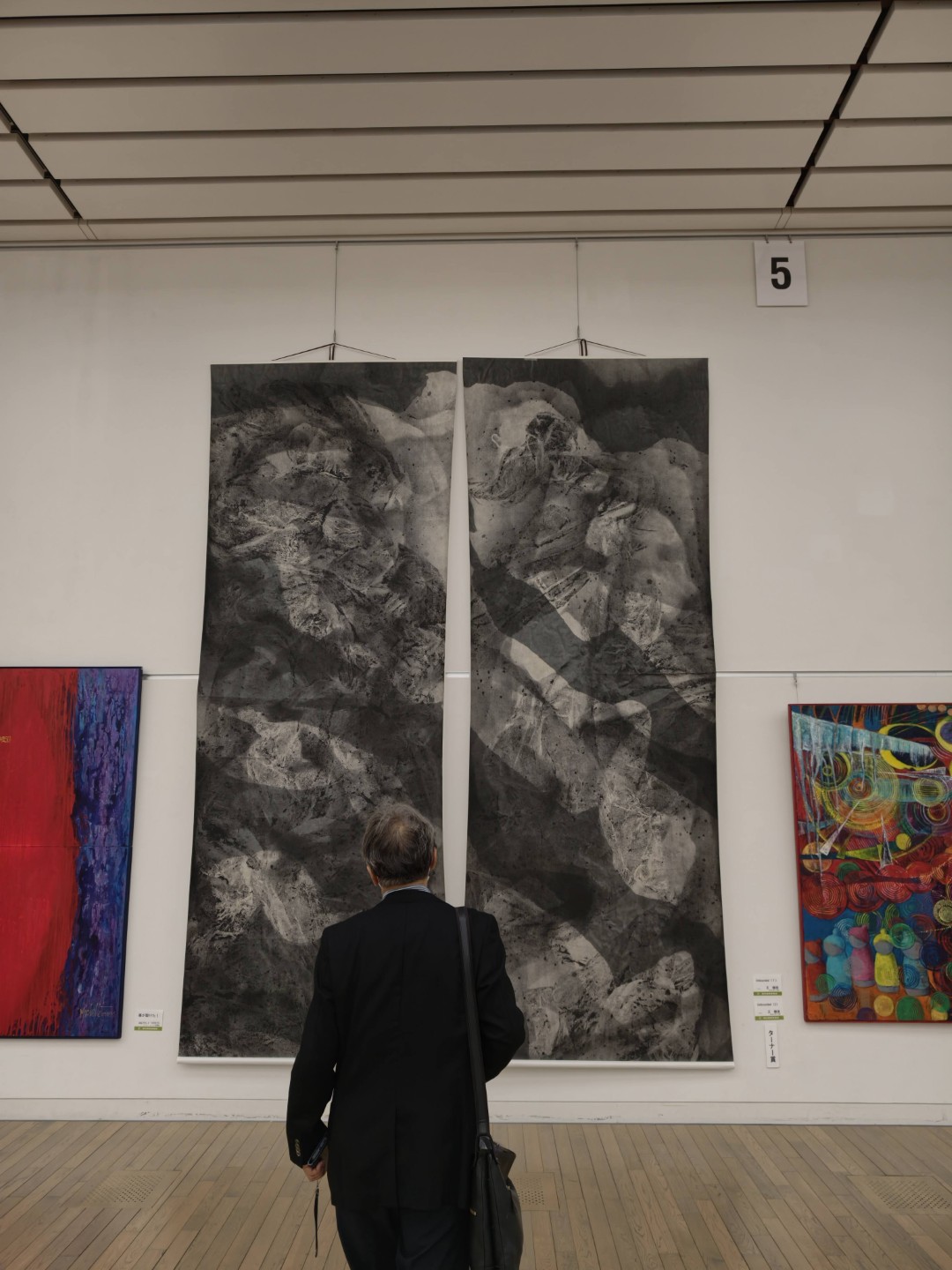
十三、與國立新美術館場域的關係:無典藏空間中的無我水墨
國立新美術館不設常設典藏,它是一個不斷清空、又不斷被展覽填滿的開放場域。 王穆提作品進入這樣的空間,具有特殊的象徵性。
一座無典藏美術館,並不以固定館藏建立永恆敘事;王穆提作品則不以固定自我建立存在基礎。展場與作品在此形成微妙呼應:美術館沒有永久典藏的「自我」,作品也質疑永恆不變的「我」。兩者都強調當下、事件、相續與臨時生成。
在國立新美術館的臨時展牆上,王穆提的水墨幾何像是一個關於時間與存在的視覺命題。展覽會撤展,作品會移動,觀眾會離開,但展覽經驗與數位檔案又會以另一種形式延續。這種展覽本身的相續性,也與王穆提作品中的因果相續形成呼應。
因此,王穆提作品不只是被放置於國立新美術館,而是在概念上與這座無典藏美術館產生對話。它們共同提出一個問題:如果沒有永久固定的中心,意義如何延續?如果沒有實體自我,因果如何不失?
十四、與掛軸展示的關係:重力、垂直性與因果下墜
本屆台灣參展作品多採掛軸形式展示。對王穆提而言,掛軸不只是運輸與裝裱策略,更能強化其作品的時間性與因果性。掛軸的垂直性與水墨流動之間具有物理上的共謀;當近四公尺的巨幅作品被垂直懸掛,觀者視線由上而下游走,彷彿閱讀一部順著重力垂流而下的地質史。
這一點對王穆提作品尤其貼切。水墨在宣紙上本就受重力、水分與纖維牽引;掛軸展示則使這種垂直流動在展場中被重新感知。觀者站在作品前,視線可能隨著墨色層次向下移動,感受到一種時間、重量與因果的下墜。
掛軸也使作品保持柔性。它不是被厚重畫框封閉,而是以可捲收、可展開、可移動的方式存在。這與「無界」思想亦相呼應:作品不是被框死的物件,而是一個可展開的相續場。它可以在不同展場中被重新懸掛,每一次展示都形成新的觀看條件。
因此,掛軸不只是形式配套,而是作品思想的延伸。它讓水墨的重力、宣紙的柔性與因果相續的哲學,共同進入展場經驗。
十五、制度與作品的互文:準會員身份如何回到創作本身
王穆提的準會員身份不應與作品分析分離。制度位置與作品內容之間存在互文關係。現展準會員意味著他在日本藝術場域中取得一種被承認的相續位置;而其作品則思考沒有固定自我時,如何仍然存在因果相續。制度與作品在此形成有趣的對照。
藝術家身份的建立本身,也是一種「假名」。姓名、獎項、入選、準會員、受賞紀錄,都是制度賦予藝術家的符號與位置。它們並非藝術家的全部實體,卻真實影響藝術家如何被觀看、被邀請、被書寫與被記錄。
王穆提作品對「假名我執」的視覺反思,反過來也使我們更清楚看見藝術制度的運作:藝術家身分不是自然存在,而是由作品、展覽、評論、推舉、資料庫與公共記憶共同建構。這並不意味制度是虛假無用的,而是指出制度也是一種條件相續。
因此,王穆提的準會員身份與其作品哲學之間並不矛盾。相反地,它讓我們看見:藝術家在制度中被命名、被推舉、被記錄,正如作品中的幾何邊界暫時劃定流動現象。這些命名與邊界不是終極實體,但能產生真實效果。
十六、專業評論觀點:王穆提作品的五重價值
綜合以上分析,王穆提在第82回現展台灣藝術家群像中具有以下五重評論價值。
第一,制度價值
王穆提參展兩次即被推舉為現展準會員,並曾入選俊英作家展等賞,顯示其作品在日本現展制度中取得高度認可。此一制度位置使其成為台灣藝術家跨國象徵資本累積的重要案例。
第二,媒材價值
其作品以宣紙、水墨、天然染料與層疊技法,充分發揮東方紙本媒材的滲透性、時間性與不可逆性。材料不只是工具,而是因果與相續的物質載體。
第三,形式價值
幾何邊界、灰階色塊與硬邊結構,使作品與西方抽象形成對話;同時,底層水墨流動又保留東方媒材的氣韻與無常感。作品在理性秩序與物質流動之間建立高度張力。
第四,哲學價值
作品將《俱舍論》中的假名我執、五蘊相續、非一非異與無我因果等思想轉化為視覺結構,使抽象佛學問題成為可被觀看的形式經驗。
第五,群像價值
作為七位藝術家中的壓軸,王穆提將前述作品中關於情感、生命、懸浮、逍遙、澄明與鄉愁的問題,提升到主體如何生成與相續的存在論層面。
十七、本章小結:在界與無界之間觀看自我的生成
王穆提的作品之所以能成為本專題藝術家評論的壓軸,正在於它同時具備制度強度、媒材深度、形式辨識度與哲學思辨力。他的準會員身份顯示其創作已在日本現展體系中取得重要位置;其作品則透過水墨、宣紙、幾何與染料,將「我」「界」「因果」「相續」等深層問題轉化為視覺經驗。
在他的畫面中,幾何邊界像是理性與自我建立的框架;底層墨色則像因果與五蘊相續的深淵。邊界存在,卻不是絕對;墨痕流動,卻不是無序。作品真正讓人震動之處,正在於它使觀者意識到:自我也許不是固定實體,而是一連串條件、痕跡、命名與相續所形成的暫時現象。
因此,王穆提的「無界」不是空泛地取消邊界,而是在看見邊界之後,進一步看見邊界的條件性。它不是逃離形式,而是透過形式破除形式;不是否定自我,而是觀看自我如何被建構、被執著、又如何在因果中流轉。
在第82回日本現展的台灣藝術家群像中,王穆提代表了台灣當代水墨最具哲學強度的一端。他讓水墨不只是文化身份的象徵,也不只是傳統媒材的延續,而成為能夠與佛教認識論、現代抽象、跨國制度與當代主體問題對話的思想性藝術。
82回現展現場影片:
從台灣藝術家群像到跨國藝術檔案
日本第82回現展的整體意義
一、從七位藝術家看見台灣當代藝術的多聲部結構
第82回日本「現展」中的台灣藝術家群像,最值得強調之處,是它並不構成一種單一、整齊、可被簡化的「台灣風格」。相反地,蔡梅芳、廖純沂、姜金玲、陳福祺、王詮富、吳智勇與王穆提七位藝術家,各自以不同媒材、題材、形式語言與哲學關懷,組成一個多聲部的台灣當代藝術現場。這組群像涵蓋自然、植物、都市、數位、佛學、情感、記憶、身體感與存在思辨,使台灣藝術在日本展場中不以單一符號被辨識,而是以多重路徑被展開。
這種多聲部結構,正是本次台灣參展最重要的文化價值。若海外觀眾只以「台灣性」作為觀看標籤,便容易期待某種地方風景、民俗符號或民族文化表徵;但第82回現展中的台灣藝術家並不服從這種單一路徑。他們既有彩墨、重彩、水墨與水彩,也有數位藝術與仿宣紙輸出;既有花鳥、荷塘、月桃、禽鳥,也有電車、街道、幾何、五蘊相續與數位擬像。這些差異使台灣藝術不是被固定為某種地方風格,而是展現為一組具有當代複雜性的創作集合。
因此,本專題報告所稱的「台灣藝術家群像」,不是以國籍統一所有差異,而是以第82回現展作為公共平台,讓差異彼此並置、互相照映。蔡梅芳的彩墨崇高與王詮富的水墨靜觀形成對照;廖純沂的心理懸浮與吳智勇的都市鄉愁互為呼應;姜金玲的亞熱帶生命衝力與陳福祺的後人類數位逍遙展開媒材跨度;王穆提則將整體群像中的主體、存在與因果問題推向哲學深處。這些作品共同證明:台灣當代藝術的核心不在於風格一致,而在於能夠同時容納地方經驗、個人生命、媒材實驗與跨文化思辨。
二、媒材光譜:從彩墨、水墨到數位擬像
若從媒材角度觀察,本次台灣藝術家群像呈現出極為開放的光譜。蔡梅芳以彩墨自動性技法處理紫藤、鴛鴦與自然崇高;廖純沂透過熟宣、重彩、刮擦與肌理建構懸浮心理空間;姜金玲以厚塗與高飽和色彩釋放亞熱帶植物的生命衝力;陳福祺則透過數位藝術、仿宣紙與光譜化圖像重新詮釋莊子「魚之樂」;王詮富以水墨留白建立精神澄明;吳智勇以水彩濕中濕技法溶解都市輪廓;王穆提則以水墨、天然染料、幾何邊界與宣紙物性建構佛學視覺拓撲。這種媒材跨度,使台灣參展作品不再被歸入單一傳統或單一當代範疇。
這一媒材光譜也對「現代美術」的定義提出回應。第82回現展作為公募型現代美術展,開放抽象與具象並行,並涵蓋繪畫、版畫、雕塑、工藝、攝影、CG與影像等多樣媒材;台灣藝術家的作品正好回應了這種制度開放性。彩墨、水墨與掛軸形式並未被視為過時傳統,數位微噴與仿宣紙也不被視為純粹科技展示;它們在同一展場中共同構成「當代」的多重面貌。
更重要的是,這些媒材並非只是技術差異,而是思想差異。蔡梅芳的彩墨使材料流動成為自然力量的可見形式;廖純沂的熟宣重彩讓表面肌理承載心理懸置;姜金玲的厚塗使生命衝動具有物質厚度;陳福祺的數位擬像使古典哲學進入後人類感知;王詮富的留白把觀看帶回空性與一念;吳智勇的水彩讓都市成為記憶中的液態場;王穆提的水墨幾何則使因果與無我成為可觀看的結構。媒材在此不是形式外殼,而是思想本身的運作方式。
82回現展現場影片:
三、現展制度:從海外參展到跨國象徵資本
第82回現展的台灣藝術家 參展,不能只被理解為藝術家把作品送往日本展出。它更是一個制度性事件:日本現代美術家協會作為1948年創立的美術團體,以公募、審查、推舉、受賞與巡迴展等機制,建立一套可供藝術家持續累積履歷與位置的制度平台。台灣藝術家進入這一平台,意味著其作品必須經過日本現代美術制度的評價,也有機會透過入選、受賞、會友、準會員等身分形成跨國藝術履歷。
這一制度脈絡,讓蔡梅芳、姜金玲與王穆提的身分尤其具有代表性。蔡梅芳於2025年成為現展會友,姜金玲於2026年成為現展會友並且同時獲得日本「日下部賞」,王穆提則為現展準會員,且曾有參展兩次即被推舉與入選俊英作家展等賞的紀錄。這些身分並非單純頭銜,而是藝術家在日本公募展制度中被辨識、被評價、被記錄的結果。對台灣藝術家而言,這樣的制度位置比單次海外展出更具長期意義,因為它可以轉化為未來展覽、研究、策展與國際交流的可累積資產。
也因此,第82回現展提供的不只是展牆,而是一條制度通道。台灣藝術家透過台灣連絡所、作品審查、運輸規格、日文翻譯、現場展出、評論撰寫與數位發布,逐步完成從本地創作到日本展覽制度的轉換。這種轉換使「海外參展」不再只是文化交流口號,而是包含行政、語言、物流、評論與檔案保存的完整工程。
四、國立新美術館:無典藏場域中的當下性
第82回現展本展於東京六本木的國立新美術館舉行,而這一場域對台灣藝術家的作品具有關鍵意義。國立新美術館於2007年開館,不設常設典藏,而以大型展示空間、多樣展覽、藝術資訊公開與教育推廣作為主要任務;這種無典藏特質,使它特別適合承接大型公募展與多元創作並置。
無典藏並不代表缺乏藝術性,反而使國立新美術館成為一種以「當下展覽事件」為核心的公共平台。傳統典藏型美術館往往以館藏建立歷史權威,新作品進入其中時,容易被既有藝術史敘事框住;國立新美術館則以不斷更替的展覽構成其生命,使每一次展覽都成為一次臨時而強烈的公共事件。台灣藝術家的作品進入這樣的場域,不必臣服於固定館藏敘事,而是在當下展覽中與日本及海外創作者直接並置。
這種場域條件,使七位藝術家的作品各自獲得不同程度的放大。蔡梅芳的彩墨風暴在白盒子空間中更顯壓迫與崇高;廖純沂的冷色浮境在大型展場中成為心理停頓;姜金玲的厚塗色彩與亞熱帶植物性衝撞現代展牆;陳福祺的數位擬像在現代美術場域中凸顯媒介轉向;王詮富的水墨留白為大型展覽製造安靜;吳智勇的都市水彩在東京展場中與觀眾日常經驗相互映照;王穆提的水墨幾何則在無典藏場域中提出無我與相續的哲學命題。
五、掛軸展示:運輸策略、東亞傳統與當代策展
本次台灣參展作品普遍採取掛軸模式展示,這一安排具有展務、形式與策展三重意義。從展務層面來看,掛軸便於運輸、包裝與海外展出,尤其適合四尺全開、六尺全開甚至接近四公尺的大型紙本作品。這使台灣藝術家能在跨國展覽條件下維持作品尺度,同時降低大型硬框作品的運輸困難。
從形式層面來看,掛軸具有東亞書畫傳統中的垂直性、柔性、可移動性與紙本質感。當台灣當代作品以掛軸形式進入日本現展時,它們一方面回應運輸與展出需求,另一方面也與東亞卷軸、書畫與懸掛觀看傳統發生連結。這使作品不只是被放在牆上,而是以一種具有文化記憶的形式被展開。
從策展層面來看,掛軸使不同媒材的台灣作品形成某種共同視覺語法。蔡梅芳的彩墨、王詮富的水墨、王穆提的幾何水墨、吳智勇的水彩,甚至其他紙本或仿紙本作品,都在掛軸的垂直展開中取得一種群體辨識度。這並不抹除各自差異,而是讓台灣參展作品在日本展場中形成一種「垂直拓撲」:柔軟而不失力量,傳統而不失當代,便於移動而能承載大型視覺敘事。
六、評論與翻譯:作品的第二現場
第82回現展台灣參展的重要特點之一,是設有「台灣參展者藝術評論」欄位,並結合日文翻譯、現場口譯、網路發布與藝術家個人頁面。這意味著作品不只是被懸掛於展場,也被納入可閱讀、可傳播、可被再次引用的評論文本之中。
藝術評論在此可被理解為作品的「第二現場」。第一現場是展場:觀者面對作品、感受尺度、色彩、材質與空間;第二現場則是文字:評論為作品建立媒材、形式、文化與思想脈絡。尤其在跨國展覽中,海外觀眾未必熟悉台灣藝術家的創作背景,若沒有評論與翻譯,作品很容易只被當作視覺印象消費。評論使作品從「被看見」進一步走向「被理解」。
翻譯則不只是行政服務,而是跨文化策展的一部分。作品名稱、媒材描述、哲學概念與文化語境都需要在中文與日文之間精準轉換。例如蔡梅芳《戀戀紫藤》中的動態崇高、廖純沂《未盡・浮境》中的心理懸浮、姜金玲作品中的生命衝動、陳福祺《魚的樂趣》中的數位擬像、王詮富《一念菩提開翠微》中的佛學意涵、吳智勇《鄉愁之秋》中的都市鄉愁,以及王穆提作品中的五蘊相續,都不可能只靠標籤完整傳達。這些概念必須透過評論與翻譯,才能在日本語境中形成有效的觀看入口。
七、數位檔案:展覽結束之後,作品如何繼續存在
展覽有明確的物理時間:開幕、展期、閉幕、撤展。但本次台灣參展透過RUMOTAN資料庫、藝術家個人頁面、展覽索引、評論文字、展場影像與網路新聞發布,將短暫展覽轉化為可保存、可搜尋、可引用的數位檔案。這使作品在撤展之後,仍能透過網路與文字繼續被閱讀。
對台灣藝術家而言,數位檔案具有重要現實意義。許多海外展覽若缺乏完整紀錄,最終只會成為履歷中的一行文字;但若有作品評論、現場影像、展覽資訊、個人頁面與日文資料,這次參展便能成為未來策展、研究、媒體報導與國際交流的基礎材料。數位檔案使作品不只存在於展場記憶中,也存在於可被查詢的公共資料結構中。
這也改變了展覽的時間觀。過去,展覽主要發生在展期內;現在,展覽同時發生在展前發布、展中觀看、展後搜尋與長期引用之中。當七位台灣藝術家的作品被評論、翻譯、拍攝並編入數位資料庫時,他們便不再只是一次性參展者,而成為可被持續閱讀的藝術主體。
八、從作品層次到交流層次:四個觀看維度
第82回現展台灣參展至少可以從四個層次理解。
第一是作品層次。七位藝術家各自以媒材、技法、主題與形式語言進入展場。彩墨、重彩、數位、水墨、水彩與幾何抽象共同形成一組台灣當代藝術的媒材譜系。
第二是制度層次。作品必須經過審查、收件、運輸、掛軸規格、翻譯、現場展示與撤展流程,才能進入國立新美術館。制度不只是外部行政,而實際影響作品如何被裝裱、如何被展示、如何被記錄。
第三是評論層次。藝術評論為作品建立理解框架,使它們不只是被看見,也被分析、被翻譯、被放入展覽脈絡。評論使作品具有第二生命,也使台灣藝術家能在日本語境中被更準確地閱讀。
第四是交流層次。本次參展不是單向輸出,而是由日本現展制度、國立新美術館、台灣連絡所、RUMOTAN數位平台、評論翻譯與現場展示共同構成的台日藝術交流案例。它顯示今日的藝術交流不只是友好互訪,而是一套包含制度、文本、媒材、語言與檔案的複合工程。
九、東京本展與地方巡迴:展覽生命的擴散
第82回現展並不只是一個東京事件。展覽除東京國立新美術館本展外,後續尚有名古屋、大阪與京都等巡迴展安排,作品或展覽脈絡得以從首都公共平台延伸至日本不同城市的藝術空間。這種東京本展與地方巡迴的結構,是日本美術團體展的重要傳統之一。
巡迴展的意義,不只是增加展期或擴大觀眾數量,而是讓作品進入不同地域的觀看語境。東京六本木代表高度都市化、國際化與媒體密度;名古屋、大阪、京都則各自具有不同文化歷史與藝術觀眾。當台灣藝術家的作品被置於這樣的巡迴結構中,其意義也可能隨著地點轉換而重新生成。
這也提醒我們,跨國展覽不是單一地點的事件,而是一種移動中的藝術網絡。台灣作品透過現展制度,不只是進入東京,也被放置在更廣泛的日本藝術公共結構中。這使台日藝術交流不只是瞬間相遇,而是可以透過展覽移動、文本保存與數位檔案持續擴散。
十、從「被看見」到「被討論」
本專題報告最核心的結論之一,是第82回現展台灣參展的價值,不應停留在「被看見」。被看見是重要的第一步,但對海外藝術家而言,更關鍵的是能否被理解、被討論、被記錄與被延伸。評論、翻譯、展場影像、個人頁面與數位資料庫,使台灣藝術家的作品從視覺展示轉化為可被閱讀的藝術文本。
「被看見」偏向曝光,「被討論」則涉及脈絡。作品被看見,可能只是觀眾在展場停留數秒;作品被討論,則表示它能引發關於媒材、文化、哲學、制度與交流的進一步思考。蔡梅芳不只是畫紫藤,而是提出自然崇高與眷戀的問題;廖純沂不只是畫花卉,而是呈現液態現代性的心理懸浮;姜金玲不只是畫荷塘與月桃,而是釋放亞熱帶生命衝動;陳福祺不只是做數位圖像,而是重寫莊子逍遙;王詮富不只是畫水墨禽鳥,而是召喚一念澄明;吳智勇不只是畫街景,而是捕捉都市鄉愁;王穆提不只是做水墨幾何,而是視覺化五蘊相續與無我思辨。
因此,台灣藝術在日本現展中的真正成就,不只是作品抵達六本木,而是作品透過展覽制度、評論文字與數位檔案,取得被深入討論的條件。這使第82回現展成為台日藝術交流從形式性展示走向內容性對話的重要案例。
十一、七位藝術家的總體定位
若將七位藝術家重新排列於整體結構中,可得到以下總體定位。
蔡梅芳代表彩墨與自然崇高的路徑。她以《戀戀紫藤》將花鳥題材推向物質流動、宇宙風暴與情感錨點,使傳統自然意象轉化為當代存在命題。
廖純沂代表心理拓撲與液態現代性的路徑。她以《未盡・浮境》讓花卉失去根系與地平線,呈現現代人在流動社會中的無根焦慮與仍然盛開的生命姿態。
姜金玲代表亞熱帶生命衝力與愛欲生態的路徑。她以《荷塘情旅》與《月桃盛開引禽来》釋放植物、色彩、情感與身體感的濃烈能量,使自然不再是背景,而成為生命主體。
陳福祺代表數位媒材與後人類感知的路徑。他以《魚的樂趣》將莊子魚之樂轉譯為數位擬像,使仿宣紙、光譜色彩與虛擬水域共同構成新的逍遙場。
王詮富代表水墨留白與精神澄明的路徑。他以《一念菩提開翠微》在視覺過載時代中提供減法、靜觀與一念覺知的可能。
吳智勇代表都市記憶與水彩鄉愁的路徑。他以《鄉愁之秋》將電車、街道、模糊人影與秋日光線轉化為現代漫遊者的心理輓歌。
王穆提代表水墨幾何與哲學思辨的路徑。他以準會員的制度位置及作品中的五蘊相續、假名我執與無界命題,將台灣當代水墨推向高度思想化的層次。
七者彼此不同,但共同構成第82回現展台灣群像的完整面貌:從自然到都市,從紙本到數位,從情感到哲學,從媒材實驗到制度推舉,台灣藝術在此不是單一形象,而是一個持續擴張的多重場域。
十二、總結:第82回現展作為台日藝術交流的公共案例
第82回日本「現展」台灣藝術家群像的整體意義,在於它將台灣當代藝術放置於一個具有歷史、制度、展場、評論與檔案系統的跨國平台中。日本現代美術家協會的公募制度提供了審查與推舉機制;國立新美術館提供了國家級公共展場;掛軸展示提供了兼具實務與文化意義的呈現方式;評論與翻譯提供了跨語言理解框架;數位檔案則使展覽在撤展後仍能被搜尋、引用與延續。
這些因素共同使本次參展不只是一次海外展示,而是一個完整的跨國藝術案例。它讓我們看見台灣藝術家如何穿越制度、語言、媒材、運輸與文化語境,進入日本當代藝術公共空間;也讓我們看見日本現展制度如何透過台灣參展者的加入,持續面向亞洲區域的創作流動。
從更長遠的角度看,第82回現展的台灣群像不只是「台灣藝術在日本展出」的紀錄,而是一個值得後續研究的藝術交流模型。它包含作品、制度、翻譯、展場、評論、影像與數位保存,也包含藝術家如何在海外累積象徵資本、如何被觀眾理解、如何在展後繼續被討論的問題。當展覽結束後,真正留下來的不只是作品曾經懸掛於牆面的事實,而是這些作品如何被寫入文字、保存於檔案,並持續在台日藝術語境之間發生作用。
82回現展現場影片:
結論
台灣當代藝術如何在日本現代藝術展中形成可被閱讀的歷史痕跡
一、從展覽事件到歷史痕跡
第82回日本「現展」中的台灣藝術家參展,表面上是一場跨國展覽事件;但若從藝術評論、制度研究與文化交流的角度觀察,它更像是一個正在形成中的歷史痕跡。這裡所謂歷史痕跡,並不是指作品已被固定寫入藝術史,而是指作品、藝術家、展覽制度、評論文字、翻譯文本與數位檔案共同留下了一組可被未來查詢、引用、研究與再詮釋的資料結構。本次台灣參展包含展覽索引、藝術評論、藝術家個人頁面、展場影像、網路新聞發布與RUMOTAN資料庫等紀錄機制,使展覽不只停留於展期,而能在展後延續其公共生命。
傳統展覽最大的限制,在於其物理時間的短暫性。作品在展場中被觀看,展期結束後作品撤下,觀眾記憶逐漸淡去,展覽作為事件便容易消失。然而,第82回現展的台灣參展,透過評論、翻譯、影像與數位平台,使作品不只以物理形式存在,也以文字與資料形式存在。這意味著台灣藝術家的海外參展不再只是「曾經展出」,而是轉化為「可被閱讀的展覽紀錄」。
從這個角度來看,本次專題報告的真正目的,不只是替七位藝術家撰寫作品介紹,而是嘗試將這次展覽放入更長遠的台日藝術交流脈絡中。蔡梅芳、廖純沂、姜金玲、陳福祺、王詮富、吳智勇與王穆提的作品,透過現展制度進入日本公共展場;又透過評論文字、日文翻譯與數位檔案,被轉化為可供未來討論的藝術文本。這正是本次參展最值得被記錄之處。
二、台灣藝術家如何從「參展者」轉化為「藝術主體」
在許多海外聯展中,藝術家常被簡化為參展名單中的姓名、國籍與作品標題。這種情況下,藝術家雖然「出現」於展覽現場,卻未必真正被理解。第82回現展台灣參展的重要性,在於它透過藝術評論、日文翻譯、個人頁面與展場紀錄,使台灣藝術家不只是參展者,而是被建構為可被理解、可被討論、可被研究的藝術主體。
所謂藝術主體,並不是單指創作者本人,而是指藝術家在作品、評論、制度與公共語境中形成的整體形象。蔡梅芳不只是展出《戀戀紫藤》的藝術家,而是以彩墨、自動性技法、動態崇高與情感錨點構成其評論形象;廖純沂不只是展出《未盡・浮境》的藝術家,而是透過熟宣重彩、懸浮花卉與液態現代性建立其心理拓撲;姜金玲不只是畫荷塘與月桃,而是以亞熱帶色彩、厚塗肌理與生命衝動呈現強烈感性主體;陳福祺不只是數位藝術參展者,而是以《魚的樂趣》重新啟動莊子命題與後人類擬像;王詮富不只是水墨畫家,而是透過《一念菩提開翠微》建立留白、澄明與一念覺知的精神路徑;吳智勇不只是都市水彩創作者,而是以《鄉愁之秋》捕捉液態都市中的現代鄉愁;王穆提則不只是現展準會員,而是以水墨幾何、五蘊相續與假名我執建構高度哲學化的視覺系統。
這樣的轉化,使台灣藝術家在日本展場中的位置不再只是國籍性或代表性,而是個別化、脈絡化與思想化。每位藝術家都透過評論獲得一套可被閱讀的語言,每件作品都被放入媒材、形式、文化與哲學的關係中。這也說明,藝術評論不是展覽之外的附屬文字,而是藝術家成為公共藝術主體的重要條件。
三、評論、翻譯與數位檔案的三重功能
第82回現展台灣參展的關鍵,不只在於作品展出,而在於作品被評論、被翻譯、被保存。這三者構成展覽的三重延伸功能。
第一,評論使作品被理解。在大型公募展中,作品數量眾多,觀眾停留時間有限,若缺少評論文字,作品很容易只被視為視覺印象。評論提供作品的媒材分析、形式解讀、文化背景與思想入口,使觀眾能從「看見畫面」進一步進入「理解作品」。本屆現展台灣相關資訊中特別設有「台灣參展者藝術評論」欄位,這使台灣作品不只是展場物件,也成為可閱讀的評論文本。
第二,翻譯使作品跨越語言邊界。台灣藝術家的作品名稱、媒材描述、創作語境與哲學概念,若不能被有效轉譯,便難以在日本觀眾中形成深入理解。翻譯不只是把中文換成日文,而是將文化語境、藝術專有名詞、東方哲學概念與當代美術語彙重新調整,使其在另一語言中仍能維持作品的思想密度。台灣參展協助包含日文翻譯、現場口譯與相關文件翻譯,這些工作是跨語言策展的重要部分。
第三,數位檔案使展覽延續生命。展覽撤展後,作品離開牆面,但若評論、影像、藝術家個人頁面與展覽資訊被保存,作品便能持續在網路中被搜尋、引用與傳播。RUMOTAN資料庫、展覽索引、網路新聞發布與展場影像,讓本次台灣參展從短暫事件轉化為可被未來重新召喚的檔案。這使展覽具有「第二生命」:第一生命發生在國立新美術館展場,第二生命則發生在文字、影像與數位資料庫中。
四、制度化的台日藝術交流:不只是友好展示
過去談台日藝術交流,常容易停留在友好、互訪、聯展、文化親善等較為概括的語彙。然而,第82回現展台灣參展呈現的是一種更具制度性的交流模式。它不只是把台灣作品帶到日本,而是包含日本現代美術家協會的公募制度、國立新美術館的展場平台、台灣連絡所的中介協助、掛軸規格的展務設計、藝術評論的文本建構、日文翻譯的語言轉換、現場影像的紀錄以及RUMOTAN數位資料庫的保存。
這種制度化交流的重要性,在於它讓藝術交流不只依賴個人關係或單次邀請,而形成可重複、可操作、可累積的流程。藝術家可以透過審查進入展覽,透過推舉累積制度位置,透過評論建立作品脈絡,透過翻譯跨越語言障礙,透過數位資料保存海外參展成果。這比單純「作品出國」更具長期價值。
同時,制度化不意味僵化。恰恰相反,現展制度的媒材開放性,使彩墨、水墨、水彩、重彩、數位藝術與幾何抽象都能在同一平台中出現。台灣藝術家進入這套制度後,並未被迫呈現單一風格,而能以各自的創作語言參與日本現代美術場域。這也說明,一個成熟的交流制度不應抹平差異,而應提供讓差異被看見與被討論的公共條件。
五、國立新美術館作為「當下性」的舞台
國立新美術館的特殊性,是本次專題報告的重要基礎。它不設常設典藏,而以大型展覽、藝術資訊公開、教育推廣與多樣展覽為核心功能。這使它不是以永久館藏建立權威,而是以不斷更替的展覽事件構成其公共性。我們可以將其稱為「無典藏異托邦」,強調其作為臨時展覽容器的當下性。
對台灣藝術家而言,這樣的場域具有重要意義。作品不必與固定館藏競爭,不必被放入既有日本美術史敘事的陰影之下,而是在當下展覽中直接與日本及其他創作者並置。這種並置使作品的當代性被放大:蔡梅芳的彩墨風暴不再只是東方花鳥變體,而成為展場中的動態崇高;廖純沂的懸浮花卉不再只是靜物,而成為液態現代性的心理圖像;姜金玲的厚塗植物不再只是自然題材,而成為亞熱帶生命力對白盒子空間的感性衝擊;陳福祺的數位魚不再只是科技影像,而成為後人類逍遙的媒介轉譯;王詮富的留白不再只是傳統水墨,而成為視覺過載時代的精神停頓;吳智勇的水彩街景不再只是都市寫生,而成為現代鄉愁的液態肖像;王穆提的水墨幾何不再只是抽象構成,而成為無我與相續的哲學場。
因此,國立新美術館不只是展覽背景,而是作品意義生成的條件之一。它的無典藏性、公共性與大型展覽空間,使台灣藝術家得以在日本現代美術制度的當下事件中被重新觀看。
六、掛軸作為台灣作品的共同展場語法
本次台灣參展普遍採用掛軸模式展示,這一點在整份報告中反覆出現,因為它不只是裝裱形式,而是一種展場語法。掛軸首先解決跨國展務問題:大型紙本作品在運輸、包裝、展出與撤展上都需要可行規格,掛軸使四尺全開、六尺全開甚至接近四公尺的大型作品能夠較有效地進入海外展場。
但掛軸更深層的意義,在於它將東亞書畫傳統帶入當代美術展場。掛軸具有垂直展開、柔性懸垂、可捲收、可移動、紙本質感與時間性觀看等特徵。當台灣當代作品以掛軸形式進入日本現展,它們一方面適應展務需求,另一方面也與日本觀眾熟悉的東亞書畫觀看傳統產生隱微對話。
更重要的是,掛軸使七位藝術家之間形成某種共同展場節奏。即使作品風格差異極大,掛軸的垂直性仍使它們在展場中形成一組可辨識的台灣作品群。王詮富的留白在掛軸中展開為氣韻,王穆提的水墨幾何在垂直尺度中呈現因果沉積,蔡梅芳的彩墨流動在柔性載體上更顯物質性,吳智勇的水彩街景也因此具有記憶卷軸般的展開感。這說明展覽形式不只是包裝作品,而會主動參與作品意義的生成。
七、台灣當代藝術的三條主線
經過前面個案與總結分析,可以將第82回現展台灣藝術家群像歸納為三條主要脈絡。
第一條是自然與生命的主線。蔡梅芳、姜金玲與部分廖純沂作品,都以花卉、植物、鳥禽或自然場域為入口,但三者方向不同。蔡梅芳以自然崇高與情感依附處理生命的脆弱與眷戀;姜金玲以厚塗色彩與亞熱帶植物表現生命衝力與愛欲生態;廖純沂則讓花卉失去根系,轉化為現代心理懸浮的象徵。自然在這裡不是背景,而是存在狀態、生命能量與心理結構。
第二條是現代感知與媒介的主線。陳福祺與吳智勇代表兩種不同的現代感知:前者進入數位擬像、仿宣紙與光譜化生命;後者則以水彩流動、電車與街景呈現都市鄉愁。兩者都不再把藝術限定於傳統自然觀看,而是面對數位時代與都市時代中感知如何被重塑的問題。
第三條是精神與哲學的主線。王詮富與王穆提分別以水墨留白與水墨幾何,處理東方思想在當代展場中的可能性。王詮富從一念、菩提、留白與禽鳥進入澄明狀態;王穆提則從五蘊相續、假名我執、幾何邊界與水墨沉積進入無我因果。兩者共同證明,東方哲學並非只能作為傳統符號,而能被轉化為當代視覺結構。
八、從個人創作到亞洲藝術網絡
第82回現展台灣群像的另一層意義,在於它將個人藝術家的創作放入更大的亞洲藝術網絡中。這些作品雖然來自台灣藝術家的個人生命經驗與媒材實驗,但當它們進入日本現展、國立新美術館、日文評論與數位資料庫後,便不再只是個人創作,而成為台日之間、乃至亞洲當代藝術交流的一部分。
這種網絡不是抽象概念,而由具體環節構成:日本現代美術家協會提供展覽制度,國立新美術館提供場地,台灣連絡所協助作品進入流程,評論者提供文本,翻譯者轉換語言,攝影與錄影保存現場,RUMOTAN等平台延續資料,觀眾、策展人、媒體與研究者則在未來可能重新閱讀這些資料。
因此,台灣藝術家的海外參展不能只以「有沒有得獎」「有沒有展出」衡量,而應看它是否進入可持續發生關係的網絡。本次台灣群像的價值,正是在於它透過制度、文字與檔案,使作品有機會在展覽結束後繼續被討論。
九、第82回現展台灣群像的文化意義
總結全文,第82回日本「現展」台灣藝術家群像的文化意義,可以歸納為五點。
第一,它展現了台灣當代藝術的多元媒材能力。從彩墨、熟宣重彩、厚塗、水墨、水彩到數位藝術與幾何抽象,七位藝術家共同呈現台灣創作不被單一媒材或風格定義的開放性。
第二,它證明台灣藝術家能夠進入日本公募展制度並取得可累積的制度位置。蔡梅芳與姜金玲的會友身分與王穆提的準會員身分,說明台灣藝術家不只是短期參展者,也可能在現展制度中獲得長期評價。
第三,它使國立新美術館的無典藏場域成為台灣作品當下發生的舞台。作品在此不被固定館藏敘事限制,而是在大型公共展覽中直接展現其當代性。
第四,它透過掛軸展示、評論翻譯與數位檔案,建立一套跨國策展與展後保存的方法。這套方法讓作品不只被懸掛,也被閱讀、被翻譯、被拍攝、被索引與被保存。
第五,它將台日藝術交流從友好展示推向制度化、文本化與檔案化。這使本次參展不只是一次文化活動,而是一個可供後續研究的公共案例。
82回現展現場影片:
十、從六本木展牆到未來的藝術記憶
當第82回現展的展期結束,作品終將離開東京六本木國立新美術館的展牆。然而,展覽的意義不會因此終止。作品曾經被展示,評論曾經被撰寫,翻譯曾經被完成,影像曾經被保存,資料曾經被編入數位平台;這些痕跡將共同構成未來藝術記憶的一部分。
對台灣藝術家而言,這是一次跨國參展,也是一次自我論述的建立。對日本現展而言,這是戰後公募制度持續面向亞洲創作流動的案例。對台日藝術交流而言,這是從作品輸出走向制度協作、評論建構與檔案保存的重要實踐。
因此,第82回現展台灣藝術家群像的最終意義,不在於它提出一個單一結論,而在於它打開了一條路徑:讓台灣藝術家從本地創作現場出發,進入日本國家級美術館平台,透過展覽制度被觀看,透過評論與翻譯被理解,透過數位檔案被保存,並在未來的藝術討論中繼續被重新閱讀。
這條路徑使「參展」不再只是短暫的展覽行為,而成為一個持續生成的文化過程。也正是在這個意義上,第82回日本「現展」台灣藝術家群像,已不只是一次展覽紀錄,而是一份正在形成的台日當代藝術交流檔案。
其他藝術評論:
【王穆提藝術評論】〈繼而工畫於山水,落筆驚世而不苟名於時〉《詹昭倫八十五回顧展》,台灣台北,2020年1月
【台日交流展】【王穆提藝術評論】日本橫濱情報志「SAKURA」Vol.25刊登 [ 若水柔剛-台灣新水墨]
【台日交流展】【王穆提藝術評論】日本橫濱三年展 橫濱トリエンナーレ: ヨコハマトリエンナーレ2017 系列報導:日本橫濱情報志「SAKURA」Vol.24 刊登文章
其他關於現展:
82回現展-2026年日本國立新美術館展-日本東京〈第82回現代美術家展〉
【台日交流展】《現場直擊》日本國立新美術館展《日本第81回現展》
【台日交流展】日本國立新美術館展-第80回現代藝術家展《第80回現展》
【台日交流展】2026年 日本現代美術家協會(現展)會務運營構成表與年度展覽計畫
【台日交流展】2026年日本現代藝術家展《現展神奈川支部 卯月展》橫濱戶塚Sakura Plaza:日本在地文化與國際藝術的交匯場域
【台日交流展】與莫內、畢卡索館藏同輝!台灣藝術家王穆提、廖純沂榮登日本MOMAS埼玉近代美術館《第49回埼玉現展》展出首位
【台日交流展】《現場直擊》2025年日本第57回《神奈川現代藝術家展》 《神奈川現展》 -展場:橫濱第一座美術館 橫濱市民畫廊
【台日交流展】【現場直擊】2025年日本第十三回 《東京現展》-展場:日本國立東京都美術館
【台日交流展】《現場直擊》日本國立新美術館展《日本第81回現展》
【台日交流展】【現場直擊】2024日本《第56回神奈川現展》
【台日交流展】【展覽現場】日本國立東京都美術館展-〈日本第十二回東京現展〉
【台日交流展】日本東京銀座志門畫廊:日本現代美術家協会《現展》〈GENTEN新春アートフェア〉2024
Portraits of Taiwanese Artists at the 82nd Genten Exhibition in Japan
Written by: WANG MUTI
General Introduction: A Transnational Scene of Viewing from Taiwan to Roppongi, Tokyo
Abstract
The participation of Taiwanese artists in the 82nd Japan “Genten” Exhibition should not be understood merely as an overseas group exhibition or as the accumulation of individual artists’ résumés. Rather, it should be regarded as a transnational art event jointly constituted by a public-entry system, a national-level exhibition venue, cross-language criticism, hanging-scroll display strategies, and digital archival preservation. This year’s Genten Exhibition was held from May 27 to June 8, 2026, at The National Art Center, Tokyo, in Roppongi, Tokyo, and was organized by the Modern Art Association of Japan, founded in 1948. Through the Taiwan liaison office, critical writing, Japanese translation, on-site documentation, and digital publication, the works of Taiwanese artists entered Japan’s public-entry system for modern art.
This article takes the form of a special report in art criticism and reexamines the works and institutional positions of seven Taiwanese artists: Tsai Mei-Fang, Liau Chun-Yi, Jiang Jinling, Chen Fu-Chi, Wang Chuan Fu, Wu Zhiyong, and Wang Muti. The core question of this report is not only “how Taiwanese artists are seen in Japan,” but further asks: How are works accepted by the exhibition system? How are they understood through criticism and translation? How do they generate new meanings of viewing within the field of The National Art Center, Tokyo? And how does digital archiving extend the life of the exhibition?
Keywords
The 82nd Genten Exhibition, Taiwanese contemporary art, The National Art Center, Tokyo, Modern Art Association of Japan, public-entry exhibition, hanging-scroll display, art criticism, Taiwan–Japan art exchange, digital archive, cross-cultural curating
I. Special Topic Positioning: This Is Not Simply Overseas Participation, but an Art-Institutional Event
The portraits of Taiwanese artists in the 82nd “Genten” Exhibition should first be understood within an institutional framework. Japan’s “Genten” is not a temporary international group exhibition, but a public-entry modern art exhibition long promoted by the Modern Art Association of Japan. Its institutional context includes multiple mechanisms such as open calls, work review, selection, awards, recommendations, traveling exhibitions, and internal status hierarchies within the organization. Founded in 1948, the Modern Art Association of Japan has long accepted works in different media, including two-dimensional works, three-dimensional works, crafts, photography, and video, and continues the life of its exhibitions through the main exhibition at The National Art Center, Tokyo, as well as traveling exhibitions in Nagoya, Osaka, Kyoto, and other places.
Therefore, the significance of Taiwanese artists’ participation in the 82nd Genten Exhibition is not merely that “their works were sent to Japan for exhibition,” but that their works entered a Japanese modern art system with historical depth and evaluative mechanisms. For artists, this means that their works must face the review standards, exhibition scale, work specifications, and audience contexts of Japanese public-entry exhibitions. For Taiwanese contemporary art, it means that Taiwanese creators no longer enter overseas contexts only through private galleries, international fairs, or friendly exchanges, but through open submission and institutional evaluation, entering the public field of Japanese modern art.
The Genten system includes classifications such as “selected artists, award recipients, and recommended artists,” and artists may accumulate institutional positions through participation and awards, such as associate friend, associate member, or member. This means that “participation” itself is not merely a one-time exhibition result, but a process through which artists gradually acquire symbolic capital within the Japanese art field. Tsai Mei-Fang is a “Genten associate friend, recommended in 2025”; Jiang Jinling was recommended this time as a “Genten associate friend”; and Wang Muti is a “Genten associate member, recommended after only two participations, and previously selected for the Young Talented Artists Exhibition and other awards.” These cases all show that Taiwanese artists are no longer merely external guests within this system, but have begun to enter the internal evaluative structure of Genten.
II. Exhibition Site: The National Art Center, Tokyo as a Contemporary Platform “Without a Collection”
The importance of this exhibition also derives from its venue—The National Art Center, Tokyo, in Roppongi, Tokyo. The National Art Center, Tokyo is located at 7-22-2 Roppongi, Minato-ku, Tokyo. Opened in 2007, it is one of the important institutions within Japan’s national art museum system. Unlike collection-based museums, The National Art Center, Tokyo does not maintain a permanent collection, but instead takes large-scale exhibition spaces, diverse exhibitions, public access to art information, and educational outreach as its core missions.
This point is crucial for the works of Taiwanese artists. Traditional collection-based museums often establish historical authority through their collections. When works enter such museums, they are often forced into comparison with, or subordination to, existing art-historical narratives. However, the particularity of The National Art Center, Tokyo lies in the fact that it does not take a permanent collection as its center of power, but rather takes constantly changing exhibitions as its public platform. In other words, it is not a museum that defines the present through the past, but an open field centered on the “exhibition event of the present.”
We may describe The National Art Center, Tokyo as a “heterotopia without a collection,” indicating that this museum is a transitional container that is constantly emptied and constantly refilled by exhibitions. For Taiwanese artists’ participation, this spatial characteristic has a double effect: on the one hand, works do not have to be placed under the fixed narratives of Japanese classical art or Western modernist collections; on the other hand, within the brief exhibition period, works must quickly establish the conditions for being seen and understood through their own formal intensity, material language, and textual support.
Therefore, The National Art Center, Tokyo is not a neutral background, but actively participates in the production of meaning for the works. Tsai Mei-Fang’s color-ink storm in Lingering Wisteria, Liau Chun-Yi’s weightless flowers in Unfinished・Floating Realm, Jiang Jinling’s subtropical colors in Emotional Journey in the Lotus Pond and Shell Ginger in Full Bloom Attracts Birds, Chen Fu-Chi’s digital simulacrum in The Pleasure of Fish, Wang Chuan Fu’s ink-wash voids in One Thought of Bodhi Opens the Verdant Mist, Wu Zhiyong’s watercolor city in Autumn of Nostalgia, and the ink-wash geometry and philosophical structure in Wang Muti’s Unbounded are not simply hung in isolation on the wall; rather, within the exhibition system and spatial scale of a national-level museum in Roppongi, they regain their publicness.
III. The Public-Entry Exhibition System: The Dual Structure of Openness and Hierarchy
As part of Japan’s postwar modern art public-entry exhibitions, “Genten” possesses a clearly open institutional spirit. Its submission categories include painting, printmaking, sculpture, crafts, photography, CG imagery, and other forms, and it does not restrict works to abstraction or figuration. This allows artists of different media, styles, and generations to be reviewed and exhibited within the same exhibition system.
However, openness does not mean the absence of hierarchy. Genten also includes recommendations and status ladders such as selection, awards, associate friends, associate members, and members. This structure enables artists to gradually accumulate recognition within the system through repeated participation, awards, and recommendations. In other words, Genten provides both an open entrance and an accumulative mechanism for artistic résumés.
For Taiwanese artists, this system has a special appeal. Many overseas exhibitions may provide exposure, but after the exhibition ends, artists’ works often leave behind only brief résumé entries. By contrast, selections, awards, and recommendations within the Genten system can form more explicit records. When these records are then preserved through art criticism, Japanese translation, personal pages, and digital publication, participation becomes not merely an event, but may become a long-term resource for artists entering Japanese art networks.
This institutional process may be called the accumulation of “transnational symbolic capital.” This formulation can be understood as follows: what Taiwanese artists obtain through Genten is not merely an opportunity to exhibit, but the possibility of being recognized, recorded, and circulated by the Japanese modern art system. Tsai Mei-Fang’s promotion from selected artist to associate friend in 2025, Jiang Jinling’s promotion from selected artist to associate friend in 2026, and Wang Muti’s rapid recommendation as an associate member after a short period of participation are all concrete examples of this conversion of symbolic capital.
IV. The Particularity of Taiwanese Participants: From “Being Seen” to “Being Read”
One of the core arguments of this special report is that the position of Taiwanese artists in the 82nd Genten Exhibition is not merely that of “overseas participants” on an exhibition list, but that they are established as readable artistic subjects through criticism and translation. The Taiwan-related information for this year’s Genten Exhibition specifically includes a section on “Art Criticism for Taiwanese Participants,” as well as artists’ individual pages, online news releases, Japanese translations of documents and works, on-site Chinese–Japanese interpretation, exhibition photography, video recording, and related content.
This point is extremely important. In overseas exhibitions, being seen does not necessarily mean being understood. Viewers may see colors, composition, materials, and labels, yet may not necessarily understand the cultural context, creative methods, life experiences of the artists, or choices of media behind the works. Especially in large-scale public-entry exhibitions, where the number of works is large and the viewing rhythm is fast, without critical texts and linguistic translation, works can easily remain at the level of superficial visual impressions.
Therefore, art criticism here plays the role of a “second site.” The exhibition wall is the first site of the work; criticism is the second site where the work is reorganized, interpreted, and circulated. It does not replace the work, but establishes an entrance for viewing it. For Tsai Mei-Fang, criticism allows Lingering Wisteria to be understood not merely as a bird-and-flower subject, but as an intersection of color ink, automatic technique, dynamic sublimity, and emotional anchors; for Liau Chun-Yi, criticism allows Unfinished・Floating Realm to be understood not merely as a floral composition, but as a suspended psychological field within liquid modernity; for Chen Fu-Chi, criticism makes The Pleasure of Fish not merely a digital image, but a meditation on simulacra, imitation xuan paper, and posthuman perception.
In other words, criticism allows works to move further from “being viewed” toward “being discussed.” This is also why this report adopts the form of professional art criticism: this article does not merely reorganize information about the works, but hopes to establish a clear analytical framework for each artist, so that their formal language, material logic, cultural context, and institutional position within the exhibition can be fully presented.
V. Hanging-Scroll Display: From Transportation Strategy to Visual Method
Many of the Taiwanese participating works in this exhibition are displayed in the form of “hanging scrolls.” This arrangement first has practical significance: transnational exhibitions involve the transportation, packaging, storage, installation, and dismantling of works, and compared with heavy frames or large panels, the hanging-scroll format offers greater flexibility in transport. Taiwan-related information for Genten lists sizes such as four-foot full sheets, six-foot full sheets, and even larger formats, and explains that this method enables Taiwanese participants to display large-scale works overseas.
However, the hanging scroll is not merely an exhibition-management technique; it is also a method of viewing. The hanging scroll has a long history in East Asian calligraphy and painting traditions. Its characteristics include vertical unfolding, storability, mobility, the softness of paper or cloth materials, and a viewing rhythm in which the viewer moves from top to bottom and from part to whole. When Taiwanese contemporary artworks enter the public-entry venue of Japanese modern art in hanging-scroll form, the works simultaneously connect two contexts: on the one hand, they enter the modern art exhibition system; on the other hand, they also create a visual dialogue with East Asian calligraphy and painting, paper-based art, scrolls, and hanging traditions.
This display form produces different effects for different artists’ works. In Wang Chuan Fu’s One Thought of Bodhi Opens the Verdant Mist, the voids and ink-wash resonance become more spiritually descending and unfolding because of the verticality of the hanging scroll; in Wang Muti’s Unbounded, the layered ink and geometric boundaries acquire a mode of reading similar to a geological cross-section because of the scale of the long hanging scroll; Tsai Mei-Fang’s flowing color ink in Lingering Wisteria, meanwhile, presents a kind of unframed and unfixed visual energy on the flexible support of the hanging scroll.
Therefore, this report regards the hanging scroll as an important curatorial condition for Taiwanese participation in this exhibition. It is both an administrative solution for transnational exhibition and a way for Taiwanese works to form a shared visual grammar within the Japanese exhibition venue. The hanging-scroll format allows these works of different styles and media to form a recognizable portrait of Taiwanese display within The National Art Center, Tokyo.
VI. Digital Archives: The Second Life After the Exhibition
Traditional exhibitions have clear temporal boundaries: opening, exhibition period, closing, and dismantling. The Tokyo main exhibition of the 82nd Genten Exhibition ran from May 27 to June 8, 2026. After the exhibition period ended, the collective presentation of the works in physical space came to a close.
However, this year’s Taiwanese participation does not stop at the physical exhibition site. Through online platforms such as RUMOTAN, exhibition information, lists of participating artists, art criticism, on-site displays, and related records are established. This means that the exhibition is no longer merely a short-lived event, but is transformed into a searchable, citable, and sustainable digital archive.
For Taiwanese artists, the importance of digital archives cannot be ignored. If overseas exhibitions lack written, visual, and online records, they often quickly fade from public memory after the exhibition ends. Yet if images of works, exhibition-site photographs, critical texts, and artists’ individual pages are comprehensively preserved, these materials may later be rediscovered by curators, researchers, media, collectors, or other art institutions.
Therefore, the full significance of Taiwanese participation in this exhibition should include three temporal levels: first, the pre-exhibition phase of registration, review, translation, and preparation; second, the on-site viewing, evaluation, and exchange during the exhibition; and third, the continuing reading and dissemination that occurs after the exhibition through digital archives. The artists’ works are not only seen at The National Art Center, Tokyo, but also acquire an extended life within texts, images, and online databases.
VII. Critical Paths for the Seven Artists
The subsequent sections of this report will analyze the seven Taiwanese artists and their works one by one in the designated order:
1. Tsai Mei-Fang
Genten associate friend, recommended in 2025. Work: Lingering Wisteria.
Her work will be analyzed through color-ink automatism, material flow, Kantian dynamic sublimity, and the emotional anchors formed by the mandarin ducks in the picture.
2. Liau, Chun-Yi Liau, Chun-Yi
Selection internally confirmed. Work: Unfinished・Floating Realm.
The critique will focus on her heavy colors on processed xuan paper, spatial rupture, suspended flowers, and the psychological topology of liquid modernity.
3. Jiang Jinling
Genten associate friend, recommended in 2026. Works: Emotional Journey in the Lotus Pond, Shell Ginger in Full Bloom Attracts Birds.**
The analysis will revolve around subtropical color, impasto texture, Spinozist conatus, and the visual expression of erotic ecology.
4. CHEN FU-CHI
Selection internally confirmed. Selected for the Special Project Exhibition Area. Work: The Pleasure of Fish.
The critique will begin from digital art, imitation xuan paper, simulacrum theory, Zhuangzi’s “pleasure of fish,” and posthuman perception.
5. WANG CHUAN FU
Selection internally confirmed. Work: One Thought of Bodhi Opens the Verdant Mist.
His work will be analyzed through ink-wash voids, phenomenological reduction, bird imagery, clarity, and the spiritual structure of “one thought of bodhi.”
6. Wu Zhiyong
Selection internally confirmed. Work: Autumn of Nostalgia “ノスタルジックな秋”.
The critique will discuss watercolor wet-on-wet technique, the sense of urban dissolution, the Benjaminian flâneur, and the visualization of modern nostalgia.
7. WANG MUTI
Genten associate member, recommended after only two participations, previously awarded in the Young Talented Artists Exhibition and other awards.
The analysis will focus on his ink-wash geometry, the continuity of the five aggregates, the thought of the Abhidharmakośa, institutional advancement, and transnational symbolic capital.
VIII. Viewing Frameworks for the Taiwanese Portrait
To summarize this opening section, if one wishes to rewrite the portraits of Taiwanese artists in the 82nd Genten Exhibition through professional art criticism, four viewing frameworks must first be established.
First, the institutional framework. Genten is not an ordinary group exhibition, but a Japanese modern art public-entry system with history, review, awards, recommendations, and traveling structures. The participation of Taiwanese artists means that they enter this system and begin to accumulate artistic positions that can be recorded.
Second, the field framework. The collectionless nature of The National Art Center, Tokyo makes it a public platform centered on the exhibition event of the present. Taiwanese works are viewed here not by being incorporated into fixed collection narratives, but by establishing their own contemporaneity within the intensity of a temporary exhibition.
Third, the display framework. Hanging-scroll display is both a transnational transportation strategy and a combination of East Asian visual tradition with contemporary exhibition methods. It enables works in different media to form a vertical, flexible, mobile shared grammar within the same exhibition venue.
Fourth, the criticism and archive framework. Art criticism, Japanese translation, image documentation, and digital platforms allow works not only to be viewed in the exhibition site, but also to be read, cited, and preserved after the exhibition. This is the key for Taiwanese artists to move from “being seen” toward “being discussed.”
Tsai Mei-Fang
Viewing Color-Ink Storms, Dynamic Sublimity, and Emotional Anchors through Lingering Wisteria
I. The Artist’s Position: The Institutional Significance from Participant to Genten Associate Friend
Among the portraits of Taiwanese artists in the 82nd Japan “Genten” Exhibition, Tsai Mei-Fang’s position carries clear institutional significance. She is a “Genten associate friend, recommended in 2025,” which means that her work is not limited to a single selection or an occasional exhibition appearance, but has already entered the recommendation ladder of the Modern Art Association of Japan. For an artist from Taiwan, the status of “associate friend” is not merely an administrative category, but also a symbol of sustained recognition within the field of Japanese public-entry exhibitions.
From the perspective of the exhibition system, the value of Genten lies not only in providing exhibition walls, but in its complete mechanisms of review, selection, awards, recommendations, and traveling exhibitions. The status obtained by an artist within this system is transformed into part of the artist’s transnational artistic résumé. Tsai Mei-Fang’s recommendation as a Genten associate friend in 2025 means that her creative language has established a certain recognizability within the field of Japanese modern art, and also shows that her work can cross the linguistic, material, and viewing differences between Taiwan and Japan and be incorporated into Genten’s evaluative system.
This institutional background is an important premise for understanding Lingering Wisteria. For Lingering Wisteria does not appear simply as a floral-themed work, but enters a Japanese exhibition system that emphasizes modernity, openness to multiple media, and public review through the juxtaposition of color ink, natural imagery, abstract flow, and figurative life. In other words, what Tsai Mei-Fang faces is not only “how to paint wisteria,” but how to allow wisteria, a traditional natural subject, to regain contemporaneity within a modern art public-entry exhibition.
II. The Titular Structure of Lingering Wisteria: From Plant Imagery to an Emotional Proposition
The title Lingering Wisteria appears on the surface to point toward the natural scene of wisteria blossoms, yet the word “lingering” shifts the work from simple botanical depiction into the realm of emotion and existence. “Lingering” contains semantic implications of attachment, reluctance to part, repeated looking back, and emotional bonds. It makes wisteria no longer merely a flower, but a symbol related to time, memory, and intimate relationships.
In the East Asian painting tradition, flowers often carry character, seasonality, emotion, and literati projection. Plum, orchid, bamboo, and chrysanthemum each have their cultural meanings; lotus may refer to purity and transcendence; peony symbolizes wealth and honor; wisteria is often connected with hanging forms, abundance, resilience, seasonal cycles, and garden memory. However, Tsai Mei-Fang does not treat wisteria as a gentle and lyrical garden flower, but pushes it into a more intense color-ink field closer to cosmic flow. Lingering Wisteria overturns the traditional bird-and-flower painting structure of “depicting objects and forms with gentle restraint,” emphasizing instead the natural flow, repulsion, and fusion of water, ink, and pigment within the fibers of paper.
Therefore, the “wisteria” in the title provides a natural entry point, while “lingering” opens an emotional dimension. What the work truly addresses is not the botanical form of wisteria, but how human beings, when facing nature, time, and impermanence, still maintain emotional attachment and connections of life.
III. The Language of Color Ink: Automatic Technique and Material Flow
The most visually impactful aspect of Tsai Mei-Fang’s Lingering Wisteria lies in the fact that the picture does not rely on the precise outlining of traditional fine-line bird-and-flower painting, but extensively employs the fluidity, diffusion, and not fully controllable material reactions of color ink. This method may be called an “automatic technique,” indicating that the large tea-brown area in the picture is not deliberately depicted by the brush, but generated through the natural penetration, repulsion, and fusion of water, ink, and pigment on paper fibers.
This creative method gives the work a strong materiality. Materiality here does not merely mean that the work is composed of pigment, paper, and ink; rather, it means that the materials themselves possess agency within the image. Water spreads, ink settles, and pigment leaves boundaries, traces, and layers within the fibers. The artist does not completely dominate the materials, but completes the image together with them between control and loss of control.
This point is especially important for Lingering Wisteria. If wisteria were depicted entirely through fine-line technique, it would primarily present the form of the plant; but when wisteria is placed within the flow of color ink, it is no longer merely an identifiable flower, but a composite of natural energy, temporal sedimentation, and emotional fluctuation. The tea-brown, purple, yellow, and ink tones in the picture are not simply filled-in colors, but collide, cover, penetrate, and settle into one another, forming a visual effect close to geology, cloud vapor, or a cosmic nebula.
Therefore, the contemporaneity of Lingering Wisteria does not lie in the novelty of its subject, but in the way it allows a traditional floral subject to break away from the framework of “representing nature” and enter a state of “generating nature.” The image does not depict a single wisteria plant; rather, it lets wisteria be regenerated through the interaction of water, ink, paper, and pigment.
IV. From Bird-and-Flower Painting to Contemporary Abstraction: The Reconstruction of Traditional Subject Matter
If Lingering Wisteria is placed back into the context of East Asian bird-and-flower painting, Tsai Mei-Fang’s strategy of transformation becomes visible. Traditional bird-and-flower painting emphasizes the posture of objects, line, brush-and-ink rhythm, and symbolic meaning. Flowers and birds are often placed within recognizable natural environments and convey seasonality, emotion, and character through compositional arrangement.
However, although Lingering Wisteria retains elements of bird-and-flower painting, it does not obey the spatial order of traditional bird-and-flower painting. In the picture, wisteria is no longer a clearly arranged cluster of flowers among branches and leaves, but is dismantled into color, points of light, and traces of flow. Nature is no longer a quiet garden, but seems like an energy field undergoing violent transformation. This shifts the work from the traditional bird-and-flower painting mode of “depicting objects” toward the contemporary painting mode of “creating a realm.”
“Creating a realm” does not simply mean creating a background, but establishing a psychological and sensory field into which the viewer may enter. The background of Lingering Wisteria is not a neutral support, but the primary source of the work’s power. The large flowing tea-brown area forms an oppressive space; the purple and yellow appear like light spots, floral shadows, or fragments of memory flickering within it. This spatial relationship means that the viewer is no longer merely standing before flowers to look at them, but is drawn into the interior of a nature that is transforming, breathing, and expanding.
Therefore, Tsai Mei-Fang’s reconstruction of bird-and-flower painting is not a complete abandonment of tradition, but a pushing of traditional bird-and-flower subjects toward contemporary abstraction. She still retains identifiable elements such as wisteria and mandarin ducks, but places them within a highly fluid, almost abstract-expressionist color-ink environment, creating tension between figuration and abstraction.
V. Dynamic Sublimity: The Oppression and Shock of Natural Forces
We may use the “dynamic sublime” in Kantian aesthetics to understand Lingering Wisteria. The dynamic sublime refers to the shock, awe, and elevation of self-consciousness produced when human beings face vast, powerful, and not fully controllable forces of nature. Tsai Mei-Fang removes the pastoral filter, reducing wisteria to symbols of deep purple and bright yellow, embedding them within a violent tea-brown ground like points of light in a cosmic abyss.
This interpretation is highly suitable for Lingering Wisteria. The work does not treat wisteria in a soft, lyrical, or refined manner, but allows wisteria to appear within a huge and unstable visual field. What the viewer faces is not a quiet floral scene, but a color-ink field close to a storm, abyss, cloud layer, or temporal sedimentation. The flowers within it are both beautiful and fragile, both bright and surrounded, both proof of life and brief points of light that seem about to be engulfed.
This aesthetic differs from the elegance of traditional flower painting and is closer to the experience of the sublime. Beauty makes one feel harmony, intimacy, and graspability; the sublime makes one feel shock, transcendence, and what cannot be fully controlled. The reason the wisteria in Lingering Wisteria is moving is precisely that it does not bloom in a stable garden, but emerges within a vast color-ink storm. Its beauty is not a quiet beauty, but a beauty that still appears after confronting chaos.
Therefore, Tsai Mei-Fang’s wisteria is not merely a plant, but a symbol of life still blooming amid impermanence and pressure. It faces a vast background, flowing matter, and unpredictable reactions of color and ink; yet precisely within such a background, its existence becomes all the more precious.
VI. The Mandarin Duck Image: The Emotional Anchor of Small Lives
If the color-ink background constitutes the macrocosmic force of Lingering Wisteria, then the mandarin ducks in the picture provide a microcosmic emotional focus. At the edge of a grand chaos full of oppressive force, Tsai Mei-Fang places a pair of mandarin ducks painted in extremely realistic fine-line technique; this extreme juxtaposition of a grand abstract storm and microscopic figurative depiction may be understood as the visualization of an “I and you” relationship.
This pair of mandarin ducks plays a crucial role in the work. Without them, the image might mainly be understood as natural energy or color-ink abstraction; with the mandarin ducks, however, the work is brought into the realm of intimate relationship, companionship, and existential attachment. In East Asian culture, mandarin ducks are often regarded as symbols of partners, fidelity, and paired existence. Tsai Mei-Fang’s use of this image here does not fall into a folkloric auspicious formula, but places it under strong visual pressure, making it an emotional support when facing a vast world.
The mandarin ducks in the picture form a sharp contrast with the background. The background is flowing, chaotic, and uncontrollable; the mandarin ducks are figurative, delicate, and recognizable. The background represents natural force, temporal change, and existential uncertainty; the mandarin ducks represent intimacy, leaning together, and mutual confirmation between lives. This contrast gives the work an existential depth: in a vast world, human beings may not be able to control fate, but they can still establish the weight of their own existence through relationships with others.
Therefore, the mandarin ducks are not decorative elements, but the emotional core of the entire work. They make Lingering Wisteria not merely an image of natural sublimity, but a work about “how to depend on one another amid impermanence.”
VII. The Deeper Meaning of “Lingering”: Attachment Is Not Weakness, but Resistance to Nihility
When the title Lingering Wisteria is read in relation to the image of the mandarin ducks, one can see that Tsai Mei-Fang’s understanding of “love” is not simply romantic. Here, “lingering” is not a light rhetoric of love, but an emotional resilience in which human beings, or life and life, still refuse to break apart when facing a vast world.
In modern society, individuals are often placed in situations of rapid change, unstable relationships, and fluid values. In analyzing other artists, we have repeatedly mentioned “liquid modernity” and the modern experience of losing certainty; if this background is brought back to Tsai Mei-Fang’s work, we can understand that the “lingering” in Lingering Wisteria is not an escape from modern unease, but the establishment of connection within unease.
The mandarin ducks in the image are not located at a stable center, but depend on one another at the edge of chaos. This gives their existence greater tension. They do not symbolize happiness in a peaceful world, but still maintain closeness to each other within a visual field of uncertainty, oppression, and flow. Thus, “lingering” becomes a way of resisting nihility: not by opposing the world with grand declarations, but by resisting isolation and dispersal through small yet firm companionship.
From this perspective, what is truly moving about Lingering Wisteria is not how beautifully the wisteria blooms, but the way the work allows viewers to see that beauty and love do not exist in an environment free from wind and waves, but are reaffirmed amid chaos, pressure, and impermanence.
VIII. Color Structure: The Psychological Tension of Tea-Brown, Deep Purple, and Bright Yellow
The color structure of Lingering Wisteria may be divided into three main levels: the tea-brown background, the deep purple floral shadows, and the bright yellow points of light. These three colors are not arranged flatly side by side, but form relationships of depth, density, gathering, dispersal, and penetration within the flow of color ink.
The tea-brown occupies the dominant position in the picture and carries connotations of soil, withered leaves, temporal sedimentation, and deep memory. It is not a bright background, but resembles a heavy field formed after sedimentation. This tea-brown gives the work a certain temporality: the viewer seems to see pigment penetrating layer by layer into the paper, leaving water marks, boundaries, and mottled traces. It resembles both earth and the remaining clouds after a storm; it has both a natural feeling and a historical feeling.
The deep purple directly connects to the wisteria image. Purple here is not sweet or decorative, but a cold light emerging under the pressure of tea-brown. It gives the wisteria an unstable, subtle quality, as if the flowers were not illuminated from outside but glowing from within the shadows. The bright yellow provides visual pulsation, like stamens, light spots, or instantaneous memories, allowing the image to retain points of brightness within its heaviness.
This color relationship prevents Lingering Wisteria from falling into mere heaviness. Tea-brown provides pressure, deep purple provides depth of feeling, and bright yellow provides the brightness of life. The interweaving of the three allows the work to find balance between gloom and brightness, chaos and tenderness, oppression and hope.
IX. Compositional Logic: The Juxtaposition of Macrocosmic Background and Microcosmic Narrative
The composition of Lingering Wisteria may be understood as a dual structure of macrocosm and microcosm. The macrocosmic level is formed by large areas of flowing color ink, creating an overwhelming visual field; the microcosmic level is formed by the wisteria and mandarin ducks, providing specific focal points of viewing. This structure gives the work both abstraction and narrativity.
The abstraction comes from the background. At first, the viewer may be drawn by the large fields of color and ink, sensing flow, diffusion, pressure, and spatial depth. This part does not provide a clear story, but first allows the body to feel the weight of the image. The narrativity comes from the mandarin ducks. When the viewer discovers the living forms in the picture, the work shifts from pure visual experience into emotional reading.
This compositional strategy gives the viewer’s path of viewing a layered structure: first being surrounded by the overall atmosphere, then finding concrete life; first sensing the vastness of nature and time, then seeing the mutual dependence of small lives. Precisely for this reason, although the mandarin ducks are small, they can become the center of gravity in the image. They gain importance not through size, but through emotional density.
X. Medium and Spirituality: Color Ink as a Vehicle of Modern Emotion
Tsai Mei-Fang’s use of color ink is not merely a continuation of traditional ink-wash media, but a transformation of color ink into a vehicle of modern emotion. Ink wash possesses characteristics of penetration, diffusion, irreversibility, and temporal sedimentation; color ink adds stronger chromatic energy, allowing traditional ink resonance to move beyond the literati elegance of black, white, and gray and express psychological and sensory experiences of greater intensity.
In Lingering Wisteria, color ink is not used to decorate nature, but to express the internal pressure of nature and emotion. The flow of pigment resembles the diffusion of feeling, the sedimentation of ink resembles the accumulation of memory, and the boundaries of water marks resemble irreversible traces left by time. These material effects together constitute the spirituality of the work.
Spirituality here does not refer to religious imagery or explicit faith, but to the work’s ability to make the viewer feel a deep experience that transcends everyday appearances. When wisteria, mandarin ducks, color ink, and the flowing background come together, the image no longer merely represents nature, but suggests how life seeks reliance within vast time and impermanence. This is precisely the importance of Lingering Wisteria as an object of art criticism: it takes the bird-and-flower subject as an entry point, but what it truly addresses is the emotional-existential problem of modern people facing an uncertain world.
XI. Relationship with the Field of The National Art Center, Tokyo
The significance of Lingering Wisteria in the 82nd Genten Exhibition must also be connected to the exhibition-site characteristics of The National Art Center, Tokyo. The National Art Center, Tokyo has no permanent collection and centers on large-scale exhibition spaces and diverse exhibitions, which means that the work must be directly juxtaposed in the exhibition site with works of other media, styles, and scales.
Within such a space, the color-ink storm of Lingering Wisteria possesses considerable visual recognizability. It is neither purely Western abstract painting nor entirely obedient to traditional bird-and-flower painting, but establishes its own position between East Asian media and contemporary abstraction. When the work is hung in hanging-scroll form at The National Art Center, Tokyo, its flexible paper support, vertical unfolding, and flow of color and ink form a contrast with the museum’s modern exhibition space: on the one hand, the rationality and neutrality of the white-cube space; on the other, the emotional and material traces of color ink penetrating paper.
This contrast makes Lingering Wisteria more than a single work within the exhibition site; it becomes a concrete case of how a Taiwanese artist brings Eastern media into a Japanese modern art platform. It does not please viewers through traditional symbols, nor does it completely imitate Western contemporary art vocabulary. Instead, through the materiality and emotionality of color ink, it establishes a visual expression with Taiwanese contemporary characteristics.
XII. Relationship with the Context of Taiwanese Contemporary Art
From the perspective of Taiwanese contemporary art, Tsai Mei-Fang’s Lingering Wisteria possesses a transitional quality between tradition and contemporaneity. Taiwanese art has long been situated at the intersection of multiple cultures: on the one hand, it inherits ink wash, glue-color painting, calligraphy and painting, and folk visual traditions; on the other hand, it has also been influenced by Western modernism, abstract expression, contemporary media experimentation, and global exhibition systems. Lingering Wisteria is formed precisely within these contexts.
The subject and medium of the work connect with East Asian tradition, yet its pictorial treatment clearly possesses contemporary consciousness. It does not take accuracy of representation as its goal, but centers on material flow, psychological tension, and visual energy. This makes it different from traditional bird-and-flower painting and also different from purely decorative color-ink works. What it presents is a possible direction for Taiwanese contemporary color ink: no longer treating ink wash as merely a classical medium, but allowing ink and color together to carry contemporary emotions, memories, and existential unease.
In addition, the emphasis on intimate relationships in Lingering Wisteria may also be seen as a response to the isolated condition of the modern individual. Contemporary art often deals with rupture, alienation, the body, memory, and identity. Tsai Mei-Fang does not enter these issues through intense political symbols, but responds to the spiritual predicament of modern people through natural and emotional imagery in a more implicit yet powerful way.
XIII. Professional Critical Perspective: The Threefold Value of Tsai Mei-Fang’s Work
In summary, Tsai Mei-Fang’s Lingering Wisteria may be understood in this special report as possessing threefold value.
First, Material Value
The work demonstrates the openness of color ink in a contemporary context. Water, ink, pigment, and paper are not passive media, but jointly participate in the generation of the image. Tsai Mei-Fang makes material fluidity the core of the work, allowing color ink to become not merely a traditional technique, but a medium with contemporary abstract expressive power.
Second, Iconic Value
The work reconstructs the language of bird-and-flower painting. Wisteria and mandarin ducks remain recognizable, but they no longer serve traditional auspicious or lyrical formulas. Instead, they enter a field of natural sublimity, emotional attachment, and existential anxiety. This allows the work to achieve balance between figuration and abstraction.
Third, Emotional Value
The work transforms “lingering” into a spiritual proposition. Within the vast, chaotic, and uncontrollable color-ink background, the mutual dependence of the mandarin ducks symbolizes connection between lives. This connection is not an escape from reality, but a force that resists nihility amid impermanence.
XIV. Chapter Summary: Confirming the Mutual Dependence of Life within a Color-Ink Storm
The reason Tsai Mei-Fang’s Lingering Wisteria can be representative within the portraits of Taiwanese artists in the 82nd Genten Exhibition lies precisely in its successful transformation of an apparently traditional bird-and-flower subject into an artistic proposition with contemporary spiritual depth. The wisteria in the work is not merely a flower, color ink is not merely a technique, and the mandarin ducks are not merely images symbolizing love. Together, they constitute a visual field concerning nature, time, impermanence, and intimate relationship.
Formally, the work establishes strong visual tension through color-ink automatism and material flow; aesthetically, it shifts from beauty toward sublimity, making nature no longer merely a view to be appreciated, but a force of existence filled with oppression and shock; emotionally, it uses the small mutual dependence of mandarin ducks to answer the question of how human beings seek spiritual anchors within a vast world.
Therefore, Lingering Wisteria is not a work that simply depicts wisteria and mandarin ducks, but a contemporary color-ink work about “how to maintain attachment within an uncontrollable world.” It enters an intense existential proposition through a soft floral subject, enters the modern exhibition site through Eastern media, and responds to a transnational art institution through personal emotion. This also means that Tsai Mei-Fang’s associate-friend status is not merely an institutional label, but corresponds with the maturity, recognizability, and cross-cultural readability of the work itself.
Liau Chun-Yi
Liquid Modernity, Suspended Flowers, and Psychological Topology in Unfinished・Floating Realm
I. The Artist’s Position: Constructing Psychological Space between Calmness and Rupture
Among the portraits of Taiwanese artists in the 82nd Japan “Genten” Exhibition, Liau Chun-Yi’s work offers a viewing experience completely different from that of Tsai Mei-Fang. If Tsai Mei-Fang’s Lingering Wisteria forms strong visual tension through color-ink storms, natural sublimity, and emotional attachment, then Liau Chun-Yi’s Unfinished・Floating Realm is closer to an inner landscape that is calm, suspended, and marked by psychological rupture. Her work does not directly pressure the viewer with intense color, but uses unstable space, weightless flowers, and subtle textures to bring the viewer into a floating field between reality, memory, and consciousness.
Liau Chun-Yi makes use of the non-absorbent quality of processed xuan paper, combining heavy color, scraping, rubbing, and automatic techniques to form a visual topology with a distinctly modernist coldness and psychological rupture. Her Unfinished・Floating Realm is especially described as an image that has lost its horizon and gravitational coordinates, in which flowers appear rootless and suspended.
These characteristics allow Liau Chun-Yi to play an important role in this Taiwanese participating group: she does not win through external narrative or clear symbolism, but expresses the weightless experience deep within contemporary people through spatiality, materiality, and psychological atmosphere. Her work appears quiet, yet is full of instability; it seems to depict flowers, yet what it actually deals with is the psychological state of the modern subject in a fluid society.
II. The Title of Unfinished・Floating Realm: Unfinished Boundaries and a Floating Field
The title Unfinished・Floating Realm itself contains rich critical clues. “Unfinished” means not yet ended, not yet arrived, not yet completed; it points toward an open state and also suggests that the time within the work is not a closed, definite, or completed narrative. The work is not a landscape that has already been organized, but resembles a psychological fragment still being generated, still flowing, and still unsettled.
“Floating realm” is even more crucial. “Floating” includes meanings of drifting, suspension, emergence, movement, and instability; “realm” may refer to space, but also to state of mind, domain, or condition of consciousness. When the two are combined, “floating realm” is not merely a floating scene, but an unstable psychological space. It is neither a completely real natural environment nor a purely abstract spiritual image, but swings between the two. In other words, it is an “unexhausted, floating boundary.” This further strengthens the work’s concern with boundaries, incompletion, and states of suspension.
Therefore, the title Unfinished・Floating Realm does not merely describe the content of the picture, but first establishes a method of viewing: the viewer should not regard the work as a fixed landscape, but should understand it as a psychological field between formation and dispersal, memory and reality, flowers and abstraction, existence and weightlessness.
III. Processed Xuan Paper and Heavy Color: From Ink-Wash Flow to the Control of Surface Texture
One of the keys to why Liau Chun-Yi’s work differs from traditional ink wash or color ink lies in her treatment of the material surface. She uses the relatively non-absorbent physical quality of “processed xuan paper,” combining it with “mineral heavy color” and multilayered texture to create images with a sense of coldness and psychological rupture.
Processed xuan paper differs from raw xuan paper. Raw xuan is highly absorbent and suitable for ink diffusion, penetration, and the flow of vital resonance; processed xuan, having been treated, is less absorbent and allows pigment to remain on the surface, making repeated layering, depiction, scraping, and control easier. Liau Chun-Yi’s use of processed xuan makes the image less like traditional ink wash, which seeks a single-breath flow, and more like the construction of a calm, dense, repeatedly worked surface structure on paper.
This surface structure gives Unfinished・Floating Realm a special visual and psychological effect. The image is not transparent, nor can it be penetrated at a glance; it has layers, coverings, traces of friction, and textures resembling matte surfaces, sand, or fine particles. When viewing it, one feels that the image is not a single space, but is accumulated from multiple times and multiple actions.
The addition of heavy color allows the work to move beyond the simple ink resonance of ink wash. The colors of the flowers appear bright against a gray-blue, dim, or chaotic background, yet they are not sweet; they seem to be placed within an unstable climate or psychological layer, both emerging and surrounded, both clear and isolated. This is precisely what is most noteworthy about Liau Chun-Yi’s work: she does not let the medium serve floral representation, but makes the medium itself become the surface of a psychological state.
IV. A Space without Horizon: How the Sense of Floating Is Established
The most obvious spatial feature of Unfinished・Floating Realm is the lack of a stable horizon. Traditional landscape painting usually uses horizon lines, foreground, middle ground, and background to let viewers know where they stand and where they are looking. In Liau Chun-Yi’s image, however, such coordinates are deliberately weakened. Unfinished・Floating Realm creates a background that has lost horizon and gravitational coordinates; its blue-gray texture resembles a sea under a storm and also a screen filled with static interference.
This spatial treatment means that the image is no longer a natural scene one can enter, but more like a floating psychological zone. The viewer cannot determine whether the flowers are in the air, on the water, within memory, or in some abstract field of consciousness. The flowers do not grow from the ground, but seem to emerge from deep within the picture; they have no visible roots and no clear support.
This rootlessness is the core of the work’s psychological meaning. When flowers lose the ground, they are no longer merely natural objects, but become symbols of the modern subject: beautiful, fragile, still blooming, yet unable to determine where they are. This floating is not light, but anxious; it is not free flight, but suspension after the loss of support.
Liau Chun-Yi does not express anxiety through violent gestures, but allows anxiety to slowly emerge through spatial uncertainty. This treatment gives the work a calm yet profound emotional force.
V. Liquid Modernity: Rootless Flowers and the Psychological State of Contemporary People
We may use Zygmunt Bauman’s “liquid modernity” to understand Unfinished・Floating Realm. Liquid modernity refers to the loosening of stable structures in contemporary society: identity, relationships, values, work, and forms of life are no longer fixed, but continue to change within rapid flows. The flowers painted by Liau Chun-Yi have no roots connected to the earth, precisely visualizing the modern person’s “anxiety of rootlessness”; nevertheless, although these flowers are suspended, they still bloom passionately, presenting a kind of heroism that remains elegant even in extremity.
This may serve as the core for understanding Unfinished・Floating Realm. The flowers in the work are not decaying or withering, but still maintain their color and form. They have no stable position, yet they do not give up blooming; they are placed within a chaotic background, yet they are not completely swallowed. This state is extremely similar to the life condition of contemporary people: in an era that has lost stable values and fixed belonging, people must still live, feel, create, and maintain the self.
Therefore, Unfinished・Floating Realm does not simply express anxiety, but expresses a posture of life within anxiety. The beauty of the flowers does not come from stability, but from their continued manifestation of themselves within unease. This beauty is neither pastoral nor decorative, but an existential aesthetics with a sense of resistance.
Liau Chun-Yi’s work therefore possesses important contemporaneity. She does not directly depict the city, technology, or social landscape, yet through the relationship between flowers and space, she precisely expresses the flow, uncertainty, and self-maintenance deep within the modern person.
VI. Floral Imagery: From Natural Object to Psychological Subject
In Unfinished・Floating Realm, although the flowers can still be recognized, their meaning has already moved beyond the scope of natural objects. They are no longer merely plants, but more like substitutes for psychological subjects. Flowers are suitable for carrying this meaning because they themselves combine fragility and vitality: flowers wither easily, yet present an extremely high visual intensity at the moment of blooming; they depend on the environment, yet can declare their existence through color and form.
Liau Chun-Yi places flowers in a floating state, thereby amplifying their fragility. Without soil, without a vase, without branches to support them, the flowers seem to be left only with their own image and color. This makes them appear both isolated and firm. The flowers in the picture are not nourished by their environment, but seem to glow by themselves within an unstable space.
The flowers here may be regarded as metaphors for the contemporary subject. In modern society, people often also lose the support of traditional communities, fixed identities, or stable belonging; nevertheless, people must still establish their own forms within fluid environments. The flowers in Liau Chun-Yi’s painting are precisely the visualization of this modern subject: rootless, yet still blooming; floating, yet not disappearing; isolated, yet preserving form.
VII. Background Texture: Psychological Noise and the Screen of Perception
The background of Unfinished・Floating Realm is neither blank nor simply a color plane that sets off the flowers. We describe it as a blue-gray texture filled with scraping, rubbing, and automatic techniques, like the sea under a storm and also like a screen covered with static interference.
This description is crucial because it reveals the background’s dual nature. On the one hand, the background resembles nature: water surface, storm, cloud vapor, sea tides; on the other hand, it also resembles media: screen, signal, noise, interference. Nature and technology intersect here, making the work no longer merely a natural landscape, but more like a metaphor for contemporary states of perception.
If the background is regarded as “psychological noise,” then the flowers are fragments of consciousness emerging from the noise. This noise is not a clear event, but is woven from memory, anxiety, sensation, and external information. The inner world of contemporary people is not quiet, but filled with information flows, emotional residues, and perceptual interference. Liau Chun-Yi’s background texture captures precisely this state.
If the background is regarded as a “screen of perception,” then the work may also be understood as a psychological image of the digital age. The flowers appear as if emerging within signal interference, both real and unstable. They may be flowers in memory, or mediated images of nature. This gives Unfinished・Floating Realm a deep implication of modern visual culture beyond the traditional floral subject.
VIII. Cool Tones and Psychological Distance: Liau Chun-Yi’s Lyricism Is Not Warmth, but Suspension
The lyricism in Liau Chun-Yi’s work is not warm, sweet, or sentimental, but a kind of suspension within cool tones. Compared with the highly saturated life impulse in Jiang Jinling’s works, Liau Chun-Yi tends to establish the mood of the image through gray-blue, darkness, mistiness, and localized brightness. This chromatic language gives the work a sense of distance.
Distance does not mean that the work is indifferent; rather, it prevents the viewer from immediately consuming it emotionally. The image does not directly speak of sadness, nor does it clearly offer consolation; it simply lets flowers float within an unstable space, allowing the viewer gradually to become aware of a difficult-to-name state of weightlessness.
This mode of lyricism is quite mature. It avoids excessive narration and also avoids turning flowers into cheap emotional symbols. Flowers are not simple signs used to express “beauty” or “sorrow,” but constitute a psychological event through their position, color, and relationship with the background.
Therefore, Liau Chun-Yi’s lyricism is a cold lyricism. It relies not on warmth, but on distance; not on direct plot, but on spatial tension; not on clear symbolism, but on the viewer slowly sensing their own unease within the image.
IX. The Temporality of “Unfinished”: How the Work Refuses Conclusion
The “unfinished” in Unfinished・Floating Realm may also be understood as a temporal structure. The work has no clear beginning or ending; the flowers in the image seem neither just blooming nor about to wither. They are in a suspended time. The background also does not resemble a specific weather or a specific moment, but rather a layer of time that continues to flow.
This makes the work refuse conclusion. It does not tell viewers where these flowers come from, nor does it explain where they will go. It presents only an intermediate state: not yet completed, not yet settled, not yet dispersed.
This temporality corresponds very closely to modern psychological experience. In contemporary life, many things do not appear with clear endings, but remain for long periods in transition, waiting, delay, and uncertainty. Personal identity, relationships, careers, and emotions often remain in an “unfinished” state. Liau Chun-Yi transforms this sense of incompletion into visible form through the image of floating flowers.
Therefore, Unfinished・Floating Realm does not depict a single moment, but a continuous state. Its power lies not in dramatic climax, but in allowing the viewer to remain within a time that cannot reach conclusion.
X. Comparison with Tsai Mei-Fang: From Natural Sublimity to Psychological Suspension
If Liau Chun-Yi’s Unfinished・Floating Realm is placed alongside Tsai Mei-Fang’s Lingering Wisteria, analyzed in the previous section, the differences and complementarity between the two artists become clearer.
Tsai Mei-Fang’s image possesses outward energy. The flow of color ink forms a storm-like visual field, within which wisteria and mandarin ducks present natural sublimity and emotional interdependence. Her work faces vast natural forces and responds through the mutual dependence of small lives.
Liau Chun-Yi’s work, by contrast, is more inward. She does not pressure the viewer with a storm, but allows the viewer to enter a psychological space that has lost coordinates. The flowers do not depend on another life, but float in isolation; the focus of the work is not emotional relationship, but how the subject maintains its own form in a rootless state.
Both deal with uncertainty, but in different ways. Tsai Mei-Fang faces a cosmic, natural uncertainty; Liau Chun-Yi faces a psychological, social uncertainty. Tsai Mei-Fang responds to nihility with “lingering”; Liau Chun-Yi presents weightlessness through the “floating realm.” This also makes the portraits of Taiwanese artists in the 82nd Genten Exhibition more polyphonic: the same floral subject can unfold entirely different spiritual dimensions.
XI. Relationship with Hanging-Scroll Display: The Contradiction of Weightlessness within Verticality
Many Taiwanese participating works in this exhibition are displayed in hanging-scroll form, and this is equally important for Liau Chun-Yi’s work. The hanging scroll itself has clear verticality: the work unfolds from top to bottom, is drawn by gravity, and forms a viewing rhythm commonly found in East Asian calligraphy and painting traditions.
However, the content of Unfinished・Floating Realm is weightless. Flowers float within the image and lack ground or support. Thus, the verticality of the display form and the weightlessness of the image content form a contradiction: the hanging scroll reminds viewers of the existence of gravity, while the image lets the flowers escape gravity.
This contradiction instead strengthens the tension of the work. Standing before the hanging scroll, the viewer’s body senses the vertical scale of the work, while the eyes enter a space in which up and down, front and back, depth and shallowness cannot be located. This makes Unfinished・Floating Realm not only a floating within the image, but also a floating experience within the exhibition site.
In other words, the hanging scroll does not weaken the contemporaneity of Liau Chun-Yi’s work, but makes its sense of weightlessness even more apparent. When an East Asian traditional form carries modern psychological space, the work forms a subtle tension between tradition and contemporaneity.
XII. Relationship with the Field of The National Art Center, Tokyo: A Psychological Air-Raid Shelter inside the White Cube
As a large-scale public-entry exhibition venue, The National Art Center, Tokyo is characterized by openness, brightness, large scale, and a great number of works. In such an exhibition space, the quietness and cool tones of Liau Chun-Yi’s work may instead create a special effect of pause. It does not immediately seize the viewer’s gaze like highly saturated works, but demands viewing at a slower pace.
With frost-like heavy colors and profound textures, Liau Chun-Yi constructs for viewers a spiritual air-raid shelter undisturbed by the flow of the outside world. This statement may be translated into a deeper language: Liau Chun-Yi’s work provides a psychological buffer zone in the exhibition site. When viewers move among numerous works and multiple media, the calmness, floating, and unfinished quality of Unfinished・Floating Realm force the rhythm of viewing to slow down.
Within the complex environment of a public-entry exhibition, such a work possesses rare contemplative quality. It does not require viewers to understand immediately through strong narrative, nor does it pursue visual competition through exaggerated form. Instead, it allows viewers to remain within uncertain space. This is precisely its professional value: it quietly resists the information overload of the exhibition site.
XIII. The Contemporaneity of Liau Chun-Yi’s Work: Not Depicting the Age, Yet Presenting a Sense of the Age
The contemporaneity of Liau Chun-Yi’s Unfinished・Floating Realm does not come from obvious symbols of the age. The work does not directly depict the city, machines, technology, politics, or social events; it still uses flowers, color, paper, and painterly texture. Yet it presents the psychological state of contemporary people with great precision.
This shows that contemporaneity does not necessarily rely on the modernization of subject matter. Painting a city is not necessarily contemporary, and painting a flower is not necessarily traditional. The key lies in how the artist handles viewing, space, subjectivity, and the sense of the age. Liau Chun-Yi uses flowers to express rootlessness, background texture to express interference, cool tones to express distance, and an unfinished floating state to express the long-term suspension of modern life. All of these give the work a distinct contemporary feeling.
Therefore, Unfinished・Floating Realm may be understood as a work of “psychological contemporaneity.” It does not mark the age on the surface, but responds to the age through the structure of feeling. The reason viewers can resonate with the work is not that it explains a particular social issue, but that it allows them to see their own unease, isolation, and continued effort to bloom within a fluid world.
XIV. Professional Critical Perspective: The Fourfold Value of Liau Chun-Yi’s Unfinished・Floating Realm
In summary, Liau Chun-Yi’s Unfinished・Floating Realm possesses the following fourfold critical value within the portraits of Taiwanese artists in the 82nd Genten Exhibition.
First, Material Value
The work demonstrates the surface-control capacity of processed xuan paper and heavy color in contemporary painting. Liau Chun-Yi does not pursue the traditional vital resonance of natural ink diffusion, but establishes a surface with psychological density through layering, scraping, rubbing, and cool-toned texture.
Second, Spatial Value
The work creates a space that has lost horizon and gravitational coordinates. This space is not a natural landscape, but a psychological field; it makes flowers leave the earth and enter a state of floating, suspension, and incompletion.
Third, Symbolic Value
Flowers are no longer merely natural objects, but become symbols of the modern subject. They are rootless yet still bloom, isolated yet do not disappear, precisely responding to the survival posture of contemporary people in a fluid society.
Fourth, Exhibition-Site Value
Within the large-scale public-entry exhibition venue of The National Art Center, Tokyo, Unfinished・Floating Realm offers a viewing rhythm opposite to visual overload through calmness, slowness, and contemplation. It does not declare loudly, but allows viewers to sense inner unease within floating.
XV. Chapter Summary: Still Blooming in a Rootless State
Liau Chun-Yi’s Unfinished・Floating Realm is a work about “floating,” but its floating is not light. It presents a modern psychological state that is rootless, unfinished, and lacking definite coordinates. The flowers in the image are no longer part of stable nature, but living forms emerging within blue-gray texture, visual noise, and weightless space.
These flowers have no soil, yet still bloom; no clear belonging, yet still maintain form; no stable background, yet are not swallowed by chaos. Precisely because of this, Unfinished・Floating Realm does not merely depict anxiety, but also expresses a life force that still maintains itself within anxiety.
Liau Chun-Yi’s professional value lies in her ability to handle extremely unstable psychological experiences through a calm formal language. She does not shout anxiety through violent brushstrokes, but lets anxiety sink into space, texture, and the suspended state of flowers. This gives the work a depth that rewards sustained viewing and makes it an important chapter in expressing modern psychological topology within the portraits of Taiwanese artists at the 82nd Genten Exhibition.
Jiang Jinling
Subtropical Life Force, Impasto Color, and Erotic Ecology in Emotional Journey in the Lotus Pond and Shell Ginger in Full Bloom Attracts Birds
I. The Artist’s Position: A Peak of Sensuous Color Released within the Taiwanese Portrait
Among the portraits of Taiwanese artists in the 82nd Japan “Genten” Exhibition, Jiang Jinling’s works present an extremely vivid sensuous force. If Tsai Mei-Fang’s Lingering Wisteria expresses natural sublimity through color-ink storms and emotional attachment, and Liau Chun-Yi’s Unfinished・Floating Realm presents the rootless state of modern people through cool-toned suspension and psychological topology, then Jiang Jinling’s Emotional Journey in the Lotus Pond and Shell Ginger in Full Bloom Attracts Birds lead viewing into a subtropical field full of color, plants, bodily sensation, and life impulse. Jiang Jinling’s works are a “sensuous uprising that completely shatters the iron cage of rationality and releases the life impulse at the cellular depths,” and it is noted that, with highly saturated hues and heavy texture, she opens a refuge of erotic ecology within the white-cube space of Roppongi.
The key to Jiang Jinling’s work does not lie in her depiction of figurative subjects such as lotus flowers, shell ginger, birds, or lovers, but in how she frees these subjects from the frameworks of traditional bird-and-flower painting, literati lotus imagery, or pastoral lyricism. The plants in her paintings are not objects to be appreciated, but subjects with strong expansiveness, invasiveness, and life energy. Her colors are also not used to represent nature, but to push the heat, desire, and growth impulse inside nature directly to the surface of the image.
Therefore, Jiang Jinling’s position in this special topic is not merely that of a “nature-themed artist” or “flower painter,” but that of a creator who reconstructs the relationships between nature, body, and emotion through subtropical plants and highly saturated color. Her work offers a path in Taiwanese contemporary art with extremely dense sensoriality: it does not win through calm analysis, but through the mutual generation of color, texture, plants, and eros, allowing viewers to feel anew the primal force of life.
II. The Dual-Work Structure: The Complementary Relationship between Emotional Journey in the Lotus Pond and Shell Ginger in Full Bloom Attracts Birds
The two works by Jiang Jinling discussed here—Emotional Journey in the Lotus Pond and Shell Ginger in Full Bloom Attracts Birds—may be regarded as a mutually resonant dual structure. The former emphasizes emotion, journey, intimate relationship, and inner refuge; the latter emphasizes botanical abundance, the attraction of birds, natural expansion, and the outward release of a life field. Shell Ginger in Full Bloom Attracts Birds displays the storm of nature itself, while Emotional Journey in the Lotus Pond gently gathers that storm-like energy into the emotional experience of human individuals.
This dual-work structure is quite important. If one looks only at Shell Ginger in Full Bloom Attracts Birds, one sees how Jiang Jinling treats subtropical plants as high-intensity life events: shell ginger is no longer merely a plant, but seems like a natural will expanding outward. If one looks only at Emotional Journey in the Lotus Pond, one sees how nature becomes a refuge for emotion and eros: the lotus pond is not a background, but a sensuous field that receives human intimacy.
The two works together constitute a visual system that moves from outside to inside, from nature to emotion, from botanical expansion to human leaning-together. Shell Ginger in Full Bloom Attracts Birds is an eruption of natural vitality, while Emotional Journey in the Lotus Pond is the gathering of vitality within emotional space; the former approaches a declaration of life itself, while the latter approaches a poetics of love and refuge. Precisely because of this, Jiang Jinling’s works cannot be simply classified as flower paintings, but should be understood as a contemporary color-ink practice in which “life ecology” and “emotional ecology” are interwoven.
III. Shell Ginger in Full Bloom Attracts Birds: The Expansive Life of Subtropical Plants
The title Shell Ginger in Full Bloom Attracts Birds itself possesses narrativity and dynamism. “Shell ginger in full bloom” points to vegetal flourishing and the state of flowers blooming at their peak; “attracts birds” suggests that the plant is not merely a static existence, but has the ability to attract, summon, and draw others toward it. In other words, shell ginger is not an isolated plant, but the center of an entire ecological relationship.
In Shell Ginger in Full Bloom Attracts Birds, Jiang Jinling abandons the restraint of traditional ink wash, adopts impasto textures with Fauvist qualities, and uses highly saturated colors such as burning magenta, dazzling gold, and deep Prussian blue to completely shatter the inherent colors of plants. This shows that she does not seek botanically accurate representation, but presents the internal intensity of plant life through subjective color.
Shell ginger has distinctive local and sensory characteristics within Taiwan’s subtropical environment. Its leaves are broad, its inflorescences full, and it is often associated with humid heat, forest margins, folk uses of plants, and island experiences of nature. Jiang Jinling does not treat shell ginger as a symbol of local color, but further transforms it into a life force with subjectivity. The shell ginger in the work seems to stretch outward, swell, glow, and even possess an almost aggressive will to grow.
This gives Shell Ginger in Full Bloom Attracts Birds a strong subtropical quality. The subtropical here is not tourist-like scenery, nor folkloric local color, but a humid, intense, and difficult-to-rationally-frame state of life. Through color and texture, Jiang Jinling makes viewers feel that nature does not meekly wait to be viewed, but actively grows outward, attracts, surrounds, and transforms the viewer.
IV. Impasto and Heavy Color: Medium as the Surface of Life Force
One of the most recognizable features of Jiang Jinling’s work is its heavy and high-energy chromatic surface. Her paintings possess qualities of “impasto” and “the subjective liberation of color”; the image is formed through large brushstrokes and layers of intense pigment, making the canvas or paper surface itself become an organism undergoing a thermodynamic reaction.
Impasto here is not merely a technique, but part of the meaning of the work. When pigment is no longer merely a thin covering on the surface, but forms physical thickness through layering, squeezing, covering, and collision, the image acquires an almost bodily presence. Viewers not only “see” color, but also sense its weight, temperature, and tactility.
This material treatment is highly consistent with Jiang Jinling’s theme. If what she wants to express is the expansion of plant life and sensuous eruption, then thin, transparent, restrained material treatment is insufficient to carry this force. Impasto makes plants no longer images being depicted, but as if they were growing out of the surface of the picture. Color is not merely a visual effect, but becomes a trace of life impulse.
Therefore, Jiang Jinling’s impasto heavy color may be understood as a “materialized vitality.” It transforms invisible growth, desire, attraction, reproduction, and energy into visible, sensible, almost touchable surfaces. This is precisely what distinguishes her work from traditional bird-and-flower painting: traditional bird-and-flower painting often expresses vital resonance through line and void, while Jiang Jinling expresses the heat of life through the thickness of pigment and the collision of color.
V. Fauvist Color and Subjective Nature
The colors in Jiang Jinling’s work are not naturalistic. She does not depict shell ginger or lotus ponds according to their inherent colors, but uses highly subjective, highly saturated, and strongly contrasting colors to transform nature from recognizable objects into fields of emotion and energy. The magenta, gold, and Prussian blue in Shell Ginger in Full Bloom Attracts Birds completely shatter the inherent colors of plants and present a liberation of color close to Fauvism.
The core of Fauvist color does not lie in brightness itself, but in the fact that color no longer obeys natural representation, but obeys the artist’s feeling and inner intensity. Jiang Jinling’s color has precisely this quality. She does not ask, “What color is shell ginger originally?” but asks, “How should the inner vitality of shell ginger be seen?” Thus, color becomes the language of vitality rather than the outer garment of objects.
This subjective view of nature gives Jiang Jinling’s plants strong emotionality. Shell ginger is not merely shell ginger, but seems like the burning of life itself; the lotus pond is not merely water, flowers, and leaves, but a field where emotion, memory, and bodily sensation are interwoven. Color here is no longer subordinate to form, but co-generates the spiritual state of the work together with form.
Therefore, Jiang Jinling’s work may be regarded as a kind of “emotionalized nature.” Nature is not calmly observed, but felt by the body; it is not rationally classified, but reignited through color.
VI. Spinozist Conatus: Nature Is Not Background, but Subject
We may understand Jiang Jinling’s work through Spinoza’s “conatus,” pointing out that her highly saturated colors are a visual proof of the inner life impulse of all things. This theoretical perspective helps explain the subjectivity of nature in Jiang Jinling’s work.
Conatus may be briefly understood as the internal force by which every being maintains itself, expands itself, and continues to exist. If viewed from this perspective, the shell ginger in Shell Ginger in Full Bloom Attracts Birds is not a passive plant, but a life subject displaying the intensity of its own existence. It blooms, extends, attracts birds, and transforms the surrounding space into part of its own life field.
This also explains why the plants in the work carry a certain oppressive quality. Viewers do not observe the plants from a safe distance, but seem to be surrounded by their color, leaves, flowers, and energy. Nature is no longer scenery under the human gaze, but an existence with a reverse gaze and active generative capacity.
Here, Jiang Jinling overturns the human-centered perspective commonly found in traditional nature painting. The nature she paints is not an object waiting for human interpretation, but a force of self-expansion, self-affirmation, and self-manifestation. This view of nature also resonates with contemporary ecological consciousness: human beings no longer occupy the center of the world, but must re-sense the shared web of life composed of plants, animals, climate, and environment.
VII. Emotional Journey in the Lotus Pond: From Natural Storm to Emotional Refuge
Compared with the outward release and expansion of Shell Ginger in Full Bloom Attracts Birds, Emotional Journey in the Lotus Pond leans more toward inwardness, emotion, and refuge. The “lotus pond” in the title points to water, plants, and natural space; “emotional journey” gives the work meanings of journey, emotion, companionship, and psychological movement—namely, “a spiritual journey through the lotus pond”—showing that the work does not simply depict the scenery of a lotus pond, but transforms the lotus pond into a space of emotional and spiritual journey.
In Emotional Journey in the Lotus Pond, nature is no longer merely an eruption of vitality, but becomes a place where human emotion can be temporarily placed. A pair of extremely small lovers lean together among lotus flowers as vast as a supernova explosion and deep blue water waves; this imbalance of scale makes human individuals appear small, yet precisely because of this smallness, their gesture of leaning together becomes more meaningful.
The lotus pond here is not an otherworldly symbol in traditional literati painting, nor simply an image of purity. It is more like a maternal space that enfolds emotion and receives body and memory. The lovers in the lotus pond do not look at nature, but are surrounded by nature; they do not stand above nature, but merge into it. This gives Emotional Journey in the Lotus Pond an obvious quality of erotic ecology: love is not an isolated interpersonal event, but occurs within a living environment jointly constituted by water, flowers, leaves, color, and space.
VIII. The Transformation of the Lotus-Pond Image: From Symbol of Purity to Erotic Ecology
The lotus has a deep tradition in East Asian art and is often regarded as a symbol of purity, emerging unstained from the mud, elegance, Chan/Zen meaning, and literati character. However, Jiang Jinling does not repeat this traditional interpretation. Her lotus pond is not calm, distant, or otherworldly, but full of color, texture, eros, and bodily sensation.
This transformation is highly significant. Traditional lotus images often emphasize “purity” and “distance,” with the artist and viewer maintaining a spiritually detached distance; Jiang Jinling’s lotus pond emphasizes “nearness” and “entry,” as if the viewer were brought into intense color and water waves. The lotus is no longer merely a moral symbol, but becomes part of sensuous life.
In Emotional Journey in the Lotus Pond, Jiang Jinling blurs the contour lines between the lovers and the surrounding lotus pond, presenting the dissolution of self-boundaries and allowing eros to transcend worldly calculation and enter a state of fusion with the cosmic maternal body. This may be understood as Jiang Jinling’s contemporary rewriting of the lotus tradition: purity is not produced by leaving the human world behind, but is regenerated within the most intense experiences of life.
Therefore, Emotional Journey in the Lotus Pond is not an otherworldly lotus pond, but a worldly one; it does not reject the body, but lets body, emotion, and nature penetrate one another. Jiang Jinling shifts the lotus pond from literati appreciation toward sensuous refuge, and from moral symbol toward a community of life.
IX. The Image of Lovers: The Proportional Dialectic between Tiny Figures and Vast Nature
If there is a pair of lovers in Emotional Journey in the Lotus Pond, their importance lies not in narrative plot, but in proportional relationship. In the image, the lovers are extremely small, leaning together among enormous lotus flowers and deep blue water waves, forming a strong imbalance of scale.
This imbalance of scale means that human beings are no longer the dominant center of the picture. Traditional figure painting or narrative painting often takes figures as the visual focus, with nature becoming the background; but in Jiang Jinling’s work, nature is vast and human beings are small. This does not belittle people, but readjusts the relationship between humans and nature. Human emotion does not exist apart from the environment, but finds a brief and precious place within a vast field of life.
The leaning-together posture of the lovers makes love in the work not merely a personal emotion, but a mode of existence. When two tiny figures are placed within a vast natural color field, their mutual dependence carries the meaning of resisting isolation. Similar to the emotional anchor of mandarin ducks in Tsai Mei-Fang’s Lingering Wisteria, Jiang Jinling’s lovers also symbolize closeness between lives; however, the atmosphere differs. Tsai Mei-Fang confirms attachment within a cosmic storm, while Jiang Jinling allows eros and life to merge within an intense natural maternal body.
Therefore, the figures in Emotional Journey in the Lotus Pond are not narrative protagonists, but condensations of emotional density. They make the entire lotus pond no longer merely a botanical space, but a place capable of containing love, body, and spiritual journey.
X. Color as the Language of Eros
Jiang Jinling’s color in Emotional Journey in the Lotus Pond is not only natural color, but also a language of eros. If the color of Shell Ginger in Full Bloom Attracts Birds tends toward expansion, burning, and summoning, then the color of Emotional Journey in the Lotus Pond tends more toward enveloping, penetration, and fusion. Purple-red, deep blue, ink tones, and bright leaves together form a color field between dream and bodily sensation.
Eros here is not expressed as a concrete plot, but is transformed into spatial atmosphere. The intensity of color makes the lotus pond no longer transparent; the deep blue of the water waves gives emotion depth; the expansion of flowers and leaves surrounds the figures with nature. What the viewer feels is not an external event, but the spread of emotion within space.
This treatment allows Emotional Journey in the Lotus Pond to avoid straightforward narration. Jiang Jinling does not need to depict a clear story in order for viewers to sense intimacy, leaning together, immersion, and refuge. She replaces narrative with color and psychological description with color fields, making eros the sensory structure of the entire image.
XI. Dissolving Boundaries: The Mutual Penetration of Figures, Plants, and Water
The most noteworthy aspect of Emotional Journey in the Lotus Pond is the dissolution of boundaries. The artist blurs the contour lines between the lovers and the surrounding lotus pond; the deep blue water waves and magenta lotus halos seem to invade the bodies of the figures, loosening the boundaries of the self.
This dissolution of boundaries is an important aesthetic feature of Jiang Jinling’s work. She does not keep figures and background clearly separate, but lets figures, plants, water, and color mutually penetrate one another. This means that the individual is not closed, but co-generated with environment, emotion, and nature.
In contemporary society, individuals are often cut into isolated units by institutions, technology, and social division of labor; Jiang Jinling’s image proposes another imagination of life: human beings need no longer oppose nature, nor must love be regarded as a purely private event, but may regain wholeness through fusion with the environment.
Therefore, the dissolution of boundaries in Emotional Journey in the Lotus Pond is not merely formal blurring, but the core of the work’s thought. It makes human beings and nature no longer relate as subject and object, but jointly participate in an emotional ecological field.
XII. Difference from the Traditional Literati Lotus
If Jiang Jinling’s lotus pond is compared with the traditional literati lotus, the difference becomes very clear. Traditional literati lotus paintings often value restraint of line, elegant ink tones, voids, and spiritual character; the image usually pursues a plain, distant, and transcendental beauty. Jiang Jinling proceeds in exactly the opposite direction. Her lotus pond is not plain, but intense; not distant, but immersive; not focused on transcendence, but on entering the world; not pursuing self-purification, but the fusion of emotion and life.
Comparing the traditional literati lotus with Jiang Jinling’s modern color ink, the former tends toward raw xuan paper and voids, otherworldly Chan contemplation, and study-room seclusion, while the latter tends toward processed xuan or mixed-media impasto, Spinozist conatus, and sensuous breakthrough within the liquid space of Roppongi.
This difference shows that Jiang Jinling is not continuing the lotus subject, but re-embodying and contemporizing the lotus. She makes the lotus no longer belong only to the spiritual fastidiousness of literati, but return to a mixed state of mud, water, body, eros, and color. She reminds viewers that true life does not lie in distancing itself from muddiness, but in being able to absorb nutrients from muddiness and bloom.
This perspective gives Jiang Jinling’s work strong contemporary significance. She does not deny tradition, but refuses to be restricted by its paradigm of elegance. She makes the lotus moist, passionate, worldly, and alive once again.
XIII. Relationship with Taiwan’s Subtropical Experience
The strong plant quality and sense of color in Jiang Jinling’s work may also be understood within Taiwan’s subtropical environment. Taiwan’s climate is humid and its vegetation abundant; mountains, forests, rivers, wetlands, and rural margins are often full of dense natural life. This environmental experience differs from dry, cold, or highly artificial natural landscapes, and also differs from the seasonal restraint, mono no aware, and yūgen often emphasized in traditional Japanese aesthetics.
Through intense color and heavy texture, Jiang Jinling brings the humid heat, density, and sense of growth of Taiwan’s subtropical nature into The National Art Center, Tokyo, in Roppongi. This is not a simple display of “Taiwanese scenery,” but the transformation of a life feeling derived from an island environment into contemporary artistic language.
When translating Jiang Jinling’s Shell Ginger in Full Bloom Attracts Birds, Japanese viewers should be made to feel that this Fauvist color differs from the sentimental and passive aesthetics of decay associated with traditional Japanese mono no aware, and is instead a subtropical energy with expansiveness and aggressiveness.
This point is very important. Nature in Jiang Jinling’s work is not sorrowful, nor does it take withering as beauty; it is blooming, expanding, attracting, surrounding, and burning. This view of nature allows Taiwanese art to present a clear difference within the Japanese exhibition site: it is not viewed as exoticism, but encounters Japanese viewers through intense vitality and sensory energy.
XIV. Relationship with the Field of The National Art Center, Tokyo: A Riot of Color in the White Cube
As the main venue of the 82nd Genten Exhibition, The National Art Center, Tokyo, possesses large-scale exhibition spaces, a modern architectural scale, and the characteristics of the white cube. The museum has no permanent collection and takes large-scale exhibition spaces, diverse exhibitions, and public access to art information as its primary functions. In such a field, the color and texture of Jiang Jinling’s works inevitably produce strong spatial effects.
The white-cube exhibition space is often regarded as neutral, rational, and decontextualized; Jiang Jinling’s images, however, are full of humidity, heat, plant life, and bodily sensation. When her Emotional Journey in the Lotus Pond and Shell Ginger in Full Bloom Attracts Birds enter The National Art Center, Tokyo, in Roppongi, the works themselves seem like a surge of subtropical life energy breaking into the calm space of the modern exhibition system.
This contrast strengthens the presence of the works. Standing before the white walls of a modern art museum, viewers are not merely looking at a plant painting, but encountering a chromatic life that is difficult for the white cube to fully domesticate. Jiang Jinling’s images seem to refuse to hang quietly on the wall; instead, they spread outward, attempting to reoccupy the viewing space through color and texture.
Therefore, a dialectical relationship forms between Jiang Jinling’s works and the field of The National Art Center, Tokyo: the museum provides institutionality and publicness, while the works challenge the rational order of space through sensuous color. This is precisely her importance within this Taiwanese portrait—she makes Taiwanese art not only incorporated into the Japanese exhibition site, but also emit a powerful sensory voice within it.
XV. Relationship with Hanging-Scroll Display: The Expansion of Life on a Flexible Support
Many Taiwanese participating works in this exhibition are displayed in hanging-scroll form, and Jiang Jinling’s works may also be reunderstood in this context. The hanging scroll has flexibility, verticality, and mobility; it originates in East Asian calligraphy and painting traditions and also responds to the practical needs of transnational transportation and the display of large-scale works.
If Jiang Jinling’s color and impasto are placed within the hanging-scroll format, they produce a special tension. The hanging scroll itself is a soft, storable, and pendant support; Jiang Jinling’s images, however, are full of swelling, expansion, and chromatic weight. The contrast between flexible support and intense content makes the work seem to carry excessive vitality within a light form.
This contrast also makes the viewing experience more dynamic. When facing a hanging scroll, the viewer’s gaze naturally moves vertically; Jiang Jinling’s plants and colors, however, continually expand outward in all directions, forming a pull between vertical viewing and horizontal spreading. This pull corresponds very closely to the life theme of her work: plants are not restricted by boundaries, and color refuses to be framed, but continues to grow within the flexible space of the hanging scroll.
XVI. Feminine Sensibility and the Biopolitics of Jiang Jinling’s Work
The sensuous force in Jiang Jinling’s work may also be understood through the bodily perspective of a woman creator. What is meant here by feminine sensibility is not to reduce the work to gender essence, but to point out that her treatment of plants, emotion, body, and spaces of refuge carries a biopolitics different from cold rationality or heroic narrative.
Her works do not aim to conquer nature, nor to control the image through abstract order, but allow nature and emotion to expand together. She does not exclude eros from art, nor suppress color into pure form; rather, she lets eros, plants, color, and bodily sensation jointly form the center of the work. This creative method gives her work a certain resistance: it resists the suppression of body, sensibility, and nature in modern society.
The leaning-together lovers in Emotional Journey in the Lotus Pond and the botanical summoning in Shell Ginger in Full Bloom Attracts Birds both point toward a relational view of life. Life is not an isolated unit, but exists through attraction, closeness, refuge, penetration, and symbiosis. This relationality is the deepest ethical meaning of Jiang Jinling’s work.
XVII. Professional Critical Perspective: The Fourfold Value of Jiang Jinling’s Work
In summary, Jiang Jinling’s Emotional Journey in the Lotus Pond and Shell Ginger in Full Bloom Attracts Birds possess the following fourfold value in this special report.
First, Material Value
Through impasto, heavy color, and highly saturated color, Jiang Jinling breaks through the restrained aesthetics of traditional bird-and-flower painting and literati lotus imagery. She makes pigment thickness, brushstroke traces, and color conflict become visible forms of vitality.
Second, Botanical Value
Shell ginger and the lotus pond are no longer natural backgrounds in her painting, but life fields with subjectivity. Plants are not merely viewed, but bloom, attract, surround, and transform the viewer.
Third, Emotional Value
Emotional Journey in the Lotus Pond transforms nature into a refuge of eros and emotion. The lovers lean together within the vast lotus pond, making love no longer merely an interpersonal event, but a life relationship occurring within natural ecology.
Fourth, Cross-Cultural Value
Jiang Jinling brings the humid heat, abundance, and chromatic energy of Taiwan’s subtropical environment into the field of Japan’s Genten Exhibition, forming a difference from the more restrained and sentimental view of nature in traditional Japanese aesthetics. This gives her work clear recognizability within Taiwan–Japan art exchange.
XVIII. Chapter Summary: Rebuilding a Community of Life through Intense Color
Jiang Jinling’s Emotional Journey in the Lotus Pond and Shell Ginger in Full Bloom Attracts Birds are not simply works with natural subjects, but use subtropical plants as an entry point to reconstruct the relationships among nature, body, emotion, and life impulse. Shell Ginger in Full Bloom Attracts Birds displays nature’s power of outward expansion, self-affirmation, and summoning others; Emotional Journey in the Lotus Pond transforms this power into a space of eros, refuge, and emotional fusion.
Her works resist overly rationalized viewing through impasto and heavy color, release repressed sensuous life through highly saturated color, and reaffirm the mutual dependence between lives through the dissolution of boundaries between plants and figures. Different from Tsai Mei-Fang’s dynamic sublimity and Liau Chun-Yi’s psychological suspension, Jiang Jinling brings an artistic language that is intense, humid, burning, and ecological.
Within the portraits of Taiwanese artists in the 82nd Genten Exhibition, Jiang Jinling’s importance lies in the fact that she allows the subtropical vitality of Taiwanese contemporary art to enter a national-level exhibition venue in Roppongi, Tokyo, with an undeniable intensity of color. Her works remind viewers that life is not always calm, elegant, rational, or controllable; life may also be blooming, spreading, attracting, immersing, and fusing. True artistic power often comes precisely from this sensuous excess that cannot be fully domesticated.
CHEN FU-CHI
Digital Simulacra, Imitation Xuan Paper, and Posthuman Freedom in The Pleasure of Fish
I. The Artist’s Position: A Turn of Medium in the Special Project Exhibition Area
Among the portraits of Taiwanese artists in the 82nd Japan “Genten” Exhibition, Chen Fu-Chi occupies a position of special significance. His work The Pleasure of Fish “魚の楽しみ” was listed as selected for the Special Project Exhibition Area. This is not merely a difference in exhibition placement, but also indicates that Genten, as an art institution with a postwar public-entry tradition, accepts digital art, image-based art, and cross-media creation.
If the preceding artists mainly responded to the possibilities of East Asian paper-based painting in the contemporary exhibition site through color ink, ink wash, heavy color, processed xuan paper, and hanging-scroll formats, then Chen Fu-Chi pushes the question in another direction: when artistic creation no longer relies entirely on handmade brushstrokes, but is completed through digital generation, image output, imitation xuan-paper supports, and contemporary printing technologies, how can the work still preserve Eastern philosophy, viewing experience, and emotional depth?
Therefore, Chen Fu-Chi’s importance in this special topic lies not only in the fact that he presents a digital artwork, but in the way he prevents “digital media” from being understood as cold technical tools, transforming them instead into an artistic language capable of rewriting classical thought, life perception, and posthuman aesthetics.
His The Pleasure of Fish is not simply “an image made by computer,” nor merely the transformation of a traditional fish subject into a new medium. More importantly, he places the classical philosophical proposition of Zhuangzi’s “pleasure of fish” within the mediating structure of contemporary digital imagery and imitation xuan paper, allowing the work to face three levels simultaneously: classical thought, digital simulacra, and contemporary perception.
II. The Title of The Pleasure of Fish: From Zhuangzi’s Proposition to Digital Perception
The title The Pleasure of Fish directly calls to mind the famous debate between Zhuangzi and Huizi on the bridge over the Hao River: “You are not a fish; how do you know the pleasure of fish?” This proposition has long been more than a philosophical anecdote; it also involves questions of perception, empathy, subjectivity, and the experience of the other.
In the classical context, the “pleasure of fish” is not simply a discussion of whether fish are happy, but a question of how human beings understand the feelings of nonhuman life. Zhuangzi affirms the pleasure of fish through intuition and freedom, while Huizi raises objections through logical argument. Behind this debate are two ways of understanding the world: one is rational analysis, and the other is sympathetic resonance with all things.
When Chen Fu-Chi transforms this proposition into The Pleasure of Fish and places it within digital art, the question becomes even more complex. Today’s viewers no longer face real fish swimming in water, but fish generated through digital processing, color translation, image output, and imitation xuan-paper support. At this point, “How do we know the pleasure of fish?” is no longer merely a question between human and fish, but also a question among human beings, images, algorithms, media, and the perception of life.
In other words, Chen Fu-Chi’s work does not retell Zhuangzi’s story, but pushes Zhuangzi’s proposition into the posthuman age: when fish are no longer merely natural lives but luminous bodies within digital images; when water is no longer merely a natural liquid but a virtual environment composed of fluorescent color and pixels; when xuan paper is no longer true handmade paper but a modern output material with the texture of xuan paper, where exactly does “the pleasure of fish” exist?
This question allows the work to move beyond simple image appreciation and enter the level of philosophy and media criticism.
III. The Mediating Significance of Imitation Xuan Paper: The Intersection of Classical Memory and Digital Output
One of the important keys to The Pleasure of Fish lies in the fact that its medium has the quality of “imitation xuan paper.” Imitation xuan paper is not the same as traditional xuan paper. It may possess fiber-like texture, visual grain, or an East Asian paper-based impression similar to xuan paper, yet in essence it exists as a support for modern image output, digital giclée printing, or related technologies.
This medium itself has critical value. Traditional xuan paper is closely connected to Eastern ink wash, carrying the immediate reactions among brush, ink, water, and paper; when a brushstroke falls, ink penetrates the fibers and leaves irreversible traces. The value of xuan paper lies in its material sensitivity, and also in its relationship with the bodily nature of calligraphy and painting.
Imitation xuan paper, however, occupies another state. It preserves the cultural memory of xuan paper, yet serves the output of digital images. It appears traditional, yet is in fact modern; it appears paper-based, yet carries the logic of industrial production and image media. This contradiction gives The Pleasure of Fish very distinct media tension.
Chen Fu-Chi chooses imitation xuan paper rather than ordinary photographic paper, aluminum panels, acrylic, or screens, showing that he does not wish the work to completely detach from the Eastern paper-based tradition. On the contrary, he allows the digital image to wear a skin with classical memory, making the work seem as if it came from traditional ink wash while also clearly belonging to the digital age.
Therefore, imitation xuan paper is not a neutral support, but part of the work’s meaning. It places The Pleasure of Fish simultaneously between “resembling ink wash” and “not being ink wash,” and also makes viewers constantly aware of the instability of the medium’s identity while viewing.
IV. Digital Simulacrum: The Fish after the Disappearance of Reality
If observed through postmodern media theory, The Pleasure of Fish may be regarded as a work about “simulacra.” A simulacrum refers to an image that no longer merely represents reality, but replaces reality with its own system of signs, even producing a “hyperreal” effect more vivid and more intense than reality itself.
The fish painted by Chen Fu-Chi does not pursue naturalistic realism. It is not a fish from an aquarium guide, nor is it a fish leisurely swimming in the voided water space of traditional ink wash. The fish in the work is more like a digital life-form: surrounded by fluorescent colors, spectral effects, a deep blue background, and a virtual water domain, its form seems to lie between organism, sign, and energy cluster.
This kind of fish no longer needs to obey the light, volume, and anatomical structure of the natural world, but obeys the color logic of digital imagery. Its body can glow, can be cut by color, and can present an almost science-fictional life-state within a non-natural water domain.
Therefore, the fish in The Pleasure of Fish is not a substitute for a “real fish,” but a digital simulacrum. It no longer asks what a fish originally looks like, but asks: in the digital age, how do we reimagine life? When life is transformed into images, data, colors, and pixels, can it still communicate happiness, freedom, and free wandering?
The reason Chen Fu-Chi’s work is worth discussing is precisely that he does not treat digital images as technical spectacle, but uses digital simulacra to reopen classical philosophical questions.
V. Fluorescent Color and Spectral Aesthetics: Fish as Luminous Life-Forms
The Pleasure of Fish has a strong spectral quality visually. The work may use fluorescent cyan-green, deep blue, bright bubbles, and high-contrast colors, forming effects similar to the deep sea, sonar, thermal imaging, or digital scanning. This color language is completely different from traditional fish subjects.
Fish in traditional ink wash are often expressed through concise lines, pale ink diffusion, and the void of water, conveying a sense of agility. The pleasure of fish often comes from the flow between blank space and brush-and-ink. Chen Fu-Chi’s pleasure of fish, however, comes from glowing, flickering, floating, and spectralization. The fish does not swim leisurely in blankness, but shines in a digital deep sea.
This spectral aesthetics has a double meaning.
First, it removes fish from natural representation and transforms them into energetic existence. Fish are not merely tangible bodies, but resemble masses of light with emotional and vital intensity. Their pleasure is no longer expressed through posture or facial expression, but through color intensity and visual rhythm.
Second, it turns the water domain into a virtual environment. The deep blue background and fluorescent colors together construct a non-natural yet highly immersive space. Viewers seem not to see fish in water, but to enter a digital field of perception and feel life swimming, flickering, and breathing within it.
Therefore, the color of The Pleasure of Fish is not decoration, but a contemporary view of life. Through spectral color, Chen Fu-Chi proposes that in the digital age, life does not necessarily have to be understood only through the flesh; it may also be re-perceived in the forms of light, signals, energy, and images.
VI. Fish and Bubbles: A Digital Life-Field of Dissolving Boundaries
In The Pleasure of Fish, the boundaries among fish, bubbles, and water may not be stable. Bubbles are not merely background elements, nor merely decorative signs, but seem to share the same digital substance as the fish. They are all composed of color, points of light, pixels, and transparency, jointly forming a virtual field of life.
This dissolution of boundaries allows the work to respond again to Zhuangzi’s thought of “the equality of all things.” In traditional philosophy, Zhuangzi emphasizes that human beings and all things should not be divided by rigid boundaries; true free wandering comes from loosening distinctions, oppositions, and fixed identities.
Chen Fu-Chi translates this thought into digital imagery. In his work, fish and water are not completely separate subject and environment, but seem like different manifestations within the same set of digital energies. The contour of the fish may echo the bubbles, the deep blue of the water may seep into the fish’s body, and points of light may simultaneously belong to fish, bubbles, and background.
Therefore, life in The Pleasure of Fish is not a closed individual, but a relational existence. The fish’s happiness does not come only from itself, but from its co-generation with water, bubbles, light, color, and virtual space.
This gives the work posthuman aesthetic significance. The posthuman perspective no longer treats human beings as the sole center, nor does it limit life to traditional bodily forms; it is concerned with how life is reconstituted within technology, environment, media, and perceptual systems. Chen Fu-Chi’s fish is precisely a subject within such a posthuman field of life.
VII. The Contemporary Translation of Zhuangzi’s Free Wandering
The deepest artistic value of The Pleasure of Fish lies in its contemporary translation of Zhuangzi’s thought of free wandering. Zhuangzi’s pleasure of fish originally pointed toward a realm beyond logical opposition, in which all things are understood through sympathetic resonance. Chen Fu-Chi places this realm within the digital world, making free wandering no longer merely carefree movement in nature, but free transformation within virtual media.
In traditional literati painting, fish are often depicted within ink-wash blankness, representing natural agility, freedom, and leisure. In Chen Fu-Chi’s work, however, free wandering does not occur in classical mountains and waters or ponds, but in a digital deep sea. The fish’s freedom does not come from natural space, but from virtual possibilities created by images, colors, and algorithms.
This does not mean that Chen Fu-Chi departs from Zhuangzi. On the contrary, he may be closer to the core of Zhuangzi’s spirit: free wandering does not remain in any fixed form, but can continuously change, turn, transform, and move among different states. If there are “becoming butterfly” and “pleasure of fish” in Zhuangzi’s world, then in the digital age, fish becoming light, becoming pixels, and becoming simulacra may also be regarded as another form of contemporary free wandering.
Therefore, The Pleasure of Fish is not an illustration of classical philosophy, but the rebirth of classical philosophy in a new medium. It makes Zhuangzi no longer merely a thought within texts, but a contemporary image that can be viewed, perceived, and digitally re-experienced.
VIII. Digital Media and the Question of Hand Feel: Without Brushstrokes, Is There Still Spirituality?
When discussing digital art, one common question is: when a work no longer directly presents handmade brushstrokes, does it lose the bodily and spiritual qualities of traditional art? Chen Fu-Chi’s The Pleasure of Fish provides precisely a case worth discussing.
In traditional ink wash, brushstrokes directly connect to the artist’s body: wrist, breath, speed, force, pauses, and ink tone all remain on the paper. Digital art, by contrast, is often completed through software, parameters, image processing, and output devices, so bodily traces no longer appear in the same way.
However, this does not mean that digital art lacks spirituality. Spirituality does not necessarily exist only in brushstrokes; it may also exist in the choice of medium, image structure, color intensity, philosophical propositions, and viewing experience. Chen Fu-Chi’s spirituality does not come from traditional brush-and-ink traces, but from how he reconstructs the question of the “pleasure of fish” within digital imagery.
In other words, the spirituality of The Pleasure of Fish is not calligraphic, but medial. Through the contradiction between imitation xuan paper and digital imagery, through the dissolution of boundaries between fish and bubbles, and through the connection between spectral color and Zhuangzi’s thought, it forms a spiritual space belonging to the digital age.
This also reminds us that contemporary art criticism cannot evaluate digital works only by the standards of traditional media. If we still ask only “whether there is hand feel” or “whether there is brush-and-ink,” we may ignore the aesthetic logic of digital art itself. Chen Fu-Chi’s work asks us to change our way of viewing: from the bodily nature of brushstrokes to the spirituality of media relations.
IX. The Institutional Significance of the Special Project Exhibition Area
Chen Fu-Chi’s work being selected for the Special Project Exhibition Area also has significance at the level of exhibition institution. As a modern art public-entry exhibition with a postwar history, Genten has long accepted different media and forms, yet digital art still often faces questions of classification and positioning in traditional art association exhibitions.
When The Pleasure of Fish enters the Special Project Exhibition Area, it indicates that Genten does not confine modern art to traditional painting, sculpture, or craft, but is willing to reserve space for digital media, image-based art, and cross-media creation. This is especially important for Taiwanese artists, because Taiwanese contemporary art itself is already highly diverse, developing from ink wash, glue-color painting, oil painting, and installation to digital imagery.
Chen Fu-Chi’s selection prevents this year’s Taiwanese artist portrait from being understood as a single group of paper-based painters, and instead displays a span of media. From color ink, processed xuan heavy color, and ink-wash voids to digital imitation xuan paper and image output, this diversity is precisely an important aspect of Taiwanese contemporary art being seen in Japan’s Genten Exhibition.
Therefore, Chen Fu-Chi’s work is not only an individual work, but also an institutional signal: the contemporaneity of Taiwanese artists comes not only from subject matter and content, but also from the expansion of media boundaries.
X. Comparison with the Previous Artists: From Paper-Based Life to Digital Life
If Chen Fu-Chi is placed alongside the previous artists, his uniqueness becomes clearer.
Tsai Mei-Fang’s Lingering Wisteria uses the aqueous flow of color ink to present natural sublimity and emotional attachment; Liau Chun-Yi’s Unfinished・Floating Realm uses processed xuan heavy color and suspended flowers to present the psychological space of liquid modernity; Jiang Jinling’s Emotional Journey in the Lotus Pond and Shell Ginger in Full Bloom Attracts Birds release subtropical life impulse through impasto color and botanical abundance.
Chen Fu-Chi also addresses life, but his life no longer primarily depends on plants, flowers, birds, or ink-wash materials, but becomes fish within digital imagery. This shifts his work from “natural life” toward “digital life,” and from “material generation” toward “media generation.”
However, he does not completely sever his relationship with Eastern tradition. Through imitation xuan paper and the proposition of Zhuangzi, he allows digital life still to connect with classical thought. This combination makes the work neither merely technological aesthetics nor merely the reuse of traditional symbols, but a media experiment spanning the classical and the posthuman.
Therefore, within the Taiwanese portrait, Chen Fu-Chi plays the role of a “media translator.” He connects Eastern philosophy, paper-based memory, and digital imagery, allowing viewers to see that Taiwanese contemporary art can not only look back to tradition, but can also reproduce tradition through new media.
XI. Posthuman Perception: When Fish Become Our Mirror Image
The Pleasure of Fish appears on the surface to be a work about fish, but ultimately returns to the question of human beings. The reason Zhuangzi’s “pleasure of fish” is moving lies in the way it makes people think: Can we perceive the other? Can we transcend our own position? Can we understand the world without taking human beings as the center?
After Chen Fu-Chi transforms fish into digital luminous bodies, this question becomes even sharper. Human life today has already been surrounded by screens, images, algorithms, and data flows. When we view nature, we often already do so through photographs, images, social platforms, and digital interfaces. In other words, our perception of the world is being reshaped by media.
Therefore, the fish in The Pleasure of Fish may also be regarded as a mirror image of human beings. Fish swim in a digital water domain, just as modern people live in digital environments; the fish’s body is spectralized, and human bodies and emotions are also gradually being datafied, imagized, and networked. Whether the fish’s happiness is real corresponds to whether human happiness is also being rewritten by media.
This gives the work a gentle yet profound criticality. It does not directly accuse technology, nor does it pessimistically reject the digital age, but raises an open question: within digital media, can we still preserve free wandering? Can we still feel the other? Can we find new freedom within the world of simulacra?
XII. The Poetic Quality of the Work: Technology Does Not Exclude Sensibility
Digital art is sometimes easily misunderstood as cold, technical, or lacking emotion. Yet Chen Fu-Chi’s The Pleasure of Fish shows that technological media do not necessarily exclude poetic quality. On the contrary, digital media can create light effects, transparency, virtual depth, and chromatic intensity that traditional media find difficult to achieve, giving the work a new poetry.
This poetry is not the pale distance of traditional literati art, but is closer to the dreamscape of the digital age: luminous, floating, deep blue, transparent, immaterial, between reality and virtuality. The fish within it is not merely a living creature, but like a floating poem, a metaphor about freedom and perception.
Chen Fu-Chi’s contribution lies precisely in the fact that he does not make digital art into a mere display of technique, but allows digital imagery to carry philosophy and poetry. He proves that digital art can also possess Eastern poetic resonance; only this resonance no longer relies on the blankness of mountains and waters, but on spectra, pixels, virtual water domains, and media memory.
XIII. Professional Critical Perspective: The Fourfold Value of Chen Fu-Chi’s The Pleasure of Fish
In summary, Chen Fu-Chi’s The Pleasure of Fish possesses the following fourfold value within the portraits of Taiwanese artists in the 82nd Genten Exhibition.
First, Media Value
Through the combination of imitation xuan paper and digital art, the work establishes tension between traditional paper-based memory and contemporary image output. It makes xuan paper no longer merely a support for ink wash, but the cultural skin of digital simulacra.
Second, Philosophical Value
The work reinterprets Zhuangzi’s proposition of the “pleasure of fish,” shifting classical thought from a natural scene into digital space, and allowing “free wandering,” “sympathetic resonance,” and “the experience of the other” to acquire new meanings in a posthuman context.
Third, Visual Value
Through fluorescent color, deep blue water domains, spectral effects, and dissolving boundaries, the work creates a strong sense of digital life, transforming fish from natural objects into luminous energy subjects.
Fourth, Institutional Value
As a work selected for the Special Project Exhibition Area, The Pleasure of Fish expands the range of media within the Taiwanese participating portrait, showing that Taiwanese artists do not only speak through traditional paper-based and ink-wash fields, but can also enter the public platform of Japanese modern art through digital media.
XIV. Chapter Summary: Re-understanding Free Wandering in the Digital Deep Sea
Chen Fu-Chi’s The Pleasure of Fish is a work that reopens a classical philosophical proposition through digital media. It is not satisfied with depicting fish, nor does it stop at displaying digital technology; rather, through imitation xuan paper, spectral color, virtual water domains, and the translation of Zhuangzi’s thought of the “pleasure of fish,” it raises contemporary questions about life, perception, the other, and freedom.
The fish in the work are no longer merely natural beings, but luminous life-forms of the digital age; water is no longer merely a flowing natural element, but a perceptual field composed of images, colors, and virtual space; xuan paper is no longer merely the material foundation of classical ink wash, but becomes an interface where traditional memory and digital simulacra intersect.
Within the portraits of Taiwanese artists in the 82nd Genten Exhibition, Chen Fu-Chi’s importance lies in the way he makes the media map of Taiwanese contemporary art more complete. From Tsai Mei-Fang’s color ink, Liau Chun-Yi’s processed xuan heavy color, and Jiang Jinling’s impasto color to Chen Fu-Chi’s digital imitation xuan paper, Taiwanese art is no longer defined by a single medium or style, but displays multiple possibilities spanning the classical, the contemporary, and the posthuman.
The Pleasure of Fish ultimately allows us to re-understand “free wandering”: today, free wandering does not necessarily exist only among natural mountains and waters, but may also appear in digital deep seas, luminous images, and media translation. As long as the work can still open perception, loosen boundaries, and summon us to understand the other anew, the pleasure of fish is not only the fish’s pleasure, but also a possible way for viewers to recover a sense of freedom in the digital age.
WANG CHUAN FU
Ink-Wash Void, Phenomenological Reduction, and Spiritual Clarity in One Thought of Bodhi Opens the Verdant Mist
I. The Artist’s Position: A Contemplative Viewer in an Age of Visual Overload
Among the portraits of Taiwanese artists in the 82nd Japan “Genten” Exhibition, Wang Chuan Fu’s work offers a mode of viewing that is extremely quiet yet deeply powerful. If Tsai Mei-Fang’s Lingering Wisteria responds to natural sublimity through color-ink storms, Liau Chun-Yi’s Unfinished・Floating Realm presents modern psychological suspension through weightless flowers, Jiang Jinling releases subtropical life force through Emotional Journey in the Lotus Pond and Shell Ginger in Full Bloom Attracts Birds, and Chen Fu-Chi translates Zhuangzi’s proposition into digital simulacra through The Pleasure of Fish, then Wang Chuan Fu’s One Thought of Bodhi Opens the Verdant Mist represents a completely different artistic path: through ink wash, voids, small birds, and concise composition, he establishes a spiritual pause within the noisy contemporary exhibition site.
Wang Chuan Fu’s expressive ink-wash work appears, in the exhibition field of the 82nd Genten Exhibition filled with strong visual impact and diverse media, like a crisp rest note; through an extreme visual subtraction, it approaches the essence of existence. His One Thought of Bodhi Opens the Verdant Mist especially uses splashed ink, voids, and bird imagery to provide viewers with a spiritual anchor that transcends time and rests in the present moment.
Therefore, Wang Chuan Fu’s position in this special topic is not to compete for visual attention through intense color or new-media language, but rather to oppose “more” with “less,” “agitation” with “stillness,” and “fullness” with “emptiness.” His work reminds us that the power of contemporary art does not necessarily come from the expansion of media and the increase of visual stimulation; it may also come from restraint of the desire to view and the slow summoning of spiritual depth.
II. The Titular Structure of One Thought of Bodhi Opens the Verdant Mist: Time, Awakening, and Mountain Atmosphere
The title One Thought of Bodhi Opens the Verdant Mist possesses a high degree of poetic and philosophical quality. “One thought” refers to an extremely brief instant of mind, and may also be understood as the smallest unit of consciousness arising, turning, or becoming aware; “bodhi” means awakening, awareness, or enlightenment; “opens the verdant mist” brings into the title the realms of mountain forest, greenness, cloud vapor, and subtle depth. The entire title does not describe an external landscape, but combines psychology, Buddhist thought, and natural imagery into a spiritual event.
If the title is broken down, “one thought” is temporal; “bodhi” is spiritual; and “verdant mist” is spatial and natural. The intersection of the three means that the work does not merely depict mountain forests and birds, but depicts an instant in which a thought opens awakening within nature and emptiness.
This title also suggests the way the work should be viewed. Viewers should not understand the picture as an ordinary landscape, bird-and-flower painting, or bird study, but should regard it as a spiritual process: from chaos to clarity, from flow to resting, from external scenery to inner awareness. The small bird in the work pierces through anxiety within “one thought,” fully accords with the present moment, and becomes a spiritual anchor for modern viewers to rest in the now.
Therefore, the title One Thought of Bodhi Opens the Verdant Mist has already set an important direction: the work is not concerned with natural objects themselves, but with whether viewers can enter a clearer, more stable, and more awakened state of viewing through natural imagery.
III. The Contemporaneity of Expressive Ink Wash: Not Retro, but Subtraction
Wang Chuan Fu’s use of expressive ink wash easily calls to mind traditional literati painting or classical landscape and bird-and-flower painting. However, his work is not simply retro, nor does it use traditional form to oppose the contemporary. Instead, it allows the voids, ink tones, brush momentum, and spirituality within ink wash to respond anew to the visual fatigue and psychological anxiety of modern people.
Contemporary society is a highly visualized society. Screens, images, advertisements, social platforms, and short videos continually increase the intensity of visual stimulation, and viewers’ attention is rapidly consumed. Art exhibition sites often face similar problems: works become larger and larger, colors more and more intense, media increasingly complex, and viewing sometimes no longer remains contemplation but becomes sensory competition.
Against this background, Wang Chuan Fu’s choice of the “subtraction” of ink wash has contemporary critical significance. He does not occupy the retina with full-field color, nor does he pile up information through complex images; instead, he allows the picture to retain blankness, breathing, and pause. His work is connected to Husserl’s “phenomenological reduction,” indicating that he brackets color and worldly noise and guides viewers to look directly at the truth of things.
This “subtraction” is not simplification, nor impoverishment, but an active choice. Wang Chuan Fu removes unnecessary visual noise and allows ink, white, bird, and vital resonance to become the core elements of the work. This subtraction gives the work a counter-force within the contemporary exhibition site: it does not follow the logic of visual overload, but asks viewers to slow down and learn to view again.
IV. The Topology of the Void: Emptiness Is Not Absence, but an Energy Field
One of the most important formal languages in One Thought of Bodhi Opens the Verdant Mist is the void. The void has a long tradition in East Asian ink wash, but in Wang Chuan Fu’s work, it is not a formal habit; it is the core of the work’s spirituality.
In Western classical painting, the canvas is often understood as a space that needs to be filled; too much blankness may be regarded as unfinished. In East Asian ink wash, however, white is not merely absence, but cloud vapor, water vapor, time, light, emptiness, and imaginative space. Wang Chuan Fu’s use of voids breaks the obsession with “fear of empty space” in Western classical painting, making the paper surface untouched by brush and ink become a “nothingness” full of life potential.
This point is especially important for One Thought of Bodhi Opens the Verdant Mist. The void in the picture is not a background, but part of the subject. Where ink is present, it provides form; where the void is present, it provides qi. Ink is visible; white is invisible yet sensible. In the white, viewers sense air, distance, silence, and the unfolding of mind.
Therefore, the void may be understood as a kind of topological space. It is not a flat “nothing,” but a field that allows the various elements to enter into relationship. The bird appears solitary yet settled because of the void; ink gains flow and weight because of the void; viewers also gain a spiritual space for entering the work because of the void.
Wang Chuan Fu’s void reminds us that art does not need to fill everything. Truly profound viewing sometimes comes precisely from what has not been fully spoken, not fully painted, and not fully occupied.
V. Splashed Ink and Chaos: Another Presentation of Natural Force
Although Wang Chuan Fu’s work as a whole gives an impression of quietness, One Thought of Bodhi Opens the Verdant Mist is not completely peaceful. The picture still contains splashed ink, broken ink, or relatively heavy ink blocks, forming a sense of primordial chaos. In this work, wild splashed ink and broken ink appear on the left side or lower part of the picture, surging like giant waves, resembling the primordial chaos of the universe or the unpredictable torrent of fate in modern society.
This prevents the work from falling into mere elegance. Wang Chuan Fu does not depict a completely carefree world, but establishes stillness at the edge of chaos. The tension between dense ink and void allows the picture to contain both unease and resting; splashed ink provides movement, birds provide fixed points; ink represents the uncontrollable external world, while the bird and one thought represent the awareness found by the subject within it.
This structure gives the work profound modernity. The condition of contemporary people is not completely stable, but involves facing information torrents, social changes, emotional uncertainty, and existential anxiety. Wang Chuan Fu does not deny these forms of chaos, but transforms them into the surging of ink. The real focus is not to eliminate chaos, but to find one thought of clarity at the edge of chaos.
Therefore, the splashed ink in One Thought of Bodhi Opens the Verdant Mist is not pure technique, nor decorative ink resonance, but a necessary part of the work’s spiritual dialectic. Without chaos, bodhi would lose its meaning; without dense ink, the void would not be so clear.
VI. Bird Imagery: The Spiritual Anchor of a Small Existence
In One Thought of Bodhi Opens the Verdant Mist, the small bird is the key to the picture. Wang Chuan Fu places a bird lowering its head in concentration at the edge of the chaotic sea of ink; this bird is small yet clear, becoming a spiritual anchor for the modern wanderer to rest in the present moment.
Birds in East Asian painting often have multiple meanings. They may be natural lives, seasonal markers, or symbols of solitude, leisure, freedom, or contemplation. The bird under Wang Chuan Fu’s brush is not a bird in flight, but a bird lowering its head, concentrating, and resting in one place. This posture is extremely important: it is not escape, but staying; not intense action, but inner settling.
Compositionally, the smallness of the bird creates a proportional difference with the large voids and dense ink. It seems like a small life cast into a vast world, yet it does not appear frightened. On the contrary, its head-lowered posture presents a kind of self-sufficiency and awareness. This makes it not merely a natural object, but a projection of the human subject.
When viewers see this bird, they also see themselves: small, finite, and fragile within a vast world, yet still able to find a place to rest through one thought of awareness. This is precisely the most moving aspect of Wang Chuan Fu’s work. He does not comfort viewers with grand narrative, but uses a small bird to suggest that true stability may come from the smallest turning of thought.
VII. Phenomenological Reduction: Bringing Viewing Back to the Things Themselves
We use Husserl’s “phenomenological reduction” to understand Wang Chuan Fu’s work, pointing out that through chromatic subtraction and the void, he allows viewers to bracket worldly noise and look directly at the truth of things.
If this perspective is applied to One Thought of Bodhi Opens the Verdant Mist, one may say that Wang Chuan Fu’s image carries out a visual reduction. Reduction here does not mean making things simple, but temporarily setting aside external attachments, allowing things to appear in a more primordial manner.
In the work, mountain forest, bird, air, ink tone, and paper surface are all highly simplified. Viewers do not see complex scenery, nor are they distracted by narrative details, but directly face several basic elements: ink, white, bird, and qi. These elements appear simple, yet are sufficient to establish a complete spiritual field.
This reduction also requires viewers to change their mode of viewing. When facing intense colors or narrative works, viewers often enter the work through identifying images and interpreting stories; when facing Wang Chuan Fu, however, viewers must enter a slower, more meditative mode of viewing. They must feel the breathing of ink, the depth of white, the pause of the bird, and the quietness of the overall space.
Therefore, Wang Chuan Fu’s work does not merely paint stillness, but trains viewers to enter stillness. This is precisely where its artistic value lies.
VIII. “One Thought” as the Smallest Turning of Time
In One Thought of Bodhi Opens the Verdant Mist, “one thought” is the most central concept of time in the work. One thought is extremely brief, yet it can change the entire spiritual direction. It is not a description of the result of long cultivation, but the instant in which awareness occurs.
Wang Chuan Fu expresses one thought through ink wash not by painting a concrete event, but by establishing a sense of instantaneous concentration. The bird in the picture lowers its head in concentration, dense ink pauses at the edge, and the void opens like qi; the entire image seems to pause at a threshold of imminent or already accomplished awakening.
This kind of time differs from narrative time. Narrative time has causes and consequences, development and conclusion; Wang Chuan Fu’s time is condensed, present, and internal. Within one thought, the disturbances of the past and anxieties about the future are temporarily set aside, leaving only awareness of the present.
This is also an important reminder the work offers to modern people. Modern life is often dominated by accelerated time: schedules, notifications, messages, efficiency, and anxiety constantly push us forward. Wang Chuan Fu uses “one thought” to pause time and bring viewers back to the present. Bodhi is not a distant other shore, but may occur between one thought.
IX. The Visualization of “Bodhi”: Awakening Is Not Religious Imagery, but a State of Viewing
The term “bodhi” carries Buddhist meaning, but Wang Chuan Fu does not express awakening through religious imagery or explicit symbols. There are no Buddha images, scriptures, or ritual implements in the picture, but only ink, white, and birds. This prevents “bodhi” from being concretized into a religious sign and transforms it into a state of viewing.
This is a mature treatment. If the work directly depicted religious symbols, viewers might quickly classify it as religious art; but Wang Chuan Fu allows bodhi to exist in the atmosphere, void, and settled quality of the picture, making awakening a state that can be felt but not fully spoken.
Here, bodhi is not an object being seen, but the transformation of viewing itself. When viewers slow down before the picture, when the gaze moves from dense ink into the void, and when the mind follows the bird and stops, the work opens its bodhi meaning within the process of viewing.
Therefore, One Thought of Bodhi Opens the Verdant Mist does not “paint awakening,” but “brings viewers close to a state of awakening.” This kind of work is not preaching, but guidance; not explanation, but opening.
X. The Natural Poetics of “Verdant Mist”: Mountain Atmosphere, Green Color, and a Realm of Subtle Depth
The “verdant mist” in the title allows the work to retain the atmosphere of landscape poetics. Verdant mist may refer to green mountain colors, faintness among mountains, or the deep realm where distant mountains and cloud vapor meet. It is not a clearly measurable geographical location, but a natural atmosphere between the visible and the invisible.
In the work, verdant mist may not necessarily be concretely depicted as green mountains and forests, but may be suggested through ink tone, void, and spatial resonance. This treatment is closer to the spirit of ink wash than directly painting mountains: mountains do not need to be fully visible; mountain atmosphere can emerge through the relationship between ink and white.
“Opening the verdant mist” also implies opening. One thought of bodhi opens verdant mist, or a clear mind reveals subtle mountain atmosphere. Nature here is not external scenery, but the result of mutual opening between mind-state and world. When the mind is clear, mountain color unfolds accordingly; when viewing becomes settled, the world again reveals its subtle depth.
This makes One Thought of Bodhi Opens the Verdant Mist possess both landscapeness and Chan/Zen meaning, but its landscapeness does not lie in the depiction of scenery, but in vital resonance and spatial feeling; its Chan/Zen meaning also does not lie in religious symbols, but in the transformation of mind.
XI. Relationship with Hanging-Scroll Display: Spiritual Descent in Vertical Viewing
Many Taiwanese participating works in this exhibition are displayed in hanging-scroll form, and Wang Chuan Fu’s ink-wash work is highly compatible with the hanging-scroll format. The verticality, flexibility, and East Asian calligraphy-and-painting tradition of the hanging scroll allow Taiwanese works to form a special spatial rhetoric within The National Art Center, Tokyo.
For One Thought of Bodhi Opens the Verdant Mist, the verticality of the hanging scroll strengthens its spiritual descent and the flow of vital resonance. The viewer’s gaze moves from top to bottom across the image, wandering among void, ink tone, and bird. This mode of viewing is not rapid scanning, but more like reading a passage of breath.
The hanging scroll also allows the work to avoid the sense of closure brought by a heavy frame. Wang Chuan Fu’s void needs to breathe, and ink tone needs to penetrate the surrounding space; the flexibility and paper-based feeling of the hanging scroll allow the work to better preserve the openness of East Asian ink wash. When it hangs on the white wall of a modern art museum, the work not only presents itself, but also resonates with the space.
Therefore, for Wang Chuan Fu, the hanging scroll is not merely a mounting format, but an extension of the work’s spirituality. It prevents ink wash from being fixed as a closed object, making it resemble a spiritual experience that can be unfolded, rolled up, moved, and unfolded again.
XII. Relationship with the Field of The National Art Center, Tokyo: Producing Quietness in a Large-Scale Public-Entry Exhibition
As the exhibition venue of the 82nd Genten Exhibition, The National Art Center, Tokyo, is characterized by large-scale exhibition spaces and the juxtaposition of diverse works. The museum has no permanent collection and takes large-scale exhibitions, diverse displays, and public access to art information as its main tasks.
Within such a vast public-entry exhibition environment, the quietness of Wang Chuan Fu’s work instead becomes a kind of force. Large public-entry exhibitions often include many works and complex media; viewers facing large amounts of visual information in a short time can easily become fatigued. One Thought of Bodhi Opens the Verdant Mist creates a point of pause for the exhibition site through voids and ink-wash subtraction.
This pause is not passive, but an active regulation of viewing. It allows viewers to shift from quick browsing to gazing, from external stimulation to inner feeling. If Jiang Jinling uses color to let the white-cube space be struck by subtropical vitality, and Chen Fu-Chi uses digital spectra to bring the exhibition site into posthuman perception, then Wang Chuan Fu uses ink-wash voids to open a quiet spiritual space within the exhibition site.
The function of this kind of work within the exhibition site is very precious. It proves that art does not have to win through volume; it can also establish intensity through silence.
XIII. Comparison with the Previous Artists: From Expansion to Contraction
Wang Chuan Fu’s work forms a clear contrast with the previous artists. Tsai Mei-Fang’s color ink possesses dynamic sublimity; Jiang Jinling’s heavy color possesses life expansion; Chen Fu-Chi’s digital imagery possesses spectralization and virtuality; Liau Chun-Yi establishes psychological suspension within a cool-toned floating realm. Wang Chuan Fu, however, gathers all these outward or complex forces into one thought, one bird, one field of ink, and a large amount of void.
This contraction is not retreat, but another form of intensity. Expansive art makes people feel the vastness of the world; contracted art makes people feel the depth of thought. Wang Chuan Fu does not attempt to fill the world, but allows the world to recede so that one thought may appear.
Within the portraits of Taiwanese artists, he represents one possibility for the spirit of Eastern ink wash in the contemporary exhibition site: not reviving classical style, nor imitating contemporary trends, but responding to the spiritual needs of modern people through the subtraction, emptiness, and vital resonance of ink wash.
XIV. Professional Critical Perspective: The Fourfold Value of Wang Chuan Fu’s One Thought of Bodhi Opens the Verdant Mist
In summary, Wang Chuan Fu’s One Thought of Bodhi Opens the Verdant Mist possesses the following fourfold value within the portraits of Taiwanese artists in the 82nd Genten Exhibition.
First, Material Value
The work uses expressive ink wash, splashed ink, and voids to show the spiritual possibilities of ink wash in the contemporary exhibition site. Wang Chuan Fu does not use ink wash as a nostalgic medium, but responds to the viewing predicament of the age of visual overload through its subtractive qualities.
Second, Spatial Value
The void in the work is not absence, but a space full of vital resonance and spiritual potential. Between ink and white, movement and stillness, chaos and clarity, a highly condensed spatial dialectic is formed.
Third, Symbolic Value
The small bird is the spiritual anchor of the work. It symbolizes a subject that can still rest in the present within a vast world, and also transforms “one thought of bodhi” from an abstract concept into a visible posture.
Fourth, Exhibition-Site Value
Within the large-scale public-entry exhibition environment of The National Art Center, Tokyo, the work creates a pause in viewing through quietness and voids, offering viewers the possibility of returning from visual stimulation to inner contemplation.
XV. Chapter Summary: Opening Clarity between One Thought
Wang Chuan Fu’s One Thought of Bodhi Opens the Verdant Mist is a work that addresses deep spiritual propositions through an extremely concise ink-wash language. It does not win through complex imagery, nor does it pressure viewers with intense color; instead, through voids, splashed ink, and a small bird, it establishes a visual space concerning the present, awareness, and resting.
The “one thought” in the work condenses time, “bodhi” transforms viewing, and “verdant mist” lets nature unfold subtly. Ink tone represents chaos and the unknowability of the world, the void represents emptiness and spiritual breathing, and the bird represents a life subject that can still concentrate and rest at the edge of chaos.
Within the portraits of Taiwanese artists in the 82nd Genten Exhibition, Wang Chuan Fu’s importance lies in the way he allows viewers to see another kind of contemporaneity: not the newer the more contemporary, not the fuller the more powerful, and not the more intense the more profound. True contemporaneity sometimes comes precisely from restraint toward excessive stimulation, from trust in blankness, and from allowing a small bird between ink and void to teach us again how to view, how to stop, and how to open clarity between one thought.
Wu Zhiyong
Watercolor Flow, Liquid City, and the Flâneur’s Elegy in Autumn of Nostalgia
I. The Artist’s Position: Pre-Confirmed Selection and the Contemporaneity of Urban Watercolor
Among the portraits of Taiwanese artists in the 82nd Japan “Genten” Exhibition, Wu Zhiyong’s Autumn of Nostalgia “ノスタルジックな秋” is marked as pre-confirmed for selection. This institutional position indicates that his work had already received recognition from the review system before its formal exhibition, and also means that his watercolor language and urban narrative possess sufficient expressive power to enter the public-entry field of Japanese modern art. Wu Zhiyong’s Autumn of Nostalgia receiving pre-confirmed selection before formal exhibition shows that the combination of his watercolor technique and contemporary urban narrative precisely struck an aesthetic resonance with the Genten jury.
Compared with the preceding artists, Wu Zhiyong’s work shifts the focus of viewing within the Taiwanese artist portrait toward urban space. Tsai Mei-Fang faces natural sublimity, Liau Chun-Yi deals with psychological suspension, Jiang Jinling releases subtropical vitality, Chen Fu-Chi enters digital simulacra, and Wang Chuan Fu returns to contemplative ink wash; Wu Zhiyong, however, uses watercolor to depict movement, blurring, memory, and solitude in the modern city. His work does not win through grand philosophical symbols or intense chromatic impact, but through the transparency, moistness, and dissolving boundaries of watercolor, turning the urban landscape into a perceptible psychological state.
The reason Autumn of Nostalgia is worthy of special critical attention lies precisely in the way it transforms an apparently ordinary street scene into a metaphor for the spiritual condition of modern people. The city in the work is not a hard, cold, and definite space, but a field gradually dissolving in moisture, light, and memory. Trains, streets, buildings, light and shadow, and blurred human figures together form an autumnal psychological landscape, making “nostalgia” point not only toward one’s hometown, but toward the modern person’s longing for genuine connection in a fluid world.
II. The Title of Autumn of Nostalgia: Autumn Is Not a Season, but a Filter of Memory
The title Autumn of Nostalgia consists of two key words: “nostalgia” and “autumn.” Taken literally, it seems to point toward homesickness in autumn; yet in Wu Zhiyong’s work, this nostalgia does not necessarily refer to a clearly defined geographical hometown. The work is titled Autumn of Nostalgia, but there is no pastoral homeland in the traditional sense within the painting. Instead, it raises a deeper question: toward where, exactly, does modern nostalgia point?
This question is central to understanding the work. Traditional nostalgia is often related to hometown, home, childhood, land, or family memory. However, in modern urban experience, many people live amid movement, commuting, renting, migration, and flows of information; the hometown is no longer a stable place to which one can return. Thus, nostalgia is no longer merely “wanting to return somewhere,” but becomes “wanting to return to a certain sense of certainty”—a state in which one once believed the world possessed stable connections, the body had belonging, and memory could be placed somewhere.
“Autumn” functions in the work as an emotional filter. Autumn is not only a seasonal change; it is also often associated with the passage of time, weakening light, the settling of life, and emotional retrospection. By naming the work with autumn, Wu Zhiyong covers the urban landscape in the picture with a layer of memory and decline. Streets are not merely streets, trains are not merely means of transportation, and blurred human figures are not merely passersby; all of them are transformed by autumn into afterimages of memory.
Therefore, Autumn of Nostalgia is not simply a watercolor work depicting an autumn city, but a work about how modern people feel loss, remembrance, and the search for belonging in the city. It transforms season into psychological tonality and transforms the city into a vessel of memory.
III. The Material Characteristics of Watercolor: Transparency, Flow, and Incomplete Control
Wu Zhiyong’s choice of watercolor as a medium is highly consistent with the theme of the work. Watercolor is characterized by transparency, flow, penetration, and incomplete control. After pigment and water meet on paper, they change according to humidity, the absorbency of the paper, the speed of brushstrokes, and the passage of time; the artist can guide the water, but cannot completely dominate it. This half-controlled, half-accidental quality makes watercolor especially suitable for expressing memory, weather, mist, light, and emotion.
In Autumn of Nostalgia, Wu Zhiyong makes extensive use of the “wet-on-wet” rendering technique, blurring the boundaries of train and building contours, as if they were being dissolved by air and moisture.
This technique is not merely a watercolor skill, but part of the meaning of the work. In the wet-on-wet technique, the city loses its hard edges; buildings are no longer solid, trains are no longer sharp, and the street scene is no longer clearly layered. The entire urban landscape seems to be enveloped by humid air, post-rain light, or the moisture of recollection. This sense of dissolution transforms the city in the picture from physical space into psychological space.
The transparency of watercolor also gives the work a sense of time. Different layers of color overlap without completely concealing one another; the lower layers still faintly show through, just as past experiences in memory continue to surface in the present. Wu Zhiyong does not use watercolor merely to depict the surface of the city; rather, he allows watercolor itself to become a medium of memory sedimentation and temporal flow.
IV. Wet-on-Wet Technique: The Dissolution of Urban Contours
The most important visual effect in Autumn of Nostalgia is the dissolution of urban contours. The wet-on-wet watercolor technique loosens the boundaries of forms; the street scene is neither as precise as photography nor as rational as an architectural drawing, but presents a state softened by moisture. We understand this as a visualization of “liquid modernity”: this city of dissolved boundaries is precisely the miniature of a society that has lost its solid structure.
This point is crucial. The modern city is usually regarded as an assemblage of solidity, reinforced concrete, transportation systems, and capitalist order. Yet in Wu Zhiyong’s painting, the city is not hard. It is dissolved by watercolor, diffused by autumn light, and pushed into the distance through aerial perspective. A train may be approaching, but its outline is not sharp; buildings may stand on both sides of the street, yet resemble memories in mist; the road extends into the distance, yet offers no clear direction.
This dissolution is not simple romanticization, but a visual expression of uncertainty in modern life. In contemporary cities, people may seem to possess clear transportation routes, workplaces, and routines, yet psychologically they often remain in a state of drifting. Relationships are unstable, the sense of belonging is weak, and the rhythm of life is pulled by external systems. By dissolving the contours of the city, Wu Zhiyong presents the contradiction between external order and inner weightlessness.
Therefore, the wet-on-wet technique does not merely create beauty; it makes the city lose certainty and allows viewers to feel the liquefaction of modern life.
V. The Image of the Train: Movement, Commuting, and Modern Time
If a train appears in Autumn of Nostalgia, it carries important symbolic meaning. The train is one of the most representative devices of movement in the modern city. It connects different places and also disciplines everyday time. It carries commuting, work, waiting, missing, arriving, and departing. For many modern people, the train is not merely a means of transportation, but a framework for the rhythm of life.
In Wu Zhiyong’s watercolor, the train is not depicted as a cold, hard machine, but penetrates one another with humid air, street colors, and autumn light and shadow. This means that it is no longer merely a symbol of modernity, but becomes a carrier of memory and emotion. It may represent a journey, or it may represent daily commuting; it may point away from home, or toward a return.
The mobility of the train forms tension with the nostalgia in the title. Nostalgia usually implies looking back, staying, and wanting to return; the train implies movement, moving forward, and being continuously transported elsewhere. By placing these two within the same image, Wu Zhiyong makes the emotional condition of modern people visible: we long for stability while constantly moving, seek belonging in urban transportation, and desire a place that truly belongs to us within everyday life driven by systems.
Therefore, the train is not a background object, but a symbol of modern time. It makes Autumn of Nostalgia not merely an urban landscape, but a work about mobile life and emotional loss.
VI. Streets and Aerial Perspective: The Formation of a Passage of Memory
The streets in Wu Zhiyong’s work are not merely spatial passages, but may also be understood as passages of memory. When roads, buildings, cables, and trains gradually blur in watercolor, the street is no longer merely the physical structure of the city, but resembles a psychological corridor leading toward the past, the inner self, or an unknown direction.
The street in Autumn of Nostalgia is swallowed by aerial perspective and mist, like a psychological corridor leading into the depths of memory. This description may serve as a key understanding of the work. The street extends into the depth of the image, and the viewer’s gaze is also led into the distance; yet that distance is not clear, but is obscured by light, fog, watercolor diffusion, and layers of color. This makes viewing become an act of recollection: we see a direction, but cannot clearly see the endpoint.
This spatial treatment echoes the psychological structure of nostalgia. Nostalgia is often not the reproduction of clear memory, but the pursuit of something blurred and impossible to fully return to. The hometown or past in memory does not appear in complete form, but always carries mist, gaps, deformation, and emotional filters. The street presented by Wu Zhiyong in watercolor is precisely the visualization of this state of recollection.
VII. Blurred Human Figures: The Modern Solitude of the Benjaminian Flâneur
In Autumn of Nostalgia, blurred human figures have extremely high critical value. The blurred black figure in the picture may be understood as the “flâneur” described by Walter Benjamin, who stands in the noisy street yet maintains an aesthetic distance from the world.
The flâneur was originally an observer in the modern city. He walks among streets, crowds, and commodity spectacles; he appears to wander idly, yet in fact senses the changes of the city with a keen gaze. He is both within the city and at a distance from it; both participant and observer.
The blurred human figure in Wu Zhiyong’s painting extends precisely this characteristic of the modern urban subject. This figure may simply be a passerby on a street corner, or may be the artist himself, the viewer, or anyone wandering in the city. Its blurriness deprives it of specific identity and instead makes it a universal symbol: in the modern city, we may all be that lonely figure swallowed by moisture and light.
This figure appears without a clear face and without definite action, and is therefore more psychologically projective. Viewers may place their own experiences into it: waiting for a train, going home, leaving, passing by, missing some place, or simply standing on a street and feeling an inexpressible loss.
Therefore, the blurred figure is the emotional pivot of the work. It makes the city not merely a landscape, but a human spiritual condition; it also makes nostalgia no longer abstract, but condensed into a lonely, silent body walking or staying within the city.
VIII. Modern Nostalgia: Not Missing a Hometown, but Mourning Lost Certainty
The most contemporary aspect of Autumn of Nostalgia lies in the way it redefines nostalgia. The nostalgia in the work is not longing for a concrete homeland, but an endless mourning for the “lost genuine connections and certainty” of modern society.
This allows the work to transcend traditional nostalgia. Traditional nostalgia often points toward a certain time or place in the past; Wu Zhiyong’s nostalgia is more abstract and more universal. It points toward the spiritual gap of modern people in a highly fluid society: we live in cities, yet may not feel belonging; we pass by many people, yet may not establish real connections; we move every day, yet may not know where we are supposed to return.
Therefore, the nostalgia in Autumn of Nostalgia is an existential state. It is not a simple nostalgic emotion, but the modern subject’s desire for stability, reality, intimacy, and belonging. The work does not state this desire directly, but lets it spread through the moist boundaries of watercolor, autumn light, train tracks, and blurred human figures.
Wu Zhiyong’s subtlety lies in the fact that he does not express sadness through direct narration, but lets viewers sense a kind of soft loss through the atmosphere of the entire city. This loss is not violent, but continuous, low-voiced, surrounding people like autumn rain or thin mist.
IX. Autumn Light: A Gentle Yet Fading Sense of Time
The emotional force of Autumn of Nostalgia also comes from autumn light. Autumn light differs from the strong light of summer and from the cold light of winter; it often carries qualities of slanting, softness, gold, grayness, and temporal sedimentation. Through transparent watercolor layers, Wu Zhiyong makes the light seem diluted by moisture and dispersed among streets and buildings.
This light makes the city no longer a purely functional space, but a space of memory. Everyday street scenes appear softer and more fragile in autumn light. Buildings and transportation are no longer merely symbols of modern order, but are covered by a layer of temporality. What viewers feel is not the clarity of “the present,” but a present that is “passing away.”
Autumn light also prevents nostalgia from becoming too heavy. Wu Zhiyong’s work is not a dark and despairing critique of the city, but a gentle elegy. He does not depict the coldness and alienation of the city with a critical gaze, but uses gentle, moist watercolor brushwork to cover the concrete jungle with an autumn filter full of memory and warmth.
This is precisely the character of the work: it does not negate the city, but uses watercolor to restore emotional warmth to the city. Even if the city makes people lonely, the city can still be remembered, missed, and viewed with tenderness.
X. Liquid City: How the City Loses Its Hard Edges
We may describe Wu Zhiyong’s work with the term “liquid city,” a concept that is highly appropriate. Liquid city does not mean that the city literally becomes liquid, but that the city no longer provides stable belonging in modern life. Its spaces, relationships, and identities are all in a state of flow.
In Autumn of Nostalgia, liquidity first appears in the watercolor technique: pigment flows, boundaries diffuse, and forms loosen. Second, it appears in the urban structure: trains move, streets extend, and human figures are unstable. Finally, it appears at the emotional level: nostalgia has no clear object, memory has no clear contour, and belonging cannot be fixed.
These three levels together constitute the liquid aesthetics of the work. Wu Zhiyong does not explain modernity through theory, but allows the city to lose its hard edges on paper, making viewers physically sense the state of liquid modernity.
This treatment gives the work a strong contemporaneity. It does not rely on technological subjects or social slogans, but transforms the fluidity, weightlessness, and uncertainty of modern life into visual experience through the medium of watercolor itself.
XI. Comparison with Wang Chuan Fu: Contemplation and Wandering
If Wu Zhiyong is compared with Wang Chuan Fu from the previous section, we can see that both respond to modern anxiety in relatively quiet ways, though in different directions.
Wang Chuan Fu’s One Thought of Bodhi Opens the Verdant Mist uses ink-wash voids, birds, and one thought of awareness to guide viewers from the noise of the world back to inner clarity; Wu Zhiyong’s Autumn of Nostalgia, by contrast, does not allow viewers to leave the city, but searches within the city for soft memory and lost belonging.
Wang Chuan Fu’s bird stops, while Wu Zhiyong’s human figure wanders through the street; Wang Chuan Fu’s blankness points toward the resting of mind, while Wu Zhiyong’s watercolor diffusion points toward the dissolution of memory and city. Neither artist is a radically critical type, yet both handle the spiritual condition of contemporary people through quietness.
This contrast gives the Taiwanese portrait of the 82nd Genten Exhibition greater depth. Taiwanese artists are not limited to intense color or philosophical grand discourse; they also include delicate observations of everyday cities, lonely figures, and subtle emotions.
XII. Relationship with the Field of The National Art Center, Tokyo: Viewing Urban Nostalgia in Tokyo
When Autumn of Nostalgia is exhibited at The National Art Center, Tokyo, in Roppongi, Tokyo, it carries special field significance. Roppongi itself is a highly urbanized, internationalized area of Tokyo dense with cultural institutions. When a watercolor work depicting urban nostalgia enters such an exhibition site, it does not merely represent the city, but reflects on urban experience from within the core of the city.
The main exhibition of the 82nd Genten Exhibition was held at The National Art Center, Tokyo, which is located in Roppongi, Minato-ku, Tokyo, and serves as an important platform for large-scale public-entry exhibitions and diverse artistic activities. Within such a field, Wu Zhiyong’s work can directly connect with the everyday experience of Tokyo viewers. Viewers may have just arrived at the museum from subways, trains, streets, and crowds, and then see in the exhibition a work about trains, streets, and a lonely figure. The image is therefore no longer merely scenery from elsewhere, but may touch their own urban memories.
This gives Autumn of Nostalgia a cross-cultural quality different from attracting Japanese viewers through Taiwanese local scenery. It presents the shared experience of modern urban people: moving within transportation systems and street networks, being lonely among crowds, and suddenly recalling some lost connection in autumn light. This emotion crosses national boundaries and gives the work a universal readability within the Japanese exhibition site.
XIII. Relationship with Hanging-Scroll Display: The Vertical Memory of Watercolor Street Scenes
Many Taiwanese participating works in this exhibition are displayed in hanging-scroll form, and if Wu Zhiyong’s watercolor work is presented as a hanging scroll, it produces a special effect. The hanging scroll is usually associated with East Asian calligraphy and painting, landscape, and paper-based traditions; Wu Zhiyong brings urban street scenes, watercolor, and modern transportation into this form.
This combination gives the work a cross-temporal quality. Traditional hanging scrolls often allow viewers to read mountains and waters, cloud vapor, trees and rocks, and figures along a vertical direction; Wu Zhiyong may instead allow viewers to read streets, buildings, trains, and light and shadow along the vertical image. The city replaces landscape, the train replaces the boat, and the blurred figure replaces the hermit or traveler. The hanging-scroll form is thus reactivated by modern urban content.
The fluidity of watercolor and the verticality of the hanging scroll also echo each other. The downward penetration of moist color on paper forms a subtle relationship with the natural hanging of the scroll, giving the image a stronger sense of temporal flow. Viewers do not face a framed city, but a vertically suspended urban fragment that unfolds like memory.
XIV. Professional Critical Perspective: The Fourfold Value of Wu Zhiyong’s Autumn of Nostalgia
Wu Zhiyong’s Autumn of Nostalgia possesses the following fourfold value within the portraits of Taiwanese artists in the 82nd Genten Exhibition.
First, Material Value
The work fully brings out the transparent, flowing, penetrating, and incompletely controllable qualities of watercolor. The wet-on-wet technique is not merely a formal technique, but becomes a visual language of urban memory and modern uncertainty.
Second, Urban Value
The work transforms the city from hard architecture and transportation systems into a soft psychological space. Trains, streets, buildings, and light and shadow are no longer merely urban objects, but symbols of the fluidity of modern life.
Third, Emotional Value
Autumn of Nostalgia redefines nostalgia, making it no longer point only toward one’s hometown, but toward modern people’s search for genuine connection, stable belonging, and certainty.
Fourth, Cross-Cultural Value
Within the exhibition site in Roppongi, Tokyo, the work connects Taiwanese artists and Japanese viewers through urban experience. It does not rely on local symbols, but resonates through the shared solitude and sense of memory of modern urban people.
XV. Chapter Summary: Searching for Belonging in a Dissolving City
Wu Zhiyong’s Autumn of Nostalgia is a work that uses watercolor to express modern urban psychology. It appears to depict a street scene, but in fact deals with movement, memory, solitude, and nostalgia. The trains, streets, buildings, and human figures in the picture all lose their hard edges within the moist flow of watercolor, forming a liquid city that is dissolving.
In this city, nostalgia is no longer merely longing for one’s homeland, but a gentle mourning for lost certainty. The blurred figure resembles a modern flâneur wandering within light, shadow, and moisture; the autumnal filter makes the city no longer cold, but filled with the warmth of memory. Wu Zhiyong does not depict urban alienation through intense critique, but sings a low-voiced elegy for the city with soft watercolor.
Within the portraits of Taiwanese artists in the 82nd Genten Exhibition, Wu Zhiyong’s importance lies in the fact that he brings the vision of Taiwanese contemporary art into modern urban everyday life. He proves that everyday street scenes are not ordinary; as long as they are treated with precise medium and deep feeling, trains, streets, and autumn light can also become portraits of the spiritual state of modern people. His Autumn of Nostalgia ultimately lets us see that even if the city is no longer solid, and even if belonging is no longer clear, people will still search for the direction home within dissolving light and shadow.
WANG MUTI
The Institutional Singularity of a Genten Associate Member and the Continuity of the Five Aggregates in Ink-Wash Geometry
I. The Artist’s Position: The Institutional Singularity from Participant to Genten Associate Member
Among the portraits of Taiwanese artists in the 82nd Japan “Genten” Exhibition, Wang Muti’s position carries a concluding institutional significance. He is identified as “Genten associate member, recommended after only two participations, and previously selected for the Young Talented Artists Exhibition and other awards.” This is not only a highlight in an individual résumé, but also a representative case of a Taiwanese artist rapidly obtaining an evaluative position after entering the institutional structure of the Modern Art Association of Japan. The Genten system contains ladders such as selection, awards, associate friend, associate member, and member; Wang Muti’s recommendation as an associate member after only two participations shows that his work has achieved high recognizability and institutional recognition within the field of Genten in Japan.
Viewed from the Genten system itself, associate membership is not merely a title, but a symbolic position. It means that the artist is no longer simply an external submitter or one-time selected participant, but has been incorporated into Genten’s internal system of evaluation and recommendation. For Taiwanese artists, such recommendation is especially transnational in significance: the work must cross differences in language, medium, cultural context, and judging system, while still being recognized by the field of Japanese modern art as a creation with sustained developmental value.
Wang Muti’s case may therefore be called an “institutional singularity.” Singularity here does not mythologize personal achievement, but indicates an institutional turning point: Taiwanese artists’ participation is no longer only exhibition exchange, but begins to enter the internal identity structure of Japan’s Genten. This transformation means that Taiwanese works in Genten are not only “seen,” but also begin to be “evaluated,” “recommended,” and “accumulated.” We may describe this process as the accumulation of transnational symbolic capital; that is, through selection, awards, criticism, and recommendation, the artist transforms personal creation into résumé resources recognizable within the international art field.
Therefore, Wang Muti’s importance in this special topic lies not only in the philosophical depth of his work, but also in how he embodies the way Taiwanese artists acquire a higher-level cultural position through the Genten system. His work and status together constitute a question: when Taiwanese contemporary ink wash enters Japan’s modern art public-entry system, how can it avoid being regarded as merely a continuation of traditional media and instead be understood as a visual language with contemporary intellectual intensity and international circulation?
II. The Work as Philosophical Structure: Wang Muti Does Not Simply Paint Ink Wash
The most noteworthy aspect of Wang Muti’s work is that it cannot be summarized simply as “ink-wash work.” Although the work uses xuan paper, ink wash, natural dyes, or similar Eastern paper-based media, its true core does not lie in traditional brush-and-ink taste, but in transforming the penetration, layering, boundaries, geometry, and spatial organization of ink wash into a highly philosophical visual structure.
Taking Unbounded as an example, we point out that Wang Muti’s work appears on the surface to be a formal dialogue between Eastern ink wash and Western hard-edge abstraction, but on a deeper level it involves issues in Vasubandhu’s Abhidharmakośa: Refutation of the Self, including “attachment to a nominal self,” “continuity of the five aggregates,” “causal inheritance,” and “no-self.”
Wang Muti’s work does not paint landscape, nor does it reproduce traditional ink-wash mood. Instead, it addresses epistemological and ontological issues at the visual level. He is concerned with: How are boundaries formed? How is the self constructed? How are flowing physical and mental phenomena mistaken for a stable subject? How does causality continue without an eternal substance? These questions originally belong to Buddhist philosophy and metaphysical discussion, but Wang Muti translates them into visible formal relationships.
Therefore, when evaluating Wang Muti, one cannot merely ask whether the work has ink resonance, composition, or color; one must further ask: How do layers of ink become traces of time? How do geometric boundaries become cognitive frameworks? How does the penetration of xuan paper present causal continuity? How do the work’s “boundary” and “unboundedness” allow viewers to rethink the formation of the self?
This is also why he serves as the concluding artist in this Taiwanese portrait: his work possesses not only visual intensity, but also a high degree of theoretical charge, capable of pushing Taiwanese contemporary ink wash toward philosophical speculation.
III. Geometric Boundaries: Rational Order and “Attachment to a Nominal Self”
One of the most recognizable formal vocabularies in Wang Muti’s work is the geometric boundary on the picture surface. These geometric forms often carry sharp oblique angles, hard-edge structures, grayscale layers, or semi-transparent color blocks. They form an obvious contrast with the natural diffusion of ink wash on xuan paper: one is calm, rational, and defining; the other is flowing, diffusing, and not fully controllable.
On xuan paper, a material with strong absorbency and capillary action, Wang Muti uses almost precise control to draw boundaries by hand, temporarily restraining flowing liquid and forming a geometric “boundary.” This boundary may be understood as the visualization of “attachment to a nominal self” in the Abhidharmakośa.
“Attachment to a nominal self” may be briefly understood as follows: human beings mistake constantly flowing and momentarily arising-and-ceasing physical and mental phenomena for the existence of a stable, independent, and eternal “self” behind them. This “self” is not a substance, but a nominal construct formed by language, concepts, habits, and cognitive frameworks. Wang Muti’s geometric boundaries are like frameworks imposed by human consciousness upon flowing phenomena.
In the work, geometry is not merely decoration, nor merely a citation of modernist formal language. It symbolizes rational cutting into chaos, the consciousness’s framing of flowing life, and the self-boundaries people establish in order to gain a sense of security. These boundaries appear clear, yet are built upon flowing ink wash; they appear stable, yet depend on the momentary penetration, drying, and coagulation of material.
Therefore, Wang Muti’s geometric boundaries possess a dual nature: on the one hand, they demonstrate the artist’s control; on the other hand, they reveal the illusory nature of control itself. They let viewers see how “boundary” is established, and also make viewers realize that “boundary” is actually temporary, conditional, and constructed.
IV. The Materiality of Xuan Paper: A Flowing Field That Cannot Be Fully Dominated
If geometric boundaries represent rationality and control, then xuan paper and ink wash represent a material field of flow, penetration, and incomplete domination. Xuan paper is not a smooth, closed surface, but an active medium with fibers, absorbency, diffusion speed, and capillary action. After ink falls on xuan paper, it does not remain on the surface as it would on plastic or metal; it penetrates, spreads, sediments, and forms an irreversible relationship with the paper.
Wang Muti uses precisely this irreversibility to establish the depth of his work. The thick, sedimented black ink-wash blocks at the bottom layers of the work are formed through countless pourings, penetrations, dryings, and re-layerings of ink; each layer of ink trace represents the momentary arising and ceasing of the five aggregates. Although the previous layer has dried and disappeared, it changes the texture of the paper and affects the path of the next layer of ink.
This description is crucial because it closely connects the material process of the work with philosophical thought. Each penetration of ink is not an isolated event, but changes subsequent possibilities; after paper has absorbed ink once, it is no longer the same paper. When the next ink enters, it is affected by previous traces, humidity, thickness, and fiber conditions. This is like causal continuity: the past does not remain as a substance, but affects the present as a condition.
Therefore, Wang Muti’s xuan paper is not a passive background, but a carrier of time and causality. It records every ink-wash action and preserves the conditional changes caused by each action. On the surface, the work is a still image; in reality, it is the result of the accumulation of multiple times.
V. Continuity of the Five Aggregates: No Eternal Self, Yet Causality Is Not Lost
The deepest intellectual aspect of Wang Muti’s work lies in the fact that it may be understood as a visual enactment of the “continuity of the five aggregates.” In Buddhist thought, the five aggregates refer to form, feeling, perception, formations, and consciousness—the five aggregations that constitute bodily and mental experience. The five aggregates are not fixed and unchanging, but continuously arise, cease, continue, and transform. The illusion of “self” arises because these flowing aggregates are mistaken for a stable substance.
The Abhidharmakośa considers causality through the notion of “neither identical nor different”: the five aggregates that performed actions in the past and the five aggregates that receive effects today are not the same substance, but neither are they completely unrelated; they exist within the same stream of continuity.
Wang Muti’s layered ink wash precisely visualizes this abstract theory. Each layer of ink has already passed, yet has not completely disappeared; it leaves traces and changes the conditions for the next layer. The new ink layer is not the old ink layer itself, but it cannot be completely separated from it. They are neither entirely identical nor entirely different.
This point allows the work to transcend ordinary abstract ink wash. Many abstract ink-wash works emphasize ink resonance, spatial rhythm, or spiritual expression; Wang Muti further turns layered ink into a visual model of causal continuity. What viewers see in the image is not merely ink, but the nonlinear accumulation of time; not merely form, but how existence continues to flow without a fixed self.
Therefore, the “unboundedness” in Wang Muti’s work is not merely formal boundlessness, nor simple free abstraction, but points toward an existential state of no-self in which causality continues. True unboundedness does not mean the absence of a frame around the picture, but that life and causality themselves cannot be fully framed by a fixed self.
VI. Black Ink Layers: Abyss, Geology, and Temporal Sedimentation
The black ink-wash layers in Wang Muti’s work often possess a sense of abyss. It is not a single black, but a complex structure formed through repeated penetration, drying, and covering. This black differs from flat coloring and from purely visual darkness; it resembles a geological section, temporal sedimentation, deep memory, or the gathering of invisible causality.
We have described Wang Muti’s work as “a geological history formed by the interlocking of ink particles,” pointing out that its underlying ink blocks present unfathomable dark currents of causality.
This geological quality is very important. Geological strata are not formed in a single day, but are the results of long-term accumulation, compression, and transformation; Wang Muti’s ink layers are the same. Every lightness and darkness on the surface of the work may contain multiple actions, waits, dryings, and overwritings. What viewers see is a condensed result, yet they can sense the long generative process behind it.
This gives the work temporal thickness. It is not a performance of instantaneous brushstrokes, but the result of repeated accumulation. This temporal thickness resonates with the thought of continuity in the Abhidharmakośa: existence is not a fixed point, but an accumulation of conditions, traces, and transformations.
Black also gives the work an abyssal quality. It allows viewers to sense the unknowability at the bottom of the self, and to feel that life is not transparent or fully graspable, but constituted by countless invisible conditions. Geometric boundaries attempt to provide order, while the black depths continually remind viewers that any order is built upon deeper, more flowing, and less fully controllable causality.
VII. Grayscale and Semi-Transparency: Boundary Is Not Absolute, but a Filter
The geometric color blocks in Wang Muti’s work are often not completely opaque entities, but possess grayscale, semi-transparency, or layered qualities. This is quite important. If geometry were completely closed, it would form absolute division; but semi-transparent geometry allows the underlying ink color to remain visible, representing that rational boundaries cannot completely conceal underlying flow.
This semi-transparency may be understood as a “filter.” Human concepts of self, linguistic categories, and rational frameworks neither completely create the world nor are completely unrelated to it; they function like filters, allowing us to see flowing phenomena in certain ways. Wang Muti’s geometric color blocks are precisely the visualization of such filters.
They make the image seem planned, cut, and ordered, yet underlying ink traces still penetrate through. This means that no matter how humans establish self-boundaries, the flow of the five aggregates and causality continues to operate beneath those boundaries. Boundary is not nothingness, but neither is it substance; it is a temporary cognitive structure.
This treatment gives Wang Muti’s work great subtlety. He does not simply oppose rationality, nor romantically praise chaos, but lets rationality and chaos, boundary and flow, control and penetration coexist. The true intellectual force of the work comes precisely from the coexistence of these contradictions.
VIII. Natural Dyes and Ink Wash: Material Ethics and a Sense of Time
If natural dyes are used in Wang Muti’s work, this material choice also has important significance. Natural dyes differ from industrial pigments; they are often related to plants, minerals, land, time, oxidation, and color change. They are not completely stable or fully standardized colors, but carry the temporality and fragility of natural materials.
When natural dyes and ink wash enter xuan paper together, the work is no longer merely a visual image, but becomes the interactive result of natural material and artistic action. Dyes may penetrate paper fibers and produce subtle changes over time; ink wash leaves traces through sedimentation and diffusion. Together, these materials establish a sense of time that is neither industrialized nor purely digital.
This resonates with Wang Muti’s philosophical theme. If the work is to address the continuity of the five aggregates, causal conditions, and impermanence, then the materials themselves must also be able to present change, sedimentation, and incomplete domination. The qualities of natural dyes and ink wash enable the work to practice impermanence and continuity at the material level.
Therefore, Wang Muti’s materials are not neutral tools, but part of the thinking. Materials age, penetrate, sediment, and change; the work therefore becomes an existence that continues to relate to time, rather than a fixed and unchanging image.
IX. Ink Wash and Hard-Edge Abstraction: The Interweaving of Eastern and Western Formal Languages
Wang Muti’s work is often understood as a combination of ink wash and geometric abstraction. From the perspective of art history, this involves the interweaving of Eastern ink wash and Western hard-edge abstraction. Ink wash emphasizes flow, vital resonance, diffusion, accident, and brush nature; hard-edge abstraction emphasizes geometry, flatness, boundaries, rationality, and composition. Wang Muti places the two within the same picture not as simple collage, but as a way of making the two visual logics question one another.
The ink-wash part reminds viewers that the world is flowing, impermanent, and not fully frameable. The geometric part reminds viewers that human beings always attempt to establish order, boundaries, categories, and cognitive structures. The conflict between the two is precisely the intellectual core of the work.
This combination also gives Wang Muti’s work cross-cultural readability. Within the field of Japan’s Genten Exhibition, viewers can recognize both the cultural context of East Asian paper and ink wash and the compositional language of modern abstract painting. The work belongs neither to pure tradition nor entirely to Western abstraction, but establishes a new position for Taiwanese contemporary ink wash between the two.
This point is especially important for Taiwanese art. Taiwanese art has long existed among East Asian tradition, Western modernism, Japanese art institutions, and global contemporary art. The ink-wash geometry in Wang Muti’s work may be regarded as a condensation of these multiple contexts: it responds to Eastern philosophy while entering modern abstraction; it uses traditional media while possessing contemporary formal consciousness.
X. Unbounded: Not the Absence of Boundaries, but Seeing the Conditionality of Boundaries
If Unbounded is taken as representative of Wang Muti’s thought, one must note that “unbounded” does not mean the complete cancellation of boundaries. On the contrary, Wang Muti precisely uses numerous boundaries, geometry, layering, and ink traces to allow viewers to see how boundaries are constructed, how they temporarily take shape, and how they are continually questioned by underlying flow.
“Unbounded” is therefore not an empty formal freedom, but a deep reflection on “boundary.” Without boundary, there is no way to speak of unboundedness; only when viewers see the strong presence of geometric boundaries can they further realize that these boundaries are not ultimate truth. Wang Muti’s work does not easily deny boundary, but reveals its conditionality.
This resonates with the Buddhist thought of no-self. No-self does not mean that human beings do not exist; it means that there is no independent, eternal, and unchanging substantial self. Human beings as phenomena of the continuity of the five aggregates still exist, causality still operates, and experience still occurs; only all of this cannot be reduced to a fixed self. Wang Muti’s “unbounded” is the same: there are boundaries in the picture, but boundaries are not absolute; there is form, but form is not self-sufficient; there is continuity, but no fixed subject.
Therefore, the most profound aspect of Wang Muti’s work lies in the fact that it does not turn philosophical concepts into slogans, but allows viewers to personally experience the mutual generation of “boundary” and “unboundedness” through viewing.
XI. The Viewer’s Position: Viewing Itself as a Form of Breaking Attachment
Wang Muti’s work makes higher demands on viewers. It is not an image that can be consumed at a glance, nor does it guide viewers through plot or clear symbols. Viewers must repeatedly look among geometric boundaries, ink layers, transparent grayscale, and xuan-paper texture before gradually sensing the work’s intellectual structure.
This viewing process itself carries the meaning of breaking attachment. At first glance, viewers may be attracted by geometric forms and attempt to understand the compositional order; upon further viewing, the gaze is drawn into the depths by the underlying ink tones, realizing that beneath geometry there remains a more complex flow; finally, viewers may discover themselves moving back and forth between “seeing boundaries” and “seeing the instability of boundaries.”
This is precisely a visual form of breaking attachment. The work first allows viewers to establish cognition, then loosens that cognition; first to see boundary, then to feel unboundedness; first to believe in form, then to realize the conditionality of form. This viewing process is highly consistent with the Buddhist thinking of the work.
Therefore, the philosophical quality of Wang Muti’s work is not an external explanation, but is internal to the viewing experience. Even if viewers are not familiar with the Abhidharmakośa, they may still sense through visual experience that stable self and clear boundaries are not matters of course, but are temporarily generated within flowing conditions.
XII. Relationship with the Previous Six Artists: The Philosophical Finale of the Taiwanese Portrait
As the final artist discussed in this special-topic criticism, Wang Muti can form a kind of summary and elevation of the works of the previous six artists.
Tsai Mei-Fang’s Lingering Wisteria seeks an emotional anchor within natural sublimity; Liau Chun-Yi’s Unfinished・Floating Realm presents rootless suspension within liquid modernity; Jiang Jinling releases life impulse through Emotional Journey in the Lotus Pond and Shell Ginger in Full Bloom Attracts Birds; Chen Fu-Chi’s The Pleasure of Fish reinterprets free wandering within digital simulacra; Wang Chuan Fu’s One Thought of Bodhi Opens the Verdant Mist opens clarity through voids and birds; Wu Zhiyong’s Autumn of Nostalgia seeks lost belonging within a liquid city.
Wang Muti pushes these questions toward a deeper ontology: emotion, suspension, life, the digital, clarity, and nostalgia ultimately all concern how the “self” is constructed, how it continues through time, and how it flows within causality. If there is no fixed self, then who is lingering? Who is suspended? Who feels life impulse? Who wanders freely? Who opens clarity in one thought? Who feels nostalgia?
Wang Muti’s work does not answer directly, but raises visual questions through ink-wash geometry. This makes him the philosophical finale of the Taiwanese portrait: he does not merely display a style, but pushes the recurring questions of the modern subject throughout the entire portrait toward a more fundamental level.
XIII. Relationship with the Field of The National Art Center, Tokyo: No-Self Ink Wash in a Collectionless Space
The National Art Center, Tokyo has no permanent collection; it is an open field that is constantly emptied and constantly refilled by exhibitions. Wang Muti’s work entering such a space has special symbolic significance.
A collectionless museum does not establish an eternal narrative through fixed collections; Wang Muti’s work does not establish the foundation of existence through a fixed self. The exhibition site and the work form a subtle resonance here: the museum has no permanent-collection “self,” and the work also questions the eternal and unchanging “self.” Both emphasize the present, event, continuity, and temporary generation.
On the temporary exhibition walls of The National Art Center, Tokyo, Wang Muti’s ink-wash geometry appears like a visual proposition about time and existence. The exhibition will be dismantled, the work will move, and viewers will leave, yet the exhibition experience and digital archive will continue in another form. This continuity of the exhibition itself also resonates with the causal continuity in Wang Muti’s work.
Therefore, Wang Muti’s work is not merely placed in The National Art Center, Tokyo, but conceptually enters into dialogue with this collectionless museum. Together, they raise a question: if there is no permanent fixed center, how does meaning continue? If there is no substantial self, how is causality not lost?
XIV. Relationship with Hanging-Scroll Display: Gravity, Verticality, and the Descent of Causality
Many Taiwanese participating works in this exhibition are displayed in hanging-scroll form. For Wang Muti, the hanging scroll is not merely a transportation and mounting strategy, but can further strengthen the temporality and causality of the work. There is a physical complicity between the verticality of the hanging scroll and the flow of ink wash; when a nearly four-meter monumental work is hung vertically, the viewer’s gaze moves from top to bottom, as if reading a geological history flowing downward with gravity.
This point is especially fitting for Wang Muti’s work. Ink wash on xuan paper is already guided by gravity, moisture, and fibers; hanging-scroll display allows this vertical flow to be re-perceived within the exhibition site. Standing before the work, viewers may follow the layers of ink downward with their gaze and sense a descent of time, weight, and causality.
The hanging scroll also allows the work to retain flexibility. It is not enclosed by a heavy frame, but exists in a form that can be rolled, unfolded, and moved. This also resonates with the thought of “unboundedness”: the work is not a framed-dead object, but an unfoldable field of continuity. It can be rehung in different exhibition sites, and each display forms new viewing conditions.
Therefore, the hanging scroll is not merely a formal arrangement, but an extension of the work’s thought. It allows the gravity of ink wash, the flexibility of xuan paper, and the philosophy of causal continuity to enter the exhibition experience together.
XV. Intertextuality between Institution and Work: How Associate-Member Status Returns to Creation Itself
Wang Muti’s associate-member status should not be separated from the analysis of his work. There is an intertextual relationship between institutional position and work content. Genten associate membership means that he has obtained a recognized position of continuity within the Japanese art field; his work, meanwhile, considers how causal continuity still exists when there is no fixed self. Institution and work form an interesting contrast here.
The establishment of an artist’s identity itself is also a kind of “nominal designation.” Name, awards, selection, associate membership, and award records are all signs and positions given to the artist by institutions. They are not the artist’s entire substance, yet they truly affect how the artist is viewed, invited, written about, and recorded.
Wang Muti’s visual reflection on “attachment to a nominal self” also allows us, in turn, to see more clearly how art institutions operate: an artist’s identity is not naturally given, but is jointly constructed by works, exhibitions, criticism, recommendations, databases, and public memory. This does not mean that institutions are false and useless, but points out that institutions are also a kind of conditional continuity.
Therefore, Wang Muti’s associate-member status and the philosophy of his work are not contradictory. On the contrary, they allow us to see that the artist is named, recommended, and recorded within the institution, just as geometric boundaries in the work temporarily demarcate flowing phenomena. These names and boundaries are not ultimate substances, but they produce real effects.
XVI. Professional Critical Perspective: The Fivefold Value of Wang Muti’s Work
In summary, Wang Muti possesses the following fivefold critical value within the portraits of Taiwanese artists in the 82nd Genten Exhibition.
First, Institutional Value
Wang Muti was recommended as a Genten associate member after only two participations, and was previously selected for the Young Talented Artists Exhibition and other awards, showing that his work has achieved high recognition within Japan’s Genten system. This institutional position makes him an important case of Taiwanese artists’ accumulation of transnational symbolic capital.
Second, Material Value
His works use xuan paper, ink wash, natural dyes, and layering techniques to fully bring out the permeability, temporality, and irreversibility of Eastern paper-based media. Materials are not merely tools, but material carriers of causality and continuity.
Third, Formal Value
Geometric boundaries, grayscale color blocks, and hard-edge structures allow the work to enter into dialogue with Western abstraction; at the same time, the underlying flow of ink wash preserves the vital resonance and sense of impermanence of Eastern media. The work establishes high tension between rational order and material flow.
Fourth, Philosophical Value
The work transforms thoughts from the Abhidharmakośa—such as attachment to a nominal self, continuity of the five aggregates, neither identity nor difference, and no-self causality—into visual structures, making abstract Buddhist questions into formal experiences that can be viewed.
Fifth, Portrait Value
As the concluding figure among the seven artists, Wang Muti raises the questions of emotion, life, suspension, free wandering, clarity, and nostalgia found in the preceding works to the ontological level of how the subject is generated and continues.
XVII. Chapter Summary: Viewing the Generation of the Self between Boundary and Unboundedness
The reason Wang Muti’s work can serve as the finale of this special-topic artist criticism lies in its simultaneous possession of institutional strength, material depth, formal recognizability, and philosophical speculative power. His associate-member status shows that his creation has already obtained an important position within Japan’s Genten system; his works, through ink wash, xuan paper, geometry, and dyes, transform deep questions such as “self,” “boundary,” “causality,” and “continuity” into visual experience.
In his images, geometric boundaries resemble frameworks established by rationality and self; the underlying ink tones resemble the abyss of causality and the continuity of the five aggregates. Boundaries exist, yet are not absolute; ink traces flow, yet are not disorderly. What truly moves the viewer in the work is the way it makes one realize that the self may not be a fixed substance, but a temporary phenomenon formed by a series of conditions, traces, names, and continuities.
Therefore, Wang Muti’s “unboundedness” does not emptily cancel boundaries, but, after seeing boundaries, further reveals their conditionality. It does not escape form, but breaks form through form; it does not negate the self, but observes how the self is constructed, attached to, and then flows within causality.
Within the portraits of Taiwanese artists in the 82nd Japan Genten Exhibition, Wang Muti represents one of the most philosophically intense ends of Taiwanese contemporary ink wash. He makes ink wash not merely a symbol of cultural identity, nor merely a continuation of traditional media, but an intellectual art capable of entering dialogue with Buddhist epistemology, modern abstraction, transnational institutions, and contemporary questions of subjectivity.
On-site video of the 82nd Genten Exhibition:
From Portraits of Taiwanese Artists to a Transnational Art Archive
The Overall Significance of the 82nd Japan Genten Exhibition
I. Seeing the Polyphonic Structure of Taiwanese Contemporary Art through Seven Artists
What deserves greatest emphasis in the portraits of Taiwanese artists at the 82nd Japan “Genten” Exhibition is that they do not constitute a single, neat, or easily simplified “Taiwanese style.” On the contrary, the seven artists—Tsai Mei-Fang, Liau Chun-Yi, Jiang Jinling, Chen Fu-Chi, Wang Chuan Fu, Wu Zhiyong, and Wang Muti—each use different media, subjects, formal languages, and philosophical concerns to form a polyphonic scene of Taiwanese contemporary art. This group portrait encompasses nature, plants, cities, the digital, Buddhist thought, emotion, memory, bodily sensation, and existential speculation, allowing Taiwanese art to unfold through multiple paths in the Japanese exhibition site rather than being recognized through a single symbol.
This polyphonic structure is precisely the most important cultural value of the Taiwanese participation in this exhibition. If overseas viewers use “Taiwaneseness” merely as a viewing label, they may easily expect local scenery, folk symbols, or national-cultural representation. However, the Taiwanese artists in the 82nd Genten Exhibition do not submit to such a singular path. They include color ink, heavy color, ink wash, and watercolor, as well as digital art and imitation xuan-paper output; they include flowers and birds, lotus ponds, shell ginger, birds, as well as trains, streets, geometry, the continuity of the five aggregates, and digital simulacra. These differences prevent Taiwanese art from being fixed as a certain local style, and instead present it as a creative constellation with contemporary complexity.
Therefore, the “portraits of Taiwanese artists” referred to in this special report do not unify all differences through nationality. Rather, they use the 82nd Genten Exhibition as a public platform that allows differences to be juxtaposed and illuminate one another. Tsai Mei-Fang’s color-ink sublimity forms a contrast with Wang Chuan Fu’s contemplative ink wash; Liau Chun-Yi’s psychological suspension resonates with Wu Zhiyong’s urban nostalgia; Jiang Jinling’s subtropical life force and Chen Fu-Chi’s posthuman digital free wandering unfold a span of media; Wang Muti pushes the questions of subjectivity, existence, and causality within the overall portrait into philosophical depth. Together, these works prove that the core of Taiwanese contemporary art does not lie in stylistic consistency, but in its ability to simultaneously accommodate local experience, individual life, media experimentation, and cross-cultural speculation.
II. The Spectrum of Media: From Color Ink and Ink Wash to Digital Simulacra
Viewed from the perspective of media, this group portrait of Taiwanese artists presents an extremely open spectrum. Tsai Mei-Fang uses color-ink automatism to treat wisteria, mandarin ducks, and natural sublimity; Liau Chun-Yi constructs a suspended psychological space through processed xuan paper, heavy color, scraping, and texture; Jiang Jinling releases the life force of subtropical plants through impasto and highly saturated color; Chen Fu-Chi reinterprets Zhuangzi’s “pleasure of fish” through digital art, imitation xuan paper, and spectral imagery; Wang Chuan Fu establishes spiritual clarity through ink-wash voids; Wu Zhiyong dissolves urban contours through watercolor wet-on-wet technique; and Wang Muti constructs a Buddhist visual topology through ink wash, natural dyes, geometric boundaries, and the materiality of xuan paper. This span of media means that the Taiwanese participating works can no longer be placed into a single traditional or contemporary category.
This media spectrum also responds to the definition of “modern art.” As a public-entry modern art exhibition, the 82nd Genten Exhibition allows abstraction and figuration to coexist and includes diverse media such as painting, printmaking, sculpture, craft, photography, CG, and video. The works of Taiwanese artists respond precisely to this institutional openness. Color ink, ink wash, and hanging-scroll formats are not treated as outdated traditions, nor are digital giclée and imitation xuan paper treated as purely technological display. Together, within the same exhibition site, they constitute multiple faces of the “contemporary.”
More importantly, these media are not merely technical differences, but differences of thought. Tsai Mei-Fang’s color ink makes material flow into a visible form of natural force; Liau Chun-Yi’s processed xuan heavy color allows surface texture to carry psychological suspension; Jiang Jinling’s impasto gives material thickness to life impulse; Chen Fu-Chi’s digital simulacra bring classical philosophy into posthuman perception; Wang Chuan Fu’s voids return viewing to emptiness and one thought; Wu Zhiyong’s watercolor turns the city into a liquid field of memory; and Wang Muti’s ink-wash geometry makes causality and no-self into structures that can be viewed. Here, medium is not an external shell of form, but the very mode through which thought operates.
On-site video of the 82nd Genten Exhibition:
III. The Genten System: From Overseas Participation to Transnational Symbolic Capital
The participation of Taiwanese artists in the 82nd Genten Exhibition should not be understood merely as artists sending works to Japan for display. It is also an institutional event: the Modern Art Association of Japan, founded in 1948, has established an institutional platform through mechanisms such as open submission, review, recommendation, awards, and traveling exhibitions, allowing artists to continuously accumulate résumés and positions. When Taiwanese artists enter this platform, it means that their works must undergo evaluation by the Japanese modern art system, while also gaining the opportunity to form transnational artistic résumés through statuses such as selection, awards, associate friend, and associate member.
This institutional context makes the statuses of Tsai Mei-Fang, Jiang Jinling, and Wang Muti especially representative. Tsai Mei-Fang became a Genten associate friend in 2025; Jiang Jinling became a Genten associate friend in 2026 and at the same time received Japan’s “Kusakabe Award”; Wang Muti is a Genten associate member and has records of being recommended after only two participations and being selected for the Young Talented Artists Exhibition and other awards. These statuses are not merely titles, but the result of artists being recognized, evaluated, and recorded within the Japanese public-entry exhibition system. For Taiwanese artists, such institutional positions are more meaningful in the long term than a single overseas exhibition, because they can be transformed into accumulative assets for future exhibitions, research, curating, and international exchange.
For this reason, the 82nd Genten Exhibition offers not merely exhibition walls, but an institutional pathway. Through the Taiwan liaison office, work review, transportation specifications, Japanese translation, on-site exhibition, critical writing, and digital publication, Taiwanese artists gradually complete the transition from local creation to Japan’s exhibition system. This transformation means that “overseas participation” is no longer merely a slogan of cultural exchange, but a complete project involving administration, language, logistics, criticism, and archival preservation.
IV. The National Art Center, Tokyo: Presentness in a Collectionless Field
The main exhibition of the 82nd Genten Exhibition was held at The National Art Center, Tokyo, in Roppongi, Tokyo, and this field holds crucial significance for the works of Taiwanese artists. Opened in 2007, The National Art Center, Tokyo has no permanent collection, but takes large-scale exhibition spaces, diverse exhibitions, public access to art information, and educational outreach as its main missions. This collectionless character makes it especially suitable for hosting large-scale public-entry exhibitions and the juxtaposition of diverse creations.
The absence of a collection does not mean a lack of artistic quality. On the contrary, it makes The National Art Center, Tokyo a public platform centered on the “exhibition event of the present.” Traditional collection-based museums often establish historical authority through their collections, and when new works enter them, they can easily be framed by existing art-historical narratives. The National Art Center, Tokyo, however, constitutes its life through constantly changing exhibitions, making each exhibition a temporary yet intense public event. When Taiwanese artists’ works enter such a field, they need not submit to fixed collection narratives, but are directly juxtaposed with Japanese and overseas creators within the exhibition of the present.
This field condition amplifies the works of the seven artists in different ways. Tsai Mei-Fang’s color-ink storm becomes more oppressive and sublime in the white-cube space; Liau Chun-Yi’s cool-toned floating realm becomes a psychological pause within the large exhibition site; Jiang Jinling’s impasto color and subtropical plant quality collide with the modern exhibition wall; Chen Fu-Chi’s digital simulacra highlight a turn in media within a modern art field; Wang Chuan Fu’s ink-wash voids create quietness within a large exhibition; Wu Zhiyong’s urban watercolor reflects viewers’ everyday experience in the Tokyo exhibition site; and Wang Muti’s ink-wash geometry raises philosophical propositions of no-self and continuity within a collectionless field.
V. Hanging-Scroll Display: Transportation Strategy, East Asian Tradition, and Contemporary Curating
The Taiwanese participating works in this exhibition generally adopt the hanging-scroll mode of display, an arrangement with threefold significance in exhibition management, form, and curating. From the standpoint of exhibition management, hanging scrolls are convenient for transportation, packaging, and overseas display, especially for large paper-based works such as four-foot full sheets, six-foot full sheets, or even works approaching four meters. This allows Taiwanese artists to maintain the scale of their works under transnational exhibition conditions while reducing the transportation difficulties of large hard-framed works.
From the formal perspective, the hanging scroll possesses the verticality, flexibility, mobility, and paper-based texture of East Asian calligraphy and painting traditions. When Taiwanese contemporary works enter Japan’s Genten Exhibition in hanging-scroll form, they respond on the one hand to the demands of transportation and display, and on the other hand connect with East Asian scroll, calligraphy-and-painting, and hanging-viewing traditions. This means that the works are not merely placed on walls, but unfolded in a form carrying cultural memory.
From the curatorial perspective, the hanging scroll allows Taiwanese works of different media to form a shared visual grammar. Tsai Mei-Fang’s color ink, Wang Chuan Fu’s ink wash, Wang Muti’s geometric ink wash, Wu Zhiyong’s watercolor, and even other paper-based or paper-like works all acquire a kind of group recognizability through the vertical unfolding of the hanging scroll. This does not erase individual differences, but allows Taiwanese participating works to form a “vertical topology” within the Japanese exhibition site: soft yet powerful, traditional yet contemporary, mobile yet able to carry large-scale visual narratives.
VI. Criticism and Translation: The Second Site of the Work
One important characteristic of the Taiwanese participation in the 82nd Genten Exhibition is the establishment of an “Art Criticism for Taiwanese Participants” section, combined with Japanese translation, on-site interpretation, online publication, and individual artist pages. This means that the works are not only hung in the exhibition site, but also incorporated into critical texts that can be read, circulated, and cited again.
Art criticism here may be understood as the “second site” of the work. The first site is the exhibition venue: viewers face the work and experience scale, color, material, and space. The second site is text: criticism establishes material, formal, cultural, and intellectual contexts for the work. Especially in a transnational exhibition, overseas viewers may not be familiar with the creative background of Taiwanese artists; without criticism and translation, works can easily be consumed only as visual impressions. Criticism allows works to move from “being seen” toward “being understood.”
Translation is not merely an administrative service, but part of cross-cultural curating. Work titles, media descriptions, philosophical concepts, and cultural contexts all require precise conversion between Chinese and Japanese. For example, Tsai Mei-Fang’s dynamic sublimity in Lingering Wisteria, Liau Chun-Yi’s psychological suspension in Unfinished・Floating Realm, the life impulse in Jiang Jinling’s works, Chen Fu-Chi’s digital simulacra in The Pleasure of Fish, the Buddhist implications in Wang Chuan Fu’s One Thought of Bodhi Opens the Verdant Mist, Wu Zhiyong’s urban nostalgia in Autumn of Nostalgia, and the continuity of the five aggregates in Wang Muti’s work cannot be fully conveyed through labels alone. These concepts must be delivered through criticism and translation in order to form effective points of entry for viewing within the Japanese context.
VII. Digital Archives: How Works Continue to Exist after the Exhibition Ends
Exhibitions have clear physical time: opening, exhibition period, closing, and dismantling. However, this Taiwanese participation transforms the temporary exhibition into a preservable, searchable, and citable digital archive through the RUMOTAN database, individual artist pages, exhibition indexes, critical texts, exhibition-site images, and online news releases. This allows the works to continue being read through the internet and texts after the exhibition is dismantled.
For Taiwanese artists, digital archives have important practical significance. If many overseas exhibitions lack complete documentation, they ultimately become only a line in a résumé; but if there are work critiques, on-site images, exhibition information, individual pages, and Japanese-language materials, this participation can become foundational material for future curating, research, media reporting, and international exchange. Digital archives allow the works to exist not only in exhibition memory, but also within a searchable public data structure.
This also changes the temporality of exhibitions. In the past, exhibitions mainly occurred during the exhibition period; now, exhibitions occur simultaneously in pre-exhibition publication, on-site viewing, post-exhibition searching, and long-term citation. When the works of the seven Taiwanese artists are critiqued, translated, photographed, and entered into digital databases, they are no longer merely one-time participants, but artistic subjects that can be continuously read.
VIII. From the Level of Works to the Level of Exchange: Four Viewing Dimensions
The Taiwanese participation in the 82nd Genten Exhibition can be understood through at least four levels.
The first is the level of works. The seven artists each enter the exhibition site through medium, technique, theme, and formal language. Color ink, heavy color, digital art, ink wash, watercolor, and geometric abstraction together form a media genealogy of Taiwanese contemporary art.
The second is the institutional level. Works must pass through review, receiving, transportation, hanging-scroll specifications, translation, on-site display, and dismantling processes before entering The National Art Center, Tokyo. Institution is not merely external administration; it actually affects how works are mounted, displayed, and recorded.
The third is the critical level. Art criticism establishes frameworks of understanding for the works, allowing them not only to be seen, but also to be analyzed, translated, and placed within exhibition contexts. Criticism gives works a second life and allows Taiwanese artists to be read more accurately within the Japanese context.
The fourth is the exchange level. This participation is not one-way export, but a Taiwan–Japan art exchange case jointly constituted by Japan’s Genten system, The National Art Center, Tokyo, the Taiwan liaison office, the RUMOTAN digital platform, critical translation, and on-site display. It shows that today’s art exchange is not merely friendly visits, but a complex project involving institutions, texts, media, language, and archives.
IX. The Tokyo Main Exhibition and Regional Traveling Exhibitions: The Diffusion of Exhibition Life
The 82nd Genten Exhibition is not only a Tokyo event. In addition to the main exhibition at The National Art Center, Tokyo, there are subsequent traveling exhibitions planned in Nagoya, Osaka, Kyoto, and other places, allowing works or exhibition contexts to extend from the public platform of the capital to art spaces in different Japanese cities. This structure of a Tokyo main exhibition and regional traveling exhibitions is one of the important traditions of Japanese art association exhibitions.
The significance of traveling exhibitions lies not only in extending the exhibition period or increasing the number of viewers, but in allowing works to enter viewing contexts in different regions. Roppongi, Tokyo represents high urbanization, internationalization, and media density; Nagoya, Osaka, and Kyoto each have different cultural histories and art audiences. When Taiwanese artists’ works are placed within such a traveling structure, their meanings may also be regenerated as locations change.
This also reminds us that transnational exhibitions are not events at a single site, but mobile art networks. Through the Genten system, Taiwanese works enter not only Tokyo, but are also placed within a broader public structure of Japanese art. This means that Taiwan–Japan art exchange is not a momentary encounter, but can continue to diffuse through exhibition movement, textual preservation, and digital archives.
X. From “Being Seen” to “Being Discussed”
One of the core conclusions of this special report is that the value of Taiwanese participation in the 82nd Genten Exhibition should not stop at “being seen.” Being seen is an important first step, but for overseas artists, what is more crucial is whether they can be understood, discussed, recorded, and extended. Criticism, translation, exhibition-site images, individual pages, and digital databases transform the works of Taiwanese artists from visual displays into readable art texts.
“Being seen” tends toward exposure, while “being discussed” involves context. A work may be seen when a viewer pauses for a few seconds in the exhibition site; a work is discussed when it can trigger further thinking about medium, culture, philosophy, institution, and exchange. Tsai Mei-Fang does not merely paint wisteria, but raises questions of natural sublimity and attachment; Liau Chun-Yi does not merely paint flowers, but presents psychological suspension in liquid modernity; Jiang Jinling does not merely paint lotus ponds and shell ginger, but releases subtropical life force; Chen Fu-Chi does not merely create digital images, but rewrites Zhuangzi’s free wandering; Wang Chuan Fu does not merely paint ink-wash birds, but summons clarity within one thought; Wu Zhiyong does not merely paint street scenes, but captures urban nostalgia; Wang Muti does not merely create ink-wash geometry, but visualizes the continuity of the five aggregates and no-self speculation.
Therefore, the true achievement of Taiwanese art in Japan’s Genten Exhibition is not merely that the works arrived in Roppongi, but that through the exhibition system, critical writing, and digital archives, the works obtained the conditions for deeper discussion. This makes the 82nd Genten Exhibition an important case of Taiwan–Japan art exchange moving from formal display toward substantive dialogue.
XI. Overall Positioning of the Seven Artists
If the seven artists are rearranged within the overall structure, the following general positioning can be obtained.
Tsai Mei-Fang represents the path of color ink and natural sublimity. Through Lingering Wisteria, she pushes the bird-and-flower subject toward material flow, cosmic storm, and emotional anchors, transforming traditional natural imagery into a contemporary existential proposition.
Liau Chun-Yi represents the path of psychological topology and liquid modernity. Through Unfinished・Floating Realm, she makes flowers lose their roots and horizon, presenting the rootless anxiety of modern people in a fluid society and a life posture that still blooms.
Jiang Jinling represents the path of subtropical life force and erotic ecology. Through Emotional Journey in the Lotus Pond and Shell Ginger in Full Bloom Attracts Birds, she releases the intense energy of plants, color, emotion, and bodily sensation, making nature no longer a background but a subject of life.
Chen Fu-Chi represents the path of digital media and posthuman perception. Through The Pleasure of Fish, he translates Zhuangzi’s pleasure of fish into digital simulacra, making imitation xuan paper, spectral color, and virtual water domains jointly constitute a new field of free wandering.
Wang Chuan Fu represents the path of ink-wash voids and spiritual clarity. Through One Thought of Bodhi Opens the Verdant Mist, he offers possibilities of subtraction, contemplation, and awareness of one thought in an age of visual overload.
Wu Zhiyong represents the path of urban memory and watercolor nostalgia. Through Autumn of Nostalgia, he transforms trains, streets, blurred human figures, and autumn light into a psychological elegy of the modern flâneur.
Wang Muti represents the path of ink-wash geometry and philosophical speculation. Through his institutional position as an associate member, as well as the continuity of the five aggregates, attachment to a nominal self, and the proposition of unboundedness in his work, he pushes Taiwanese contemporary ink wash toward a highly intellectual level.
Although the seven artists differ from one another, together they form the complete appearance of the Taiwanese portrait in the 82nd Genten Exhibition: from nature to the city, from paper to the digital, from emotion to philosophy, from media experimentation to institutional recommendation. Taiwanese art here is not a single image, but an expanding multiple field.
XII. Conclusion: The 82nd Genten Exhibition as a Public Case of Taiwan–Japan Art Exchange
The overall significance of the portraits of Taiwanese artists in the 82nd Japan “Genten” Exhibition lies in placing Taiwanese contemporary art within a transnational platform with history, institution, exhibition venue, criticism, and archival systems. The public-entry system of the Modern Art Association of Japan provides mechanisms of review and recommendation; The National Art Center, Tokyo provides a national-level public exhibition site; hanging-scroll display provides a presentation method with both practical and cultural significance; criticism and translation provide cross-language frameworks of understanding; and digital archives allow the exhibition to remain searchable, citable, and continuous after dismantling.
These factors together make this participation not merely an overseas display, but a complete transnational art case. It shows how Taiwanese artists cross institutions, language, media, transportation, and cultural contexts to enter Japan’s contemporary public art space; it also shows how Japan’s Genten system continues to face creative flows in Asia through the participation of Taiwanese artists.
From a longer-term perspective, the Taiwanese portrait in the 82nd Genten Exhibition is not merely a record of “Taiwanese art exhibited in Japan,” but an art-exchange model worthy of further study. It includes works, institutions, translation, exhibition sites, criticism, images, and digital preservation. It also includes questions of how artists accumulate symbolic capital overseas, how they are understood by audiences, and how they continue to be discussed after the exhibition. After the exhibition ends, what truly remains is not merely the fact that the works once hung on walls, but how these works are written into texts, preserved in archives, and continue to function between Taiwanese and Japanese art contexts.
On-site video of the 82nd Genten Exhibition:
Conclusion
How Taiwanese Contemporary Art Forms Readable Historical Traces in Japan’s Modern Art Exhibition
I. From Exhibition Event to Historical Trace
The participation of Taiwanese artists in the 82nd Japan “Genten” Exhibition is, on the surface, a transnational exhibition event. However, viewed from the perspectives of art criticism, institutional research, and cultural exchange, it is more like a historical trace in formation. The historical trace referred to here does not mean that the works have already been fixed into art history, but that the works, artists, exhibition system, critical writing, translated texts, and digital archives together leave behind a data structure that can be searched, cited, researched, and reinterpreted in the future. This Taiwanese participation includes recording mechanisms such as exhibition indexes, art criticism, individual artist pages, exhibition-site images, online news releases, and the RUMOTAN database, allowing the exhibition not only to remain within the exhibition period, but to continue its public life afterward.
The greatest limitation of traditional exhibitions lies in the brevity of their physical time. Works are viewed in the exhibition site, and after the exhibition period ends, the works are taken down, audience memory gradually fades, and the exhibition as an event can easily disappear. However, through criticism, translation, images, and digital platforms, the Taiwanese participation in the 82nd Genten Exhibition allows works to exist not only in physical form, but also in textual and data forms. This means that the overseas participation of Taiwanese artists is no longer merely “having once been exhibited,” but is transformed into “readable exhibition records.”
From this perspective, the true purpose of this special report is not merely to write work introductions for seven artists, but to place this exhibition within a longer-term context of Taiwan–Japan art exchange. The works of Tsai Mei-Fang, Liau Chun-Yi, Jiang Jinling, Chen Fu-Chi, Wang Chuan Fu, Wu Zhiyong, and Wang Muti enter a Japanese public exhibition site through the Genten system; through critical writing, Japanese translation, and digital archives, they are further transformed into art texts available for future discussion. This is precisely what deserves to be recorded most from this participation.
II. How Taiwanese Artists Transform from “Participants” into “Artistic Subjects”
In many overseas group exhibitions, artists are often simplified into names, nationalities, and work titles on a list of participants. In such cases, although artists “appear” in the exhibition site, they may not truly be understood. The importance of Taiwanese participation in the 82nd Genten Exhibition lies in the way art criticism, Japanese translation, individual pages, and exhibition-site records allow Taiwanese artists to be not merely participants, but artistic subjects who can be understood, discussed, and researched.
An artistic subject here does not refer only to the creator personally, but to the overall image formed by the artist within works, criticism, institution, and public context. Tsai Mei-Fang is not merely the artist who exhibits Lingering Wisteria, but forms a critical image through color ink, automatic technique, dynamic sublimity, and emotional anchors; Liau Chun-Yi is not merely the artist who exhibits Unfinished・Floating Realm, but establishes psychological topology through processed xuan heavy color, suspended flowers, and liquid modernity; Jiang Jinling does not merely paint lotus ponds and shell ginger, but presents a strong sensuous subject through subtropical color, impasto texture, and life impulse; Chen Fu-Chi is not merely a digital-art participant, but reactivates Zhuangzi’s proposition and posthuman simulacra through The Pleasure of Fish; Wang Chuan Fu is not merely an ink-wash painter, but establishes a spiritual path of void, clarity, and awareness of one thought through One Thought of Bodhi Opens the Verdant Mist; Wu Zhiyong is not merely an urban watercolor creator, but captures modern nostalgia in the liquid city through Autumn of Nostalgia; and Wang Muti is not merely a Genten associate member, but constructs a highly philosophical visual system through ink-wash geometry, the continuity of the five aggregates, and attachment to a nominal self.
This transformation means that the position of Taiwanese artists in the Japanese exhibition site is no longer merely national or representative, but individualized, contextualized, and intellectualized. Each artist obtains a readable language through criticism, and each work is placed within relationships of medium, form, culture, and philosophy. This also shows that art criticism is not supplementary writing outside the exhibition, but an important condition for artists to become public artistic subjects.
III. The Threefold Function of Criticism, Translation, and Digital Archives
The key to Taiwanese participation in the 82nd Genten Exhibition lies not only in the exhibition of works, but in the fact that the works are critiqued, translated, and preserved. These three aspects constitute the threefold extension function of the exhibition.
First, criticism allows works to be understood. In large-scale public-entry exhibitions, the number of works is large and viewers’ stopping time is limited. Without critical texts, works can easily be treated merely as visual impressions. Criticism provides media analysis, formal interpretation, cultural background, and intellectual points of entry for works, allowing viewers to move from “seeing the image” toward “understanding the work.” The Taiwan-related information for this year’s Genten Exhibition specifically includes an “Art Criticism for Taiwanese Participants” section, making Taiwanese works not only exhibition objects, but also readable critical texts.
Second, translation allows works to cross linguistic boundaries. If Taiwanese artists’ work titles, media descriptions, creative contexts, and philosophical concepts cannot be effectively translated, it is difficult for them to form deep understanding among Japanese viewers. Translation does not merely convert Chinese into Japanese, but readjusts cultural context, artistic terminology, Eastern philosophical concepts, and contemporary art vocabulary so that the work’s intellectual density can still be maintained in another language. Assistance for Taiwanese participants includes Japanese translation, on-site interpretation, and translation of related documents; these tasks are important parts of cross-language curating.
Third, digital archives extend the life of the exhibition. After an exhibition is dismantled, the works leave the walls; however, if criticism, images, individual artist pages, and exhibition information are preserved, the works can continue to be searched, cited, and circulated online. The RUMOTAN database, exhibition indexes, online news releases, and exhibition-site images transform this Taiwanese participation from a temporary event into an archive that can be summoned again in the future. This gives the exhibition a “second life”: its first life occurs in the exhibition site of The National Art Center, Tokyo; its second life occurs in texts, images, and digital databases.
IV. Institutionalized Taiwan–Japan Art Exchange: More than Friendly Display
In the past, discussions of Taiwan–Japan art exchange often remained at the level of general terms such as friendship, mutual visits, group exhibitions, and cultural goodwill. However, the Taiwanese participation in the 82nd Genten Exhibition presents a more institutionalized model of exchange. It is not simply bringing Taiwanese works to Japan, but involves the public-entry system of the Modern Art Association of Japan, the exhibition platform of The National Art Center, Tokyo, mediation by the Taiwan liaison office, exhibition-management design through hanging-scroll specifications, textual construction through art criticism, linguistic conversion through Japanese translation, documentation through on-site images, and preservation through the RUMOTAN digital database.
The importance of this institutionalized exchange lies in the fact that it allows art exchange to rely not only on personal relationships or one-time invitations, but to form a repeatable, operable, and accumulative process. Artists can enter exhibitions through review, accumulate institutional positions through recommendations, establish work contexts through criticism, cross linguistic barriers through translation, and preserve overseas participation results through digital data. This has greater long-term value than simply “sending works abroad.”
At the same time, institutionalization does not mean rigidity. On the contrary, the media openness of the Genten system allows color ink, ink wash, watercolor, heavy color, digital art, and geometric abstraction to appear on the same platform. After Taiwanese artists enter this system, they are not forced to present a single style, but can participate in the Japanese modern art field through their own creative languages. This also shows that a mature exchange system should not erase differences, but should provide the public conditions under which differences can be seen and discussed.
V. The National Art Center, Tokyo as a Stage of “Presentness”
The particularity of The National Art Center, Tokyo is an important foundation of this special report. It has no permanent collection, but centers on large-scale exhibitions, public access to art information, educational outreach, and diverse exhibitions. This means that it does not establish authority through a permanent collection, but constitutes its publicness through constantly changing exhibition events. We may call it a “collectionless heterotopia,” emphasizing its presentness as a temporary exhibition container.
For Taiwanese artists, such a field is highly significant. The works do not need to compete with fixed collections, nor do they need to be placed under the shadow of existing narratives of Japanese art history. Instead, they are directly juxtaposed with Japanese and other creators in the exhibition of the present. This juxtaposition amplifies the contemporaneity of the works: Tsai Mei-Fang’s color-ink storm is no longer merely a variant of Eastern bird-and-flower painting, but becomes dynamic sublimity within the exhibition site; Liau Chun-Yi’s suspended flowers are no longer still lifes, but psychological images of liquid modernity; Jiang Jinling’s impasto plants are no longer merely natural subjects, but a sensuous impact of subtropical vitality against the white-cube space; Chen Fu-Chi’s digital fish are no longer merely technological images, but media translations of posthuman free wandering; Wang Chuan Fu’s void is no longer merely traditional ink wash, but a spiritual pause in an age of visual overload; Wu Zhiyong’s watercolor street scene is no longer merely urban sketching, but a liquid portrait of modern nostalgia; and Wang Muti’s ink-wash geometry is no longer merely abstract composition, but a philosophical field of no-self and continuity.
Therefore, The National Art Center, Tokyo is not merely the background of the exhibition, but one of the conditions for the generation of meaning in the works. Its collectionless character, publicness, and large-scale exhibition space allow Taiwanese artists to be viewed anew within the present event of Japan’s modern art system.
VI. Hanging Scrolls as the Shared Exhibition-Site Grammar of Taiwanese Works
This Taiwanese participation generally adopts the hanging-scroll mode of display, a point that appears repeatedly throughout this report because it is not merely a mounting format, but an exhibition-site grammar. The hanging scroll first solves transnational exhibition-management issues: large paper-based works require workable specifications for transportation, packaging, display, and dismantling, and the hanging scroll allows four-foot full sheets, six-foot full sheets, and even works approaching four meters to enter overseas exhibition sites more effectively.
Yet the deeper meaning of the hanging scroll lies in bringing East Asian calligraphy and painting traditions into the contemporary art exhibition site. The hanging scroll is characterized by vertical unfolding, flexible suspension, rollability, mobility, paper-based texture, and temporal viewing. When Taiwanese contemporary works enter Japan’s Genten Exhibition in hanging-scroll form, they adapt to exhibition-management needs on the one hand, and on the other hand enter into a subtle dialogue with the East Asian calligraphy-and-painting viewing tradition familiar to Japanese audiences.
More importantly, the hanging scroll allows the seven artists to form a shared exhibition rhythm. Even though the styles of the works differ greatly, the verticality of the hanging scroll still makes them form a recognizable group of Taiwanese works in the exhibition site. Wang Chuan Fu’s voids unfold as vital resonance in the hanging scroll; Wang Muti’s ink-wash geometry presents causal sedimentation within vertical scale; Tsai Mei-Fang’s color-ink flow shows greater materiality on a flexible support; and Wu Zhiyong’s watercolor street scene gains an unfolding quality like a scroll of memory. This shows that exhibition form is not merely the packaging of works, but actively participates in the generation of their meaning.
VII. Three Main Lines of Taiwanese Contemporary Art
After the preceding case analyses and overall summary, the Taiwanese artist portrait in the 82nd Genten Exhibition can be summarized into three main lines.
The first is the line of nature and life. Tsai Mei-Fang, Jiang Jinling, and part of Liau Chun-Yi’s work all take flowers, plants, birds, or natural fields as points of entry, but each moves in a different direction. Tsai Mei-Fang deals with the fragility of life and attachment through natural sublimity and emotional dependence; Jiang Jinling expresses life force and erotic ecology through impasto color and subtropical plants; Liau Chun-Yi makes flowers lose their roots, transforming them into symbols of modern psychological suspension. Nature here is not background, but existential state, life energy, and psychological structure.
The second is the line of modern perception and media. Chen Fu-Chi and Wu Zhiyong represent two different forms of modern perception: the former enters digital simulacra, imitation xuan paper, and spectralized life; the latter presents urban nostalgia through watercolor flow, trains, and street scenes. Both no longer limit art to traditional views of nature, but face the question of how perception is reshaped in the digital age and the urban age.
The third is the line of spirit and philosophy. Wang Chuan Fu and Wang Muti respectively use ink-wash voids and ink-wash geometry to deal with the possibilities of Eastern thought in the contemporary exhibition site. Wang Chuan Fu enters a state of clarity through one thought, bodhi, voids, and birds; Wang Muti enters no-self causality through the continuity of the five aggregates, attachment to a nominal self, geometric boundaries, and ink sedimentation. Together, they prove that Eastern philosophy need not function only as traditional symbols, but can be transformed into contemporary visual structures.
VIII. From Individual Creation to Asian Art Networks
Another layer of significance in the Taiwanese portrait of the 82nd Genten Exhibition lies in placing the creations of individual artists within a larger Asian art network. Although these works arise from the personal life experiences and media experiments of Taiwanese artists, once they enter Japan’s Genten Exhibition, The National Art Center, Tokyo, Japanese criticism, and digital databases, they are no longer merely individual creations, but become part of Taiwan–Japan and even Asian contemporary art exchange.
This network is not an abstract concept, but is formed by concrete links: the Modern Art Association of Japan provides the exhibition system; The National Art Center, Tokyo provides the venue; the Taiwan liaison office assists works in entering the process; critics provide texts; translators convert language; photography and video preserve the site; platforms such as RUMOTAN extend the data; and audiences, curators, media, and researchers may reread these materials in the future.
Therefore, the overseas participation of Taiwanese artists should not be measured only by “whether there were awards” or “whether there was exhibition,” but by whether it enters a network in which relationships can continue to occur. The value of this Taiwanese portrait lies precisely in the fact that, through institutions, texts, and archives, the works have the opportunity to continue being discussed after the exhibition ends.
IX. The Cultural Significance of the Taiwanese Portrait in the 82nd Genten Exhibition
To summarize the entire text, the cultural significance of the portraits of Taiwanese artists in the 82nd Japan “Genten” Exhibition can be summarized in five points.
First, it demonstrates the diverse media capacities of Taiwanese contemporary art. From color ink, processed xuan heavy color, impasto, ink wash, watercolor, to digital art and geometric abstraction, the seven artists together present the openness of Taiwanese creation, which is not defined by a single medium or style.
Second, it proves that Taiwanese artists can enter Japan’s public-entry exhibition system and obtain accumulative institutional positions. The associate-friend statuses of Tsai Mei-Fang and Jiang Jinling, and Wang Muti’s associate-member status, show that Taiwanese artists are not merely short-term participants, but may obtain long-term evaluation within the Genten system.
Third, it makes the collectionless field of The National Art Center, Tokyo a stage where Taiwanese works occur in the present. The works are not restricted by fixed collection narratives, but directly demonstrate their contemporaneity within a large-scale public exhibition.
Fourth, through hanging-scroll display, critical translation, and digital archives, it establishes a method of transnational curating and post-exhibition preservation. This method allows works not only to be hung, but also to be read, translated, photographed, indexed, and preserved.
Fifth, it pushes Taiwan–Japan art exchange from friendly display toward institutionalization, textualization, and archivalization. This makes the participation not merely a cultural activity, but a public case available for future research.
On-site video of the 82nd Genten Exhibition:
X. From the Exhibition Walls of Roppongi to Future Artistic Memory
When the exhibition period of the 82nd Genten Exhibition ends, the works will eventually leave the walls of The National Art Center, Tokyo, in Roppongi. However, the significance of the exhibition will not end there. The works have been displayed, the criticism has been written, the translations have been completed, the images have been preserved, and the data have been entered into digital platforms. Together, these traces will constitute part of future artistic memory.
For Taiwanese artists, this is a transnational exhibition participation and also an establishment of self-discourse. For Japan’s Genten Exhibition, it is a case of a postwar public-entry system continuing to face the flow of Asian creation. For Taiwan–Japan art exchange, it is an important practice moving from the export of works toward institutional collaboration, critical construction, and archival preservation.
Therefore, the ultimate significance of the portraits of Taiwanese artists in the 82nd Genten Exhibition does not lie in presenting a single conclusion, but in opening a pathway: allowing Taiwanese artists to depart from local creative scenes, enter a national-level museum platform in Japan, be viewed through the exhibition system, be understood through criticism and translation, be preserved through digital archives, and continue to be reread in future art discussions.
This pathway means that “participation” is no longer merely a temporary exhibition act, but a cultural process that continues to generate. It is in this sense that the portraits of Taiwanese artists in the 82nd Japan “Genten” Exhibition are no longer merely an exhibition record, but a Taiwan–Japan contemporary art exchange archive in formation.
Other Art Criticism:
Fu & Light: Jingxiang Friends’ Calligraphy Exhibition---Written and Critiqued by Wang Muti
日本第82回「現展」における台湾芸術家群像
執筆:王 穆提(WANG MUTI)
総論:台湾から東京・六本木へ向かう越境的な鑑賞の現場
要旨
第82回日本「現展」における台湾芸術家の参加は、単なる海外グループ展、あるいは芸術家個人の履歴の蓄積としてのみ理解されるべきではない。むしろ、公募制度、国家級の展示会場、言語を越えた評論、掛軸展示の戦略、デジタル・アーカイブ保存によって共同で構成される越境的な芸術事件として捉えられるべきである。本回の現展は2026年5月27日から6月8日まで東京・六本木の国立新美術館で開催され、1948年に設立された日本の現代美術家協会によって主催された。台湾芸術家の作品は、台湾連絡所、評論執筆、日本語翻訳、現場記録、デジタル公開を通じて、日本の現代美術公募体系の中へと入っていった。
本稿は芸術評論の特集報告という形式を取り、蔡梅芳、廖純沂、姜金玲、陳福祺、王詮富、吳智勇、王穆提の七名の台湾芸術家の作品と制度的位置を改めて検討する。本報告の核心的な問いは、「台湾芸術家はいかに日本で見られるのか」にとどまらない。さらに、作品はいかに展覧会制度に受け入れられるのか。評論と翻訳を通じていかに理解されるのか。国立新美術館という場においていかに新たな鑑賞の意味を生み出すのか。そしてデジタル・アーカイブによって展覧会の生命はいかに延長されるのか。という問いを提起する。
キーワード
第82回現展、台湾現代美術、国立新美術館、日本現代美術家協会、公募展、掛軸展示、芸術評論、台日芸術交流、デジタル・アーカイブ、異文化キュレーション
一、特集の位置づけ:これは単なる海外出展ではなく、芸術制度の事件である
第82回「現展」における台湾芸術家群像は、まず制度的な枠組みの中で理解されるべきである。日本の「現展」は一時的な国際グループ展ではなく、日本現代美術家協会が長期にわたり推進してきた公募型の現代美術展である。その制度的文脈には、公開募集、作品審査、入選、受賞、推挙、巡回展、団体内部の身分階梯など、多層的な仕組みが含まれる。日本現代美術家協会は1948年に設立され、長年にわたり平面、立体、工芸、写真、映像など異なるメディアの作品を受け入れてきた。そして東京の国立新美術館における本展、および名古屋、大阪、京都などでの巡回展によって、その展覧会の生命を継続している。
したがって、台湾芸術家が第82回現展に参加する意義は、単に「作品が日本に送られて展示された」ということにとどまらない。むしろ、作品がすでに歴史的厚みと評価機構を備えた日本の現代美術制度の中に入ったことを意味する。芸術家にとって、それは自身の作品が日本の公募展の審査基準、展示空間の尺度、作品規格、観客の文脈に向き合わなければならないことを意味する。台湾現代美術にとっては、台湾の創作者がもはや私設画廊、国際アートフェア、友好交流だけを通じて海外へ入るのではなく、公開募集と制度的評価という方法によって、日本現代美術の公共的な場へ入ることを意味している。
現展制度には「入選者、受賞者、推挙者」などの分類があり、芸術家は出展や受賞を通じて、会友、準会員、会員といった制度的位置を蓄積することができる。これにより、「出展」そのものは一回限りの展示結果ではなく、芸術家が日本の芸術場域において象徴資本を段階的に獲得していく過程となる。蔡梅芳は「現展会友、2025年推挙」、姜金玲は今回「現展会友」として推挙され、王穆提は「現展準会員、出展二回で推挙、俊英作家展等賞にも入選」とされる。これらはいずれも、台湾芸術家がこの制度においてもはや外部からの来賓にとどまらず、現展内部の評価構造へ入り始めていることを示している。
二、展覧会の場:国立新美術館という「コレクションを持たない」現代的プラットフォーム
本展の重要性は、その会場——東京・六本木の国立新美術館——にも由来する。国立新美術館は東京都港区六本木7-22-2に位置し、2007年に開館した日本の国立美術館体系における重要な館の一つである。コレクション型美術館とは異なり、国立新美術館は常設コレクションを持たず、大規模な展示空間、多様な展覧会、芸術情報の公開、教育普及を中心的任務としている。
この点は台湾芸術家の作品にとって決定的な意味を持つ。従来のコレクション型美術館は、しばしば所蔵品によって歴史的権威を築き、作品がそこに入る時、既存の美術史叙述との比較や従属関係を強いられることが多い。しかし、国立新美術館の特殊性は、永久的な所蔵品を権力の中心とせず、絶えず入れ替わる展覧会を公共的プラットフォームとしている点にある。言い換えれば、それは過去によって現在を定義する美術館ではなく、「現在の展覧会事件」を中心とする開かれた場なのである。
私たちは国立新美術館を「コレクションを持たないヘテロトピア」と形容することができる。この美術館は、絶えず空にされ、また絶えず展覧会によって満たされる過渡的な容器である。台湾芸術家の出展にとって、この空間的特質は二重の効果を持つ。一方で、作品は日本古典美術や西洋モダニズムの所蔵品による固定的叙述の下に置かれる必要がない。他方で、作品は短い会期の中で、自らの形式的強度、メディア言語、テキストによる補助を通じて、迅速に見られ、理解されるための条件を築かなければならない。
したがって、国立新美術館は中立的な背景ではなく、作品の意味生成に積極的に関与している。蔡梅芳《恋恋紫藤》の彩墨の嵐、廖純沂《未尽・浮境》の重力を失った花々、姜金玲《荷塘情旅》と《月桃盛開引禽来》の亜熱帯的色彩、陳福祺《魚の楽しみ》のデジタル擬像、王詮富《一念菩提開翠微》の水墨の余白、吳智勇《郷愁の秋》の水彩都市、そして王穆提《Unbounded》における水墨幾何と哲学的構造は、単に壁面に孤立して掛けられているのではない。それらは六本木の国家級美術館における展覧会制度と空間的尺度の中で、改めて公共性を獲得しているのである。
三、公募展制度:開放性と階梯性の二重構造
「現展」は日本戦後の現代美術公募展の一環として、明確な開放性を制度精神として持っている。現展の募集範囲は平面絵画、版画、彫刻、工芸、写真、CG映像などのジャンルを含み、抽象か具象かを限定しない。これにより、異なるメディア、様式、世代の芸術家が同一の展覧会制度の中で審査され、展示されることが可能となる。
しかし、開放性は制度に階層がないことを意味しない。現展には同時に、入選、受賞、会友、準会員、会員などの推挙と身分階梯が存在する。この構造により、芸術家は反復的な出展、受賞、推挙を通じて、制度内での認可を段階的に蓄積することができる。言い換えれば、現展は開かれた入口を提供すると同時に、蓄積可能な芸術履歴の仕組みを構築している。
台湾芸術家にとって、この制度は特別な魅力を持つ。多くの海外展覧会は露出の機会を提供できるが、展覧会終了後、芸術家の作品はしばしば短い履歴として残るだけである。それに対して、現展制度における入選、受賞、推挙は、より明確な記録を形成することができる。これらの記録がさらに芸術評論、日本語翻訳、個人ページ、デジタル公開によって保存される時、出展は単なる一回の活動ではなく、芸術家が日本の芸術ネットワークへ入るための長期的資源となりうる。
この制度は「越境的象徴資本」の蓄積と呼ぶことができる。この表現は次のように理解できる。台湾芸術家が現展を通じて得るものは、単なる展示機会ではなく、日本の現代美術制度によって承認され、記録され、伝播される可能性である。蔡梅芳が2025年に入選者から会友へ昇格したこと、姜金玲が2026年に入選者から会友へ昇格したこと、王穆提が短期間の出展を経て迅速に準会員へ推挙されたことは、いずれもこの象徴資本の転換を示す具体的事例である。
四、台湾出展者の特殊性:「見られる」から「読まれる」へ
本特集報告の核心的観点の一つは、第82回現展における台湾芸術家の位置が、展覧会名簿上の「海外出展者」にとどまらず、評論と翻訳を通じて読まれうる芸術主体として構築されているという点である。本回の現展における台湾関連情報には、特に「台湾出展者芸術評論」の欄が設けられ、芸術家個人ページ、オンラインニュース公開、文書と作品の日本語翻訳、現場での中日通訳、展覧会写真および映像記録などが含まれている。
この点は極めて重要である。海外展覧会において、作品が見られることは理解されることと等しくない。観客は色彩、構図、素材、ラベルを見ることはできても、作品の背後にある文化的文脈、制作方法、芸術家の人生経験、メディア選択を必ずしも理解できるわけではない。とりわけ大型公募展では作品数が多く、観客の鑑賞速度も速い。評論文と語学的翻訳がなければ、作品は容易に表層的な視覚印象にとどまってしまう。
したがって、芸術評論はここで「第二の現場」の役割を果たす。展示壁は作品の第一の現場であり、評論は作品が再構成され、解釈され、伝播される第二の現場である。評論は作品を置き換えるものではなく、作品への鑑賞の入口を築くものである。蔡梅芳にとって、評論は《恋恋紫藤》を単なる花鳥題材ではなく、彩墨、自動性技法、動的崇高、感情の錨点が交差するものとして理解させる。廖純沂にとって、評論は《未尽・浮境》を単なる花卉構図ではなく、液状近代性の中の浮遊する心理的場として理解させる。陳福祺にとって、評論は《魚の楽しみ》を単なるデジタル画像ではなく、擬像、模造宣紙、ポストヒューマン的知覚についての思索として開く。
言い換えれば、評論は作品を「鑑賞される」段階からさらに「議論される」段階へと導く。これこそが本報告が専門的な芸術評論の形式を採る理由である。本稿は単に作品情報を整理し直すものではなく、各芸術家のために明確な作品分析の枠組みを築き、その形式言語、メディア論理、文化的文脈、展覧会制度上の位置を完全に提示することを目指している。
五、掛軸展示:輸送戦略から視覚的方法へ
本回の台湾出展作品の多くは「掛軸」形式で展示されている。この配置にはまず実務的な意義がある。越境的な展覧会には作品の輸送、梱包、保管、設営、撤収が伴い、掛軸形式は重い額装や大型パネルに比べて高い輸送の柔軟性を持つ。現展の台湾関連情報では、四尺全紙、六尺全紙およびさらに大きなサイズが示されており、この方法が台湾出展者に海外で大型作品を展示させるためのものであることが説明されている。
しかし、掛軸は単なる展務技術ではなく、一つの鑑賞方法でもある。掛軸は東アジアの書画伝統において長い歴史を持ち、その特徴には、垂直に展開すること、収納可能であること、移動可能であること、紙本または布面素材の柔軟性、そして観者が上から下へ、部分から全体へと見る鑑賞リズムが含まれる。台湾現代美術作品が掛軸形式で日本の現代美術公募展会場に入る時、作品は同時に二つの文脈を結びつける。一方では現代美術の展覧会制度に入り、他方では東アジアの書画、紙本、巻物、掛ける伝統との視覚的対話を生み出す。
この展示形式は、異なる芸術家の作品に異なる効果をもたらす。王詮富《一念菩提開翠微》における余白と水墨の気韻は、掛軸の垂直性によって精神的な沈潜と展開をより際立たせる。王穆提《Unbounded》における水墨の積層と幾何的結界もまた、長幅掛軸の尺度によって地質断面に近い読解感を持つ。蔡梅芳《恋恋紫藤》の彩墨の流動は、掛軸という柔軟な支持体の上で、非枠化され、固定されない視覚エネルギーを示す。
したがって、本報告は掛軸を本回の台湾出展における重要なキュレーション条件として捉える。それは越境展覧会の行政的解決策であると同時に、台湾作品が日本の展示場において共通の視覚文法を形成する方法でもある。掛軸は、これら異なる様式、異なるメディアの作品に、国立新美術館において識別可能な台湾展示群像を形成させている。
六、デジタル・アーカイブ:展覧会後の第二の生命
従来の展覧会には明確な時間的境界がある。開幕、展示、閉幕、撤収である。第82回現展の東京本展は2026年5月27日から6月8日までであり、会期終了後、作品が物理空間の中で共に提示される状態は終わる。
しかし、本回の台湾出展は物理的な展示会場にとどまらず、RUMOTANなどのオンラインプラットフォームを通じて展覧会情報、出展者リスト、芸術評論、現場展示、関連記録を構築している。これにより、展覧会はもはや短暫な事件ではなく、検索可能で、引用可能で、継続可能なデジタル・アーカイブへと転化される。
台湾芸術家にとって、デジタル・アーカイブの重要性は軽視できない。海外展覧会に文字、映像、オンライン記録がなければ、会期終了後すぐに公共的記憶から薄れてしまうことが多い。しかし作品画像、展示風景写真、評論文、芸術家個人ページが完全に保存されれば、これらの資料は将来、キュレーター、研究者、メディア、コレクター、あるいは他の芸術機関によって再発見される可能性がある。
したがって、本回の台湾出展の完全な意義は、三つの時間層を含むべきである。第一は展覧会前の申請、審査、翻訳、準備であり、第二は展覧会中の現場鑑賞、評価、交流であり、第三は展覧会後にデジタル・アーカイブを通じて継続的に発生する読解と伝播である。芸術家の作品は国立新美術館で見られるだけでなく、文字、映像、オンラインデータベースの中で延長された生命を獲得する。
七、七名の芸術家の評論経路
本報告では以後、指定された順序に従い、七名の台湾芸術家とその作品を一人ずつ分析する。
1. 蔡梅芳 Tsai Mei-Fang
現展会友、2025年推挙。作品:《恋恋紫藤》。
その作品は、彩墨の自動性、物質的流動、カント的な動的崇高、そして画面中の鴛鴦が形成する感情の錨点から分析される。
2. 廖純沂 Liau, Chun-Yi
入選内定。作品:《未尽・浮境》。
評論は、熟宣重彩、空間の断裂、浮遊する花々、液状近代性の心理的トポロジーに焦点を当てる。
3. 姜金玲 Jiang Jinling
現展会友、2026年推挙。作品:《荷塘情旅》、《月桃盛開引禽来》。**
分析は、亜熱帯的色彩、厚塗りの肌理、スピノザ的生命衝動、そしてエロスの生態学の視覚表現を中心に展開する。
4. 陳福祺 CHEN FU-CHI
入選内定。特別企画展示区に入選。作品:《魚の楽しみ》。
評論は、デジタルアート、模造宣紙、擬像理論、荘子の「魚の楽しみ」、ポストヒューマン的知覚から切り込む。
5. 王詮富 WANG CHUAN FU
入選内定。作品:《一念菩提開翠微》。
その作品は、水墨の余白、現象学的還元、鳥のイメージ、澄明、一念菩提の精神構造から分析される。
6. 吳智勇 Wu Zhiyong
入選内定。作品:《郷愁の秋》「ノスタルジックな秋」。
評論では、水彩のウェット・オン・ウェット技法、都市の溶解感、ベンヤミン的遊歩者、そして現代的郷愁の視覚化を論じる。
7. 王穆提 WANG MUTI
現展準会員、出展二回で推挙、俊英作家展等賞を受賞。
分析は、水墨幾何、五蘊相続、『俱舎論』思想、制度的昇格、越境的象徴資本に焦点を当てる。
八、台湾群像の鑑賞フレーム
本回を総括すると、第82回現展における台湾芸術家群像を専門的な芸術評論の方法で改めて書き直すためには、まず四つの鑑賞フレームを構築しなければならない。
第一に、制度フレームである。現展は一般的なグループ展ではなく、歴史、審査、受賞、推挙、巡回構造を備えた日本現代美術の公募制度である。台湾芸術家の参加は、彼らがこの制度に入り、記録可能な芸術的位置を蓄積し始めたことを意味する。
第二に、場域フレームである。国立新美術館のコレクションを持たない性格は、それを現在の展覧会事件を中心とする公共的プラットフォームにしている。台湾作品はここで、固定的な所蔵品叙述に組み込まれるのではなく、臨時展覧会の強度の中で自らの現代性を構築する。
第三に、展示フレームである。掛軸展示は越境輸送の戦略であると同時に、東アジアの視覚伝統と現代展示方法の結合でもある。それは異なるメディアの作品を、同一の展示場の中で垂直的、柔軟、可動的な共通文法へと形成させる。
第四に、評論とアーカイブのフレームである。芸術評論、日本語翻訳、映像記録、デジタルプラットフォームは、作品が展示場で見られるだけでなく、展覧会後にも読まれ、引用され、保存されることを可能にする。これは台湾芸術家が「見られる」ことから「議論される」ことへ進む鍵である。
蔡梅芳 Tsai Mei-Fang
《恋恋紫藤》から見る彩墨の嵐、動的崇高、感情の錨点
一、芸術家の位置:出展者から現展会友へという制度的意義
第82回日本「現展」の台湾芸術家群像の中で、蔡梅芳の位置は明確な制度的意義を持っている。彼女は「現展会友、2025年推挙」であり、これはその作品が一回限りの入選や偶然の展示にとどまらず、日本現代美術家協会の推挙階梯の中へすでに入っていることを意味する。台湾出身の芸術家にとって、「会友」という身分は単なる行政上の分類ではなく、日本の公募展場域において継続的な認可を獲得した象徴でもある。
展覧会制度の角度から見るなら、現展の価値は展示壁面を提供することだけにあるのではなく、審査、入選、受賞、推挙、巡回展といった完全な仕組みを備えている点にある。芸術家がこの制度の中で得る身分は、越境的な芸術履歴の一部へと転化される。蔡梅芳が2025年に現展会友として推挙されたことは、彼女の創作言語が日本の現代美術場域において一定の識別性を確立したことを意味し、またその作品が台日間の言語、メディア、鑑賞上の差異を越え、現展の評価システムに組み込まれうることを示している。
この制度的背景は、《恋恋紫藤》を理解するための重要な前提である。なぜなら《恋恋紫藤》は、単なる花卉題材の作品として現れるのではなく、彩墨、自然イメージ、抽象的流動、具象的生命の並置によって、現代性、多メディアへの開放性、公共的審査を重視する日本の展覧会制度の中へ入っているからである。言い換えれば、蔡梅芳が向き合っているのは「どのように藤を描くか」だけではなく、藤という伝統的な自然題材を、現代美術公募展の中でいかに再び現代性を獲得させるかなのである。
二、《恋恋紫藤》の題名構造:植物イメージから感情的命題へ
《恋恋紫藤》という題名は、表面的には藤の花の自然景観を指している。しかし「恋恋」という二字によって、作品は単なる植物描写から感情と存在の次元へと移行する。「恋恋」には、愛着、名残惜しさ、何度も振り返ること、感情的なつながりといった意味が含まれる。それは藤を単なる花ではなく、時間、記憶、親密な関係に関わる象徴物へと変える。
東アジア絵画の伝統において、花卉はしばしば品格、季節、感情、文人の託した思いを担ってきた。梅、蘭、竹、菊にはそれぞれ文化的寓意があり、蓮は清浄と超俗を指し、牡丹は富貴を象徴し、藤は垂れ下がる形、繁茂、柔韌さ、季節の巡り、庭園の記憶と結びつくことが多い。しかし蔡梅芳は藤を穏やかで抒情的な庭園の花として処理せず、それをより激しく、より宇宙的な流動に近い彩墨の場へと押し出している。《恋恋紫藤》は、伝統的花鳥画の「物を写し形を描く、穏やかで内向的な」構図を覆し、水、墨、顔料が紙の繊維の中で自然に流動し、反発し、融合することを強調する。
したがって、題名の中の「紫藤」は自然への入口を提供し、「恋恋」は感情の次元を開く。作品が本当に扱おうとしているのは、藤の植物学的形態ではなく、人が自然、時間、無常に向き合う時、いかにしてなお感情的な依存と生命のつながりを維持するかという問題である。
三、彩墨言語:自動性技法と物質的流動
蔡梅芳《恋恋紫藤》において最も視覚的衝撃力を持つ点は、画面が伝統的な工筆花鳥の精密な輪郭描写に依存せず、彩墨の流動性、にじみ、完全には制御できない物質反応を大量に用いていることである。この方法は「自動性技法」と呼ぶことができ、画面中の巨大な茶褐色の領域は、筆によって意図的に描かれたものではなく、水、墨、顔料が紙繊維上で自然に浸透し、反発し、融合することによって生成されたものだと指摘できる。
この創作方法は作品に強い物質性を与える。ここでいう物質性とは、作品が顔料、紙、墨によって構成されているということだけを指すのではない。むしろ、素材そのものが画面の中で能動性を持つことを指す。水は広がり、墨は沈殿し、顔料は繊維の中に境界、痕跡、層を残す。芸術家は素材を完全に支配しているのではなく、制御と失控の間で、素材と共に画面を完成させている。
この点は《恋恋紫藤》にとって特に重要である。もし藤が完全に工筆の方法で描かれていたなら、それは主に植物の形態を示すことになるだろう。しかし藤が彩墨の流動の中に置かれる時、それはもはや識別可能な花にとどまらず、自然エネルギー、時間の沈積、感情の波動の複合体となる。画面中の茶褐色、紫色、黄色、墨色は単なる塗色ではなく、互いに衝突し、覆い、浸透し、沈積し、地質、雲気、あるいは宇宙の星雲に近い視覚効果を形成する。
したがって、《恋恋紫藤》の現代性は題材の新しさにあるのではなく、伝統的な花卉題材を「自然の再現」という枠組みから離脱させ、「自然の生成」という状態へ移行させる点にある。画面は一本の藤を描いているのではなく、水、墨、紙、顔料の相互作用の中で藤を改めて生成させているのである。
四、花鳥画から現代抽象へ:伝統題材の再構築
《恋恋紫藤》を東アジア花鳥画の文脈に戻して見るなら、蔡梅芳の変換戦略が見えてくる。伝統的花鳥画は物象の姿態、線、筆墨のリズム、象徴的寓意を重視する。花と鳥はしばしば識別可能な自然環境の中に置かれ、構図の配置によって季節感、感情、品格を表現する。
しかし《恋恋紫藤》は花鳥画の要素を保持しているものの、伝統的花鳥画の空間秩序には従わない。画面の中で、藤は枝葉の間に明確に配置された花房ではなく、色彩、光点、流動の痕跡へと分解されている。自然はもはや静かな庭園ではなく、激しく変動しているエネルギー場のようである。これにより作品は伝統的花鳥画の「物を写す」ことから、現代絵画の「境を造る」ことへ移行する。
いわゆる「境を造る」とは、単に背景を作ることではなく、鑑賞者が入り込むことのできる心理的・感覚的な場を構築することである。《恋恋紫藤》の背景は中立的な引き立て役ではなく、作品の最も主要な力の源である。茶褐色の大きく流動する領域は圧迫的な空間を構成し、紫と黄は光斑、花影、あるいは記憶の断片のように、その中で瞬く。この空間関係により、鑑賞者は花の前に立って花を見るだけではなく、変動し、呼吸し、拡張する自然の内部へと導かれる。
したがって、蔡梅芳による花鳥画の再構築は、伝統を完全に放棄することではなく、伝統的花鳥題材を現代抽象へと押し出すことである。彼女は藤や鴛鴦などの識別可能な要素を保持しながら、それらを高度に流動的で、ほとんど抽象表現に近い彩墨環境の中に置くことで、具象と抽象の間に緊張を形成している。
五、動的崇高:自然の力による圧迫と震撼
私たちはカント美学における「動的崇高」を用いて《恋恋紫藤》を理解することができる。動的崇高とは、人が巨大で強烈で完全には制御できない自然の力に直面する時に生じる震撼、畏怖、自己意識の高まりを指す。蔡梅芳は田園的なフィルターを取り除き、藤を幽かな紫と明るい黄色の色彩記号へと還元し、それらを荒々しい茶褐色の地の中に埋め込む。それは宇宙の深淵に浮かぶ光斑のようである。
この解釈は《恋恋紫藤》に非常によく適している。なぜなら作品は藤を柔美、抒情、雅致の方法で扱っているのではなく、藤を巨大で不安定な視覚場の中に出現させているからである。鑑賞者が向き合うのは静かな花景色ではなく、嵐、深淵、雲層、あるいは時間の沈積に近い彩墨の場である。花はその中で美しくも脆く、明るくも取り囲まれ、生命の証であると同時に、飲み込まれようとする一瞬の光点のようでもある。
この美感は伝統的花卉画の優雅さとは異なり、むしろ崇高経験に近い。優美は人に調和、親近、把握可能性を感じさせる。崇高は人に震撼、超越、完全には制御できないものを感じさせる。《恋恋紫藤》の藤が人の心を動かすのは、それが安定した庭園の中で咲いているのではなく、巨大な彩墨の嵐の中に浮かび上がるからである。その美は静かな美ではなく、混沌と対峙した後になお現れる美である。
したがって、蔡梅芳の藤は単なる植物ではなく、無常と圧力の中でもなお開花する生命の象徴である。それが向き合うのは巨大な背景、流動する物質、予測できない色墨の反応である。しかしまさにこのような背景の中で、その存在はいっそう貴重なものとなる。
六、鴛鴦のイメージ:小さな生命の感情の錨点
彩墨の背景が《恋恋紫藤》のマクロな力を構成しているとすれば、画面中の鴛鴦はミクロな感情の焦点を提供している。圧迫感に満ちた壮大な混沌の縁に、蔡梅芳は極めて写実的な工筆で描かれた一対の鴛鴦を配置している。この壮大な抽象的嵐と微視的な具象描写の極端な並置は、「私とあなた」という関係の視覚化として理解できる。
この一対の鴛鴦は作品の中で決定的な役割を果たす。もしそれらがなければ、画面は主に自然エネルギーや彩墨抽象として理解されるかもしれない。しかし鴛鴦があることで、作品は親密な関係、伴侶性、存在への依拠の次元へ導かれる。鴛鴦は東アジア文化においてしばしば伴侶、貞節、対としての存在の象徴とされる。蔡梅芳はこのイメージをここで使用しているが、それは民俗的な吉祥図式に流れるものではなく、それを強烈な視覚的圧力の下に置くことで、巨大な世界に向き合う際の感情的支点としている。
画面中の鴛鴦と背景は鮮明な対比を形成する。背景は流動し、混沌とし、制御不能である。鴛鴦は具象的で、繊細で、識別可能である。背景は自然の力、時間の変化、存在の不確定性を表し、鴛鴦は親密さ、寄り添い、生命同士の相互確認を表す。この対比により、作品は実存主義的な深みを持つ。人は巨大な世界の中で運命を支配できないかもしれないが、それでも他者との関係を通じて、自らの存在の重みを築くことができる。
したがって、鴛鴦は装飾的要素ではなく、作品全体の感情的核心である。それらは《恋恋紫藤》を単なる自然崇高の画面ではなく、「無常の中でいかに互いに寄り添うか」についての作品にしている。
七、「恋恋」の深層的意味:愛着は弱さではなく、虚無への抵抗である
《恋恋紫藤》の題名を鴛鴦のイメージと照らし合わせると、蔡梅芳における「恋」の理解が単なるロマンティックなものではないことが分かる。ここでの「恋恋」は軽やかな愛の修辞ではなく、巨大な世界に向き合う時、人と人、生命と生命の間に、なお断絶を拒む感情的な強靭さである。
現代社会において、個体はしばしば急速な変化、不安定な関係、流動する価値の状況に置かれる。他の芸術家を分析する際、私たちは何度も「液状近代性」や確実性を失った近代経験に言及してきた。この背景を蔡梅芳の作品へ戻してみれば、《恋恋紫藤》における「恋恋」は現代的不安からの逃避ではなく、不安の中においてつながりを築くことだと理解できる。
画面中の鴛鴦は安定した中心にいるのではなく、混沌の縁で寄り添っている。これにより、その存在はいっそう緊張を帯びる。彼らは平穏な世界の中で幸福を象徴しているのではなく、不確定で、圧迫され、流動する視覚場の中で、なお互いに近づき続けている。そこで「恋恋」は虚無に抵抗する一つの方法となる。壮大な宣言によって世界に対抗するのではなく、小さくも確かな伴侶性によって、孤立と消散に抵抗するのである。
この角度から見ると、《恋恋紫藤》が本当に人の心を動かすのは、藤がどれほど美しく咲いているかではない。作品が鑑賞者に見せるのは、美と愛が風も波もない環境に存在するものではなく、混沌、圧力、無常の中で改めて確認されるものだということである。
八、色彩構造:茶褐、幽紫、明黄の心理的緊張
《恋恋紫藤》の色彩構造は、三つの主要な層に分けることができる。茶褐色の背景、幽かな紫の花影、そして明るい黄色の光点である。これら三種の色彩は平面的に並置されているのではなく、彩墨の流動の中で深浅、濃淡、集合と拡散、浸透の関係を形成している。
茶褐色は画面の主導的位置を占め、土、枯葉、時間の沈積、深層記憶を思わせる。それは明るい背景ではなく、沈殿を経た重厚な場のようである。この茶褐色は作品にある種の時間性を与える。鑑賞者は顔料が紙の中へ一層また一層と浸透し、水痕、境界、斑状の痕跡を残すのを見ているかのようである。それは土地のようでもあり、嵐の後に残る雲のようでもある。自然感を持つと同時に、歴史感も備えている。
幽紫色は直接的に藤のイメージと結びつく。ここでの紫は甘美なものでも装飾的なものでもなく、茶褐色の圧力の中から浮かび上がる冷たい光である。それは藤に不安定で幽かな感覚を与え、花が照らされているのではなく、影の中から自ら発光しているかのように見せる。明黄色は視覚的な跳躍を提供し、花蕊、光斑、あるいは一瞬の記憶のように、画面の重さの中に明るい点を残す。
この色彩関係により、《恋恋紫藤》は単なる重苦しさに陥らない。茶褐色は圧力を提供し、幽紫色は深情を提供し、明黄色は生命の明るさを提供する。三者が交錯することで、作品は沈鬱と明るさ、混沌と優しさ、圧迫と希望の間に均衡を得ている。
九、構図論理:マクロな背景とミクロな物語の並置
《恋恋紫藤》の構図は、マクロとミクロの二重構造として理解できる。マクロな層は大面積の彩墨の流動によって構成され、圧倒的な視覚場を形成する。ミクロな層は藤と鴛鴦によって構成され、具体的な鑑賞の焦点を提供する。この構造により、作品は抽象性と物語性を同時に持つ。
抽象性は背景から来る。鑑賞者はまず大きな色墨の領域に引きつけられ、流動、にじみ、圧迫、空間の深みを感じるかもしれない。この部分は明確な物語を提供せず、まず身体に画面の重さを感じさせる。物語性は鴛鴦から来る。鑑賞者が画面中の生命像を発見する時、作品は純粋な視覚経験から感情的読解へ移行する。
この構図戦略により、鑑賞者の視線の経路は層を持つ。まず全体の雰囲気に包み込まれ、次に具体的な生命を見つける。まず自然と時間の巨大さを感じ、次に小さな生命の寄り添いを見る。まさにそのため、鴛鴦は小さくても画面の重心となることができる。それらは大きさによって重要性を得るのではなく、感情の密度によって視覚的重みを獲得している。
十、メディアと精神性:現代感情の担い手としての彩墨
蔡梅芳が彩墨を用いることは、単に伝統水墨メディアを継承することではなく、彩墨を現代感情の担い手へと転化することである。水墨には浸透、にじみ、不可逆性、時間の沈殿という特質がある。彩墨はそこにより強烈な色彩エネルギーを加え、伝統的な墨韻を白黒灰の文人趣味に限定せず、より高い強度の心理的・感覚的経験を表現できるようにする。
《恋恋紫藤》において、彩墨は自然を装飾するためではなく、自然と感情の内部圧力を表現するために用いられている。顔料の流動は感情の拡散のようであり、墨色の沈殿は記憶の蓄積のようであり、水痕の境界は時間が残した不可逆の痕跡のようである。これらの物質的効果が共に作品の精神性を構成している。
ここでいう精神性とは、宗教的図像や明確な信仰を指すものではない。むしろ作品が鑑賞者に、日常的表象を超えた深層経験を感じさせることを意味する。藤、鴛鴦、彩墨、流動する背景が結びつく時、画面は単に自然を再現するのではなく、巨大な時間と無常の中で生命がいかに依り所を探すのかを示唆する。これこそが《恋恋紫藤》を芸術評論の対象として重要にしている点である。それは花鳥題材を入口としながら、実際には現代人が不確定な世界に向き合う際の感情的存在の問題を扱っているのである。
十一、国立新美術館という場との関係
《恋恋紫藤》が第82回現展において持つ意義は、国立新美術館という展示場の特質とも結びつけて考えなければならない。国立新美術館は常設コレクションを持たず、大規模な展示空間と多様な展覧会を中心としている。これにより、作品は展示場の中で、他のメディア、様式、尺度の作品と直接並置されなければならない。
このような空間において、《恋恋紫藤》の彩墨の嵐はかなり強い視覚的識別性を持つ。それは純粋な西洋抽象画のようでもなく、伝統的花鳥画に完全に従うものでもない。東アジアのメディアと現代抽象の間に、自らの位置を築いている。作品が掛軸形式で国立新美術館に掛けられる時、その柔軟な紙本、垂直的な展開、色墨の流動は、美術館の現代的展示空間と対比を形成する。一方にはホワイトキューブ空間の理性と中性性があり、他方には紙上に浸透する彩墨の感情と物質的痕跡がある。
この対比により、《恋恋紫藤》は展示場において単一の作品であるだけでなく、台湾芸術家がいかに東方のメディアを日本現代美術のプラットフォームへ持ち込むかを示す具体的事例となる。それは伝統的記号によって観客に迎合することもなく、西洋現代美術の語彙を完全に模倣することもない。むしろ彩墨の物質性と感情性を通じて、台湾現代的特質を備えた視覚表現を築いている。
十二、台湾現代美術の文脈との関係
台湾現代美術の角度から見ると、蔡梅芳《恋恋紫藤》は伝統と現代の間に位置する過渡的性格を持っている。台湾美術は長く複数の文化が交差する中に置かれてきた。一方では水墨、膠彩、書画、民間視覚伝統を受け継ぎ、他方では西洋モダニズム、抽象表現、現代メディア実験、グローバルな展覧会制度の影響も受けてきた。《恋恋紫藤》はまさにこれらの文脈の中で形成されている。
作品の題材とメディアは東アジアの伝統に接続しているが、その画面処理は明らかに現代的意識を備えている。それは再現の正確さを目的とせず、素材の流動、心理的緊張、視覚エネルギーを核心としている。これにより、それは伝統的花鳥画とも、純粋に装飾的な彩墨作品とも異なるものとなる。そこに示されているのは、台湾現代彩墨の一つの可能な方向である。すなわち、水墨を単なる古典メディアとして見るのではなく、水墨と色彩が共に現代人の感情、記憶、存在不安を担うものにする方向である。
さらに、《恋恋紫藤》における親密な関係の強調は、現代の個人が孤立する状況への応答としても見ることができる。現代美術はしばしば断裂、疎外、身体、記憶、アイデンティティの問題を扱う。蔡梅芳は激しい政治的記号によってこれらの問題に入るのではなく、自然と感情のイメージを通じて、より含蓄的でありながら力強い方法で現代人の精神的困境に応答している。
十三、専門的評論の観点:蔡梅芳作品の三重の価値
総合すると、蔡梅芳《恋恋紫藤》は本特集報告において三重の価値に整理することができる。
第一、メディアの価値
作品は現代的文脈における彩墨の開放性を示している。水、墨、顔料、紙は受動的なメディアではなく、画面生成に共に参与するものである。蔡梅芳は素材の流動性を作品の核心にし、彩墨を単なる伝統技法ではなく、現代抽象の表現力を備えたメディアにしている。
第二、図像の価値
作品は花鳥画の言語を再構築している。藤と鴛鴦はなお識別可能性を持つが、それらはもはや伝統的な吉祥や抒情の図式に奉仕するものではない。むしろ自然崇高、感情的依拠、存在不安の場へと入っている。これにより、作品は具象と抽象の間に均衡を獲得している。
第三、感情の価値
作品は「恋恋」を一つの精神的命題へと転化している。巨大で、混沌とし、制御不能な彩墨の背景の中で、鴛鴦の寄り添いは生命同士のつながりを象徴する。このつながりは現実からの逃避ではなく、無常の中で虚無に抵抗する力を築くものである。
十四、本章小結:彩墨の嵐の中で生命の相依を確認する
蔡梅芳《恋恋紫藤》が第82回現展の台湾芸術家群像において代表性を持つのは、一見伝統的な花鳥題材を、現代的精神の深みを持つ芸術命題へと転化することに成功しているからである。作品中の藤は単なる花ではなく、彩墨は単なる技法ではなく、鴛鴦もまた単に愛情を象徴する図像ではない。それらは共に、自然、時間、無常、親密な関係に関する視覚場を構成している。
形式上、作品は彩墨の自動性と物質的流動によって強い視覚的緊張を築いている。美学上、それは優美から崇高へと移行し、自然を単に鑑賞可能な景物ではなく、圧迫と震撼に満ちた存在の力として提示する。感情上、それは鴛鴦の小さな寄り添いによって、人が巨大な世界の中でいかに精神的な錨点を探すかという問いに答えている。
したがって、《恋恋紫藤》は藤と鴛鴦を単純に描いた作品ではなく、「制御できない世界の中で、いかに愛着を維持するか」についての現代彩墨作品である。それは柔らかな花卉題材を通じて強烈な存在命題へ入り、東方メディアを通じて現代展示場へ入り、個人的感情によって越境的芸術制度に応答している。このことはまた、蔡梅芳の会友という身分が単なる制度上のラベルではなく、その作品自体の成熟度、識別性、異文化における可読性と相互に呼応していることを示している。
廖純沂 Liau, Chun-Yi
《未尽・浮境》における液状近代性、浮遊する花卉、心理的トポロジー
一、芸術家の位置:冷静さと断裂の間に心理空間を構築する
第82回日本「現展」の台湾芸術家群像の中で、廖純沂の作品は蔡梅芳とはまったく異なる鑑賞経験を提供している。蔡梅芳《恋恋紫藤》が彩墨の嵐、自然崇高、感情的依拠によって強烈な視覚的緊張を形成しているとすれば、廖純沂の《未尽・浮境》は、むしろ冷静で、浮遊し、心理的断裂感を帯びた内面的風景に近い。彼女の作品は激しい色彩によって直接鑑賞者を圧迫するのではなく、不安定な空間、重力を失った花卉、幽かな肌理によって、鑑賞者を現実、記憶、意識の間にある浮動する場域へと導く。
廖純沂は熟宣の吸水しにくい特性を利用し、重彩、擦り、拓印、自動性技法を組み合わせることで、極めてモダニズム的な冷峻さと心理的断裂性を備えた視覚的トポロジーを形成している。とりわけ《未尽・浮境》は、地平線と重力座標を失った画面として描写され、花卉はその中で根を失い、浮遊する状態を呈している。
このような作品特質により、廖純沂は今回の台湾出展群像の中で重要な役割を担っている。彼女は外在的な物語や明確な象徴によって勝負するのではなく、空間感、材質感、心理的雰囲気を通じて、現代人の内面深部にある無重力の経験を表現している。彼女の作品は一見静謐でありながら、実際には不安定性に満ちている。一見花卉を描いているようでありながら、実際に扱っているのは流動する社会における現代主体の心理状態である。
二、《未尽・浮境》の題名:未完成の境界と漂う場域
《未尽・浮境》という題名そのものが、豊かな評論の手がかりを含んでいる。「未尽」は、まだ終わっていない、まだ到達していない、まだ完成していないことを意味する。それは開かれた状態を指し示すとともに、作品中の時間が閉じられたもの、確定されたもの、あるいは完成済みの叙事ではないことを暗示している。作品はすでに整理された風景ではなく、なお生成され、なお流動し、なお定着していない心理の断片のようである。
「浮境」はさらに重要である。「浮」には漂う、浮遊する、浮かび上がる、揺れ動く、不安定であるといった意味が含まれる。「境」は空間を指すこともでき、心境、境界、意識状態を指すこともできる。二字が結びつくことで、「浮境」は単なる漂う景象ではなく、不安定な心理空間となる。それは完全に現実的な自然環境でも、純粋に抽象的な精神図像でもなく、その両者の間を揺れ動く。すなわち「尽きることのない、浮動する境界」である。このことは、作品が境界、未完成、浮遊状態に向ける関心をさらに強化している。
したがって、《未尽・浮境》の題名は単に画面内容を描写するものではなく、あらかじめ一つの鑑賞方法を構築している。鑑賞者は作品を固定された風景として見るべきではなく、形成と消散、記憶と現実、花卉と抽象、存在と無重力の間にある心理的場域として理解すべきである。
三、熟宣と重彩:水墨の流動から表面肌理の制御へ
廖純沂の作品が伝統的な水墨や彩墨と異なる理由の一つは、メディア表面の処理にある。彼女は「熟宣」の比較的吸水しにくい物理的特性を利用し、「鉱物重彩」と多層的な肌理を組み合わせることで、冷峻感と心理的断裂性を備えた画面を構築している。
熟宣は生宣とは異なる。生宣は吸水性が高く、墨色のにじみ、浸透、気韻の流動に適している。一方、熟宣は加工を経ているため吸水性が比較的低く、顔料を表層にとどめることができ、反復的な積層、描写、擦り、制御に適している。廖純沂による熟宣の使用は、画面を伝統水墨のような一気呵成の流動を追求するものではなく、紙面上に冷静で、密度が高く、反復加工された表層構造を築くものにしている。
この表層構造により、《未尽・浮境》は特殊な視覚的・心理的効果を持つ。画面は透明ではなく、一目で透過できるものでもない。そこには層があり、覆いがあり、摩擦の痕跡があり、霧面、砂質、あるいは微粒子のような肌理がある。鑑賞者は見る時、画面が単一の空間ではなく、複数の時間と複数の行為が積み重なってできたものだと感じる。
重彩の導入は、作品を水墨の単純な墨韻の範囲から解き放つ。花卉の色彩は灰青、暗さ、あるいは混沌とした背景の中で明るく見えるが、それは甘美なものではない。それらは不安定な気候、あるいは心理的な層の中に置かれているかのようで、浮かび上がりながら包囲され、明晰でありながら孤立している。これこそが廖純沂作品において最も注目すべき点である。彼女はメディアを花卉再現に奉仕させるのではなく、メディアそのものを心理状態の表面にしている。
四、地平線を失った空間:浮遊感はいかに構築されるか
《未尽・浮境》の最も明確な空間的特徴は、画面に安定した地平線が欠けていることである。伝統的風景画は通常、地平線、前景、中景、遠景などの配置によって、鑑賞者に自分がどこに立ち、どこを見ているのかを知らせる。しかし廖純沂の画面では、このような座標が意図的に弱められている。《未尽・浮境》は地平線と重力座標を失った背景を創り出しており、その青灰色の肌理は嵐の下の海面のようでもあり、静電気の干渉に満ちたスクリーンのようでもある。
この空間処理によって、画面はもはや歩み入ることのできる自然場景ではなく、浮遊する心理領域のようになる。鑑賞者は花卉が空中にあるのか、水面にあるのか、記憶の中にあるのか、あるいは何らかの抽象的な意識場にあるのかを判断できない。花は地面に生えているのではなく、画面の深部から浮かび上がっているようである。そこには見える根系も、明確な支点もない。
この根のなさこそ、作品の心理的意味の核心である。花卉が土地を失う時、それはもはや単なる自然物ではなく、現代主体の象徴となる。美しく、脆く、なお開いているが、自らがどこにいるのかを確定できない。この浮遊は軽やかなものではなく、不安を帯びている。自由な飛翔ではなく、依り所を失った後の懸置である。
廖純沂は激しい姿態によって不安を表現するのではなく、空間の不確定性によって不安をゆっくりと浮かび上がらせる。この処理方法により、作品は冷静でありながら深層的な感情の力を持つ。
五、液状近代性:根のない花卉と現代人の心理状態
私たちはジグムント・バウマンの「液状近代性」によって《未尽・浮境》を理解することができる。液状近代性は、現代社会における安定構造の緩みを指す。すなわち、身分、関係、価値、仕事、生活形式はもはや固定されず、急速な流動の中で絶えず変化する。廖純沂が描く花卉には大地に結びつく根系がなく、現代人の「根なしの不安」を正確に視覚化している。しかし、これらの花卉は浮遊しているにもかかわらず、なお熱烈に咲き続け、絶境の中でも優雅さを保つ一種の英雄主義を示している。
これは《未尽・浮境》を理解する核心となりうる。作品中の花卉は衰敗しているわけでも枯れているわけでもなく、なお色彩と形態を保っている。それらには安定した位置がないが、開くことを放棄してはいない。混沌とした背景の中に置かれていても、完全に飲み込まれてはいない。この状態は現代人の生命状況と極めてよく似ている。安定した価値と固定された帰属を失った時代において、人はなお生活し、感じ、創造し、自己を維持しなければならない。
したがって、《未尽・浮境》は単に不安を表現しているのではなく、不安の中にある生命の姿勢を表現している。花卉の美は安定から来るのではなく、不安の中でもなお自らを現すことから来る。この美は田園的なものでも装飾的なものでもなく、抵抗の意味を帯びた存在美学である。
そのため、廖純沂の作品は重要な現代性を持つ。彼女は都市、テクノロジー、社会的風景を直接描いてはいないが、花卉と空間の関係を通じて、現代人の内面深部にある流動、不確定性、自己維持を正確に表現している。
六、花卉イメージ:自然物から心理主体へ
《未尽・浮境》において、花卉はなお識別可能であるが、その意味はすでに自然物の範囲を超えている。それらはもはや単なる植物ではなく、心理主体の代替物のようである。花卉がこの意味を担うのに適しているのは、それ自体が脆さと生命力を兼ね備えているからである。花は容易に凋落するが、開く瞬間には極めて高い視覚的強度を示す。環境に依存しながらも、色と形によって自らの存在を宣言することができる。
廖純沂は花卉を浮遊状態に置くことで、その脆弱性を拡大している。土地もなく、花瓶もなく、枝幹の支えもない花卉は、あたかも自らの形象と色彩だけを残しているかのようである。これにより、それらは孤立していると同時に堅固にも見える。画面中の花は環境によって養われているのではなく、不安定な空間の中で自ら光を放っているかのようである。
ここでの花卉は、現代主体の隠喩と見なすことができる。現代社会において、人もまた伝統的共同体、固定された身分、安定した帰属の支えを失うことが多い。しかし人はなお、流動する環境の中で自らの形を築かなければならない。廖純沂の描く花卉は、まさにこの現代主体の視覚化である。根はないが、なお開く。漂っているが、消えない。孤立しているが、形象を保っている。
七、背景肌理:心理的ノイズと知覚のスクリーン
《未尽・浮境》の背景は空白ではなく、花を単純に引き立てる色面でもない。私たちはそれを、擦り、拓印、自動性技法に満ちた青灰色の肌理として形容する。それは嵐の下の海面のようでもあり、静電気の干渉に覆われたスクリーンのようでもある。
この描写は非常に重要である。なぜなら、それは背景の二重性を明らかにしているからである。一方で、背景は自然に似ている。水面、嵐、雲気、潮流である。他方で、背景はまたメディアにも似ている。スクリーン、信号、ノイズ、干渉である。自然とテクノロジーがここで交錯し、作品はもはや単なる自然風景ではなく、現代的知覚状態の隠喩のようになる。
背景を「心理的ノイズ」と見るなら、花卉はノイズの中から浮かび上がる意識の断片である。これらのノイズは明確な出来事ではなく、記憶、不安、感覚、外界からの情報が織り合わさってできている。現代人の内面世界は静かではなく、情報の流れ、感情の残響、知覚の干渉に満ちている。廖純沂の背景肌理は、まさにこの状態を捉えている。
背景を「知覚のスクリーン」と見るなら、作品はデジタル時代の心理図像としても理解できる。花は信号干渉の中で現像されるように見え、真実でありながら不安定である。それらは記憶の中の花であるかもしれず、メディア化された自然イメージであるかもしれない。これにより《未尽・浮境》は、伝統的な花卉題材を超えて、現代視覚文化の深層的意味を帯びる。
八、寒色調と心理的距離:廖純沂の抒情は温かさではなく、懸置である
廖純沂作品における抒情性は、温かさ、甘美さ、感傷ではなく、寒色調の中の懸置である。姜金玲作品における高彩度の生命衝動に比べ、廖純沂は灰青、暗さ、霧化、局部的な明るさによって画面の感情を築く傾向が強い。この色彩言語は作品に距離感を与えている。
距離感は作品が冷淡であることを意味しない。むしろ、それは鑑賞者が作品を直ちに感情的に消費することを不可能にする。画面は直接悲しみを語ることも、明確な慰めを与えることもない。ただ花卉を不安定な空間の中に漂わせ、鑑賞者に名づけがたい無重力状態を徐々に意識させる。
この抒情の方法は非常に成熟している。それは過度な叙事を避け、花卉を安易な感情記号に変えることも避けている。花は「美しさ」や「哀愁」を表すための単純な記号ではなく、その位置、色彩、背景との関係を通じて、一つの心理的事件を構成している。
したがって、廖純沂の抒情は冷たい抒情である。それは温度によるのではなく、距離による。直接的な筋書きによるのではなく、空間的緊張による。明確な象徴によるのではなく、鑑賞者が画面の中でゆっくりと自らの不安を感じ取ることによる。
九、「未尽」の時間性:作品はいかに結論を拒むか
《未尽・浮境》における「未尽」は、一つの時間構造としても理解できる。作品には明確な始まりも終わりもない。画面中の花卉は、ちょうど咲いたばかりのようでも、まもなく凋むようでもない。それらは懸置された時間の中にある。背景も特定の天候や特定の時刻ではなく、持続的に流動する時間の層のようである。
これにより、作品は結論を拒む。作品は鑑賞者にこれらの花がどこから来たのかを告げず、それらがどこへ向かうのかも説明しない。ただ一つの中間状態を提示する。まだ完成しておらず、まだ定着しておらず、まだ消散していない状態である。
この時間性は、現代人の心理経験に非常によく合っている。現代生活において、多くの事柄は明確な結末をもって現れるのではなく、長期にわたり移行、待機、遅延、不確定の中に置かれる。個人の身分、関係、職業、感情もしばしば「未尽」の状態にある。廖純沂は花卉が漂う画面によって、この未完成感を可視的な形式へと転化している。
したがって、《未尽・浮境》はある一瞬を描いているのではなく、一つの持続状態を描いている。その力は劇的なクライマックスにあるのではなく、鑑賞者を結論に到達できない時間の中に留まらせる点にある。
十、蔡梅芳との対照:自然崇高から心理的浮遊へ
廖純沂《未尽・浮境》を前回分析した蔡梅芳《恋恋紫藤》と並置すれば、二人の芸術家の差異と相互補完性がより明確に見えてくる。
蔡梅芳の画面には外向きのエネルギーがある。彩墨の流動は嵐のような視覚場を形成し、藤と鴛鴦はその中で自然崇高と感情的な相依を示している。彼女の作品が向き合っているのは宏大な自然の力であり、小さな生命同士の寄り添いをその応答としている。
廖純沂の作品はより内向きである。彼女は嵐によって鑑賞者を圧迫するのではなく、鑑賞者を座標を失った心理空間へと入らせる。花卉は他の生命と寄り添うのではなく、孤立して漂っている。作品の重点は感情関係ではなく、主体が根を失った状態においていかに自身の形象を維持するかにある。
両者はいずれも不確定性を扱っているが、その方法は異なる。蔡梅芳が向き合うのは宇宙的・自然的な不確定性であり、廖純沂が向き合うのは心理的・社会的な不確定性である。蔡梅芳は「恋恋」によって虚無に応答し、廖純沂は「浮境」によって無重力を提示する。これにより第82回現展の台湾芸術家群像は、さらに多声的になる。同じ花卉題材であっても、まったく異なる精神的次元を展開できるのである。
十一、掛軸展示との関係:垂直性における無重力の矛盾
本回の台湾出展作品の多くは掛軸形式で展示されており、この点は廖純沂の作品にとっても同様に重要である。掛軸そのものは明確な垂直性を持つ。作品は上から下へ展開し、重力に牽引され、東アジア書画伝統においてよく見られる鑑賞リズムを形成する。
しかし、《未尽・浮境》の画面内容は無重力である。花卉は画面の中で漂い、地面や支点を欠いている。そこで、展示形式の垂直性と画面内容の無重力感との間に矛盾が形成される。掛軸は鑑賞者に重力の存在を思い出させるが、画面は花卉を重力から逃れさせている。
この矛盾はむしろ作品の緊張を強めている。鑑賞者は掛軸の前に立つ時、身体では作品の垂直的尺度を感じるが、目は上下、前後、深浅を定位できない空間へと入っていく。これにより《未尽・浮境》は画面の中の浮動であるだけでなく、展示場における浮動経験にもなる。
言い換えれば、掛軸は廖純沂作品の現代性を弱めるのではなく、かえってその無重力感をより明確にしている。東アジアの伝統形式が現代の心理空間を担う時、作品は伝統と現代の間に繊細な緊張を形成する。
十二、国立新美術館という場との関係:ホワイトキューブの中の心理的防空壕
国立新美術館は大型公募展会場として、開放的で、明るく、規模が大きく、作品数が多いという特徴を持つ。このような展示場において、廖純沂作品の静謐さと冷調は、むしろ特殊な停止効果を形成しうる。それは高彩度の作品のように直ちに鑑賞者の視線をつかむのではなく、より遅いリズムでの鑑賞を要求する。
廖純沂は霜のような重彩と深い肌理によって、外界の流転に妨げられない精神的な防空壕を鑑賞者のために築いている。この表現は、さらに深い言葉へと転化できる。すなわち、廖純沂の作品は展示場において心理的緩衝地帯を提供している。鑑賞者が大量の作品と多様なメディアの間を通り抜ける時、《未尽・浮境》の冷静さ、浮遊感、未完成感は、鑑賞のリズムを強制的に遅くする。
公募展の複雑な環境において、このような作品は稀有な瞑想性を持つ。それは強烈な叙事によって鑑賞者に即時理解を求めるものでもなく、誇張された形式によって視覚的競争を追求するものでもない。むしろ鑑賞者を不確定な空間の中に留まらせる。これこそがその専門的価値である。それは静かな方法によって、展覧会現場の情報過多に抵抗している。
十三、廖純沂作品の現代性:時代を描かず、時代感を提示する
廖純沂《未尽・浮境》の現代性は、明確な時代記号から来るものではない。作品は都市、機械、テクノロジー、政治、社会事件を直接描いていない。用いられているのはなお花卉、色彩、紙本、絵画肌理である。しかし、それは現代人の心理状態を非常に正確に提示している。
これは、現代性が必ずしも題材の現代化に依存するわけではないことを示している。都市を描くことが必ずしも現代的であるとは限らず、花を描くことが必ずしも伝統的であるとも限らない。鍵となるのは、芸術家が鑑賞、空間、主体、時代感をどのように処理するかである。廖純沂は花卉によって根のなさを表し、背景肌理によって干渉を表し、寒色調によって距離を表し、未完成の浮遊状態によって現代生活の長期的懸置を表している。これらすべてが、作品に鮮明な現代感を与えている。
したがって、《未尽・浮境》は一種の「心理的現代性」の作品として理解できる。それは表面上に時代を標示するのではなく、感受構造において時代に応答している。鑑賞者が作品と共鳴できるのは、作品が何らかの社会的議題を説明しているからではなく、流動する世界の中にある自らの不安、孤立、そしてなお懸命に咲こうとする状態を見せるからである。
十四、専門的評論の観点:廖純沂《未尽・浮境》の四重の価値
以上の分析を総合すると、廖純沂《未尽・浮境》は第82回現展の台湾芸術家群像において、以下の四重の評論的価値を持っている。
第一、メディアの価値
作品は熟宣と重彩が現代絵画において持つ表面制御力を示している。廖純沂は水墨の自然なにじみによる伝統的気韻を追求するのではなく、積層、擦り、拓印、寒色の肌理を通じて、心理的密度を備えた画面表面を構築している。
第二、空間の価値
作品は地平線と重力座標を失った空間を創造している。この空間は自然風景ではなく、心理的場域である。それは花卉を土地から離脱させ、浮遊、懸置、未完成の状態へと入らせる。
第三、象徴の価値
花卉はもはや単なる自然物ではなく、現代主体の象徴となっている。それらは根を持たないがなお開き、孤立しているが消えない。まさに流動社会における現代人の生存姿勢に応答している。
第四、展示場の価値
国立新美術館の大型公募展会場において、《未尽・浮境》は冷静で、ゆっくりとした、瞑想的な方法によって、視覚過多とは反対の鑑賞リズムを提供している。それは大声で宣言するのではなく、鑑賞者に浮遊の中で内面的不安を感じさせる。
十五、本章小結:根のない状態においてなお咲き続ける
廖純沂《未尽・浮境》は「浮遊」に関する作品である。しかし、その浮遊は軽やかなものではない。それは根を持たず、未完成で、確定した座標を欠いた現代的心理状態を提示している。画面中の花卉は、もはや安定した自然の一部ではなく、青灰色の肌理、視覚的ノイズ、無重力空間の中に浮かび上がる生命像である。
これらの花卉には土地がないが、なお咲いている。明確な帰属がないが、なお形象を保っている。安定した背景がないが、混沌に飲み込まれてはいない。まさにそのため、《未尽・浮境》は不安を描くだけではなく、不安の中でもなお自らを維持する生命の力を表現している。
廖純沂の専門的価値は、極めて不安定な心理経験を、冷静な形式言語によって処理できる点にある。彼女は激しい筆触によって不安を叫ぶのではなく、不安を空間、肌理、花卉の浮遊状態の中へ沈めている。これにより作品は見続けるに値する深みを持ち、第82回現展の台湾芸術家群像において、現代的心理トポロジーを表現する重要な章となっている。
姜金玲 Jiang Jinling
《荷塘情旅》と《月桃盛開引禽来》における亜熱帯の生命衝動、厚塗り色彩、エロスの生態学
一、芸術家の位置:台湾群像において感性的色彩を解放する頂点
第82回日本「現展」の台湾芸術家群像において、姜金玲の作品は極めて鮮明な感性的力を示している。蔡梅芳《恋恋紫藤》が彩墨の嵐と感情的依拠によって自然崇高を示し、廖純沂《未尽・浮境》が寒色の浮遊と心理的トポロジーによって現代人の根なし状態を提示しているとすれば、姜金玲の《荷塘情旅》と《月桃盛開引禽来》は、鑑賞を色彩、植物、身体感、生命衝動に満ちた亜熱帯の場域へと導く。姜金玲の作品は「理性の鉄の檻を全面的に粉砕し、細胞の底層にある生命衝動を解放する感性的暴動」であり、彼女は高度に飽和した色相と重厚な肌理によって、六本木のホワイトキューブ空間の中にエロスの生態学の庇護所を切り開いているといえる。
姜金玲作品の鍵は、彼女が蓮、月桃、鳥、恋人といった具象題材を描いていることにあるのではない。むしろ、それらの題材を伝統的花鳥画、文人の蓮、田園的抒情の枠組みからいかに解放しているかにある。彼女の筆下の植物は鑑賞される客体ではなく、強烈な拡張性、侵入性、生命エネルギーを備えた主体である。彼女の色彩もまた自然を再現するためのものではなく、自然内部の熱、欲望、成長衝動を直接画面表層へと押し出すものである。
したがって、本特集における姜金玲の位置は、単なる「自然題材の芸術家」や「花卉画家」ではない。彼女は亜熱帯植物と高彩度の色彩を通じて、自然、身体、感情の関係を再構築する創作者である。彼女の作品は、台湾現代美術の中で極めて感覚密度の高い一つの道筋を提示している。冷静な分析によって勝負するのではなく、色彩、肌理、植物、エロスの相互生成によって、鑑賞者に生命の原初的な力を改めて感じさせるのである。
二、二作品構造:《荷塘情旅》と《月桃盛開引禽来》の相補関係
今回論じられる姜金玲の二作品——《荷塘情旅》と《月桃盛開引禽来》——は、互いに呼応する二重構造として見ることができる。前者は感情、旅、親密な関係、内面的庇護に重点を置き、後者は植物の繁盛、鳥を惹き寄せる力、自然の拡張、生命場域の外向的解放を強調する。《月桃盛開引禽来》は自然そのものの疾風怒濤を示し、《荷塘情旅》はその荒々しいエネルギーを人間個体の感情経験の中へとやさしく収束させている。
この二作品構造は非常に重要である。《月桃盛開引禽来》だけを見れば、姜金玲がいかに亜熱帯植物を高強度の生命事件として処理しているかが見える。月桃はもはや単なる植物ではなく、外へ向かって拡張する自然の意志のようである。《荷塘情旅》だけを見れば、自然がいかに感情とエロスの庇護空間となるかが見える。荷塘は背景ではなく、人間の親密な関係を受け止める感性的場域である。
二つの作品は共に、外から内へ、自然から感情へ、植物の拡張から人間の寄り添いへと向かう視覚システムを構成している。《月桃盛開引禽来》は自然生命力の爆発であり、《荷塘情旅》は感情空間における生命力の収束である。前者は生命そのものの宣言に近く、後者は愛と庇護の詩学に近い。まさにそのため、姜金玲の作品は単純に花卉画として分類されるべきではなく、「生命生態」と「感情生態」が交錯する現代彩墨実践として理解されるべきである。
三、《月桃盛開引禽来》:亜熱帯植物の拡張的生命
《月桃盛開引禽来》という題名そのものが、叙事性と動的感覚を備えている。「月桃盛開」は植物の繁茂、花が最盛期まで咲ききった状態を指し、「引禽来」は植物が単なる静的存在ではなく、他者を惹き寄せ、召喚し、牽引する能力を持つことを暗示している。言い換えれば、月桃は孤立した植物ではなく、全体の生態関係の中心である。
姜金玲は《月桃盛開引禽来》において、伝統水墨の抑制を捨て、フォーヴィスム的性質を帯びた厚塗りの肌理を採用し、燃えるようなマゼンタ、まばゆい金黄、深いプルシアンブルーなどの高彩度色彩によって、植物の固有色を徹底的に粉砕している。これは彼女が植物学的な正確な再現を追求しているのではなく、主観的色彩によって植物内部の生命強度を提示していることを示す。
月桃は台湾の亜熱帯環境において、鮮明な地域性と感覚的特徴を持つ。その葉は広く、花序は豊かであり、湿熱の気候、山林の境界、民間における植物利用、島嶼の自然経験と結びつくことが多い。姜金玲は月桃を地方風情の記号として処理するのではなく、さらにそれを主体性を備えた生命力へと変えている。作品中の月桃は、外へ向かって伸び、膨張し、発光し、さらにはほとんど侵略的ともいえる成長意志を持っているようである。
これにより《月桃盛開引禽来》は強烈な亜熱帯性を備える。ここでいう亜熱帯は観光的な風景でも、民俗的な地方色でもなく、湿潤で、濃烈で、理性によって枠づけることが難しい生命状態である。姜金玲は色彩と肌理によって、自然が従順に見られるのを待っているのではなく、能動的に外へ成長し、惹き寄せ、包囲し、鑑賞者を変えていくものだと感じさせる。
四、厚塗りと重彩:生命衝動の表面としてのメディア
姜金玲作品の最も識別しやすい特徴の一つは、重厚で高エネルギーな色彩表面である。彼女の絵画は「厚塗り(Impasto)」と「色彩の主観的解放」という特質を持ち、画面は大きな筆触と濃烈な顔料の積層によって構成され、カンヴァスまたは紙面そのものが熱力学的反応を起こしている有機体のようになる。
ここでの厚塗りは単なる技法ではなく、作品の意味の一部である。顔料がもはや表面を薄く覆うだけではなく、積み重ね、押し出し、覆い、衝突する方法で物理的厚みを形成する時、画面は身体に近い存在感を持つ。鑑賞者は色彩を「見る」だけではなく、色彩の重さ、温度、触覚をも感じることになる。
このメディア処理は姜金玲の主題と高度に一致している。もし彼女が表現しようとするものが植物生命の拡張と感性的爆発であるなら、薄く、透明で、抑制されたメディア処理ではその力を担うには不十分である。厚塗りは植物を描かれた図像ではなく、画面表面から生えてくるもののようにする。色彩は単なる視覚効果ではなく、生命衝動の痕跡となる。
したがって、姜金玲の厚塗り重彩は一種の「物質化された生命力」として理解できる。それは見えない成長、欲望、誘引、繁殖、エネルギーを、見えるもの、感じられるもの、ほとんど触れられそうな表面へと転化する。これこそが彼女の作品を伝統的花鳥画と区別する重要な点である。伝統的花鳥画はしばしば線と余白によって気韻を表現するが、姜金玲は顔料の厚みと色彩の衝突によって生命の熱を表現している。
五、フォーヴィスム的色彩と主観的自然
姜金玲作品における色彩は自然主義的ではない。彼女は月桃や荷塘を植物の固有色に従って描くのではなく、高度に主観化され、高彩度で、強い対比を持つ色彩を用いることで、自然を識別可能な物象から感情とエネルギーの場へと転化している。《月桃盛開引禽来》におけるマゼンタ、金黄、プルシアンブルーは、植物の固有色を徹底的に粉砕し、フォーヴィスムに近い色彩の解放を示している。
フォーヴィスム的色彩の核心は、色が鮮やかであること自体にあるのではなく、色彩がもはや自然再現に従わず、芸術家の感覚と内面的強度に従う点にある。姜金玲の色彩はまさにこのような特徴を持つ。彼女は「月桃は本来何色か」と問うのではなく、「月桃内部の生命力はどのように見られるべきか」と問う。そこで色彩は生命力の言語となり、物象の外衣ではなくなる。
この主観的自然観は、姜金玲の植物に強烈な感情性を与えている。月桃は単なる月桃ではなく、生命そのものの燃焼のようである。荷塘は単なる池水や花葉ではなく、感情、記憶、身体感が交錯する場域のようである。色彩はここで形体に従属するのではなく、形体と共に作品の精神状態を生成している。
したがって、姜金玲の作品は一種の「感情化された自然」と見なすことができる。自然は冷静に観察されるものではなく、身体によって感じられるものである。理性的に分類されるものではなく、色彩によって再び火をつけられるものである。
六、スピノザ的生命衝動:自然は背景ではなく主体である
私たちはスピノザの「生命衝動(Conatus)」によって姜金玲作品を理解することができる。彼女の高彩度色彩は、万物に内在する生命衝動の視覚的証成である。この理論的視点は、姜金玲作品における自然の主体性を説明する助けとなる。
いわゆる生命衝動は、各存在者が自己を維持し、自己を拡張し、存在し続けようとする内在的な力として簡潔に理解できる。この観点から《月桃盛開引禽来》を見るなら、月桃は受動的な植物ではなく、自らの存在強度を示している生命主体である。それは咲き、伸び、鳥を惹き寄せ、周囲の空間を自らの生命場の一部へと転化する。
これはまた、なぜ作品中の植物がある種の圧迫性を帯びているのかを説明している。鑑賞者は安全な距離から植物を見るのではなく、植物の色彩、葉、花、エネルギーに包囲されるように感じる。自然はもはや人間のまなざしの下にある景物ではなく、逆向きのまなざしと能動的生成能力を備えた存在である。
姜金玲はここで、伝統的自然画にしばしば見られる人間中心的視点を覆している。彼女の筆下の自然は、人間の解釈を待つ客体ではなく、自己拡張、自己肯定、自己顕現の力である。この自然観は現代の生態意識とも呼応している。人類はもはや世界の中心に位置するのではなく、植物、動物、気候、環境によって構成される共通の生命ネットワークを改めて感じ取らなければならない。
七、《荷塘情旅》:自然の疾風怒濤から感情の庇護へ
《月桃盛開引禽来》の外向的解放と拡張に比べ、《荷塘情旅》はより内面的で、感情と庇護に傾いている。題名中の「荷塘」は水域、植物、自然空間を指し、「情旅」は旅、感情、寄り添い、心理的移動の意味を作品に与える。すなわち「蓮池を巡る心の旅」であり、作品が単に荷塘の景色を描いているのではなく、荷塘を感情と心の旅の空間へと転化していることを示している。
《荷塘情旅》において、自然はもはや生命力の爆発であるだけでなく、人間の感情が一時的に安置される場所となる。画面中では、極めて小さな一対の恋人が、超新星爆発のように巨大な蓮花と深い青の水波の間で寄り添っている。この比例の不均衡は人間個体を小さく見せるが、まさにその小ささゆえに、その寄り添う姿勢はいっそう意味を持つ。
ここでの荷塘は、伝統的文人画における出世の象徴でも、単純な清浄のイメージでもない。それはむしろ感情を包み込み、身体と記憶を受け止める母体的空間のようである。恋人たちは荷塘の中で自然を見ているのではなく、自然に包まれている。彼らは自然の上に立つのではなく、その中へ溶け込んでいる。これにより《荷塘情旅》は明確なエロスの生態学的性質を持つ。愛は孤立した人間関係の事件ではなく、水、花、葉、色彩、空間が共に構成する生命環境の中で発生しているのである。
八、荷塘イメージの転化:清浄の象徴からエロスの生態へ
蓮は東アジア芸術において深い伝統を持ち、しばしば清浄、泥中から出て染まらないこと、清雅、禅意、文人の品格の象徴とされてきた。しかし姜金玲はこの伝統的解釈を繰り返さない。彼女の荷塘は冷静で、疎遠で、出世的なものではなく、色彩、肌理、エロス、身体感に満ちている。
この転化は重要な意味を持つ。伝統的な蓮の図像はしばしば「浄」と「遠」を強調し、芸術家と鑑賞者は精神的にある種の超然とした距離を保つ。姜金玲の荷塘は、それに対して「近」と「入」を強調する。鑑賞者は濃烈な色彩と水波の中へ導かれるかのようである。蓮はもはや道徳的象徴にとどまらず、感性的生命の一部となる。
姜金玲は《荷塘情旅》において、恋人と周囲の荷塘の輪郭線を曖昧にし、自己境界の消融を提示している。これにより、エロスは世俗的計算を超え、宇宙的母体と融合する状態へ入る。これは姜金玲による蓮の伝統の現代的書き換えとして理解できる。純潔とは俗世から遠ざかることではなく、最も濃烈な生命経験の中で改めて生成されるものなのである。
したがって、《荷塘情旅》は出世の荷塘ではなく、入世の荷塘である。身体を拒むものではなく、身体、感情、自然を互いに浸透させるものである。姜金玲は荷塘を文人的清賞から感性的庇護へ、道徳的象徴から生命共同体へと転化している。
九、恋人のイメージ:小さな人物と巨大な自然の比例的弁証法
《荷塘情旅》に一対の恋人の形象があるとすれば、その重要性は叙事情節ではなく、比例関係にある。画面中の恋人は極めて小さく、巨大な蓮花と深い青の水波の間に寄り添い、強烈な比例の不均衡を形成している。
この比例の不均衡により、人間はもはや画面中心の支配者ではなくなる。伝統的な人物画や叙事画は、しばしば人物を視覚的焦点とし、自然は背景となる。しかし姜金玲の作品では、自然が巨大であり、人間は小さい。これは人を貶めることではなく、人と自然の関係を再調整することである。人間の感情は環境から離れて存在するのではなく、巨大な生命場の中で一時的で貴重な位置を見出すのである。
恋人の寄り添う姿勢は、作品中の愛を単なる個人的感情ではなく、一つの存在方式にしている。二人の小さな人物が巨大な自然の色域の中に置かれる時、その相依は孤立への抵抗の意味を持つ。蔡梅芳《恋恋紫藤》における鴛鴦の感情の錨点と同様に、姜金玲の恋人も生命同士の接近を象徴している。しかし両者の雰囲気は異なる。蔡梅芳は宇宙的嵐の中で愛着を確認するが、姜金玲は濃烈な自然母体の中でエロスと生命を交融させる。
したがって、《荷塘情旅》における人物は叙事の主人公ではなく、感情密度の凝結点である。彼らは荷塘全体を単なる植物空間ではなく、愛、身体、心の旅を受け入れることのできる場所にしている。
十、エロスの言語としての色彩
姜金玲の色彩は《荷塘情旅》において、自然色彩であるだけでなく、エロスの言語でもある。《月桃盛開引禽来》の色彩が拡張、燃焼、召喚に傾くとすれば、《荷塘情旅》の色彩は包み込み、浸透、融合に傾いている。紫紅、深青、墨色、明るい花葉が共に、夢境と身体感の間にある色域を形成している。
ここでのエロスは具体的な情節として表現されるのではなく、空間の雰囲気へと転化されている。色彩の濃烈さは荷塘をもはや透明ではないものにし、水波の深青は感情に深度を与え、花葉の拡張は人物を自然に包囲させる。鑑賞者が感じるのは外在的な出来事ではなく、感情が空間の中で広がっていくことである。
この処理方法により、《荷塘情旅》は直截的な叙事を避けている。姜金玲は明確な物語を描く必要なしに、鑑賞者に親密さ、寄り添い、没入、庇護を感じさせることができる。彼女は色彩によって叙事を代替し、色域によって心理描写を代替し、エロスを画面全体の感覚構造にしている。
十一、境界の消融:人物、植物、水域の相互浸透
《荷塘情旅》で最も注目すべき点は、境界の消融である。芸術家は恋人と周囲の荷塘の輪郭線を曖昧にし、深青の水波とマゼンタの蓮花の光暈が人物の身体へ侵入しているかのように見せ、自己境界を緩ませている。
この境界の消融は、姜金玲作品の重要な美学的特徴である。彼女は人物と背景を明確に分離したままにせず、人物、植物、水域、色彩を互いに浸透させる。これは個体が閉じられたものではなく、環境、感情、自然と共に生成されるものであることを意味する。
現代社会において、個体は制度、テクノロジー、社会的分業によって孤立した単位へと切り分けられることが多い。姜金玲の画面は、それとは別の生命想像を提出している。人は自然と対立し続ける必要はなく、愛を純粋な私的事件として見る必要もない。環境との交融の中で、再び全体感を獲得することができるのである。
したがって、《荷塘情旅》における境界の消融は、形式上の曖昧さではなく、作品思想の核心である。それは人と自然を主体と客体の関係から解放し、共に一つの感情的生態場に参与させる。
十二、伝統的文人の蓮との違い
姜金玲の荷塘を伝統的文人の蓮と比較すると、その違いは非常に明らかである。伝統的文人の蓮は、しばしば線の抑制、清雅な墨色、余白、精神的品格を重視する。画面は通常、簡淡で、清遠で、俗世を離れた美感を追求する。姜金玲はこれとは完全に逆の方向へ進む。彼女の荷塘は淡泊ではなく、濃烈である。疎遠ではなく、没入的である。出世を強調するのではなく、入世を強調する。自己浄化を追求するのではなく、感情と生命の交融を追求する。
伝統的文人の蓮と姜金玲の現代彩墨を対比すると、前者は生宣の余白、出世的禅観、書斎的隠逸に傾き、後者は熟宣あるいはミクストメディアの厚塗り、スピノザ的生命衝動、六本木の液状空間における感性的突破に傾く。
この違いは、姜金玲が蓮の題材を単に継承しているのではなく、蓮を再身体化し、現代化していることを示している。彼女は蓮をもはや文人の精神的潔癖だけに属するものではなく、泥、水、身体、エロス、色彩が混ざり合う状態へと戻している。彼女は鑑賞者に、真の生命は濁りから遠ざかることにあるのではなく、濁りの中から養分を吸収して咲くことにあると気づかせる。
この観点は姜金玲作品に強烈な現代的意味を与えている。彼女は伝統を否定しないが、伝統の清雅な範式に制限されることを拒む。彼女は蓮を再び湿った、熱烈な、世俗的で生命あるものにしている。
十三、台湾の亜熱帯経験との関係
姜金玲作品における強烈な植物性と色彩感は、台湾の亜熱帯環境の中に置いて理解することもできる。台湾の気候は湿潤で、植物は繁茂し、山林、河川、湿地、農村の境界にはしばしば濃密な自然生命が満ちている。このような環境経験は、乾燥した、冷冽な、あるいは高度に人工化された自然景観とは異なり、日本伝統美学においてしばしば強調される季節的節制、物哀、幽玄とも異なる。
姜金玲の作品は濃烈な色彩と重厚な肌理によって、台湾亜熱帯自然の湿熱、繁密さ、成長感を東京・六本木の国立新美術館へ持ち込んでいる。これは単に「台湾の風景」を展示することではなく、島嶼環境に由来する生命感を現代芸術言語へと転化することである。
姜金玲《月桃盛開引禽来》を翻訳する際には、日本の観客に、このフォーヴィスム的色彩が日本伝統の「物哀」に見られる感傷的で消極的な凋落美学とは異なり、拡張性と侵略性を備えた亜熱帯エネルギーであることを感じさせるべきである。
この点は非常に重要である。姜金玲作品中の自然は悲しげではなく、凋落を美とするものでもない。それは咲き、拡張し、惹き寄せ、包囲し、燃焼する。この自然観は、日本の展示場において台湾芸術に鮮明な差異性を与える。異国情緒として見られるのではなく、強烈な生命力と感覚エネルギーによって日本の観客と衝突するのである。
十四、国立新美術館という場との関係:ホワイトキューブの中の色彩暴動
国立新美術館は第82回現展本展の場として、大規模な展示空間、現代建築の尺度、ホワイトキューブ的展示場の特徴を持っている。同館は常設コレクションを持たず、大規模な展示空間、多様な展覧会、芸術情報の公開を主要機能としている。このような場において、姜金玲作品の色彩と肌理は必然的に強烈な空間効果を生み出す。
ホワイトキューブの展示空間は、しばしば中立的、理性的、脱文脈化された展示空間と見なされる。しかし姜金玲の画面は湿度、熱、植物性、身体感に満ちている。彼女の《荷塘情旅》と《月桃盛開引禽来》が六本木の国立新美術館へ入る時、作品そのものは亜熱帯の生命エネルギーが現代展覧会制度の冷静な空間へ突入するかのようである。
この対比は作品の存在感を強化する。鑑賞者は現代美術館の白い壁の前で、単に一枚の植物画を見ているのではなく、ホワイトキューブによって完全には馴化できない色彩の生命に遭遇している。姜金玲の画面は、壁に静かに掛かることを拒むかのように、外へと広がり、色彩と肌理によって鑑賞空間を再占拠しようとしている。
したがって、姜金玲作品と国立新美術館という場の間には、一種の弁証法的関係が形成される。美術館は制度性と公共性を提供し、作品は感性的色彩によって空間の理性的秩序に挑戦する。これこそが、本回の台湾群像における彼女の重要性である。彼女は台湾芸術を単に日本の展示場に組み込ませるだけでなく、展示場の中で強烈な感覚的声を発させている。
十五、掛軸展示との関係:柔軟な支持体上の生命の膨張
本回の台湾出展作品の多くは掛軸形式で展示されており、姜金玲作品もこの文脈の中で改めて理解できる。掛軸は柔軟性、垂直性、移動可能性を持ち、東アジア書画伝統に由来すると同時に、越境輸送と大型作品展示の実務的必要にも応えている。
姜金玲の色彩と厚塗りが掛軸形式の中に置かれる時、特殊な緊張が生じる。掛軸そのものは柔らかく、収納可能で、垂下できる支持体である。しかし姜金玲の画面は膨張、拡張、色彩の重さに満ちている。柔軟な支持体と強烈な内容が対比を形成し、作品は軽やかな形式の中に過剰な生命力を担っているかのように見える。
この対比は鑑賞経験をより動的なものにする。鑑賞者が掛軸に向き合う時、視線は自然に垂直方向へ移動する。しかし姜金玲の植物と色彩は絶えず四方へ拡張し、垂直的鑑賞と横方向への蔓延との間に引っ張り合いを形成する。この引っ張り合いは彼女の作品の生命主題に非常によく合っている。植物は境界に制限されず、色彩もまた枠に閉じ込められることを望まず、掛軸の柔軟な空間の中で成長し続ける。
十六、姜金玲作品の女性的感性と生命政治
姜金玲作品における感性的力は、女性創作者の身体的視点から理解することもできる。ここでいう女性的感性とは、作品を性別本質へ単純化することではなく、彼女が植物、感情、身体、庇護空間を処理する方法に、冷峻な理性や英雄的叙事とは異なる生命政治が含まれていることを指す。
彼女の作品は自然を征服することを目標とせず、抽象的秩序によって画面を制御することも目指さない。むしろ自然と感情を共に拡張させる。彼女はエロスを芸術から排除せず、色彩を純粋形式へと抑圧することもない。エロス、植物、色彩、身体感を共に作品の中心にしている。この創作方法は彼女の作品に一種の対抗性を与える。それが対抗しているのは、現代社会における身体、感性、自然への抑圧である。
《荷塘情旅》における恋人の寄り添い、《月桃盛開引禽来》における植物の召喚は、いずれも関係的な生命観を指し示している。生命は孤立した単位ではなく、惹き寄せ、接近し、庇護し、浸透し、共生することによって存在する。この関係性こそ、姜金玲作品の最も深層にある倫理的意味である。
十七、専門的評論の観点:姜金玲作品の四重の価値
以上の分析を総合すると、姜金玲《荷塘情旅》と《月桃盛開引禽来》は、本特集報告において以下の四重の価値を持っている。
第一、メディアの価値
姜金玲は厚塗り、重彩、高彩度色彩によって、伝統的花鳥画と文人の蓮における抑制の美学を突破している。彼女は顔料の厚み、筆触の痕跡、色彩の衝突を、生命力の可視的形式にしている。
第二、植物の価値
月桃と荷塘は彼女の筆下において、もはや自然背景ではなく、主体性を備えた生命場である。植物は単に見られるものではなく、咲き、惹き寄せ、包囲し、鑑賞者を変えるものである。
第三、感情の価値
《荷塘情旅》は自然をエロスと感情の庇護所へと転化している。恋人は巨大な荷塘の中で寄り添い、愛をもはや人間関係の事件にとどめず、自然生態の中で発生する生命関係にしている。
第四、異文化的価値
姜金玲は台湾亜熱帯の湿熱、繁盛、色彩エネルギーを日本の現展の場へ持ち込み、日本伝統美学における比較的抑制的で感傷的な自然観との違いを形成している。これにより、その作品は台日芸術交流において鮮明な識別性を持つ。
十八、本章小結:濃烈な色彩の中で生命共同体を再構築する
姜金玲の《荷塘情旅》と《月桃盛開引禽来》は、単なる自然題材の作品ではない。それは亜熱帯植物を入口として、自然、身体、感情、生命衝動の間の関係を再構築する作品である。《月桃盛開引禽来》は、自然が外へ拡張し、自己肯定し、他者を召喚する力を示す。《荷塘情旅》は、その力をエロス、庇護、感情交融の空間へと転化している。
彼女の作品は厚塗りと重彩によって過度に理性化された鑑賞に抵抗し、高彩度色彩によって抑圧された感性的生命を解放し、植物と人物の境界消融によって生命同士の相互依存を改めて主張している。蔡梅芳の動的崇高、廖純沂の心理的浮遊とは異なり、姜金玲がもたらすのは、濃烈で、湿潤で、燃え上がり、生態感を備えた芸術言語である。
第82回現展の台湾芸術家群像における姜金玲の重要性は、彼女が台湾現代美術の亜熱帯的生命力を、無視できない色彩強度によって東京・六本木の国家級展示場へと持ち込んでいる点にある。彼女の作品は鑑賞者に、生命が常に冷静、清雅、理性的、制御可能であるとは限らないことを思い出させる。生命はまた、咲き、蔓延し、惹き寄せ、没入し、交融するものでもありうる。真の芸術の力は、しばしばこの完全には馴化できない感性的過剰から生まれるのである。
陳福祺 CHEN FU-CHI
《魚の楽しみ》におけるデジタル擬像、模造宣紙、ポストヒューマンの逍遙
一、芸術家の位置:特別企画展示区におけるメディアの転向
第82回日本「現展」の台湾芸術家群像において、陳福祺の位置は特別な意味を持っている。彼の作品《魚の楽しみ》「魚の楽しみ」は特別企画展示区入選とされており、これは単に作品の展示位置の違いにとどまらず、戦後公募の伝統を持つ現展という美術制度が、デジタルアート、映像芸術、クロスメディア創作を受け入れていることを意味している。
前の数名の芸術家が主に彩墨、水墨、重彩、熟宣、掛軸形式を通して、東アジアの紙本絵画が現代展示場において持つ可能性に応答していたとすれば、陳福祺は問題を別の方向へ押し進める。芸術創作がもはや完全に手作業の筆触に依拠せず、デジタル生成、画像出力、模造宣紙の支持体、現代印刷技術によって完成される時、作品はいかにしてなお東方哲学、鑑賞経験、感情の深度を保ちうるのか。
したがって、本特集における陳福祺の重要性は、単に一件のデジタルアート作品を提示したことにあるのではない。彼は「デジタルメディア」を冷たい技術的道具として理解させるのではなく、古典思想、生命感知、ポストヒューマン美学を書き直すことのできる芸術言語へと変えているのである。
彼の《魚の楽しみ》は、単なる「コンピューターで作られた画像」でもなく、伝統的な魚の題材を新しいメディアへ置き換えただけのものでもない。より重要なのは、彼が荘子の「魚之楽」という古典哲学的命題を、現代デジタル画像と模造宣紙のメディア構造の中に置き、作品を同時に三つの層へ向けて開いている点である。古典思想、デジタル擬像、現代的感知である。
二、《魚の楽しみ》の題名:荘子の命題からデジタル感知へ
《魚の楽しみ》という題名は、荘子と恵子が濠梁の上で交わした有名な議論、「子は魚に非ず、安んぞ魚の楽しみを知らんや」を直接想起させる。この命題は長きにわたり単なる哲学的逸話ではなく、感知、共感、主体性、他者経験の問題にも関わってきた。
古典的文脈において、「魚之楽」は魚が幸福かどうかを単純に論じるものではなく、人間が非人間的生命の感受をいかに理解するかを問うものである。荘子は直観と逍遙の方法によって魚の楽しみを肯定し、恵子は論理的弁証によって疑義を呈する。この論争の背後には、世界を理解する二つの方法がある。一つは理性的分析であり、もう一つは万物と感応することである。
陳福祺はこの命題を《魚の楽しみ》へと転化し、さらにデジタルアートの中に置くことで、問題をいっそう複雑にしている。今日の鑑賞者が向き合うのは、もはや水中を泳ぐ本物の魚ではなく、デジタル処理、色彩の翻訳、画像出力、模造宣紙支持体によって生成された魚である。この時、「私たちはいかに魚の楽しみを知るのか」という問いは、もはや人と魚の間だけの問題ではなく、人、画像、アルゴリズム、メディア、生命感知の間の問題となる。
言い換えれば、陳福祺の作品は荘子の物語を再述しているのではなく、荘子の命題をポストヒューマン時代へ押し出しているのである。魚がもはや自然生命でなくデジタル画像中の発光体となる時、水がもはや自然の液体でなく蛍光色彩とピクセルによって構成された仮想環境となる時、宣紙がもはや本物の手漉き紙でなく宣紙の質感を持つ現代出力材となる時、「魚の楽しみ」はいったいどこに存在するのか。
この問いによって、作品は単なる画像鑑賞を超え、哲学とメディア批評の層へと入っていく。
三、模造宣紙のメディア的意義:古典的記憶とデジタル出力の交差
《魚の楽しみ》における重要な鍵の一つは、そのメディアが「模造宣紙」の特性を持っている点にある。模造宣紙は伝統的宣紙と同一ではない。宣紙に似た繊維感、視覚的紋理、あるいは東方紙本の印象を持つ可能性はあるが、本質的には現代の画像出力、デジタルジクレー、あるいは関連技術のために存在する支持体である。
このメディアそのものが評論的価値を持っている。伝統的宣紙は東方水墨と密接に関わり、筆、墨、水、紙の間の即時的反応を担ってきた。一筆が落ちると、墨色は繊維へ浸透し、不可逆の痕跡を残す。宣紙の価値は、その物質的敏感性にあり、また書画の身体性との関係にある。
しかし、模造宣紙は別の状態にある。それは宣紙の文化的記憶を保持しながら、デジタル画像の出力に奉仕する。一見伝統的でありながら実際には現代的であり、一見紙本でありながら工業的製程と映像メディアの論理を帯びている。この矛盾が《魚の楽しみ》に極めて明確なメディア的緊張を与えている。
陳福祺が一般的な写真用紙、アルミ板、アクリル、スクリーンではなく模造宣紙を選んだことは、作品を東方紙本伝統から完全に切り離したくないという意志を示している。むしろ彼は、デジタル画像に古典的記憶を持つ皮膚をまとわせ、作品が伝統水墨から来たかのように見えながらも、明らかにデジタル時代に属するものにしている。
したがって、模造宣紙は中性的な支持体ではなく、作品の意味の一部である。それは《魚の楽しみ》を「水墨に似ている」と「水墨ではない」の間に置き、鑑賞者が見る時、メディアの身分の不安定性を絶えず意識させる。
四、デジタル擬像:リアルが消失した後の魚
ポストモダンのメディア理論から見るなら、《魚の楽しみ》は「擬像」に関する作品として捉えることができる。擬像とは、画像がもはや現実を再現するだけでなく、自身の記号体系によって現実を置き換え、さらには現実よりも鮮明で強烈な「超現実」の効果を生み出すことを指す。
陳福祺の筆下の魚は、自然主義的な写実を追求していない。それは水族図鑑の中の魚でもなく、伝統水墨において余白の水域を悠然と泳ぐ魚でもない。作品中の魚は、むしろ一種のデジタル生命体である。蛍光色、スペクトル効果、深い青の背景、仮想水域に包囲され、その形体は生物、記号、エネルギーの塊の間にあるように見える。
このような魚は、もはや自然界の光、体積、解剖構造に従う必要がなく、デジタル画像の色彩論理に従う。その身体は発光し、色彩によって切断され、非自然的な水域の中でほとんどSF的な生命状態を示すことができる。
したがって、《魚の楽しみ》の中の魚は「本物の魚」の代替物ではなく、デジタル擬像である。それは魚が本来どのような姿をしているかを問うのではなく、デジタル時代において私たちは生命をどのように再想像するのかを問う。生命が画像、データ、色彩、ピクセルへと転化される時、それはなお幸福、自由、逍遙を伝えることができるのか。
陳福祺の作品が論じるに値するのは、彼がデジタル画像を技巧の誇示として扱うのではなく、デジタル擬像を通じて古典哲学の問題を再び開いているからである。
五、蛍光色彩とスペクトル美学:発光する生命体としての魚
《魚の楽しみ》は視覚的に強いスペクトル感を持っている。作品は蛍光の青緑、深い青、明るい泡、高コントラストの色彩を用い、深海、ソナー、熱画像、あるいはデジタルスキャンに近い効果を形成している可能性がある。この色彩言語は伝統的な魚の題材とはまったく異なる。
伝統水墨における魚は、しばしば簡潔な線、淡墨のにじみ、水の余白によって生動感を表す。魚の楽しみはしばしば余白と筆墨の間の流動から生まれる。しかし、陳福祺の魚の楽しみは、発光、点滅、浮動、スペクトル化から生まれる。それは余白の中を悠然と泳ぐのではなく、デジタル深海の中で光っている。
このスペクトル美学には二重の意味がある。
第一に、それは魚を自然再現から離脱させ、エネルギー化された存在へと変える。魚は単に形ある身体ではなく、感情と生命強度を持つ光の塊のようである。その幸福は姿勢や表情によって表されるのではなく、色彩強度と視覚リズムによって示される。
第二に、それは水域を仮想環境へと変える。深い青の背景と蛍光色彩は、非自然的でありながら極めて没入感のある空間を共に構成する。鑑賞者は水中の魚を見ているというより、デジタル感知場の中へ入り、生命がその中で泳ぎ、点滅し、呼吸しているのを感じるかのようである。
したがって、《魚の楽しみ》の色彩は装飾ではなく、一つの現代的生命観である。陳福祺はスペクトル色彩によって、デジタル時代において生命は必ずしも肉身を通じてのみ理解されるものではなく、光、信号、エネルギー、画像の形式によって再び感知されうると提示している。
六、魚と泡:境界が融解するデジタル生命場
《魚の楽しみ》において、魚、泡、水域の間の境界は安定していない可能性がある。泡は単なる背景要素でもなく、装飾的記号でもなく、魚と同じデジタル物質を共有しているかのようである。それらはすべて色彩、光点、ピクセル、透明度によって構成され、共に仮想生命場を形成している。
この境界の融解は、作品を荘子の「万物斉一」の思想へと再び応答させる。伝統哲学において、荘子は人と万物の間を硬直した境界で切断すべきではないと強調する。真の逍遙は、区別、対立、固定された身分を緩めることから生まれる。
陳福祺はこの思想をデジタル画像へと翻訳している。彼の作品において、魚と水は截然と分離された主体と環境ではなく、同じデジタルエネルギーの中の異なる顕現のようである。魚の輪郭は泡と呼応し、水域の深青は魚の身体へ浸透し、光点は魚、泡、背景のいずれにも同時に属しているかもしれない。
したがって、《魚の楽しみ》の中の生命は閉じられた個体ではなく、関係的存在である。魚の幸福は自身からだけ生まれるのではなく、水、泡、光、色彩、仮想空間との共同生成から生まれる。
この点により、作品はポストヒューマン美学の意味を持つ。ポストヒューマンの視点は、もはや人間を唯一の中心とは見なさず、生命を伝統的な肉身形態に限定することもない。それが関心を向けるのは、生命が技術、環境、メディア、感知システムの中でいかに再構成されるかである。陳福祺の魚は、まさにこのポストヒューマン生命場における主体である。
七、荘子的逍遙の現代的翻訳
《魚の楽しみ》の最も深い芸術的価値は、荘子の逍遙思想を現代的に翻訳している点にある。荘子の魚之楽は、本来、論理的対立を超え、感応によって万物を理解する境地を指していた。陳福祺はこの境地をデジタル世界の中に置くことで、逍遙をもはや自然の中の自在な遊泳にとどめず、仮想メディアの中の自由な転化へと変えている。
伝統的文人画において、魚はしばしば水墨の余白の中に描かれ、自然の生動、自由、閑適を表す。しかし陳福祺作品において、逍遙は古典的山水や池の中で起こるのではなく、デジタル深海の中で起こる。魚の自由は自然空間から来るのではなく、画像、色彩、アルゴリズムによって創り出された仮想的可能性から来る。
これは陳福祺が荘子に背いていることを意味しない。むしろ、彼は荘子精神の核心により近いのかもしれない。逍遙とはある固定形式にとどまることではなく、絶えず変化し、身を翻し、変身し、異なる状態の間を移動できることである。荘子の世界に「化蝶」と「魚楽」があるなら、デジタル時代において魚が光となり、ピクセルとなり、擬像となることもまた、もう一つの現代的逍遙と見なすことができる。
したがって、《魚の楽しみ》は古典哲学の挿絵ではなく、新しいメディアの中での古典哲学の再生である。それは荘子をもはやテキスト中の思想にとどめず、見られ、感知され、デジタル化されて再経験されうる現代的画像へと変えている。
八、デジタルメディアと手触りの問題:筆触がなくても精神性はあるのか
デジタルアートを論じる際によく見られる問いの一つは、作品がもはや手作業の筆触を直接提示しない時、伝統芸術における身体性と精神性を失うのではないかというものである。陳福祺の《魚の楽しみ》は、まさにこの点について論じるに値する事例を提供している。
伝統水墨において、筆触は芸術家の身体に直接つながる。手首、呼吸、速度、力、停止、墨色はすべて紙の上に残る。デジタルアートはしばしばソフトウェア、パラメータ、画像処理、出力装置を通じて完成されるため、身体の痕跡は同じ方法では現れない。
しかし、これはデジタルアートに精神性がないことを意味しない。精神性は必ずしも筆触のみに存在するものではなく、メディアの選択、画像構造、色彩強度、哲学的命題、鑑賞経験の中にも存在しうる。陳福祺の精神性は伝統的筆墨の痕跡から来るのではなく、彼がデジタル画像の中で「魚之楽」の問題をいかに再構築しているかから来る。
言い換えれば、《魚の楽しみ》の精神性は書写的なものではなく、メディア的なものである。それは模造宣紙とデジタル画像の矛盾を通じ、魚と泡の境界の融解を通じ、スペクトル色彩と荘子思想の連結を通じて、デジタル時代に属する精神空間を形成している。
これはまた、現代美術批評が伝統メディアの基準だけでデジタル作品を評価してはならないことを私たちに思い出させる。もしなお「手触りがあるか」「筆墨があるか」とだけ問うなら、デジタルアート自身の美学論理を見落とす可能性がある。陳福祺の作品は、私たちに鑑賞方法の変更を要求している。筆触の身体性から、メディア関係の精神性へと移行することである。
九、特別企画展示区の制度的意義
陳福祺の作品が特別企画展示区に入選したことは、展覧会制度の層においても意味を持つ。現展は戦後の歴史を持つ現代美術公募展として、長期にわたり異なるメディアと形式を受け入れてきたが、伝統的美術団体展においてデジタルアートはなお分類と位置づけの問題に直面することが多い。
《魚の楽しみ》が特別企画展示区に入ったことは、現展が現代美術を伝統的絵画、彫刻、工芸に限定せず、デジタルメディア、映像芸術、クロスメディア創作のための空間を残す意思を持っていることを示している。これは台湾芸術家にとって特に重要である。台湾現代美術そのものがすでに高度に多元化しており、水墨、膠彩、油彩、インスタレーションからデジタル映像まで発展しているからである。
陳福祺の入選により、本回の台湾芸術家群像は単一の紙本絵画群として理解されることを免れ、メディアの幅を示している。前には彩墨、熟宣重彩、水墨の余白があり、後にはデジタル模造宣紙と画像出力がある。この多様性こそ、日本の現展において台湾現代美術が見られる重要な側面である。
したがって、陳福祺の作品は一件の個別作品であるだけでなく、一つの制度的信号でもある。台湾芸術家の現代性は、題材と内容だけから来るのではなく、メディア境界の拡張からも来るのである。
十、前の数名の芸術家との対照:紙本生命からデジタル生命へ
陳福祺を前の数名の芸術家と並置すると、その独自性がより明確に見えてくる。
蔡梅芳《恋恋紫藤》は彩墨の水性流動によって自然崇高と感情的依拠を提示し、廖純沂《未尽・浮境》は熟宣重彩と浮遊する花卉によって液状近代性の心理空間を提示し、姜金玲《荷塘情旅》と《月桃盛開引禽来》は厚塗り色彩と植物の繁盛によって亜熱帯の生命衝動を解放している。
陳福祺もまた生命を扱っているが、彼の生命はもはや植物、花卉、鳥禽、水墨材料に主として依拠するのではなく、デジタル画像の中の魚へと変化している。これにより彼の作品は「自然生命」から「デジタル生命」へ、「材料生成」から「メディア生成」へと移行する。
しかし、彼は東方伝統との関係を完全に断ち切ってはいない。模造宣紙と荘子の命題を通じて、デジタル生命をなお古典思想と結びつけている。この結合により、作品は単なるテクノロジー美学でも、伝統記号の再利用でもなく、古典とポストヒューマンを横断するメディア実験となっている。
したがって、台湾群像において、陳福祺は「メディアの翻訳者」という役割を担っている。彼は東方哲学、紙本記憶、デジタル画像を結びつけ、鑑賞者に台湾現代美術が伝統を振り返るだけでなく、新しいメディアを通じて伝統を再生産できることを見せている。
十一、ポストヒューマン的感知:魚が私たちの鏡像となる時
《魚の楽しみ》は表面上は魚の作品であるが、最終的にはなお人間の問題へ戻ってくる。荘子の「魚之楽」が人を動かすのは、それが私たちに考えさせるからである。私たちは他者を感知できるのか。自分自身の位置を超えられるのか。人間中心ではなく世界を理解できるのか。
陳福祺が魚をデジタル発光体へ転化した後、この問題はいっそう鋭くなる。今日の人間生活はすでにスクリーン、画像、アルゴリズム、データの流れに囲まれている。私たちが自然を見る時、多くの場合すでに写真、映像、SNS、デジタルインターフェースを通して見ている。言い換えれば、私たちの世界への感知はメディアによって再形成されている。
したがって、《魚の楽しみ》の魚は人間の鏡像としても見ることができる。魚がデジタル水域の中を泳ぐのは、現代人がデジタル環境の中で生活することに似ている。魚の身体がスペクトル化されるように、人間の身体と感情も次第にデータ化、画像化、ネットワーク化されている。魚の幸福が本物かどうかという問いは、人間の幸福もまたメディアによって書き換えられているのではないかという問いに対応している。
これにより作品は、ある種の柔らかくも深い批判性を帯びる。それはテクノロジーを直接告発するものでも、デジタル時代を悲観的に否定するものでもない。むしろ開かれた問いを提示する。デジタルメディアの中で、私たちはなお逍遙を保てるのか。他者を感じることができるのか。擬像の世界の中で新しい自由を見つけられるのか。
十二、作品の詩性:テクノロジーは感性を排除しない
デジタルアートは時に、冷たく、技術的で、感情に乏しいものと誤解されやすい。しかし陳福祺の《魚の楽しみ》は、テクノロジーメディアが必ずしも詩性を排除しないことを示している。むしろデジタルメディアは、伝統メディアでは到達しにくい光感、透明度、仮想的深度、色彩強度を生み出し、作品に新しい詩情を発生させることができる。
この詩情は伝統文人的な淡遠ではなく、デジタル時代の夢境に近い。発光、漂浮、幽青、透明、非物質、現実と仮想の間にある状態である。その中の魚は単なる生物ではなく、漂う一行の詩、自由と感知についての隠喩のようである。
陳福祺の貢献は、デジタルアートを単なる技術展示にしなかった点にある。彼はデジタル画像に哲学と詩性を担わせている。彼は、デジタルアートもまた東方的意境を持ちうることを証明している。ただし、その意境はもはや山水の余白に依拠するのではなく、スペクトル、ピクセル、仮想水域、メディア記憶に依拠しているのである。
十三、専門的評論の観点:陳福祺《魚の楽しみ》の四重の価値
総合すると、陳福祺《魚の楽しみ》は第82回現展の台湾芸術家群像において、以下の四重の価値を持っている。
第一、メディアの価値
作品は模造宣紙とデジタルアートの結合を通じて、伝統的紙本記憶と現代的画像出力の間に緊張を築いている。それは宣紙をもはや水墨の支持体にとどめず、デジタル擬像の文化的皮膚にしている。
第二、哲学の価値
作品は荘子の「魚之楽」という命題を再解釈し、古典思想を自然場景からデジタル空間へ移すことで、「逍遙」「感通」「他者経験」がポストヒューマンの文脈において新しい意味を獲得するようにしている。
第三、視覚の価値
作品は蛍光色彩、深い青の水域、スペクトル効果、境界の融解によって、強烈なデジタル生命感を創造し、魚を自然物から発光するエネルギー主体へと転化している。
第四、制度の価値
特別企画展示区入選作品として、《魚の楽しみ》は台湾出展群像のメディア範囲を拡張し、台湾芸術家が伝統的紙本や水墨領域で発言するだけでなく、デジタルメディアによって日本現代美術の公共プラットフォームへ入ることもできることを示している。
十四、本章小結:デジタル深海の中で逍遙を再理解する
陳福祺の《魚の楽しみ》は、デジタルメディアによって古典哲学の命題を再び開く作品である。それは魚を描くことに満足せず、デジタル技術を展示するだけにもとどまらない。模造宣紙、スペクトル色彩、仮想水域、荘子の「魚之楽」の思想翻訳を通じて、生命、感知、他者、自由についての現代的問いを提示している。
作品中の魚はもはや自然生物ではなく、デジタル時代の発光生命体である。水はもはや流動する自然要素ではなく、画像、色彩、仮想空間によって構成された感知場である。宣紙もまた、もはや古典水墨の物質的基盤ではなく、伝統記憶とデジタル擬像が交差する界面となっている。
第82回現展の台湾芸術家群像において、陳福祺の重要性は、台湾現代美術のメディア地図をより完全なものにしている点にある。蔡梅芳の彩墨、廖純沂の熟宣重彩、姜金玲の厚塗り色彩から、陳福祺のデジタル模造宣紙まで、台湾芸術はもはや単一のメディアや単一の様式によって定義されるものではなく、古典、現代、ポストヒューマンを横断する多重の可能性を示している。
《魚の楽しみ》は最終的に、私たちに「逍遙」を再理解させる。今日において、逍遙は必ずしも自然山水の間にのみ存在するのではなく、デジタル深海、発光画像、メディア翻訳の中にも現れうる。作品がなお感知を開き、境界を緩め、他者を再理解するよう私たちを呼びかける限り、魚の楽しみは魚だけのものではなく、デジタル時代に鑑賞者が自由感を再び取り戻す一つの可能性でもある。
王詮富 WANG CHUAN FU
《一念菩提開翠微》における水墨の余白、現象学的還元、精神的澄明
一、芸術家の位置:視覚過多の時代における静観者
第82回日本「現展」の台湾芸術家群像の中で、王詮富の作品は極めて静かでありながら深い力を持つ鑑賞方法を提供している。蔡梅芳《恋恋紫藤》が彩墨の嵐によって自然崇高に応答し、廖純沂《未尽・浮境》が無重力の花卉によって現代心理の浮遊を提示し、姜金玲が《荷塘情旅》と《月桃盛開引禽来》によって亜熱帯の生命衝動を解放し、陳福祺が《魚の楽しみ》によって荘子の命題をデジタル擬像へ翻訳するなら、王詮富の《一念菩提開翠微》はまったく異なる芸術的経路である。彼は水墨、余白、小さな禽鳥、簡潔な構図によって、喧騒の現代展示場の中に精神的な停止点を築いている。
王詮富の写意水墨作品は、第82回現展の強烈な視覚的衝撃と多様なメディアに満ちた展示場の中で、一つの澄んだ休止符のように響く。極限までの視覚的減法を通じて存在の本体へ迫るのであり、とりわけ《一念菩提開翠微》は潑墨、余白、禽鳥のイメージによって、鑑賞者に時間を超え、現在に安住する精神的錨点を提供している。
したがって、本特集における王詮富の位置は、強烈な色彩やニューメディア言語によって視覚的注意を奪うことではなく、逆に「少」によって「多」に対抗し、「静」によって「躁」に対抗し、「空」によって「満」に対抗するところにある。彼の作品は私たちに思い出させる。現代美術の力は、必ずしもメディアの拡張や視覚刺激の増加から来るのではなく、鑑賞欲望の節制、そして精神深部への緩やかな召喚からも来るのである。
二、《一念菩提開翠微》の題名構造:時間、覚悟、山気
《一念菩提開翠微》という題名は、高度な詩性と哲学性を持っている。「一念」は極めて短い心念の瞬間を指し、意識の生成、転向、あるいは覚察の最小単位としても理解できる。「菩提」は覚悟、覚知、覚醒を意味する。「開翠微」は題名に山林、青翠、雲気、幽微の境を導き入れる。題名全体は外在的景観を描写するものではなく、心理、仏学、自然イメージを一つの精神的事件として結びつけている。
題名を分解して見るなら、「一念」は時間的であり、「菩提」は精神的であり、「翠微」は空間的かつ自然的である。三者の交差によって、作品は単に山林や禽鳥を描くのではなく、自然と空寂の中で一つの心念が覚悟を開く瞬間を描くものとなる。
この題名はまた、作品の鑑賞方法を示唆している。鑑賞者は画面を普通の山水、花鳥、あるいは禽鳥小品として理解すべきではなく、一つの精神的過程として見るべきである。混沌から澄明へ、流動から安住へ、外在的景物から内在的覚知へ。作品中の小さな禽鳥は「一念」の間に焦慮を貫き、完全に現在と契合し、現代の鑑賞者が現在に安住するための精神的錨点となる。
したがって、《一念菩提開翠微》の題名はすでに一つの重要な方向を設定している。作品が関心を向けるのは自然物象そのものではなく、鑑賞者が自然物象を通して、より明晰で、より安定し、より覚悟に近い鑑賞状態へ入ることができるかどうかである。
三、写意水墨の現代性:復古ではなく減法である
王詮富が写意水墨を用いることは、伝統的文人画や古典山水花鳥を容易に想起させる。しかし、彼の作品は単なる復古ではなく、伝統形式によって現代に対抗しているわけでもない。むしろ、水墨における余白、墨色、筆勢、精神性を、現代人の視覚疲労と心理的焦慮へ再び応答させている。
現代社会は高度に視覚化された社会である。スクリーン、画像、広告、SNS、ショート動画は視覚刺激の強度を絶えず高め、鑑賞者の注意力は急速に消耗される。芸術展示場もまた似た問題に直面している。作品はますます大きくなり、色彩はますます強くなり、メディアはますます複雑になり、鑑賞は時に沈思ではなく感官競争となる。
このような背景の中で、王詮富が水墨の「減法」を選ぶことには現代的批判の意味がある。彼は画面いっぱいの色彩によって網膜を占有せず、複雑な図像によって情報を積み重ねることもしない。むしろ画面に空白、呼吸、停止を残す。彼の作品はフッサールの「現象学的還元」と連結され、色彩と世俗の喧騒を括弧に入れ、鑑賞者を事物の本真へ直視させる。
ここでの「減法」は簡略化でも貧しさでもなく、能動的な選択である。王詮富は余分な視覚ノイズを削除し、墨、白、鳥、気韻を作品の核心要素とする。この減法は作品に現代展示場における反向きの力を与える。それは視覚過多の論理に従わず、鑑賞者に速度を落とし、再び見ることを学ぶよう要求する。
四、余白のトポロジー:空は無ではなくエネルギー場である
《一念菩提開翠微》において最も重要な形式言語の一つは余白である。余白は東アジア水墨において長い伝統を持つが、王詮富作品において余白は形式的習慣ではなく、作品の精神性の核心である。
西洋古典絵画において、キャンバスはしばしば埋められるべき空間として理解される。空白が多すぎれば未完成と見なされることもある。しかし東アジア水墨において、白は単なる欠落ではなく、雲気、水気、時間、光、虚無、想像空間である。王詮富の余白の運用は、西洋古典絵画における「空間恐怖」の執念を打破し、筆墨が触れていない紙面を、生命のポテンシャルに満ちた「無」にしている。
この点は《一念菩提開翠微》にとって特に重要である。画面中の余白は背景ではなく、主体の一部である。墨色がある場所は形を提供し、余白がある場所は気を提供する。墨は見えるものであり、白は見えないが感じられるものである。鑑賞者は白の中に空気、距離、静黙、心念の展開を感じる。
したがって、余白は一種のトポロジー空間として理解できる。それは平面的な「無」ではなく、諸要素を関係させる場である。禽鳥は余白によって孤寂でありながら安定して見え、墨色は余白によって流動と重量を持ち、鑑賞者も余白によって作品へ入る精神空間を得る。
王詮富の余白は私たちに思い出させる。芸術はすべてを埋める必要はない。本当に深遠な鑑賞は、しばしば語り尽くされず、描き尽くされず、完全には占有されていない場所から生まれるのである。
五、潑墨と混沌:自然の力のもう一つの提示
王詮富作品は全体として静かな印象を与えるが、《一念菩提開翠微》は完全に平和な作品ではない。画面中にはなお潑墨、破墨、あるいは比較的濃重な墨色の塊が見られ、原初的混沌感を形成している。この作品では、画面の左側または下方に奔放な潑墨と破墨があり、巨浪のようにうねり、宇宙創成の混沌、あるいは現代社会の予測不可能な運命の奔流のようである。
これにより作品は単純な清雅へ流れることを免れている。王詮富は完全に憂いのない世界を描いているのではなく、混沌の縁に定静を築いている。濃墨と余白の間の緊張により、画面は不安と安住を同時に含む。潑墨は動勢を提供し、禽鳥は定点を提供する。墨色は制御できない外在世界を表し、禽鳥と一念はその中で主体が見出す覚知を表す。
この構造は作品に深い現代性を与える。現代人の状況は完全に平穏なものではなく、情報の奔流、社会変動、感情の不確定性、存在不安に向き合うものである。王詮富はこれらの混沌を否定するのではなく、それを墨色のうねりへと転化している。本当の重点は混沌を消去することではなく、混沌の縁で一念の清明を見出すことである。
したがって、《一念菩提開翠微》の潑墨は純粋な技巧でも装飾的な墨韻でもなく、作品の精神的弁証法に不可欠な部分である。混沌がなければ菩提は意味を失い、濃墨がなければ余白もこれほど澄明にはならない。
六、禽鳥イメージ:小さな存在の精神的錨点
《一念菩提開翠微》において、小さな禽鳥は画面の鍵である。王詮富は混沌とした墨海の縁に、頭を下げて精神を集中させる一羽の禽鳥を配置している。この鳥は小さいが明瞭であり、現代の遊歩者が現在に安住するための精神的錨点となっている。
禽鳥は東アジア絵画においてしばしば多重の意味を持つ。それは自然生命であり、季節の標識であり、孤高、閑逸、自由、静観の象徴でもありうる。王詮富の筆下の禽鳥は飛翔中の鳥ではなく、頭を下げ、凝神し、一か所に安住する鳥である。この姿勢は非常に重要である。それは逃避ではなく滞留であり、激しい行動ではなく内面的な凝定である。
構図上、禽鳥の小ささは大きな余白と濃墨との間に比例の差異を形成する。それは巨大な世界へ投げ込まれた小さな生命のようだが、慌てているようには見えない。むしろその頭を下げた姿勢は、一種の自足と覚察を示している。これにより、それは単なる自然物象ではなく、人間主体の投影となる。
鑑賞者がこの鳥を見る時、自分自身を見る。巨大な世界の中で小さく、有限で、脆いが、それでも一念の覚知を通じて安住の場所を見出すことができる。これこそが王詮富作品の最も人を動かす点である。彼は壮大な叙事によって鑑賞者を慰めるのではなく、一羽の小鳥によって、真の安定は最も小さな心念の転向から来るかもしれないと示唆している。
七、現象学的還元:鑑賞を事物そのものへ戻す
私たちはフッサールの「現象学的還元」によって王詮富作品を理解し、彼が色彩の減法と余白を通じて、鑑賞者に世俗の喧騒を括弧に入れさせ、事物の本真を直視させていると指摘できる。
この観点を《一念菩提開翠微》に適用するなら、王詮富の画面は視覚上の一種の還元を行っていると言える。ここでいう還元とは、事物を単純にすることではなく、外在的な付着物を一時的に手放し、事物をより原初的な方法で現れさせることである。
作品中では、山林、鳥、空気、墨色、紙面が高度に簡化されている。鑑賞者は複雑な景物を見ることもなく、叙事的細部によって注意を逸らされることもない。ただいくつかの基本要素——墨、白、鳥、気——に直接向き合う。これらの要素は一見単純であるが、完全な精神場を築くには十分である。
この還元はまた、鑑賞者に鑑賞方法の変更を要求する。濃烈な色彩や叙事的作品に向き合う時、鑑賞者はしばしば図像の識別と物語の解読を通じて作品に入る。しかし王詮富に向き合う時、鑑賞者はより遅く、より瞑想に近い鑑賞へ入らなければならない。墨の呼吸、白の深度、鳥の停止、全体空間の静けさを感じなければならない。
したがって、王詮富作品は静けさを描くだけではなく、鑑賞者を静けさへ入るよう訓練している。これこそがその芸術的価値である。
八、「一念」としての時間の最小転換
《一念菩提開翠微》において、「一念」は作品の最も核心的な時間概念である。一念は極めて短いが、精神全体の方向を変えることができる。それは長い修行の結果の描写ではなく、覚知が発生する瞬間である。
王詮富は水墨によって一念を表現しているが、具体的な事件を描いているのではない。むしろ、瞬間的な凝定感を築いている。画面中の鳥は頭を下げて凝神し、濃墨は縁で停止し、余白は気のように開く。画面全体が、まもなく悟る、あるいはすでに悟った臨界点に止まっているかのようである。
この時間は叙事時間とは異なる。叙事時間には原因と結果があり、発展と結末がある。王詮富の時間は凝縮され、現在的で、内在的である。一念の中で、過去の紛擾と未来への焦慮は一時的に手放され、現在の覚察だけが残る。
これはまた、作品が現代人に与える重要な提醒でもある。現代生活はしばしば加速する時間に支配されている。予定、通知、メッセージ、効率、焦慮が絶えず私たちを前へ押し出す。王詮富は「一念」によって時間を停止させ、鑑賞者を現在へ戻す。菩提は遥かな彼岸ではなく、一念の間に起こりうるのである。
九、「菩提」の視覚化:覚悟は宗教図像ではなく鑑賞状態である
「菩提」という語は仏学的含意を持つが、王詮富は宗教図像や明確な記号によって覚悟を表現していない。画面には仏像、経文、法器はなく、墨、白、禽鳥だけがある。これにより「菩提」は宗教標識として具象化されることなく、鑑賞状態へと転化されている。
これは成熟した処理方法である。もし作品が直接宗教的記号を描いていれば、鑑賞者はそれをすぐに宗教芸術として分類するかもしれない。しかし王詮富は菩提を画面の気息、余白、安定の中に存在させ、覚悟を感じることはできるが完全には言語化できない状態にしている。
ここで菩提は見られる物件ではなく、鑑賞そのものの転化である。鑑賞者が画面の前で速度を落とし、視線が濃墨から余白へ入り、心念が禽鳥に従って止まる時、作品は鑑賞過程の中でその菩提的意味を開く。
したがって、《一念菩提開翠微》は「覚悟を描く」のではなく、「鑑賞者を覚悟の状態へ近づける」作品である。このような作品は宣教ではなく導きであり、説明ではなく開示である。
十、「翠微」の自然詩学:山気、青色、幽微の境
題名中の「翠微」は、作品に山水詩学の気息を保たせている。翠微は青々とした山色、山間のかすかな場所、遠山と雲気が交わる幽深な境を指しうる。それは明確に測定できる地理的位置ではなく、可視と不可視の間にある自然の雰囲気である。
作品において、翠微は必ずしも青山緑林として具体的に描かれているわけではなく、墨色、余白、空間の気韻によって暗示されている可能性がある。この処理方法は、直接山を描くよりも水墨精神に近い。山は完全に姿を現す必要がなく、山気は墨と白の関係を通じて浮かび上がることができる。
「開翠微」は開くという意味を持つ。菩提の一念が翠微を開く、あるいは心念の清明が幽微な山気を現れさせる。ここでの自然は外在的風景ではなく、心境と世界が互いに開き合う結果である。心念が澄明になる時、山色もそれに伴って開かれる。鑑賞が安定する時、世界はその幽微を再び現す。
これにより《一念菩提開翠微》は、山水性と禅意を同時に持つ。しかしその山水性は景物描写にあるのではなく、気韻と空間感にある。その禅意もまた宗教的記号にあるのではなく、心念の転化にある。
十一、掛軸展示との関係:垂直鑑賞における精神の沈降
本回の台湾出展作品の多くは掛軸形式で展示されており、王詮富の水墨作品と掛軸形式は高度に適合している。掛軸の垂直性、柔軟性、東アジア書画伝統は、台湾作品に国立新美術館の中で特殊な空間修辞を形成させている。
《一念菩提開翠微》にとって、掛軸の垂直性はその精神的沈降と気韻の流動を強化する。鑑賞者の視線は画面に沿って上から下へ移動し、余白、墨色、禽鳥の間をさまよう。この鑑賞は素早いスキャンではなく、一段の気息を読むことに近い。
掛軸はまた、重い額縁がもたらす閉鎖感を作品から避けさせる。王詮富の余白には呼吸が必要であり、墨色は周囲の空間と相互に浸透する必要がある。掛軸の柔軟性と紙本感は、作品が東アジア水墨の開放性をよりよく保つことを可能にする。それが現代美術館の白壁に掛けられる時、作品は自身を提示するだけでなく、空間とも呼応する。
したがって、王詮富にとって掛軸は単なる表装形式ではなく、作品の精神性の延伸である。それは水墨を閉じられた物件として固定せず、展開し、巻き取り、移動し、再び展開できる精神経験のようにする。
十二、国立新美術館という場との関係:大型公募展の中に静けさを作る
国立新美術館は第82回現展の会場として、大規模展示空間と多元的作品の並置という特徴を持つ。同館は常設コレクションを持たず、大型展覧会、多様な展示、芸術情報の公開を主要任務としている。
このような巨大な公募展環境の中で、王詮富作品の静けさは逆に一つの力となる。大型公募展はしばしば作品数が多く、メディアも複雑であり、鑑賞者は短時間で大量の視覚情報に向き合うため疲労しやすい。《一念菩提開翠微》は余白と水墨の減法によって、展示場に一つの停止点を作り出している。
この停止は消極的なものではなく、積極的な鑑賞調整である。それは鑑賞者を素早い閲覧から凝視へ、外在的刺激から内在的感受へと移行させる。姜金玲が色彩によってホワイトキューブ展示場を亜熱帯生命力で衝突させ、陳福祺がデジタルスペクトルによって展示場をポストヒューマン感知へ入らせるとすれば、王詮富は水墨の余白によって展示場の中に静かな精神空間を開いている。
このような作品の展示場における作用は非常に貴重である。それは芸術が音量で勝つ必要はなく、静黙によって強度を築くこともできると証明している。
十三、前の数名の芸術家との対照:拡張から収斂へ
王詮富の作品は前の数名の芸術家と明確な対照を形成する。蔡梅芳の彩墨は動的崇高を持ち、姜金玲の重彩は生命拡張を持ち、陳福祺のデジタル画像はスペクトル化と仮想感を持ち、廖純沂は冷調の浮境の中に心理的懸置を築く。王詮富はこれらすべての外向き、あるいは複雑な力を、一念、一羽の鳥、一片の墨、大量の余白へと収斂させる。
この収斂は退縮ではなく、別の強度である。拡張する芸術は人に世界の巨大さを感じさせ、収斂する芸術は人に心念の深さを感じさせる。王詮富は世界を満たそうとせず、世界を後退させることで、一念を現れさせる。
台湾芸術家群像の中で、彼が代表するのは、東方水墨精神が現代展示場において持ちうる一つの可能性である。古典様式の復興でも、現代潮流の模倣でもなく、水墨の減法、空性、気韻によって現代人の精神的需要に応答するのである。
十四、専門的評論の観点:王詮富《一念菩提開翠微》の四重の価値
以上の分析を総合すると、王詮富《一念菩提開翠微》は第82回現展の台湾芸術家群像において、以下の四重の価値を持っている。
第一、メディアの価値
作品は写意水墨、潑墨、余白によって、現代展示場における水墨の精神的可能性を示している。王詮富は水墨を懐古的メディアとして用いるのではなく、その減法的特質を通じて、視覚過多時代の鑑賞の困難に応答している。
第二、空間の価値
作品中の余白は欠落ではなく、気韻と精神的ポテンシャルに満ちた空間である。墨と白、動と静、混沌と澄明の間に、高度に凝縮された空間的弁証法が形成されている。
第三、象徴の価値
小さな禽鳥は作品の精神的錨点である。それは巨大な世界の中でも現在に安住できる主体を象徴し、「一念菩提」を抽象概念から可視的姿勢へと転化している。
第四、展示場の価値
国立新美術館の大型公募展環境において、作品は静けさと余白によって鑑賞の停止を作り出し、鑑賞者に視覚刺激から内面的凝視へ戻る可能性を提供している。
十五、本章小結:一念の間に澄明を開く
王詮富《一念菩提開翠微》は、極めて簡潔な水墨言語によって深層の精神的命題を扱う作品である。それは複雑な図像によって勝負することも、強烈な色彩によって鑑賞者を圧迫することもない。むしろ余白、潑墨、小さな禽鳥を通じて、現在、覚知、安住に関する視覚空間を築いている。
作品中の「一念」は時間を凝縮し、「菩提」は鑑賞を転化し、「翠微」は自然を幽かに展開させる。墨色は混沌と世界の不可測性を表し、余白は空性と精神的呼吸を表し、禽鳥は混沌の縁でもなお凝神し安住できる生命主体を表す。
第82回現展の台湾芸術家群像において、王詮富の重要性は、鑑賞者にもう一つの現代性を見せている点にある。新しければ新しいほど現代的なのではなく、満ちていれば満ちているほど力強いのでもなく、強烈であれば強烈であるほど深いのでもない。真の現代性は、時に過度な刺激への節制、空白への信頼、そして一羽の小鳥が一片の墨色と余白の間で、私たちにいかに見るか、いかに止まるか、いかに一念の間に澄明を開くかを教え直すことから来るのである。
吳智勇 Wu Zhiyong
《郷愁の秋》における水彩の流動、液状都市、遊歩者の挽歌
一、芸術家の位置:入選内定と都市水彩の現代性
第82回日本「現展」の台湾芸術家群像において、吳智勇の《郷愁の秋》「ノスタルジックな秋」は入選内定と記されている。この制度的位置は、その作品が正式展示の前にすでに審査体系から肯定を得ていたことを示しており、また彼の水彩言語と都市叙事が、日本現代美術の公募展場へ入るに足る表現力を備えていることを意味している。吳智勇《郷愁の秋》が正式展示前に入選内定を得たことは、その水彩技法と現代都市叙事の結合が、現展審査団の美的共鳴を的確に捉えたことを示している。
前の数名の芸術家と比べると、吳智勇の作品は台湾芸術家群像の鑑賞焦点を都市空間へと向けている。蔡梅芳は自然崇高に向き合い、廖純沂は心理的浮遊を扱い、姜金玲は亜熱帯の生命力を解放し、陳福祺はデジタル擬像へ入り、王詮富は水墨の静観へ戻る。それに対して吳智勇は、水彩によって現代都市における移動、曖昧さ、記憶、孤独を描く。彼の作品は巨大な哲学的記号や強烈な色彩衝撃によって勝負するのではなく、水彩の透明性、湿潤感、境界の溶解を通じて、都市景観を感受可能な心理状態へと変えている。
《郷愁の秋》が特集評論の対象として価値を持つのは、一見日常的な街景を現代人の精神的状況の隠喩へと転化しているからである。作品中の都市は硬く、冷たく、確定された空間ではなく、水分、光線、記憶の中で徐々に溶解していく場域である。電車、街道、建築、光影、ぼやけた人物像が共に秋の日の心理的地景を構成し、「郷愁」をもはや故郷だけへ向けるのではなく、流動する世界の中で現代人が真実のつながりを渇望することへと向けている。
二、《郷愁の秋》の題名:秋日は季節ではなく、記憶のフィルターである
《郷愁の秋》という題名は、「郷愁」と「秋」という二つのキーワードから構成されている。字義通りに理解すれば、それは秋季の思郷感情を指しているように見える。しかし吳智勇の作品において、この郷愁は必ずしも明確な地理的故郷を指すものではない。作品の題名は《郷愁の秋》であるが、画中には伝統的意味での田園的故土はなく、むしろより深層の問いを引き出している。現代人の郷愁はいったいどこへ向かうのか。
この問いは本作を理解する核心である。伝統的郷愁はしばしば故郷、家、幼年期、土地、親族の記憶と関係している。しかし現代都市経験において、多くの人は移動、通勤、賃貸居住、移住、情報流動の中で生きており、故郷はもはや安定して帰還できる場所ではない。そこで郷愁は単に「どこかへ帰りたい」ということではなく、「ある種の確かさへ戻りたい」というものになる。すなわち、世界には安定したつながりがあり、身体には帰属があり、記憶は置き場を持つと信じられた状態へ戻りたいのである。
「秋」は作品中で感情のフィルターとして機能する。秋は単なる季節変化ではなく、時間の流逝、光の弱まり、生命の沈殿、感情の回顧とも関係することが多い。吳智勇は秋の日によって作品を命名することで、画面中の都市景観を記憶と衰微感の層で覆っている。街道は単なる街道ではなく、電車は単なる交通手段ではなく、ぼやけた人物像も単なる通行人ではない。それらはすべて秋によって記憶の中の残影へと転化されている。
したがって、《郷愁の秋》は単に秋の都市を描いた水彩作品ではなく、現代人が都市の中でいかに喪失、懐かしさ、帰属の探求を感じるかについての作品である。それは季節を心理的色調へ、都市を記憶の容器へと転化している。
三、水彩のメディア特性:透明、流動、完全には制御できないこと
吳智勇が水彩をメディアとして選んだことは、作品主題と高度に合致している。水彩の特性は透明性、流動性、浸透、完全には制御できないことにある。顔料と水が紙面で出会った後、それは湿度、紙の吸水性、筆触の速度、時間の推移に応じて変化する。芸術家は水分を導くことはできるが、それを完全に支配することはできない。この半制御、半偶発的な特質により、水彩は記憶、天候、霧、光線、感情を表現するのに特に適している。
吳智勇は《郷愁の秋》において、「ウェット・オン・ウェット(Wet-on-wet)」の渲染技法を大量に用い、電車と建築の輪郭境界を曖昧にし、それらが空気と水分によって溶解されつつあるかのように見せている。
この技法は単なる水彩技術ではなく、作品の意味の一部である。都市はウェット・オン・ウェット技法の中で硬い縁を失い、建築はもはや堅固ではなく、電車はもはや鋭くなく、街景も明確に層分けされていない。都市景観全体が湿った空気、雨上がりの光、あるいは回想の水気に包まれているかのようである。この溶解感により、画面中の都市は物理空間から心理空間へと転化される。
水彩の透明性はまた、作品に時間感覚を与える。異なる色層は互いに重なり合うが、完全には覆い隠さない。底層はなおかすかに透けて見え、まるで記憶の中の過去の経験が現在に浮かび上がってくるようである。吳智勇は水彩によって都市の表面を描写しているのではなく、水彩そのものを記憶の沈殿と時間の流動のメディアにしている。
四、ウェット・オン・ウェット技法:都市輪郭の溶解
《郷愁の秋》において最も重要な視覚効果は、都市輪郭の溶解である。水彩のウェット・オン・ウェット技法は形体の境界を緩ませ、街景を写真のように精密でも、建築図のように理性的でもないものにし、水気によって柔らかくされた状態として提示する。私たちはこれを「液状近代性」の視覚化として理解する。この境界が融解する都市こそ、固体的構造を失った社会の縮図である。
この点は非常に重要である。現代都市は通常、堅固なもの、鉄筋コンクリート、交通システム、資本秩序の集合として見なされる。しかし吳智勇の画中において、都市は硬くない。それは水彩によって溶かされ、秋日の光によってにじみ、空気遠近法によって遠ざけられている。電車は近づいてきているかもしれないが、その輪郭は鋭くない。建築は街道の両側にあるかもしれないが、霧の中の記憶のようである。道路は遠方へ伸びているが、明確な方向を与えない。
この溶解は単なるロマン化ではなく、現代生活の不確定性の視覚的表現である。現代都市において、人々は一見明確な交通経路、勤務先、生活規律を持っているように見える。しかし心理的にはしばしば漂流状態にある。関係は不安定で、帰属感は弱く、生活リズムは外在的システムに牽引される。吳智勇が都市輪郭を溶解させることは、まさにこの外在的秩序と内在的無重力の矛盾を提示しているのである。
したがって、ウェット・オン・ウェット技法は美感を作るだけではなく、都市に確定性を失わせ、鑑賞者に現代生活の液状化を感じさせる。
五、電車イメージ:移動、通勤、現代時間
《郷愁の秋》に電車が現れるなら、それは重要な象徴的意味を持つ。電車は現代都市において最も代表的な移動装置の一つであり、異なる場所を結び、日常時間を規律化する。それは通勤、仕事、待機、乗り遅れ、到着、出発を担う。多くの現代人にとって、電車は単なる交通手段ではなく、生活リズムの枠組みである。
吳智勇の水彩において、電車は冷たく硬い機械として描かれているのではなく、湿った空気、街道の色彩、秋日の光影と相互に浸透している。これにより、それはもはや単なる近代性の記号ではなく、記憶と感情の担い手となる。それは一つの旅を表しているかもしれず、日々繰り返される通勤を表しているかもしれない。家を離れることを指すかもしれず、帰路を指すかもしれない。
電車の移動性と題名中の郷愁は緊張関係を形成する。郷愁は通常、振り返ること、留まること、戻りたいことを意味する。電車は移動、前進、絶えず他所へ運ばれることを意味する。吳智勇はこの二つを同じ画面に置くことで、現代人の感情的状況を可視化している。私たちは絶えず移動しながら安定を懐かしみ、都市交通の中で帰属を探し、システムに動かされる日常の中で、真に自分のものといえる場所を渇望している。
したがって、電車は背景物ではなく、現代時間の象徴である。それは《郷愁の秋》を単なる都市風景ではなく、移動生活と感情的喪失についての作品にしている。
六、街道と空気遠近法:記憶通路の形成
吳智勇作品における街道は単なる空間通路ではなく、記憶通路としても理解できる。道路、建築、電線、電車が水彩の中で徐々に曖昧になる時、街道はもはや都市の物理構造ではなく、過去、内面、あるいは未明の方向へ向かう心理的長廊のようになる。
《郷愁の秋》の街道は空気遠近法と迷霧に飲み込まれ、記憶の深部へ向かう心理的長廊のようである。この描写は本作を理解する鍵となる。街道は画面の奥へ伸び、鑑賞者の視線も遠方へ導かれる。しかしその遠方は明瞭ではなく、光、霧、水彩のにじみ、色層によって遮られている。これにより、鑑賞は一種の追憶となる。私たちは方向を見るが、終点をはっきり見ることはできない。
この空間処理は郷愁の心理構造と互いに呼応している。郷愁はしばしば明確な記憶の再現ではなく、曖昧で完全には戻れないものへの追求である。記憶の中の故郷や過去は、完全な形貌で現れることはなく、常に霧、欠落、変形、感情のフィルターを帯びている。吳智勇が水彩で提示する街道は、まさにこの追憶状態の視覚化である。
七、ぼやけた人物像:ベンヤミン的遊歩者の現代的孤独
《郷愁の秋》において、ぼやけた人物像は極めて高い評論的価値を持つ。画面中のぼやけた黒い人物像は、ヴァルター・ベンヤミンの筆下における「遊歩者(Flâneur)」として理解できる。彼は喧騒の街頭に身を置きながら、世界と美学的距離を保っている。
遊歩者は本来、現代都市における観察者である。彼は街道、人群、商品景観の間を歩き、一見ぶらぶらしているように見えるが、実際には鋭いまなざしによって都市の変化を感じ取っている。彼は都市の中にいながら都市と距離を保ち、参与者であると同時に傍観者でもある。
吳智勇の画中のぼやけた人物像は、まさにこの現代都市主体の特質を引き継いでいる。この人物像は街角の通行人であるかもしれず、芸術家自身であるかもしれず、鑑賞者自身、あるいは都市を徘徊するすべての人であるかもしれない。その曖昧さは特定の身分を持たせず、かえって一種の普遍的象徴にしている。現代都市において、私たちは皆、水気と光影に飲み込まれるその孤独な影でありうる。
この人物は明確な顔で現れず、明確な動作も持たないため、より心理的投影性を持っている。鑑賞者は自らの経験をそこに置くことができる。電車を待つこと、家へ帰ること、離れること、通り過ぎること、どこかを懐かしむこと、あるいはただ街頭に立ち、言葉にしがたい喪失を感じること。
したがって、ぼやけた人物像は作品中の感情的枢軸である。それは都市を単なる景観ではなく、人の精神的状況にし、郷愁を抽象的なものではなく、都市の中を歩く、あるいは留まる孤独で沈黙した身体へと凝縮している。
八、現代的郷愁:故郷を思うことではなく、失われた確かさを悼むこと
《郷愁の秋》において最も現代的な点は、郷愁を再定義していることにある。作品中の郷愁は具体的な故土への思慕ではなく、現代社会における「失われた真実のつながりと確かさ」への尽きることのない哀悼である。
この点により、作品は伝統的懐旧を超えている。伝統的懐旧はしばしば過去のある時間や場所を指す。吳智勇の郷愁はより抽象的で、より普遍的である。それは高度に流動する社会における現代人の精神的欠落を指している。私たちは都市に住んでいるが、必ずしも帰属を感じているわけではない。多くの人とすれ違うが、必ずしも本当のつながりを築いているわけではない。毎日移動しているが、自分がどこへ帰るべきか必ずしも分かっているわけではない。
したがって、《郷愁の秋》における郷愁は一つの存在状態である。それは単純な懐旧感情ではなく、現代主体が安定、真実、親密さ、帰属を渇望することである。作品はこの渇望を直接語るのではなく、水彩の湿った境界、秋日の光、電車の軌跡、ぼやけた人物像の中に散布している。
吳智勇の巧みさは、彼が直接的な叙事によって悲しみを表現していない点にある。むしろ都市全体の雰囲気を通じて、鑑賞者にある柔らかな喪失を感じさせている。この喪失は激しいものではなく、持続的で、低い声で、秋雨や薄霧のように人を包み込む。
九、秋日の光線:柔らかく衰微する時間感
《郷愁の秋》の感情的力は、秋日の光線からも来ている。秋の光は夏の強い光とも、冬の冷たい光とも異なる。それはしばしば傾き、柔らかさ、金色、灰暗さ、時間の沈殿という性質を帯びている。吳智勇は水彩の透明な層を通じて、光線が湿気によって薄められ、街道と建築の間に散布されているかのように見せている。
この光線により、都市はもはや純粋な機能空間ではなく、記憶空間となる。日常の街景は秋日の光の中でより柔らかく、より脆く見える。建築と交通はもはや現代秩序の象徴にすぎず、一層の時間感に覆われている。鑑賞者が感じるのは「現在」の明晰さではなく、「過ぎ去りつつある」現在である。
秋日の光線はまた、郷愁を過度に重くしない。吳智勇の作品は暗く絶望的な都市批判ではなく、柔らかな挽歌である。彼は批判的なまなざしで都市の冷酷さや疎外を描くのではなく、柔らかく湿った水彩の筆触によって、鉄筋コンクリートの森に記憶と温度に満ちた秋日のフィルターをかけている。
これこそが作品の特徴である。それは都市を否定するのではなく、水彩によって都市に感情の温度を取り戻している。たとえ都市が人を孤独にするとしても、都市はなお記憶され、懐かしまれ、柔らかく見つめられることができる。
十、液状都市:都市はいかに硬い縁を失うか
私たちは「液状都市」という言葉で吳智勇の作品を形容することができる。この概念は非常に的確である。液状都市とは、都市が本当に液体になることではなく、現代生活において都市がもはや安定した帰属を提供しないことを指す。その空間、関係、身分はいずれも流動状態にある。
《郷愁の秋》において、液状性はまず水彩技法に現れる。顔料が流れ、境界がにじみ、形体が緩む。次に都市構造に現れる。電車が移動し、街道が延伸し、人物像は不定である。最後に感情の層に現れる。郷愁には明確な対象がなく、記憶には明確な輪郭がなく、帰属感も固定できない。
この三つの層が共に作品の液状美学を構成している。吳智勇は理論によって現代性を説明しているのではなく、紙の上で都市に硬い縁を失わせ、鑑賞者に身体を通して液状近代性の状態を感じさせている。
この処理方法により、作品は強い現代性を持つ。それはテクノロジー題材や社会的スローガンに依拠するのではなく、水彩メディアそのものを通じて、現代生活の流動感、無重力感、不確定性を視覚経験へと転化している。
十一、王詮富との対照:静観と遊歩
吳智勇を前回の王詮富と対照して見るなら、二人はいずれも比較的静かな方法で現代の焦慮に応答しているが、その方向は異なる。
王詮富《一念菩提開翠微》は水墨の余白、禽鳥、一念の覚知によって、鑑賞者を世界の喧騒から内面的澄明へ導く。吳智勇《郷愁の秋》は鑑賞者を都市から離れさせるのではなく、都市の中で柔らかな記憶と失われた帰属を探す。
王詮富の鳥は停止し、吳智勇の人物像は街道の中を徘徊する。王詮富の空白は心念の安住を指し、吳智勇の水彩のにじみは記憶と都市の溶解を指す。二人はいずれも激しい批判型の芸術家ではないが、いずれも静黙の方法によって現代人の精神的状況を扱っている。
この対照により、第82回現展の台湾群像はいっそう層を持つ。台湾芸術家は強烈な色彩や哲学的な大論だけではなく、日常都市、孤独な影、微弱な感情への繊細な観察も持っている。
十二、国立新美術館という場との関係:東京で都市郷愁を見る
《郷愁の秋》が東京・六本木の国立新美術館で展示される時、特殊な場の意味を持つ。六本木そのものが東京における高度に都市化され、国際化され、文化機関が密集した区域である。都市郷愁を描く一件の水彩作品がこのような展示場に入る時、それは単に都市を再現するのではなく、都市の核心において都市経験を反観することになる。
第82回現展本展は国立新美術館で開催され、同館は東京都港区六本木に位置し、大型公募展と多様な芸術活動の重要なプラットフォームとして機能している。このような場において、吳智勇の作品は東京の観客の日常経験と直接関係を生む。鑑賞者は地下鉄、電車、街道、人群から美術館へ到着したばかりかもしれず、展示場で電車、街道、孤独な人物像についての一枚の作品を見る。すると画面はもはや異地の風景ではなく、彼ら自身の都市記憶に触れる可能性がある。
これにより、《郷愁の秋》の異文化性は、台湾の地方風景によって日本の観客を惹きつける方法とは異なるものとなる。それが提示するのは、現代都市人に共通する経験である。交通システムと街道ネットワークの中で移動し、人群の中で孤独であり、秋日の光の中で突然、失われたつながりを思い出す。この感情は国境を越え、作品を日本の展示場において普遍的に読みうるものにしている。
十三、掛軸展示との関係:水彩街景の垂直的記憶
本回の台湾出展作品の多くは掛軸形式で展示されており、吳智勇の水彩作品が掛軸として提示されるなら、特殊な効果を生む。掛軸は通常、東アジアの書画、山水、紙本伝統と関係している。吳智勇はそこへ都市街景、水彩、現代交通を持ち込んでいる。
この結合により、作品は時代横断的な感覚を持つ。伝統的掛軸はしばしば鑑賞者に、垂直方向に沿って山水、雲気、樹石、人物を読ませる。吳智勇はおそらく、鑑賞者に垂直画面に沿って街道、建築、電車、光影を読ませる。都市が山水に取って代わり、電車が舟に取って代わり、ぼやけた人物像が隠士や旅人に取って代わる。掛軸形式はこのように現代都市内容によって再び活性化されている。
水彩の流動性と掛軸の垂直性もまた互いに呼応する。湿った色彩が紙面で下へ浸透する感覚は、掛軸の自然な垂れと微妙な関係を形成し、画面により強い時間の流動感を与える。鑑賞者が向き合うのは額装された都市ではなく、垂直に掛けられ、記憶のように展開する都市の断片である。
十四、専門的評論の観点:吳智勇《郷愁の秋》の四重の価値
吳智勇《郷愁の秋》は第82回現展の台湾芸術家群像において、以下の四重の価値を持っている。
第一、メディアの価値
作品は水彩の透明性、流動性、浸透性、完全には制御できない特質を十分に発揮している。ウェット・オン・ウェット技法は単なる形式技法ではなく、都市記憶と現代的不確定性の視覚言語となっている。
第二、都市の価値
作品は都市を硬い建築と交通システムから、柔らかな心理空間へと転化している。電車、街道、建築、光影はもはや単なる都市物件ではなく、現代生活の流動性の象徴となっている。
第三、感情の価値
《郷愁の秋》は郷愁を再定義し、それを故郷だけへ向けるものではなく、現代人が真実のつながり、安定した帰属、確かさを追い求めることへ向けている。
第四、異文化的価値
東京・六本木の展示場において、作品は都市経験によって台湾芸術家と日本の観客を結びつけている。それは地方記号に依存せず、現代都市人に共通する孤独と記憶感によって共鳴を生む。
十五、本章小結:溶解する都市の中で帰属を探す
吳智勇《郷愁の秋》は、水彩によって現代都市心理を表現する作品である。それは一見街景を描いているようだが、実際には移動、記憶、孤独、郷愁を扱っている。画面中の電車、街道、建築、人物像はすべて、水彩の湿った流動の中で硬い縁を失い、溶解しつつある液状都市を形成している。
この都市において、郷愁はもはや故土への思念だけではなく、失われた確かさへの柔らかな哀悼である。ぼやけた人物像は現代の遊歩者のように、光影と水気の中を徘徊する。秋日のフィルターは都市をもはや冷たいものにせず、記憶の温度を帯びさせる。吳智勇は激しい批判によって都市の疎外を描くのではなく、柔らかな水彩によって都市に低い声の挽歌を歌わせている。
第82回現展の台湾芸術家群像において、吳智勇の重要性は、台湾現代美術の視野を現代都市の日常へと入らせている点にある。彼は日常街景が平凡ではないことを証明している。精確なメディアと深い感受を通じれば、電車、街道、秋日の光線もまた現代人の精神状態の肖像となりうる。《郷愁の秋》は最終的に私たちに見せている。都市がもはや堅固でなくても、帰属がもはや明確でなくても、人はなお溶解する光影の中で帰る方向を探し続けるのである。
王穆提 WANG MUTI
現展準会員の制度的特異点と水墨幾何における五蘊相続
一、芸術家の位置:出展者から現展準会員へという制度的特異点
第82回日本「現展」の台湾芸術家群像において、王穆提の位置は締めくくりとしての制度的意義を持っている。彼は「現展準会員、出展二回で推挙、俊英作家展等賞にも入選」と記されている。これは個人履歴上のハイライトであるだけでなく、台湾芸術家が日本現代美術家協会の制度構造に入り、迅速に評価上の位置を獲得した代表的事例でもある。現展制度には入選、受賞、会友、準会員、会員などの階梯が存在するが、王穆提が出展二回で準会員に推挙されたことは、その作品が日本の現展場域において高い識別性と制度的認可を獲得したことを示している。
現展制度そのものから見るなら、準会員は単なる称号ではなく、象徴的な位置である。それは芸術家がもはや外部からの投稿者、あるいは一回限りの入選者ではなく、現展内部の評価と推挙システムの中へ組み込まれたことを意味する。台湾芸術家にとって、この推挙はとりわけ越境的意味を持つ。作品は言語、メディア、文化的文脈、審査制度の差異を越えながら、なお日本現代美術の場域において持続的発展価値を持つ創作として識別されなければならないからである。
したがって、王穆提の事例は「制度的特異点」と呼ぶことができる。ここでいう特異点とは、個人的成果を神話化するものではなく、一つの制度的転換点を指している。台湾芸術家の参加は、もはや展覧会交流にとどまらず、日本現展の内部的身分構造へ入り始めている。この転換により、台湾作品は現展において単に「見られる」だけでなく、「評価され」「推挙され」「蓄積される」ようになる。この過程は、越境的象徴資本の蓄積として説明できる。すなわち、芸術家は入選、受賞、評論、推挙を通じて、個人の創作を国際的芸術場域に承認されうる履歴資源へと転化しているのである。
したがって、本特集における王穆提の重要性は、その作品が哲学的深度を持つことだけにあるのではなく、台湾芸術家がいかに現展制度を通じてより高次の文化的位置を獲得するかを体現している点にもある。彼の作品と身分は共に一つの問いを構成している。台湾現代水墨が日本現代美術の公募体系に入る時、それはいかにして伝統メディアの延長として見なされることを避け、現代的思想強度と国際的流通性を備えた視覚言語として理解されうるのか。
二、哲学的構造としての作品:王穆提は単に水墨を描いているのではない
王穆提作品において最も注目すべき点は、それを単に「水墨作品」として概括することができないことである。作品は宣紙、水墨、天然染料、あるいは類似した東方紙本メディアを用いているが、その真の核心は伝統的筆墨趣味にあるのではなく、水墨の浸透、層化、境界、幾何、空間組織を、高度に哲学化された視覚構造へと転化することにある。
私たちは《Unbounded》を例に取り、王穆提の作品が表面的には東方水墨と西方ハードエッジ抽象の形式的対話であるが、より深層では、世親菩薩『倶舎論・破我品』における「仮名我執」「五蘊相続」「因果継承」「無我」の問題に関わっていると指摘できる。
王穆提作品は山水を描いているのでも、伝統水墨の意境を再現しているのでもない。視覚的層面において認識論と存在論の問題を扱っているのである。彼が関心を向けるのは、境界はいかに形成されるのか、自己はいかに構築されるのか、流動する身心現象はいかに安定した主体として誤認されるのか、永遠の実体がない状況で因果はいかに継続するのか、という問いである。これらの問題は本来、仏教哲学と形而上学の議論に属するものだが、王穆提はそれらを鑑賞可能な形式関係へと転化している。
したがって、王穆提を評価する際には、作品に墨韻があるか、構図があるか、色彩があるかだけを問うべきではない。さらに、墨の層はいかに時間の痕跡となるのか、幾何的境界はいかに認知枠組みとなるのか、宣紙の浸透はいかに因果相続を提示するのか、作品の「界」と「無界」はいかに鑑賞者に自己の生成を再考させるのかを問うべきである。
これこそ、彼が今回の台湾群像において締めくくりの芸術家となる理由でもある。彼の作品は視覚的強度を持つだけでなく、高度な理論的負荷を備え、台湾現代水墨を哲学的思弁の層へと押し上げることができるからである。
三、幾何的境界:理性的秩序と「仮名我執」
王穆提作品において最も識別しやすい形式語彙の一つは、画面上の幾何的境界である。これらの幾何形体はしばしば鋭い斜角、ハードエッジ構造、グレースケールの層、あるいは半透明の色面を帯びている。それらは宣紙上における水墨の自然な浸透と明確な対比を形成する。一方は冷静、理性、界定であり、他方は流動、にじみ、完全には制御できないものである。
宣紙という極めて高い吸水性と毛細現象を持つ素材の上で、王穆提はほとんど精密な制御力によって手で境界を描き出し、流動する液体を一時的に拘束し、幾何学的な「界」を形成する。ここでの界は、『倶舎論』における「仮名我執」の視覚化として理解できる。
「仮名我執」は簡潔に言えば、人が絶えず流動し、刹那的に生滅する身心現象を、その背後に安定し、独立し、永遠である「我」が存在すると誤認することである。この「我」は実体ではなく、言語、概念、習慣、認知枠組みによって構築された仮名である。王穆提の幾何的境界は、人間の意識が流動現象の上に押しつける枠組みのようである。
作品において、幾何は単なる装飾でも、モダニズムの形式言語の引用にとどまるものでもない。それは理性が混沌を切断することを象徴し、意識が流動する生命を枠づけることを象徴し、人が安全感を得るために築く自己境界を象徴している。これらの境界は明確に見えるが、流動する水墨の上に築かれている。堅固に見えるが、素材の瞬間的な浸透、乾燥、凝固に依存している。
したがって、王穆提の幾何的境界は二重性を持つ。一方では芸術家の制御力を示し、他方では制御そのものの虚妄を露呈する。それは鑑賞者に「界」がいかに築かれるのかを見せると同時に、「界」が実は一時的で、条件的で、構築されたものであることを意識させる。
四、宣紙の物性:完全には支配できない流動場
幾何的境界が理性と制御を表すなら、宣紙と水墨は流動、浸透、完全には支配できない物質場を表す。宣紙は滑らかで閉じた表面ではなく、繊維、吸水性、浸透速度、毛細作用を持つ活性メディアである。水墨が宣紙に落ちると、プラスチックや金属表面のように表層に留まるのではなく、浸透し、拡散し、沈積し、紙と不可逆的な関係を生む。
王穆提はまさにこの不可逆性を利用して作品の深度を築いている。作品の底層にある厚く沈積した黒い水墨の塊は、無数回の墨水の注ぎ込み、浸透、乾燥、再積染によって形成されている。各層の墨痕は五蘊の刹那生滅を表しており、前の層はすでに乾いて消えたようでありながら、紙の質感を変え、次の墨水の軌跡に影響を与える。
この描写は非常に重要である。なぜなら、作品の物質的過程と哲学思想を緊密に結びつけているからである。水墨の各回の浸透は孤立した事件ではなく、後続の可能性を変える。紙は一度墨を吸収すると、もはや元の紙ではない。次の墨水が入る時、それは以前の痕跡、湿度、厚み、繊維状態の影響を受ける。これはまさに因果相続に似ている。過去は実体として残るのではないが、条件として現在に影響を与える。
したがって、王穆提の宣紙は受動的背景ではなく、時間と因果の担い手である。それは水墨の各行為を記録し、各行為がもたらした条件の変化を保存する。作品は表面上、一枚の静止画像であるが、実際には多重の時間が蓄積された結果である。
五、五蘊相続:永遠の自己はないが、因果は失われない
王穆提作品において最も思想的深度を持つ点は、それが「五蘊相続」の視覚的演繹として理解できることである。仏教思想における五蘊とは、色、受、想、行、識という、身心経験を構成する五種の集まりを指す。五蘊は固定不変ではなく、絶えず生滅し、相続し、転変する。人が「我」という幻覚を生むのは、これらの流動する集まりを安定した実体と誤認するからである。
『倶舎論』における「非一非異」の因果思考では、過去に業を造った五蘊と今日報いを受ける五蘊は同一の実体ではないが、完全に無関係でもない。それらは同じ相続流の中にある。
王穆提の水墨の層化は、この抽象理論をちょうど可視化している。各層の墨はすでに過ぎ去っているが、完全に消えてはいない。それは痕跡を残し、次の層の条件を変える。新しい墨層は旧い墨層そのものではないが、旧い墨層から截然と切り離すこともできない。それらの間には、完全な同一でも完全な相違でもない関係がある。
この点により、作品は一般的な抽象水墨を超えている。多くの抽象水墨は墨色の韻味、空間リズム、精神的抒発を強調する。王穆提はさらに、墨色の層化を因果相続の視覚モデルにしている。鑑賞者が画面の中で見るのは単なる墨ではなく、時間の非線形な堆積である。単なる形ではなく、固定された自己がない状況において存在がいかに持続的に流転するかである。
したがって、王穆提作品における「無界」は、形式上の果てしなさにとどまるものでも、単純な自由抽象でもない。それは無我でありながら因果が絶えない存在状態を指している。本当に無界であるのは、画面に枠がないことではなく、生命と因果そのものが一つの固定された自己によって完全には枠づけられないことである。
六、黒い墨層:深淵、地質、時間の沈積
王穆提作品における黒い水墨層は、しばしば深淵感を持っている。それは単一の黒ではなく、何度もの浸透、乾燥、再被覆によって形成された複雑な構造である。この黒は平塗りとも、純粋に視覚的な暗色とも異なる。それは地質断面、時間の沈積、深層記憶、あるいは不可視の因果の集積のようである。
私たちはかつて王穆提作品を「水墨粒子が噛み合って形成された地質史」と形容し、その底層の墨塊が測りがたい因果の暗流を呈していると指摘した。
この地質感は非常に重要である。地質層は一日で形成されるものではなく、長時間の堆積、圧縮、変質の結果である。王穆提の墨層もまた同様である。作品表面の一つ一つの濃淡には、複数回の行為、待機、乾燥、上書きが含まれている可能性がある。鑑賞者が見ているのは凝結した結果であるが、その背後にある長い生成過程を感じ取ることができる。
これにより作品は時間の厚みを持つ。それは瞬間的筆触のパフォーマンスではなく、反復的蓄積の結果である。この時間の厚みは『倶舎論』における相続思想と互いに呼応している。存在は固定された一点ではなく、一連の条件、痕跡、転化の蓄積である。
黒はまた作品に深淵性を与える。それは鑑賞者に自己の底層の不可測性を感じさせ、生命が透明で把握可能なものではなく、無数の不可視の条件によって構成されていることを感じさせる。幾何的境界は秩序を与えようとするが、黒い深層は鑑賞者に絶えず提醒する。いかなる秩序も、より深く、より流動し、より完全には制御できない因果の上に築かれているのである。
七、グレースケールと半透明:境界は絶対ではなくフィルターである
王穆提作品における幾何的色面は、しばしば完全に不透明な実体ではなく、グレースケール、半透明性、あるいは層次感を持っている。この点は非常に重要である。もし幾何が完全に閉じていれば、絶対的な分割が形成される。しかし半透明の幾何は底層の墨色をなお見えるものにし、理性的境界が底層の流動を完全には覆い隠せないことを表している。
この半透明性は「フィルター」として理解できる。人間の自己概念、言語分類、理性的枠組みは、世界を完全に創造するものでも、世界と完全に無関係なものでもない。それらはフィルターのように、流動現象をある方法で見せる。王穆提の幾何的色面は、まさにこのフィルターの視覚化である。
それらは画面が計画され、切断され、秩序化されているように見せるが、底層の墨痕はなお透過して現れる。これは、人がいかに自己境界を築いたとしても、五蘊と因果の流動は境界の下方でなお持続的に作用していることを意味する。界は虚無ではないが、実体でもない。それは一時的な認知構造である。
この処理により、王穆提の作品は高度な繊細さを持つ。彼は単純に理性に反対しているのでも、ロマンティックに混沌を称揚しているのでもない。理性と混沌、境界と流動、制御と浸透を同時に存在させている。作品の真の思想的力は、まさにこれらの矛盾の共存から来ている。
八、天然染料と水墨:材料倫理と時間感
王穆提作品に天然染料が用いられているなら、このメディア選択もまた重要な意味を持つ。天然染料は工業顔料とは異なり、しばしば植物、鉱物、土地、時間、酸化、変色と関係している。それは完全に安定し、完全に標準化された色彩ではなく、自然材料の時間性と脆弱性を帯びている。
天然染料と水墨が共に宣紙へ入る時、作品は単なる視覚図像ではなく、自然物質と芸術行為の相互作用の結果となる。染料は紙繊維へ浸透し、時間と共に微細な変化を生む可能性がある。水墨は沈積とにじみによって痕跡を残す。これらの材料は共に、非工業化、非純粋デジタル化の時間感を築く。
これは王穆提の哲学的主題と互いに呼応している。作品が五蘊相続、因果条件、無常を扱うのであれば、材料そのものも変化、沈積、完全には支配できないことを提示できなければならない。天然染料と水墨の特性は、作品に物質的層面で無常と相続を実践させている。
したがって、王穆提の材料は中性的な道具ではなく、思想の一部である。材料は老化し、浸透し、沈殿し、変化する。そのため作品は、固定不変の図像ではなく、時間と持続的に関係を結ぶ存在となる。
九、水墨とハードエッジ抽象:東西形式言語の交錯
王穆提作品はしばしば、水墨と幾何抽象の結合として理解される。美術史の角度から見るなら、これは東方水墨と西方ハードエッジ抽象の交錯に関わっている。水墨は流動、気韻、浸透、偶発性、筆性を強調する。ハードエッジ抽象は幾何、平面、境界、理性、構成を強調する。王穆提は両者を同じ画面に置いているが、それは単純なコラージュではなく、二つの視覚論理を互いに問い直させるものである。
水墨部分は鑑賞者に、世界は流動し、無常であり、完全には枠づけられないことを提醒する。幾何部分は鑑賞者に、人間は常に秩序、境界、分類、認知構造を築こうとすることを提醒する。両者の衝突こそ、作品の思想的核心である。
この結合はまた、王穆提作品に異文化的可読性を与える。日本現展の場域において、鑑賞者は東アジアの紙本と水墨の文化的文脈を識別できると同時に、現代抽象絵画の構成言語を感じることもできる。作品は純粋な伝統にも属さず、西方抽象に完全に属するわけでもなく、その両者の間に台湾現代水墨の新しい位置を築いている。
この点は台湾芸術にとって特に重要である。台湾芸術は長く、東アジア伝統、西洋モダニズム、日本美術制度、グローバル現代美術の間に置かれてきた。王穆提作品における水墨幾何は、まさにこの多重文脈の凝縮と見ることができる。それは東方哲学に応答しながら現代抽象へ入り、伝統メディアを用いながら現代的形式意識を持っている。
十、無界:境界がないことではなく、境界の条件性を見ること
《無界》を王穆提作品思想の代表として見るなら、「無界」は完全に境界を取消すことと同義ではないことに注意しなければならない。反対に、王穆提はまさに大量の境界、幾何、層化、墨痕を通じて、鑑賞者に境界がいかに構築され、いかに一時的に成立し、またいかに底層の流動によって絶えず問い直されるのかを見せている。
したがって、「無界」は形式上の空疎な自由ではなく、「界」に対する深層的反省である。界がなければ無界を語ることはできない。鑑賞者が幾何的境界の強烈な存在を見て初めて、それらが究極的真実ではないことをさらに意識できる。王穆提の作品は安易に界を否定するのではなく、界の条件性を明らかにしている。
これは仏教の無我思想と呼応している。無我とは、人が存在しないということではなく、独立し、永遠で、不変の実体的自己が存在しないということである。人は五蘊相続の現象としてなお存在し、因果はなお作用し、経験はなお発生する。ただし、それらすべては一つの固定された自己へ帰結されえない。王穆提の「無界」もまた同様である。画面には界があるが、界は絶対ではない。形があるが、形は自足しない。相続があるが、固定された主体はない。
したがって、王穆提作品の最も深い点は、哲学概念を標語に変えるのではなく、鑑賞者が鑑賞の中で「界」と「無界」の相互生成を自ら経験できるようにしている点にある。
十一、鑑賞者の位置:見ること自体もまた一種の破執である
王穆提作品は鑑賞者に比較的高い要求を提出している。それは一目で消費できる画像ではなく、筋書きや明確な記号によって鑑賞者を導くものでもない。鑑賞者は幾何的境界、墨色の層、透明なグレースケール、宣紙の肌理の間を反復して見なければ、作品の思想構造を徐々に感じ取ることはできない。
この鑑賞過程そのものが、破執の意味を持っている。初見では、鑑賞者はまず幾何形体に惹きつけられ、構図秩序を理解しようとするかもしれない。再び見る時、視線は底層の墨色によって深部へ引き込まれ、幾何の下になおより複雑な流動があることに気づく。最後には、鑑賞者は自分が「境界を見る」ことと「境界の不安定さを見る」ことの間を往復していることに気づくかもしれない。
これはまさに視覚上の破執である。作品は鑑賞者にまず認知を築かせ、その後に認知を緩める。まず界を見せ、その後に無界を感じさせる。まず形を信じさせ、その後に形の条件性を意識させる。この鑑賞過程は作品の仏学的思考と高度に一致している。
したがって、王穆提作品の哲学性は外から加えられた解説ではなく、鑑賞経験の内側にある。たとえ鑑賞者が『倶舎論』に詳しくなくても、視覚経験を通じて、安定した自己と明確な境界が当然のものではなく、流動する条件の中で一時的に生成されるものだと感じ取ることができる。
十二、前六名の芸術家との関係:台湾群像の哲学的締めくくり
王穆提は本特集の芸術家評論における最後の一人として、前の六名の芸術家の作品に対して、ある種の総括と深化を形成することができる。
蔡梅芳《恋恋紫藤》は自然崇高の中で感情の錨点を探す。廖純沂《未尽・浮境》は液状近代性の中で根なしの浮遊を提示する。姜金玲は《荷塘情旅》と《月桃盛開引禽来》によって生命衝動を解放する。陳福祺《魚の楽しみ》はデジタル擬像の中で逍遙を再解釈する。王詮富《一念菩提開翠微》は余白と禽鳥によって澄明を開く。吳智勇《郷愁の秋》は液状都市の中で失われた帰属を探す。
王穆提はこれらの問題をさらに深層の存在論へと押し進める。感情、浮遊、生命、デジタル、澄明、郷愁は、最終的にはすべて「我」がいかに構築され、時間の中でいかに相続し、因果の中でいかに流転するかに関わっている。もし固定された自己がないなら、誰が愛着するのか。誰が浮遊するのか。誰が生命衝動を感じるのか。誰が逍遙するのか。誰が一念の澄明にあるのか。誰が郷愁を抱くのか。
王穆提作品は直接答えるのではなく、水墨幾何によって視覚的な問いを提出する。これにより彼は台湾群像における哲学的締めくくりとなる。彼は単に一つの様式を展示しているのではなく、群像全体に繰り返し現れる現代主体の問題を、より根本的な層へと押し上げている。
十三、国立新美術館という場との関係:コレクションを持たない空間における無我水墨
国立新美術館は常設コレクションを持たない。それは絶えず空にされ、また絶えず展覧会によって満たされる開かれた場域である。王穆提作品がこのような空間へ入ることは、特殊な象徴性を持つ。
コレクションを持たない美術館は、固定された所蔵品によって永遠の叙事を築くことはない。王穆提作品もまた、固定された自己によって存在の基礎を築くことはない。展示場と作品はここで微妙に呼応している。美術館には永久所蔵の「自己」がなく、作品もまた永遠不変の「我」を問い直す。両者はいずれも現在、事件、相続、一時的生成を強調している。
国立新美術館の臨時展示壁の上で、王穆提の水墨幾何は時間と存在に関する視覚的命題のようである。展覧会は撤収され、作品は移動し、観客は去る。しかし展覧会経験とデジタルアーカイブは別の形式で延続する。この展覧会そのものの相続性もまた、王穆提作品における因果相続と呼応している。
したがって、王穆提作品は単に国立新美術館に置かれているのではなく、概念的にこのコレクションを持たない美術館と対話している。それらは共に一つの問いを提出する。永久に固定された中心がないなら、意味はいかに延続するのか。実体的自己がないなら、因果はいかに失われないのか。
十四、掛軸展示との関係:重力、垂直性、因果の下降
本回の台湾出展作品の多くは掛軸形式で展示されている。王穆提にとって、掛軸は単なる輸送と表装の戦略ではなく、さらに作品の時間性と因果性を強化することができる。掛軸の垂直性と水墨の流動の間には、物理的な共謀関係がある。約四メートルに近い巨大な作品が垂直に掛けられる時、鑑賞者の視線は上から下へ移動し、まるで重力に沿って垂れ流れる地質史を読むかのようである。
この点は王穆提作品にとってとりわけ適切である。水墨は宣紙の上で本来、重力、水分、繊維に牽引されている。掛軸展示はこの垂直的流動を展示場の中で再び感知させる。鑑賞者が作品の前に立つ時、視線は墨色の層に沿って下方へ移動し、時間、重量、因果の下降を感じるかもしれない。
掛軸はまた作品に柔軟性を保たせる。それは重厚な額縁によって閉じられるのではなく、巻き取ることができ、展開でき、移動できる方法で存在する。これは「無界」の思想とも呼応している。作品は額によって死んだ物件ではなく、展開可能な相続場である。それは異なる展示場で再び掛けられることができ、各展示が新しい鑑賞条件を形成する。
したがって、掛軸は単なる形式的付属ではなく、作品思想の延伸である。それは水墨の重力、宣紙の柔軟性、因果相続の哲学を、共に展示場経験へと入らせる。
十五、制度と作品の相互テクスト性:準会員身分はいかに創作そのものへ戻るか
王穆提の準会員身分は、作品分析から切り離されるべきではない。制度的位置と作品内容の間には相互テクスト的関係が存在する。現展準会員とは、彼が日本芸術場域において承認された相続的な位置を獲得したことを意味する。一方、その作品は固定された自己がない時に、いかに因果相続がなお存在するのかを思考している。制度と作品はここで興味深い対照を形成している。
芸術家身分の確立そのものもまた、一種の「仮名」である。姓名、賞、入選、準会員、受賞記録は、すべて制度が芸術家に付与する記号と位置である。それらは芸術家の全実体ではないが、芸術家がいかに見られ、招かれ、書かれ、記録されるかに実際の影響を与える。
王穆提作品における「仮名我執」への視覚的反省は、反対に私たちに芸術制度の作動をより明確に見せる。芸術家身分は自然に存在するものではなく、作品、展覧会、評論、推挙、データベース、公共記憶によって共同で構築される。これは制度が虚偽で無用であることを意味するのではなく、制度もまた一種の条件相続であることを指摘している。
したがって、王穆提の準会員身分と彼の作品哲学の間に矛盾はない。むしろ、それは私たちに見せている。芸術家は制度の中で命名され、推挙され、記録される。それは作品中の幾何的境界が流動現象を一時的に区切ることと同じである。これらの命名と境界は究極的実体ではないが、現実の効果を生むことができる。
十六、専門的評論の観点:王穆提作品の五重の価値
以上の分析を総合すると、王穆提は第82回現展の台湾芸術家群像において、以下の五重の評論的価値を持っている。
第一、制度の価値
王穆提は出展二回で現展準会員に推挙され、また俊英作家展等賞にも入選したことがあり、その作品が日本現展制度の中で高度な認可を獲得していることを示している。この制度的位置は、彼を台湾芸術家による越境的象徴資本蓄積の重要な事例にしている。
第二、メディアの価値
その作品は宣紙、水墨、天然染料、層化技法を用い、東方紙本メディアの浸透性、時間性、不可逆性を十分に発揮している。材料は単なる道具ではなく、因果と相続の物質的担い手である。
第三、形式の価値
幾何的境界、グレースケールの色面、ハードエッジ構造は、作品を西方抽象との対話へ入らせる。同時に、底層の水墨の流動は東方メディアの気韻と無常感を保っている。作品は理性的秩序と物質的流動の間に高度な緊張を築いている。
第四、哲学の価値
作品は『倶舎論』における仮名我執、五蘊相続、非一非異、無我因果などの思想を視覚構造へと転化し、抽象的な仏学問題を鑑賞可能な形式経験にしている。
第五、群像の価値
七名の芸術家の締めくくりとして、王穆提は前述の作品における感情、生命、浮遊、逍遙、澄明、郷愁の問題を、主体がいかに生成し相続するかという存在論的層面へと高めている。
十七、本章小結:界と無界の間で自己の生成を見る
王穆提の作品が本特集の芸術家評論の締めくくりとなりうるのは、それが制度的強度、メディアの深度、形式的識別性、哲学的思弁力を同時に備えているからである。彼の準会員身分は、その創作がすでに日本現展体系の中で重要な位置を獲得していることを示している。彼の作品は水墨、宣紙、幾何、染料を通じて、「我」「界」「因果」「相続」などの深層的問題を視覚経験へと転化している。
彼の画面において、幾何的境界は理性と自己が築く枠組みのようであり、底層の墨色は因果と五蘊相続の深淵のようである。境界は存在するが、絶対ではない。墨痕は流動するが、無秩序ではない。作品が本当に人を震わせるのは、それが鑑賞者に、自己はおそらく固定された実体ではなく、一連の条件、痕跡、命名、相続によって形成された一時的現象であることを意識させる点にある。
したがって、王穆提の「無界」は、空疎に境界を取消すことではなく、境界を見た後、さらに境界の条件性を見ることである。それは形式から逃れることではなく、形式を通じて形式を破ることである。自己を否定することではなく、自己がいかに構築され、執着され、また因果の中で流転するのかを見ることである。
第82回日本現展の台湾芸術家群像において、王穆提は台湾現代水墨の中で最も哲学的強度を持つ一端を代表している。彼は水墨を単なる文化的身分の象徴にも、伝統メディアの延長にもとどめず、仏教認識論、現代抽象、越境制度、現代主体の問題と対話できる思想的芸術へとしている。
第82回現展現場映像:
台湾芸術家群像から越境的芸術アーカイブへ
日本第82回現展の全体的意義
一、七名の芸術家から見る台湾現代美術の多声的構造
第82回日本「現展」における台湾芸術家群像において、最も強調すべき点は、それが単一で、整然として、簡略化可能な「台湾スタイル」を構成していないことである。むしろ、蔡梅芳、廖純沂、姜金玲、陳福祺、王詮富、吳智勇、王穆提の七名の芸術家は、それぞれ異なるメディア、題材、形式言語、哲学的関心によって、一つの多声的な台湾現代美術の現場を構成している。この群像は自然、植物、都市、デジタル、仏学、感情、記憶、身体感、存在論的思弁を含み、台湾芸術を日本の展示場において単一の記号として識別させるのではなく、複数の経路によって展開させている。
この多声的構造こそ、今回の台湾出展における最も重要な文化的価値である。海外の観客が「台湾性」を鑑賞ラベルとしてのみ用いるなら、ある種の地方風景、民俗的記号、民族文化の表象を期待しがちである。しかし第82回現展における台湾芸術家は、この単一路線に従っていない。彼らには彩墨、重彩、水墨、水彩があり、デジタルアートと模造宣紙出力もある。花鳥、荷塘、月桃、禽鳥があり、電車、街道、幾何、五蘊相続、デジタル擬像もある。これらの差異により、台湾芸術はある地方様式として固定されるのではなく、現代的複雑性を持つ創作集合として現れている。
したがって、本特集報告でいう「台湾芸術家群像」とは、国籍によってすべての差異を統一するものではなく、第82回現展を公共的プラットフォームとして、差異を互いに並置し、相互に照らし合わせるものである。蔡梅芳の彩墨の崇高と王詮富の水墨の静観は対照を形成し、廖純沂の心理的浮遊と吳智勇の都市郷愁は互いに呼応し、姜金玲の亜熱帯生命衝動と陳福祺のポストヒューマン的デジタル逍遙はメディアの幅を展開し、王穆提は群像全体における主体、存在、因果の問題を哲学的深部へ押し進める。これらの作品は共に証明している。台湾現代美術の核心は様式の一致にあるのではなく、地方経験、個人の生命、メディア実験、異文化的思弁を同時に包摂できることにある。
二、メディアのスペクトル:彩墨、水墨からデジタル擬像へ
メディアの角度から見るなら、今回の台湾芸術家群像は極めて開かれたスペクトルを示している。蔡梅芳は彩墨の自動性技法によって藤、鴛鴦、自然崇高を扱い、廖純沂は熟宣、重彩、擦り、肌理によって浮遊する心理空間を構築し、姜金玲は厚塗りと高彩度色彩によって亜熱帯植物の生命衝動を解放し、陳福祺はデジタルアート、模造宣紙、スペクトル化された図像を通じて荘子の「魚之楽」を再解釈し、王詮富は水墨の余白によって精神的澄明を築き、吳智勇は水彩のウェット・オン・ウェット技法によって都市輪郭を溶解させ、王穆提は水墨、天然染料、幾何的境界、宣紙の物性によって仏学的視覚トポロジーを構築する。このメディアの跨度により、台湾出展作品はもはや単一の伝統、あるいは単一の現代範疇に分類されない。
このメディアのスペクトルはまた、「現代美術」の定義に対する応答でもある。第82回現展は公募型の現代美術展として、抽象と具象の並行を開き、絵画、版画、彫刻、工芸、写真、CG、映像など多様なメディアを含んでいる。台湾芸術家の作品は、まさにこの制度的開放性に応答している。彩墨、水墨、掛軸形式は時代遅れの伝統として見なされず、デジタルジクレーと模造宣紙も純粋なテクノロジー展示として見なされない。それらは同じ展示場の中で「現代」の多重な姿を共同で構成している。
さらに重要なのは、これらのメディアが単なる技術的差異ではなく、思想的差異であるという点である。蔡梅芳の彩墨は材料の流動を自然の力の可視的形式にし、廖純沂の熟宣重彩は表面肌理に心理的懸置を担わせ、姜金玲の厚塗りは生命衝動に物質的厚みを与え、陳福祺のデジタル擬像は古典哲学をポストヒューマン的感知へ入らせ、王詮富の余白は鑑賞を空性と一念へ戻し、吳智勇の水彩は都市を記憶中の液状場へ変え、王穆提の水墨幾何は因果と無我を鑑賞可能な構造にしている。ここでメディアは形式の外殻ではなく、思想そのものの作動方式である。
第82回現展現場映像:
三、現展制度:海外出展から越境的象徴資本へ
第82回現展における台湾芸術家の出展は、芸術家が作品を日本へ送り展示することとしてのみ理解されてはならない。それはさらに一つの制度的事件である。日本現代美術家協会は1948年に創立された美術団体として、公募、審査、推挙、受賞、巡回展などの仕組みによって、芸術家が履歴と位置を継続的に蓄積できる制度的プラットフォームを築いている。台湾芸術家がこのプラットフォームに入ることは、その作品が日本現代美術制度の評価を経なければならないことを意味し、また入選、受賞、会友、準会員などの身分を通じて越境的な芸術履歴を形成する機会を持つことも意味する。
この制度的文脈により、蔡梅芳、姜金玲、王穆提の身分はとりわけ代表性を持つ。蔡梅芳は2025年に現展会友となり、姜金玲は2026年に現展会友となると同時に日本の「日下部賞」を受賞し、王穆提は現展準会員であり、出展二回で推挙されたこと、俊英作家展等賞に入選した記録を持つ。これらの身分は単なる肩書きではなく、芸術家が日本の公募展制度の中で識別され、評価され、記録された結果である。台湾芸術家にとって、このような制度的位置は単発の海外展示よりも長期的意味を持つ。なぜなら、それは未来の展覧会、研究、キュレーション、国際交流のための蓄積可能な資産へ転化できるからである。
それゆえ、第82回現展が提供しているのは展示壁だけではなく、一つの制度的通路である。台湾芸術家は台湾連絡所、作品審査、輸送規格、日本語翻訳、現場展示、評論執筆、デジタル公開を通じて、ローカルな創作から日本の展覧会制度への転換を段階的に完成させている。この転換により、「海外出展」はもはや文化交流のスローガンにとどまらず、行政、言語、物流、評論、アーカイブ保存を含む完全な工程となる。
四、国立新美術館:コレクションを持たない場域における現在性
第82回現展本展は東京・六本木の国立新美術館で開催され、この場域は台湾芸術家の作品にとって重要な意味を持つ。国立新美術館は2007年に開館し、常設コレクションを持たず、大型展示空間、多様な展覧会、芸術情報の公開、教育普及を主要任務としている。このコレクションを持たない特質により、それは大型公募展と多元的創作の並置を受け止めるのに特に適している。
コレクションを持たないことは芸術性の欠如を意味しない。むしろ国立新美術館を「現在の展覧会事件」を核心とする公共的プラットフォームにしている。伝統的なコレクション型美術館は、しばしば所蔵品によって歴史的権威を築き、新しい作品がそこに入る時、既存の美術史叙述に枠づけられやすい。国立新美術館は、絶えず入れ替わる展覧会によってその生命を構成し、各展覧会を一時的でありながら強烈な公共的事件にしている。台湾芸術家の作品がこのような場域に入る時、固定された所蔵品叙述に従う必要はなく、現在の展覧会の中で日本および海外の創作者と直接並置される。
この場域条件により、七名の芸術家の作品はそれぞれ異なる程度で拡大される。蔡梅芳の彩墨の嵐はホワイトキューブ空間の中でより圧迫的で崇高に見え、廖純沂の寒色の浮境は大型展示場の中で心理的停止となり、姜金玲の厚塗り色彩と亜熱帯植物性は現代展示壁に衝突し、陳福祺のデジタル擬像は現代美術場域の中でメディアの転向を際立たせ、王詮富の水墨の余白は大型展覧会に静けさを作り、吳智勇の都市水彩は東京の展示場で観客の日常経験と相互に照応し、王穆提の水墨幾何はコレクションを持たない場域の中で無我と相続の哲学的命題を提出している。
五、掛軸展示:輸送戦略、東アジア伝統、現代キュレーション
今回の台湾出展作品は一般的に掛軸方式で展示されており、この配置は展務、形式、キュレーションという三重の意味を持つ。展務の層面から見ると、掛軸は輸送、梱包、海外展示に便利であり、特に四尺全紙、六尺全紙、さらには約四メートルに近い大型紙本作品に適している。これにより、台湾芸術家は越境的展覧会条件の下で作品の尺度を維持しつつ、大型の硬い額装作品に伴う輸送上の困難を減らすことができる。
形式の層面から見ると、掛軸は東アジア書画伝統における垂直性、柔軟性、移動可能性、紙本質感を備えている。台湾現代作品が掛軸形式で日本の現展に入る時、それらは一方で輸送と展示の需要に応答し、他方で東アジアの巻物、書画、懸掛して見る伝統と結びつく。これにより、作品は単に壁に置かれるのではなく、文化的記憶を持つ形式として展開される。
キュレーションの層面から見ると、掛軸は異なるメディアの台湾作品に、ある種の共通した視覚文法を形成させる。蔡梅芳の彩墨、王詮富の水墨、王穆提の幾何水墨、吳智勇の水彩、さらには他の紙本または模造紙本作品も、掛軸の垂直展開の中で一種の群体的識別性を獲得する。これはそれぞれの差異を消すものではなく、台湾出展作品が日本の展示場において一種の「垂直トポロジー」を形成することを可能にしている。柔らかくありながら力を失わず、伝統的でありながら現代性を失わず、移動しやすくありながら大型の視覚叙事を担うことができるのである。
六、評論と翻訳:作品の第二の現場
第82回現展における台湾出展の重要な特徴の一つは、「台湾出展者芸術評論」の欄が設けられ、日本語翻訳、現場通訳、オンライン公開、芸術家個人ページと結びつけられていることである。これは作品が展示場に掛けられるだけでなく、読まれ、伝播され、再び引用されうる評論テキストの中に組み込まれていることを意味する。
ここで芸術評論は作品の「第二の現場」として理解できる。第一の現場は展示場である。鑑賞者は作品に向き合い、尺度、色彩、材質、空間を感じる。第二の現場は文字である。評論は作品のメディア、形式、文化、思想の文脈を構築する。とりわけ越境展覧会において、海外の観客は台湾芸術家の創作背景に必ずしも詳しくない。評論と翻訳がなければ、作品は視覚印象として消費されるだけになりやすい。評論は作品を「見られる」ことからさらに「理解される」ことへ導く。
翻訳は単なる行政サービスではなく、異文化キュレーションの一部である。作品名、メディア記述、哲学的概念、文化的文脈は、中国語と日本語の間で精確に転換される必要がある。例えば蔡梅芳《恋恋紫藤》における動的崇高、廖純沂《未尽・浮境》における心理的浮遊、姜金玲作品における生命衝動、陳福祺《魚の楽しみ》におけるデジタル擬像、王詮富《一念菩提開翠微》における仏学的含意、吳智勇《郷愁の秋》における都市郷愁、そして王穆提作品における五蘊相続は、ラベルだけで完全に伝達することはできない。これらの概念は評論と翻訳を通じて初めて、日本語文脈の中で有効な鑑賞の入口を形成することができる。
七、デジタル・アーカイブ:展覧会終了後、作品はいかに存在し続けるか
展覧会には明確な物理的時間がある。開幕、会期、閉幕、撤収である。しかし今回の台湾出展は、RUMOTANデータベース、芸術家個人ページ、展覧会索引、評論文、展示場映像、オンラインニュース公開を通じて、短い展覧会を保存可能、検索可能、引用可能なデジタル・アーカイブへと転化している。これにより作品は撤収後も、インターネットと文字を通じて読み続けられる。
台湾芸術家にとって、デジタル・アーカイブは重要な現実的意味を持つ。多くの海外展覧会は完全な記録を欠く場合、最終的には履歴中の一行の文字にとどまってしまう。しかし作品評論、現場映像、展覧会情報、個人ページ、日本語資料があれば、今回の出展は未来のキュレーション、研究、メディア報道、国際交流の基礎資料となりうる。デジタル・アーカイブは作品を展示場の記憶の中だけでなく、検索可能な公共資料構造の中にも存在させる。
これはまた展覧会の時間観を変えている。過去において展覧会は主に会期内に発生していた。現在、展覧会は会期前の公開、会期中の鑑賞、会期後の検索、長期的引用の中で同時に発生している。七名の台湾芸術家の作品が評論され、翻訳され、撮影され、デジタルデータベースへ編入される時、彼らはもはや一回限りの出展者ではなく、継続的に読まれうる芸術主体となる。
八、作品の層から交流の層へ:四つの鑑賞次元
第82回現展における台湾出展は、少なくとも四つの層から理解できる。
第一は作品の層である。七名の芸術家はそれぞれメディア、技法、主題、形式言語によって展示場へ入る。彩墨、重彩、デジタル、水墨、水彩、幾何抽象が共に、台湾現代美術のメディア系譜を形成している。
第二は制度の層である。作品は審査、受付、輸送、掛軸規格、翻訳、現場展示、撤収の流れを経て初めて国立新美術館へ入る。制度は単なる外部行政ではなく、作品がどのように表装され、どのように展示され、どのように記録されるかに実際に影響を与える。
第三は評論の層である。芸術評論は作品に理解の枠組みを築き、それらを見られるだけでなく、分析され、翻訳され、展覧会文脈の中へ置かれるものにする。評論は作品に第二の生命を与え、台湾芸術家が日本語文脈の中でより正確に読まれることを可能にする。
第四は交流の層である。今回の出展は一方向の輸出ではなく、日本の現展制度、国立新美術館、台湾連絡所、RUMOTANデジタルプラットフォーム、評論翻訳、現場展示が共同で構成する台日芸術交流の事例である。それは今日の芸術交流が単なる友好訪問ではなく、制度、テキスト、メディア、言語、アーカイブを含む複合的工程であることを示している。
九、東京本展と地方巡回:展覧会生命の拡散
第82回現展は東京だけの事件ではない。展覧会は東京の国立新美術館での本展のほか、後続して名古屋、大阪、京都などで巡回展が予定されており、作品あるいは展覧会文脈は首都の公共プラットフォームから日本各地の芸術空間へ延伸される。このような東京本展と地方巡回の構造は、日本の美術団体展における重要な伝統の一つである。
巡回展の意義は、会期を延ばしたり観客数を増やしたりすることだけではない。作品を異なる地域の鑑賞文脈へ入らせることにある。東京・六本木は高度な都市化、国際化、メディア密度を代表する。名古屋、大阪、京都はそれぞれ異なる文化史と芸術観客を持つ。台湾芸術家の作品がこのような巡回構造の中に置かれる時、その意味もまた場所の転換に伴って再生成される可能性がある。
これはまた、越境展覧会が単一地点の事件ではなく、移動する芸術ネットワークであることを私たちに思い出させる。台湾作品は現展制度を通じて、東京へ入るだけでなく、より広範な日本芸術の公共構造の中へ置かれる。これにより台日芸術交流は瞬間的な出会いではなく、展覧会の移動、テキスト保存、デジタル・アーカイブを通じて継続的に拡散しうるものとなる。
十、「見られる」から「議論される」へ
本特集報告の最も核心的な結論の一つは、第82回現展における台湾出展の価値が「見られる」ことにとどまるべきではないということである。見られることは重要な第一歩である。しかし海外芸術家にとって、より重要なのは、理解され、議論され、記録され、延伸されることができるかどうかである。評論、翻訳、展示場映像、個人ページ、デジタルデータベースは、台湾芸術家の作品を視覚展示から読まれうる芸術テキストへと転化している。
「見られる」は露出に近く、「議論される」は文脈に関わる。作品が見られるとは、観客が展示場で数秒立ち止まるだけかもしれない。作品が議論されるとは、それがメディア、文化、哲学、制度、交流についてのさらなる思考を引き起こせることを意味する。蔡梅芳は単に藤を描いているのではなく、自然崇高と愛着の問題を提出している。廖純沂は単に花を描いているのではなく、液状近代性の心理的浮遊を提示している。姜金玲は単に荷塘と月桃を描いているのではなく、亜熱帯の生命衝動を解放している。陳福祺は単にデジタル画像を作っているのではなく、荘子の逍遙を書き直している。王詮富は単に水墨の禽鳥を描いているのではなく、一念の澄明を召喚している。吳智勇は単に街景を描いているのではなく、都市郷愁を捕捉している。王穆提は単に水墨幾何を作っているのではなく、五蘊相続と無我思弁を視覚化している。
したがって、日本現展における台湾芸術の真の成果は、作品が六本木へ到達したことだけではなく、作品が展覧会制度、評論文、デジタル・アーカイブを通じて、深く議論される条件を獲得したことにある。これにより第82回現展は、台日芸術交流が形式的展示から内容的対話へ進む重要な事例となっている。
十一、七名の芸術家の総体的位置づけ
七名の芸術家を全体構造の中に改めて配置するなら、以下の総体的位置づけが得られる。
蔡梅芳は彩墨と自然崇高の経路を代表する。彼女は《恋恋紫藤》によって花鳥題材を物質流動、宇宙的嵐、感情の錨点へ押し進め、伝統的自然イメージを現代的存在命題へと転化している。
廖純沂は心理的トポロジーと液状近代性の経路を代表する。彼女は《未尽・浮境》によって花卉に根系と地平線を失わせ、流動社会における現代人の根なしの不安と、それでもなお咲き続ける生命姿勢を提示している。
姜金玲は亜熱帯生命衝動とエロスの生態の経路を代表する。彼女は《荷塘情旅》と《月桃盛開引禽来》によって植物、色彩、感情、身体感の濃烈なエネルギーを解放し、自然を背景ではなく生命主体にしている。
陳福祺はデジタルメディアとポストヒューマン感知の経路を代表する。彼は《魚の楽しみ》によって荘子の魚之楽をデジタル擬像へ翻訳し、模造宣紙、スペクトル色彩、仮想水域を共に新しい逍遙の場にしている。
王詮富は水墨の余白と精神的澄明の経路を代表する。彼は《一念菩提開翠微》によって、視覚過多の時代に減法、静観、一念の覚知の可能性を提供している。
吳智勇は都市記憶と水彩郷愁の経路を代表する。彼は《郷愁の秋》によって電車、街道、ぼやけた人物像、秋日の光線を現代遊歩者の心理的挽歌へと転化している。
王穆提は水墨幾何と哲学的思弁の経路を代表する。彼は準会員という制度的位置、および作品中の五蘊相続、仮名我執、無界の命題によって、台湾現代水墨を高度に思想化された層へと押し上げている。
七者は互いに異なるが、共に第82回現展台湾群像の完全な姿を構成している。自然から都市へ、紙本からデジタルへ、感情から哲学へ、メディア実験から制度的推挙へ。ここで台湾芸術は単一のイメージではなく、持続的に拡張する多重の場域である。
十二、総結:第82回現展を台日芸術交流の公共的事例として
第82回日本「現展」台湾芸術家群像の全体的意義は、台湾現代美術を、歴史、制度、展示場、評論、アーカイブシステムを備えた越境的プラットフォームの中に置いた点にある。日本現代美術家協会の公募制度は審査と推挙の仕組みを提供し、国立新美術館は国家級の公共展示場を提供し、掛軸展示は実務と文化的意味を兼ね備えた提示方法を提供し、評論と翻訳は言語を越えた理解の枠組みを提供し、デジタル・アーカイブは展覧会が撤収後も検索され、引用され、延続されることを可能にしている。
これらの要素が共に、今回の出展を単なる海外展示ではなく、完全な越境芸術事例にしている。それは台湾芸術家がいかに制度、言語、メディア、輸送、文化的文脈を越えて、日本の現代芸術公共空間へ入るかを見せている。また、日本の現展制度が台湾出展者の参加を通じて、いかにアジア地域の創作流動へ向き続けているかも見せている。
より長期的な角度から見るなら、第82回現展の台湾群像は単なる「台湾芸術が日本で展示された」記録ではなく、今後の研究に値する芸術交流モデルである。それは作品、制度、翻訳、展示場、評論、映像、デジタル保存を含み、また芸術家が海外でいかに象徴資本を蓄積し、いかに観客に理解され、いかに展覧会後も議論され続けるかという問題も含んでいる。展覧会終了後、本当に残るものは、作品がかつて壁面に掛けられたという事実だけではない。むしろ、これらの作品がいかに文字へ書き込まれ、アーカイブに保存され、台日芸術文脈の間で持続的に作用するかである。
第82回現展現場映像:
結論
台湾現代美術はいかに日本現代美術展において読まれうる歴史的痕跡を形成するか
一、展覧会事件から歴史的痕跡へ
第82回日本「現展」における台湾芸術家の出展は、表面的には一つの越境展覧会事件である。しかし芸術評論、制度研究、文化交流の角度から観察するなら、それはむしろ形成されつつある歴史的痕跡のようである。ここでいう歴史的痕跡とは、作品がすでに美術史へ固定的に書き込まれたという意味ではない。作品、芸術家、展覧会制度、評論文、翻訳テキスト、デジタル・アーカイブが共に、未来に検索され、引用され、研究され、再解釈されうる資料構造を残したということである。今回の台湾出展には、展覧会索引、芸術評論、芸術家個人ページ、展示場映像、オンラインニュース公開、RUMOTANデータベースなどの記録機構が含まれており、展覧会を会期内にとどめず、会期後もその公共的生命を延続させている。
伝統的展覧会の最大の制限は、その物理的時間の短さにある。作品は展示場で見られ、会期終了後には撤去され、観客の記憶は徐々に薄れ、展覧会は事件として容易に消えていく。しかし第82回現展の台湾出展は、評論、翻訳、映像、デジタルプラットフォームを通じて、作品を物理的形式としてだけでなく、文字と資料の形式としても存在させている。これは台湾芸術家の海外出展が、もはや「かつて展示された」だけではなく、「読まれうる展覧会記録」へ転化されたことを意味する。
この角度から見ると、本特集報告の真の目的は、七名の芸術家のために作品紹介を書くことだけではない。この展覧会を、より長期的な台日芸術交流の文脈の中に置くことを試みることである。蔡梅芳、廖純沂、姜金玲、陳福祺、王詮富、吳智勇、王穆提の作品は、現展制度を通じて日本の公共展示場へ入り、さらに評論文、日本語翻訳、デジタル・アーカイブを通じて、未来の議論に供されうる芸術テキストへと転化されている。これこそが今回の出展において最も記録されるべき点である。
二、台湾芸術家はいかに「出展者」から「芸術主体」へ転化するか
多くの海外グループ展において、芸術家はしばしば出展者名簿の中の姓名、国籍、作品名へと簡略化される。このような場合、芸術家は展覧会現場に「現れる」ものの、必ずしも本当に理解されるわけではない。第82回現展における台湾出展の重要性は、芸術評論、日本語翻訳、個人ページ、展示場記録を通じて、台湾芸術家を単なる出展者ではなく、理解され、議論され、研究されうる芸術主体として構築している点にある。
いわゆる芸術主体とは、創作者本人だけを指すものではなく、芸術家が作品、評論、制度、公共文脈の中で形成する全体的イメージを指す。蔡梅芳は単に《恋恋紫藤》を展示する芸術家ではなく、彩墨、自動性技法、動的崇高、感情の錨点によって評論的イメージを構成している。廖純沂は単に《未尽・浮境》を展示する芸術家ではなく、熟宣重彩、浮遊する花卉、液状近代性を通じて心理的トポロジーを築いている。姜金玲は単に荷塘と月桃を描くのではなく、亜熱帯色彩、厚塗り肌理、生命衝動によって強烈な感性的主体を提示している。陳福祺は単なるデジタルアート出展者ではなく、《魚の楽しみ》によって荘子の命題とポストヒューマン擬像を再起動している。王詮富は単なる水墨画家ではなく、《一念菩提開翠微》を通じて余白、澄明、一念の覚知という精神的経路を築いている。吳智勇は単なる都市水彩創作者ではなく、《郷愁の秋》によって液状都市の中の現代的郷愁を捉えている。王穆提は単なる現展準会員ではなく、水墨幾何、五蘊相続、仮名我執によって高度に哲学化された視覚システムを構築している。
このような転化により、台湾芸術家の日本展示場における位置は、もはや国籍性や代表性だけではなく、個別化され、文脈化され、思想化されたものとなる。各芸術家は評論を通じて読まれうる言語を獲得し、各作品はメディア、形式、文化、哲学の関係の中に置かれる。これはまた、芸術評論が展覧会の外にある付属文ではなく、芸術家が公共的芸術主体となるための重要条件であることを示している。
三、評論、翻訳、デジタル・アーカイブの三重機能
第82回現展における台湾出展の鍵は、作品が展示されたことだけではなく、作品が評論され、翻訳され、保存されたことにある。この三者は展覧会の三重の延伸機能を構成している。
第一に、評論は作品を理解されるものにする。大型公募展では作品数が多く、観客の滞在時間は限られている。評論文がなければ、作品は容易に視覚印象としてのみ見なされる。評論は作品のメディア分析、形式解読、文化的背景、思想への入口を提供し、観客が「画面を見る」ことからさらに「作品を理解する」ことへ進むことを可能にする。本回の現展台湾関連情報には特に「台湾出展者芸術評論」の欄が設けられており、これにより台湾作品は展示場の物件であるだけでなく、読まれうる評論テキストにもなっている。
第二に、翻訳は作品に言語境界を越えさせる。台湾芸術家の作品名、メディア記述、創作文脈、哲学的概念が有効に翻訳されなければ、日本の観客の中で深い理解を形成することは難しい。翻訳は中国語を日本語に置き換えるだけではなく、文化的文脈、芸術専門用語、東方哲学概念、現代美術語彙を改めて調整し、別の言語の中でも作品の思想密度を維持できるようにすることである。台湾出展の協力には日本語翻訳、現場通訳、関連文書翻訳が含まれており、これらの作業は言語横断的キュレーションの重要な部分である。
第三に、デジタル・アーカイブは展覧会の生命を延続させる。展覧会撤収後、作品は壁面を離れる。しかし評論、映像、芸術家個人ページ、展覧会情報が保存されれば、作品はインターネット上で継続的に検索され、引用され、伝播されうる。RUMOTANデータベース、展覧会索引、オンラインニュース公開、展示場映像は、今回の台湾出展を短い事件から未来に再び召喚されうるアーカイブへと転化している。これにより展覧会は「第二の生命」を持つ。第一の生命は国立新美術館の展示場で発生し、第二の生命は文字、映像、デジタルデータベースの中で発生する。
四、制度化された台日芸術交流:単なる友好展示ではない
過去に台日芸術交流を語る際、友好、相互訪問、グループ展、文化親善などの比較的概括的な語彙にとどまりがちであった。しかし第82回現展における台湾出展が提示しているのは、より制度的な交流モデルである。それは単に台湾作品を日本へ持ち込むことではなく、日本現代美術家協会の公募制度、国立新美術館の展示場プラットフォーム、台湾連絡所の仲介協力、掛軸規格の展務設計、芸術評論のテキスト構築、日本語翻訳の言語転換、現場映像の記録、RUMOTANデジタルデータベースの保存を含んでいる。
この制度化交流の重要性は、芸術交流を個人的関係や単発の招待だけに依存させるのではなく、反復可能で、操作可能で、蓄積可能な流れを形成する点にある。芸術家は審査を通じて展覧会へ入り、推挙を通じて制度的位置を蓄積し、評論を通じて作品文脈を築き、翻訳を通じて言語障壁を越え、デジタル資料を通じて海外出展成果を保存できる。これは単に「作品が海外へ出る」ことよりも長期的価値を持つ。
同時に、制度化は硬直化を意味しない。むしろ正反対である。現展制度のメディア開放性により、彩墨、水墨、水彩、重彩、デジタルアート、幾何抽象が同じプラットフォーム上に現れることができる。台湾芸術家はこの制度へ入った後、単一様式を提示するよう強制されるのではなく、それぞれの創作言語によって日本現代美術場域に参与することができる。これはまた、成熟した交流制度が差異を均すべきではなく、差異が見られ、議論されるための公共条件を提供すべきであることを示している。
五、国立新美術館を「現在性」の舞台として
国立新美術館の特殊性は、本特集報告の重要な基礎である。それは常設コレクションを持たず、大型展覧会、芸術情報の公開、教育普及、多様な展覧会を核心機能としている。これにより、それは永久所蔵品によって権威を築くのではなく、絶えず入れ替わる展覧会事件によって公共性を構成している。私たちはこれを「コレクションを持たないヘテロトピア」と呼び、臨時展覧会の容器としての現在性を強調できる。
台湾芸術家にとって、このような場域は重要な意味を持つ。作品は固定された所蔵品と競争する必要がなく、既存の日本美術史叙述の陰の下へ置かれる必要もない。むしろ現在の展覧会の中で、日本およびその他の創作者と直接並置される。この並置は作品の現代性を拡大する。蔡梅芳の彩墨の嵐はもはや東方花鳥の変奏ではなく、展示場における動的崇高となる。廖純沂の浮遊する花卉はもはや静物ではなく、液状近代性の心理的画像となる。姜金玲の厚塗り植物はもはや自然題材ではなく、亜熱帯生命力がホワイトキューブ空間へ与える感性的衝撃となる。陳福祺のデジタル魚はもはやテクノロジー画像ではなく、ポストヒューマン逍遙のメディア翻訳となる。王詮富の余白はもはや伝統水墨ではなく、視覚過多時代の精神的停止となる。吳智勇の水彩街景はもはや都市写生ではなく、現代郷愁の液状肖像となる。王穆提の水墨幾何はもはや抽象構成ではなく、無我と相続の哲学場となる。
したがって、国立新美術館は単なる展覧会背景ではなく、作品の意味生成の条件の一つである。そのコレクションを持たない性格、公共性、大型展示空間により、台湾芸術家は日本現代美術制度の現在の事件の中で改めて見られることができる。
六、台湾作品の共通展示場文法としての掛軸
今回の台湾出展は一般的に掛軸方式で展示されており、この点は報告全体で繰り返し現れる。なぜなら、それは単なる表装形式ではなく、一種の展示場文法だからである。掛軸はまず越境展務の問題を解決する。大型紙本作品は輸送、梱包、展示、撤収において実行可能な規格を必要とする。掛軸は四尺全紙、六尺全紙、さらには約四メートルに近い大型作品がより有効に海外展示場へ入ることを可能にする。
しかし掛軸のより深層的な意味は、東アジア書画伝統を現代美術展示場へ導き入れる点にある。掛軸は垂直展開、柔軟な懸垂、巻き取り可能性、移動可能性、紙本質感、時間的鑑賞などの特徴を持つ。台湾現代作品が掛軸形式で日本の現展へ入る時、それらは一方で展務の需要に適応し、他方で日本の観客に馴染みのある東アジア書画の鑑賞伝統と微かな対話を生み出す。
さらに重要なのは、掛軸が七名の芸術家の間にある種の共通した展示場リズムを形成させることである。作品様式の差異が極めて大きくても、掛軸の垂直性はなお展示場の中でそれらを識別可能な台湾作品群として形成する。王詮富の余白は掛軸の中で気韻として展開され、王穆提の水墨幾何は垂直尺度の中で因果の沈積を提示し、蔡梅芳の彩墨の流動は柔軟な支持体上でより物質性を示し、吳智勇の水彩街景もまた記憶の巻物のような展開感を持つ。これは、展覧会形式が単に作品を包装するだけではなく、作品の意味生成に能動的に参与することを示している。
七、台湾現代美術の三つの主線
前述の個別分析と総括分析を経て、第82回現展における台湾芸術家群像は、三つの主要な文脈に整理できる。
第一の線は自然と生命の主線である。蔡梅芳、姜金玲、そして一部の廖純沂作品は、いずれも花卉、植物、鳥禽、自然場域を入口としているが、三者の方向は異なる。蔡梅芳は自然崇高と感情的依拠によって生命の脆さと愛着を扱い、姜金玲は厚塗り色彩と亜熱帯植物によって生命衝動とエロスの生態を表現し、廖純沂は花卉に根系を失わせ、現代心理の浮遊の象徴へと転化している。ここで自然は背景ではなく、存在状態、生命エネルギー、心理構造である。
第二の線は現代感知とメディアの主線である。陳福祺と吳智勇は、二種類の異なる現代感知を代表する。前者はデジタル擬像、模造宣紙、スペクトル化された生命へ入り、後者は水彩の流動、電車、街景によって都市郷愁を提示する。両者はいずれも芸術を伝統的な自然鑑賞に限定せず、デジタル時代と都市時代において感知がいかに再形成されるかという問題に向き合っている。
第三の線は精神と哲学の主線である。王詮富と王穆提は、それぞれ水墨の余白と水墨幾何によって、東方思想が現代展示場において持つ可能性を扱っている。王詮富は一念、菩提、余白、禽鳥から澄明状態へ入り、王穆提は五蘊相続、仮名我執、幾何的境界、水墨の沈積から無我因果へ入る。両者は共に、東方哲学が伝統的記号としてのみ存在するのではなく、現代的視覚構造へ転化されうることを証明している。
八、個人創作からアジア芸術ネットワークへ
第82回現展台湾群像のもう一つの意義は、個人芸術家の創作をより大きなアジア芸術ネットワークの中へ置いている点にある。これらの作品は台湾芸術家の個人的生命経験とメディア実験に由来するが、それらが日本現展、国立新美術館、日本語評論、デジタルデータベースへ入った後、もはや個人創作だけではなく、台日間、さらにはアジア現代芸術交流の一部となる。
このネットワークは抽象的概念ではなく、具体的な環節によって構成されている。日本現代美術家協会は展覧会制度を提供し、国立新美術館は会場を提供し、台湾連絡所は作品がプロセスに入ることを支援し、評論者はテキストを提供し、翻訳者は言語を転換し、写真と映像は現場を保存し、RUMOTANなどのプラットフォームは資料を延続させ、観客、キュレーター、メディア、研究者は未来にこれらの資料を再読する可能性を持つ。
したがって、台湾芸術家の海外出展は、「受賞したか」「展示されたか」だけで測られるべきではなく、持続的に関係が発生しうるネットワークへ入っているかどうかを見るべきである。今回の台湾群像の価値は、まさに制度、文字、アーカイブを通じて、作品が展覧会終了後も議論され続ける機会を持つ点にある。
九、第82回現展台湾群像の文化的意義
全文を総括すると、第82回日本「現展」台湾芸術家群像の文化的意義は、五点に整理できる。
第一に、それは台湾現代美術の多元的メディア能力を示している。彩墨、熟宣重彩、厚塗り、水墨、水彩からデジタルアートと幾何抽象まで、七名の芸術家は共に、台湾創作が単一のメディアや様式によって定義されない開放性を提示している。
第二に、それは台湾芸術家が日本の公募展制度へ入り、蓄積可能な制度的位置を獲得できることを証明している。蔡梅芳と姜金玲の会友身分、王穆提の準会員身分は、台湾芸術家が単なる短期出展者ではなく、現展制度の中で長期的評価を得る可能性を示している。
第三に、それは国立新美術館のコレクションを持たない場域を、台湾作品が現在的に発生する舞台にしている。作品はここで固定された所蔵品叙述に制限されることなく、大型公共展覧会の中で直接その現代性を示している。
第四に、それは掛軸展示、評論翻訳、デジタル・アーカイブを通じて、越境キュレーションと展覧会後保存の方法を築いている。この方法により、作品は掛けられるだけでなく、読まれ、翻訳され、撮影され、索引化され、保存される。
第五に、それは台日芸術交流を友好展示から制度化、テキスト化、アーカイブ化へ押し進めている。これにより今回の出展は単なる文化活動ではなく、今後の研究に供されうる公共的事例となっている。
第82回現展現場映像:
十、六本木の展示壁から未来の芸術記憶へ
第82回現展の会期が終了すれば、作品はいずれ東京・六本木の国立新美術館の展示壁を離れる。しかし展覧会の意義はそれによって終わることはない。作品はかつて展示され、評論はかつて執筆され、翻訳はかつて完成し、映像はかつて保存され、資料はかつてデジタルプラットフォームへ編入された。これらの痕跡は、共に未来の芸術記憶の一部を構成する。
台湾芸術家にとって、これは一回の越境出展であると同時に、自己言説の構築でもある。日本現展にとって、これは戦後公募制度がアジアの創作流動へ継続的に向き合う事例である。台日芸術交流にとって、これは作品輸出から制度協働、評論構築、アーカイブ保存へ進む重要な実践である。
したがって、第82回現展台湾芸術家群像の最終的意義は、それが一つの単一結論を提出することにあるのではなく、一つの経路を開くことにある。台湾芸術家がローカルな創作現場から出発し、日本の国家級美術館プラットフォームへ入り、展覧会制度を通じて見られ、評論と翻訳を通じて理解され、デジタル・アーカイブを通じて保存され、未来の芸術討論の中で再び読まれ続けるための経路である。
この経路により、「出展」はもはや短い展覧会行為ではなく、持続的に生成される文化過程となる。まさにこの意味において、第82回日本「現展」台湾芸術家群像は、すでに単なる展覧会記録ではなく、形成されつつある台日現代芸術交流アーカイブなのである。
その他の芸術評論:
【王穆提藝術評論】〈繼而工畫於山水,落筆驚世而不苟名於時〉《詹昭倫八十五回顧展》,台灣台北,2020年1月
【台日交流展】【王穆提藝術評論】日本橫濱情報志「SAKURA」Vol.25刊登 [ 若水柔剛-台灣新水墨]
【台日交流展】【王穆提藝術評論】日本橫濱三年展 橫濱トリエンナーレ: ヨコハマトリエンナーレ2017 系列報導:日本橫濱情報志「SAKURA」Vol.24 刊登文章