Why Silence is Not Emptiness, and Why Hanging Objects Most Resemble Thought
— On Liao Chun-yi’s Realm of Thought: Silence
Written by WANG MUTI
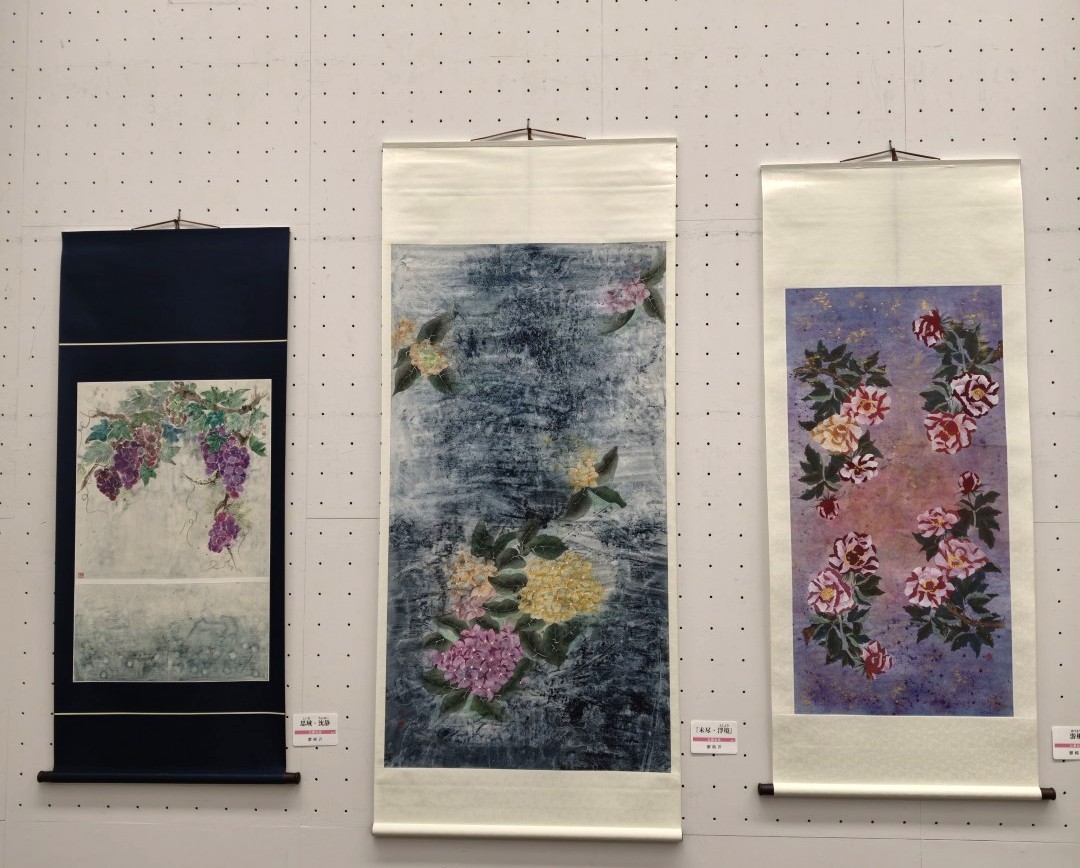
Humanity’s misunderstanding of "silence" is almost as profound as its misunderstanding of "emptiness." Whenever people see sparsity, they assume it is a lack; when they see paleness, they assume it is a retreat; when they see silence, they assume nothing is happening. In truth, the exact opposite is the case: whenever there is truly deep silence, it is rarely because there is nothing, but because too many things no longer need to clamor. It is a concentration refined by washing, an internal weight that no longer demands outward attention, yet is paradoxically more capable of retaining a person for a long time. Liao Chun-yi’s Realm of Thought: Silence, in my eyes, is precisely such a work. It does not force one to gasp in amazement, nor does it rush to occupy the vision with an overflowing composition. Instead, through a low-pitched yet continuous manner, it allows one to slowly walk into it, until one realizes that they are not merely looking at a painting of grapes, but are witnessing—how a place that quietly endures time allows thoughts to hang down like fruit.
In the upper part of the canvas, several bunches of grapes cling among vines and leaves—purple tinted with ochre, purple tinted with red, and immature spots flushed with green. The berries are plump but not exaggerated; they do not resemble the market produce that is bright to the point of unreality, but are closer to a maturity soaked collectively by air, mist, light, and water. The leaves are a greyish cyan-green, and the vines twist and turn without wildness. Curled tendrils occasionally droop down like handwritten lines, leaving faintly trembling trajectories in the air. The most distinctive feature is that while the fruit and vine leaves generally occupy the upper half, the lower half is almost entirely a silent, pale grey-blue field: it resembles a water surface, a layer of mist, a breath left behind after the years have been diluted, or a piece of mind-land that has not yet been fully occupied. The viewer’s gaze, therefore, does not solely rest on the depictive technique of the grapes, but is naturally caught by the void below, as if walking toward some depth. Precisely because of this, although the work is titled "Realm of Thought," it does not paint thought as a symbol, but rather paints the condition required for thought to truly occur—an internal place of placement.
I have never placed much faith in works that are too eager to finish expressing their meaning. If a painting figures everything out for you, the viewer is left with nothing but acceptance, with no room for response. What truly allows one to gaze for a long time is often not how many answers a work gives you, but how many crevices it leaves for the soul to enter. Realm of Thought: Silence is exactly this. It is not crammed full, nor does it pursue a booming vitality meant to draw a full house of applause; on the contrary, it is exceedingly restrained. The grapes do not occupy the entire canvas, the branches and leaves possess moderation, and even the large expanse of near-empty negative space and pale ink in the lower half seems to deliberately remind the viewer: what this work describes is not the "profusion of grapes," but the "state where, after profusion, one can still quiet down." This brings to mind the concept of "place" (basho) articulated by Kitaro Nishida.
Nishida’s concept of "place" was never merely a physical location; it is the deep field that enables things to manifest, to encounter one another, and to avoid mutually swallowing each other. Viewed through this lens, the true protagonist in the painting is perhaps not the grapes themselves, but that entire pale grey-blue place that catches the grapes, the leaves, the specks of light, and the viewing mind. That is not a passive background, but an active bearing. The grapes are able to hang quietly not because they are vividly colored enough, but because there is such a place that allows them to exist without the need to clamor. Without that silent field, grapes are merely fruit; precisely because of this field, they transform from natural objects into spiritual objects. Thus, "Realm of Thought" is not merely the beauty of a title, but a visual condition truly established: standing before the painting, the viewer will gradually realize that what they have stepped into is not a vineyard, but a place where thoughts can droop, settle, and refrain from immediate conclusion.
And if Nishida helps me understand the "place-ness" that establishes this work, then Gaston Bachelard makes it even clearer why its materiality is so moving. When Bachelard discusses water, mist, houses, corners, and various materials where the soul can reside, he always reminds us: the reason certain images have a profound effect on us is not how accurately they depict things, but how they awaken our ancient feelings toward a certain internal texture. The strongest material sense in Realm of Thought: Silence is not the gloss of the grape skins, but the slightly damp aura of stillness throughout the painting. The pale greys, white mist, thin traces of blue, and the bleeding marks and fine dots on the paper endow the canvas with a slow texture akin to water vapor. The grapes are therefore not dryly pasted onto the paper, but seem to float in a space that still possesses humidity and breath. This wetness is extremely crucial, because thought itself is not a dry, clear-cut thing like a stone; thought is more like water mist, a form that slowly rises and slowly sinks, continuously dispersing yet continuously congealing.
This makes me feel all the more that "silence" here is not a psychological adjective, but a material state. Looking at these grapes, one does not feel they are merely hanging there, but rather that they are gently pressed down by time, softly supported by the air, and retained together by the fibers of the sized Xuan paper and the composure of ink and mineral pigments. They are not suddenly flashing life, but existences that, after passing through growth, plumpness, waiting, and maturity, have finally arrived at a state free of rashness. Precisely because of this, they so closely resemble thought: true thought is not a first-moment reaction, but that which slowly forms inside, slowly becomes heavy, and finally hangs down naturally. Grapes droop because they are plump; thoughts droop because they are mature. Spoken this way, the grapes in this work are not merely fruit, but the crystallization of thought—berries nurtured by time and swelled by internal meaning.
Reaching this point, I cannot help but think of Henri Bergson. Bergson constantly reminds us that true time is not the minutes and seconds on a clock, but internal duration (durée). The grapes in the painting are moving not because they are painted realistically, but because they clearly carry duration—carrying an entire accumulation of life from flower to fruit, from green to ripe, from sunlight to misty light, from vigor to stillness. You are not looking at "the grapes of a certain moment," but are watching how a span of time settles into grapes. This makes the fruits in the painting not just objects of the present, but forms of duration. Within every berry, it is as if all the light and rain previously experienced are hidden; every bend of the vine seems to record every hesitation and reliance encountered during growth. Thus, these grapes in the painting are no longer merely the appearance of maturity, but have become the visible form of time.
However, speaking only of time is still insufficient to explain the depth of this work. For the subtler and more brilliant aspect of this piece lies in its insistence that silence does not equal closure. Though the canvas is still, it is not dead; though empty, it is not cold. The large expanse of empty space below causes me to repeatedly drift into reverie. There are virtually no concrete objects there, but precisely because of this, it becomes the most spiritually weighty part of the entire painting. At this moment, I am reminded of Zhuangzi’s void and wandering, as well as the saying from the Laozi: "Being brings advantage, but non-being brings utility." Borrowing this Eastern line of thought, the emptiness below in this work is not just negative space (liubai), but a truly usable "non-being." The grapes hang above, but the thought occurs in the void below. The viewer not only looks upward at the mature fruit, but is simultaneously anchored by that soft, mist-like empty field below, as if slowly clearing out a space in the heart capable of bearing silence. Such emptiness is not a lack of content, but the most precious state before content is brutally crammed in. That a person can truly think is often not because of how many things are in their mind, but because a place un-occupied by noise remains in their heart. Liao Chun-yi understands this principle deeply, so she makes the work not full, but reserved; not a flashy display, but a pause; not dragging the viewer outward, but leading the viewer inward.
From another angle, this work can also be viewed through Hannah Arendt’s comprehension of thinking. Arendt once viewed true thinking as a form of withdrawal: not an escape from the world, but a temporary stepping back from the clamor to return to judgment and internal dialogue. Do the grapes in Realm of Thought: Silence not resemble exactly this image of thought? They do not expand wildly in all directions, but hang low, abide, and hold themselves. Grapes have never been fruits that hold their heads high; their posture always carries a downward gravity. Precisely because of this downwardness, they come closer to the symbol of interiority: all truly composed things ultimately do not float on high, but slowly settle themselves inward, downward, and into gravity. Thought is the same. Not all rapid reactions are called thought; true thought often resembles grapes, requiring accumulation, silence, waiting, and finally drooping down with full weight.
This also brings to mind Simone Weil’s understanding of attention. Weil believed that true attention is not a compulsion of the will, but a gaze that does not brutally demand from the world; it is quieting oneself down and waiting for things to open themselves up to you. Liao Chun-yi’s work is almost the pictorialization of this attention. It does not provoke a predatory viewing, nor does it force the viewer to speak immediately; on the contrary, it demands that you stay there patiently, softly, and slowly. Only in such waiting will you discover the subtle color differences between the grapes, the variations in the depth of the leaves, the floating watermark-like background, and how that large negative space is not emptiness, but like still water, silently catching everything above that is about to fall but has not yet fallen. This mode of viewing is itself philosophical: it is not possession, but concentration; not judgment, but reception.
However, I do not wish to read this painting so solemnly as to forget that it actually possesses an extremely tender intimacy. Those grapes are not icy carriers of concepts; they remain approachable, retaining the softness of fruit, the vitality of vines, and the joy of natural growth. Precisely because of this, the silence in the work does not appear stiff, but is a silence almost steeped in life. This allows it to enter philosophy without departing from human daily life. Standing before it, a person might think of the shadows beneath the grapevines, the afternoon wind, the weight of mature fruit, or a certain matter that has not yet been spoken but is gradually settling in the heart. Only such a painting is truly sublime. It does not wear philosophy on its sleeve, yet allows philosophy to slowly grow out of clusters of actual fruit.
I must always ultimately return the feelings regarding an artwork back to myself. For I have never believed that when we look at a painting, we are merely judging it; we are actually using the painting to identify our present relationship with the world. Realm of Thought: Silence acts for me as a reminder: it turns out that the state truly worth cherishing is not necessarily passionate, not necessarily soaring, and not necessarily emitting light outward at all times; sometimes it is moments like this—when everything is still alive, but there is no need to rush; when everything is already full, but without clamor; when everything is there, yet leaves a vast void for the soul to place itself. If a person can have such an internal land, they need not fear how noisy the world is, for they still possess a realm of thought that has not been exhausted; if a person can achieve such a silence, they need not fear life's vicissitudes, for they still have certain things that, like grapes, hang there quietly, self-sufficiently, and with deep sweetness.
Therefore, when I look at Realm of Thought: Silence, what I ultimately read is not merely grapes, but a philosophy painted as grapes: Thought is not a sharp knife, but more like a fruit; Silence is not a blank lack, but a field capable of bearing weight; Maturity is not ostentation, but knowing how to hang low.
If I were to conclude in a single sentence, I would say it thus:
What Liao Chun-yi paints in Realm of Thought: Silence is not merely the fruit upon the vine, but how thought swells within time, and finally, with a weight that requires no clamor, hangs quietly within the world.
Summary Note: Liao Chun-yi’s Realm of Thought: Silence uses sized Xuan paper, ink wash, mineral pigments, and mixed media to construct an internal field formed collectively by grapes, vines, and a vast expanse of tranquil negative space. The grapes in the work are not a simple natural sketch, but function more like images of thought that have settled through time: plump and hanging low, mature yet un-clamorous. Drawing upon Kitaro Nishida’s concept of "place" (basho), the large empty area at the bottom of the canvas is not a background, but the deep space that enables thought to establish itself; viewed through Bergson’s duration, the grapes are not just fruits of the present moment, but visible forms of accumulated time. On the whole, Realm of Thought: Silence does not merely depict a cluster of fruit, but presents an existential state of how internal maturity acquires weight amidst silence.