在「界」的邊緣凝視「無界」:王穆提《Unbounded》於日本國立新美術館展出,獲「日本透納賞」肯定
專題新聞報導
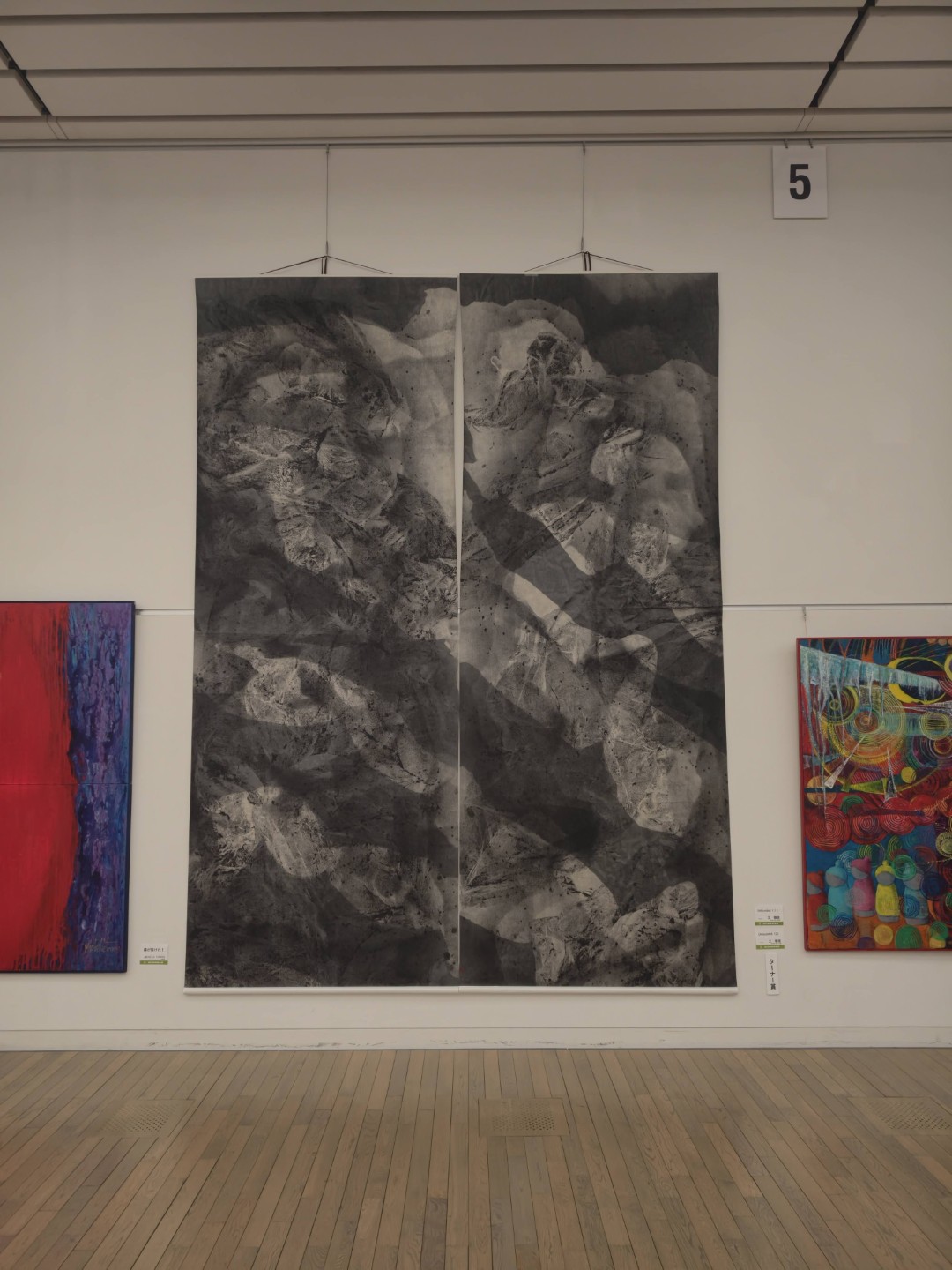
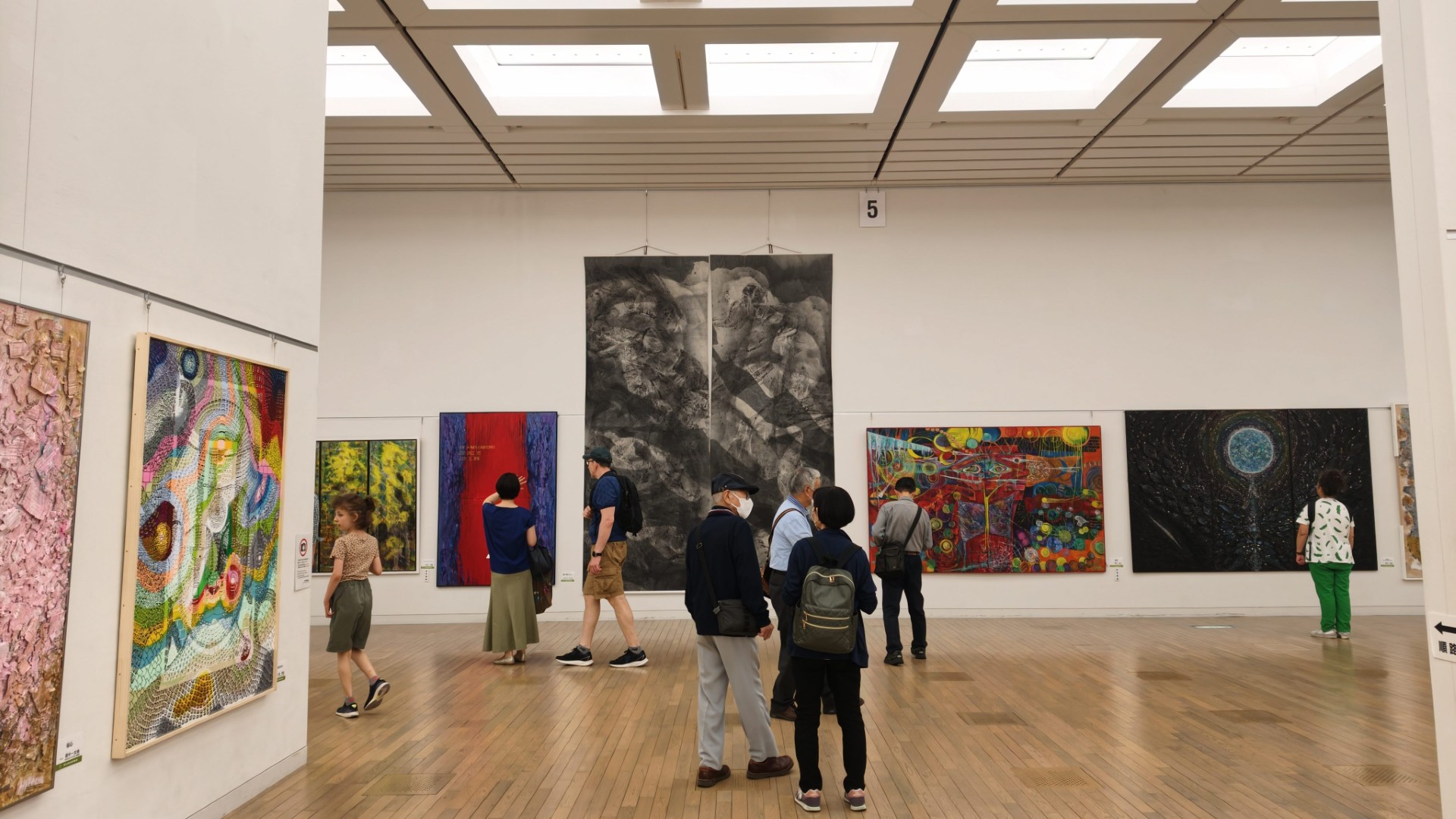
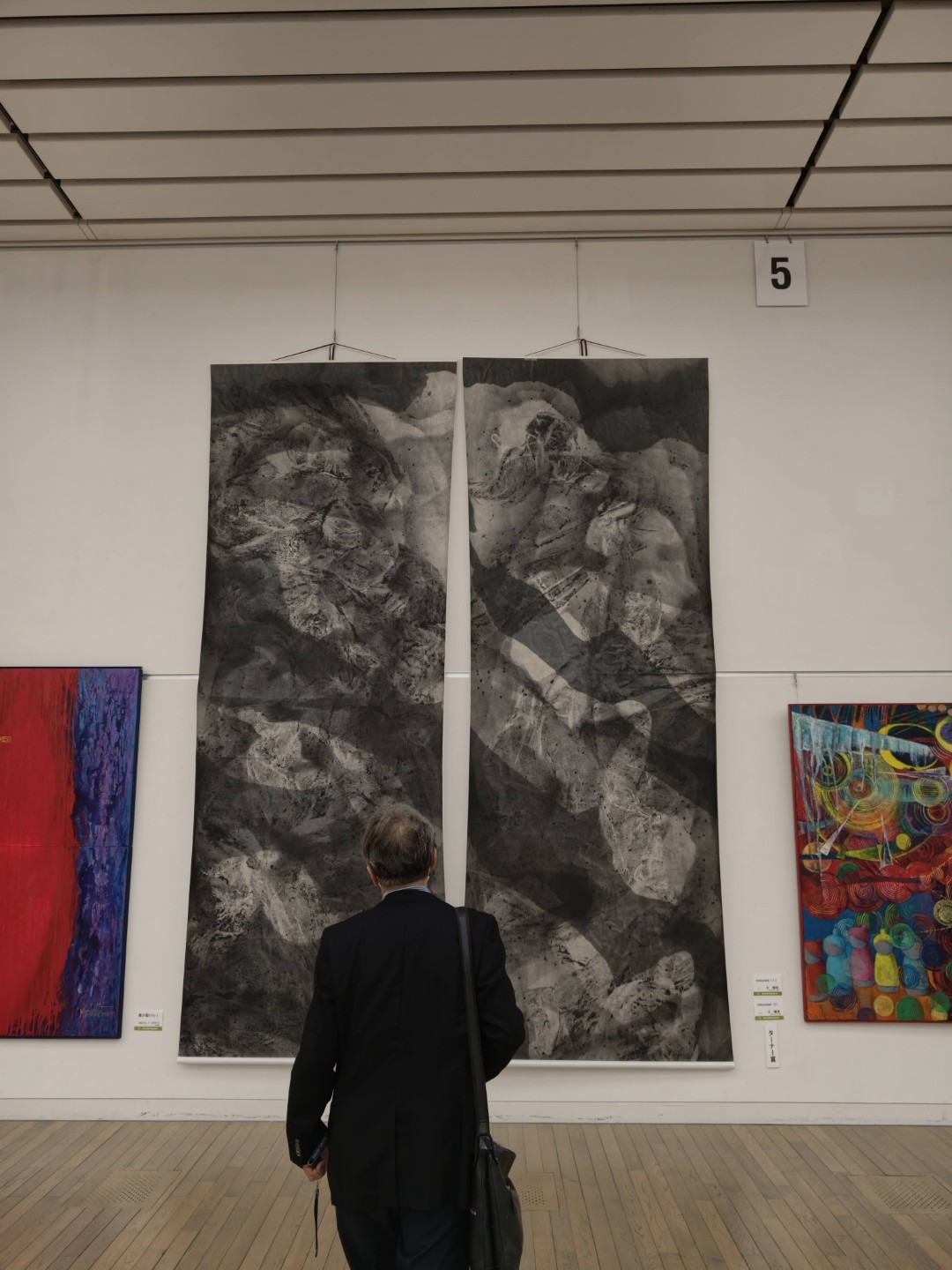
在日本國立新美術館、第82回日本現代美術家展(現展)的展場中,台灣當代藝術家王穆提的大尺幅雙聯作《無界》(Unbounded)以近四公尺的垂直尺度,成為展場中難以忽視的視覺焦點。作品以天然植物染料、日本墨、壓克力顏料與宣紙構成,長387公分、寬291公分,兩幅並置懸掛,猶如一道被撕開的深色峽谷,也像一面正在生成中的精神地圖。
《Unbounded》獲得日本知名畫材企業透納色彩株式會社(1946年成立)設立的「透納賞」肯定,並且在日本國立新美術館的82回日本現代美術家展頒發,旨在鼓勵於媒材掌握、色彩表現與當代藝術語彙上具有突出表現的創作者,其同時也是打破日本現代美術家展紀錄,參展兩次(兩年)就被推薦成為準會員者(於2025年),日本公募展團體一般要成為準會員的階段需要花費四到七年以上。
巨幅雙聯:一場水墨與幾何的對峙
《Unbounded》最直接的震撼,來自其近乎建築性的尺度。兩幅作品並置後,形成一個垂直展開的深黑空間。觀者站在作品前,視線很難一次掌握全貌,只能在上方濃重的墨層、中央游移的灰白暈痕,以及下方厚重堆疊的黑色區塊之間來回移動。
畫面表層可見多道帶有斜角與直線邊界的半透明灰階色塊,這些幾何形體像是冷靜的切面,也像漂浮於混沌之上的觀測鏡片。與此同時,底層水墨並未被馴服成單一圖像,而是以積疊、滲流、沉澱與暈染的方式,形成深淵、岩層、星雲般的複雜紋理。
這種視覺結構使《Unbounded》不只是抽象水墨,也不只是幾何繪畫。作品的核心張力,正在於「界」與「無界」之間的反覆拉扯:一方面是直線、邊框、理性秩序;另一方面是流動、擴散、不可測量的墨色暗流。
從「界」到「無界」:當代水墨的精神現場
王穆提在這件作品中,並未依賴明顯的物理肌理或外部遮蔽效果來製造視覺衝擊。相反地,作品更接近一種對水墨本質的長時間凝視:水分如何推動墨粒,宣紙纖維如何吸納顏料,時間如何讓色層逐步沉降。
在傳統水墨中,筆墨常被用來描繪山水、花鳥或人物;而在《Unbounded》中,水墨不再服務於再現,而是成為作品的主體。墨本身的流動、停滯、沉積與爆裂,構成了畫面的生命節奏。觀者所看見的不是某個具體景物,而是一種物質生成的過程。
這種創作方式,也讓作品具有明顯的當代性。它既保留了東方水墨對氣韻、時間與留白的敏感,也引入了近似西方硬邊抽象、極簡結構與空間切割的視覺邏輯。兩者並未彼此抵銷,而是在同一張宣紙上形成辯證關係。
理性的結界:在柔軟媒材上劃出堅硬邊界
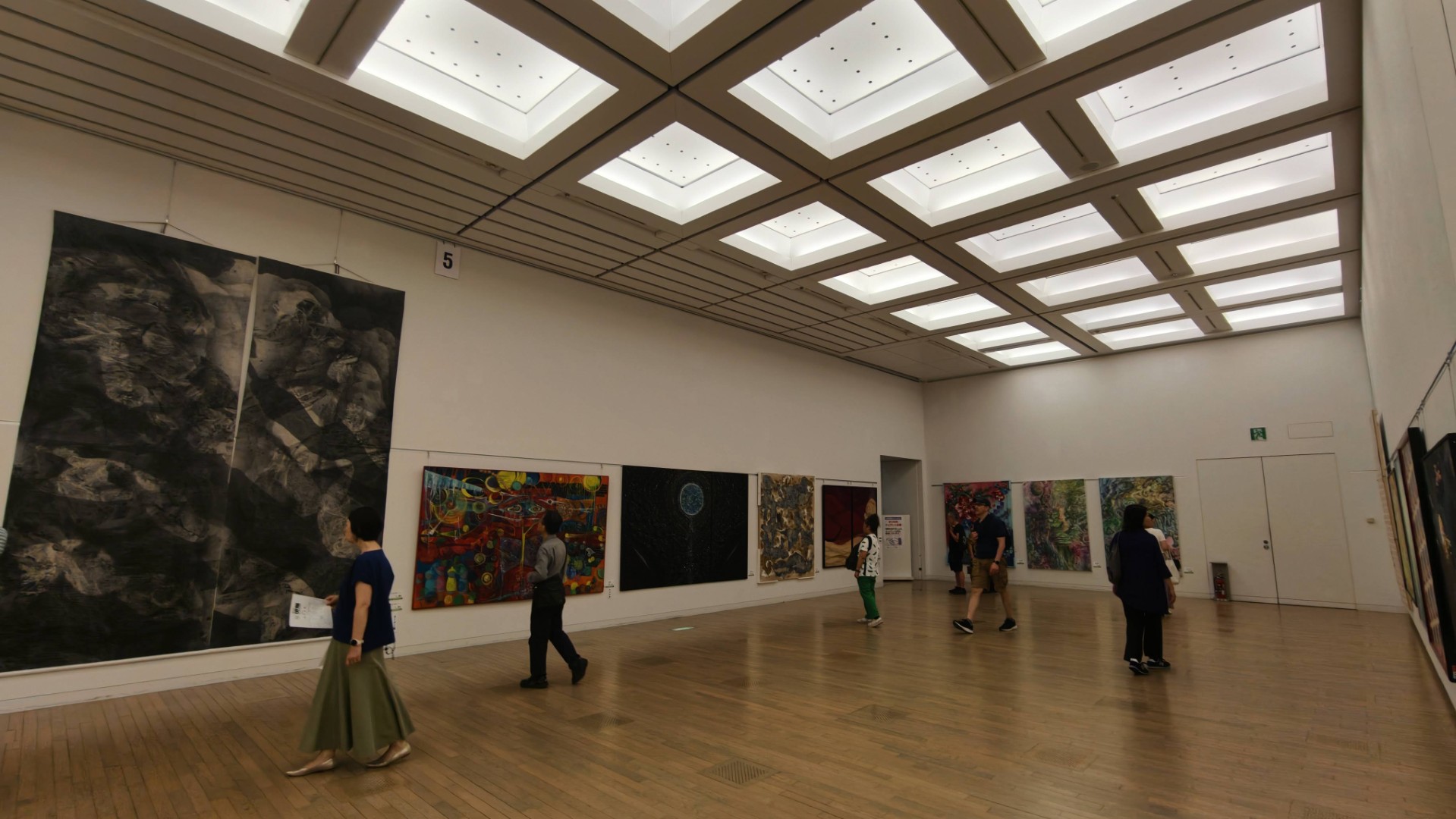
《Unbounded》最值得細看的地方之一,是畫面中那些看似冷靜、精準的幾何邊界。宣紙與水性媒材本身具有高度流動性,墨與顏料一旦滲入紙纖維,便容易產生暈散、毛邊與不可逆的痕跡。要在這樣的媒材上保留筆直、斜切、具有控制感的邊界,並非單純形式設計,而是高度技術與身體控制的結果。
這些半透明幾何色塊像是介入混沌的理性系統。它們並未完全遮蔽底層墨痕,而是讓下方紋理若隱若現地浮出。於是畫面產生一種多層次觀看經驗:觀者既能看見理性框架,也能透過框架凝視底層深不可測的暗流。
在這個意義上,《Unbounded》的「界」並不是封閉的牆,而是一種暫時成立的秩序;它既限制墨色,也讓墨色被重新觀看。
「無界」的深淵:生命、時間與潛意識的暗流
相對於幾何結構所代表的理性秩序,畫面中大面積的水墨積層則呈現出難以馴服的「無界」力量。黑、灰、白之間不斷交纏,形成像岩層、雲氣、風暴或肉身紋理般的複合圖像。它們沒有明確起點,也沒有清楚終點,彷彿持續向畫面外延伸。
這樣的視覺效果,使作品不只停留在形式美感,而具有心理與哲學層面的厚度。若從佛教唯識學的角度觀看,底層墨跡可被理解為潛藏於意識深處的種子流動;若從現代社會的角度觀看,它也像是被理性制度、數據系統與秩序外殼壓抑的生命能量。
《Unbounded》因此可被視為一幅當代人的精神肖像:在高度規訓的世界中,人們不斷建構秩序,卻也始終面對內在混沌的回返。
現展與透納賞:日本現代美術場域中的肯定
日本現代美術家協會主辦的「現展」,長期以來是日本現代藝術創作者發表作品的重要場域,涵蓋平面、立體、工藝、攝影等多元媒材。現展中的「透納賞」為企業贊助獎,由日本知名畫材品牌透納色彩株式會社支持。
獲得此獎,意味著作品在媒材運用與當代表現上受到展覽評審與專業企業的肯定。對王穆提而言,《Unbounded》以天然植物染料、日本墨、壓克力顏料與宣紙交織而成,正好回應了透納賞對媒材實驗與色彩表現的重視。
結語:在深淵之前,重新理解水墨
《Unbounded》並不是一件提供安穩答案的作品。它不描繪可辨識的山水,也不讓觀者停留在裝飾性的抽象美感中。作品更像是一個視覺現場:理性與混沌、控制與流動、邊界與無邊,在巨幅宣紙上持續對峙。
王穆提透過這組雙聯作,將水墨從傳統圖像的再現中釋放出來,使水墨成為時間、物質與精神力量交會的場域。站在《Unbounded》前,觀者所面對的不只是墨色的深淵,也是一個關於當代生存狀態的問題:在失控的世界裡,人如何劃出自己的邊界?而那些被劃出的邊界,又是否真的能阻止內在深處的無界之流?
Gazing at the “Unbounded” from the Edge of “Boundaries”: Wang Muti’s Unbounded Exhibited at The National Art Center, Tokyo, Recognized with the “Japan Turner Award”
Feature News Report
At The National Art Center, Tokyo, in the exhibition venue of the 82nd Japan Contemporary Artists Exhibition (Genten), the large-scale diptych Unbounded by Taiwanese contemporary artist Wang Muti has become an unmistakable visual focal point with its nearly four-meter vertical scale. Composed of natural plant dyes, Japanese ink, acrylic paint, and xuan paper, the work measures 387 cm in height and 291 cm in width. The two panels are hung side by side, resembling a dark canyon torn open, and also like a spiritual map in the process of coming into being.
Unbounded received recognition from the “Turner Award,” established by the renowned Japanese art materials company Turner Colour Works Ltd. (founded in 1946), and was presented at the 82nd Japan Contemporary Artists Exhibition at The National Art Center, Tokyo. The award aims to encourage creators who demonstrate outstanding achievement in mastery of materials, color expression, and contemporary artistic vocabulary. At the same time, Wang Muti has also broken the record of the Japan Contemporary Artists Exhibition by being recommended as an associate member after participating only twice over two years (in 2025); in Japanese open-call exhibition organizations, reaching the associate member stage generally requires more than four to seven years.
A Monumental Diptych: A Confrontation Between Ink and Geometry
The most immediate impact of Unbounded comes from its almost architectural scale. When the two panels are placed side by side, they form a vertically unfolding deep-black space. Standing before the work, viewers find it difficult to grasp the whole image at once; their gaze can only move back and forth between the dense layers of ink above, the drifting gray-white halos in the center, and the heavily accumulated black blocks below.
On the surface of the image, multiple semi-transparent grayscale color blocks with diagonal angles and straight-edged boundaries can be seen. These geometric forms resemble calm cross-sections, and also like observational lenses floating above chaos. At the same time, the underlying ink has not been tamed into a single image, but instead forms complex textures reminiscent of abysses, rock strata, and nebulae through accumulation, seepage, sedimentation, and diffusion.
This visual structure makes Unbounded not merely abstract ink painting, nor merely geometric painting. The core tension of the work lies precisely in the repeated pulling between “boundary” and “unboundedness”: on one side are straight lines, frames, and rational order; on the other are movement, diffusion, and immeasurable undercurrents of ink.
From “Boundary” to “Unboundedness”: The Spiritual Site of Contemporary Ink
In this work, Wang Muti does not rely on obvious physical textures or external masking effects to create visual impact. On the contrary, the work is closer to a prolonged gaze into the essence of ink: how water propels ink particles, how the fibers of xuan paper absorb pigment, and how time allows layers of color to gradually settle.
In traditional ink painting, brush and ink are often used to depict landscapes, flowers and birds, or figures; in Unbounded, however, ink no longer serves representation, but becomes the subject of the work itself. The movement, stagnation, sedimentation, and rupture of ink itself constitute the vital rhythm of the image. What viewers see is not a specific object or scene, but a process of material generation.
This creative approach also gives the work a distinct contemporaneity. It preserves the Eastern ink tradition’s sensitivity to spirit resonance, time, and empty space, while also introducing a visual logic akin to Western hard-edge abstraction, minimalist structure, and spatial segmentation. The two do not cancel each other out, but instead form a dialectical relationship on the same sheet of xuan paper.
A Rational Boundary: Drawing Hard Edges on Soft Materials
One of the most rewarding aspects of Unbounded to examine closely is the seemingly calm and precise geometric boundaries within the image. Xuan paper and water-based media are inherently highly fluid; once ink and pigment seep into the paper fibers, they easily produce diffusion, feathered edges, and irreversible traces. To preserve straight, diagonally cut, and controlled boundaries on such materials is not merely a matter of formal design, but the result of advanced technique and bodily control.
These semi-transparent geometric color blocks resemble rational systems intervening in chaos. They do not completely obscure the ink traces beneath, but allow the underlying textures to emerge faintly. As a result, the image produces a multilayered viewing experience: viewers can see the rational framework, while also gazing through that framework into the unfathomable undercurrents below.
In this sense, the “boundary” in Unbounded is not a closed wall, but a temporarily established order; it both restricts the ink and allows the ink to be seen anew.
The Abyss of the “Unbounded”: Undercurrents of Life, Time, and the Subconscious
In contrast to the rational order represented by the geometric structure, the large areas of accumulated ink layers in the image reveal an untamable force of “unboundedness.” Black, gray, and white continually intertwine, forming composite images reminiscent of rock strata, clouds, storms, or bodily textures. They have no definite starting point and no clear ending point, as if they continue extending beyond the surface of the image.
This visual effect allows the work to move beyond formal beauty and gain psychological and philosophical depth. Viewed from the perspective of Buddhist Yogācāra thought, the underlying ink traces may be understood as the flow of seeds hidden deep within consciousness; viewed from the perspective of modern society, they also resemble life energy suppressed by rational systems, data structures, and shells of order.
Unbounded can therefore be regarded as a spiritual portrait of contemporary humanity: in a highly disciplined world, people continuously construct order, yet must always face the return of inner chaos.
Genten and the Turner Award: Recognition Within Japan’s Modern Art Field
Organized by the Japan Contemporary Artists Association, “Genten” has long been an important platform for modern and contemporary artists in Japan to present their works, covering diverse media including two-dimensional works, three-dimensional works, crafts, and photography. The “Turner Award” in Genten is a corporate-sponsored award supported by the renowned Japanese art materials brand Turner Colour Works Ltd.
Receiving this award means that the work has been recognized by the exhibition jury and a professional company for its use of materials and contemporary expression. For Wang Muti, Unbounded, woven together through natural plant dyes, Japanese ink, acrylic paint, and xuan paper, aptly responds to the Turner Award’s emphasis on material experimentation and color expression.
Conclusion: Reunderstanding Ink Before the Abyss
Unbounded is not a work that provides comforting answers. It does not depict recognizable landscapes, nor does it allow viewers to remain within decorative abstract beauty. Rather, the work is more like a visual site: reason and chaos, control and flow, boundary and boundlessness continue to confront each other on monumental xuan paper.
Through this diptych, Wang Muti releases ink from the representation of traditional imagery, transforming it into a field where time, matter, and spiritual force converge. Standing before Unbounded, viewers face not only an abyss of ink, but also a question concerning the condition of contemporary existence: in an out-of-control world, how does one draw one’s own boundaries? And can those boundaries truly stop the unbounded currents deep within?
「界」の縁から「無界」を見つめる:王穆提《Unbounded》、国立新美術館で展示、「日本ターナー賞」を受賞
特集ニュース報道
国立新美術館、第82回日本現代美術家展(現展)の会場において、台湾の現代美術家・王穆提による大尺幅の二連作《無界》(Unbounded)は、約4メートルに及ぶ垂直的なスケールによって、会場内で見過ごすことのできない視覚的焦点となっている。作品は天然植物染料、日本墨、アクリル絵具、宣紙によって構成され、高さ387センチ、幅291センチ。二幅が並置して掛けられ、まるで引き裂かれた暗色の峡谷のようであり、また生成途上にある精神の地図のようでもある。
《Unbounded》は、日本の著名な画材企業であるターナー色彩株式会社(1946年創業)が設立した「ターナー賞」による評価を受け、第82回日本現代美術家展において国立新美術館で授与された。同賞は、媒材の掌握、色彩表現、そして現代美術の語彙において際立った表現を示す創作者を奨励することを目的としている。また同時に、王穆提は日本現代美術家展の記録を打ち破り、わずか2回(2年)の出品で準会員に推薦された(2025年)。日本の公募展団体において、通常、準会員となる段階に至るには4年から7年以上を要する。
巨大な二連作:水墨と幾何の対峙
《Unbounded》が最も直接的に与える衝撃は、そのほとんど建築的ともいえるスケールに由来する。二幅の作品が並置されることで、垂直に展開する深い黒の空間が形成される。鑑賞者が作品の前に立つと、視線は一度に全体像を捉えることが難しく、上部の濃密な墨層、中央を漂う灰白色のにじみ、そして下部に重厚に堆積する黒い領域のあいだを往復するほかない。
画面の表層には、斜角と直線的な境界をもつ半透明のグレースケールの色面が複数見られる。これらの幾何学的形体は、冷静な切断面のようでもあり、混沌の上に浮遊する観測レンズのようでもある。同時に、下層の水墨は単一のイメージへと馴致されているのではなく、積層、滲流、沈澱、にじみによって、深淵、岩層、星雲を思わせる複雑な紋理を形成している。
このような視覚構造によって、《Unbounded》は単なる抽象水墨でも、単なる幾何学絵画でもなくなっている。作品の核心的な張力は、まさに「界」と「無界」のあいだの反復的なせめぎ合いにある。一方には直線、枠組み、理性的秩序があり、もう一方には流動、拡散、測定不能な墨色の暗流がある。
「界」から「無界」へ:現代水墨の精神的現場
王穆提はこの作品において、明確な物理的肌理や外部的な遮蔽効果に頼って視覚的衝撃を生み出しているわけではない。むしろ作品は、水墨の本質を長時間にわたって凝視する行為に近い。水分はいかに墨粒を押し動かすのか、宣紙の繊維はいかに顔料を吸収するのか、時間はいかに色層を徐々に沈降させるのか。
伝統的な水墨において、筆墨はしばしば山水、花鳥、人物を描くために用いられてきた。しかし《Unbounded》において、水墨はもはや再現に奉仕するものではなく、作品そのものの主体となっている。墨そのものの流動、停滞、沈積、破裂が、画面の生命リズムを構成している。鑑賞者が目にするのは、何らかの具体的な景物ではなく、物質が生成していく過程である。
このような制作方法は、作品に明確な同時代性をもたらしている。それは東洋水墨がもつ気韻、時間、余白への感受性を保ちながら、西洋のハードエッジ抽象、ミニマルな構造、空間分割に近い視覚論理を導入している。両者は互いを相殺するのではなく、同じ一枚の宣紙の上で弁証法的な関係を形成している。
理性の結界:柔らかな媒材の上に硬い境界を引く
《Unbounded》において特に注目すべき点の一つは、画面内に見られる、一見冷静で精密な幾何学的境界である。宣紙と水性媒材そのものは高度な流動性をもっており、墨や顔料がいったん紙の繊維に浸透すれば、にじみ、毛羽立った縁、不可逆的な痕跡が生じやすい。そのような媒材の上に、まっすぐで、斜めに切り込まれ、制御感を備えた境界を残すことは、単なる形式設計ではなく、高度な技術と身体的制御の結果である。
これらの半透明の幾何学的色面は、混沌へと介入する理性的システムのようである。それらは下層の墨痕を完全に覆い隠すのではなく、その下にある紋理をほのかに浮かび上がらせている。その結果、画面には多層的な鑑賞経験が生まれる。鑑賞者は理性的な枠組みを見ることができると同時に、その枠組みを通して、底層にある測り知れない暗流を見つめることができる。
この意味において、《Unbounded》における「界」は閉ざされた壁ではなく、暫定的に成立した秩序である。それは墨色を制限すると同時に、墨色を新たに見直させるものでもある。
「無界」の深淵:生命、時間、潜在意識の暗流
幾何学的構造が示す理性的秩序に対して、画面内の大面積にわたる水墨の積層は、馴致しがたい「無界」の力を呈している。黒、灰、白が絶えず絡み合い、岩層、雲気、嵐、あるいは肉体の紋理を思わせる複合的なイメージを形成している。それらには明確な始点も、はっきりした終点もなく、まるで画面の外へと持続的に伸び広がっているかのようである。
このような視覚効果によって、作品は形式的な美感にとどまらず、心理的かつ哲学的な厚みを備えている。仏教の唯識思想の観点から見るならば、下層の墨跡は意識の深部に潜む種子の流動として理解することができる。現代社会の観点から見るならば、それは理性的制度、データシステム、秩序の外殻によって抑圧された生命エネルギーのようにも見える。
したがって《Unbounded》は、現代人の精神的肖像として捉えることができる。高度に規律化された世界の中で、人々は絶えず秩序を構築しながらも、常に内なる混沌の回帰に直面しているのである。
現展とターナー賞:日本の現代美術領域における評価
日本現代美術家協会が主催する「現展」は、長年にわたり、日本の現代美術作家が作品を発表する重要な場であり、平面、立体、工芸、写真など多様な媒材を含んでいる。現展における「ターナー賞」は企業協賛賞であり、日本の著名な画材ブランドであるターナー色彩株式会社によって支援されている。
この賞を受賞することは、作品が媒材の運用と現代的表現において、展覧会審査員および専門企業から評価されたことを意味する。王穆提にとって、天然植物染料、日本墨、アクリル絵具、宣紙によって織り成された《Unbounded》は、まさにターナー賞が重視する媒材実験と色彩表現に応答するものである。
結語:深淵の前で、水墨を再び理解する
《Unbounded》は、安定した答えを提示する作品ではない。それは識別可能な山水を描くものでもなく、鑑賞者を装飾的な抽象美の中に留まらせるものでもない。作品はむしろ一つの視覚的現場である。理性と混沌、制御と流動、境界と無辺が、巨大な宣紙の上で持続的に対峙している。
王穆提はこの二連作を通じて、水墨を伝統的図像の再現から解放し、水墨を時間、物質、精神的力が交差する場へと変容させている。《Unbounded》の前に立つとき、鑑賞者が向き合うのは墨色の深淵だけではない。それはまた、現代の生存状態に関する問いでもある。制御不能な世界の中で、人はいかにして自らの境界を引くのか。そして、その引かれた境界は、内奥にある無界の流れを本当にせき止めることができるのだろうか。