The Dialectic of Skeleton and Flesh: Gazing upon Death in Hu Wen-Hsien's Surreal Heterotopia
Written by: WANG MUTI
I often wonder why humanity is always so deeply fascinated by imagery symbolizing death and nothingness. In the sixteenth century, I once wrote in an essay, "To philosophize is to learn how to die"; and today, as I stand before this painting by Hu Wen-hsien, brimming with surreal metaphors, this long-lost reverence for the fragility of my own existence surrounds me once again like a cold mist.
I do not intend to deconstruct his laws of perspective like a rigid art historian. I only wish to adopt the posture of an ordinary wanderer, borrowing the ideological filters from our "Database of Philosophy and Contemporary Art," to discuss how this painting, on an ordinary afternoon, forced me to directly confront the gravity of life and the ruthlessness of time.
The Pedestal and the Universe: The Heavy Being in Liquid Modernity
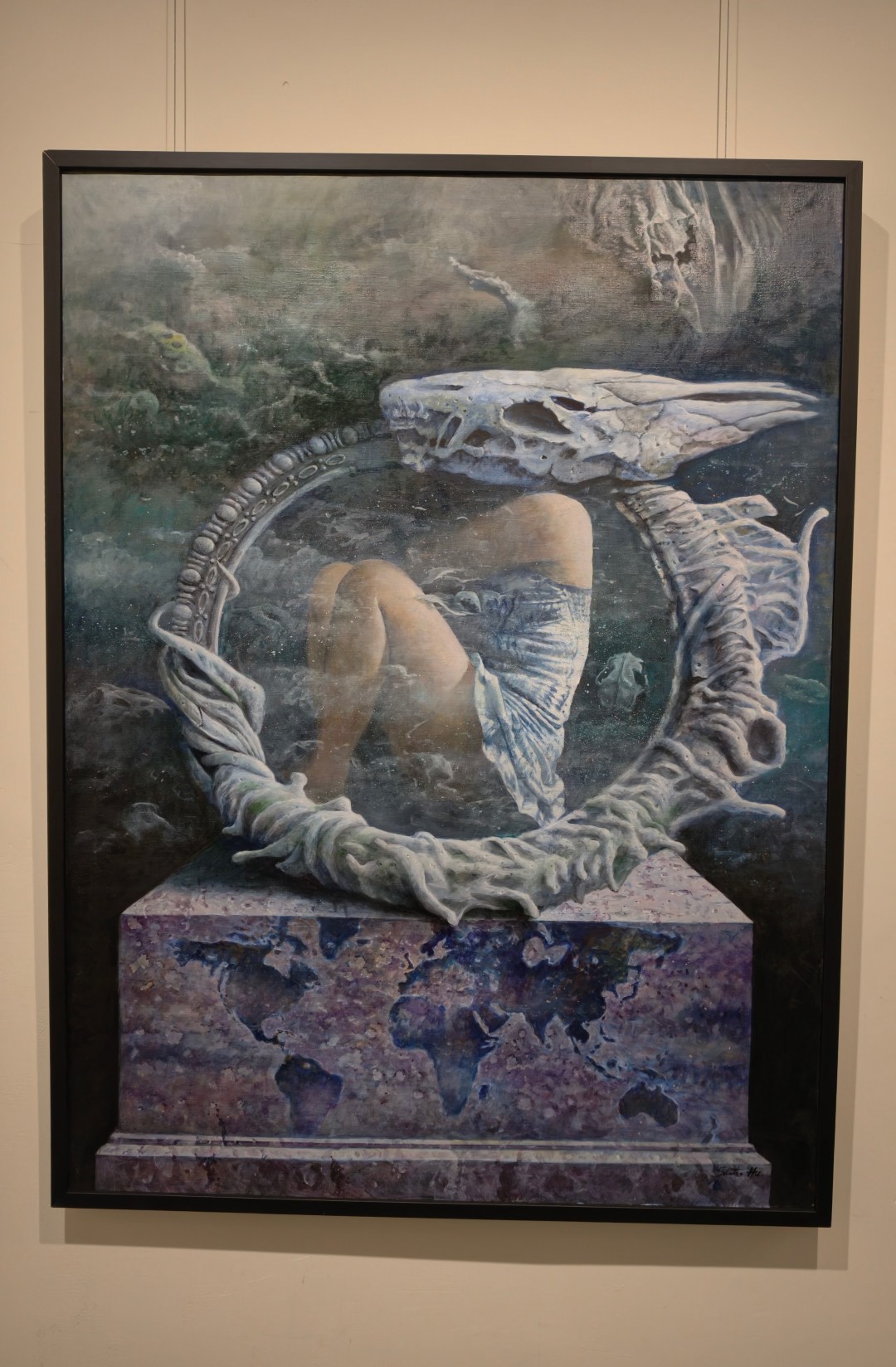
At the very bottom of the painting is a steady, heavy stone pedestal akin to a tombstone, upon which a map of the world is mottledly painted.
As I gaze at this cold stone, the first thing that comes to mind is what the French philosopher Jean-Paul Sartre called "Being-in-itself". This pedestal exudes a cold purplish-blue tone; it possesses no consciousness, no emotion, and simply exists absolutely and heavily. We humans, who pride ourselves as the lords of creation, spend our entire lives rushing about and fighting on this map, forgetting that all of this is nothing but a piece of inorganic matter in the vast universe.
And in the context of sociologist Zygmunt Bauman, this hard pedestal acts more like a contrast full of irony. We live in a "Liquid Modernity" where all that is solid is melting away, and values and relationships are constantly flowing; yet, in the face of the laws of death and time, the world retreats back to the coldest, most unshakable solid state. We attempt to build immortal empires upon this stone, but ultimately, the entire Earth is merely an altar upon which to place our bones.
The Ouroboros of Bones: The Abyss of Non-Self and the Dynamical Sublime
As the line of sight climbs upward, a massive ring-shaped object rests upon the pedestal. It is a framework interwoven from pale dry bones and twisted roots, and at the very top of the ring, there is impressively a giant skull of a beast.
This ring, resembling the mythical "Ouroboros," connects head to tail, symbolizing the devouring of time and endless reincarnation. If placed under the anatomical scalpel of Vasubandhu's Abhidharmakośa-bhāṣya, these dry bones represent the most brutal shattering of the "attachment to the nominal self (Prajñapti)". Stripped of all flesh, hair, and expression, this beast's bone is reduced to its hardest calcium structure, calmly declaring: there is simply no eternally unchanging "substantive self." The life to which we cling is nothing more than the "momentary arising and ceasing" and the "continuity of cause and effect (Santāna)" of the five aggregates in the long river of time.
Facing this colossal framework of death, I cannot help but feel the "Dynamical Sublime" described by Immanuel Kant. It transcends the control of human reason, revealing the essence of that cold, immense, and overwhelmingly powerful force in the universe. We tremble before it because it ruthlessly measures out the insignificance and inevitable perishing of our lives.
The Fetus in the Mirror: The Thrown "Dasein" and the Sanctuary of Eros
However, what makes me ponder the most and feel a trace of tremor in this painting is the space at the center of the ring. There is no darkness of death there; instead, it is permeated with a mist like the deep sea or a nebula. And curled up within this chaos is a frail female body.
- The Thrown Dasein: She wears a thin white gauze dress, legs curled up, hands hugging her knees, presenting the posture of an infant in the womb. In the existentialism of Martin Heidegger, this is precisely the truest situation of humanity as "Dasein"—we are "thrown (Geworfenheit)" into this world full of threats and impermanence without our consent.
- The Ontology of the Flesh: Her skin is warm and soft, full of what Henri Bergson called the "vital impetus (Élan vital)", as well as the "Flesh" that perceives the world as described by Maurice Merleau-Ponty. This softness forms a tragic contrast with the rough, cold bones on the periphery.
- The Sanctuary of the Poetics of Space: This is a highly paradoxical image. Surrounding her are dry bones symbolizing death; yet her own posture is the initial gestation of life. From the perspective of Gaston Bachelard's The Poetics of Space, the interior of this ring of death ironically becomes her "inner sanctuary" to ward off the external nothingness. The cage of death is simultaneously the matrix of rebirth.
She seems to be suspended (Epoché) in a mirror or within some sort of Michel Foucault-esque crack of a "Heterotopia". We can see her, but we cannot touch her; she exists above our world (the Earth on the pedestal), yet she appears to be floating in another dimension devoid of time.
Tranquility in the Gaze of Death
Hu Wen-hsien does not provide any cheap answers about redemption on the canvas; he merely borrows a surreal brush to perform a rigorous phenomenological reduction for us.
We are born upon this cold rock, imprisoned within the fleshly skin bags, and will ultimately be devoured by the dry bones of time. But in this inevitable tragedy of existence, the flesh curled up in the mist still retains a tranquil and fragile dignity. We may not be able to break this continuity of cause and effect constructed of white bones, but at the very least, we can choose to be like that tiny soul in the painting—reclaiming our own moment of clarity and contemplation when facing the abyss of the universe.
The Body Behind the Door
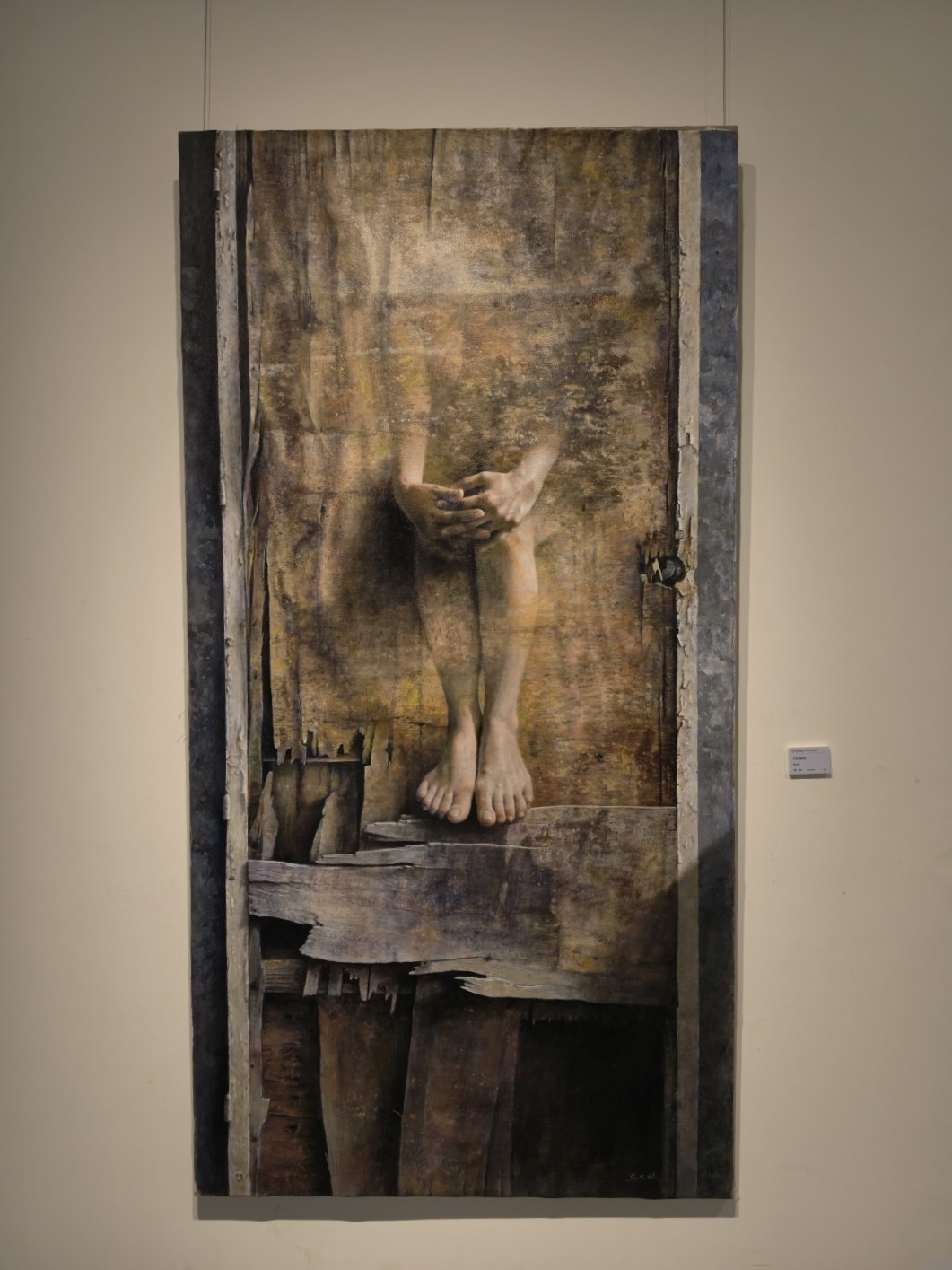
I often feel that if a painting uses a "door" as its structure, it is no longer just painting a space, but painting a situation. A door can be opened or closed; it can lead to the outside world, or it can keep people inside. At first glance, this work by Hu Wen-hsien appears to be a partial body placed in front of a dilapidated door panel or wall surface; but if you look a little longer, you will discover that what the image truly depicts is not a body, but an "obscured existence."
The body in the painting is not complete. What the viewer sees are the lower limbs, feet, hands folded in front of the body, and a partial torso treated with an atomized, abraded effect. The head and the upper half of the body are mostly submerged within the mottled texture, preventing the figure from becoming a portrait or a narrative protagonist, appearing instead like a trace left behind by time. This incompleteness is a crucial compositional choice by the painter: Hu Wen-hsien does not allow the body to seize the total right to speak for the image; rather, he allows the body to voice out together with the door panel, wood splinters, rust colors, dust, and peeling surfaces.
1. Vertical Composition: The Door Frame as a Cage and a Shrine
This work adopts an obvious vertical rectangular composition. The entire painting resembles a narrow door, as well as a standing shrine. The dark borders on the left and right sides create a strong longitudinal oppression, causing the central space to be clamped. This composition prevents the viewer's gaze from freely spreading horizontally, forcing it to move solely vertically along the image: from the mottled wall above, slowly descending to the hands, legs, and feet, and finally falling onto the fragmented wooden structure below.
This verticality brings about two layers of effects.
First, it creates a sense of enclosure. The partial figure in the painting seems to be embedded within the door panel; not standing in front of the door, but rather appearing to be absorbed by the door and preserved by the wall. There is no clear boundary between the person and the background, and the body is gradually swallowed by the space.
Second, it brings a sense of religious gazing. The central body is arranged in an almost dead-center position; the wooden boards below act like a pedestal, while the mottled wall above acts like a background screen. This gives the image a certain altar-like temperament: the body is not a body of everyday life, but a body that is placed, observed, and examined by time.
2. Central Axis: The Confrontation Between a Still Body and a Restless Background
The most obvious compositional core of the image is the central vertical axis. The feet are located in the lower center of the painting, the legs extend upward, and the hands are folded in front, forming an introverted posture. This posture makes the body appear condensed, restrained, and enclosed.
It is worth noting that the body itself is relatively stable and soft; yet the surrounding background is filled with damage, scratches, stains, and cracks. Thus, a contrast emerges in the image: the stillness of the body confronts the corrosion of the background; the softness of the flesh confronts the roughness of the wood and the wall; the fragility of the human confronts the brutality of time.
This confrontation is not a dramatic conflict, but a slow erosion. Hu Wen-hsien does not let events occur within the image; instead, he leaves behind the traces of events that have long since transpired. What the viewer sees is not the moment of destruction, but the silence following the destruction.
3. Obscuration and Manifestation: The Body is Not Painted, But Excavated
The most fascinating aspect of this work is that the body is not fully presented with clear outlines. The painter makes the body appear as if it is emerging from the background, and simultaneously as if it is retreating back into it. In particular, the upper part of the torso almost merges into the texture of the wall, forming a semi-transparent, half-disappeared state.
The technique here possesses strong psychological qualities. Hu Wen-hsien is not simply depicting the human body, but rather addressing "how the body is covered by time." The partial figure seems to be collectively obscured by dust, rust colors, peeling walls, memory, and light. Consequently, the body in the painting is not merely a physical existence, but more like a residual shadow of a memory.
I even feel that this painting is not depicting a person standing behind a door, but depicting how a person slowly becomes a part of the door. The human is preserved by the space, and is also consumed by the space. This ambiguity imbues the work with a profound sense of existence.
4. The Wooden Boards Below: Fragmented Structures Creating Psychological Weight
The wooden boards, splinters, and splits in the lower half of the image are extremely important. Without these fragmented objects, the central body might appear overly lightweight; but the heavy wooden structure below grants the entire work its weight.
These boards approximate ruins, and also resemble a temporarily erected pedestal. They are uneven, incomplete, bearing cracks, gaps, and shadows. The feet are positioned upon them, forming an unstable support. This makes the viewer realize: the body in the painting is not standing steadily, but temporarily pausing upon dilapidated objects.
Compositionally, these horizontal wooden boards also balance the vertical pressure of the whole painting. The left and right door frames and the central body form a longitudinal trend, while the wooden boards below slice the image horizontally and diagonally, preventing the picture from becoming overly monotonous. They act like a coarse baseline, supporting the silence above.
5. Color and Texture: The Sense of Time Amidst Brown, Gray, and Black
The coloring of this painting is highly restrained. It is primarily composed of brown, gray, black, dark gold, and woody tones. The image contains no bright, vivid colors, but instead presents a chromatic sensation blending old walls, rust, dust, and damp wood.
This tonal palette allows the work to evade the definitiveness of a realistic scene, entering into a depth of time. The brown in the painting is not simply a background color, but resembles the sedimentation of years; the gray is not a neutral color, but resembles memories that have been worn away; the black is not merely shadow, but resembles an impenetrable depth.
Texture, meanwhile, is one of the souls of this piece. The walls and wooden boards are rendered mottled, peeling, and rough, forming a contrast with the softer depiction of the body. The painter utilizes texture to make time visible: time is no longer just an abstract concept, but rather the smudges on the wall, the cracks on the wood, and the blurring of the body's boundaries.
Thinking of the Body in Front of a Broken Door
I am not entirely sure whether this painting is truly depicting a door. Perhaps it is just a wall, just wooden boards, just a dilapidated space. But the reason humans need art is perhaps precisely because we cannot simply accept the true names of things. If a door is merely a door, it is too impoverished; if a wall is merely a wall, it is not worth gazing at for long. Hu Wen-hsien turns the door into a situation for the body, turns the wall into the epidermis of memory, and turns the wood into the skeleton left behind by time.
The segment of a body in the painting makes me think about how humans exist in the world. People always believe they own their bodies, yet the body is actually also owned by external things: owned by rooms, owned by history, owned by gazes, owned by memory. The body in the painting has no complete face, no identifiable personal identity, and thus it paradoxically draws closer to the universal human. If there were a face, the viewer might rush to identify it; without a face, the viewer is left with no choice but to contemplate.
The hands are folded in front, an introverted posture, resembling a kind of defense, and also a kind of waiting. The feet are resting on unstable wooden boards, surrounded by damage and shadows. This is not a heroic stance, but a form of existence after being compressed by the world. The person stands, yet is not free; the person manifests, yet is not complete; the person remains in the center of the image, yet has already been slowly worn away by the surrounding time.
I am particularly fond of the large expanse of mottled wall at the top of the painting. There are no specific events there, yet it feels as if everything has occurred. The colors, scratches, and dark shadows on the wall are far more powerful than direct narrative. Because a person's life is often not composed of a few clear events, but rather formed by countless unnamable sedimentations. What we remember is not necessarily the event itself, but the color the event leaves behind within the body.
What Hu Wen-hsien accomplishes here is not pure realism, nor is it pure surrealism. He uses realistic techniques to depict the body, wooden boards, and wall, yet combines these real objects into a spiritual scene that defies everyday logic. The more real the parts, the more dreamlike the whole; the more tangible the objects, the more unfathomable the atmosphere. This is precisely the depth of the work: it does not escape from reality, but pushes reality into a much deeper realm.
If the previous piece uses bones, waters, and rings to contemplate the cycle of life, then this piece utilizes doors, walls, wooden boards, and the body to ponder the enclosure of existence. The former is like seeing life and death entwined in deep water; this work is like seeing how a person is obscured by time in front of an old door. Neither rushes to narrate, but instead establishes a field that invites the viewer into deep contemplation.
In this work, the true brilliance of the composition lies not merely in its steady proportional arrangement, nor just its clear central axis, but in the painter's ability to turn form into thought. The vertical door frames are not decoration, but confinement; the broken boards are not background, but support and collapse; the blurred body is not a technical effect, but a state of existence. Every formal choice in the image is responding to the exact same question: how does humanity preserve itself amidst time?
I think that facing this painting, one might not rush to discuss stylistic schools. They might first think of their own body, think about how the body ages, how it is wrapped by clothing, rooms, habits, and memories; think about how a person essentially stands before a certain kind of door throughout their entire life, unable to truly enter, nor truly leave. The power of art lies right here: it does not resolve life's predicaments for us, but allows us to see the shape of the predicament.
This piece by Hu Wen-hsien leads me to believe that a good painting does not paint a person completely, but rather makes one realize their own incompleteness. The body in the painting is obscured, yet gains a stronger sense of existence because of it; the space is dilapidated, yet moves closer to reality because of it; the image is silent, yet lingers all the more within the viewer's heart.
Finally, I am willing to view this painting as a fable about "invisibility." People do not disappear into the darkness, but disappear into the everyday walls, door panels, wood grains, and time. The body is still there, but has already been covered by the world; the feet still stand, but stand upon fragmentation; the hands are still folded, yet unable to stop themselves from being slowly ground into a trace by the years.
Just as the French phenomenologist Maurice Merleau-Ponty stated, the world is an intertwined "flesh," where the perceiver and the perceived permeate each other. In this painting, the hard boundary between human and object has been thoroughly destroyed. The painter employs masterful optical illusion techniques akin to Glazing and Double exposure, allowing the texture of the wood to pierce directly through the skin. We are unable to distinguish whether this fleshly body is struggling to be born from the wooden door, or if it is being ruthlessly swallowed by this ancient rotten wood?
Gazing at that pair of hands folded over the knees, it is an extremely introverted, self-defensive posture. In the existentialism of German philosopher Martin Heidegger, humanity as "Dasein" is ruthlessly "thrown (Geworfenheit)" into this world teeming with impermanence and threat. These hands hug themselves tightly, as if attempting to retain the last trace of existential warmth. And from the perspective of Gaston Bachelard's The Poetics of Space, this retreating posture is the final "inner sanctuary" constructed by the individual when confronting massive nothingness.
And all I can do standing before the painting is slow down my viewing. Because this painting does not demand that I explain it; rather, it demands that I acknowledge: to live as a human is essentially like standing behind a mottled door, partly manifested, partly concealed; a part belongs to oneself, and a part has long been handed over to time.
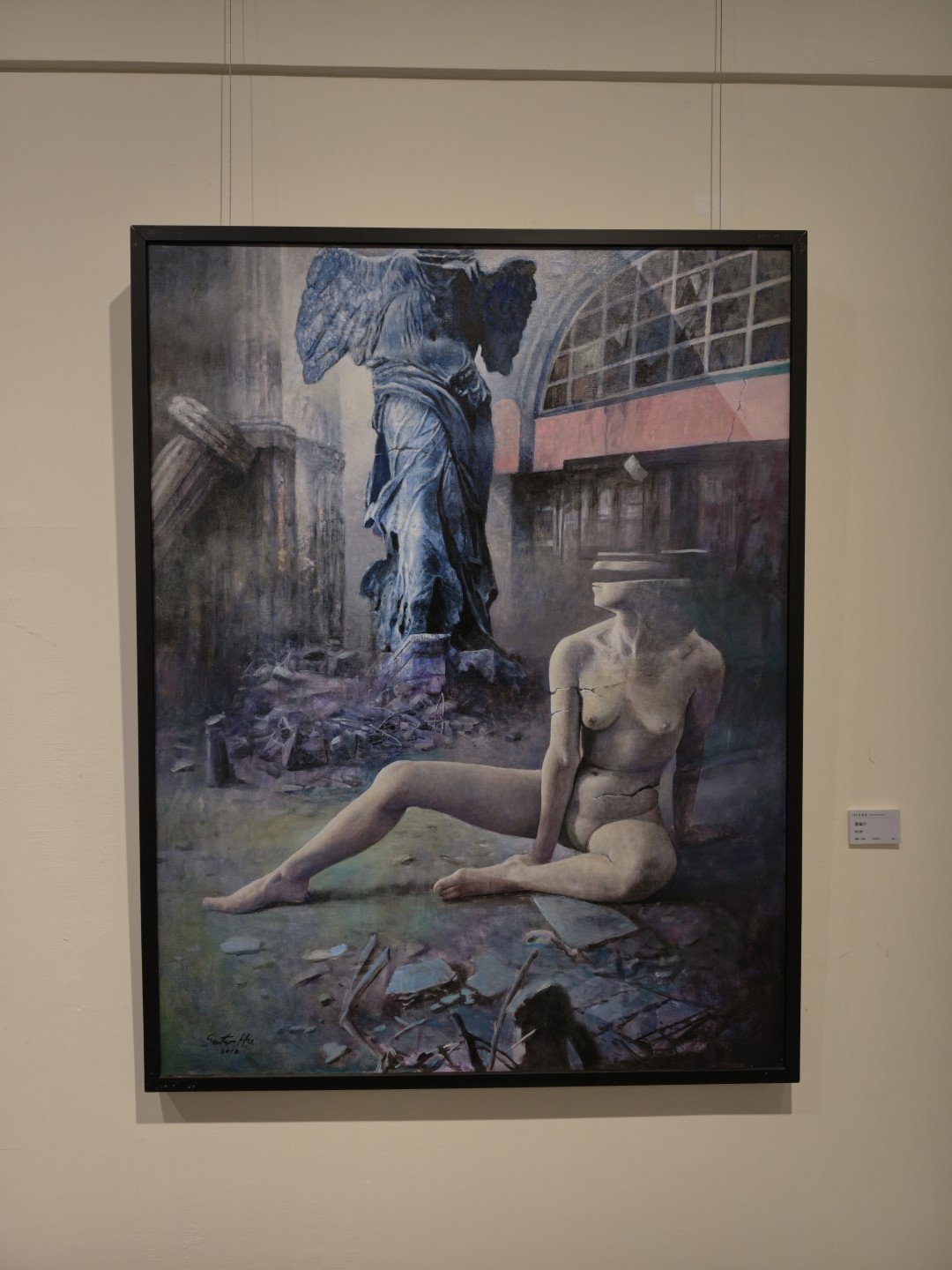
Victory in the Ruins
This work differs from the previous "The Body Behind the Door." The former uses a vertical door frame to compress the body, making the human form seem embedded into the wall by time; this piece shifts the human body into a more open, yet more desolate setting. There are two main figures in the image: a winged, headless, incomplete statue situated from the top left to the center, and a seated human figure with a headless or atomized face in the lower right. Both are equally incomplete; one resembles the wreckage of a classical deity statue, the other resembles the fragments of a contemporary body; they encounter each other in the same ruin, forming a contemplation on civilization, flesh, time, and collapse.
Overall Composition: Dual Protagonists within Diagonal Tension
This work adopts a nearly square or slightly rectangular composition, and the spatial depth is more complex than the previous piece. The foreground, center, and background all contain objects and architectural clues, forming a multi-layered ruined scene.
The overall composition can be divided into two main blocks:
- Top Left to Center: The Winged Incomplete Statue
- The statue is towering and vertical, located slightly to the left of the image.
- The wings spread out to both sides, giving the upper half a strong sense of weight.
- The headless treatment infuses the statue with a sense of historical rupture.
- Bottom Right: The Seated Human Body
- The body's posture is low and close to the ground.
- The body extends to the left, with the legs forming a long diagonal line.
- The head or face is atomized and erased, turning the body into an anonymous existence.
These two figures constitute the core dialogue of the image: the statue above represents the body that has been sanctified and historicized; the seated human body below represents the body that is still at the scene, yet equally subjected to destruction and obscuration.
Diagonal Composition: Falling from Deity to Human Body
The most important dynamic movement in the image is an invisible diagonal line extending from the top left to the bottom right.
This diagonal line can be viewed as follows:
- Starting from the dilapidated architecture and gloomy background in the top left;
- Passing through the winged statue slightly left of center;
- Descending to the seated human body in the bottom right;
- Extending further into the fragmented rubble and wood splinters in the foreground.
This diagonal line is not purely a visual path, but a path of civilization's descent. The viewer's gaze is first drawn to the statue, then guided to the human body on the ground, and finally falls into the foreground fragments. Thus, the image forms a descending movement from high to low, from the sacred to the fleshly, from the monument to the ruin.
If the statue once belonged to the heights, belonging to temples, squares, history, and victory, then the seated human body belongs to the ground, belonging to dust, silence, and reality. Compositionally, Hu Wen-hsien lets the two share the same dilapidated space, so that the "sublime" and the "fragile" are no longer separated.
Vertical and Horizontal Contrast: The Standing Remnant, The Seated Flesh
The winged statue in the painting possesses strong verticality. Although incomplete, the statue still maintains an upward posture, with folds of clothing draping down in layers, forming a columnar structure. The statue resembles a fractured monument; though it has lost its head, it retains a certain majesty.
In contrast, the human body in the lower right adopts a low-profile seated posture. The legs stretch horizontally, and the body's center of gravity hugs the ground. This forms a stark contrast in the image:
- The Statue: vertical, monumental, historical, cold and hard
- The Human Body: horizontal, fragile, immediate, soft
- The Statue survives upwardly
- The Human Body sinks downwardly
This contrast allows the work to transcend depicting just two figures, instead comparing two modes of existence: one is the body preserved by history, the other is the body still being eroded within time.
Yet the two are not simply in opposition. Though the statue is tall, it is incomplete; though the human body is low, it still holds warmth. This ambiguity is precisely the depth of the work. The painter has neither painted the classical statue to be perfect, nor painted the modern body to be complete. He allows both to be wounded, turning the entire painting into a "gathering of incomplete things."
Why does humanity always harbor a nearly morbid obsession with "ruins"? We sigh before toppling stone pillars, searching for the phantoms of past glory amidst broken walls and debris. Perhaps, ruins are the most honest mirror, mercilessly reflecting the inevitable mortality of human civilization. Today, as I stand before this painting by Hu Wen-hsien, this contemplation on history, time, and the fragmentation of the self heavily envelops me once again, much like the gloomy blue mist in the painting.
Please allow me once more to use the gaze of a secular wanderer, rather than a stringent art historian, to discuss how this painting, amidst a silent collapse, reveals to us the deepest existential anxieties of modern humanity.
The Angel of History and Fallen Classicism: The Topology of Gazing at Ruins
In the middle ground of the image stands a statue that is incredibly familiar to us—the Winged Victory of Samothrace housed in the Louvre. But under Hu Wen-hsien's brush, she is no longer the lofty, radiant deity symbolizing victory and glory.
- A Gloomy Monument: This goddess is covered in a deep, almost bruise-like dark blue tone. She has lost her original pure white, as if having just been excavated from the ashes of a catastrophe. Beneath her feet is no longer a battleship riding the wind and waves, but a modern ruin of shattered bricks and reinforced concrete.
- Benjamin's "Angel of History": Looking at this incomplete goddess spreading her wings in the ruins, the "Angel of History" described by German philosopher Walter Benjamin comes to mind. The angel's face is turned toward the past, perceiving one single catastrophe that ceaselessly piles wreckage at his feet; the angel would like to stay, awaken the dead, and make whole what has been smashed, but a storm blowing from Paradise irresistibly propels him into the unknown future. This goddess fallen into ruins is exactly the materialization of that irretrievable historical disaster. She is massive, silent, bearing a kind of "Terrifying Sublime," coldly observing the collapse of civilization.
The Porcelained Flesh and Slices of Consciousness: A Spiritual Portrait of Modern Man
However, what evokes the most tremor and sense of tragic loss in this painting is the naked female figure collapsed amidst the shattered glass and rubble in the foreground. She and the grand historical ruins in the background form a tragic contrast between the micro and the macro.
- The Fear of Objectification and Freud's "Uncanny (Das Unheimliche)": Her flesh is depicted with highly realistic warmth and weight, but what is deeply unsettling is that her skin is covered with cracks resembling porcelain or plaster (appearing on the arms, waist, and thighs). Psychologically, when a fleshly body that should be brimming with life exhibits the fragmented characteristics of inorganic matter, it triggers a profound sense of the "uncanny." Here, the painter destroys the boundary between organic and inorganic: the flesh of which we are so proud is, in fact, just as fragile and prone to collapse at any moment as those toppling stone pillars.
- Slices of Consciousness and the Lost Face: The most visually impactful aspect is the treatment of her head. Her face is not completely painted, but rather horizontally sliced into several suspended sections, with the eyes and expressions utterly vanishing into the void. This is the ultimate metaphor for the "self-alienation" and "fragmentation of subjectivity" of modern humanity. In the contemporary society of information explosion and value dissolution, our consciousness has long been sliced into disjointed fragments. We have lost our complete faces and lost our ability to gaze at the world, able only to let our souls hover and fracture in mid-air.
A Cross-Temporal Dialogue Between Two Incomplete Bodies
In this painting, Hu Wen-hsien orchestrates a highly exquisite counterpoint of geometry and meaning.
Observe these two bodies: one is a stone statue representing the classical and the sacred, the other is a flesh-and-blood body representing the contemporary and the profane. Neither possesses a head (or rather, they have lost complete faces), and both are incomplete. The goddess has lost her arms, while the mortal woman has lost her complete self-consciousness.
This Juxtaposition generates an intense sense of nihilism. We once looked up to deities and classical art, attempting to seek eternal refuge in them; but today, the deities cannot even protect themselves, having fallen into ruins, and we beings of flesh and blood can only sit dejectedly amidst the wreckage of our era, allowing our own spirits and bodies to crack together. The half-remaining arched window and the peeling pink wall in the background seem to mock the futility of human attempts to establish order.
Placing the Self Amidst Fragmentation
In an era resembling ruins, how are we to live comfortably? This painting is a frigid visual elegy. It offers no cheap hope or dawn of redemption; it simply, with utmost honesty, spreads this fragmentation out before our eyes. We are all that incomplete goddess, and we are all that mortal with sliced consciousness.
But perhaps, this is exactly where the mercy of art lies. When we can calmly gaze at our own fragmentation, acknowledging the fragility of the flesh and the ruthlessness of history, we paradoxically attain a bizarre freedom. We no longer need to desperately maintain the illusion of perfection; we can sit down openly amidst this ruin made of shattered glass and broken bricks, accepting our fate as "incomplete beings." Since the world will inevitably collapse, before it completely shatters, let us quietly feel the true weight of each and every crack.
Spatial Arrangement: The Ruin is Not a Background, But a Spiritual Field
The background of this work is not a passive stage, but a part of the subject matter.
On the left are blurry remnants of architecture, resembling collapsed walls, pillars, or wooden structures. On the top right are arched window panes or an architectural facade, bearing geometric order; yet this order is equally dilapidated, grim, and non-functional. The foreground below is piled high with fragments, rubble, and shattered objects. The entire scene feels like a space post-catastrophe.
Compositionally, these architectural elements form three forces:
- Geometric lines of the top right window panes
- Provide a symbol of rationality, order, and civilization.
- However, the window panes are dark, unable to truly lead to the light.
- Dilapidated architecture on the left
- Forms a sense of historical ruin.
- Echoes the winged statue.
- Foreground fragments
- Pull the viewer into the scene.
- Make the image not just an allegory viewed from afar, but akin to a dilapidated space that can be stepped upon.
Therefore, the ruin is not decoration, but thought. The painter uses the ruin to tell the viewer: civilization is not solid, deities are not eternal, and the body is not complete; everything is collapsing, merely at different speeds.
Lighting Arrangement: A Subtle Theater in Cool Gray-Blue Light
The entire painting is dominated by gray, blue, purple, black, and dark green, with local areas featuring pink walls and warmer tones on the human body. There is no bright sunlight in the image, but rather a diffused light akin to dust, mist, or an overcast day.
This lighting has several effects:
- Gives the statue a cool-toned stone texture;
- Makes the human body appear caught between reality and illusion;
- Strips the space of clear time, looking like day, but also like a dream;
- Makes the fragmented pieces not just objects, but deposits of memory.
Especially the location of the seated human body's head, which is obscured by white, mist-like brushstrokes. This treatment is highly crucial. The painter has not established a narrative via a clear face, but instead creates a depth of viewing through "absence." Without a face, the viewer cannot comprehend it as a specific persona; the human body becomes a more universal symbol of existence.
Seeing Two Kinds of Bodies in the Ruins
An incomplete statue speaks louder than a complete one. Complete objects often induce awe, whereas incomplete objects provoke thought. A complete deity demands to be looked up to, while a fractured one invites approach. The winged statue in Hu Wen-hsien's work is exactly thus. It has lost its head, yet not its posture; lost its completeness, yet not its dignity. It resembles a question left behind by history: if victory is ultimately destined to be fragmented, then what exactly has victory triumphed over?
The seated human body in the painting feels much closer to us. The statue belongs to the heights, the human body belongs to the ground. The statue was once enshrined, while the human body seems tossed into the scene. Yet both are headless, incomplete, and silent within the ruins. This arrangement makes me think: humans always believe they can conquer time through art, architecture, mythology, and monuments, but ultimately, even the forms that conquer time will be defeated by time.
There are architectural remnants behind the statue, and shattered rubble in front of the human body. This is a space without an exit. The window panes exist, but bring no real outside world; the ground unfolds, but is strewn with fragments. The image seems to tell us: what civilization leaves behind are not answers, but layers of fractured materials. As humans sit within it, it is not for rest, but rather being forced to face our own limitations.
I am particularly drawn to the winged statue. Wings are meant to signify flight, but here, the wings are far too heavy. Stone wings cannot fly; they can only become dead weight. This is a profound irony: humans create wings to imagine transcendence; but when the wings become a statue, the transcendence is frozen. It no longer flies, but is preserved; it is no longer free, but memorialized. Art is sometimes just like this: it preserves the human longing for freedom, whilst simultaneously exposing the impotence of that longing.
The posture of the seated human body pulls the whole painting back to flesh. The body sits on the ground, legs extended diagonally, arms supporting the weight. This is not a heroic body, nor a sacred body, but a body placed within ruins. It lacks uplifting, lacks protest, and lacks dramatic movement. It simply exists. Yet this existence is paradoxically more powerful than posture. For true fragility is often not falling down, but continuing to remain amidst dilapidation.
Hu Wen-hsien's "Aesthetics of Incompleteness"
From this piece, we can see that Hu Wen-hsien is not just painting fantasy scenes, but addressing the issues of human existence using surrealist vocabulary. The image contains a classical statue, a human body, ruins, window panes, and fragments—elements that seem to originate from different eras, yet are placed within the same psychological space.
This artistic language can be termed an "aesthetics of incompleteness."
The so-called incompleteness is not just a formal rupture, but a conceptual lack of entirety:
- The body is incomplete;
- The statue is incomplete;
- The architecture is incomplete;
- The space is incomplete;
- And history, too, is incomplete.
But Hu Wen-hsien does not paint incompleteness as pure tragedy. He grants incompleteness a poetic quality. The fragmented objects in the painting signify not only destruction, but also memory. Precisely because everything is already damaged, the viewer begins to interrogate what they might originally have been, and how they came to this state today.
This line of questioning is deeper than complete narratives. A complete narrative offers satisfaction, an incomplete scene instills unease; and unease is exactly where viewing truly begins.
Connections with the Previous Two Works
If we view this work alongside the previous two, we can observe several motifs that repeatedly surface in Hu Wen-hsien's works:
The Localization of the Body
The body in the preceding work is obscured by the door frame and wall; the human body in this work similarly loses its complete appearance. Hu Wen-hsien seems unwilling to treat the human body as a complete portrait, preferring to regard it as fragments of existence.
The Materialization of Time
Door panels, wood splinters, bones, stone pedestals, ruins, and statues are all matter left behind by time. Time in his paintings is not an abstract concept, but rather cracks, mottling, and damage that can be visibly seen.
The Interweaving of Life and Death, Civilization and Flesh
The first work contemplates the cycle of life via bones and waters; the second work contemplates obscuration via the door and the body; this work contemplates the collapse of civilization via statues, ruins, and the human body. Although the three depict different scenes, they all revolve around the exact same question: how does humanity exist amidst time?
The Overlap of Realism and Dreamscape
Hu Wen-hsien's technique holds realistic foundations, yet the image composition defies realistic logic. This situates the work between reality and dream: the viewer believes in every object, yet cannot believe the entire scene truly exists. This is precisely where its surrealistic tension lies.
Viewing the Human Position Amidst Fragmentation
The deepest aspect of this work lies not in its painting of a statue, nor its painting of a human body, but in its allowing the two to illuminate each other. The statue is a body elevated by history, the human body is one lowered by reality; the statue is incomplete, and the human body is also incomplete; the statue still exhibits majesty in ruins, and the human body still retains its existence amidst fragments.
Therefore, this painting is not pure mourning, nor is it pure decadent aesthetics. It acts more like a contemplation on civilization and the flesh: humans create deity statues to transcend the flesh; but statues ultimately shatter just like the flesh. Humans erect architecture to resist time; but architecture ultimately becomes rubble too. Humans think art can preserve eternity; and the most honest moment of art is perhaps exactly when it admits that eternity, too, can be wounded.
I am willing to view this work as Hu Wen-hsien's counter-question to the word "Victory." The winged statue in the painting easily brings to mind victory, flight, and glory; but it is headless, fractured, and heavy, standing amidst ruins. The so-called victory, in the end, might just be another kind of preserved incompleteness. And the human body in the lower right, though prostrate on the ground, brings this incompleteness back to the human scale.
Observing up to this point, I no longer ask which ruin this painting depicts, or which statue it is. These questions can certainly be traced, but the deeper question is: when we are also situated amidst the fragments of time, how are we to understand our own bodies? How are we to understand the promises civilization has made to us? How are we to understand those wings that were once held high, but are now broken?
Hu Wen-hsien provides no answers. He merely places the statue, human body, window panes, fragments, and shadows within the same painting, letting them gaze at one another. Thus, the viewer is forced to stop and relearn how to look within the ruins: to see how the sacred shatters, how the flesh remains silent, and how time brings all heights back to the ground.