撰文:王穆提( WANG MUTI)
我時常在想,人類為何總是對那些象徵死亡與虛無的意象深深著迷。十六世紀時,我曾在隨筆中寫下「探究哲學,就是學習死亡」;而今日,當我佇立在胡文賢這幅充滿超現實隱喻的畫作前,這份久違的、對自身存在之脆弱的敬畏,再次如冷冽的霧氣般將我包圍。
我並不打算像個刻板的藝術史學家那樣去拆解他的透視法則,我只想以一個尋常漫遊者的姿態,借用我們這座「哲學與當代藝術資料庫」中的思想濾鏡,來談談這幅畫是如何在一個平凡的午後,逼迫我直視生命的重力與時間的無情。
基座與寰宇:液態現代性中的沉重存有
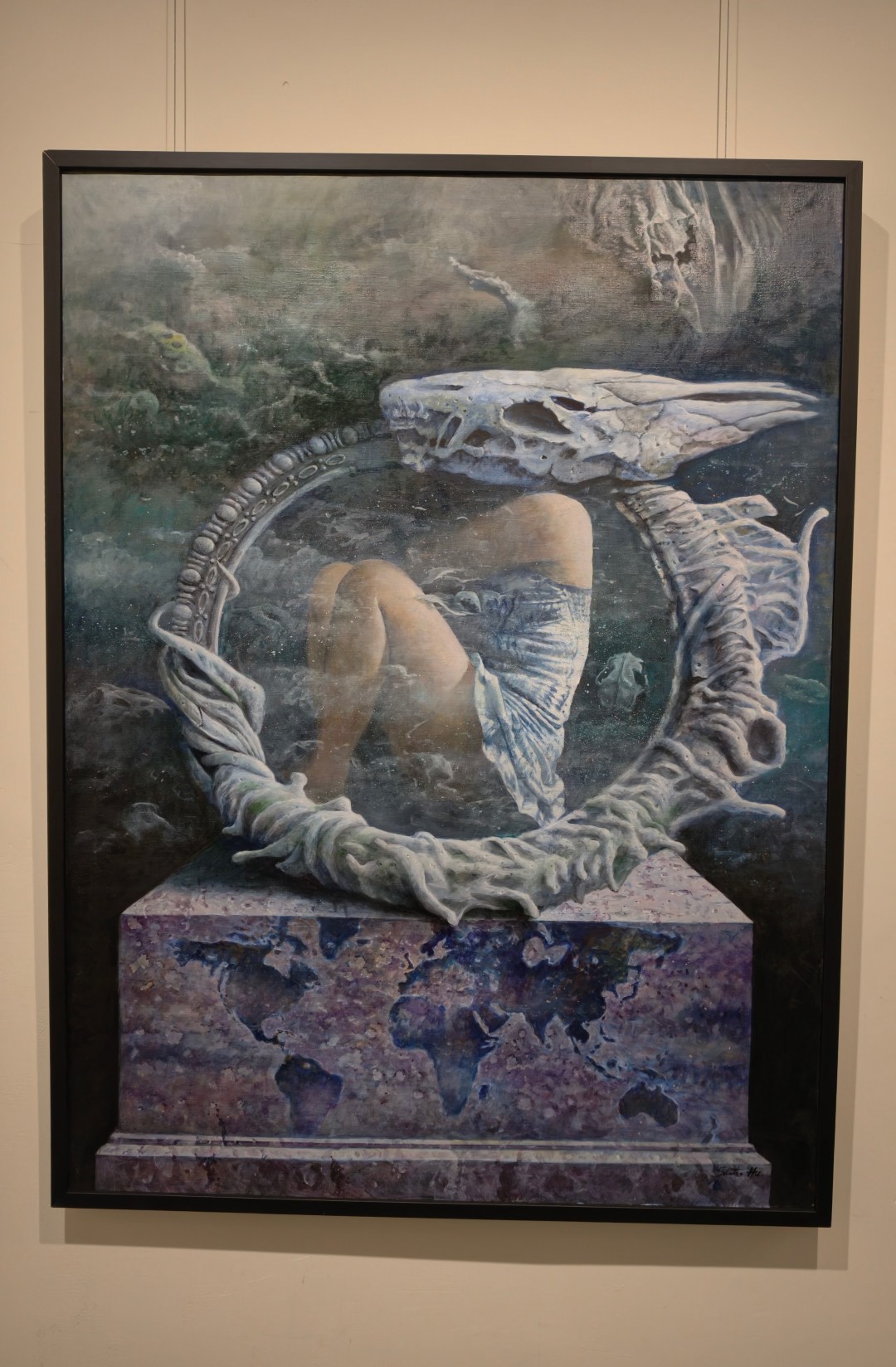
畫作的最底端,是一個猶如墓碑般沉穩、厚重的石質基座,其上斑駁地繪著一幅世界地圖。
當我凝視這塊冰冷的石頭時,我首先想到的是法國哲學家沙特(Jean-Paul Sartre)所說的「自在的存有(Being-in-itself)」。這塊基座散發著冷酷的紫藍色調,它沒有意識,沒有情感,只是絕對地、沉重地存在著。我們這些自詡為萬物之靈的人類,終其一生都在這幅地圖上奔波、爭奪,卻忘了這一切不過是浩瀚宇宙中一塊無機的物質。
而在社會學家齊格蒙·鮑曼(Zygmunt Bauman)的語境中,這塊堅硬的基座更像是一種充滿諷刺的對比。我們生活在一個一切堅固之物都在消散的「液態現代性(Liquid Modernity)」之中,價值與關係不斷流動;然而在死亡與時間的法則面前,世界卻又退回了最冷酷、最不可撼動的固態。我們試圖在這塊石頭上建立不朽的帝國,但最終,整個地球也不過是安放我們骨骸的祭壇罷了。
骨骸的銜尾蛇:無我的深淵與動態崇高
視線向上攀升,基座之上安放著一個巨大的環狀物。那是由蒼白的枯骨、扭曲的根鬚所交織而成的框架,而環的頂端,赫然是一具巨大的獸骨頭顱。
這個猶如神話中「銜尾蛇(Ouroboros)」的圓環,首尾相連,象徵著時間的吞噬與無盡的輪迴。若將其置於世親菩薩《俱舍論》的解剖刀下,這具枯骨正是對「假名我執(Prajñapti)」最殘酷的粉碎。這具獸骨褪去了所有皮肉、毛髮與表情,只剩下最堅硬的鈣質結構,它冷靜地宣告:根本沒有一個永恆不變的「實體我」。我們所執著的生命,不過是五蘊在時間長河中的「剎那生滅」與「因果相續(Santāna)」。
面對這具巨大的死亡框架,我不禁感受到康德(Immanuel Kant)筆下的「動態崇高(Dynamical Sublime)」。它超越了人類理性的掌控,展現了宇宙中那股冷酷、巨大、充滿壓倒性力量的本質。我們在它面前感到戰慄,因為它無情地丈量出了我們生命的微小與必然的消亡。
鏡中之胎:被拋擲的「此在」與愛欲的庇護所
然而,這幅畫最令我深思且感到一絲戰慄的,是圓環中心的那個空間。那裡沒有死亡的黑暗,反而瀰漫著如深海或星雲般的迷霧。而在這片混沌之中,蜷縮著一具柔弱的女性肉體。
- 被拋擲的此在: 她穿著單薄的白色紗裙,雙腿蜷縮,雙手抱膝,呈現出嬰孩在子宮中的姿態。在海德格爾(Martin Heidegger)的存在主義中,這正是人類作為「此在(Dasein)」最真實的處境——我們未經同意,便被「拋擲(Geworfenheit)」到這個充滿威脅與無常的世界裡。
- 肉身的本體論: 她的肌膚溫潤而柔軟,充滿了柏格森(Henri Bergson)所謂的「生命衝力(Élan vital)」,以及梅洛-龐蒂(Maurice Merleau-Ponty)筆下那感知著世界的「肉(Flesh)」。這份柔軟與外圍粗糙、冰冷的骨骸形成了慘烈的對比。
- 空間詩學的庇護所: 這是一個極具悖論的畫面。包圍著她的,是象徵死亡的枯骨;但她自身的姿態,卻是生命最初的孕育。在加斯東·巴什拉(Gaston Bachelard)的《空間詩學》視角下,這個死亡的圓環內部,反而成為了她抵禦外界虛無的「內在庇護所」。死亡的牢籠,同時也是重生的母體。
她彷彿被懸置(Epoché)在一面鏡子或某種福柯(Michel Foucault)式的「異托邦(Heterotopia)」裂縫之中。我們看得到她,卻無法觸及;她身處於我們這個世界(基座上的地球)之上,卻又似乎懸浮在另一個沒有時間的維度。
在死亡的凝視中定靜
胡文賢並沒有在畫布上給出任何關於救贖的廉價答案,他只是借用超現實的畫筆,為我們進行了一場嚴密的現象學還原。
我們誕生於這塊冰冷的岩石上,被囚禁在肉身的皮囊裡,最終又將被時間的枯骨所吞噬。但在這場無可避免的存在悲劇中,那蜷縮在迷霧中的肉身,依然保有著一種寧靜而易碎的尊嚴。我們或許無法打破這個由白骨構成的因果相續,但至少,我們可以選擇像畫中那個微小的靈魂一樣,在面對宇宙的深淵時,找回屬於我們自己的、一念之間的澄明與靜觀。
門後之身
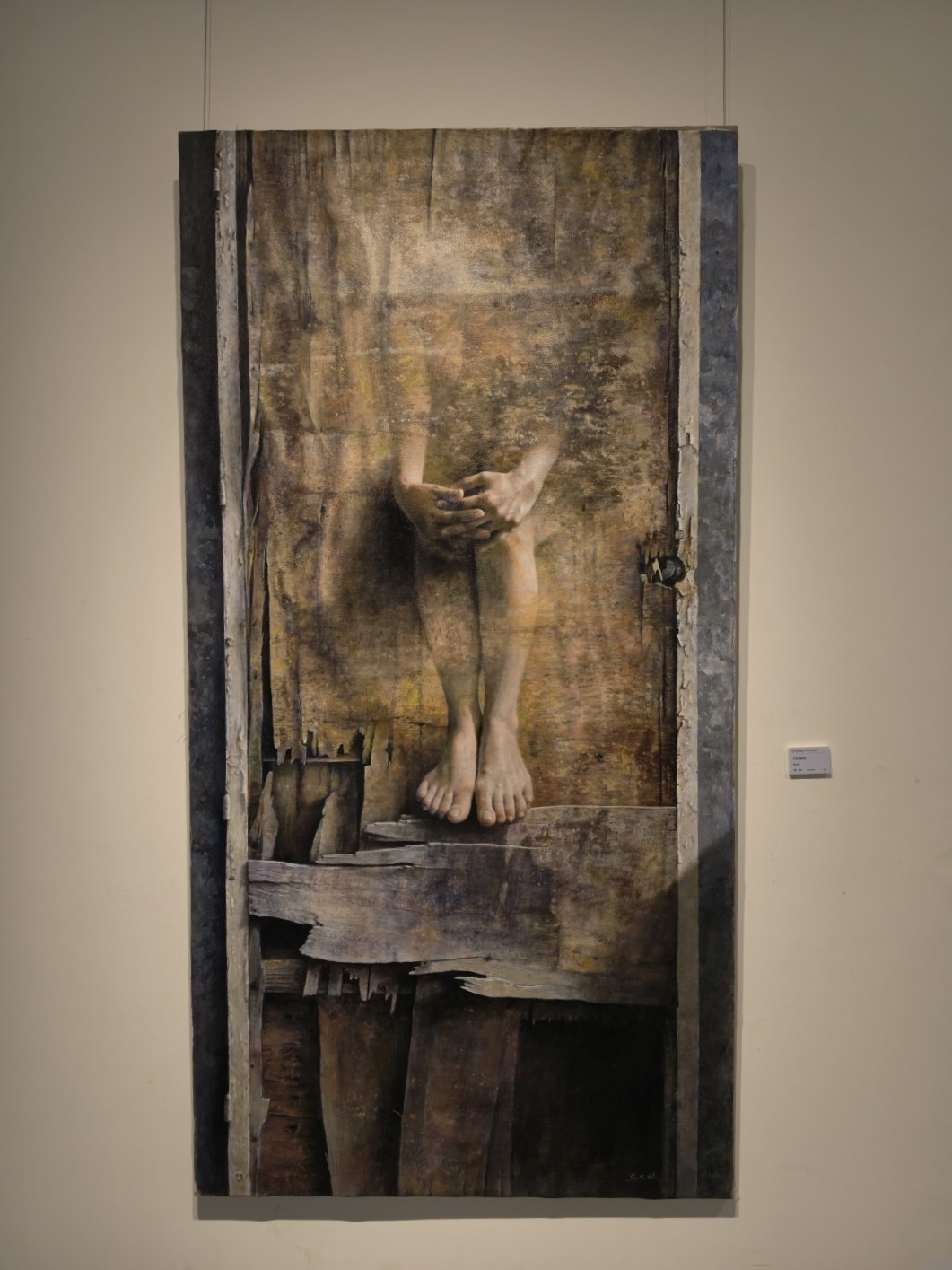
我常覺得,一幅畫若以「門」作為結構,便已經不只是畫一個空間,而是在畫一種處境。門可開,可關;可通往外界,也可把人留在裡面。胡文賢這件作品,乍看是一具局部身體被安置在一扇破舊門板或壁面之前;但若看久一點,便會發現畫面真正描繪的不是身體,而是「被遮蔽的存在」。
畫中身體並不完整。觀者看見的是下肢、足部、交疊於身前的雙手,以及被霧化、磨蝕般處理的軀幹局部。頭部與上半身大多隱沒在斑駁肌理之中,使人物不成為肖像,也不成為敘事主角,而像是一段被時間留下的痕跡。這種不完整性,是畫家構圖上的關鍵選擇:胡文賢沒有讓身體取得畫面的全部發言權,反而讓身體與門板、木片、鏽色、灰塵、剝落的表層共同發聲。
一、垂直構圖:門框作為囚籠,也作為祭龕
此作採取明顯的垂直長方形構圖。整幅畫像一扇窄門,也像一座立式祭龕。左右兩側深色邊框形成強烈的縱向壓迫,使中央空間被夾住。這種構圖讓觀者的視線無法自由橫向擴散,只能沿著畫面垂直移動:從上方斑駁的牆面,慢慢下降到手部、腿部、足部,再落到下方破碎的木板結構。
這種垂直性帶來兩層效果。
第一,它製造出一種封閉感。畫中人物局部彷彿被嵌入門板之中,不是站在門前,而像是被門吸收、被牆保存。人與背景之間沒有清楚界線,身體逐漸被空間吞沒。
第二,它帶來一種宗教式的凝視感。中央身體被安排在近乎正中的位置,下方木板像基座,上方斑駁牆面像背景屏障。這使畫面有某種祭壇氣質:身體不是日常生活中的身體,而是被擺放、被觀看、被時間審視的身體。
二、中央軸線:靜止身體與不安背景的對抗
畫面最明顯的構圖核心,是中央垂直軸線。足部位於畫面下方中央,雙腿向上延伸,雙手交疊於身前,形成一個內收的姿態。這個姿態使身體顯得凝縮、克制、封閉。
值得注意的是,身體本身相對穩定、柔和;但周圍背景卻充滿破損、刮痕、污漬與裂縫。於是畫面產生一種對比:身體的靜止,對抗背景的腐蝕;肉身的柔軟,對抗木板與牆面的粗糙;人的脆弱,對抗時間的粗暴。
這種對抗並非戲劇化的衝突,而是一種緩慢的侵蝕。胡文賢不讓畫面發生事件,而是讓事件早已發生之後的痕跡留下來。觀者看見的不是破壞的瞬間,而是破壞之後的沉默。
三、遮蔽與顯現:身體不是被畫出,而是被挖出
此作最迷人的地方,在於身體並非以清楚輪廓被完整呈現。畫家讓身體像從背景中浮現,又像正在退回背景之中。尤其軀幹上方幾乎融入牆面肌理,形成一種半透明、半消失的狀態。
這裡的技法具有強烈的心理性。胡文賢不是單純描繪人體,而是在處理「身體如何被時間覆蓋」。人物局部像被灰塵、鏽色、牆皮、記憶與光線共同遮住。畫面中的身體因此不只是物理存在,更像是一段記憶殘影。
我甚至覺得,這幅畫不是在畫一個人站在門後,而是在畫一個人如何慢慢成為門的一部分。人被空間保存,也被空間消耗。這種曖昧,使作品帶有深沉的存在感。
四、下方木板:破碎結構造成心理重量
畫面下半部的木板、碎片與裂口非常重要。若沒有這些破碎物,中央身體可能會顯得過於輕盈;但下方沉重的木質結構,使整件作品獲得重量。
這些木板近似廢墟,也像臨時搭建的臺座。它們不平整、不完整,有裂縫、缺口與陰影。足部被安置在其上,形成一種不穩定的支撐。這使觀者意識到:畫中身體並不是安穩地站立,而是在破敗之物上暫時停留。
構圖上,這些橫向木板也平衡了整幅畫的垂直壓力。左右門框與中央身體形成縱向走勢,而下方木板則以橫向與斜向切割畫面,讓畫面不至於過度單調。它們像一道粗糙的底線,托住上方的沉默。
五、色彩與肌理:褐、灰、黑之中的時間感
這幅畫的色彩非常節制。主要由褐色、灰色、黑色、暗金色與木質色調組成。畫面沒有明亮艷麗的色彩,而是呈現一種老牆、鐵鏽、塵土與潮濕木頭混合的色感。
這種色調使作品避開了現實場景的明確性,進入一種時間深處。畫中的褐色不是單純的背景色,而像歲月沉積;灰色不是中性色,而像被磨去的記憶;黑色不只是陰影,而像一種無法進入的深處。
肌理則是此作的靈魂之一。牆面與木板被處理得斑駁、剝落、粗糙,與身體較柔和的描繪形成對照。畫家以肌理讓時間可見:時間不再只是抽象概念,而是牆上的污痕、木板上的裂縫、身體邊界的模糊。
我在一扇破門前想到身體
我並不確定,這幅畫是否真在畫一扇門。或許它只是牆,只是木板,只是一個破敗空間。但人之所以需要藝術,或許正因為我們不能只接受事物的本名。門若只是門,便太貧乏;牆若只是牆,也不值得久看。胡文賢讓門成為身體的處境,讓牆成為記憶的表皮,讓木板成為時間留下的骨架。
畫中那段身體,使我想到人如何存在於世界。人總以為自己擁有身體,然而身體其實也被外物擁有:被房間擁有,被歷史擁有,被觀看擁有,被記憶擁有。畫中的身體沒有完整面孔,沒有可辨識的個人身分,於是它反而更接近普遍的人。若有面孔,觀者也許會急著辨認;沒有面孔,觀者便只能思考。
雙手交疊於身前,姿態內收,像一種防護,也像一種等待。足部安放在不穩的木板上,周圍是破損與陰影。這不是英雄式的站立,而是一種被世界壓縮後的存在。人站著,卻不自由;人顯現,卻不完整;人仍在畫面中央,卻已被周圍的時間慢慢磨去。
我尤其喜歡畫面上方那大片斑駁的牆面。那裡沒有具體事件,卻好像什麼都曾經發生過。牆上的顏色、刮痕與暗影,比直接敘事更有力量。因為人的一生,往往不是由幾個清楚事件組成,而是由無數無法命名的沉積構成。我們記得的,未必是事情本身,而是事情留在身體裡的顏色。
胡文賢在這裡所做的,不是單純的寫實,也不是單純的超現實。他以寫實的手法描繪身體、木板與牆面,卻把這些真實物象組合成不合日常邏輯的精神場景。局部越真實,整體越像夢;物件越可觸,氣氛越不可測。這正是作品的深度:它不是逃離現實,而是把現實推到更深的地方。
如果說前一件作品以骨骸、水域與圓環思考生命的循環,那麼這件作品則以門、牆、木板與身體思考存在的封閉。前者像是在深水裡看見生命與死亡互相纏繞;此作則像是在一扇舊門前,看見人如何被時間遮蔽。兩者都不急於敘事,而是建立一個讓觀者沉思的場域。
在這件作品裡,構圖的真正高明處,不只是比例安排得穩,也不只是中央軸線清楚,而是畫家讓形式成為思想。垂直門框不是裝飾,而是限制;破木板不是背景,而是支撐與崩壞;模糊身體不是技法效果,而是存在狀態。畫面中每一個形式選擇,都在回應同一個問題:人如何在時間之中保有自身?
我想,若面對此畫,也許不會急著談風格流派。他也許會先想到自己的身體,想到身體如何老去,如何被衣物、房間、習慣、記憶包裹;想到人一生其實都站在某種門前,既不能真正進入,也不能真正離開。藝術的力量正在此處:它不替我們解決人生的困境,卻使我們看見困境的形狀。
胡文賢這件作品使我相信,好的繪畫不是把人畫得完整,而是讓人意識到自己的不完整。畫中的身體被遮住,卻因此更有存在感;空間破敗,卻因此更接近真實;畫面沉默,卻因此更能停留在觀看者心中。
最後,我願意把這幅畫看作一篇關於「隱身」的寓言。人並非消失於黑暗之中,而是消失於日常的牆面、門板、木紋與時間裡。身體仍在,卻已被世界覆蓋;足部仍站立,卻站在破碎之上;雙手仍交疊,卻無法阻止自身被歲月慢慢磨成痕跡。
誠如法國現象學家梅洛-龐蒂(Maurice Merleau-Ponty)所言,世界是交織的「肉」,感知者與被感知者相互滲透。在這幅畫中,人與物的堅硬邊界被徹底摧毀了。畫家運用了高超的罩染(Glazing)與雙重曝光(Double exposure)般的錯視技法,讓木頭的紋理直接穿透了肌膚。我們無法分辨,是這具肉身正在從木門中掙扎著誕生,還是他正在被這扇古老的朽木無情地吞噬?
凝視那雙交疊在膝蓋上的手,這是一個極度內斂、自我防禦的姿態。在德國哲學家海德格爾(Martin Heidegger)的存在主義中,人類作為「此在(Dasein)」,是被無情地「拋擲(Geworfenheit)」到這個充滿無常與威脅的世界裡的。這雙手緊緊抱住自己,彷彿在試圖留住最後一絲存在的溫度。而在加斯東·巴什拉(Gaston Bachelard)的《空間詩學》視角下,這個退縮的姿態,是個體在面對龐大虛無時,為自己構築的最後一道「內在庇護所」。
而我站在畫前所能做的,也只是放慢觀看。因為這幅畫不要求我解釋它,而要求我承認:人活著,本就像站在一扇斑駁的門後,一部分顯現,一部分隱沒;一部分屬於自己,一部分早已交給時間。
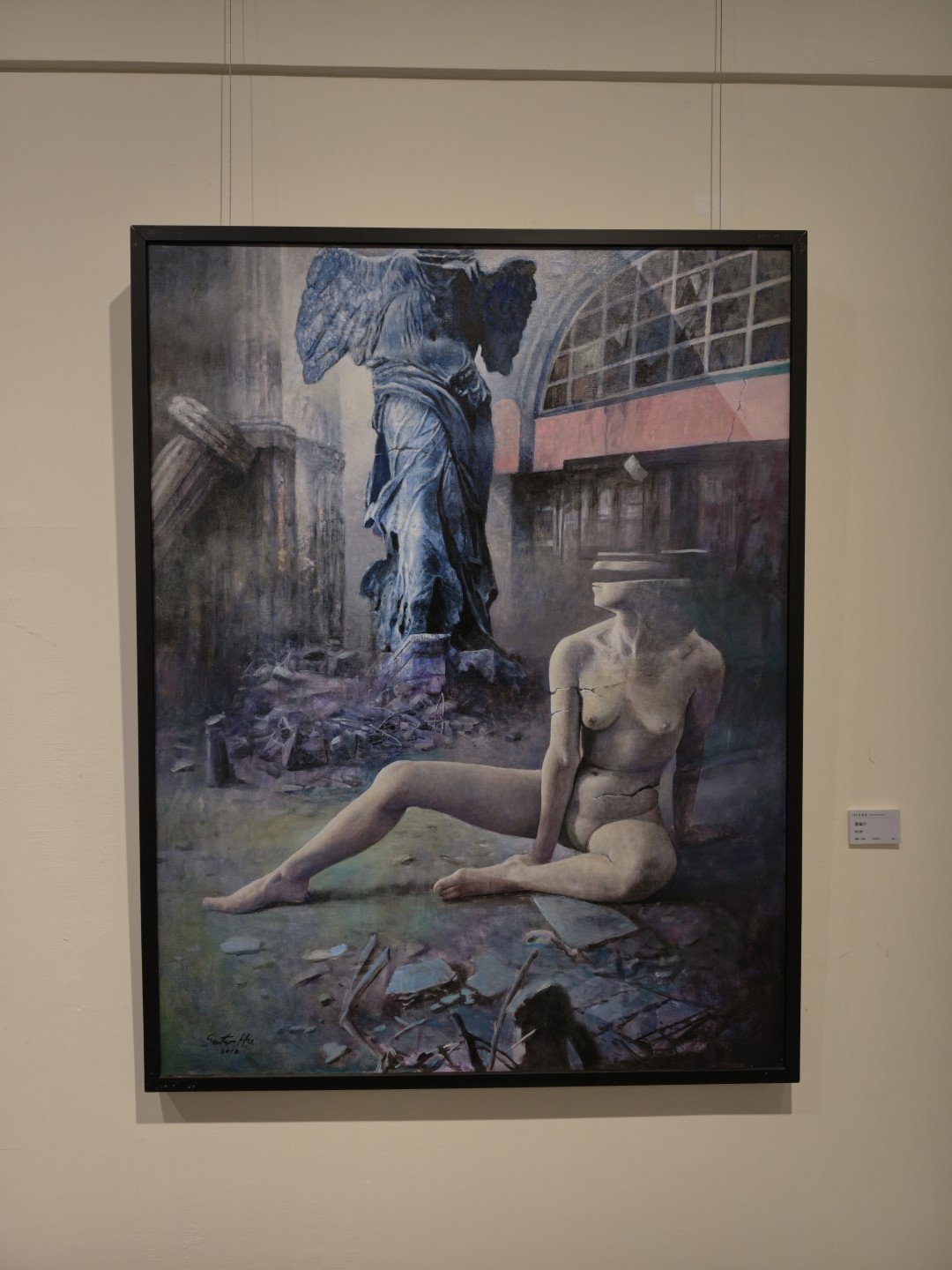
廢墟中的勝利
這件作品與前一件「門後之身」不同。前一件以垂直門框壓縮身體,使人體像被時間嵌入牆中;這一件則把人體移到一個更開闊、卻更荒涼的場景裡。畫面中有兩個主要形象:一尊位於左上至中央的有翼、無頭、殘缺的雕像,以及右下方一具坐姿、無頭或面部被霧化處理的人體形象。兩者同樣不完整,一者像古典神像的殘骸,一者像當代身體的殘片;它們在同一處廢墟中相遇,形成一種關於文明、肉身、時間與崩壞的沉思。
構圖總體:斜向張力中的雙重主角
此作採取近乎方形或略長方形的構圖,畫面空間比前一件作品更複雜。前景、中央、背景都有物件與建築線索,形成一個多層次的廢墟場景。
整體構圖可分為兩個主要區塊:
- 左上至中央:有翼殘缺雕像
- 雕像高聳、垂直,位於畫面偏左的位置。
- 翅膀向兩側展開,使上半部形成強烈的重量。
- 無頭的處理,使雕像具有歷史斷裂感。
- 右下:坐姿人體
- 人體姿態低伏、貼近地面。
- 身體向左延伸,腿部形成一條長斜線。
- 頭部或面部被霧化、抹除,使身體成為匿名存在。
這兩個形象構成畫面的核心對話:上方的雕像代表已被神聖化、歷史化的身體;下方的坐姿人體則代表仍在現場、但同樣遭到破壞與遮蔽的身體。
斜線構圖:從神像墜落到人體
畫面最重要的動勢,是一條由左上往右下延展的隱形斜線。
這條斜線可以這樣看:
- 從左上方殘破建築與陰暗背景開始;
- 經過中央偏左的有翼雕像;
- 下降至右下方坐姿人體;
- 再延伸到前景破碎的瓦礫與木片。
這條斜線不是單純的視覺路徑,而是一條文明墜落的路徑。觀者的視線先被雕像吸引,再被帶到地上的人體,最後落入前景碎片。由此,畫面形成一種由高到低、由神聖到肉身、由紀念碑到廢墟的下降運動。
若說雕像曾經屬於高處,屬於神殿、廣場、歷史與勝利,那麼坐姿人體則屬於地面,屬於塵土、沉默與現實。胡文賢在構圖上讓兩者共享同一個破敗空間,使「崇高」與「脆弱」不再分離。
垂直與水平的對比:站立的殘像,坐落的肉身
畫中的有翼雕像具有強烈的垂直性。雖然雕像殘缺,仍保持向上的姿態,衣褶層層下墜,形成柱狀結構。雕像像一座斷裂的紀念碑,雖失去頭部,仍保有某種莊嚴。
相對地,右下方人體採取低姿態坐姿。腿部橫向伸展,身體重心貼近地面。這使畫面形成強烈對照:
- 雕像:垂直、紀念性、歷史性、冷硬
- 人體:水平、脆弱、當下性、柔軟
- 雕像向上殘存
- 人體向下沉落
這種對比,使作品不只是描繪兩個形象,而是在比較兩種存在方式:一種是被歷史保留下來的身體,一種是仍在時間之中被磨蝕的身體。
然而兩者又不是簡單對立。雕像雖高,卻殘缺;人體雖低,卻仍有溫度。這種曖昧正是作品的深度。畫家沒有把古典雕像畫成完美,也沒有把現代人體畫成完整。他讓二者都受傷,使整幅畫成為「殘缺之物的聚會」。
人類為何總是對「廢墟」懷抱著一種近乎病態的迷戀。我們在傾頹的石柱前感嘆,在斷壁殘垣中尋找昔日榮光的幻影。或許,廢墟是一面最誠實的鏡子,它毫不留情地映照出人類文明的必朽性。今日,當我佇立在胡文賢的這幅畫作前,這份對於歷史、時間與自我碎裂的沉思,再次如畫中那幽暗的藍色迷霧般,將我重重包裹。
請容我再次以一個世俗漫遊者的目光,而非嚴苛的藝術史學者,來談談這幅畫是如何在無聲的崩塌中,向我們展露了現代人最深層的存在焦慮。
歷史的天使與淪陷的古典:凝視廢墟的拓撲
在畫面的中景,矗立著一尊我們無比熟悉的雕像——那是收藏於羅浮宮的《薩莫色雷斯的勝利女神》(Winged Victory of Samothrace)。但在胡文賢的筆下,她不再是高高在上、象徵勝利與榮耀的光明神祇。
- 陰鬱的紀念碑: 這尊女神被覆蓋上一層深沉、近乎瘀傷般的暗藍色調。她失去了原有的潔白,彷彿剛從一場浩劫的灰燼中被挖掘出來。她腳下不再是乘風破浪的戰艦,而是碎裂的磚石與鋼筋水泥的現代廢墟。
- 班雅明的「歷史天使」: 看著這尊在廢墟中展翅的殘缺女神,我腦海中浮現出德國哲學家瓦爾特·班雅明(Walter Benjamin)筆下的「歷史的天使」。天使的臉朝向過去,看見的是一場不斷將殘骸堆疊在腳前的單一災難;天使想停下來喚醒死者、修補破碎的世界,但從天堂吹來的風暴卻無情地將她推向未知的未來。這尊淪陷在廢墟中的女神,正是那無法挽回的歷史災難的具象化。她巨大、沉默,帶著一種「恐怖的崇高(Terrifying Sublime)」,冷眼旁觀著文明的瓦解。
瓷化的肉身與意識的切片:現代人的精神肖像
然而,這幅畫最令人感到戰慄與悲損的,是前景那位跌坐在碎玻璃與瓦礫堆中的裸體女性。她與後方宏大的歷史廢墟,形成了一種微觀與宏觀的慘烈對照。
- 物化的恐懼與弗洛伊德的「詭異(Das Unheimliche)」: 她的肉體被描繪得極具寫實的溫度與重量,但令人不安的是,她的肌膚上佈滿了如同瓷器或石膏般的裂痕(出現在手臂、腰際與大腿)。在心理學上,當一個原本應該充滿生命的肉體,展現出無機物的碎裂特徵時,便會引發一種深刻的「詭異感」。畫家在此摧毀了有機與無機的邊界:我們引以為傲的肉身,其實與那些傾頹的石柱一樣,脆弱且隨時可能崩解。
- 意識的切片與失去的臉孔: 最具視覺衝擊力的,是她頭部的處理。她的臉孔沒有被完整畫出,而是被水平切割成了數個懸浮的切片,雙眼與表情徹底消失在虛空中。這是對現代人「自我異化」與「主體性碎裂」最極致的隱喻。在資訊爆炸、價值解體的當代社會,我們的意識早已被切割得支離破碎。我們失去了完整的臉孔,也失去了凝視世界的能力,只能任由靈魂在半空中懸浮、斷裂。
兩具殘缺之軀的跨時空對話
胡文賢在這幅畫中,安排了一場極其精妙的幾何與意義的對位法。
請觀察這兩具身體:一具是代表古典與神聖的石頭雕像,一具是代表當代與凡俗的血肉之軀。 她們都沒有頭顱(或者說失去了完整的臉孔),她們都殘缺不全。女神失去了雙臂,而凡人女性則失去了完整的自我意識。
這種並置(Juxtaposition)產生了一種強烈的虛無感。我們曾經仰望神明與古典藝術,試圖從中尋找永恆的庇護;但如今,神祇自身難保,淪陷在廢墟之中,而我們這些血肉之軀,也只能頹然地坐在時代的殘骸裡,任由自身的精神與肉體一同龜裂。背景那扇只剩一半的拱窗與剝落的粉色牆面,似乎在嘲笑著人類試圖建立秩序的徒勞。
在碎裂中安放自我
在一個廢墟般的時代裡,我們該如何適意地生活?這幅畫作是一首冰冷的視覺輓歌。它沒有給出任何廉價的希望或救贖的曙光,它只是極其誠實地將這份碎裂攤開在我們眼前。我們都是那尊殘缺的女神,也都是那個意識被切片的凡人。
但也許,這正是藝術的慈悲之處。當我們能夠平靜地凝視自身的碎裂,承認肉身的脆弱與歷史的無情時,我們反而獲得了一種奇異的自由。我們不再需要拼命維持完美的假象,我們可以在這片由碎玻璃與破磚爛瓦構成的廢墟中,坦然地坐下,接受自己作為一個「殘缺者」的命運。既然世界終將崩塌,那麼在徹底粉碎之前,且讓我們安靜地感受這每一道裂痕的真實重量。
空間安排:廢墟不是背景,而是精神場域
此作的背景不是被動的舞臺,而是主題的一部分。
左側有模糊的建築殘影,像倒塌的牆、柱或木構。右上方則有弧形窗格或建築立面,帶有幾何秩序;但這秩序同樣破敗、灰暗、失去功能。下方前景堆滿碎片、瓦礫與破裂物。整個場景像一處經歷災變後的空間。
構圖上,這些建築元素形成三種力量:
- 右上窗格的幾何線條
- 提供理性、秩序、文明的象徵。
- 但窗格陰暗,無法真正通向光明。
- 左側殘破建築
- 形成歷史廢墟感。
- 與有翼雕像相互呼應。
- 前景碎片
- 把觀者拉入現場。
- 使畫面不只是遠觀的寓言,而像一個可被踩踏的破敗空間。
因此,廢墟不是裝飾,而是思想。畫家以廢墟告訴觀者:文明不是堅固的,神像不是永恆的,身體也不是完整的;一切都在崩解,只是崩解速度不同。
光線安排:灰藍冷光中的幽微劇場
整幅畫以灰、藍、紫、黑、暗綠為主,局部有粉紅色牆面與人體較暖的色調。畫面沒有明亮陽光,而是一種像灰塵、霧氣或陰天中的漫射光。
這種光線有幾個效果:
- 使雕像帶有冷色石質感;
- 使人體顯得介於真實與幻影之間;
- 使空間失去清楚時間,像白日,也像夢境;
- 使破碎物不只是物件,而像記憶的沉積。
尤其是坐姿人體的頭部位置,被一種白色霧氣般的筆觸遮蔽。這個處理非常關鍵。畫家並未以清楚面孔建立敘事,而是以「缺席」製造觀看的深度。沒有面孔,觀者便無法將其理解為某個特定人物;人體成為更普遍的存在象徵。
我在廢墟中看見兩種身體
殘缺的雕像比完整的雕像更能說話。完整之物常使人讚嘆,殘缺之物卻使人思考。完整的神像要求人仰望,斷裂的神像則邀人靠近。胡文賢這件作品中的有翼雕像,正是如此。它失去了頭部,卻沒有失去姿態;失去了完整,卻沒有失去尊嚴。它像一個被歷史留下來的問題:若勝利終將殘破,那麼勝利究竟勝過了什麼?
畫中的坐姿人體則更接近我們。雕像屬於高處,人體屬於地面。雕像曾被供奉,人體則像被拋入現場。可是兩者皆無頭,皆不完整,皆在廢墟中沉默。這種安排使我想到,人類總以為自己能以藝術、建築、神話與紀念碑戰勝時間,但最後連戰勝時間的形式,也會被時間擊敗。
雕像背後有建築殘影,人體前方有碎裂瓦礫。這是一個沒有出口的空間。窗格存在,卻不帶來真正的外界;地面展開,卻佈滿破片。畫面像在告訴我們:文明所留下的不是答案,而是層層斷裂的材料。人在其中坐下,不是休息,而是被迫面對自己的有限。
我尤其被那尊有翼雕像吸引。翅膀本應意味飛翔,但在此,翅膀太重了。石質的翅膀不能飛,只能成為重量。這是很深的諷刺:人類創造翅膀,想像超越;但當翅膀成為雕像,超越也就凝固了。它不再飛,而是被保存;不再自由,而是被紀念。藝術有時正是如此:它保存人類對自由的渴望,同時也暴露這種渴望的無能。
坐姿人體的姿態則將整幅畫拉回肉身。身體坐在地上,腿部斜伸,手臂支撐重量。這不是英雄的身體,也不是神聖的身體,而是一個被放在廢墟中的身體。它沒有高舉,沒有抗辯,也沒有戲劇化的動作。它只是存在。可是這種存在反而比姿態更有力量。因為真正的脆弱,往往不是倒下,而是在破敗之中仍然停留。
胡文賢的「殘缺美學」
從這件作品可以看出,胡文賢並不只是描繪奇幻場景,而是以超現實語彙處理人的存在問題。畫面中有古典雕像、人體、廢墟、窗格、碎片,這些元素看似來自不同時空,卻被置於同一個心理空間之中。
這種藝術語言可稱為一種「殘缺美學」。
所謂殘缺,不只是形式上的斷裂,而是思想上的不完整:
- 身體不完整;
- 雕像不完整;
- 建築不完整;
- 空間不完整;
- 歷史也不完整。
但胡文賢並沒有把殘缺畫成單純的悲劇。他讓殘缺具有詩性。畫中的破碎物並非只意味毀滅,也意味記憶。正因為一切都已破損,觀者才開始追問它們原本可能是什麼,又如何走到今日這一步。
這種追問,比完整的敘事更深。完整敘事讓人滿足,殘缺場景使人不安;而不安,正是觀看真正開始的地方。
與前兩件作品的關聯
若將這件作品與前面兩件一起看,可以發現胡文賢作品中反覆出現幾個母題:
身體的局部化
前一件作品中的身體被門框與牆面遮蔽;這一件作品中的人體同樣失去完整面貌。胡文賢似乎不願把人體當作完整肖像,而是把人體當作存在的碎片。
時間的物質化
門板、木片、骨骸、石臺、廢墟、雕像,都是時間留下的物質。時間在他的畫中不是抽象觀念,而是可以被看見的裂縫、斑駁與破損。
生與死、文明與肉身的交錯
第一件作品以骨骸與水域思考生命循環;第二件作品以門與身體思考遮蔽;這件作品則以雕像、廢墟與人體思考文明的崩解。三者雖場景不同,但都圍繞同一問題:人在時間之中如何存在?
寫實與夢境的重疊
胡文賢的技法具有寫實根基,但畫面組合卻不服從現實邏輯。這使作品介於真實與夢之間:觀者相信每個物件,卻無法相信整個場景真的存在。這正是其超現實張力所在。
在破碎之中,觀看人的位置
這件作品最深的地方,不在於它畫了一座雕像,也不在於它畫了一具人體,而在於它讓兩者互相照映。雕像是被歷史抬高的身體,人體是被現實放低的身體;雕像殘缺,人體也殘缺;雕像在廢墟中仍顯莊嚴,人體在碎片中仍保有存在。
因此,這幅畫不是單純的哀悼,也不是單純的頹敗美學。它更像一篇關於文明與肉身的沉思:人創造神像,是為了超越肉身;但神像終究也像肉身一樣破碎。人建立建築,是為了抵抗時間;但建築終究也成為瓦礫。人以為藝術能保存永恆;而藝術最誠實的時刻,或許正是在承認永恆也會受傷。
我願意把這件作品看作胡文賢對「勝利」二字的反問。畫中的有翼雕像容易使人想起勝利、飛翔、榮耀;但它無頭、斷裂、沉重,立於廢墟之中。所謂勝利,到了最後,也許只是另一種被保存下來的殘缺。而畫面右下的人體,雖低伏於地,卻使這殘缺重新回到人的尺度。
觀看至此,我不再問這幅畫畫的是哪一處廢墟,或哪一尊雕像。這些問題固然可以追索,但更深的問題是:當我們也置身於時間的破片之中,該如何理解自己的身體?該如何理解文明給我們的承諾?該如何理解那些曾經高舉、如今斷裂的翅膀?
胡文賢沒有給出答案。他只是把雕像、人體、窗格、碎片與陰影放在同一幅畫裡,讓它們彼此凝視。於是觀者也被迫停下來,在廢墟中重新學習觀看:看見神聖如何破碎,看見肉身如何沉默,看見時間如何把一切高處帶回地面。
胡文賢新莊藝術文化中心個展現場
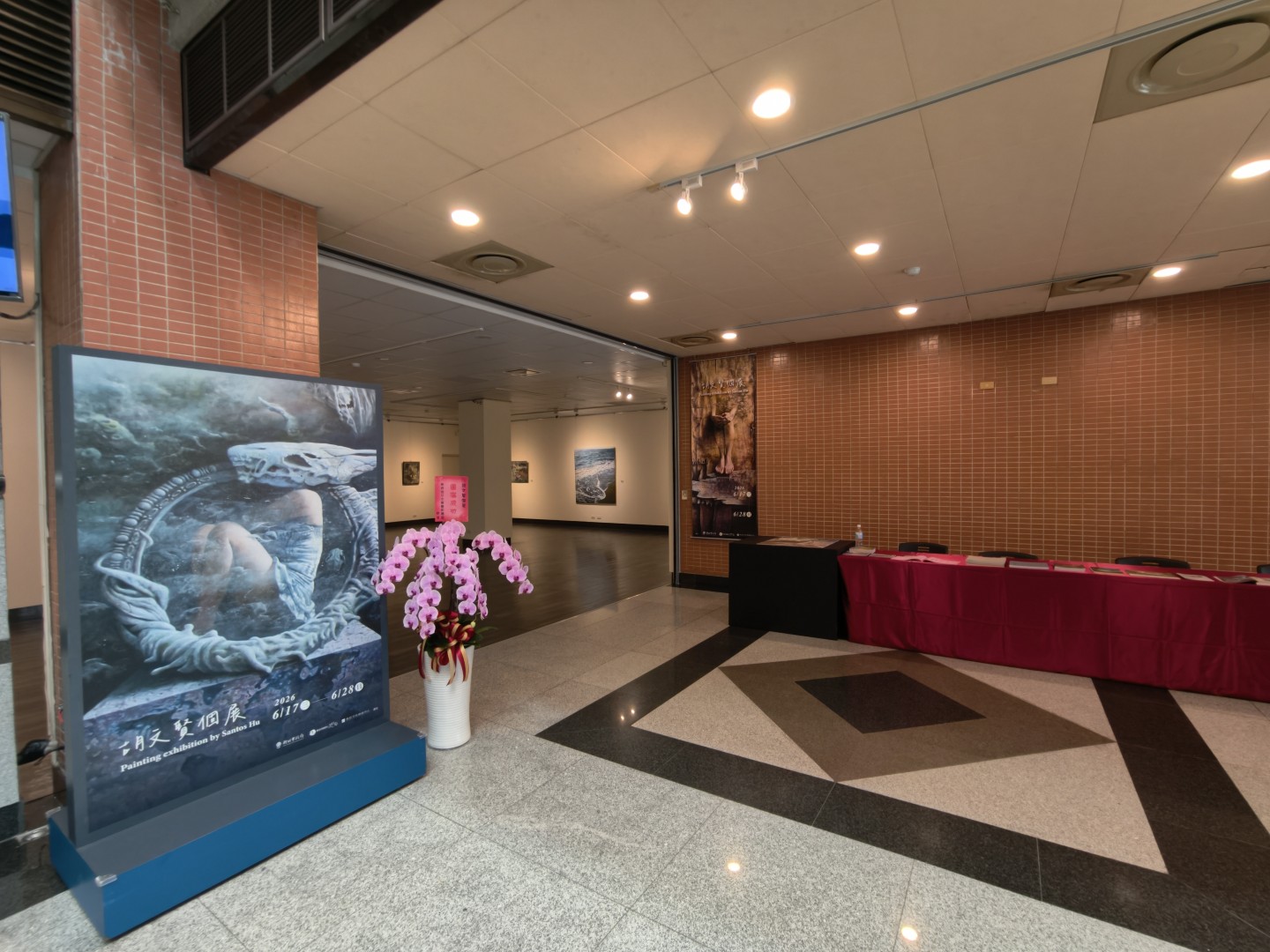
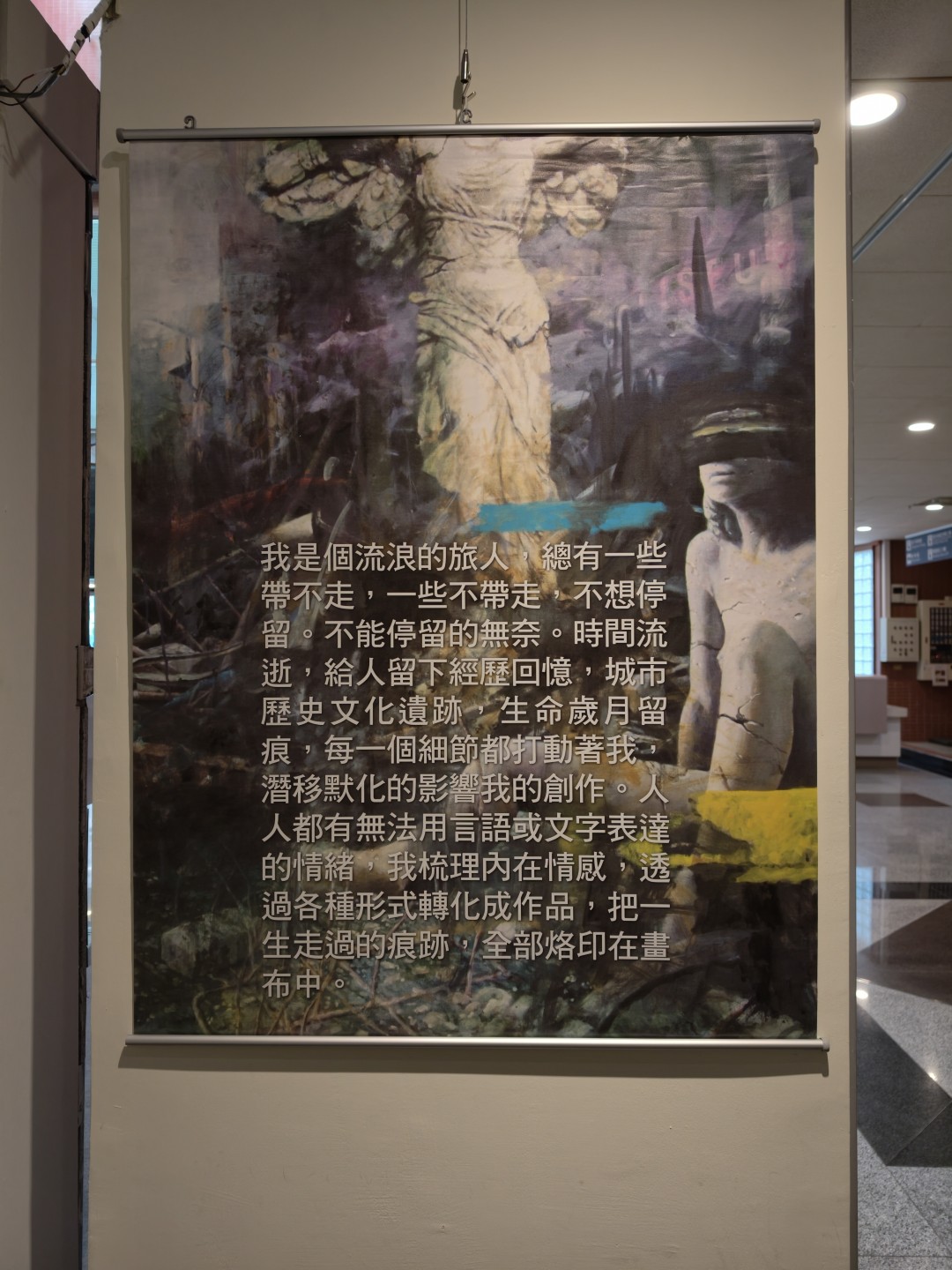
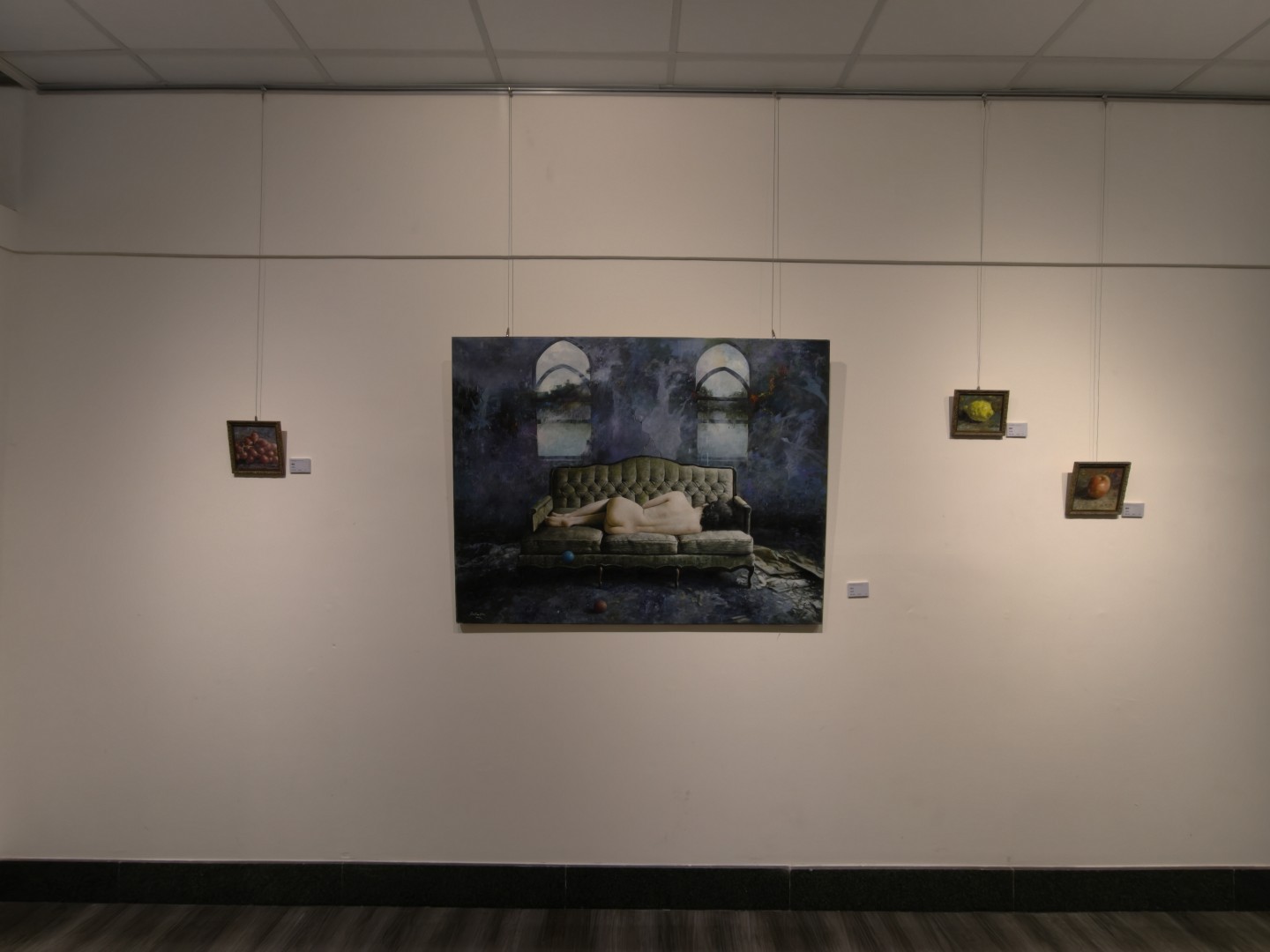
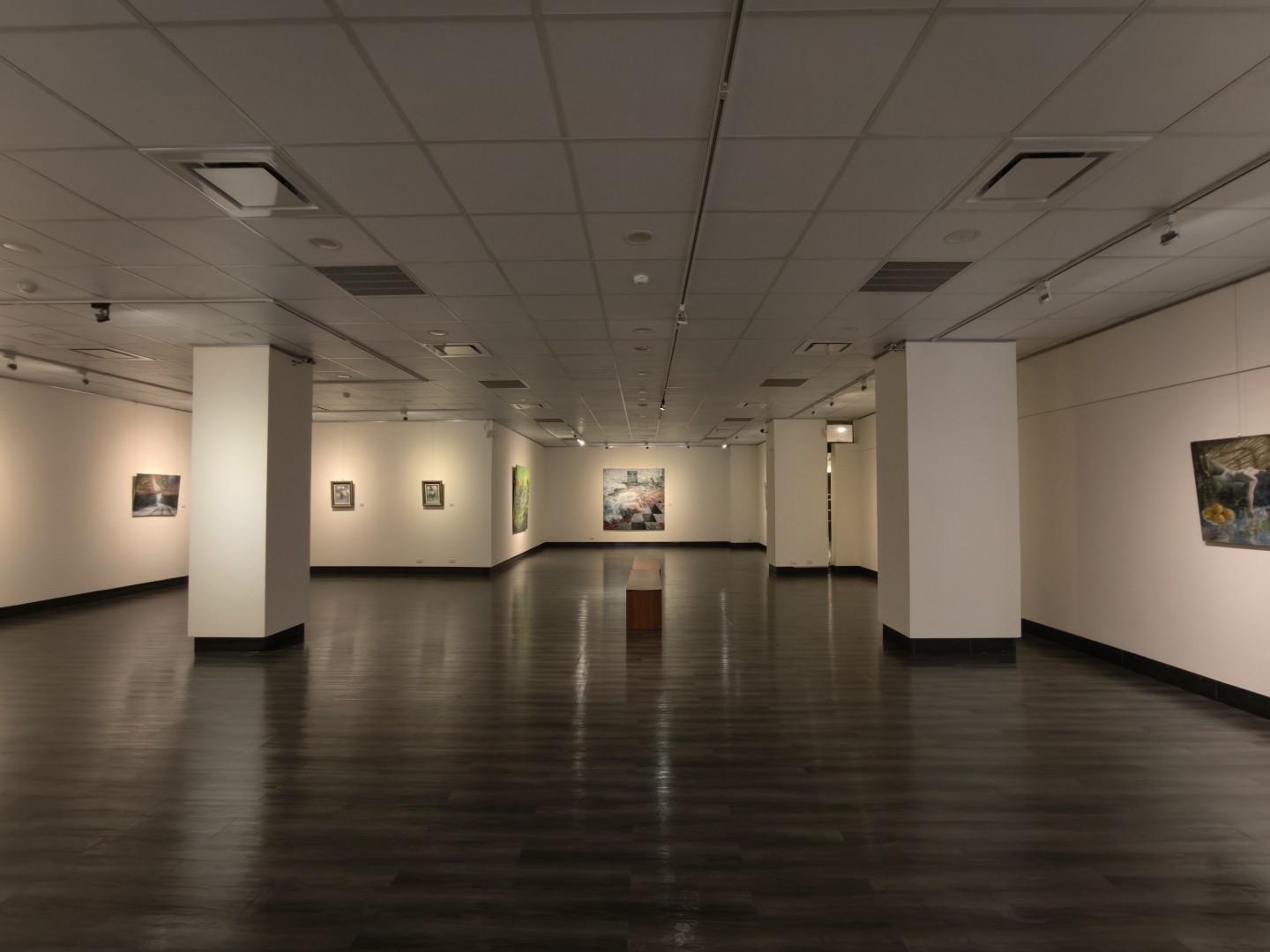
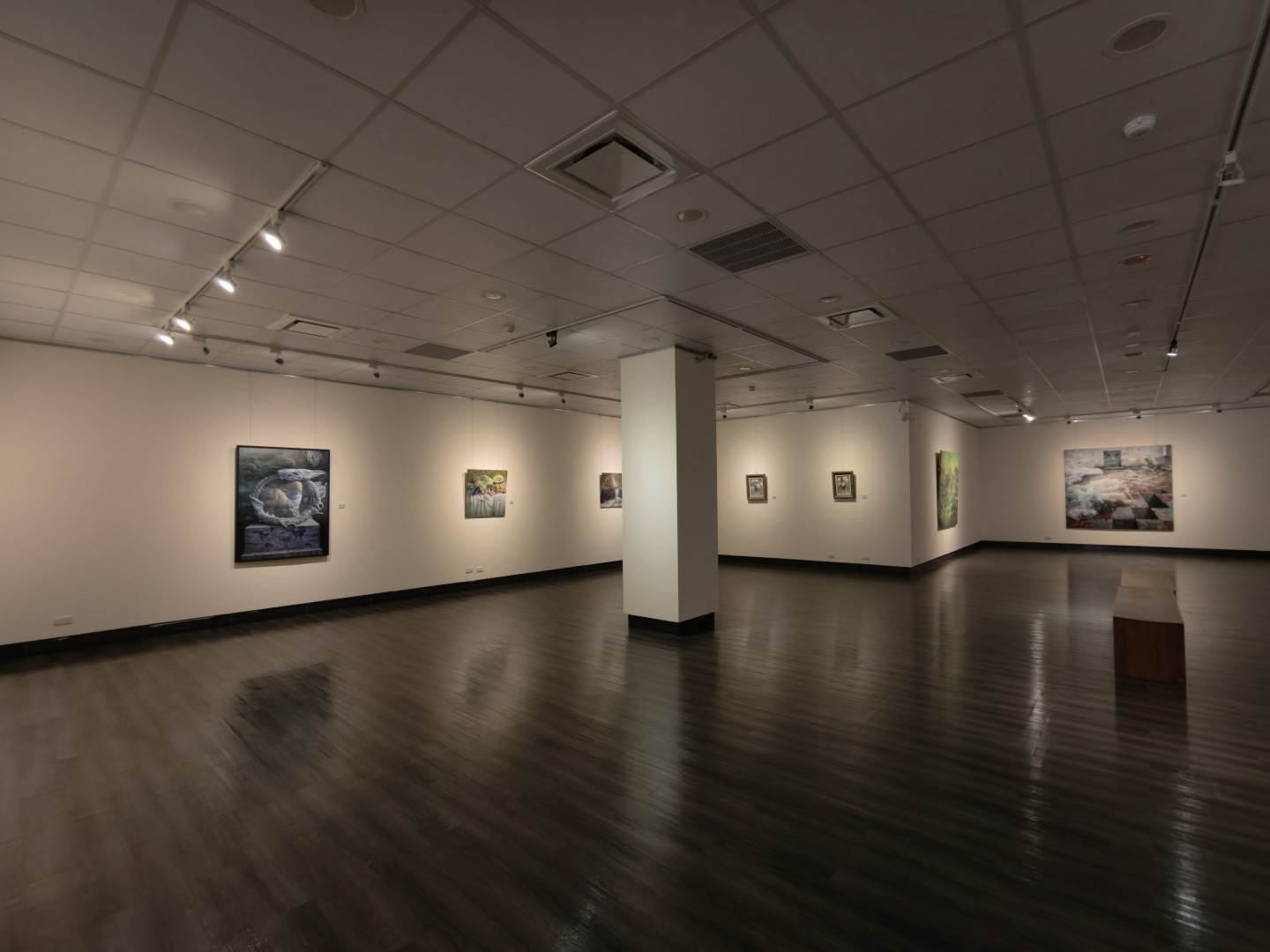
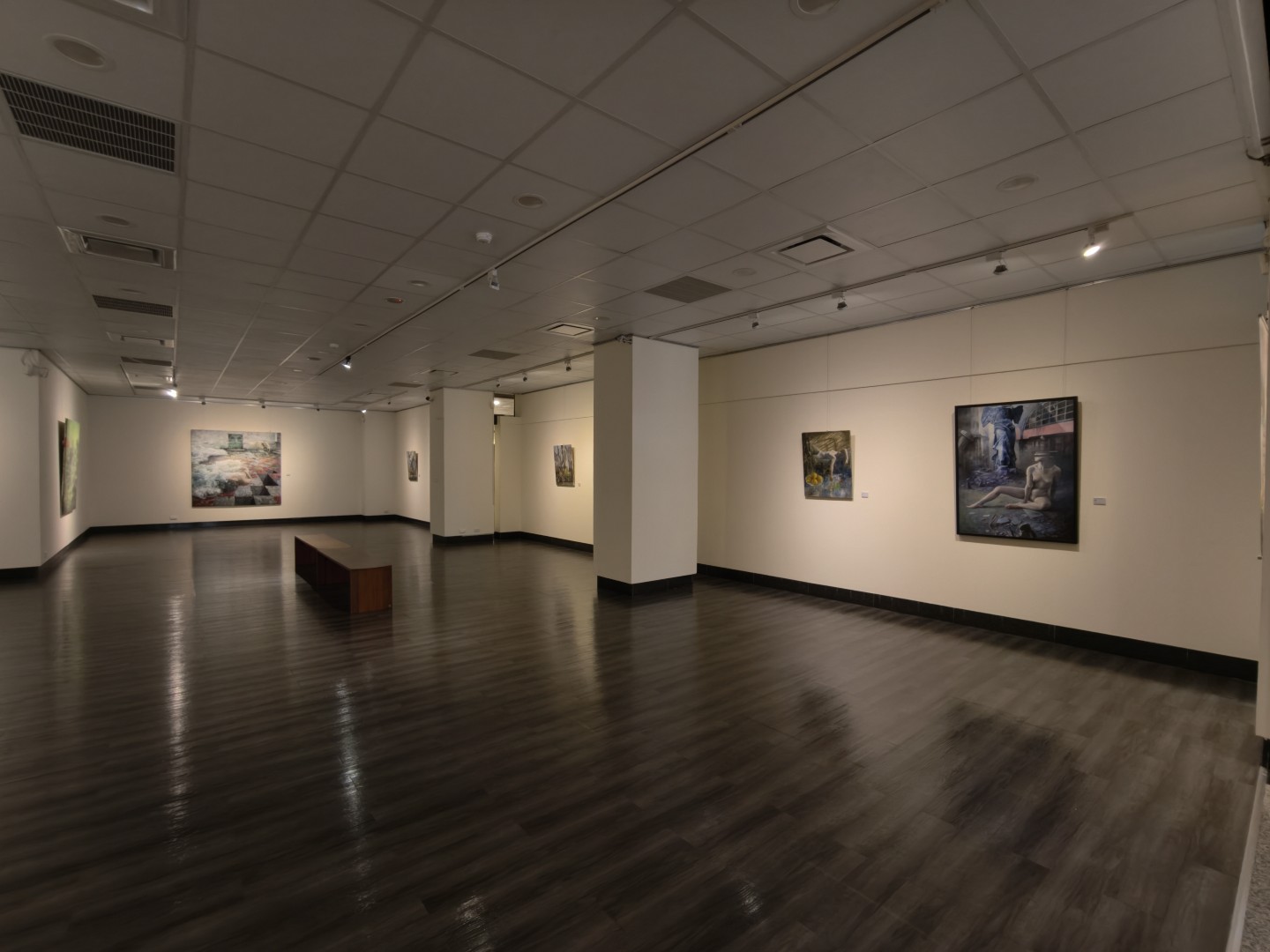
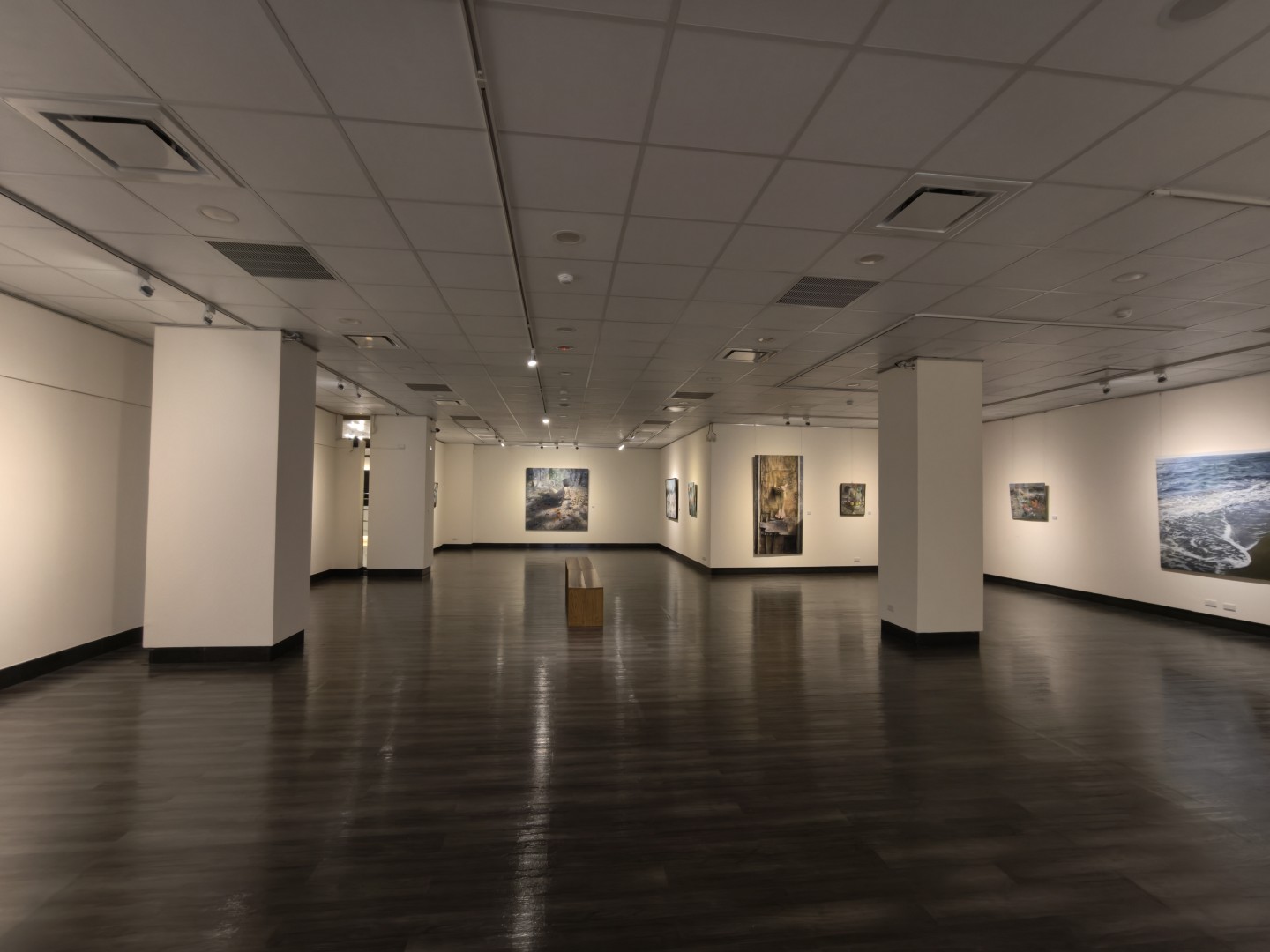
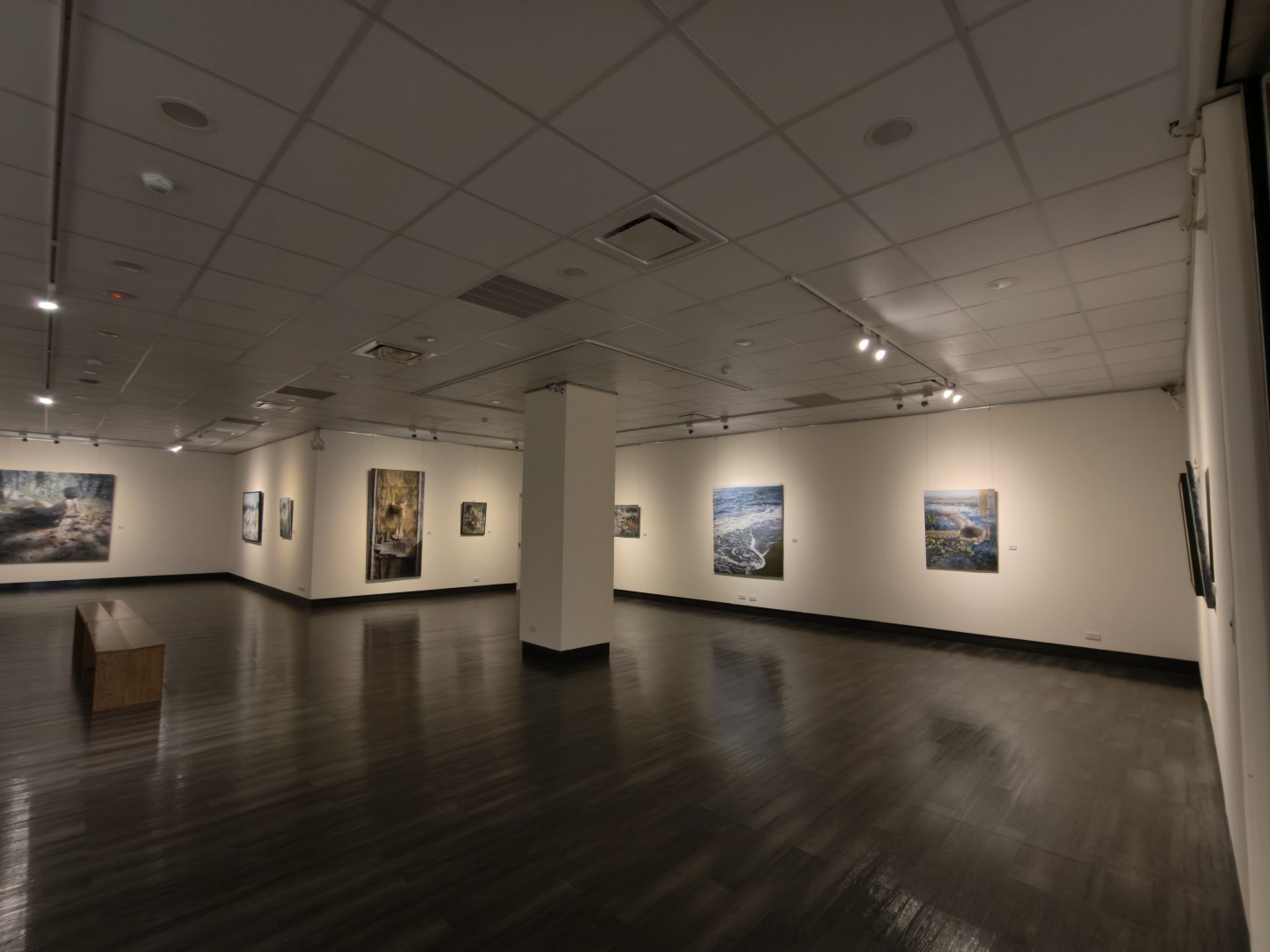
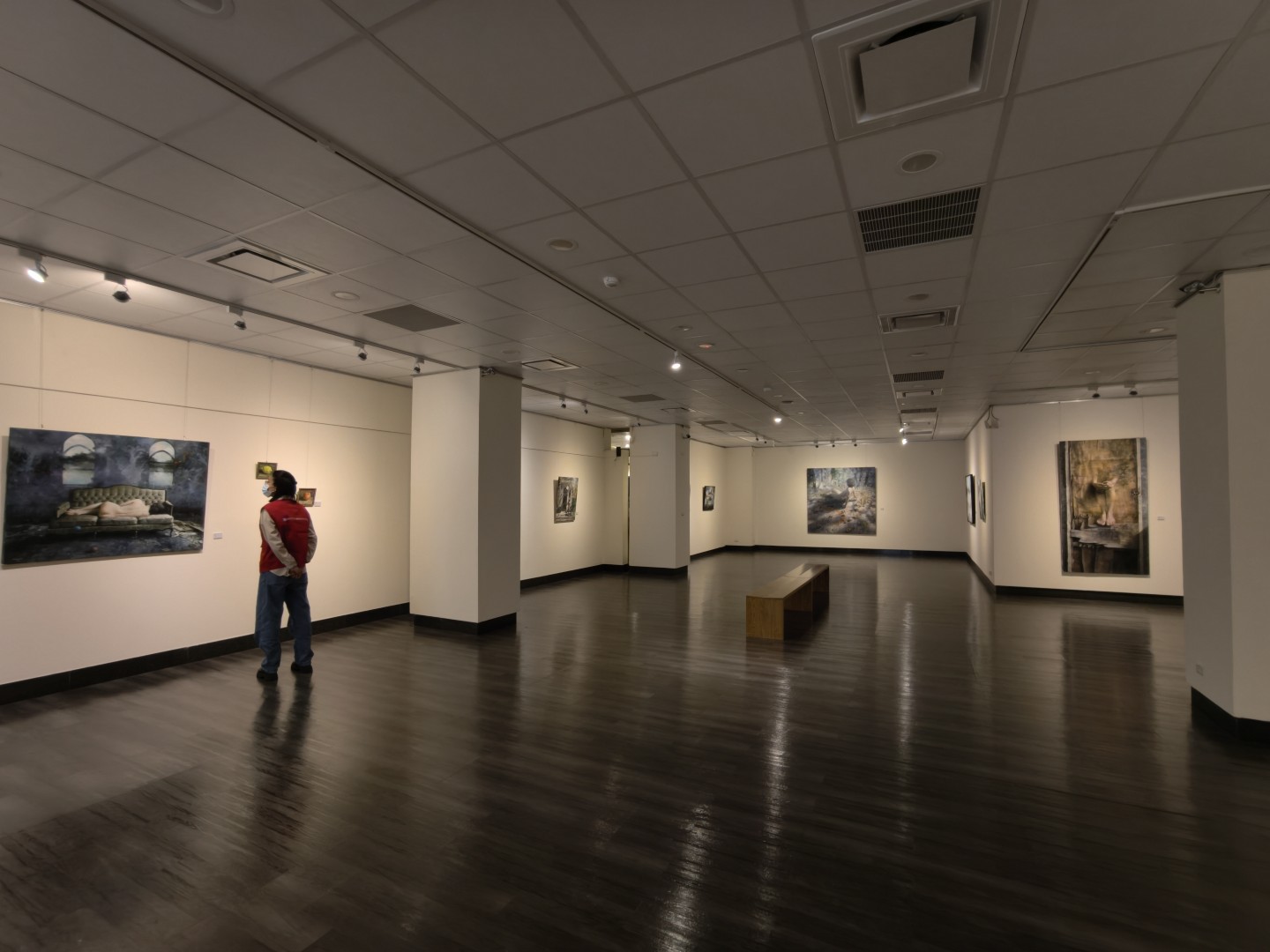
胡文賢畫歷
Hu Wen-shian / Santos Hu
胡文賢,1955年出生於臺灣臺南善化,是臺灣具代表性的旅西藝術家之一。國立臺灣美術館典藏資料記載,胡文賢畢業於國立藝專,後於1984年赴西班牙馬德里大學藝術學院就讀,並長期旅居西班牙,其作品具有寫實基礎與東方色彩的超現實主義風格。 阿波羅畫廊資料亦記載,胡文賢於1978年畢業於國立臺灣藝術專科學校,1988年畢業於馬德里大學藝術學院,1989年進入馬德里大學藝術學院博士班。
胡文賢的繪畫以精密寫實為基礎,並結合夢境、身體、自然、骨骸、廢墟與時間意識,形成具有象徵性與哲學深度的圖像語言。國立臺灣美術館典藏資料指出,胡文賢重視內在直覺與情感表現,作品描繪細膩、色彩豐富,並能精確掌握物體肌理、比例、透視與構圖;「女體」與「大自然」亦是其創作與思想的重要核心。
其作品並非單純描繪現實,而是在現實物象中滲入夢幻、潛意識與生命寓言。人體在胡文賢畫中常呈現局部、遮蔽、殘缺或被時間侵蝕的狀態;骨骸、石臺、門板、廢墟與古典雕像,則成為生命、死亡、記憶與文明崩解的象徵。透過寫實技法與超現實構成,胡文賢建立出一種介於現實與幻境、肉身與精神、生命與死亡之間的獨特美學。
學歷
- 1978年
畢業於國立臺灣藝術專科學校,今國立臺灣藝術大學。 - 1988年
畢業於西班牙馬德里大學藝術學院。 - 1989年
進入西班牙馬德里大學藝術學院博士班。
重要個展
胡文賢自1980年代起即活躍於臺灣與西班牙兩地,其個展橫跨臺北、臺中、臺南、西班牙馬德里、巴塞隆納、畢爾包、奧維多、馬拉加等地。阿波羅畫廊與相關藝術資料記載,胡文賢曾多次於臺灣阿波羅畫廊舉辦個展,形成長期而穩定的展覽脈絡。
- 1987年
個展,格拉納達銀行展覽室,西班牙。 - 1992年
《生命與糧食》,阿波羅畫廊第一次個展,臺北,臺灣。 - 1993年
《輕喚生命的靈質》,阿波羅畫廊第二次個展,臺北,臺灣。 - 1995年
《時空之幻》,阿波羅畫廊第三次個展,臺北,臺灣。 - 1997年
《自然組曲》,阿波羅畫廊第四次個展,臺北,臺灣。 - 1999年
《懷享組曲》,阿波羅畫廊第五次個展,臺北,臺灣。 - 2001年
《生命印象之巡》,阿波羅畫廊第六次個展,臺北,臺灣。 - 2002年
個展,阿里馬利畫廊,塔拉戈納,西班牙;另於布勞略畫廊、沙爾杜巴畫廊、畢沙羅畫廊等地展出。 - 2003年
個展,烏丹格林畫廊,維多利亞,西班牙;個展,海之畫廊,巴塞隆納,西班牙。 - 2004年
阿波羅畫廊第七次個展,臺北,臺灣;並於杜拉畫廊、布勞略畫廊、貝內迪托畫廊等西班牙畫廊舉辦個展。 - 2005年
個展,海之畫廊,巴塞隆納,西班牙;個展,沙巴蘭畫廊,馬德里,西班牙。 - 2006年
個展,阿里馬利畫廊、布勞略畫廊、貝內迪托畫廊,西班牙。 - 2007年
個展,瓜達拉哈銀行展覽廳,瓜達拉哈,西班牙;個展,海之畫廊,巴塞隆納,西班牙。 - 2008年
個展,塞萬提斯畫廊,奧維多,西班牙。 - 2009年、2010年
個展,雅瑪斯畫廊,畢爾包,西班牙。 - 2011年
個展,蒙提西里畫廊,希宏,西班牙。 - 2012年
《意象・夢境》,阿波羅畫廊第八次個展,臺北,臺灣。 - 2015年
《脫離・束縛》,阿波羅畫廊第九次個展,臺北,臺灣。 - 2018年
《莫測》,阿波羅畫廊第十次個展,臺北,臺灣;同年亦於阿波羅畫廊 x The One 中山店、阿波羅畫廊 x 恆好等空間展出。 - 2021年
《求索》油畫個展,臺南生活美學館,臺南,臺灣。 - 2022年
《藝與慾》胡文賢油畫展,臺中市大墩文化中心,臺中,臺灣。 - 2023年
《記憶迷迭香》,阿波羅畫廊第十一次個展,臺北,臺灣。
重要聯展與藝術博覽會
胡文賢除個展外,亦曾參與多項臺灣與國際聯展及藝術博覽會。阿波羅畫廊資料記載,胡文賢曾參與臺北國際藝術博覽會、臺南藝術博覽會、新竹藝術博覽會、上海城市藝術博覽會等,作品持續於臺灣與國際藝術市場中展出。
- 1996年
入選西班牙達河雙年展,西班牙。 - 1998年
馬德里畫廊博覽會,西班牙。 - 2000年
巴塞隆納畫廊博覽會,西班牙。 - 2003年
入選第15屆阿達哈全國雙年展,土耳其。 - 2004年
《十三沙龍》,由西班牙全國選出十三位傑出畫家參展,馬德里,西班牙。 - 2013年
臺南藝術博覽會,阿波羅畫廊展位,臺南,臺灣;上海城市藝術博覽會,阿波羅畫廊展位,上海,中國;臺北國際藝術博覽會,阿波羅畫廊展位,臺北,臺灣。 - 2014年
臺南藝術博覽會、臺中藝術博覽會、上海城市藝術博覽會、臺北國際藝術博覽會,阿波羅畫廊展位。 - 2015年
臺北國際藝術博覽會,阿波羅畫廊展位,臺北,臺灣。 - 2016年
臺北國際藝術博覽會,阿波羅畫廊展位,臺北,臺灣。 - 2017年
臺灣文創藝術博覽會,阿波羅畫廊展位,臺中,臺灣。 - 2019年
臺北國際藝術博覽會,阿波羅畫廊展位,臺北,臺灣。 - 2022年
《女人與海》聯展,阿波羅畫廊,臺北,臺灣;新竹藝術博覽會與臺南藝術博覽會,阿波羅畫廊展位。 - 2023年
臺北國際藝術博覽會,阿波羅畫廊展位;《花・海》胡文賢、林嶺森、林玉雯聯展,阿波羅畫廊 x The One 南園人文客棧,新竹,臺灣。
獲獎紀錄
胡文賢曾於西班牙參與多項美術競賽並獲獎或入選,顯示其旅西創作階段與當地藝術場域之連結。
- 1988年
第一屆巴地美展第一名,西班牙。 - 1990年
第五十屆馬德里秋季沙龍銀牌獎,西班牙。 - 1991年
第八屆杜拉美展第一名,西班牙。 - 2002年
入選第17屆西班牙寶馬 BMW 創意繪畫比賽,西班牙。 - 2003年
入選第18屆西班牙寶馬 BMW 創意繪畫比賽,西班牙。 - 2004年
入選第19屆西班牙寶馬 BMW 創意繪畫比賽,西班牙。 - 2005年
第一屆世界火腿大會美術大賽第二名,西班牙。 - 2008年
入選第22屆西班牙寶馬 BMW 創意繪畫比賽,西班牙。
出版紀錄
胡文賢多本油畫集由阿波羅畫廊出版,記錄其不同階段的繪畫面貌與創作思考。
- 1992年
《生命與糧食》胡文賢油畫集,阿波羅畫廊發行。 - 1993年
《輕喚生命的靈質》胡文賢油畫集,阿波羅畫廊發行。 - 1995年
《時空之幻》胡文賢油畫集,阿波羅畫廊發行。 - 1997年
《自然組曲》胡文賢油畫集,阿波羅畫廊發行。 - 1999年
《懷享組曲》胡文賢油畫集,阿波羅畫廊發行。 - 2001年
《生命印象之巡》胡文賢油畫集,阿波羅畫廊發行。 - 2012年
《意象・夢境》胡文賢油畫集,阿波羅畫廊發行。
典藏與藝術史定位
國立臺灣美術館典藏胡文賢1994年油畫作品《生活與幻化》,作品媒材為油彩、畫布,尺寸80.5 × 88.0 公分,國美館典藏資料指出該作屬於胡文賢中期創作,畫面以局部畫框區分內外、有限與無限的超現實空間,並模糊生活與幻化之間的界線。 國美館資料亦指出,胡文賢作品為國立臺灣美術館與臺南市美術館典藏。
從藝術史角度而言,胡文賢的作品可被視為臺灣藝術家在歐洲學院訓練、旅外經驗與本土生命感之間形成的特殊成果。其畫面結合寫實能力、超現實空間、身體寓言與自然象徵,使作品既具有歐洲古典與超現實主義的影響,也保留臺灣藝術家對生命、土地、自然與精神性的深層關懷。
藝術風格與創作特色
胡文賢的繪畫特色可歸納為以下幾點:
一、寫實技法與超現實構成並置
胡文賢具備紮實的寫實能力,能精確描繪人體、骨骸、石材、木板、布褶與自然物的肌理。然而其畫面並不以再現現實為終點,而是將寫實物象放入夢境般的空間,使現實進入超現實狀態。國立臺灣美術館資料亦指出,其作品具東方色彩之超現實主義風格。
二、身體作為存在寓言
胡文賢畫中的身體常非完整肖像,而是局部化、遮蔽化、殘缺化的存在。人體既是生命的象徵,也是時間侵蝕的場所;既是慾望與感知的容器,也是死亡意識與精神孤獨的載體。
三、自然、骨骸與廢墟的象徵系統
骨骸、植物、石臺、海、水域、古典雕像、門板與廢墟等元素,在胡文賢畫中形成一套高度辨識性的象徵系統。這些物象不只是背景或裝飾,而是承載生命輪迴、文明衰敗、記憶沉積與死亡凝視的哲學符號。
四、時間的物質化
胡文賢擅長以斑駁、剝落、裂痕、霧化與陰影處理時間感。時間在其畫中不是抽象概念,而是可被觀看的肌理:牆面上的腐蝕、木板上的裂縫、人體邊界的模糊、石材與骨骸的冷硬,皆使時間成為可見之物。
總評
胡文賢的藝術價值,在於其以精密寫實技法承載超現實想像,並以人體、自然、骨骸與廢墟構築一套關於生命、死亡、記憶與時間的視覺哲學。他的作品既有技法上的細膩,也有思想上的深度;既能呈現肉身的溫度,也能揭示死亡與時間的冷酷。
若以臺灣美術史脈絡觀之,胡文賢是少數長期旅居西班牙、並能在歐洲繪畫傳統與臺灣生命經驗之間建立個人語言的藝術家。其作品透過阿波羅畫廊長期展出與出版,形成穩定而清晰的創作脈絡;同時其作品亦為國立臺灣美術館等機構典藏,顯示其在臺灣現代與當代藝術發展中具有值得重視的位置。
The Dialectic of Skeleton and Flesh: Gazing upon Death in Hu Wen-Hsien's Surreal Heterotopia
Written by: WANG MUTI
I often wonder why humanity is always so deeply fascinated by imagery symbolizing death and nothingness. In the sixteenth century, I once wrote in an essay, "To philosophize is to learn how to die"; and today, as I stand before this painting by Hu Wen-hsien, brimming with surreal metaphors, this long-lost reverence for the fragility of my own existence surrounds me once again like a cold mist.
I do not intend to deconstruct his laws of perspective like a rigid art historian. I only wish to adopt the posture of an ordinary wanderer, borrowing the ideological filters from our "Database of Philosophy and Contemporary Art," to discuss how this painting, on an ordinary afternoon, forced me to directly confront the gravity of life and the ruthlessness of time.
The Pedestal and the Universe: The Heavy Being in Liquid Modernity
At the very bottom of the painting is a steady, heavy stone pedestal akin to a tombstone, upon which a map of the world is mottledly painted.
As I gaze at this cold stone, the first thing that comes to mind is what the French philosopher Jean-Paul Sartre called "Being-in-itself". This pedestal exudes a cold purplish-blue tone; it possesses no consciousness, no emotion, and simply exists absolutely and heavily. We humans, who pride ourselves as the lords of creation, spend our entire lives rushing about and fighting on this map, forgetting that all of this is nothing but a piece of inorganic matter in the vast universe.
And in the context of sociologist Zygmunt Bauman, this hard pedestal acts more like a contrast full of irony. We live in a "Liquid Modernity" where all that is solid is melting away, and values and relationships are constantly flowing; yet, in the face of the laws of death and time, the world retreats back to the coldest, most unshakable solid state. We attempt to build immortal empires upon this stone, but ultimately, the entire Earth is merely an altar upon which to place our bones.
The Ouroboros of Bones: The Abyss of Non-Self and the Dynamical Sublime
As the line of sight climbs upward, a massive ring-shaped object rests upon the pedestal. It is a framework interwoven from pale dry bones and twisted roots, and at the very top of the ring, there is impressively a giant skull of a beast.
This ring, resembling the mythical "Ouroboros," connects head to tail, symbolizing the devouring of time and endless reincarnation. If placed under the anatomical scalpel of Vasubandhu's Abhidharmakośa-bhāṣya, these dry bones represent the most brutal shattering of the "attachment to the nominal self (Prajñapti)". Stripped of all flesh, hair, and expression, this beast's bone is reduced to its hardest calcium structure, calmly declaring: there is simply no eternally unchanging "substantive self." The life to which we cling is nothing more than the "momentary arising and ceasing" and the "continuity of cause and effect (Santāna)" of the five aggregates in the long river of time.
Facing this colossal framework of death, I cannot help but feel the "Dynamical Sublime" described by Immanuel Kant. It transcends the control of human reason, revealing the essence of that cold, immense, and overwhelmingly powerful force in the universe. We tremble before it because it ruthlessly measures out the insignificance and inevitable perishing of our lives.
The Fetus in the Mirror: The Thrown "Dasein" and the Sanctuary of Eros
However, what makes me ponder the most and feel a trace of tremor in this painting is the space at the center of the ring. There is no darkness of death there; instead, it is permeated with a mist like the deep sea or a nebula. And curled up within this chaos is a frail female body.
- The Thrown Dasein: She wears a thin white gauze dress, legs curled up, hands hugging her knees, presenting the posture of an infant in the womb. In the existentialism of Martin Heidegger, this is precisely the truest situation of humanity as "Dasein"—we are "thrown (Geworfenheit)" into this world full of threats and impermanence without our consent.
- The Ontology of the Flesh: Her skin is warm and soft, full of what Henri Bergson called the "vital impetus (Élan vital)", as well as the "Flesh" that perceives the world as described by Maurice Merleau-Ponty. This softness forms a tragic contrast with the rough, cold bones on the periphery.
- The Sanctuary of the Poetics of Space: This is a highly paradoxical image. Surrounding her are dry bones symbolizing death; yet her own posture is the initial gestation of life. From the perspective of Gaston Bachelard's The Poetics of Space, the interior of this ring of death ironically becomes her "inner sanctuary" to ward off the external nothingness. The cage of death is simultaneously the matrix of rebirth.
She seems to be suspended (Epoché) in a mirror or within some sort of Michel Foucault-esque crack of a "Heterotopia". We can see her, but we cannot touch her; she exists above our world (the Earth on the pedestal), yet she appears to be floating in another dimension devoid of time.
Tranquility in the Gaze of Death
Hu Wen-hsien does not provide any cheap answers about redemption on the canvas; he merely borrows a surreal brush to perform a rigorous phenomenological reduction for us.
We are born upon this cold rock, imprisoned within the fleshly skin bags, and will ultimately be devoured by the dry bones of time. But in this inevitable tragedy of existence, the flesh curled up in the mist still retains a tranquil and fragile dignity. We may not be able to break this continuity of cause and effect constructed of white bones, but at the very least, we can choose to be like that tiny soul in the painting—reclaiming our own moment of clarity and contemplation when facing the abyss of the universe.
The Body Behind the Door
I often feel that if a painting uses a "door" as its structure, it is no longer just painting a space, but painting a situation. A door can be opened or closed; it can lead to the outside world, or it can keep people inside. At first glance, this work by Hu Wen-hsien appears to be a partial body placed in front of a dilapidated door panel or wall surface; but if you look a little longer, you will discover that what the image truly depicts is not a body, but an "obscured existence."
The body in the painting is not complete. What the viewer sees are the lower limbs, feet, hands folded in front of the body, and a partial torso treated with an atomized, abraded effect. The head and the upper half of the body are mostly submerged within the mottled texture, preventing the figure from becoming a portrait or a narrative protagonist, appearing instead like a trace left behind by time. This incompleteness is a crucial compositional choice by the painter: Hu Wen-hsien does not allow the body to seize the total right to speak for the image; rather, he allows the body to voice out together with the door panel, wood splinters, rust colors, dust, and peeling surfaces.
1. Vertical Composition: The Door Frame as a Cage and a Shrine
This work adopts an obvious vertical rectangular composition. The entire painting resembles a narrow door, as well as a standing shrine. The dark borders on the left and right sides create a strong longitudinal oppression, causing the central space to be clamped. This composition prevents the viewer's gaze from freely spreading horizontally, forcing it to move solely vertically along the image: from the mottled wall above, slowly descending to the hands, legs, and feet, and finally falling onto the fragmented wooden structure below.
This verticality brings about two layers of effects.
First, it creates a sense of enclosure. The partial figure in the painting seems to be embedded within the door panel; not standing in front of the door, but rather appearing to be absorbed by the door and preserved by the wall. There is no clear boundary between the person and the background, and the body is gradually swallowed by the space.
Second, it brings a sense of religious gazing. The central body is arranged in an almost dead-center position; the wooden boards below act like a pedestal, while the mottled wall above acts like a background screen. This gives the image a certain altar-like temperament: the body is not a body of everyday life, but a body that is placed, observed, and examined by time.
2. Central Axis: The Confrontation Between a Still Body and a Restless Background
The most obvious compositional core of the image is the central vertical axis. The feet are located in the lower center of the painting, the legs extend upward, and the hands are folded in front, forming an introverted posture. This posture makes the body appear condensed, restrained, and enclosed.
It is worth noting that the body itself is relatively stable and soft; yet the surrounding background is filled with damage, scratches, stains, and cracks. Thus, a contrast emerges in the image: the stillness of the body confronts the corrosion of the background; the softness of the flesh confronts the roughness of the wood and the wall; the fragility of the human confronts the brutality of time.
This confrontation is not a dramatic conflict, but a slow erosion. Hu Wen-hsien does not let events occur within the image; instead, he leaves behind the traces of events that have long since transpired. What the viewer sees is not the moment of destruction, but the silence following the destruction.
3. Obscuration and Manifestation: The Body is Not Painted, But Excavated
The most fascinating aspect of this work is that the body is not fully presented with clear outlines. The painter makes the body appear as if it is emerging from the background, and simultaneously as if it is retreating back into it. In particular, the upper part of the torso almost merges into the texture of the wall, forming a semi-transparent, half-disappeared state.
The technique here possesses strong psychological qualities. Hu Wen-hsien is not simply depicting the human body, but rather addressing "how the body is covered by time." The partial figure seems to be collectively obscured by dust, rust colors, peeling walls, memory, and light. Consequently, the body in the painting is not merely a physical existence, but more like a residual shadow of a memory.
I even feel that this painting is not depicting a person standing behind a door, but depicting how a person slowly becomes a part of the door. The human is preserved by the space, and is also consumed by the space. This ambiguity imbues the work with a profound sense of existence.
4. The Wooden Boards Below: Fragmented Structures Creating Psychological Weight
The wooden boards, splinters, and splits in the lower half of the image are extremely important. Without these fragmented objects, the central body might appear overly lightweight; but the heavy wooden structure below grants the entire work its weight.
These boards approximate ruins, and also resemble a temporarily erected pedestal. They are uneven, incomplete, bearing cracks, gaps, and shadows. The feet are positioned upon them, forming an unstable support. This makes the viewer realize: the body in the painting is not standing steadily, but temporarily pausing upon dilapidated objects.
Compositionally, these horizontal wooden boards also balance the vertical pressure of the whole painting. The left and right door frames and the central body form a longitudinal trend, while the wooden boards below slice the image horizontally and diagonally, preventing the picture from becoming overly monotonous. They act like a coarse baseline, supporting the silence above.
5. Color and Texture: The Sense of Time Amidst Brown, Gray, and Black
The coloring of this painting is highly restrained. It is primarily composed of brown, gray, black, dark gold, and woody tones. The image contains no bright, vivid colors, but instead presents a chromatic sensation blending old walls, rust, dust, and damp wood.
This tonal palette allows the work to evade the definitiveness of a realistic scene, entering into a depth of time. The brown in the painting is not simply a background color, but resembles the sedimentation of years; the gray is not a neutral color, but resembles memories that have been worn away; the black is not merely shadow, but resembles an impenetrable depth.
Texture, meanwhile, is one of the souls of this piece. The walls and wooden boards are rendered mottled, peeling, and rough, forming a contrast with the softer depiction of the body. The painter utilizes texture to make time visible: time is no longer just an abstract concept, but rather the smudges on the wall, the cracks on the wood, and the blurring of the body's boundaries.
Thinking of the Body in Front of a Broken Door
I am not entirely sure whether this painting is truly depicting a door. Perhaps it is just a wall, just wooden boards, just a dilapidated space. But the reason humans need art is perhaps precisely because we cannot simply accept the true names of things. If a door is merely a door, it is too impoverished; if a wall is merely a wall, it is not worth gazing at for long. Hu Wen-hsien turns the door into a situation for the body, turns the wall into the epidermis of memory, and turns the wood into the skeleton left behind by time.
The segment of a body in the painting makes me think about how humans exist in the world. People always believe they own their bodies, yet the body is actually also owned by external things: owned by rooms, owned by history, owned by gazes, owned by memory. The body in the painting has no complete face, no identifiable personal identity, and thus it paradoxically draws closer to the universal human. If there were a face, the viewer might rush to identify it; without a face, the viewer is left with no choice but to contemplate.
The hands are folded in front, an introverted posture, resembling a kind of defense, and also a kind of waiting. The feet are resting on unstable wooden boards, surrounded by damage and shadows. This is not a heroic stance, but a form of existence after being compressed by the world. The person stands, yet is not free; the person manifests, yet is not complete; the person remains in the center of the image, yet has already been slowly worn away by the surrounding time.
I am particularly fond of the large expanse of mottled wall at the top of the painting. There are no specific events there, yet it feels as if everything has occurred. The colors, scratches, and dark shadows on the wall are far more powerful than direct narrative. Because a person's life is often not composed of a few clear events, but rather formed by countless unnamable sedimentations. What we remember is not necessarily the event itself, but the color the event leaves behind within the body.
What Hu Wen-hsien accomplishes here is not pure realism, nor is it pure surrealism. He uses realistic techniques to depict the body, wooden boards, and wall, yet combines these real objects into a spiritual scene that defies everyday logic. The more real the parts, the more dreamlike the whole; the more tangible the objects, the more unfathomable the atmosphere. This is precisely the depth of the work: it does not escape from reality, but pushes reality into a much deeper realm.
If the previous piece uses bones, waters, and rings to contemplate the cycle of life, then this piece utilizes doors, walls, wooden boards, and the body to ponder the enclosure of existence. The former is like seeing life and death entwined in deep water; this work is like seeing how a person is obscured by time in front of an old door. Neither rushes to narrate, but instead establishes a field that invites the viewer into deep contemplation.
In this work, the true brilliance of the composition lies not merely in its steady proportional arrangement, nor just its clear central axis, but in the painter's ability to turn form into thought. The vertical door frames are not decoration, but confinement; the broken boards are not background, but support and collapse; the blurred body is not a technical effect, but a state of existence. Every formal choice in the image is responding to the exact same question: how does humanity preserve itself amidst time?
I think that facing this painting, one might not rush to discuss stylistic schools. They might first think of their own body, think about how the body ages, how it is wrapped by clothing, rooms, habits, and memories; think about how a person essentially stands before a certain kind of door throughout their entire life, unable to truly enter, nor truly leave. The power of art lies right here: it does not resolve life's predicaments for us, but allows us to see the shape of the predicament.
This piece by Hu Wen-hsien leads me to believe that a good painting does not paint a person completely, but rather makes one realize their own incompleteness. The body in the painting is obscured, yet gains a stronger sense of existence because of it; the space is dilapidated, yet moves closer to reality because of it; the image is silent, yet lingers all the more within the viewer's heart.
Finally, I am willing to view this painting as a fable about "invisibility." People do not disappear into the darkness, but disappear into the everyday walls, door panels, wood grains, and time. The body is still there, but has already been covered by the world; the feet still stand, but stand upon fragmentation; the hands are still folded, yet unable to stop themselves from being slowly ground into a trace by the years.
Just as the French phenomenologist Maurice Merleau-Ponty stated, the world is an intertwined "flesh," where the perceiver and the perceived permeate each other. In this painting, the hard boundary between human and object has been thoroughly destroyed. The painter employs masterful optical illusion techniques akin to Glazing and Double exposure, allowing the texture of the wood to pierce directly through the skin. We are unable to distinguish whether this fleshly body is struggling to be born from the wooden door, or if it is being ruthlessly swallowed by this ancient rotten wood?
Gazing at that pair of hands folded over the knees, it is an extremely introverted, self-defensive posture. In the existentialism of German philosopher Martin Heidegger, humanity as "Dasein" is ruthlessly "thrown (Geworfenheit)" into this world teeming with impermanence and threat. These hands hug themselves tightly, as if attempting to retain the last trace of existential warmth. And from the perspective of Gaston Bachelard's The Poetics of Space, this retreating posture is the final "inner sanctuary" constructed by the individual when confronting massive nothingness.
And all I can do standing before the painting is slow down my viewing. Because this painting does not demand that I explain it; rather, it demands that I acknowledge: to live as a human is essentially like standing behind a mottled door, partly manifested, partly concealed; a part belongs to oneself, and a part has long been handed over to time.
Victory in the Ruins
This work differs from the previous "The Body Behind the Door." The former uses a vertical door frame to compress the body, making the human form seem embedded into the wall by time; this piece shifts the human body into a more open, yet more desolate setting. There are two main figures in the image: a winged, headless, incomplete statue situated from the top left to the center, and a seated human figure with a headless or atomized face in the lower right. Both are equally incomplete; one resembles the wreckage of a classical deity statue, the other resembles the fragments of a contemporary body; they encounter each other in the same ruin, forming a contemplation on civilization, flesh, time, and collapse.
Overall Composition: Dual Protagonists within Diagonal Tension
This work adopts a nearly square or slightly rectangular composition, and the spatial depth is more complex than the previous piece. The foreground, center, and background all contain objects and architectural clues, forming a multi-layered ruined scene.
The overall composition can be divided into two main blocks:
- Top Left to Center: The Winged Incomplete Statue
- The statue is towering and vertical, located slightly to the left of the image.
- The wings spread out to both sides, giving the upper half a strong sense of weight.
- The headless treatment infuses the statue with a sense of historical rupture.
- Bottom Right: The Seated Human Body
- The body's posture is low and close to the ground.
- The body extends to the left, with the legs forming a long diagonal line.
- The head or face is atomized and erased, turning the body into an anonymous existence.
These two figures constitute the core dialogue of the image: the statue above represents the body that has been sanctified and historicized; the seated human body below represents the body that is still at the scene, yet equally subjected to destruction and obscuration.
Diagonal Composition: Falling from Deity to Human Body
The most important dynamic movement in the image is an invisible diagonal line extending from the top left to the bottom right.
This diagonal line can be viewed as follows:
- Starting from the dilapidated architecture and gloomy background in the top left;
- Passing through the winged statue slightly left of center;
- Descending to the seated human body in the bottom right;
- Extending further into the fragmented rubble and wood splinters in the foreground.
This diagonal line is not purely a visual path, but a path of civilization's descent. The viewer's gaze is first drawn to the statue, then guided to the human body on the ground, and finally falls into the foreground fragments. Thus, the image forms a descending movement from high to low, from the sacred to the fleshly, from the monument to the ruin.
If the statue once belonged to the heights, belonging to temples, squares, history, and victory, then the seated human body belongs to the ground, belonging to dust, silence, and reality. Compositionally, Hu Wen-hsien lets the two share the same dilapidated space, so that the "sublime" and the "fragile" are no longer separated.
Vertical and Horizontal Contrast: The Standing Remnant, The Seated Flesh
The winged statue in the painting possesses strong verticality. Although incomplete, the statue still maintains an upward posture, with folds of clothing draping down in layers, forming a columnar structure. The statue resembles a fractured monument; though it has lost its head, it retains a certain majesty.
In contrast, the human body in the lower right adopts a low-profile seated posture. The legs stretch horizontally, and the body's center of gravity hugs the ground. This forms a stark contrast in the image:
- The Statue: vertical, monumental, historical, cold and hard
- The Human Body: horizontal, fragile, immediate, soft
- The Statue survives upwardly
- The Human Body sinks downwardly
This contrast allows the work to transcend depicting just two figures, instead comparing two modes of existence: one is the body preserved by history, the other is the body still being eroded within time.
Yet the two are not simply in opposition. Though the statue is tall, it is incomplete; though the human body is low, it still holds warmth. This ambiguity is precisely the depth of the work. The painter has neither painted the classical statue to be perfect, nor painted the modern body to be complete. He allows both to be wounded, turning the entire painting into a "gathering of incomplete things."
Why does humanity always harbor a nearly morbid obsession with "ruins"? We sigh before toppling stone pillars, searching for the phantoms of past glory amidst broken walls and debris. Perhaps, ruins are the most honest mirror, mercilessly reflecting the inevitable mortality of human civilization. Today, as I stand before this painting by Hu Wen-hsien, this contemplation on history, time, and the fragmentation of the self heavily envelops me once again, much like the gloomy blue mist in the painting.
Please allow me once more to use the gaze of a secular wanderer, rather than a stringent art historian, to discuss how this painting, amidst a silent collapse, reveals to us the deepest existential anxieties of modern humanity.
The Angel of History and Fallen Classicism: The Topology of Gazing at Ruins
In the middle ground of the image stands a statue that is incredibly familiar to us—the Winged Victory of Samothrace housed in the Louvre. But under Hu Wen-hsien's brush, she is no longer the lofty, radiant deity symbolizing victory and glory.
- A Gloomy Monument: This goddess is covered in a deep, almost bruise-like dark blue tone. She has lost her original pure white, as if having just been excavated from the ashes of a catastrophe. Beneath her feet is no longer a battleship riding the wind and waves, but a modern ruin of shattered bricks and reinforced concrete.
- Benjamin's "Angel of History": Looking at this incomplete goddess spreading her wings in the ruins, the "Angel of History" described by German philosopher Walter Benjamin comes to mind. The angel's face is turned toward the past, perceiving one single catastrophe that ceaselessly piles wreckage at his feet; the angel would like to stay, awaken the dead, and make whole what has been smashed, but a storm blowing from Paradise irresistibly propels him into the unknown future. This goddess fallen into ruins is exactly the materialization of that irretrievable historical disaster. She is massive, silent, bearing a kind of "Terrifying Sublime," coldly observing the collapse of civilization.
The Porcelained Flesh and Slices of Consciousness: A Spiritual Portrait of Modern Man
However, what evokes the most tremor and sense of tragic loss in this painting is the naked female figure collapsed amidst the shattered glass and rubble in the foreground. She and the grand historical ruins in the background form a tragic contrast between the micro and the macro.
- The Fear of Objectification and Freud's "Uncanny (Das Unheimliche)": Her flesh is depicted with highly realistic warmth and weight, but what is deeply unsettling is that her skin is covered with cracks resembling porcelain or plaster (appearing on the arms, waist, and thighs). Psychologically, when a fleshly body that should be brimming with life exhibits the fragmented characteristics of inorganic matter, it triggers a profound sense of the "uncanny." Here, the painter destroys the boundary between organic and inorganic: the flesh of which we are so proud is, in fact, just as fragile and prone to collapse at any moment as those toppling stone pillars.
- Slices of Consciousness and the Lost Face: The most visually impactful aspect is the treatment of her head. Her face is not completely painted, but rather horizontally sliced into several suspended sections, with the eyes and expressions utterly vanishing into the void. This is the ultimate metaphor for the "self-alienation" and "fragmentation of subjectivity" of modern humanity. In the contemporary society of information explosion and value dissolution, our consciousness has long been sliced into disjointed fragments. We have lost our complete faces and lost our ability to gaze at the world, able only to let our souls hover and fracture in mid-air.
A Cross-Temporal Dialogue Between Two Incomplete Bodies
In this painting, Hu Wen-hsien orchestrates a highly exquisite counterpoint of geometry and meaning.
Observe these two bodies: one is a stone statue representing the classical and the sacred, the other is a flesh-and-blood body representing the contemporary and the profane. Neither possesses a head (or rather, they have lost complete faces), and both are incomplete. The goddess has lost her arms, while the mortal woman has lost her complete self-consciousness.
This Juxtaposition generates an intense sense of nihilism. We once looked up to deities and classical art, attempting to seek eternal refuge in them; but today, the deities cannot even protect themselves, having fallen into ruins, and we beings of flesh and blood can only sit dejectedly amidst the wreckage of our era, allowing our own spirits and bodies to crack together. The half-remaining arched window and the peeling pink wall in the background seem to mock the futility of human attempts to establish order.
Placing the Self Amidst Fragmentation
In an era resembling ruins, how are we to live comfortably? This painting is a frigid visual elegy. It offers no cheap hope or dawn of redemption; it simply, with utmost honesty, spreads this fragmentation out before our eyes. We are all that incomplete goddess, and we are all that mortal with sliced consciousness.
But perhaps, this is exactly where the mercy of art lies. When we can calmly gaze at our own fragmentation, acknowledging the fragility of the flesh and the ruthlessness of history, we paradoxically attain a bizarre freedom. We no longer need to desperately maintain the illusion of perfection; we can sit down openly amidst this ruin made of shattered glass and broken bricks, accepting our fate as "incomplete beings." Since the world will inevitably collapse, before it completely shatters, let us quietly feel the true weight of each and every crack.
Spatial Arrangement: The Ruin is Not a Background, But a Spiritual Field
The background of this work is not a passive stage, but a part of the subject matter.
On the left are blurry remnants of architecture, resembling collapsed walls, pillars, or wooden structures. On the top right are arched window panes or an architectural facade, bearing geometric order; yet this order is equally dilapidated, grim, and non-functional. The foreground below is piled high with fragments, rubble, and shattered objects. The entire scene feels like a space post-catastrophe.
Compositionally, these architectural elements form three forces:
- Geometric lines of the top right window panes
- Provide a symbol of rationality, order, and civilization.
- However, the window panes are dark, unable to truly lead to the light.
- Dilapidated architecture on the left
- Forms a sense of historical ruin.
- Echoes the winged statue.
- Foreground fragments
- Pull the viewer into the scene.
- Make the image not just an allegory viewed from afar, but akin to a dilapidated space that can be stepped upon.
Therefore, the ruin is not decoration, but thought. The painter uses the ruin to tell the viewer: civilization is not solid, deities are not eternal, and the body is not complete; everything is collapsing, merely at different speeds.
Lighting Arrangement: A Subtle Theater in Cool Gray-Blue Light
The entire painting is dominated by gray, blue, purple, black, and dark green, with local areas featuring pink walls and warmer tones on the human body. There is no bright sunlight in the image, but rather a diffused light akin to dust, mist, or an overcast day.
This lighting has several effects:
- Gives the statue a cool-toned stone texture;
- Makes the human body appear caught between reality and illusion;
- Strips the space of clear time, looking like day, but also like a dream;
- Makes the fragmented pieces not just objects, but deposits of memory.
Especially the location of the seated human body's head, which is obscured by white, mist-like brushstrokes. This treatment is highly crucial. The painter has not established a narrative via a clear face, but instead creates a depth of viewing through "absence." Without a face, the viewer cannot comprehend it as a specific persona; the human body becomes a more universal symbol of existence.
Seeing Two Kinds of Bodies in the Ruins
An incomplete statue speaks louder than a complete one. Complete objects often induce awe, whereas incomplete objects provoke thought. A complete deity demands to be looked up to, while a fractured one invites approach. The winged statue in Hu Wen-hsien's work is exactly thus. It has lost its head, yet not its posture; lost its completeness, yet not its dignity. It resembles a question left behind by history: if victory is ultimately destined to be fragmented, then what exactly has victory triumphed over?
The seated human body in the painting feels much closer to us. The statue belongs to the heights, the human body belongs to the ground. The statue was once enshrined, while the human body seems tossed into the scene. Yet both are headless, incomplete, and silent within the ruins. This arrangement makes me think: humans always believe they can conquer time through art, architecture, mythology, and monuments, but ultimately, even the forms that conquer time will be defeated by time.
There are architectural remnants behind the statue, and shattered rubble in front of the human body. This is a space without an exit. The window panes exist, but bring no real outside world; the ground unfolds, but is strewn with fragments. The image seems to tell us: what civilization leaves behind are not answers, but layers of fractured materials. As humans sit within it, it is not for rest, but rather being forced to face our own limitations.
I am particularly drawn to the winged statue. Wings are meant to signify flight, but here, the wings are far too heavy. Stone wings cannot fly; they can only become dead weight. This is a profound irony: humans create wings to imagine transcendence; but when the wings become a statue, the transcendence is frozen. It no longer flies, but is preserved; it is no longer free, but memorialized. Art is sometimes just like this: it preserves the human longing for freedom, whilst simultaneously exposing the impotence of that longing.
The posture of the seated human body pulls the whole painting back to flesh. The body sits on the ground, legs extended diagonally, arms supporting the weight. This is not a heroic body, nor a sacred body, but a body placed within ruins. It lacks uplifting, lacks protest, and lacks dramatic movement. It simply exists. Yet this existence is paradoxically more powerful than posture. For true fragility is often not falling down, but continuing to remain amidst dilapidation.
Hu Wen-hsien's "Aesthetics of Incompleteness"
From this piece, we can see that Hu Wen-hsien is not just painting fantasy scenes, but addressing the issues of human existence using surrealist vocabulary. The image contains a classical statue, a human body, ruins, window panes, and fragments—elements that seem to originate from different eras, yet are placed within the same psychological space.
This artistic language can be termed an "aesthetics of incompleteness."
The so-called incompleteness is not just a formal rupture, but a conceptual lack of entirety:
- The body is incomplete;
- The statue is incomplete;
- The architecture is incomplete;
- The space is incomplete;
- And history, too, is incomplete.
But Hu Wen-hsien does not paint incompleteness as pure tragedy. He grants incompleteness a poetic quality. The fragmented objects in the painting signify not only destruction, but also memory. Precisely because everything is already damaged, the viewer begins to interrogate what they might originally have been, and how they came to this state today.
This line of questioning is deeper than complete narratives. A complete narrative offers satisfaction, an incomplete scene instills unease; and unease is exactly where viewing truly begins.
Connections with the Previous Two Works
If we view this work alongside the previous two, we can observe several motifs that repeatedly surface in Hu Wen-hsien's works:
The Localization of the Body
The body in the preceding work is obscured by the door frame and wall; the human body in this work similarly loses its complete appearance. Hu Wen-hsien seems unwilling to treat the human body as a complete portrait, preferring to regard it as fragments of existence.
The Materialization of Time
Door panels, wood splinters, bones, stone pedestals, ruins, and statues are all matter left behind by time. Time in his paintings is not an abstract concept, but rather cracks, mottling, and damage that can be visibly seen.
The Interweaving of Life and Death, Civilization and Flesh
The first work contemplates the cycle of life via bones and waters; the second work contemplates obscuration via the door and the body; this work contemplates the collapse of civilization via statues, ruins, and the human body. Although the three depict different scenes, they all revolve around the exact same question: how does humanity exist amidst time?
The Overlap of Realism and Dreamscape
Hu Wen-hsien's technique holds realistic foundations, yet the image composition defies realistic logic. This situates the work between reality and dream: the viewer believes in every object, yet cannot believe the entire scene truly exists. This is precisely where its surrealistic tension lies.
Viewing the Human Position Amidst Fragmentation
The deepest aspect of this work lies not in its painting of a statue, nor its painting of a human body, but in its allowing the two to illuminate each other. The statue is a body elevated by history, the human body is one lowered by reality; the statue is incomplete, and the human body is also incomplete; the statue still exhibits majesty in ruins, and the human body still retains its existence amidst fragments.
Therefore, this painting is not pure mourning, nor is it pure decadent aesthetics. It acts more like a contemplation on civilization and the flesh: humans create deity statues to transcend the flesh; but statues ultimately shatter just like the flesh. Humans erect architecture to resist time; but architecture ultimately becomes rubble too. Humans think art can preserve eternity; and the most honest moment of art is perhaps exactly when it admits that eternity, too, can be wounded.
I am willing to view this work as Hu Wen-hsien's counter-question to the word "Victory." The winged statue in the painting easily brings to mind victory, flight, and glory; but it is headless, fractured, and heavy, standing amidst ruins. The so-called victory, in the end, might just be another kind of preserved incompleteness. And the human body in the lower right, though prostrate on the ground, brings this incompleteness back to the human scale.
Observing up to this point, I no longer ask which ruin this painting depicts, or which statue it is. These questions can certainly be traced, but the deeper question is: when we are also situated amidst the fragments of time, how are we to understand our own bodies? How are we to understand the promises civilization has made to us? How are we to understand those wings that were once held high, but are now broken?
Hu Wen-hsien provides no answers. He merely places the statue, human body, window panes, fragments, and shadows within the same painting, letting them gaze at one another. Thus, the viewer is forced to stop and relearn how to look within the ruins: to see how the sacred shatters, how the flesh remains silent, and how time brings all heights back to the ground.
骨骸と肉体の弁証法――胡文賢のシュルレアリスム的ヘテロトピアにおける死へのまなざし
文:王穆提( WANG MUTI)
私は時々考える。なぜ人類は、死や虚無を象徴するイメージにこれほど深く魅了されるのかと。16世紀、私は随筆に「哲学を探求することは、死を学ぶことである」と書いたことがある。そして今日、シュルレアリスムの隠喩に満ちた胡文賢(フー・ウェンシエン)のこの絵の前に立つと、自身の存在の脆さに対する久しく忘れていた畏敬の念が、冷たい霧のように再び私を包み込んだ。
私は、型にはまった美術史家のように彼の透視図法を分解するつもりはない。ただ、一人のありふれた散策者として、私たちのこの「哲学と現代アートのデータベース」の思想的フィルターを借りて、ある平凡な午後、この絵がどのようにして私に生命の重力と時間の無情さを直視させたかについて語りたいだけである。
台座と宇宙:リキッド・モダニティにおける重々しい存在
絵の最下部には、まるで墓石のようにどっしりとした重厚な石の台座があり、その上には世界地図が斑模様に描かれている。
この冷たい石を見つめるとき、私がまず思い浮かべるのは、フランスの哲学者サルトル(Jean-Paul Sartre)が言う「即自存在(Being-in-itself)」である。この台座は冷酷な紫青色を放ち、意識も感情もなく、ただ絶対的かつ重々しく存在している。万物の霊長を自称する私たち人類は、一生涯この地図の上で奔走し争い続けるが、それが広大な宇宙の中の無機質な物質に過ぎないことを忘れている。
また、社会学者ジグムント・バウマン(Zygmunt Bauman)の文脈において、この硬い台座は皮肉に満ちた対比のようである。私たちは、あらゆる強固なものが消散していく「液状化した近代(Liquid Modernity)」の中に生きており、価値や関係は絶えず流動している。しかし、死と時間の法則の前では、世界は再び最も冷酷で揺るぎない固体の状態へと後退する。私たちはこの石の上に不滅の帝国を築こうとするが、結局のところ、地球全体も私たちの遺骨を安置する祭壇に過ぎないのだ。
骸骨のウロボロス:無我の深淵と力学的崇高
視線を上に移すと、台座の上には巨大な環状のものが置かれている。それは蒼白な枯れ骨とねじれた根が交錯してできた枠であり、環の頂点には巨大な獣の頭骨がはっきりと見える。
この神話の「ウロボロス(Ouroboros)」のような円環は、尾を噛むように繋がっており、時間の貪りや果てしない輪廻を象徴している。これを世親(ヴァスバンドゥ)の『倶舎論』の解剖刀の下に置けば、この枯れ骨はまさに「仮名の我執(Prajñapti)」に対する最も残酷な粉砕である。この獣の骨はすべての肉、毛髪、表情を剥ぎ取られ、最も硬いカルシウムの構造だけが残り、「永遠に変わらない『実体としての自我』など根本的に存在しない」と冷静に宣告している。私たちが執着する生命は、五蘊が時間の長河において「刹那に生滅」し、「因果が相続(Santāna)」しているものに過ぎない。
この巨大な死の枠組みを前にして、私はカント(Immanuel Kant)の言う「力学的崇高(Dynamical Sublime)」を感じずにはいられない。それは人間の理性の制御を超え、宇宙における冷酷で巨大な、圧倒的な力に満ちた本質を示している。私たちがその前で戦慄するのは、それが私たちの生命の矮小さと必然的な消滅を無情にも測り出しているからである。
鏡の中の胎児:投げ出された「現存在」とエロスの避難所
しかし、この絵で私に最も深い思索を促し、一抹の戦慄を覚えさせるのは、円環の中心にある空間である。そこには死の暗闇はなく、むしろ深海や星雲のような霧が立ち込めている。そして、この混沌の中に、弱々しい女性の肉体が丸まっている。
- 被投的な現存在: 彼女は薄い白い紗のドレスを着て、両脚を曲げ、両手で膝を抱え、子宮の中の胎児のような姿勢をとっている。ハイデガー(Martin Heidegger)の実存主義において、これこそが「現存在(Dasein)」としての人間にとって最もリアルな状況である。私たちは同意なしに、この脅威と無常に満ちた世界へと「投げ出されて(Geworfenheit)」いる。
- 肉体の存在論: 彼女の肌は温かく柔らかく、ベルクソン(Henri Bergson)の言う「生命の飛躍(Élan vital)」、そしてメルロ=ポンティ(Maurice Merleau-Ponty)が描く世界を知覚する「肉(Flesh)」に満ちている。この柔らかさは、周囲の粗雑で冷たい骸骨と凄まじい対比をなしている。
- 空間の詩学の避難所: これは極めてパラドックスに満ちた画面である。彼女を包んでいるのは死を象徴する枯れ骨だが、彼女自身の姿勢は生命の最初の孕みを表している。ガストン・バシュラール(Gaston Bachelard)の『空間の詩学』の視点から見れば、この死の円環の内部は、むしろ彼女が外界の虚無に抵抗するための「内なる避難所」となっている。死の檻は、同時に再生の母体でもある。
彼女はまるで鏡の中、あるいはフーコー(Michel Foucault)的な「ヘテロトピア(Heterotopia)」の裂け目に懸けられている(Epoché)かのようだ。私たちには彼女が見えるが、触れることはできない。彼女は私たちの世界(台座の上の地球)の上にいながら、時間のない別の次元に浮かんでいるかのようでもある。
死の凝視の中での静寂
胡文賢はキャンバス上に救済に関する安っぽい答えを一切提示していない。彼はただシュルレアリスムの筆を借りて、私たちに厳密な現象学的還元を行っているだけだ。
私たちはこの冷たい岩の上に生まれ、肉体の皮袋に囚われ、最後には時間の枯れ骨に飲み込まれる。しかし、この避けられない存在の悲劇の中で、霧の中に丸まる肉体は、依然として静かで壊れやすい尊厳を保っている。私たちは白骨で構成された因果の連鎖を断ち切ることはできないかもしれないが、少なくとも絵の中のあの小さな魂のように、宇宙の深淵に直面したとき、私たち自身の、一念の間の澄明と静観を取り戻すことを選ぶことはできる。
扉の背後にある身体
私はよく、一枚の絵が「扉」を構造としている場合、それはもはや一つの空間を描いているのではなく、一つの状況を描いているのだと感じる。扉は開けることも閉めることもでき、外界へ通じることも、人を中に留めることもできる。胡文賢のこの作品は、一見すると、古い扉や壁の前に身体の一部が配置されているように見える。しかし、長く見つめていると、画面が本当に描いているのは身体ではなく、「隠蔽された存在」であることが分かる。
絵の中の身体は不完全である。観者が見るのは、下肢、足、体の前で交差された両手、そして霧がかかり、削り取られたように処理された胴体の一部である。頭部と上半身の大部分は斑模様のテクスチャーの中に沈み込んでおり、人物は肖像画にも、物語の主人公にもならず、時間によって残された痕跡のようになっている。この不完全さは、画家の構図における重要な選択である。胡文賢は身体に画面のすべての発言権を与えず、むしろ扉、木片、錆色、ほこり、剥がれ落ちた表面とともに身体に発声させている。
一、垂直の構図:檻としての、そして祭壇としての扉の枠
この作品は明確な垂直の長方形の構図を採用している。絵全体が狭い扉のようであり、また立てられた祭壇のようでもある。左右の暗い色の枠が強い縦方向の圧迫感を生み出し、中央の空間を挟み込んでいる。この構図により、観者の視線は自由に横に広がることができず、画面に沿って垂直に移動するしかない。上方の斑模様の壁から、手、脚、足へとゆっくりと下がり、最後に下方の壊れた木の板の構造へと落ちる。
この垂直性は二つの効果をもたらす。
第一に、それは閉鎖感を作り出す。絵の中の人物の一部は扉に埋め込まれているかのようで、扉の前に立っているのではなく、扉に吸収され、壁に保存されているように見える。人と背景の間に明確な境界線はなく、身体は徐々に空間に飲み込まれていく。
第二に、それは宗教的な凝視感をもたらす。中央の身体はほぼ真ん中に配置され、下方の木の板は台座のようであり、上方の斑模様の壁は背景のスクリーンのようである。これにより、画面に一種の祭壇のような気配が生じる。身体は日常生活の中の身体ではなく、配置され、観られ、時間によって吟味される身体となる。
二、中心軸:静止した身体と不安定な背景の対立
画面の最も明らかな構図の中心は、中央の垂直軸である。足は画面下部の中央に位置し、両脚は上に伸び、両手は体の前で交差して、内に収束する姿勢を形成している。この姿勢により、身体は凝縮され、抑制され、閉じられているように見える。
注目すべきは、身体自体が比較的安定して柔らかい一方で、周囲の背景には破損、傷、汚れ、ひび割れが満ちていることである。こうして画面にはある対比が生じる。身体の静止が背景の腐食と対抗し、肉体の柔らかさが木の板や壁の粗さと対抗し、人間の脆弱さが時間の暴力と対抗している。
この対抗はドラマチックな衝突ではなく、緩やかな浸食である。胡文賢は画面に出来事を起こさせるのではなく、出来事がとうに起こった後の痕跡を残している。観者が見るのは破壊の瞬間ではなく、破壊の後の沈黙である。
三、隠蔽と現れ:身体は描かれたのではなく、掘り出された
この作品の最も魅力的なところは、身体が明確な輪郭で完全に表現されていない点にある。画家は身体を背景から浮かび上がらせるように、同時に背景へと退いていくように描いている。特に胴体の上部は壁のテクスチャーにほとんど溶け込んでおり、半透明で、半分消えかかっているような状態を形成している。
ここでの技法は強い心理性を持っている。胡文賢は単純に人体を描いているのではなく、「身体が時間によってどのように覆われるか」を処理しているのだ。人物の一部は、ほこり、錆色、壁の皮、記憶、光によって共に隠されているかのようである。そのため、画面の中の身体は単なる物理的存在ではなく、記憶の残像のようなものである。
私はさらに、この絵が一人の人が扉の背後に立っている様子を描いているのではなく、一人の人がどのようにしてゆっくりと扉の一部になっていくかを描いているのだと感じる。人は空間に保存され、空間に消費される。この曖昧さが、作品に深い存在感を与えている。
四、下部の木の板:崩壊した構造がもたらす心理的重量
画面の下半分にある木の板、破片、裂け目は非常に重要である。もしこれらの壊れたものがなければ、中央の身体はあまりにも軽やかに見えるかもしれないが、下方の重い木の構造が作品全体に重量を与えている。
これらの木の板は廃墟に近く、一時的に組まれた台座のようでもある。それらは不平坦で、不完全であり、ひび割れや欠け、影がある。足はその上に配置され、不安定な支えを形成している。これにより観者は、絵の中の身体が安定して立っているのではなく、朽ち果てた物の上に一時的に留まっているのだと気づく。
構図上、これらの横向きの木の板は絵全体の垂直の圧力のバランスもとっている。左右の扉の枠と中央の身体が縦方向の流れを形成する一方で、下部の木の板は横方向や斜め方向に画面を切り裂き、画面が単調になりすぎるのを防いでいる。それらは粗いベースラインのように、上方の沈黙を下から支えている。
五、色彩とテクスチャー:褐色、灰色、黒の中にある時間感覚
この絵の色彩は非常に抑制されている。主に褐色、灰色、黒色、暗い金色、木の色調で構成されている。画面に明るく鮮やかな色はなく、古い壁、鉄錆、ほこり、湿った木が混ざり合ったような色合いを呈している。
このような色調は、作品を現実の風景の明確さから遠ざけ、時間の深淵へと導く。絵の中の褐色は単なる背景色ではなく、歳月の堆積のようであり、灰色は中間色ではなく、削り取られた記憶のようであり、黒色はただの影ではなく、入り込めない深みのようである。
テクスチャーはこの作品の魂の一つである。壁や木の板は、斑になり、剥がれ落ち、粗雑に処理され、身体のより柔らかな描写と対照をなしている。画家はテクスチャーによって時間を可視化している。時間とはもはや抽象的な概念ではなく、壁の汚れであり、木の板のひび割れであり、身体の境界の曖昧さなのである。
壊れた扉の前で身体について考える
私は、この絵が本当に一つの扉を描いているのか確信が持てない。もしかすると、それはただの壁であり、木の板であり、朽ち果てた空間に過ぎないのかもしれない。しかし人間が芸術を必要とするのは、おそらく私たちが事物の本来の名前を受け入れるだけでは済まないからだ。扉がただの扉であればあまりに貧相であり、壁がただの壁であれば長く見つめる価値はない。胡文賢は扉を身体の状況とし、壁を記憶の表皮とし、木の板を時間が残した骨格としている。
絵の中のその身体の部分は、人間がどのように世界に存在しているかを私に考えさせる。人間は常に自分が身体を所有していると思っているが、実際には身体もまた外的なものに所有されている。部屋に所有され、歴史に所有され、視線に所有され、記憶に所有されている。絵の中の身体には完全な顔がなく、識別可能な個人のアイデンティティもない。そのため、それはかえって普遍的な人間に近づいている。顔があれば、観者は急いで見分けようとするかもしれないが、顔がなければ、観者は思考するしかないのである。
体の前で交差された両手と内に収束する姿勢は、一種の防御のようでもあり、待ち受ける姿のようでもある。足は不安定な木の板の上に置かれ、周囲は破損と影に囲まれている。これは英雄的な立ち姿ではなく、世界によって圧縮された後の存在である。人は立っているが自由ではなく、現れているが不完全であり、いまだ画面の中央にいるが、すでに周囲の時間によってゆっくりと削り取られている。
私は特に画面上方の大きく広がる斑模様の壁が好きだ。そこには具体的な出来事はないが、まるで何事もかつてそこで起きたかのようである。壁の色、傷、暗い影は、直接的な物語よりも力強い。なぜなら、人の一生は多くの場合、いくつかの明確な出来事で構成されているわけではなく、名付けようのない無数の堆積によって構成されているからだ。私たちが覚えているのは出来事そのものではなく、出来事が身体の中に残した色なのである。
胡文賢がここで行っているのは、単純な写実でもなければ、単純なシュルレアリスムでもない。彼は写実的な手法で身体、木の板、壁を描きながら、これらのリアルな対象物を組み合わせて日常の論理に合わない精神の風景を作り出している。部分がリアルであればあるほど全体は夢のようになり、物体が触れられそうであればあるほど雰囲気は測りがたくなる。これこそが作品の深みである。それは現実から逃避するのではなく、現実をより深い場所へと押しやっているのだ。
前の作品が骸骨、水域、円環を用いて生命の循環を思索しているとすれば、この作品は扉、壁、木の板、身体を用いて存在の閉鎖性を思索している。前者が深い水の中で生と死が絡み合うのを見ているかのようであれば、この作品は古い扉の前で、人がどのように時間に隠蔽されるかを見ているかのようだ。どちらも物語ることを急がず、観者が沈思黙考するための場を構築している。
この作品において、構図の真の卓越さは、プロポーションが安定していることや中心軸が明確であることだけでなく、画家が形式を思想としている点にある。垂直の扉の枠は装飾ではなく制限であり、壊れた木の板は背景ではなく支えと崩壊であり、曖昧な身体は技法の効果ではなく存在の状態である。画面のすべての形式的選択は、同じ一つの問いに応答している。人間は時間の中でどのように自己を保つのか?
この絵の前に立てば、急いで流派やスタイルを語ることはしないだろう。人はまず自分の身体を思い浮かべ、身体がどのように老いていき、どのように衣服、部屋、習慣、記憶に包まれていくかを考えるかもしれない。そして、人は一生涯ある種の扉の前に立っており、本当に入ることも、本当に立ち去ることもできないという事実を考えるだろう。芸術の力はまさにここにある。芸術は私たちの人生の困難を解決してはくれないが、その困難の形を見せてくれるのだ。
胡文賢のこの作品は、私に信じさせてくれる。良い絵画とは人を完全に描くものではなく、自分の不完全さを意識させるものであると。絵の中の身体は隠されているが、それゆえに存在感を増し、空間は朽ち果てているが、それゆえに現実に近づき、画面は沈黙しているが、それゆえに観る者の心に長く留まることができる。
最後に、私はこの絵を「隠身」についての寓話として捉えたい。人は暗闇の中に消え去るのではなく、日常の壁、扉、木目、時間の中に消え去るのだ。身体はまだそこにあるが、すでに世界に覆われており、足はまだ立っているが、崩壊の上に立っており、両手はまだ交差されているが、自らが歳月にゆっくりと痕跡へと削られていくのを止めることはできないのである。
フランスの現象学者メルロ=ポンティ(Maurice Merleau-Ponty)が言うように、世界は交錯する「肉」であり、知覚する者と知覚される者は相互に浸透し合う。この絵の中では、人間と物の硬い境界が徹底的に破壊されている。画家は卓越したグレーズ技法(Glazing)と二重露光(Double exposure)のような錯視技法を用い、木のテクスチャーを肌に直接貫通させている。私たちには見分けがつかない。この肉体は木の扉から足掻くように生まれようとしているのか、それともこの古い朽ち木に無情にも飲み込まれようとしているのか?
膝の上で交差されたその手を見つめると、それは極度に内向的で自己防衛的な姿勢である。ドイツの哲学者ハイデガー(Martin Heidegger)の実存主義において、「現存在(Dasein)」としての人間は、無常と脅威に満ちたこの世界へと無情に「投げ出されて(Geworfenheit)」いる。この両手は自分自身を強く抱きしめ、存在の最後の温もりを保とうとしているかのようだ。そしてガストン・バシュラール(Gaston Bachelard)の『空間の詩学』の視点では、この退縮の姿勢は、巨大な虚無に直面したとき、個体が自分自身のために構築する最後の「内なる避難所」なのである。
私が絵の前に立ってできることは、ただ観ることを遅くすることだけだ。なぜなら、この絵は私に解釈を求めているのではなく、承認を求めているからだ。人が生きているということは、本来、斑模様の扉の背後に立っているようなものであり、一部は現れ、一部は隠れ、一部は自分に属し、一部はとうの昔に時間に引き渡されているのだと。
廃墟の中の勝利
この作品は前の「扉の背後にある身体」とは異なる。前作が垂直の扉の枠で身体を圧縮し、人体が時間によって壁に埋め込まれたように描いているのに対し、本作は人体をより開けた、しかしより荒涼とした風景の中に移動させている。画面には二つの主要なイメージがある。左上から中央にかけて位置する翼のある、頭部のない、欠損した彫像と、右下に位置する座った姿勢の、頭部または顔が霧状に処理された人体のイメージである。どちらも同様に不完全であり、一方は古典的な神像の残骸のようであり、もう一方は現代の身体の断片のようである。それらは同じ廃墟の中で出会い、文明、肉体、時間、崩壊に関する一種の沈思を形成している。
全体構図:斜めの張力における二重の主役
この作品はほぼ正方形、またはわずかに長方形の構図を採用しており、画面の空間は前作よりも複雑である。前景、中央、背景のすべてに物体と建築の手がかりがあり、多層的な廃墟の風景を形成している。
全体の構図は二つの主要なブロックに分けることができる。
- 左上から中央:翼のある欠損した彫像
- 彫像は高くそびえ、垂直で、画面のやや左に位置している。
- 翼が両側に広がり、上半身に強い重みを与えている。
- 頭部のない処理が、彫像に歴史の断絶感を与えている。
- 右下:座った姿勢の人体
- 人体の姿勢は低くうつむき、地面に密着している。
- 身体は左に伸び、脚が長い斜めの線を形成している。
- 頭部または顔が霧状にされ、消去されており、身体を匿名的な存在にしている。
これら二つのイメージが画面の中核的な対話を構成している。上方の彫像は神聖化され、歴史化された身体を代表し、下方の座った人体は現場に残りながらも、同様に破壊と隠蔽を受けている身体を代表している。
斜線の構図:神像から人体への墜落
画面で最も重要な動きは、左上から右下へと伸びる見えない斜線である。
この斜線は次のように見ることができる。
- 左上の崩れた建築と暗い背景から始まり、
- 中央やや左の翼のある彫像を通り、
- 右下の座った姿勢の人体へと下がり、
- さらに前景の砕けた瓦礫や木片へと伸びる。
この斜線は単なる視覚的な経路ではなく、文明の墜落の経路である。観者の視線はまず彫像に引きつけられ、次に地上の人体へと導かれ、最後に前景の破片に落ちる。これにより、画面には高いところから低いところへ、神聖から肉体へ、記念碑から廃墟への下降運動が形成される。
彫像がかつて高い場所、神殿、広場、歴史、勝利に属していたとすれば、座った姿勢の人体は地面、塵、沈黙、現実に属している。胡文賢は構図上で両者に同じ朽ち果てた空間を共有させ、「崇高」と「脆弱」を分離させないようにした。
垂直と水平の対比:立つ残像と座る肉体
絵の中の翼のある彫像は強い垂直性を持っている。彫像は欠損しているが、上に向かう姿勢を保ち、衣服の襞が層になって下がり、柱のような構造を形成している。彫像は断裂した記念碑のようであり、頭部を失っていても、ある種の荘厳さを保っている。
対照的に、右下の人体は低い姿勢の座り姿をとっている。脚は横に伸び、身体の重心は地面に近い。これにより画面に強い対比が生まれる。
- 彫像:垂直、記念性、歴史性、冷たく硬い
- 人体:水平、脆弱、即今性、柔らかい
- 彫像は上に向かって残存し、
- 人体は下に向かって沈み込む。
このような対比により、作品は単に二つのイメージを描写するのではなく、二つの存在のあり方を比較している。一つは歴史によって保存された身体であり、もう一つは時間の中で摩耗し続けている身体である。
しかし、両者は単純な対立ではない。彫像は高いが欠損しており、人体は低いがなお温度を持っている。この曖昧さこそが作品の深みである。画家は古典的な彫像を完璧なものとして描かず、また現代の人体を完全なものとしても描かなかった。彼は両者を傷つかせ、絵全体を「欠損した物たちの集まり」にしたのである。
なぜ人類は常に「廃墟」に対して一種の病的なまでの執着を抱くのだろうか。私たちは傾いた石柱の前で感嘆し、断崖や残骸の中で過去の栄光の幻影を探す。もしかすると、廃墟とは最も正直な鏡であり、人間文明の必然的な朽ち果てを容赦なく映し出しているのかもしれない。今日、私が胡文賢のこの絵の前に立つと、歴史、時間、自己の砕け散ることに対する思索が、絵の中のあの暗青色の霧のように、再び私を幾重にも包み込んだ。
厳格な美術史家としてではなく、世俗的な散策者の眼差しで、この絵がいかにして無音の崩壊の中で、現代人の最も深い存在の不安を提示しているかについて語らせていただきたい。
歴史の天使と陥落した古典:廃墟を見つめるトポロジー
画面の中景には、私たちがよく見知っている彫像がそびえ立っている。ルーヴル美術館に収蔵されている『サモトラケのニケ(Winged Victory of Samothrace)』である。しかし、胡文賢の筆の下では、彼女はもはや高くそびえ立つ、勝利と栄光を象徴する光の神ではない。
- 陰鬱な記念碑: この女神は、打撲傷のような深い暗青色で覆われている。彼女は本来の白さを失い、まるで大惨事の灰の中から発掘されたばかりのようである。彼女の足元には、風波に乗る戦艦ではなく、砕けたレンガや鉄筋コンクリートの現代の廃墟がある。
- ベンヤミンの「歴史の天使」: 廃墟の中で羽を広げるこの欠損した女神を見ていると、ドイツの哲学者ヴァルター・ベンヤミン(Walter Benjamin)が描く「歴史の天使」が私の脳裏に浮かぶ。天使の顔は過去に向けられ、見ているのは足元に絶えず残骸を積み上げる一つの大惨事である。天使は立ち止まり、死者を呼び覚まし、壊れた世界を修復したいと願うが、楽園から吹く嵐が無情にも彼を未知の未来へと押し流していく。廃墟に陥落したこの女神は、まさに取り返しのつかない歴史的災難の具象化である。彼女は巨大で沈黙し、「恐るべき崇高(Terrifying Sublime)」を帯びて、文明の崩壊を冷ややかに傍観している。
磁器化された肉体と意識の断片:現代人の精神の肖像
しかし、この絵で最も戦慄と深い喪失感を覚えさせるのは、前景の割れたガラスや瓦礫の中に崩れ落ちた裸体の女性である。彼女と後方の壮大な歴史の廃墟は、ミクロとマクロの凄惨な対比をなしている。
- 物化の恐怖とフロイトの「不気味なもの(Das Unheimliche)」: 彼女の肉体は極めて写実的な温度と重みを持って描かれているが、不安を煽るのは、彼女の肌に磁器や石膏のようなひび割れ(腕、腰、太ももに現れている)が走っていることである。心理学において、本来生命に満ちているはずの肉体が無機物の砕け散る特徴を示すとき、それは深い「不気味さ」を引き起こす。画家はここで有機物と無機物の境界を破壊している。私たちが誇る肉体は、実は傾いた石柱と同じように脆弱で、いつでも崩壊しうるものなのだ。
- 意識の断片と失われた顔: 視覚的な衝撃が最も強いのは、彼女の頭部の処理である。彼女の顔は完全に描かれておらず、水平に切り刻まれたいくつかの浮遊するスライスとなっており、両目と表情は虚空に完全に消え去っている。これは現代人の「自己疎外」と「主体性の断片化」に対する究極の隠喩である。情報爆発と価値の解体が進む現代社会において、私たちの意識はとうにバラバラに切り刻まれている。私たちは完全な顔を失い、世界を凝視する能力を失い、ただ魂が空中で浮遊し、断裂するがままに任せるしかないのだ。
二つの欠損した身体の時空を超えた対話
胡文賢はこの絵の中で、極めて精妙な幾何学と意味の対位法を配置している。
この二つの身体を観察してほしい。一つは古典と神聖を代表する石の彫像であり、もう一つは現代と凡俗を代表する血肉の体である。 彼女たちはどちらも頭部を持たず(あるいは完全な顔を失い)、どちらも不完全である。女神は両腕を失い、凡人の女性は完全な自己意識を失っている。
この並置(Juxtaposition)は、強い虚無感を生み出している。私たちはかつて神々や古典芸術を仰ぎ見、そこから永遠の庇護を見出そうとした。しかし今や、神々自身すら身を守れず廃墟に陥落し、血肉を持つ私たちは時代の残骸の中に崩れ落ちて座り、自身の精神と肉体が共にひび割れるがままにするしかない。背景の半分だけ残ったアーチ窓と剥がれ落ちたピンクの壁は、人間が秩序を築こうとする徒労を嘲笑っているかのようである。
破片の中に自己を安置する
廃墟のような時代において、私たちはどのように心の安らぎを得て生活すべきか?この絵画は冷たい視覚の挽歌である。それは安っぽい希望や救済の曙光を一切提示せず、ただ極めて誠実にこの砕け散った様を私たちの目の前に広げている。私たちは皆あの欠損した女神であり、意識を切り刻まれたあの凡人でもあるのだ。
しかし、もしかするとこれこそが芸術の慈悲であるのかもしれない。私たちが自身の砕け散る様を静かに見つめ、肉体の脆弱さと歴史の無情さを認めることができたとき、私たちはかえって奇妙な自由を獲得する。完璧な仮象を必死に維持する必要はなくなり、割れたガラスや瓦礫でできたこの廃墟の中で坦々と座り、「欠損者」としての運命を受け入れることができる。世界がいずれ崩壊するのであれば、完全に粉砕される前に、静かにこの一つ一つのひび割れの本当の重みを感じてみようではないか。
空間配置:廃墟は背景ではなく、精神の場である
この作品の背景は受動的な舞台ではなく、テーマの一部である。
左側には倒壊した壁、柱、木構造のようなぼんやりとした建築の残影がある。右上にはアーチ状の窓枠や建物のファサードがあり、幾何学的な秩序を帯びているが、この秩序もまた崩れ、暗く、機能を失っている。下方の前景には破片、瓦礫、壊れたものが山積みにされている。シーン全体が災害を経た後の空間のようである。
構図上、これらの建築要素は三つの力を形成している。
- 右上の窓枠の幾何学的な線
- 理性、秩序、文明の象徴を提供する。
- しかし窓枠は暗く、本当に光へ通じることはない。
- 左側の崩れた建築
- 歴史の廃墟感を形成する。
- 翼のある彫像と互いに呼応する。
- 前景の破片
- 観者を現場に引き込む。
- 画面を遠くから眺める寓話だけでなく、足で踏めるような崩れた空間のようにする。
したがって、廃墟は装飾ではなく思想である。画家は廃墟をもって観者に語りかける。文明は堅固なものではなく、神像は永遠ではなく、身体も完全ではない。すべては崩壊しつつあり、ただ崩壊の速度が違うだけなのだと。
光の配置:灰青色の冷光の中の幽玄な劇場
絵全体は灰、青、紫、黒、暗緑を基調とし、部分的にピンクの壁面や人体のやや暖かい色調がある。画面に明るい陽光はなく、ほこり、霧、曇り空の中のような乱反射光である。
この光にはいくつかの効果がある。
- 彫像に寒色の石の質感を持たせる。
- 人体を現実と幻影の間にいるように見せる。
- 空間から明確な時間を奪い、白昼のようでもあり、夢のようでもあるようにする。
- 砕けた物をただの対象物ではなく、記憶の堆積のように見せる。
特に座った姿勢の人体の頭部は、白い霧のような筆致で隠されている。この処理は非常に重要である。画家は明確な顔で物語を築くのではなく、「不在」によって観る深みを作り出している。顔がないことで、観者はそれを特定の人物として理解することができず、人体はより普遍的な存在の象徴となる。
私は廃墟の中で二種類の身体を見た
欠損した彫像は、完全な彫像よりも語りかける。完全な物は人を感嘆させるが、欠損した物は人を思考させる。完全な神像は見上げることを要求し、断裂した神像は近づくことを誘う。胡文賢のこの作品の翼ある彫像はまさにそうである。それは頭部を失ったが、姿勢は失っていない。完全さを失ったが、尊厳は失っていない。それは歴史によって残された問いのようである。もし勝利がいずれ崩れ去るものなら、勝利とは一体何に勝ったというのか?
絵の中の座った人体はより私たちに近い。彫像は高い場所に属し、人体は地面に属する。彫像はかつて供奉されたが、人体は現場に投げ出されたかのようだ。しかし両者とも頭がなく、不完全で、廃墟の中で沈黙している。この配置は私に考えさせる。人類は常に芸術、建築、神話、記念碑によって時間に打ち勝つことができると思っているが、最後には時間に打ち勝つはずの形式さえも、時間に敗れ去るのだと。
彫像の背後には建築の残影があり、人体の前には砕けた瓦礫がある。これは出口のない空間である。窓枠は存在するが、本当の外界をもたらさない。地面は広がるが、破片に満ちている。画面は私たちに告げているかのようだ。文明が残したのは答えではなく、層状に断裂した材料である。人がその中に座るのは、休息するためではなく、自分の有限性に直面させられているからなのだ。
私は特にあの翼のある彫像に惹きつけられる。翼は本来飛翔を意味するはずだが、ここでは翼はあまりに重すぎる。石の翼は飛ぶことができず、重りになるしかない。これは深い皮肉である。人間は超越を想像して翼を創ったが、翼が彫像になったとき、超越もまた凝固した。それはもはや飛ばず、保存され、もはや自由ではなく、記念される。芸術も時にまさにこのようなものである。それは自由に対する人間の渇望を保存すると同時に、その渇望の無力さを露呈する。
座った人体の姿勢は、絵全体を肉体へと引き戻す。身体は地面に座り、脚を斜めに伸ばし、腕で体重を支えている。これは英雄の身体でも、神聖な身体でもなく、廃墟の中に置かれた身体である。高く掲げることも、抗弁もなく、劇的な動作もない。ただ存在するだけだ。しかし、この存在は姿勢よりもかえって力強い。なぜなら真の脆弱さとは、倒れることではなく、崩壊の中になお留まり続けることだからである。
胡文賢の「欠損の美学」
この作品から分かるように、胡文賢は単に奇幻なシーンを描いているのではなく、シュルレアリスムの語彙で人間の存在問題を処理している。画面には古典的な彫像、人体、廃墟、窓枠、破片があり、これらの要素は異なる時空から来たように見えながら、同じ心理的空間に置かれている。
この芸術言語は「欠損の美学」と呼ぶことができる。
いわゆる欠損とは、形式上の断裂だけでなく、思想上の不完全さである。
- 身体の不完全さ
- 彫像の不完全さ
- 建築の不完全さ
- 空間の不完全さ
- そして歴史の不完全さ
しかし胡文賢は、欠損を単なる悲劇としては描かなかった。彼は欠損に詩性を持たせている。絵の中の壊れた物は破滅を意味するだけでなく、記憶をも意味する。すべてがすでに破損しているからこそ、観者はそれらが本来何であったのか、そしてどのようにして今日に至ったのかを問い始めるのである。
この問いかけは、完全な物語よりも深い。完全な物語は人を満足させ、欠損したシーンは人を不安にさせる。そして不安こそが、観るという行為が真に始まる場所なのである。
前の二作品との関連性
この作品を前の二つの作品と一緒に見ると、胡文賢の作品に繰り返し現れるいくつかのモチーフに気づくことができる。
身体の局所化
前の作品では身体が扉の枠と壁に隠され、この作品でも人体は完全な容貌を失っている。胡文賢は人体を完全な肖像として扱うことを好まず、存在の破片として扱っているようだ。
時間の物質化
扉の板、木片、骸骨、石の台座、廃墟、彫像は、すべて時間が残した物質である。彼の絵の中で時間は抽象的な観念ではなく、目に見えるひび割れ、斑、破損なのである。
生と死、文明と肉体の交錯
最初の作品は骸骨と水域で生命の循環を考え、第二の作品は扉と身体で隠蔽を考え、この作品は彫像、廃墟、人体で文明の崩壊を考えている。三者はシーンこそ違えど、皆「人間は時間の中でどのように存在するのか」という同じ問題を取り巻いている。
写実と夢の重なり
胡文賢の技法は写実の基盤を持っているが、画面の構成は現実の論理に従わない。これにより作品は現実と夢の間に位置づけられる。観者はそれぞれの物体を信じるが、シーン全体が本当に存在しているとは信じられない。これこそがそのシュルレアリスムの張力である。
崩壊の中で、人間の位置を見る
この作品の最も深いところは、彫像を描いたことでも人体を描いたことでもなく、両者を互いに照らし合わせた点にある。彫像は歴史によって高く引き上げられた身体であり、人体は現実によって低く置かれた身体である。彫像も欠損し、人体も欠損している。彫像は廃墟の中でなお荘厳さを示し、人体は破片の中でなお存在を保っている。
したがって、この絵は単なる哀悼でも、単なる退廃の美学でもない。それは文明と肉体についての沈思に近い。人間は肉体を超越するために神像を創るが、神像も最後には肉体のように砕け散る。人間は時間に抵抗するために建築を建てるが、建築も最後には瓦礫になる。人間は芸術が永遠を保存できると思うが、芸術が最も正直な瞬間とは、永遠もまた傷つくことを認めた時なのかもしれない。
私はこの作品を、「勝利」という二文字に対する胡文賢の問い返しとして捉えたい。絵の中の翼のある彫像は、勝利、飛翔、栄光を思い起こさせやすいが、それは頭部がなく、断裂し、重く、廃墟の中に立っている。いわゆる勝利とは、最後には別の形で保存された欠損に過ぎないのかもしれない。そして画面右下の人体は、地にひれ伏しているが、この欠損を再び人間の尺度へと引き戻している。
ここまで見つめると、私はこの絵がどの廃墟を描いているのか、どの彫像を描いているのかをもう問わない。それらの問題を追及することはできるが、より深い問いはここにある。私たち自身も時間の破片の中に身を置いているとき、自分の身体をどのように理解すべきか?文明が私たちに与えた約束をどのように理解すべきか?かつて高く掲げられ、今は折れてしまったあの翼を、どのように理解すべきか?
胡文賢は答えを出していない。彼はただ、彫像、人体、窓枠、破片、影を同じ絵の中に置き、それらに互いを見つめさせている。そして観者も立ち止まり、廃墟の中で見つめることを学び直すことを余儀なくされるのだ。神聖がいかにして砕け、肉体がいかにして沈黙し、時間がいかにしてすべての高いものを地面へと連れ戻すのかを見るために。