 【專題評論】日本第82回「現展」台灣藝術家群像
王詮富 WANG CHUAN FU
《一念菩提開翠微》中的水墨留白、現象學還原與精神澄明
撰文:王穆提(WANG MUTI)
一、藝術家位置:在視覺過載時代中的靜觀者
在第82回日本「現展」台灣藝術家群像之中,王詮富的作品提供了一種極為安靜卻深具力量的觀看方式。若蔡梅芳《戀戀紫藤》以彩墨風暴回應自然崇高,廖純沂《未盡・浮境》以失重花卉呈現現代心理懸浮,姜金玲以《荷塘情旅》與《月桃盛開引禽来》釋放亞熱帶生命衝力,陳福祺則以《魚的樂趣》將莊子命題轉譯為數位擬像,那麼王詮富的《一念菩提開翠微》則是一種截然不同的藝術路徑:他以水墨、留白、微小禽鳥與簡約構圖,在喧囂的當代展場中建立一處精神性的停頓。
王詮富的寫意水墨作品在第82回現展充滿強烈視覺衝擊與多元媒材的展場中,猶如一記清脆的休止符,透過極致的視覺減法直逼存在本體;其《一念菩提開翠微》尤其以潑墨、留白與禽鳥意象,提供觀者一個超越時間、安住當下的精神錨點。
因此,王詮富在本專題中的位置,不是以強烈色彩或新媒體語言爭奪視覺注意,而是反向地以「少」對抗「多」、以「靜」對抗「躁」、以「空」對抗「滿」。他的作品提醒我們:當代藝術的力量,不一定來自媒材的擴張與視覺刺激的增加,也可能來自對觀看欲望的節制,以及對精神深處的緩慢召喚。
二、《一念菩提開翠微》的題名結構:時間、覺悟與山氣
《一念菩提開翠微》這一題名具有高度詩性與哲學性。「一念」指涉極短的心念瞬間,也可理解為意識生成、轉向或覺察的最小單位;「菩提」意為覺悟、覺知或覺醒;「開翠微」則使題名帶入山林、青翠、雲氣與幽微之境。整個題名並非描述一個外在景觀,而是將心理、佛學與自然意象結合為一個精神事件。
若將題名拆解來看,「一念」是時間性的;「菩提」是精神性的;「翠微」則是空間性與自然性的。三者交會,使作品不只是描繪山林禽鳥,而是描繪一個心念在自然與空寂之中開啟覺悟的瞬間。
這一題名也暗示作品的觀看方式。觀者不應把畫面理解為普通山水、花鳥或禽鳥小品,而應把它看作一種精神過程:由混沌到澄明,由流動到安住,由外在景物到內在覺知。作品中的微小禽鳥在「一念」之間穿透焦慮,完全契合於當下,成為現代觀者安住於當下的精神錨點。
因此,《一念菩提開翠微》的題名已經設定了一個重要方向:作品關注的不是自然物象本身,而是觀者能否透過自然物象,進入一種更清明、更安定、更接近覺悟的觀看狀態。
三、寫意水墨的當代性:不是復古,而是減法
王詮富使用寫意水墨,容易使人聯想到傳統文人畫或古典山水花鳥。然而,他的作品並非單純復古,也不是以傳統形式對抗當代,而是讓水墨中的留白、墨色、筆勢與精神性,重新回應現代人的視覺疲勞與心理焦慮。
當代社會是高度視覺化的社會。螢幕、影像、廣告、社群平台與短影音不斷提高視覺刺激強度,觀者的注意力被快速消耗。藝術展場亦常面臨類似問題:作品越來越大、色彩越來越強、媒材越來越複雜,觀看有時不再是沉思,而變成感官競賽。
在這樣的背景下,王詮富選擇水墨的「減法」具有當代批判意義。他不以滿幅色彩佔有視網膜,也不以繁複圖像堆疊訊息,而是讓畫面保留空白、呼吸與停頓。他的作品與胡塞爾的「現象學還原」連結,指出他將色彩與世俗喧囂懸置,引導觀者直視事物的本真。
這裡的「減法」並不是簡化,也不是貧乏,而是一種主動的選擇。王詮富刪除多餘視覺噪音,讓墨、白、鳥與氣韻成為作品的核心元素。這種減法使作品在當代展場中具有反向力量:它不跟隨視覺過載的邏輯,而要求觀者放慢,重新學會觀看。
四、留白的拓撲:空不是沒有,而是能量場
《一念菩提開翠微》中最重要的形式語言之一,是留白。留白在東亞水墨中具有悠久傳統,但在王詮富作品中,留白並非形式習慣,而是作品精神性的核心。
在西方古典繪畫中,畫布常被理解為需要被填滿的空間;空白若過多,可能被視為未完成。但在東亞水墨中,白不只是空缺,而是雲氣、水氣、時間、光、虛無與想像空間。王詮富對留白的運用打破了西方古典繪畫中「空間恐懼」的執念,使未被筆墨觸及的紙面成為充滿生命勢能的「無」。
這一點對《一念菩提開翠微》尤其重要。畫面中的留白不是背景,而是主體的一部分。墨色所在之處提供形,留白所在之處提供氣;墨是可見的,白是不可見但可感的。觀者在白中感受到空氣、距離、靜默與心念的開展。
因此,留白可被理解為一種拓撲空間。它不是平面的「沒有」,而是使各元素發生關係的場。禽鳥因留白而顯得孤寂而安定,墨色因留白而具有流動與重量,觀者也因留白而有進入作品的精神空間。
王詮富的留白提醒我們:藝術不必填滿一切。真正深遠的觀看,有時正來自未說完、未畫滿、未被完全佔有的地方。
五、潑墨與混沌:自然力量的另一種呈現
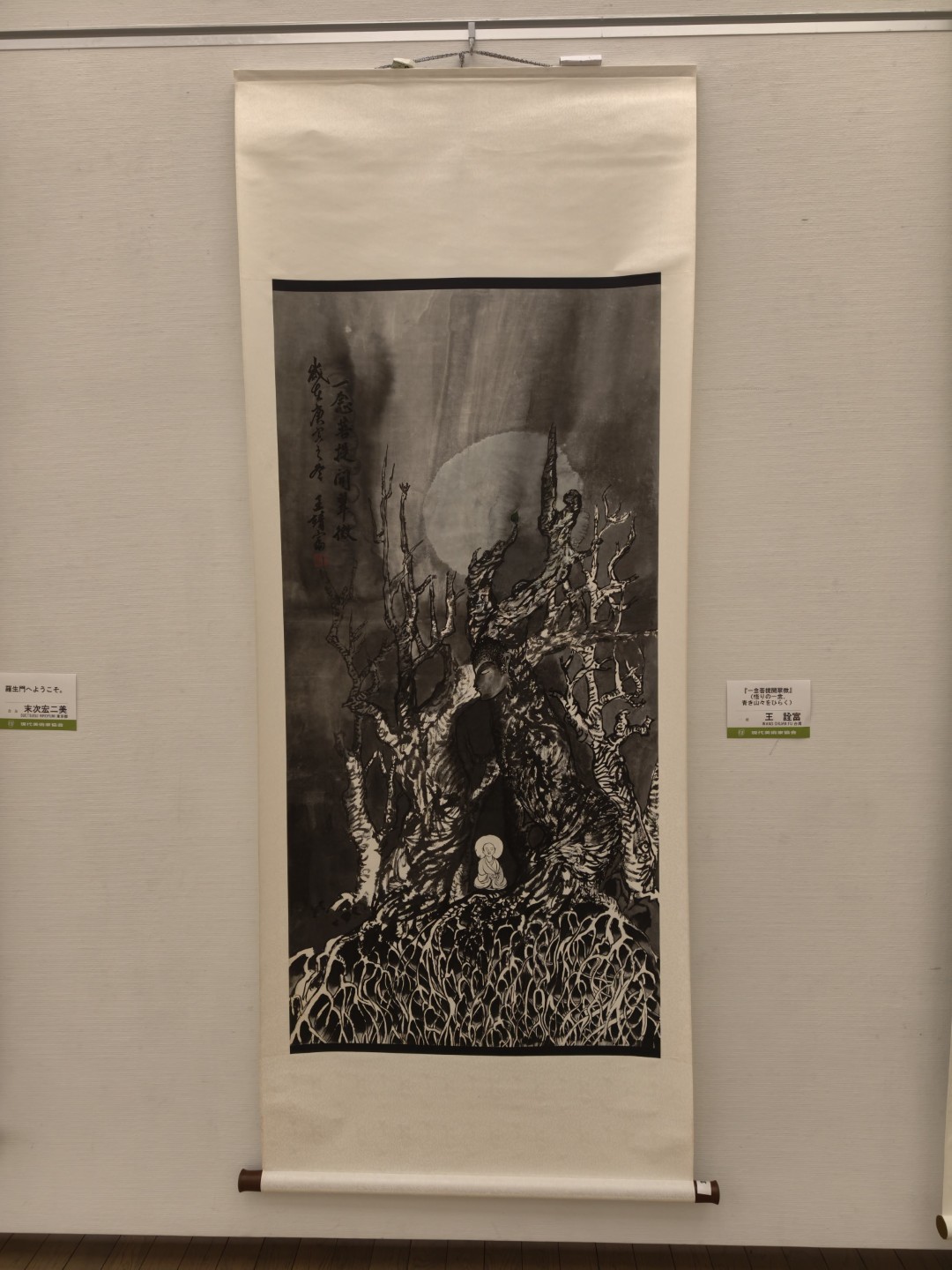
雖然王詮富作品整體給人安靜感,但《一念菩提開翠微》並非完全平和。畫面中仍可見潑墨、破墨或較為濃重的墨色塊面,形成一種原初混沌感。在此作中,畫面左側或下方有狂放的潑墨與破墨,如巨浪般翻湧,宛如宇宙太初混沌或現代社會不可預測的命運洪流。
這使作品不流於單純清雅。王詮富並非描繪一個完全無憂的世界,而是在混沌邊緣建立定靜。濃墨與留白之間的張力,使畫面同時包含不安與安住;潑墨提供動勢,禽鳥提供定點;墨色代表不可控的外在世界,禽鳥與一念則代表主體在其中尋得的覺知。
這種結構使作品具有深刻的現代性。當代人的處境並不是完全平穩,而是面對資訊洪流、社會變動、情感不確定與存在焦慮。王詮富沒有否認這些混沌,而是將其轉化為墨色的翻湧。真正的重點不在於消除混沌,而是在混沌邊緣找到一念清明。
因此,《一念菩提開翠微》的潑墨不是純粹技巧,也不是裝飾性墨韻,而是作品精神辯證的必要部分。若沒有混沌,菩提便失去意義;若沒有濃墨,留白也不會如此澄明。
六、禽鳥意象:微小存在的精神錨點
在《一念菩提開翠微》中,微小禽鳥是畫面的關鍵。王詮富在混沌墨海邊緣安排一隻低頭凝神的禽鳥;這隻鳥微小卻清晰,成為現代漫遊者安住當下的精神錨點。
禽鳥在東亞繪畫中常具有多重意義。它可以是自然生命,可以是季節標誌,也可以象徵孤高、閒逸、自由或靜觀。王詮富筆下的禽鳥並非飛翔中的鳥,而是低頭、凝神、安住於一處的鳥。這一姿態非常重要:它不是逃離,而是停留;不是激烈行動,而是內在凝定。
在構圖上,禽鳥的微小使其與大片留白和濃墨形成比例差異。牠像被拋擲到巨大世界中的小生命,卻沒有顯得驚慌。相反地,牠的低頭姿態呈現出一種自足與覺察。這使牠不只是自然物象,而成為人類主體的投影。
觀者看見這隻鳥時,也看見自己:在龐大世界中微小、有限、脆弱,卻仍可透過一念覺知找到安住之地。這正是王詮富作品最動人的地方。他沒有以宏大敘事安慰觀者,而是以一隻小鳥提示:真正的安定,可能來自最微小的心念轉向。
七、現象學還原:把觀看帶回事物本身
我們以胡塞爾「現象學還原」來理解王詮富作品,指出他透過色彩減法與留白,使觀者懸置世俗喧囂,直視事物本真。
若將這一觀點應用於《一念菩提開翠微》,可以說王詮富的畫面進行了一種視覺上的還原。所謂還原,並不是把事物變簡單,而是把外在附著物暫時放下,讓事物以更原初的方式顯現。
在作品中,山林、鳥、空氣、墨色與紙面都被高度簡化。觀者不會看到複雜景物,也不會被敘事細節分散注意,而是直接面對幾個基本元素:墨、白、鳥、氣。這些元素看似簡單,卻足以建立一個完整的精神場。
這種還原也要求觀者改變觀看方式。面對濃烈色彩或敘事作品時,觀者常透過辨認圖像與解讀故事進入作品;但面對王詮富,觀者必須進入一種更慢、更接近冥想的觀看。他必須感受墨的呼吸、白的深度、鳥的停頓與整體空間的安靜。
因此,王詮富作品不只是畫出靜,而是訓練觀看者進入靜。這正是其藝術價值所在。
八、「一念」作為時間的最小轉折
《一念菩提開翠微》中,「一念」是作品最核心的時間概念。一念極短,卻可以改變整個精神方向。它不是漫長修行的結果描述,而是覺知發生的瞬間。
王詮富以水墨表現一念,並不是畫一個具體事件,而是建立一種瞬間的凝定感。畫面中的鳥低頭凝神,濃墨暫停於邊緣,留白展開如氣,整個畫面彷彿都停在一個即將開悟或已然開悟的臨界點。
這種時間不同於敘事時間。敘事時間有前因後果,有發展與結局;王詮富的時間則是凝縮的、當下的、內在的。一念之中,過去的紛擾與未來的焦慮被暫時放下,只剩當下的覺察。
這也是作品對現代人的重要提醒。現代生活往往被加速時間支配:行程、通知、訊息、效率、焦慮不斷推動我們向前。王詮富則以「一念」讓時間暫停,使觀者重新回到當下。菩提不是遙遠彼岸,而可能發生於一念之間。
九、「菩提」的視覺化:覺悟不是宗教圖像,而是觀看狀態
「菩提」一詞帶有佛學意涵,但王詮富並未以宗教圖像或明確符號表現覺悟。畫面中沒有佛像、經文或法器,而只有墨、白與禽鳥。這使「菩提」不被具象化為宗教標誌,而轉化為觀看狀態。
這是一種成熟的處理方式。若作品直接描繪宗教符號,觀者可能迅速將其歸類為宗教藝術;但王詮富讓菩提存在於畫面的氣息、留白與安定之中,使覺悟成為一種可感但不可完全言說的狀態。
在此,菩提不是被看見的物件,而是觀看本身的轉化。當觀者在畫面前放慢,當視線從濃墨進入留白,當心念跟隨禽鳥停下,作品便在觀看過程中開啟其菩提意涵。
因此,《一念菩提開翠微》並非「畫出覺悟」,而是「使觀看者接近覺悟的狀態」。這種作品不是宣教,而是引導;不是說明,而是開啟。
十、「翠微」的自然詩學:山氣、青色與幽微之境
題名中的「翠微」使作品保留了山水詩學的氣息。翠微可指青翠山色、山間微茫之處、遠山與雲氣交會的幽深境界。它不是明確可測量的地理位置,而是一種介於可見與不可見之間的自然氛圍。
在作品中,翠微未必被具體描繪為青山綠林,而可能透過墨色、留白與空間氣韻被暗示。這種處理方式比直接畫山更接近水墨精神:山不必完全顯形,山氣可以透過墨與白之間的關係浮現。
「開翠微」則具有開啟之意。菩提一念使翠微展開,或心念清明使幽微山氣顯現。此處的自然不是外在風景,而是心境與世界互相開啟的結果。當心念澄明,山色也隨之開展;當觀看安定,世界便重新顯現其幽微。
這使《一念菩提開翠微》同時具有山水性與禪意,但它的山水性不在景物描寫,而在氣韻與空間感;它的禪意也不在宗教符號,而在心念轉化。
十一、與掛軸展示的關係:垂直觀看中的精神下沉
本屆台灣參展作品多採掛軸形式展示,王詮富的水墨作品與掛軸形式具有高度契合性。掛軸的垂直性、柔性與東亞書畫傳統,使台灣作品在國立新美術館中形成一種特殊的空間修辭。
對《一念菩提開翠微》而言,掛軸的垂直性會強化其精神下沉與氣韻流動。觀者的視線沿著畫面由上而下移動,在留白、墨色與禽鳥之間游走。這種觀看不是快速掃描,而更像閱讀一段氣息。
掛軸也使作品避免厚重畫框帶來的封閉感。王詮富的留白需要呼吸,墨色需要與周圍空間相互滲透;掛軸的柔性與紙本感,使作品更能保有東亞水墨的開放性。當它懸掛於現代美術館白牆上時,作品不僅呈現自身,也與空間形成呼應。
因此,掛軸對王詮富而言不是單純裝裱形式,而是作品精神性的延伸。它使水墨不被固定為封閉物件,而像一段可以展開、收起、移動與再度展開的精神經驗。
 【專題評論】日本第82回「現展」台灣藝術家群像
十二、與國立新美術館場域的關係:在大型公募展中製造安靜
國立新美術館作為第82回現展的展場,具有大型展示空間與多元作品並置的特徵。該館不設常設典藏,而以大型展覽、多樣展示與藝術資訊公開為主要任務。
在如此龐大的公募展環境中,王詮富作品的安靜反而是一種力量。大型公募展往往作品眾多,媒材繁複,觀者在短時間內面對大量視覺訊息,容易產生疲勞。《一念菩提開翠微》以留白與水墨減法,為展場製造一個停頓點。
這種停頓不是消極的,而是積極的觀看調節。它讓觀者從快速瀏覽轉向凝視,從外在刺激轉向內在感受。若說姜金玲以色彩使白盒子展場被亞熱帶生命力衝撞,陳福祺以數位光譜使展場進入後人類感知,那麼王詮富則以水墨留白在展場中打開一個安靜的精神空間。
這種作品在展場中的作用非常珍貴。它證明藝術不必以聲量取勝,也可以以靜默建立強度。
十三、與前幾位藝術家的對照:從擴張到收斂
王詮富的作品與前幾位藝術家形成清楚對照。蔡梅芳的彩墨具有動態崇高,姜金玲的重彩具有生命擴張,陳福祺的數位圖像具有光譜化與虛擬感,廖純沂則在冷調浮境中建立心理懸置。王詮富則將所有這些外向或複雜的力量收斂為一念、一鳥、一片墨與大量留白。
這種收斂不是退縮,而是另一種強度。擴張的藝術使人感受世界的龐大,收斂的藝術則使人感受心念的深度。王詮富不試圖填滿世界,而是讓世界退後,使一念得以顯現。
在台灣藝術家群像中,他代表的是東方水墨精神在當代展場中的一種可能:不是復興古典風格,也不是模仿當代潮流,而是以水墨的減法、空性與氣韻,回應現代人的精神需求。
十四、專業評論觀點:王詮富《一念菩提開翠微》的四重價值
綜合以上分析,王詮富《一念菩提開翠微》在第82回現展台灣藝術家群像中具有以下四重價值。
第一,媒材價值
作品以寫意水墨、潑墨與留白,展現水墨在當代展場中的精神可能。王詮富沒有將水墨作為懷舊媒材,而是透過其減法特質,回應視覺過載時代的觀看困境。
第二,空間價值
作品中的留白不是空缺,而是充滿氣韻與精神勢能的空間。墨與白、動與靜、混沌與澄明之間形成高度凝練的空間辯證。
第三,象徵價值
微小禽鳥是作品的精神錨點。牠象徵在巨大世界中仍能安住當下的主體,也使「一念菩提」從抽象概念轉化為可見姿態。
第四,展場價值
在國立新美術館的大型公募展環境中,作品以安靜與留白製造觀看停頓,為觀者提供從視覺刺激回到內在凝視的可能。
十五、本章小結:在一念之間開啟澄明
王詮富《一念菩提開翠微》是一件以極簡水墨語言處理深層精神命題的作品。它不以繁複圖像取勝,也不以強烈色彩壓迫觀者,而是透過留白、潑墨與微小禽鳥,建立一個關於當下、覺知與安住的視覺空間。
作品中的「一念」使時間凝縮,「菩提」使觀看轉化,「翠微」使自然幽微地展開。墨色代表混沌與世界的不可測,留白代表空性與精神呼吸,禽鳥則代表在混沌邊緣仍能凝神安住的生命主體。
在第82回現展的台灣藝術家群像中,王詮富的重要性正在於,他讓觀者看見另一種當代性:不是越新越當代,不是越滿越有力,也不是越強烈越深刻。真正的當代性,有時恰恰來自對過度刺激的節制,來自對空白的信任,來自於讓一隻小鳥在一片墨色與留白之間,重新教會我們如何觀看、如何停下、如何在一念之間開啟澄明。
相關內容:
王詮富《一念菩提開翠微》參展日本第82回現展,以水墨留白開啟精神澄明之境
82回現展 2026日本國立新美術館展「日本第82回現代美術家展」
【Special Review】Portraits of Taiwanese Artists at the 82nd Japan “Genten” Exhibition
WANG CHUAN FU
Ink-Wash Void, Phenomenological Reduction, and Spiritual Clarity in One Thought of Bodhi Opens the Verdant Mist
Written by WANG MUTI
I. The Artist’s Position: A Contemplative Viewer in an Age of Visual Overload
Among the portraits of Taiwanese artists in the 82nd Japan “Genten” Exhibition, Wang Chuan Fu’s work offers a mode of viewing that is extremely quiet yet deeply powerful. If Tsai Mei-Fang’s Lingering Wisteria responds to natural sublimity through color-ink storms, Liau Chun-Yi’s Unfinished・Floating Realm presents modern psychological suspension through weightless flowers, Jiang Jinling releases subtropical life force through Emotional Journey in the Lotus Pond and Shell Ginger in Full Bloom Attracts Birds, and Chen Fu-Chi translates Zhuangzi’s proposition into digital simulacra through The Pleasure of Fish, then Wang Chuan Fu’s One Thought of Bodhi Opens the Verdant Mist represents a completely different artistic path: through ink wash, voids, small birds, and concise composition, he establishes a spiritual pause within the noisy contemporary exhibition site.
Wang Chuan Fu’s expressive ink-wash work appears, in the exhibition field of the 82nd Genten Exhibition filled with strong visual impact and diverse media, like a crisp rest note; through an extreme visual subtraction, it approaches the essence of existence. His One Thought of Bodhi Opens the Verdant Mist especially uses splashed ink, voids, and bird imagery to provide viewers with a spiritual anchor that transcends time and rests in the present moment.
Therefore, Wang Chuan Fu’s position in this special topic is not to compete for visual attention through intense color or new-media language, but rather to oppose “more” with “less,” “agitation” with “stillness,” and “fullness” with “emptiness.” His work reminds us that the power of contemporary art does not necessarily come from the expansion of media and the increase of visual stimulation; it may also come from restraint of the desire to view and the slow summoning of spiritual depth.
II. The Titular Structure of One Thought of Bodhi Opens the Verdant Mist: Time, Awakening, and Mountain Atmosphere
The title One Thought of Bodhi Opens the Verdant Mist possesses a high degree of poetic and philosophical quality. “One thought” refers to an extremely brief instant of mind, and may also be understood as the smallest unit of consciousness arising, turning, or becoming aware; “bodhi” means awakening, awareness, or enlightenment; “opens the verdant mist” brings into the title the realms of mountain forest, greenness, cloud vapor, and subtle depth. The entire title does not describe an external landscape, but combines psychology, Buddhist thought, and natural imagery into a spiritual event.
If the title is broken down, “one thought” is temporal; “bodhi” is spiritual; and “verdant mist” is spatial and natural. The intersection of the three means that the work does not merely depict mountain forests and birds, but depicts an instant in which a thought opens awakening within nature and emptiness.
This title also suggests the way the work should be viewed. Viewers should not understand the picture as an ordinary landscape, bird-and-flower painting, or bird study, but should regard it as a spiritual process: from chaos to clarity, from flow to resting, from external scenery to inner awareness. The small bird in the work pierces through anxiety within “one thought,” fully accords with the present moment, and becomes a spiritual anchor for modern viewers to rest in the now.
Therefore, the title One Thought of Bodhi Opens the Verdant Mist has already set an important direction: the work is not concerned with natural objects themselves, but with whether viewers can enter a clearer, more stable, and more awakened state of viewing through natural imagery.
III. The Contemporaneity of Expressive Ink Wash: Not Retro, but Subtraction
Wang Chuan Fu’s use of expressive ink wash easily calls to mind traditional literati painting or classical landscape and bird-and-flower painting. However, his work is not simply retro, nor does it use traditional form to oppose the contemporary. Instead, it allows the voids, ink tones, brush momentum, and spirituality within ink wash to respond anew to the visual fatigue and psychological anxiety of modern people.
Contemporary society is a highly visualized society. Screens, images, advertisements, social platforms, and short videos continually increase the intensity of visual stimulation, and viewers’ attention is rapidly consumed. Art exhibition sites often face similar problems: works become larger and larger, colors more and more intense, media increasingly complex, and viewing sometimes no longer remains contemplation but becomes sensory competition.
Against this background, Wang Chuan Fu’s choice of the “subtraction” of ink wash has contemporary critical significance. He does not occupy the retina with full-field color, nor does he pile up information through complex images; instead, he allows the picture to retain blankness, breathing, and pause. His work is connected to Husserl’s “phenomenological reduction,” indicating that he brackets color and worldly noise and guides viewers to look directly at the truth of things.
This “subtraction” is not simplification, nor impoverishment, but an active choice. Wang Chuan Fu removes unnecessary visual noise and allows ink, white, bird, and vital resonance to become the core elements of the work. This subtraction gives the work a counter-force within the contemporary exhibition site: it does not follow the logic of visual overload, but asks viewers to slow down and learn to view again.
IV. The Topology of the Void: Emptiness Is Not Absence, but an Energy Field
One of the most important formal languages in One Thought of Bodhi Opens the Verdant Mist is the void. The void has a long tradition in East Asian ink wash, but in Wang Chuan Fu’s work, it is not a formal habit; it is the core of the work’s spirituality.
In Western classical painting, the canvas is often understood as a space that needs to be filled; too much blankness may be regarded as unfinished. In East Asian ink wash, however, white is not merely absence, but cloud vapor, water vapor, time, light, emptiness, and imaginative space. Wang Chuan Fu’s use of voids breaks the obsession with “fear of empty space” in Western classical painting, making the paper surface untouched by brush and ink become a “nothingness” full of life potential.
This point is especially important for One Thought of Bodhi Opens the Verdant Mist. The void in the picture is not a background, but part of the subject. Where ink is present, it provides form; where the void is present, it provides qi. Ink is visible; white is invisible yet sensible. In the white, viewers sense air, distance, silence, and the unfolding of mind.
Therefore, the void may be understood as a kind of topological space. It is not a flat “nothing,” but a field that allows the various elements to enter into relationship. The bird appears solitary yet settled because of the void; ink gains flow and weight because of the void; viewers also gain a spiritual space for entering the work because of the void.
Wang Chuan Fu’s void reminds us that art does not need to fill everything. Truly profound viewing sometimes comes precisely from what has not been fully spoken, not fully painted, and not fully occupied.
V. Splashed Ink and Chaos: Another Presentation of Natural Force
Although Wang Chuan Fu’s work as a whole gives an impression of quietness, One Thought of Bodhi Opens the Verdant Mist is not completely peaceful. The picture still contains splashed ink, broken ink, or relatively heavy ink blocks, forming a sense of primordial chaos. In this work, wild splashed ink and broken ink appear on the left side or lower part of the picture, surging like giant waves, resembling the primordial chaos of the universe or the unpredictable torrent of fate in modern society.
This prevents the work from falling into mere elegance. Wang Chuan Fu does not depict a completely carefree world, but establishes stillness at the edge of chaos. The tension between dense ink and void allows the picture to contain both unease and resting; splashed ink provides movement, birds provide fixed points; ink represents the uncontrollable external world, while the bird and one thought represent the awareness found by the subject within it.
This structure gives the work profound modernity. The condition of contemporary people is not completely stable, but involves facing information torrents, social changes, emotional uncertainty, and existential anxiety. Wang Chuan Fu does not deny these forms of chaos, but transforms them into the surging of ink. The real focus is not to eliminate chaos, but to find one thought of clarity at the edge of chaos.
Therefore, the splashed ink in One Thought of Bodhi Opens the Verdant Mist is not pure technique, nor decorative ink resonance, but a necessary part of the work’s spiritual dialectic. Without chaos, bodhi would lose its meaning; without dense ink, the void would not be so clear.
VI. Bird Imagery: The Spiritual Anchor of a Small Existence
In One Thought of Bodhi Opens the Verdant Mist, the small bird is the key to the picture. Wang Chuan Fu places a bird lowering its head in concentration at the edge of the chaotic sea of ink; this bird is small yet clear, becoming a spiritual anchor for the modern wanderer to rest in the present moment.
Birds in East Asian painting often have multiple meanings. They may be natural lives, seasonal markers, or symbols of solitude, leisure, freedom, or contemplation. The bird under Wang Chuan Fu’s brush is not a bird in flight, but a bird lowering its head, concentrating, and resting in one place. This posture is extremely important: it is not escape, but staying; not intense action, but inner settling.
Compositionally, the smallness of the bird creates a proportional difference with the large voids and dense ink. It seems like a small life cast into a vast world, yet it does not appear frightened. On the contrary, its head-lowered posture presents a kind of self-sufficiency and awareness. This makes it not merely a natural object, but a projection of the human subject.
When viewers see this bird, they also see themselves: small, finite, and fragile within a vast world, yet still able to find a place to rest through one thought of awareness. This is precisely the most moving aspect of Wang Chuan Fu’s work. He does not comfort viewers with grand narrative, but uses a small bird to suggest that true stability may come from the smallest turning of thought.
VII. Phenomenological Reduction: Bringing Viewing Back to the Things Themselves
We use Husserl’s “phenomenological reduction” to understand Wang Chuan Fu’s work, pointing out that through chromatic subtraction and the void, he allows viewers to bracket worldly noise and look directly at the truth of things.
If this perspective is applied to One Thought of Bodhi Opens the Verdant Mist, one may say that Wang Chuan Fu’s image carries out a visual reduction. Reduction here does not mean making things simple, but temporarily setting aside external attachments, allowing things to appear in a more primordial manner.
In the work, mountain forest, bird, air, ink tone, and paper surface are all highly simplified. Viewers do not see complex scenery, nor are they distracted by narrative details, but directly face several basic elements: ink, white, bird, and qi. These elements appear simple, yet are sufficient to establish a complete spiritual field.
This reduction also requires viewers to change their mode of viewing. When facing intense colors or narrative works, viewers often enter the work through identifying images and interpreting stories; when facing Wang Chuan Fu, however, viewers must enter a slower, more meditative mode of viewing. They must feel the breathing of ink, the depth of white, the pause of the bird, and the quietness of the overall space.
Therefore, Wang Chuan Fu’s work does not merely paint stillness, but trains viewers to enter stillness. This is precisely where its artistic value lies.
VIII. “One Thought” as the Smallest Turning of Time
In One Thought of Bodhi Opens the Verdant Mist, “one thought” is the most central concept of time in the work. One thought is extremely brief, yet it can change the entire spiritual direction. It is not a description of the result of long cultivation, but the instant in which awareness occurs.
Wang Chuan Fu expresses one thought through ink wash not by painting a concrete event, but by establishing a sense of instantaneous concentration. The bird in the picture lowers its head in concentration, dense ink pauses at the edge, and the void opens like qi; the entire image seems to pause at a threshold of imminent or already accomplished awakening.
This kind of time differs from narrative time. Narrative time has causes and consequences, development and conclusion; Wang Chuan Fu’s time is condensed, present, and internal. Within one thought, the disturbances of the past and anxieties about the future are temporarily set aside, leaving only awareness of the present.
This is also an important reminder the work offers to modern people. Modern life is often dominated by accelerated time: schedules, notifications, messages, efficiency, and anxiety constantly push us forward. Wang Chuan Fu uses “one thought” to pause time and bring viewers back to the present. Bodhi is not a distant other shore, but may occur between one thought.
IX. The Visualization of “Bodhi”: Awakening Is Not Religious Imagery, but a State of Viewing
The term “bodhi” carries Buddhist meaning, but Wang Chuan Fu does not express awakening through religious imagery or explicit symbols. There are no Buddha images, scriptures, or ritual implements in the picture, but only ink, white, and birds. This prevents “bodhi” from being concretized into a religious sign and transforms it into a state of viewing.
This is a mature treatment. If the work directly depicted religious symbols, viewers might quickly classify it as religious art; but Wang Chuan Fu allows bodhi to exist in the atmosphere, void, and settled quality of the picture, making awakening a state that can be felt but not fully spoken.
Here, bodhi is not an object being seen, but the transformation of viewing itself. When viewers slow down before the picture, when the gaze moves from dense ink into the void, and when the mind follows the bird and stops, the work opens its bodhi meaning within the process of viewing.
Therefore, One Thought of Bodhi Opens the Verdant Mist does not “paint awakening,” but “brings viewers close to a state of awakening.” This kind of work is not preaching, but guidance; not explanation, but opening.
X. The Natural Poetics of “Verdant Mist”: Mountain Atmosphere, Green Color, and a Realm of Subtle Depth
The “verdant mist” in the title allows the work to retain the atmosphere of landscape poetics. Verdant mist may refer to green mountain colors, faintness among mountains, or the deep realm where distant mountains and cloud vapor meet. It is not a clearly measurable geographical location, but a natural atmosphere between the visible and the invisible.
In the work, verdant mist may not necessarily be concretely depicted as green mountains and forests, but may be suggested through ink tone, void, and spatial resonance. This treatment is closer to the spirit of ink wash than directly painting mountains: mountains do not need to be fully visible; mountain atmosphere can emerge through the relationship between ink and white.
“Opening the verdant mist” also implies opening. One thought of bodhi opens verdant mist, or a clear mind reveals subtle mountain atmosphere. Nature here is not external scenery, but the result of mutual opening between mind-state and world. When the mind is clear, mountain color unfolds accordingly; when viewing becomes settled, the world again reveals its subtle depth.
This makes One Thought of Bodhi Opens the Verdant Mist possess both landscapeness and Chan/Zen meaning, but its landscapeness does not lie in the depiction of scenery, but in vital resonance and spatial feeling; its Chan/Zen meaning also does not lie in religious symbols, but in the transformation of mind.
XI. Relationship with Hanging-Scroll Display: Spiritual Descent in Vertical Viewing
Many Taiwanese participating works in this exhibition are displayed in hanging-scroll form, and Wang Chuan Fu’s ink-wash work is highly compatible with the hanging-scroll format. The verticality, flexibility, and East Asian calligraphy-and-painting tradition of the hanging scroll allow Taiwanese works to form a special spatial rhetoric within The National Art Center, Tokyo.
For One Thought of Bodhi Opens the Verdant Mist, the verticality of the hanging scroll strengthens its spiritual descent and the flow of vital resonance. The viewer’s gaze moves from top to bottom across the image, wandering among void, ink tone, and bird. This mode of viewing is not rapid scanning, but more like reading a passage of breath.
The hanging scroll also allows the work to avoid the sense of closure brought by a heavy frame. Wang Chuan Fu’s void needs to breathe, and ink tone needs to penetrate the surrounding space; the flexibility and paper-based feeling of the hanging scroll allow the work to better preserve the openness of East Asian ink wash. When it hangs on the white wall of a modern art museum, the work not only presents itself, but also resonates with the space.
Therefore, for Wang Chuan Fu, the hanging scroll is not merely a mounting format, but an extension of the work’s spirituality. It prevents ink wash from being fixed as a closed object, making it resemble a spiritual experience that can be unfolded, rolled up, moved, and unfolded again.
【Special Review】Portraits of Taiwanese Artists at the 82nd Japan “Genten” Exhibition
XII. Relationship with the Field of The National Art Center, Tokyo: Producing Quietness in a Large-Scale Public-Entry Exhibition
As the exhibition venue of the 82nd Genten Exhibition, The National Art Center, Tokyo, is characterized by large-scale exhibition spaces and the juxtaposition of diverse works. The museum has no permanent collection and takes large-scale exhibitions, diverse displays, and public access to art information as its main tasks.
Within such a vast public-entry exhibition environment, the quietness of Wang Chuan Fu’s work instead becomes a kind of force. Large public-entry exhibitions often include many works and complex media; viewers facing large amounts of visual information in a short time can easily become fatigued. One Thought of Bodhi Opens the Verdant Mist creates a point of pause for the exhibition site through voids and ink-wash subtraction.
This pause is not passive, but an active regulation of viewing. It allows viewers to shift from quick browsing to gazing, from external stimulation to inner feeling. If Jiang Jinling uses color to let the white-cube space be struck by subtropical vitality, and Chen Fu-Chi uses digital spectra to bring the exhibition site into posthuman perception, then Wang Chuan Fu uses ink-wash voids to open a quiet spiritual space within the exhibition site.
The function of this kind of work within the exhibition site is very precious. It proves that art does not have to win through volume; it can also establish intensity through silence.
XIII. Comparison with the Previous Artists: From Expansion to Contraction
Wang Chuan Fu’s work forms a clear contrast with the previous artists. Tsai Mei-Fang’s color ink possesses dynamic sublimity; Jiang Jinling’s heavy color possesses life expansion; Chen Fu-Chi’s digital imagery possesses spectralization and virtuality; Liau Chun-Yi establishes psychological suspension within a cool-toned floating realm. Wang Chuan Fu, however, gathers all these outward or complex forces into one thought, one bird, one field of ink, and a large amount of void.
This contraction is not retreat, but another form of intensity. Expansive art makes people feel the vastness of the world; contracted art makes people feel the depth of thought. Wang Chuan Fu does not attempt to fill the world, but allows the world to recede so that one thought may appear.
Within the portraits of Taiwanese artists, he represents one possibility for the spirit of Eastern ink wash in the contemporary exhibition site: not reviving classical style, nor imitating contemporary trends, but responding to the spiritual needs of modern people through the subtraction, emptiness, and vital resonance of ink wash.
XIV. Professional Critical Perspective: The Fourfold Value of Wang Chuan Fu’s One Thought of Bodhi Opens the Verdant Mist
In summary, Wang Chuan Fu’s One Thought of Bodhi Opens the Verdant Mist possesses the following fourfold value within the portraits of Taiwanese artists in the 82nd Genten Exhibition.
First, Material Value
The work uses expressive ink wash, splashed ink, and voids to show the spiritual possibilities of ink wash in the contemporary exhibition site. Wang Chuan Fu does not use ink wash as a nostalgic medium, but responds to the viewing predicament of the age of visual overload through its subtractive qualities.
Second, Spatial Value
The void in the work is not absence, but a space full of vital resonance and spiritual potential. Between ink and white, movement and stillness, chaos and clarity, a highly condensed spatial dialectic is formed.
Third, Symbolic Value
The small bird is the spiritual anchor of the work. It symbolizes a subject that can still rest in the present within a vast world, and also transforms “one thought of bodhi” from an abstract concept into a visible posture.
Fourth, Exhibition-Site Value
Within the large-scale public-entry exhibition environment of The National Art Center, Tokyo, the work creates a pause in viewing through quietness and voids, offering viewers the possibility of returning from visual stimulation to inner contemplation.
XV. Chapter Summary: Opening Clarity between One Thought
Wang Chuan Fu’s One Thought of Bodhi Opens the Verdant Mist is a work that addresses deep spiritual propositions through an extremely concise ink-wash language. It does not win through complex imagery, nor does it pressure viewers with intense color; instead, through voids, splashed ink, and a small bird, it establishes a visual space concerning the present, awareness, and resting.
The “one thought” in the work condenses time, “bodhi” transforms viewing, and “verdant mist” lets nature unfold subtly. Ink tone represents chaos and the unknowability of the world, the void represents emptiness and spiritual breathing, and the bird represents a life subject that can still concentrate and rest at the edge of chaos.
Within the portraits of Taiwanese artists in the 82nd Genten Exhibition, Wang Chuan Fu’s importance lies in the way he allows viewers to see another kind of contemporaneity: not the newer the more contemporary, not the fuller the more powerful, and not the more intense the more profound. True contemporaneity sometimes comes precisely from restraint toward excessive stimulation, from trust in blankness, and from allowing a small bird between ink and void to teach us again how to view, how to stop, and how to open clarity between one thought.
【特集評論】日本第82回「現展」台湾芸術家群像
王詮富 WANG CHUAN FU
《一念菩提開翠微》における水墨の余白、現象学的還元、精神的澄明
執筆:王穆提(WANG MUTI)
一、芸術家の位置:視覚過多の時代における静観者
第82回日本「現展」の台湾芸術家群像の中で、王詮富の作品は極めて静かでありながら深い力を持つ鑑賞方法を提供している。蔡梅芳《恋恋紫藤》が彩墨の嵐によって自然崇高に応答し、廖純沂《未尽・浮境》が無重力の花卉によって現代心理の浮遊を提示し、姜金玲が《荷塘情旅》と《月桃盛開引禽来》によって亜熱帯の生命衝動を解放し、陳福祺が《魚の楽しみ》によって荘子の命題をデジタル擬像へ翻訳するなら、王詮富の《一念菩提開翠微》はまったく異なる芸術的経路である。彼は水墨、余白、小さな禽鳥、簡潔な構図によって、喧騒の現代展示場の中に精神的な停止点を築いている。
王詮富の写意水墨作品は、第82回現展の強烈な視覚的衝撃と多様なメディアに満ちた展示場の中で、一つの澄んだ休止符のように響く。極限までの視覚的減法を通じて存在の本体へ迫るのであり、とりわけ《一念菩提開翠微》は潑墨、余白、禽鳥のイメージによって、鑑賞者に時間を超え、現在に安住する精神的錨点を提供している。
したがって、本特集における王詮富の位置は、強烈な色彩やニューメディア言語によって視覚的注意を奪うことではなく、逆に「少」によって「多」に対抗し、「静」によって「躁」に対抗し、「空」によって「満」に対抗するところにある。彼の作品は私たちに思い出させる。現代美術の力は、必ずしもメディアの拡張や視覚刺激の増加から来るのではなく、鑑賞欲望の節制、そして精神深部への緩やかな召喚からも来るのである。
二、《一念菩提開翠微》の題名構造:時間、覚悟、山気
《一念菩提開翠微》という題名は、高度な詩性と哲学性を持っている。「一念」は極めて短い心念の瞬間を指し、意識の生成、転向、あるいは覚察の最小単位としても理解できる。「菩提」は覚悟、覚知、覚醒を意味する。「開翠微」は題名に山林、青翠、雲気、幽微の境を導き入れる。題名全体は外在的景観を描写するものではなく、心理、仏学、自然イメージを一つの精神的事件として結びつけている。
題名を分解して見るなら、「一念」は時間的であり、「菩提」は精神的であり、「翠微」は空間的かつ自然的である。三者の交差によって、作品は単に山林や禽鳥を描くのではなく、自然と空寂の中で一つの心念が覚悟を開く瞬間を描くものとなる。
この題名はまた、作品の鑑賞方法を示唆している。鑑賞者は画面を普通の山水、花鳥、あるいは禽鳥小品として理解すべきではなく、一つの精神的過程として見るべきである。混沌から澄明へ、流動から安住へ、外在的景物から内在的覚知へ。作品中の小さな禽鳥は「一念」の間に焦慮を貫き、完全に現在と契合し、現代の鑑賞者が現在に安住するための精神的錨点となる。
したがって、《一念菩提開翠微》の題名はすでに一つの重要な方向を設定している。作品が関心を向けるのは自然物象そのものではなく、鑑賞者が自然物象を通して、より明晰で、より安定し、より覚悟に近い鑑賞状態へ入ることができるかどうかである。
三、写意水墨の現代性:復古ではなく減法である
王詮富が写意水墨を用いることは、伝統的文人画や古典山水花鳥を容易に想起させる。しかし、彼の作品は単なる復古ではなく、伝統形式によって現代に対抗しているわけでもない。むしろ、水墨における余白、墨色、筆勢、精神性を、現代人の視覚疲労と心理的焦慮へ再び応答させている。
現代社会は高度に視覚化された社会である。スクリーン、画像、広告、SNS、ショート動画は視覚刺激の強度を絶えず高め、鑑賞者の注意力は急速に消耗される。芸術展示場もまた似た問題に直面している。作品はますます大きくなり、色彩はますます強くなり、メディアはますます複雑になり、鑑賞は時に沈思ではなく感官競争となる。
このような背景の中で、王詮富が水墨の「減法」を選ぶことには現代的批判の意味がある。彼は画面いっぱいの色彩によって網膜を占有せず、複雑な図像によって情報を積み重ねることもしない。むしろ画面に空白、呼吸、停止を残す。彼の作品はフッサールの「現象学的還元」と連結され、色彩と世俗の喧騒を括弧に入れ、鑑賞者を事物の本真へ直視させる。
ここでの「減法」は簡略化でも貧しさでもなく、能動的な選択である。王詮富は余分な視覚ノイズを削除し、墨、白、鳥、気韻を作品の核心要素とする。この減法は作品に現代展示場における反向きの力を与える。それは視覚過多の論理に従わず、鑑賞者に速度を落とし、再び見ることを学ぶよう要求する。
四、余白のトポロジー:空は無ではなくエネルギー場である
《一念菩提開翠微》において最も重要な形式言語の一つは余白である。余白は東アジア水墨において長い伝統を持つが、王詮富作品において余白は形式的習慣ではなく、作品の精神性の核心である。
西洋古典絵画において、キャンバスはしばしば埋められるべき空間として理解される。空白が多すぎれば未完成と見なされることもある。しかし東アジア水墨において、白は単なる欠落ではなく、雲気、水気、時間、光、虚無、想像空間である。王詮富の余白の運用は、西洋古典絵画における「空間恐怖」の執念を打破し、筆墨が触れていない紙面を、生命のポテンシャルに満ちた「無」にしている。
この点は《一念菩提開翠微》にとって特に重要である。画面中の余白は背景ではなく、主体の一部である。墨色がある場所は形を提供し、余白がある場所は気を提供する。墨は見えるものであり、白は見えないが感じられるものである。鑑賞者は白の中に空気、距離、静黙、心念の展開を感じる。
したがって、余白は一種のトポロジー空間として理解できる。それは平面的な「無」ではなく、諸要素を関係させる場である。禽鳥は余白によって孤寂でありながら安定して見え、墨色は余白によって流動と重量を持ち、鑑賞者も余白によって作品へ入る精神空間を得る。
王詮富の余白は私たちに思い出させる。芸術はすべてを埋める必要はない。本当に深遠な鑑賞は、しばしば語り尽くされず、描き尽くされず、完全には占有されていない場所から生まれるのである。
五、潑墨と混沌:自然の力のもう一つの提示
王詮富作品は全体として静かな印象を与えるが、《一念菩提開翠微》は完全に平和な作品ではない。画面中にはなお潑墨、破墨、あるいは比較的濃重な墨色の塊が見られ、原初的混沌感を形成している。この作品では、画面の左側または下方に奔放な潑墨と破墨があり、巨浪のようにうねり、宇宙創成の混沌、あるいは現代社会の予測不可能な運命の奔流のようである。
これにより作品は単純な清雅へ流れることを免れている。王詮富は完全に憂いのない世界を描いているのではなく、混沌の縁に定静を築いている。濃墨と余白の間の緊張により、画面は不安と安住を同時に含む。潑墨は動勢を提供し、禽鳥は定点を提供する。墨色は制御できない外在世界を表し、禽鳥と一念はその中で主体が見出す覚知を表す。
この構造は作品に深い現代性を与える。現代人の状況は完全に平穏なものではなく、情報の奔流、社会変動、感情の不確定性、存在不安に向き合うものである。王詮富はこれらの混沌を否定するのではなく、それを墨色のうねりへと転化している。本当の重点は混沌を消去することではなく、混沌の縁で一念の清明を見出すことである。
したがって、《一念菩提開翠微》の潑墨は純粋な技巧でも装飾的な墨韻でもなく、作品の精神的弁証法に不可欠な部分である。混沌がなければ菩提は意味を失い、濃墨がなければ余白もこれほど澄明にはならない。
六、禽鳥イメージ:小さな存在の精神的錨点
《一念菩提開翠微》において、小さな禽鳥は画面の鍵である。王詮富は混沌とした墨海の縁に、頭を下げて精神を集中させる一羽の禽鳥を配置している。この鳥は小さいが明瞭であり、現代の遊歩者が現在に安住するための精神的錨点となっている。
禽鳥は東アジア絵画においてしばしば多重の意味を持つ。それは自然生命であり、季節の標識であり、孤高、閑逸、自由、静観の象徴でもありうる。王詮富の筆下の禽鳥は飛翔中の鳥ではなく、頭を下げ、凝神し、一か所に安住する鳥である。この姿勢は非常に重要である。それは逃避ではなく滞留であり、激しい行動ではなく内面的な凝定である。
構図上、禽鳥の小ささは大きな余白と濃墨との間に比例の差異を形成する。それは巨大な世界へ投げ込まれた小さな生命のようだが、慌てているようには見えない。むしろその頭を下げた姿勢は、一種の自足と覚察を示している。これにより、それは単なる自然物象ではなく、人間主体の投影となる。
鑑賞者がこの鳥を見る時、自分自身を見る。巨大な世界の中で小さく、有限で、脆いが、それでも一念の覚知を通じて安住の場所を見出すことができる。これこそが王詮富作品の最も人を動かす点である。彼は壮大な叙事によって鑑賞者を慰めるのではなく、一羽の小鳥によって、真の安定は最も小さな心念の転向から来るかもしれないと示唆している。
七、現象学的還元:鑑賞を事物そのものへ戻す
私たちはフッサールの「現象学的還元」によって王詮富作品を理解し、彼が色彩の減法と余白を通じて、鑑賞者に世俗の喧騒を括弧に入れさせ、事物の本真を直視させていると指摘できる。
この観点を《一念菩提開翠微》に適用するなら、王詮富の画面は視覚上の一種の還元を行っていると言える。ここでいう還元とは、事物を単純にすることではなく、外在的な付着物を一時的に手放し、事物をより原初的な方法で現れさせることである。
作品中では、山林、鳥、空気、墨色、紙面が高度に簡化されている。鑑賞者は複雑な景物を見ることもなく、叙事的細部によって注意を逸らされることもない。ただいくつかの基本要素——墨、白、鳥、気——に直接向き合う。これらの要素は一見単純であるが、完全な精神場を築くには十分である。
この還元はまた、鑑賞者に鑑賞方法の変更を要求する。濃烈な色彩や叙事的作品に向き合う時、鑑賞者はしばしば図像の識別と物語の解読を通じて作品に入る。しかし王詮富に向き合う時、鑑賞者はより遅く、より瞑想に近い鑑賞へ入らなければならない。墨の呼吸、白の深度、鳥の停止、全体空間の静けさを感じなければならない。
したがって、王詮富作品は静けさを描くだけではなく、鑑賞者を静けさへ入るよう訓練している。これこそがその芸術的価値である。
八、「一念」としての時間の最小転換
《一念菩提開翠微》において、「一念」は作品の最も核心的な時間概念である。一念は極めて短いが、精神全体の方向を変えることができる。それは長い修行の結果の描写ではなく、覚知が発生する瞬間である。
王詮富は水墨によって一念を表現しているが、具体的な事件を描いているのではない。むしろ、瞬間的な凝定感を築いている。画面中の鳥は頭を下げて凝神し、濃墨は縁で停止し、余白は気のように開く。画面全体が、まもなく悟る、あるいはすでに悟った臨界点に止まっているかのようである。
この時間は叙事時間とは異なる。叙事時間には原因と結果があり、発展と結末がある。王詮富の時間は凝縮され、現在的で、内在的である。一念の中で、過去の紛擾と未来への焦慮は一時的に手放され、現在の覚察だけが残る。
これはまた、作品が現代人に与える重要な提醒でもある。現代生活はしばしば加速する時間に支配されている。予定、通知、メッセージ、効率、焦慮が絶えず私たちを前へ押し出す。王詮富は「一念」によって時間を停止させ、鑑賞者を現在へ戻す。菩提は遥かな彼岸ではなく、一念の間に起こりうるのである。
九、「菩提」の視覚化:覚悟は宗教図像ではなく鑑賞状態である
「菩提」という語は仏学的含意を持つが、王詮富は宗教図像や明確な記号によって覚悟を表現していない。画面には仏像、経文、法器はなく、墨、白、禽鳥だけがある。これにより「菩提」は宗教標識として具象化されることなく、鑑賞状態へと転化されている。
これは成熟した処理方法である。もし作品が直接宗教的記号を描いていれば、鑑賞者はそれをすぐに宗教芸術として分類するかもしれない。しかし王詮富は菩提を画面の気息、余白、安定の中に存在させ、覚悟を感じることはできるが完全には言語化できない状態にしている。
ここで菩提は見られる物件ではなく、鑑賞そのものの転化である。鑑賞者が画面の前で速度を落とし、視線が濃墨から余白へ入り、心念が禽鳥に従って止まる時、作品は鑑賞過程の中でその菩提的意味を開く。
したがって、《一念菩提開翠微》は「覚悟を描く」のではなく、「鑑賞者を覚悟の状態へ近づける」作品である。このような作品は宣教ではなく導きであり、説明ではなく開示である。
十、「翠微」の自然詩学:山気、青色、幽微の境
題名中の「翠微」は、作品に山水詩学の気息を保たせている。翠微は青々とした山色、山間のかすかな場所、遠山と雲気が交わる幽深な境を指しうる。それは明確に測定できる地理的位置ではなく、可視と不可視の間にある自然の雰囲気である。
作品において、翠微は必ずしも青山緑林として具体的に描かれているわけではなく、墨色、余白、空間の気韻によって暗示されている可能性がある。この処理方法は、直接山を描くよりも水墨精神に近い。山は完全に姿を現す必要がなく、山気は墨と白の関係を通じて浮かび上がることができる。
「開翠微」は開くという意味を持つ。菩提の一念が翠微を開く、あるいは心念の清明が幽微な山気を現れさせる。ここでの自然は外在的風景ではなく、心境と世界が互いに開き合う結果である。心念が澄明になる時、山色もそれに伴って開かれる。鑑賞が安定する時、世界はその幽微を再び現す。
これにより《一念菩提開翠微》は、山水性と禅意を同時に持つ。しかしその山水性は景物描写にあるのではなく、気韻と空間感にある。その禅意もまた宗教的記号にあるのではなく、心念の転化にある。
十一、掛軸展示との関係:垂直鑑賞における精神の沈降
本回の台湾出展作品の多くは掛軸形式で展示されており、王詮富の水墨作品と掛軸形式は高度に適合している。掛軸の垂直性、柔軟性、東アジア書画伝統は、台湾作品に国立新美術館の中で特殊な空間修辞を形成させている。
《一念菩提開翠微》にとって、掛軸の垂直性はその精神的沈降と気韻の流動を強化する。鑑賞者の視線は画面に沿って上から下へ移動し、余白、墨色、禽鳥の間をさまよう。この鑑賞は素早いスキャンではなく、一段の気息を読むことに近い。
掛軸はまた、重い額縁がもたらす閉鎖感を作品から避けさせる。王詮富の余白には呼吸が必要であり、墨色は周囲の空間と相互に浸透する必要がある。掛軸の柔軟性と紙本感は、作品が東アジア水墨の開放性をよりよく保つことを可能にする。それが現代美術館の白壁に掛けられる時、作品は自身を提示するだけでなく、空間とも呼応する。
したがって、王詮富にとって掛軸は単なる表装形式ではなく、作品の精神性の延伸である。それは水墨を閉じられた物件として固定せず、展開し、巻き取り、移動し、再び展開できる精神経験のようにする。
【特集評論】日本第82回「現展」台湾芸術家群像
十二、国立新美術館という場との関係:大型公募展の中に静けさを作る
国立新美術館は第82回現展の会場として、大規模展示空間と多元的作品の並置という特徴を持つ。同館は常設コレクションを持たず、大型展覧会、多様な展示、芸術情報の公開を主要任務としている。
このような巨大な公募展環境の中で、王詮富作品の静けさは逆に一つの力となる。大型公募展はしばしば作品数が多く、メディアも複雑であり、鑑賞者は短時間で大量の視覚情報に向き合うため疲労しやすい。《一念菩提開翠微》は余白と水墨の減法によって、展示場に一つの停止点を作り出している。
この停止は消極的なものではなく、積極的な鑑賞調整である。それは鑑賞者を素早い閲覧から凝視へ、外在的刺激から内在的感受へと移行させる。姜金玲が色彩によってホワイトキューブ展示場を亜熱帯生命力で衝突させ、陳福祺がデジタルスペクトルによって展示場をポストヒューマン感知へ入らせるとすれば、王詮富は水墨の余白によって展示場の中に静かな精神空間を開いている。
このような作品の展示場における作用は非常に貴重である。それは芸術が音量で勝つ必要はなく、静黙によって強度を築くこともできると証明している。
十三、前の数名の芸術家との対照:拡張から収斂へ
王詮富の作品は前の数名の芸術家と明確な対照を形成する。蔡梅芳の彩墨は動的崇高を持ち、姜金玲の重彩は生命拡張を持ち、陳福祺のデジタル画像はスペクトル化と仮想感を持ち、廖純沂は冷調の浮境の中に心理的懸置を築く。王詮富はこれらすべての外向き、あるいは複雑な力を、一念、一羽の鳥、一片の墨、大量の余白へと収斂させる。
この収斂は退縮ではなく、別の強度である。拡張する芸術は人に世界の巨大さを感じさせ、収斂する芸術は人に心念の深さを感じさせる。王詮富は世界を満たそうとせず、世界を後退させることで、一念を現れさせる。
台湾芸術家群像の中で、彼が代表するのは、東方水墨精神が現代展示場において持ちうる一つの可能性である。古典様式の復興でも、現代潮流の模倣でもなく、水墨の減法、空性、気韻によって現代人の精神的需要に応答するのである。
十四、専門的評論の観点:王詮富《一念菩提開翠微》の四重の価値
以上の分析を総合すると、王詮富《一念菩提開翠微》は第82回現展の台湾芸術家群像において、以下の四重の価値を持っている。
第一、メディアの価値
作品は写意水墨、潑墨、余白によって、現代展示場における水墨の精神的可能性を示している。王詮富は水墨を懐古的メディアとして用いるのではなく、その減法的特質を通じて、視覚過多時代の鑑賞の困難に応答している。
第二、空間の価値
作品中の余白は欠落ではなく、気韻と精神的ポテンシャルに満ちた空間である。墨と白、動と静、混沌と澄明の間に、高度に凝縮された空間的弁証法が形成されている。
第三、象徴の価値
小さな禽鳥は作品の精神的錨点である。それは巨大な世界の中でも現在に安住できる主体を象徴し、「一念菩提」を抽象概念から可視的姿勢へと転化している。
第四、展示場の価値
国立新美術館の大型公募展環境において、作品は静けさと余白によって鑑賞の停止を作り出し、鑑賞者に視覚刺激から内面的凝視へ戻る可能性を提供している。
十五、本章小結:一念の間に澄明を開く
王詮富《一念菩提開翠微》は、極めて簡潔な水墨言語によって深層の精神的命題を扱う作品である。それは複雑な図像によって勝負することも、強烈な色彩によって鑑賞者を圧迫することもない。むしろ余白、潑墨、小さな禽鳥を通じて、現在、覚知、安住に関する視覚空間を築いている。
作品中の「一念」は時間を凝縮し、「菩提」は鑑賞を転化し、「翠微」は自然を幽かに展開させる。墨色は混沌と世界の不可測性を表し、余白は空性と精神的呼吸を表し、禽鳥は混沌の縁でもなお凝神し安住できる生命主体を表す。
第82回現展の台湾芸術家群像において、王詮富の重要性は、鑑賞者にもう一つの現代性を見せている点にある。新しければ新しいほど現代的なのではなく、満ちていれば満ちているほど力強いのでもなく、強烈であれば強烈であるほど深いのでもない。真の現代性は、時に過度な刺激への節制、空白への信頼、そして一羽の小鳥が一片の墨色と余白の間で、私たちにいかに見るか、いかに止まるか、いかに一念の間に澄明を開くかを教え直すことから来るのである。