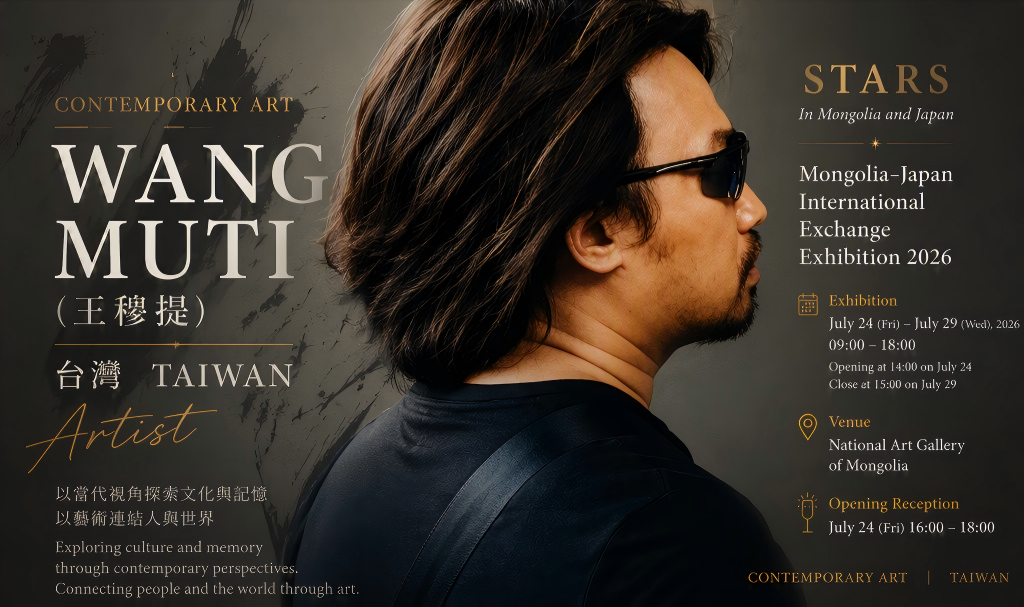
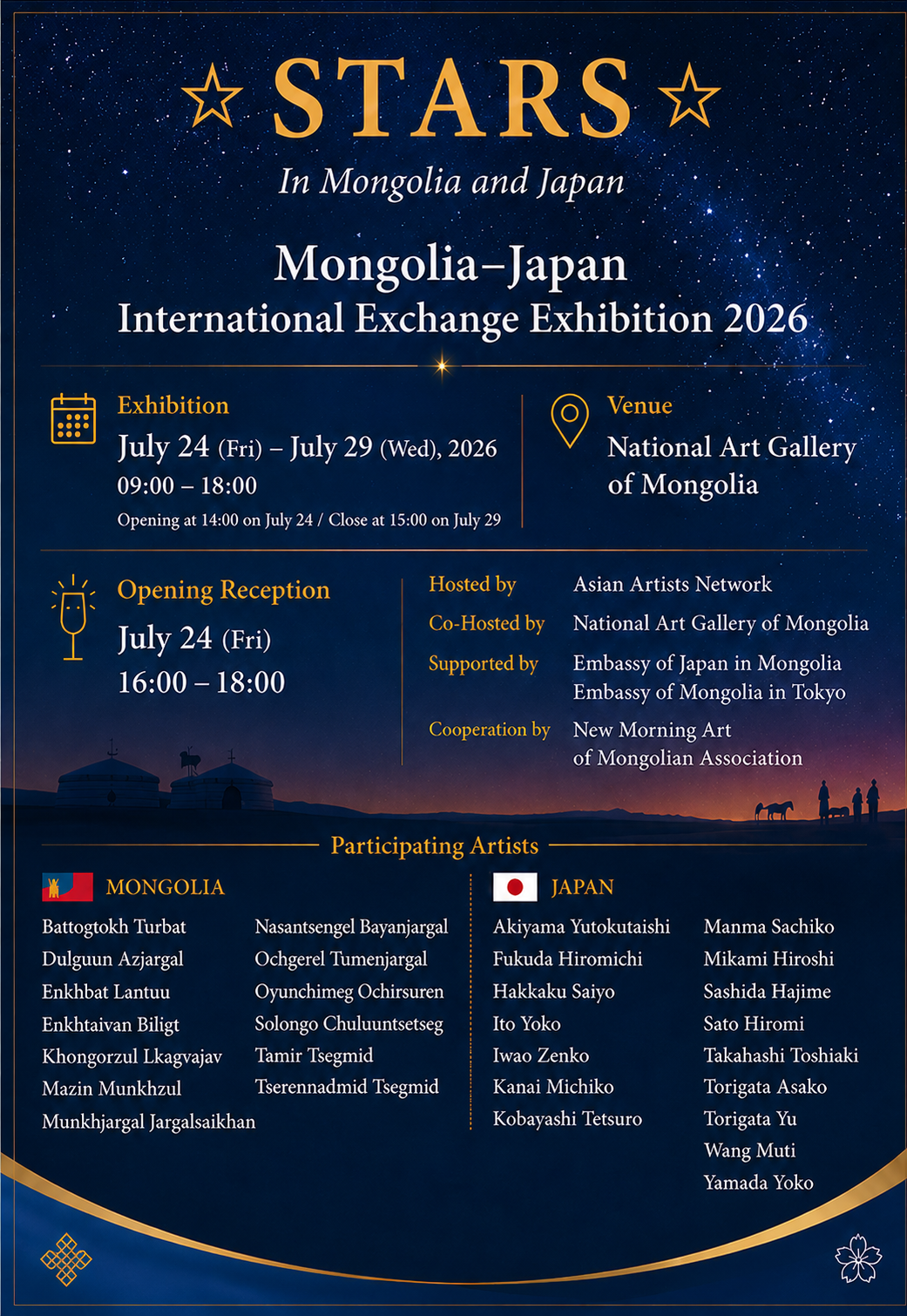
- Exhibition Title: Mongolia–Japan International Exchange Exhibition 2026 "STARS IN MONGOLIA AND JAPAN"
- Venue: National Art Gallery of Mongolia / Mongolian National Modern Art Gallery
- Exhibition Period: July 24, 2026 (Friday) – July 29, 2026 (Wednesday)
- Organizers: Asian Artists Network, National Art Gallery of Mongolia
- Supporters: Ministry of Culture of Mongolia, Embassy of Japan in Mongolia, Embassy of Mongolia in Japan
- Co-organizer: Mongolian New Morning Artists Association
 Wang Muti was invited to exhibit at the National Art Gallery of Mongolia - STARS IN MONGOLIA AND JAPAN On the Starry Sky, Identity, and the Cross-Cultural Journey
——Reading an Asian Encounter at the Mongolian National Modern Art Gallery
By Wang Muti
The French philosopher Michel de Montaigne once wrote in his essays: "The most difficult science in the world is to know oneself; and the best way to understand oneself is to place oneself in dialogue with the other."
I often ponder, when a person draws a line on a map and claims it to be the boundary of a nation, does the territory of the mind close along with it? I have always believed that humanity's earliest museum was not a physical structure built of cement and marble, but that vast night sky open to everyone free of charge. Before writing was invented and before laws were formulated, humanity had already learned to look up and contemplate the stars. Whether it was the nomadic peoples racing across the expansive steppes or the island fishermen disappearing amidst the massive waves of the Kuroshio Current, the cosmic glimmer reflected in their eyes was identical. The starry sky is the shared ceiling of humankind and the oldest language of civilization, one that requires no translation.
In the midsummer of 2026, when "STARS" became the title of this art exchange exhibition between Mongolia and Japan, what it stirred within my intellect and soul was not the superficial romance often penned by writers and poets, but a more fundamental ontological inquiry: across different regions, different historical encounters, and varying geopolitical landscapes, do we, standing at different coordinates, truly share the exact same sky?
Dialogue Between Island and Land: A Taiwanese Creator's Cross-Border Existence
As a creator born and raised in island Taiwan, my life experience is destined to be a journey of continuous boundary-crossing. Surrounded by the sea on all sides, this island naturally carries the fluidity, inclusiveness, and marginality of the ocean within its genes. Such soil and water endow us with a unique spiritual vision—one accustomed to seeking anchors amidst constant mutation and establishing self-identity at the intersection of diverse cultures.
As a Taiwanese contemporary artist and curator, I have long immersed myself within the networks of Asian art exchange. Whether serving as the head of the Taiwan Liaison Office of the Japan Modern Fine Artists Association or as a member of Japan’s "NAU (21st Century Fine Art Union)," I am constantly contemplating: In an increasingly flattened and technologized world, how can the philosophical spirit of the East find a profound resonance with the world through a contemporary abstract vocabulary?
Precisely due to the fluid essence of island culture, when we face different civilizations, we possess a fraction less of self-isolated arrogance and a fraction more of empathetic understanding. In this exhibition, the perspective of Taiwanese creators happens to form an invisible spiritual bridge, with one end connecting to the untamed, free, and expansive land-vitality of the Mongolian steppe, and the other echoing the exquisite, subtle, and inward-looking seasonal aesthetic of the Japanese archipelago.
【 The Spiritual Bridge of Asian Art 】 ┌───────────────────────┼───────────────────────┐ │ │ │ Mongolian Steppe Civilization Taiwanese Contemporary Art Japanese Archipelago Aesthetics (Vast, Free, Vitality) (Ink, Abstract, Madhyamaka Thought) (Exquisite, Seasonal, Shadow)
Repositioning Cultural Coordinates in the National Palace of Ulaanbaatar
The stage for this exhibition is set at the National Art Gallery of Mongolia in Ulaanbaatar, the capital of Mongolia. This is a national-level palace of art holding a supreme status; it preserves, researches, and displays all visual memories since the Mongolian Revolution of 1921.
For me, being able to exhibit alongside twenty-nine exceptional artists from Mongolia and Japan in this venue means far more than simply adding another line to my artistic resume. In the past, I had the honor of becoming the first Taiwanese artist to hold an "exhibition-within-an-exhibition solo showcase" at the National Art Center, Tokyo, and was awarded the "Future Prize" at the Japan NAU Exhibition; those exhibition experiences at the Tokyo Metropolitan Art Museum, Yokohama, and other venues granted me a profound understanding of Western abstraction and Japanese contemporary art.
However, when artworks cross oceans and lands to enter this National Art Gallery of Mongolia, a place steeped in the historical thickness of nomadic culture, the object of dialogue undergoes a qualitative change. Once an artwork leaves the private studio and enters a public space, the subject of conversation is no longer just the shifting audience, but history's depth and cultural evolution. Here, creators from different regions of Asia encounter one another within the same national gallery, and the exhibition hall becomes a magic mirror reflecting one another, compelling us to reposition our own cultural coordinates before immense time and space.
The Physical Dialectics of Madhyamaka Thought and Heavy Ink Gold-and-Green
In this exhibition, the contemporary ink creations I bring forth (such as "The Gaze of the Abyss" and "Embers of the Primordial Age") are, in essence, my personal metaphysical practice of the Mahayana Buddhist "Yogacara School" and "Madhyamaka Thought."
I attempt to fuse traditional Eastern ink, abstract art, and Eastern philosophical spirit within my work. The massive chaotic bodies in the frame—combining deep ink, mineral green, and mottled gold paste—appear as heavy as rock strata or bronze fossils, yet they hover helplessly within the vast blank space (the void) of the Xuan paper. This is precisely my physical performance of the Mahayana Buddhist verse "Form is emptiness, emptiness is form":
- Form (Matter): Dense scorched ink and shimmering gold paste push the sense of weight of matter to its extreme, symbolizing the manifestation of karmic seeds within the Alaya-vijnana since beginningless eons.
- Emptiness (Lack of Inherent Nature): The bold blank space of the Xuan paper represents absolute voidness. Having such a heavy object suspended in the void instead reveals the fragility and illusoriness of matter.
This creative focus on Buddhist cosmic views and spiritual issues happens to form a highly intense, cross-cultural dialogue with the unbridled vitality bred by the nomadic culture and Tibetan Buddhism of Mongolian artists, as well as the exquisite deconstruction of sensory and traditional aesthetics by new and old generations of Japanese artists. Art does not demand uniformity; art allows for difference. And true exchange begins precisely from recognizing one another's differences.
Watching Over Under the Same Starry Sky
The value of "STARS" is by no means limited to a single multi-day cross-border group exhibition; it is more like the beginning of a continuously growing Asian Art Community. Curated and driven by Ms. YAMADA YOKO, representative of the Asian Artists Network, and supported by the Ministry of Culture of Mongolia, the Embassy of Japan in Mongolia, and the Embassy of Mongolia in Japan, this cross-border cooperation between civil society and official bodies proves once again: Art sometimes establishes understanding between people much earlier than politics does. Because art directly faces living human beings and our shared humanity, rather than cold borders or institutional frameworks.
Within this starry roster composed of twenty-nine artists, each creator represents an independent universe. Different mediums, different backgrounds, and distinct life experiences interweave into a brand-new cultural constellation.
The starry sky over the Mongolian steppe is immensely vast; the starry sky over the Japanese coastline is filled with tranquility; and the starry sky atop Taiwan’s mountain peaks is equally beautiful. No matter where we stand at this moment, as long as we look up, what we gaze upon is actually the exact same universe. Although the stars are distant from one another in physical space, they illuminate the very same night sky together through their respective solitude and pursuits. This is the most authentic secret regarding art that I read in the Ulaanbaatar of 2026.
🏛️ Exhibition Document Memorandum
| Exhibition Item | Content Details |
| Exhibition Title |
STARS — In Mongolia and Japan Mongolia–Japan International Exchange Exhibition 2026 |
| Venue | National Art Gallery of Mongolia / Mongolian National Modern Art Gallery |
| Exhibition Period | July 24, 2026 (Friday) – July 29, 2026 (Wednesday) |
| Organizers | Asian Artists Network, National Art Gallery of Mongolia |
| Supporters | Ministry of Culture of Mongolia, Embassy of Japan in Mongolia, Embassy of Mongolia in Japan |
| Co-organizer | Mongolian New Morning Artists Association |
| Curatorial Representative | YAMADA YOKO(山田陽子) |
"Under the same starry sky, art allows the world to encounter one another."
Participating Artists
Mongolia
- Battogtokh Turbat
- Dulguun Azjargal
- Enkhbat Lantuu
- Enkhtaivan Biligt
- Khongorzul Lkagvajav
- Mazin Munkhzul
- Munkhjargal Jargalsaikhan
- Nasantsengel Bayanjargal
- Ochgerel Tumenjargal
- Oyunchimeg Ochirsuren
- Solongo Chuluuntsetseg
- Tamir Tsegmid
- Tserennadmid Tsegmid
Japan
- Akiyama Yutokutaishi
- Fukuda Hiromichi
- Hakkaku Saiyo
- Ito Yoko
- Iwao Zenko
- Kanai Michiko
- Kobayashi Tetsuro
- Manma Sachiko
- Mikami Hiroshi
- Sashida Hajime
- Sato Hiromi
- Takahashi Toshiaki
- Torigata Asako
- Torigata Yu
- Wang Muti(王穆提)(The Sole Exhibiting Artist from Taiwan)
- Yamada Yoko
The Cultural Significance of International Exchange
This exhibition received:
- Support from the Embassy of Japan in Mongolia
- Support from the Embassy of Mongolia in Tokyo
Demonstrating the crucial value of cultural diplomacy.
Cultural exchange often transcends political, linguistic, and regional restrictions, becoming one of the most effective ways to establish understanding and friendship.
"STARS" precisely symbolizes artists from different countries sharing each other's cultures and dreams under the same Asian sky through their creations.
Acknowledgments
The organizers sincerely thank:
- Asian Artists Network
- National Art Gallery of Mongolia
- Embassy of Japan in Mongolia
- Embassy of Mongolia in Tokyo
- Mongolian New Morning Artists Association
As well as all participating artists, the curatorial team, the media, and friends in the audience for jointly bringing this international art exchange grand event to fruition.
Regarding the Museum Level and Status of the "National Art Gallery of Mongolia / Mongolian National Modern Art Gallery":
🏛️ Museum Level and Positioning
- National-Level Museum: The National Art Gallery of Mongolia is one of the "national-level" art museums located in the capital city of Ulaanbaatar. Mongolia itself does not implement a digitized numerical rating system (such as Class I, II, III used in China); the highest positioning of this institution locally is a national palace of art.
- Official Operating Institution: This is an official modern art gallery supported and operated directly by the Government of Mongolia.
📖 Relevant Background Information
- Historical Evolution: The gallery was originally part of the Fine Arts Museum of Mongolia and officially gained independence between 1989 and 1991, becoming a venue dedicated exclusively to displaying modern art.
- Collection Features: It primarily collects and displays modern fine arts and visual art works created since the Mongolian Revolution of 1921. Currently, the collection houses approximately 4,000 to over 4,200 artworks, and the institution actively acquires original works from domestic and international artists to enrich the national collection.
Biographies of Key Participating Artists
1. Wang Muti(王穆提)|Taiwan
Artist Profile
Wang Muti has long dedicated himself to cross-cultural exchange and international art cooperation, focusing on the visual dialogue and humanistic connections among Asian cultures.
His creations frequently combine:
- East Asian cultural symbols
- Contemporary art vocabulary
- Memory and identity
- Experiences of cultural exchange
Through his works, he explores the shared plights and spiritual connections of Asian societies in the era of globalization. Wang Muti is a Taiwanese contemporary artist, curator, and promoter of cross-cultural art who has long been involved in Asian art exchange and international exhibition collaborations. He currently serves as the head of the Taiwan Liaison Office of the Japan Modern Fine Artists Association and is a member of Japan’s "NAU (21st Century Fine Art Union)."
Creative Characteristics
- Combines ink painting, abstract art, and Eastern philosophical spirit
- Focuses on Madhyamaka (Middle Way) thought in Buddhism, cosmic views, and spiritual issues
- Explores cultural memory, identity, and cross-cultural exchange
- Emphasizes art as a medium for cultural dialogue and spiritual contemplation
Major Achievements
- The first Taiwanese artist to hold an "exhibition-within-an-exhibition solo showcase" at the National Art Center, Tokyo, Japan
- Awarded the "Future Prize" at the Japan NAU Exhibition
- Long-term participant in major Japanese art exhibitions, including the Tokyo Metropolitan Art Museum and Yokohama
- Actively promotes art exchange and cooperation across Taiwan, Japan, and the broader Asian region
2. Battogtokh Turbat|Mongolia
Artist Profile
Born in Mongolia in 1972.
Graduated from the Mongolian State University of Arts and Culture, completing professional training in sculpture and opera sequentially. He became a full-time independent professional artist in 2004.
Creative Characteristics
- Specializes in large-scale installation art and sculptural creation
- Utilizes diverse mediums such as bone, leather, metal, and natural pigments
- Focuses on the relationships between cultural memory, national history, and natural ecology
- Explores the balance between the cycle of life and human civilization
Representative Series
《Mongol Khatad(Mongolian Queens)》
Through art, this series re-examines the roles and contributions of Mongolian women throughout history, showcasing female empowerment within steppe culture.
Major Experience
- Works have been exhibited in London, Warsaw, Seoul, Taipei, and other global cities
- Repeatedly won major awards in the Mongolian art community
- Recognized and professionally rewarded by the Union of Mongolian Artists
3. Akiyama Yutokutaishi(秋山祐德太子)|Japan
Artist Profile
1935-2020.
Born in Tokyo, he was one of the vital representative figures of Japanese postwar avant-garde art.
Graduated from the Sculpture Department of Musashino Art School.
Creative Fields
- Sculpture
- Photography
- Printmaking
- Performance Art
- Public Art
Creative Characteristics
- A representative icon of the Japanese avant-garde art movement
- Combined Pop Art with political performance art
- Brought art into public spaces and social issue discussions
- Continuously challenged the boundaries between art and politics
Major Experience
- Plunged into the Japanese avant-garde art movement in the 1960s
- Participated in the "Japanese Avant-Garde Art Exhibition" in Paris, France
- Served as a visiting professor at Sapporo University
- His works are widely regarded as an indispensable asset to Japanese postwar contemporary art
4. Fukuda Hiromichi(福田宏道)|Japan
Artist Profile
Born in Fukui Prefecture, Japan, in 1998.
Graduated from the Fine Arts Education sector of the University of Fukui, earning a Master’s Degree in Education.
Creative Fields
- Painting
- Installation Art
- Contemporary Art
Creative Characteristics
Fukuda Hiromichi uses the "apple" as his long-term creative theme.
Through repeatedly depicting the image of an apple, he investigates:
- Taste
- Smell
- Vision
- Memory
- Meaning of existence
His works pay particular attention to the connection between sensory experiences and psychological perceptions.
Major Exhibitions
- Solo exhibition at Gallery 58, Tokyo
- ART JAPAN International Art Exhibition
- Australia International Art Exchange Exhibition
- Group exhibitions of young artists across Japan
Creative Philosophy
Art is not merely about looking; it can evoke the viewer's associations with scent, memory, and emotion, forming a viewing experience that transcends the senses.
Core Representative Artists of This Exhibition
In terms of the international exchange significance of this "STARS – Mongolia–Japan International Exchange Exhibition 2026," the four most representative artists can be viewed as:
- Wang Muti(Taiwan)
- Representative of Asian cross-cultural exchange
- Battogtokh Turbat(Mongolia)
- Representative of Mongolian contemporary installation and sculpture
- Akiyama Yutokutaishi(Japan)
- Representative figure of Japanese postwar avant-garde art
- Fukuda Hiromichi(Japan)
- Representative of the new generation of Japanese contemporary art
These four artists respectively embody: Eastern philosophy, steppe civilization, avant-garde art, and new-generation contemporary creation, together constituting the core cross-border and cross-cultural spirit of the "STARS" exhibition.
Curator Profile
YAMADA YOKO(山田陽子)
Representative of the ASIAN ARTISTS NETWORK
Yamada Yoko is a Japanese contemporary artist, curator, and promoter of international art exchange. She has long dedicated herself to establishing art cooperation platforms between Japan and various Asian countries, with the core mission of promoting transnational cultural exchange, deepening artistic understanding, and vitalizing the development of Asian contemporary art.
Through the ASIAN ARTISTS NETWORK, Yamada Yoko actively drives international group exhibitions, artist residencies, cultural forums, and art exchange programs. She continuously links artists from all over Asia, establishing cross-cultural dialogues and cooperation mechanisms, making her one of the crucial leaders of grassroots cultural diplomacy in Asia.
Artistic Philosophy
"Through artistic exchange, we transcend the limitations of language, culture, and national borders, allowing artists from various Asian nations to learn from one another and understand each other on a shared platform, jointly creating a new future for Asian art."
Yamada Yoko's artistic and curatorial work focuses not only on personal creation but also on the social role of art as a cultural bridge. Over the years, she has continuously invested in art cooperation projects between Japan and Asian nations, fostering the establishment and growth of contemporary Asian art networks.
ASIAN ARTISTS NETWORK
Organizational Mission
The mission of the Asian Artists Network is to:
- Deepen art exchange between Japan and various Asian nations
- Promote cross-border cultural understanding and cooperation
- Drive the internationalization of Asian contemporary art
- Establish an exchange platform for Asian artists
- Vitalize creative art energy across Asia
Award Records
Yamada Yoko has received numerous international art awards and recognitions, including:
- The Embassy of Myanmar Award
- The Japan Asia Airways Award
- The Tokyo Metropolitan Assembly Speaker's Award
- The Tableau Art Association President's Award
- Multiple other awards from art exhibitions and institutions
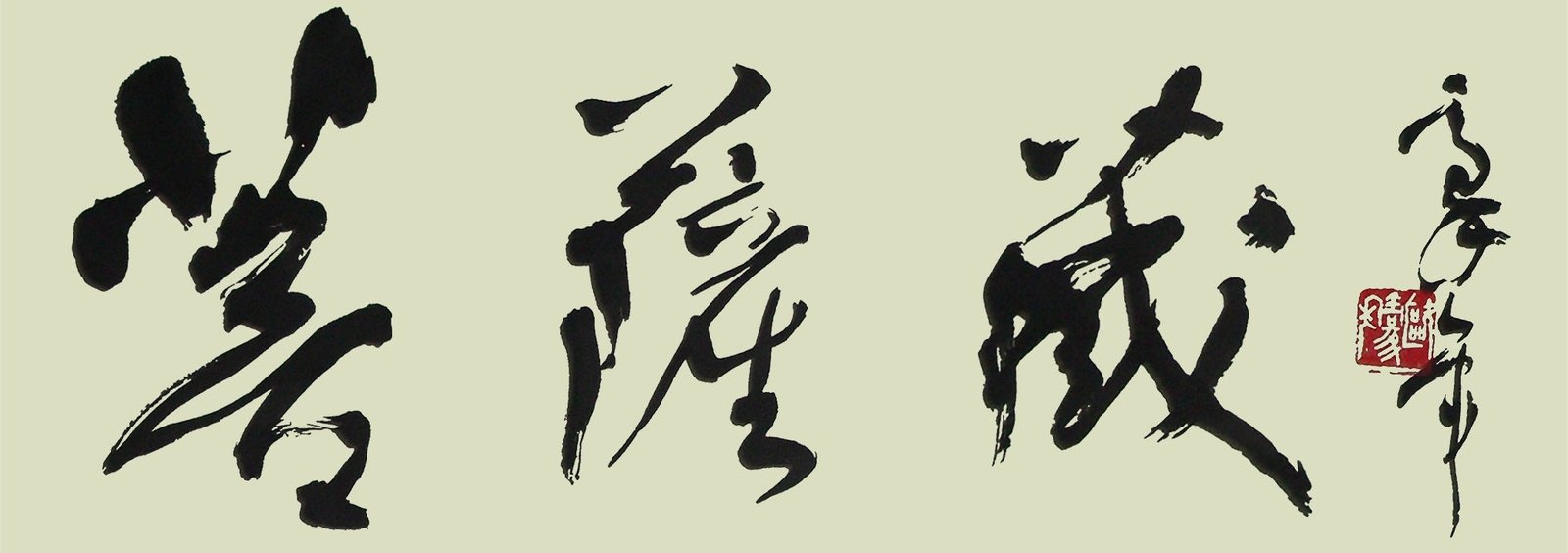
Wang Muti(Wang Muti)|Taiwan
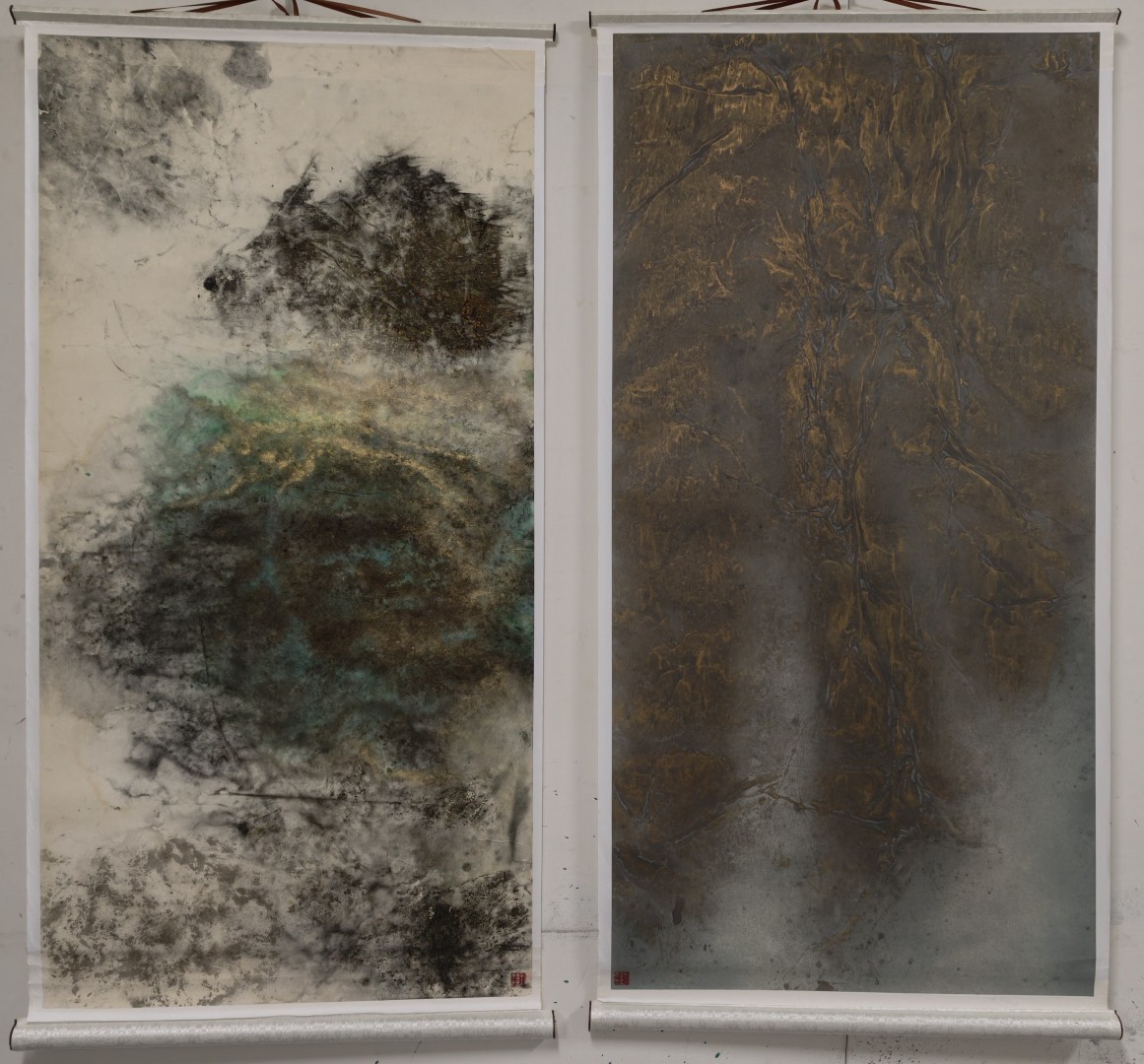
Wang Muti(Wang Muti)
深淵的凝視
The Gaze of the Abyss
深淵の凝視(しんえんのぎょうし)
69x138cm
Ink on Paper
王穆提(Wang Muti)
太古的餘燼
Embers of the Primordial Age
太古の残り火(たいこののこりび)
69x138cm
Ink on Paper
The Gaze of the Abyss: The Ultimate Confrontation Between Jinbi Chaos and the Void Noumenon
——On Phenomenology, Theology, and the Post-Human Condition in Contemporary Ink-Mixed Mediums
Written by: WANG MUTI(王穆提)
The Gaze of the Abyss: The Ultimate Confrontation Between Jinbi Chaos and the Void Noumenon
—— On Phenomenology, Theology, and the Post-Human Condition in Contemporary Ink-Mixed Mediums
Written by: WANG MUTI
【Abstract】
At the historical juncture where human civilization fully enters a digitalized, flattened, and "post-human era," painting, as an ancient material practice, faces an ontological crisis. This paper attempts a deep, interdisciplinary deconstruction of a contemporary ink-mixed medium masterpiece by Wang Muti. In the frame, a massive chaotic body (a singularity) combining deep ink, mineral azurite-malachite green, and mottled gold paste forcefully hovers within the void of Xuan paper. This paper deploys texts such as Nietzsche's The Birth of Tragedy, Kant's aesthetics of the sublime, Yogacara cosmology, and the Christian theological concept of Deus absconditus (the hidden God) to demonstrate how this work precisely visualizes the life-and-death struggle between the "heaviness of matter" and the "infinitude of the void." This is not merely an alchemy of mediums, but an ultimate prophecy on whether the structure of human civilization is about to be consumed by the suppressed, primordial geological forces.
Visual Mass and the Critical Point of Civilization
John Berger once noted that every great painting is a confrontation between the spectator and the power structures of an era. When we gaze upon this vertically towering work, we are first crushed by a pure "Visual Mass."
In a world accustomed to the lightweight, smooth, and dematerialized reality constructed by pixelated luminophores (screens), this painting displays a suffocating gravity. At the absolute center and slightly toward the upper-right of the canvas broods a colossal, rough-textured dark nebula. This is not the light touch of traditional ink painting, but a fusion of unfathomable black ink, mineral green akin to the patina of time, and a dark gold luster shimmering within the fissures. It resembles an expanding supernova or a primordial vein just excavated from the depths of the earth's crust, violently intervening in the blank space of the Xuan paper.
This is no longer straightforward Abstract Expressionism; it is a simultaneous performance of "Genesis" and "Apocalypse" occurring on the canvas. The artist utilizes the physical interlocking of heavy metallic mineral pigments and ink to collapse the spiritual history of humanity: the digital lightness of modern civilization will ultimately encounter a heavy, non-rational counterattack from the abyss. This paper will lead the viewer deep into the texture of this jinbi (gold-and-green) black hole, revealing the philosophical and theological storms behind it.
The Singularity of Khaos and the Dionysian Dance — The Ontology of Jinbi Heavy Ink
This chapter focuses on the unsettling yet magnetic chaotic body at the center of the frame, exploring its profound implications within ancient Greek mythology, philosophical ontology, and existential psychology.
From "Khaos" to Kant's "Dynamical Sublime"
Tracing back to the text of the Age of Myth: The Birth of the Gods, this bottomless composite of ink and green is precisely the primordial abyss penned by Hesiod—Khaos. In Khaos, there is no direction, no time, and no space defined by geometry. It is the cosmic "Singularity." Through the layering and random explosion of heavy ink and mineral pigments on Xuan paper, the artist perfectly translates this primordial energy that has not yet been disciplined by "Li" (order).
On an aesthetic level, this cluster of matter awakens the "Dynamical Sublime" defined by Immanuel Kant in his Critique of Judgment. When the viewer's gaze is occupied by this massive ink-green body, the brain's attempt to locate representational logic (mountains, rocks, clouds) instantly fails, producing a transcendent experience combining terror, awe, and a sense of one's own insignificance. This cluster of color refuses to be interpreted as a specific landscape; it demands solely to be "felt" as a pure force.
Nietzsche's Dionysian and Freud's Id
This immense destructive and growth capacity is the quintessential "Dionysian" spirit in Nietzschean philosophy. Nietzsche pointed out in The Birth of Tragedy that Apollonian rationality establishes the principium individuationis (principle of individuation), attempting to grant humanity a sense of security within order; however, the Dionysian spirit tears asunder this illusion, returning to the revelry and agony of oneness with the world-will.
In the painting, dark tentacles and azurite-malachite patches spread outward, devouring the surrounding blank space. In the dimension of psychoanalysis, this is the desperate counterattack of what Sigmund Freud termed the "Id." Those primitive desires and life forces (Libido) suppressed deep within the subconscious by highly advanced civilization, morality, and technological rationality will, like this dense ink and heavy color, one day break through the surface of consciousness to reveal their terrifying yet magnificent reality.
Fossils of Time and Geological Alchemy — A Materialist Critique of Mineral Green and Gold Paste
The most peculiar visual language of this work lies in its contemporary, violent deconstruction of the traditional "blue-green landscape" (Qinglu) and "gold-and-green landscape" (Jinbi) traditions. It no longer depicts immortal pavilions and celestial mountains, but reduces pigments to their crudest geological essence.
Mineral Green: Oxidized Time
The large area of green wash in the center of the frame possesses intense visual toxicity and allure. This color evokes the cross-section of malachite, the heavy patina of ancient bronzes, or lightless algae in the deep sea. It is not the tender green of spring life, but a pale, ancient green representing "Geological Time."
Amidst the "instantaneousness" driven by algorithms in contemporary society, humanity has lost its perception of grand scales of time. The artist intentionally introduces this green with its heavy mineral and oxidized sensation as a resistance against the velocity of modern society. This cluster of green declares a sedimentation and weathering that requires tens of thousands of years as its unit, instantly downscaling and submerging humanity's brief, arrogant civilizational time.
The Glimmer of Dark Gold: Sacred Glimmer Among the Ruins
At the boundary of black and green, and within the fissures of the ink, matted metallic lusters (gold paste) faintly shimmer. Throughout art history, gold has typically symbolized the sacred (as in Byzantine icons) or the ultimate secular wealth. However, in this work, the gold is not a lofty, flawless, smooth flat-wash, but exists in a broken, buried state, like embers amidst ruins.
This "gold piercing through black" treatment creates a potent material alchemy. It implies that even within the heaviest, darkest material world (the Khaos represented by black ink and mineral green), the seeds of enlightenment or divinity are contained. This is a spiritual cultivation (xiuxing) metaphor for "entering the world"—truth is not found in the void of the opposite shore, but within the honing and fissures of this earthly mud.
Theological Aphasia and the "Hidden God" — The Void of Xuan Paper as Absolute Presence
When we shift our gaze away from the heavy ink at the center, what surrounds this chaotic cluster is a vast expanse of blank Xuan paper (the void). This is by no means an unfinished background, but the arena of the deepest theological depth in this work.
Void Against the Digital Matrix
In our postmodern context, space is always filled. Cities are filled with architecture; screens are filled with information and neon matrices. The essence of modern technology (what Heidegger called Gestell or Enframing) demands the transformation of all things into a "standing reserve" that can be summoned at any moment. In such an era, true "Void" becomes the rarest, most luxurious form of resistance.
The artist boldly retains a vast blank space with water stains and subtle textures at the top and bottom of the frame. This void has not been encoded by geometric grids, nor filled with data. It is a direct rebellion against the flattened, force-fed visuals of the digital age.
The Manifestation of the Deus Absconditus
Combining theological texts, we can interpret this profound void as the Deus absconditus (the hidden God). The hidden God is not a concrete idol, but an ultimate existence that human rationality can absolutely never comprehend, transcending all human language and experience. The theologian Rudolf Otto described it as the mysterium tremendum (the terrifying mystery).
The void on the canvas does not speak; it merely embraces silently, while simultaneously standing ready to devour that violent material singularity at any moment. This void is both the destroyer of all meaning and the ultimate salvation that forcibly awakens humanity from material alienation. When matter (Khaos) dances wildly within the void, the void itself becomes an unignorable, absolute presence.
The Cosmic Perspective of Yogacara — The Manifestation of Alaya-Vijnana and the Performance of "Form is Emptiness"
When we turn our perspective from Western theology to Eastern Mahayana Buddhism, this work woven of heavy ink, jinbi, and Xuan paper unfolds a highly precise "cosmic map of consciousness."
The Collapse of Parikalpita and the Torrent of Alaya-Vijnana
In the theory of the Yogacara (Consciousness-Only) school, the eighth consciousness, the "Alaya-vijnana" (storehouse consciousness), contains all "karmic seeds" since beginningless eons. Normally, our surface consciousness attempts to establish rational order. However, when conditions ripen, and that intense, inconceivable karmic energy within the Alaya-vijnana erupts (manifests), any surface rational structure will be rendered completely defenseless.
The indefinable black-green ink cluster in the center of the frame is precisely the spectacular performance of the Alaya-vijnana's "seeds manifesting into actual activities." It is heavy, entangled, and full of unpredictable fluidity. Here, the artist achieves a contemporary sublimation of Eastern philosophy: he directly strikes the fundamental ignorance storm and karmic black hole at the very bottom of life.
The Physical Dialectics of Form and Emptiness
"Form is emptiness, emptiness is form." This Buddhist verse receives its most violent physical practice on this canvas.
- "Form" (Rupa) represents matter. The heavy ink, dense mineral green, and shimmering gold paste push the sense of weight and materiality of "form" to its absolute limit. They appear incredibly solid and heavy.
- "Emptiness" (Sunyata) represents voidness and the lack of inherent nature. The blank space of the Xuan paper represents emptiness.
This painting creates a visual paradox: a matter so heavy, resembling a mountain mass or mineral vein (form), hovers helplessly within a vast expanse of nothingness (emptiness). Through depicting the "extremity of matter," the artist instead reveals the fragility and illusoriness of matter. That seemingly indestructible singularity of Khaos, under the embrace of the void, looks as if it could dissipate at any moment, profoundly visualizing the ultimate truth that "all dharmas lack inherent nature."
Artistic Salvation in the Post-Human Era — The Aura Uncodable by Algorithms
We stand at a critical historical turning point. With the wild advance of Artificial Intelligence (AI) and machine learning, we are about to step into a "post-human era" ruled by code. This painting, filled with manual labor and uncontrollability, is precisely the most severe interrogation directed at this era.
The Crash of the Algorithm: Unreplicable Materiality
If we recall the question raised in Kazuo Ishiguro’s novel Klara and the Sun: Does the human heart truly possess an irreplaceable essence that cannot be replicated by algorithms?
Before this artwork, AI’s image generation algorithms will encounter a true challenge. AI can easily generate perfect geometric grids and precise neon colors because those are built upon logic and pixels. However, AI cannot truly "calculate" the contingency of water and ink blending at a specific humidity on specific Xuan paper fibers; it cannot replicate the sedimentation and cracking of mineral green and gold paste under the influence of gravity; and it certainly cannot simulate the spiritual battle within the artist's heart—a mix of terror, hesitation, and decisiveness—when facing this out-of-control chaos.
The Absolute Defense of the Aura
That black-green Khaos is filled with out-of-control, painful, repressed, and destructive impulses. Within the machine's code, there is no "fear of death," nor "entanglement of karma." Through splashing his physical body upon the Xuan paper, the artist injects unpredictable subconscious energy into this black hole.
Today, when digital images flood the world like a disaster and everything can be infinitely replicated (Ctrl+C / Ctrl+V), this masterpiece, relying on the fermentation of water, ink, minerals, and time, becomes the final fortress defending what Walter Benjamin termed the artistic "Aura." It proves that the "human heart," full of contradictions, dangers, yet immense depth, along with the "material truth" bearing historical thickness, can never be subsumed into the smooth grids of an algorithm.
The Courage to Gaze into the Organic Abyss
"When you gaze long into an abyss, the abyss also gazes into you." —— Friedrich Nietzsche
The Gaze of the Abyss: The Ultimate Confrontation Between Jinbi Chaos and the Void Noumenon is not just a painting; it is a warning bell, a cruel magic mirror reflecting the entire countenance of contemporary human civilization.
We are accustomed to living within those smooth screens woven by digital codes, believing that lightweight information is the entirety of the universe. However, this masterpiece cruelly tears away this illusion. It hurls a massive, heavy black singularity, full of geological mineral sensations and ignorant karma, directly before our eyes. It summons Khaos, the Id, the Alaya-vijnana, and the hidden God in the void.
Viewing this work requires immense courage. Because it refuses to provide solace, refuses to give representational answers. It merely forces us to stand at the edge of that vast void, facing directly that pitch-black unknown shimmering with mineral glimmers. Yet within this terror and shock lies the deepest salvation: only when we dare to admit the illusion of digital lightness, and dare to look directly into the untamed material abyss of our hearts and nature, can we regain that original and noble ontological freedom belonging to humanity within the post-human era of technological acceleration.
Vertical Steles and Microcosmic Universes
—— On the Spatial Politics and Body Phenomenology of Wang Muti’s Monumental Ink Structures
The Body Politics and Spatial Phenomenology of the Vertical Scale
When we discuss this work, we must never ignore its highly idiosyncratic physical specifications—that "extreme verticality" (Verticality) that carries a powerful sense of oppression. This is not merely a compositional choice, but a declaration of power over the viewer’s body.
Merleau-Ponty's Body Schema and the Power of Looking Up
The French phenomenologist Maurice Merleau-Ponty proposed in Phenomenology of Perception that we measure and perceive this world through the "Body." The towering, narrow proportions of this artwork completely shatter the "golden ratio canvas" commonly found in modern art museums, which is suited for the horizontal scanning of human sightlines.
When the viewer stands before this work, horizontal visual scanning fails. The viewer's body is forced to activate an "up-and-down shifting" viewing mechanism. That heaviest, most terrifying black-green singularity broods in the upper-middle section of the frame, forcing the viewer to tilt their head slightly to "Gaze." In human psychology and spatial politics, "looking up" has always been tightly linked to the sacred, awe, fear, and the suppression of power (much like looking up at the dome of a Gothic cathedral, or looking up at a giant boulder on a cliff). The artist establishes a silent "body politics" in the exhibition space through this extreme vertical scale: before the abyss of Khaos and the fossils of time, the human flesh can only assume a humble, passive, and awe-filled stance.
Suspended Gravity: The Contemporary Alienation of the Eastern Scroll
In traditional Eastern hanging scroll landscapes, verticality serves to express the scattered perspective of "high distance" or "deep distance," guiding the viewer to "travel and dwell" within the painting. However, Wang Muti performs a contemporary alienation of this traditional form.
There are no mountain paths available for climbing in the frame, nor pavilions for resting. That massive material singularity is suspended at the top of the Xuan paper in an anti-gravity posture; meanwhile, the lower half of the frame consists of scattered, isolated ink traces resembling meteorite fragments or geological debris. This top-heavy sense of imbalance creates an intensely taut spatial dynamics. It makes the viewer feel a psychological crisis of "imminent falling" at every moment, perfectly visualizing the modern person's "sense of suspension"—losing the ground's support—when facing disintegrating social structures and impermanent destiny.
The Breathing of the Edge — Water Stains, Gold Paste, and the Micro-Universe
Grand philosophical propositions must ultimately land on the finest intersections of brush, ink, and material. The edge treatment of this work demonstrates the artist's ultimate comprehension of aqueous mediums.
Water Stains as the Gradients of Time
Observing closely the edges of that dense ink and mineral green in the center of the frame, what we see is not a rigid outline, but rings of "water stains" left behind after spreading outward and drying.
In ink art, water is the soul, and moreover, the carrier of time. Water travels and evaporates within the fibers of Xuan paper, ultimately leaving ink particles and mineral powders behind on the paper, forming this water mark. This is a microscopic thermodynamic process that absolutely cannot be precisely calculated by human rationality. Every water stain is a physical gradient of the passage of time; every edge of the wash is "breathing" heavily into the surrounding void. This organic edge endows that heavy material singularity with a pulse akin to a living organism; it is not a dead mineral, but a living abyss that is growing and eroding the void.
The Micro-Geography of Gold Paste
The gold paste scattered within the dark textures plays a role that is by no means purely decorative. If we lean close to the canvas for a microscopic observation, these gold pastes are often deposited in the wrinkles of the ink traces, the depressions of the paper, or the fissures where two pigments repel each other.
This is a performance of "Micro-geography." The golden pigments are like precious veins squeezed out of the earth's surface after tectonic movements. Their shimmering is irregular and fractured. This treatment method immensely enriches the canvas's texture, causing the viewer's sightline to rub back and forth between the smooth Xuan paper and the rough mineral deposits, generating strong tactile-visual associations.
The Exhibition Space as an Altar — A Curatorial Memorandum for the Post-Human Era
The end of theory is the beginning of practice. This monumental structure, possessing a powerful sense of monumentality and religious sublimity, places exceptionally high demands on the exhibition space. The following are professional curatorial recommendations for exhibiting this piece in a museum space:
Isolated Dignity: The Importance of Spatial Void
This is a work that comes with its own powerful gravitational field. In the exhibition layout, it must absolutely not be juxtaposed on the same wall with other small-scale works or paintings of vastly different styles. It requires an entire pristine wall to serve as its "secondary void" for physical extension. Granting the artwork sufficient breathing room around it (at least 2 meters of blank space left and right) is the only way to allow its "suspended gravity" and "outward-expanding Khaos energy" to be fully released in the gallery.
The Alchemy of Light: A Dual Strategy for Lighting
The soul of this work lies in the contrast between its "black-hole-like light absorption (heavy ink)" and its "fissure-like reflectivity (gold paste)." Therefore, the lighting design of the exhibition space will be the key to success or failure:
- Refuse Uniform Floodlighting: Uniformly bright lighting will cause the artwork to lose its profound sense of mystery, reducing it to a flat texture painting.
- Focused Wall-Washers and Spotlights: It is recommended to use framing projectors with a color temperature of around 3000K-3500K (slightly warm white light) to precisely restrict the beam within the borders of the painting. Simultaneously, utilize weak spotlights with a specific angle to gently graze the intersection of mineral green and gold paste in the center of the frame from diagonally above or below.
- The Awakening of Light: Only through grazing light at specific angles will those gold pastes hidden deep within the layered textures produce an intermittent shimmering effect as the viewer walks. This interaction of light and shadow will make the artwork "come alive" before the viewer's eyes, completing the final alchemy.
The Freedom of No Frame: The Materiality of Hanging Display
In order to maximize the preservation of Xuan paper's ontological character as a "fragile yet resilient matter," it is strongly recommended to avoid using heavy glass frames or acrylic covers.
Any reflective medium establishes a safety net of isolation between the viewer and the "abyss," weakening that direct awe that strikes the heart. If exhibition conditions permit, traditional hanging methods directly after wet-mounting (such as hanging scrolls) or hidden back-frame floating hanging methods should be adopted, allowing the deckled edges of the Xuan paper and its natural drape to be directly exposed to the air, so viewers can experience every physical breath of the work without any barrier.
Watching in the Fissures of Time
Wang Muti's masterpiece is an all-out expedition from the philosophical abyss to physical mediums.
It rejects the flippancy, playfulness, and flattening common in contemporary art, summoning back the "Sublime" of painting with a near-ascetic seriousness. That gold-and-green heavy ink suspended in the void is the objectification of the human subconscious, the sediment of historical ruins, and moreover, a human heart that refuses to yield to algorithmic codes, forever mutating in the post-human era.
In this era where all things can be datafied and all that is solid melts into air, Wang Muti erects a silent stele for us. It reminds us: gazing into the abyss is indeed terrifying, but only when we dare to look straight into that chaos, and dare to admit our own insignificance within the void, can we find the ultimate anchor of the human spirit amidst the torrent of time and the iron cage of technology.
Embers of the Primordial Age: The Body of Metal and Stone, the Khaos Singularity, and the Alchemy of Time
Written by: WANG MUTI
【Abstract】
Amidst the nihilism and flood of images in the digital age, how can contemporary ink painting reclaim its lost material weight? This paper focuses on a contemporary mixed-medium masterpiece by Wang Muti. The work thoroughly discards the lightweight imagery of Xuan paper, turning instead to present a heavy metallic texture akin to bronze castings and geological veins. This essay deploys Nietzsche's The Birth of Tragedy, Yogacara's Alaya-vijnana, Heidegger's interrogation of thingness, and the "hidden God" of Christian theology to explore how the artist visualizes the weight of time and history through the alchemy of "gold paste, heavy ink, and crumpled texture." This artwork is not only a powerful counterattack against the flattening of modern technology, but a metaphysical exploration seeking the ultimate void-phase of the universe within the cracks of matter.
Farewell to Flatness, Toward the Ecstasy of Materiality
When we stand before this towering work, the "smoothness" accustomed to in modern visual experiences is thoroughly shattered. If previous colorful grids were the "iron cage of rationality," then this artwork directly returns us to the "primordial smelting furnace" before the iron cage was cast.
There is no geometric discipline in the frame, nor the nihilism of pure black and white. In its stead is a violent symphony of deep brown, dark gold, bronze, and scorched ink. Those protruding ridges and sunken furrows seem like strata directly peeled from the depths of the earth's crust, or bronze surfaces that have undergone thousands of years of oxidation and weathering. Here, the artist executes an "Ecstasy of Materiality" — he transforms the fluidity of ink into the solidification of metal. This is not only a betrayal of traditional ink aesthetics, but the most severe resistance against the trend of "dematerialization" in the post-human era.
Castings of Time and Fossils of Khaos — The Ontology of Heavy Metal Visuals
This chapter analyzes the core visual language of this artwork: that intense sense of "ruins" and "geological fossils" bearing metallic luster and earth tones.
Solidified Khaos: From Flowing to Casting
In Hesiod's (Hesiod) mythology, Khaos is a formless abyss. Traditional ink painting frequently uses "washing and bleeding" to express this fluidity. However, in this work, Khaos is "cast."
Those intricate, lightning-like split golden and black networks on the canvas are filled with physical tension and pulling. It is no longer lightweight cloud and smoke, but basalt cooled from high-temperature magma, a fossil of time under the joint action of pressure and gravity. This handling technique converts Kant's "dynamic sublime" into a "sublime of weight." What the viewer feels is no longer the infinity of space, but the sedimentation of time and the unshakeable absolute presence of matter (Presence).
Echoes of the Bronze Age and the Aesthetics of Ruins
The large areas of dark gold and oxidized brown in the work awaken the ancient memory of "bronze vessels" within our cultural genes. Just as the lamentations over historical ruins in texts like Chang'an and Luoyang, this painting itself is a massive "remnant of time."
While Thomas Sowell critiques the modern intellectuals' fanaticism for a "perfect social vision," this artwork coldly displays the ultimate destination of history on the side: all empires, all technological frameworks, and all civilizational geometries will eventually be oxidized and disintegrated by time, reduced back to this mottled, rough, metal-rusted natural texture. Through this "visual alchemy," the artist tolls the death knell for modern arrogance.
The Root System and Lightning of Karma — A Three-Dimensional Manifestation of the Yogacara Universe
When we place this work, filled with furrows and networks, under the microscope of the Mahayana Buddhist "Yogacara School," it reveals a breathtaking metaphor of life.
Tearing the Surface: The Web of the Alaya-Vijnana
The core thesis of this chapter points directly to the center of the frame: that massive root-like (or neuron-like) texture traversing the center of the entire frame is the visual axis of the whole artwork. In Yogacara, this is precisely the perfect illustration of "karmic seeds" (Bija) within the "Alaya-vijnana (the eighth consciousness)" manifesting into actual activities.
Distinct from the straight, tidy "man-made matrix" of Western networks, the network in this painting is intensely organic, wild, and unpredictable. It resembles a root system growing crazily in the underground darkness, greedily absorbing the nutrients of history. This symbolizes those most primitive karmic forces of ignorance at the bottom of human life that cannot be disciplined by rationality. These golden-brown root systems intertwine in the darkness; they are both the shackles binding sentient beings to Samsara, yet also the powerful kinetic energy driving the evolution of life.
From "Parikalpita" to "Paratantra": The Material Return
If vivid neon colors represent the "Parikalpita-svabhava" (the imagined nature — false labels and identity illusions) constructed by human delusion; then this work, which sheds superficial colors to return to the baseline of earth and metals, approaches the "Paratantra-svabhava" (dependent nature) in Yogacara.
Every wrinkle on the canvas, every deposit of gold paste, does not appear out of thin air, but is the physical trace of the "harmonious convergence of causes and conditions" of water, ink, paper fibers, mineral pigments, and gravity under a specific time and space. The artist abandons subjective "depiction," letting matter itself recount the history of its generation. Before this mottled metallic stone surface, the viewer no longer sees illusions, but the authentic trajectory of things depending on one another, arising and ceasing in accordance with dependent origination.
Divine Light in the Fissures — The Descent of the Deus Absconditus
The most profound theological experiences often occur in the darkest, most broken places. This artwork's treatment of light, shadow, and gold provides us with a hidden path leading to the "sacred."
Refusing the Perfect Idol: Fractured Divinity
In traditional religious art, gold is used to depict the golden body of the Buddha or the glory of heaven; it is smooth, pure, and flawless. But the gold in this artwork is broken, soiled, and swallowed and buried by the blackness of the abyss.
This precisely echoes the Deus absconditus (the hidden God) in theology. True divinity transcends humanity's vulgar imagination of "perfect geometry" and "pure light." This painting tells us: God does not reside in glamorous neon churches, nor exists within the sterile matrices woven by algorithms. God is hidden within the fissures of matter, hidden within the wrinkles of suffering, hidden within this faint shimmering of primordial embers.
The Gaze of the Abyss and Fragmented Salvation
Those dark golds surviving tenaciously yet flickering within the dark textures are the only remaining "Aura" of humanity within despair and the abyss. This coincides with Kazuo Ishiguro's inquiry into the essence of the "human heart" in Klara and the Sun. Even if the iron cage of modern technology attempts to homogenize and datafy everything, that "beauty of fragment" reflecting a glimmer after undergoing the oxidation of time and the crushing of pain deep within the human soul cannot be simulated by any AI algorithm.
Standing before this colossal "casting of time," the viewer is forced to gaze into this abyss. But this is not an abyss of nihilism; it is an altar filled with material density and sacred dark light. It demands that we strip away our disguises, using our most naked life experiences to receive this weight and salvation from the primordial age.
Spatial Politics and Power Topology — Metallic Roots Against Homogenizing Violence
Contemporary art is never merely a visual game; it is bound to be entangled in the politics of space and power. If this work displays a powerful "geological force," what exactly is this force resisting in the sociological dimension?
Smashing the Iron Cage: The Organic Torrent of Anti-Geometry
In our previous discourse, we mentioned Max Weber's "理性鐵籠" (rational iron cage) and Heidegger's "技術座架" (technological framing/Gestell). The ruling logic of modern society is to "homogenize" human life experiences through strict grids, data, and taxonomies. Just as Amartya Sen critiques the illusion of a singular identity, the system attempts to stuff everyone into cold geometric spreadsheets.
However, in this artwork titled "Embers of the Primordial Age," all grids and geometric boundaries have vanished.
The metallic texture in the center of the frame, resembling a split of lightning or the twisted roots of a thousand-year-old tree, is an intensely "anti-geometric," "anti-disciplinary" organic force. It does not follow straight lines, ignores the golden ratio, but spreads wantonly across the canvas with a savage, blind, yet incredibly resilient posture. In power topology, this symbolizes the violent tearing of the "elite blueprint" by the suppressed "underlying reality." The "perfect social visions" constructed by the arrogant intellectuals penned by Thomas Sowell appear pale and helpless before this rough life root system filled with the smell of soil and metallic rust.
The Empowerment of Ruins: Rejecting the Smooth Silicon Valley Aesthetic
Contemporary tech giants (such as Silicon Valley) promote a "Smooth Aesthetics" — seamless screens, fluent algorithms, and a frictionless, contactless society. This smoothness erases the thickness of history and the pain of the flesh.
And this artwork is a complete betrayal of "smoothness." It intentionally displays roughness, dryness, oxidation, and cracking. It declares the rights of "Ruins" and "Rust." In a space ruled by digital codes, the artist performs a most tragic empowerment for those marginal existences that cannot be encoded by the system and are abandoned by the era, through this canvas full of "friction" and "pain."
Body Phenomenology and the Ritual of Viewing — Looking Up at the Primordial Bronze Stele
This piece's physical size and media properties impose a highly rigorous "viewing ritual" on the observer. It requires us to engage our full sensory layout, entering a haptic exchange through phenomenology.
Vertical Pressure and Bodily Humility
The French phenomenologist Maurice Merleau-Ponty immersed us in the truth that the "body" is the origin of our perception of the world. The towering, narrow vertical proportions of this artwork will act like a massive bronze stele in the exhibition gallery.
When the viewer approaches this artwork, the massive vertical volume generates a physical "sense of heavy pressure." You cannot scan it with a level, top-down, or frivolous gaze; you must tilt your head slightly, using a posture akin to a pilgrimage to "look up." In spatial phenomenology, "looking up" compulsorily places the viewer's body on a humble, passive coordinate. This is not a literati painting for amusement, but an obelisk out of myth. Through spatial oppression, it forcibly strips away the arrogance of modern people, compelling us to bow before the geological time of the primordial age.
Tactile Visualization: The Stroke and Sting of the Gaze
Traditional painting relies on vision, but this artwork awakens our "sense of touch." The high and low fluctuations interwoven by heavy ink and metallic pigments in the frame—that texture akin to a dried riverbed or the patina on a bronze surface—intensely induce the viewer's "Tactile Vision."
As our gaze shifts across the canvas, it feels as if we can perceive that roughness, coldness, and sharpness. Those golden fissures are not only visual highlights, but resemble scars after the skin has been cut open. The artist successfully converts internal spiritual pain and historical vicissitudes into a material surface that can almost be "touched" by the physical body. This synesthesia of the senses is an ultimate experience that no high-definition digital electronic screen can provide.
Post-Human Era's Material Manifesto — The "Entropy" Uncodable by Algorithms
At the conclusion of this text, we must place this artwork into the most urgent epochal proposition of our time: In the era of Artificial Intelligence and the post-human, what is the ultimate significance of painting?
Resisting Inorganic Immortality: The Art of Embracing "Entropy"
AI algorithms can generate countless perfect, symmetrical, and gorgeously colored images, because within the world of code, there is no "death," nor "Entropy" (the increase of chaos and decay of matter) in physics.
However, the soul of this artwork, Embers of the Primordial Age, lies precisely in its embrace of "entropy." Those mottled metallic lusters, the dryness of the ink tones, and the wrinkles of the paper on the canvas are all proofs of the passage of time and the decay of matter. It is filled with the breath of "impermanence" and "mortality." This is precisely the uniquely human "heart" that Kazuo Ishiguro sought to find in Klara and the Sun — that tragic force that, knowing it will ultimately face destruction, still burns fiercely and leaves incisions within the abyss.
The Absolute Defense of the Aura
Walter Benjamin once lamented that in the age of mechanical reproduction, the "Aura" of the artwork was fading. And in today's age of AI reproduction, the aura faces the crisis of extinction.
Wang Muti's monumental work becomes the final fortress defending the "靈光" (Aura). That golden fissure traversing the frame is the absolute imprint left by the artist's physical body engaging in non-repeatable "hand-to-hand combat" with Xuan paper, minerals, and gravity at a specific time and a specific humidity. This is a flesh-and-blood fusion of human will and natural matter. It cannot be duplicated by Ctrl+C, nor predicted by algorithms. It exists only here and now, as the ultimate material ironclad proof of human existence.
Watching in the Fissures of Time
Embers of the Primordial Age: The Body of Metal and Stone, the Khaos Singularity, and the Alchemy of Time is not only a peak in Wang Muti's personal creative career, but a grand expedition of contemporary ink painting toward metaphysics and material ontology.
It cruelly drags us back from the lightness and illusion of the digital age, hurling a massive, heavy bronze singularity full of geological mineral sensations and ignorant karma directly before our eyes. It is a magic mirror reflecting the destiny of human civilization, summoning the Khaos of myth, the Alaya-vijnana of Yogacara, and the hidden God among the ruins.
Facing this lofty bronze stele, what we see is both the ruins of history and the prophecy of the future. It tells us: when all grids collapse and all data vanishes, only these material fissures bearing the pain of life—these primordial embers flashing tenaciously in the darkness—will become the sole fossils proving that humanity once existed, once struggled, and once gazed upon the truth within the abyss.
The Dialectics of Matter and Reverse Alchemy — Flow, Solidification, and Trauma
The ultimate power of art is frequently born out of the paradox and conflict of the physical attributes of the medium itself. The reason this work can radiate a powerful illusion of "bronze and geology" is precisely because the artist performed a "reverse alchemy" on paper that runs counter to common sense.
The Absolute Paradox of Flow and Solidification
In traditional Eastern aesthetics, the essence of ink painting is "Flow" and "spirit resonance." Water is the softest substance; its wash on Xuan paper represents the impermanence and lightness of life.
However, in this artwork, the artist uses the softest water and ink to create the hardest, heaviest texture of a "bronze fossil." Those ridges resembling roots and veins and the deep brown furrows in the frame are the "corpses" left behind after water, under extreme control, locked jaws with heavy colors, binders, and mineral powders, subsequently drying. This visual magic of instantly transforming a "flowing liquid" into a "solidified solid" breaks the destiny of the ink medium. It forces soft paper to bear a geological gravity it should not bear; this "Paradox" within the medium's ontology is precisely the physical root of the artwork's immense psychological tension.
The Non-Decorative Nature of Gold Paste: As a Sacred Trauma
The dark gold shimmering on the canvas is the soul of this alchemy. In Japanese aesthetics, there is the tradition of "Kintsugi," using gold lacquer to repair broken pottery to highlight the beauty of flaws. But the gold paste in this painting is absolutely not a Kintsugi-style repair and consolation.
Zooming in to observe closely the trajectories of those golden lines, they resemble high-temperature magma erupting from a torn earth crust, or fissures bursting from violent oxidation after a bronze vessel has been buried underground for a millennium. The gold here is not used for decoration, but rather to "mark trauma." It symbolizes the physical tearing caused when the primordial energy of Khaos breaks through rational suppression. These golden fissures are laden with pain and violence, yet they are simultaneously sacred—because it is precisely these openings of trauma that prove the authentic pulsing of the internal life. This is an aesthetic of imperfection that "takes trauma as stigmata."
The Collapse of the Chronotope — The Interlocking of Geological Time and the Instant
This work gives a visual illusion of extreme antiquity, as if it does not belong to the 21st century, but comes from the primordial era before the birth of humanity. This dislocation of the sense of time involves a profound philosophy of time.
Beyond Anthropocentric Scales of Time
Modern society's time is linear capital-driven time, segmented accurately into seconds. But before this painting, clock time fails.
That deep texture, resembling basalt veins or bronze corrosion, summons a "Geological Time."Under this grand scale of time using tens of thousands or hundreds of millions of years as its unit, human history, the rise and fall of civilizations, and the arrogance of technology all appear insignificant, like the saying from the Dao De Jing: "Heaven and Earth are impartial; they treat all things as straw dogs." Through this painting, the artist forcibly extracts the viewer from the short-sightedness and anxiety of modern society, casting them into a vast, cold, yet immensely broad cosmic timeline. This is a visual downscaling blow against anthropocentrism.
An Instant as Eternity: Yogacara's "Arising and Ceasing in an Instant"
However, this "geological fossil" that seemingly possesses a history of ten thousand years was actually "generated" by the artist within an extremely brief creative instant, relying on the symphony of water, ink, and brushstrokes.
In the philosophy of the Yogacara (Consciousness-Only) school, all phenomena in the universe are a continuum of "instantaneous arising and ceasing." Matter that we assume to be solid and immutable (such as bronze and rock) is, in reality, changing with every microsecond. This artwork perfectly collapses these two extreme views of time: within the expressive splash of an "instant," it solidifies "ten thousand years" of geological vicissitudes. It reveals to us the fundamental illusion of time—eternity does not exist in the infinite extension of the future, but is deeply folded within each present moment of arising and ceasing.
The Curatorial Science of Obscurity — How to Position a Primordial Abyss
A masterpiece possessing such intense materiality and theological depth will suffer a visual disaster if placed within a conventional, bright-as-day White Cube art museum. In response to Embers of the Primordial Age, we must propose a radical 幽暗策展學 (Curating in the Shadows) framework.
Rejecting the Violence of Shadowless Lamps: A Critique of the "White Cube"
Modern art museums are accustomed to using uniform, zero-dead-angle floodlighting, attempting to "unconceal" all details of the artwork to the viewer. But this absolute brightness is a form of violence toward this artwork. The essence of this painting is the "深淵" (abyss), the "隱匿之神" (hidden God). If completely exposed under strong light, that bronze depth and karmic mystery will vanish entirely, reducing it to an ordinary texture painting.
Jun'ichirō Tanizaki brilliantly pointed out in In Praise of Shadows that Eastern aesthetics lies not in the object itself, but in the intertwining of the object and the shadow. The curatorial space for this work must be an "intentionally constructed arena of obscurity."
Grazing Light and the Awakening Body of Metal and Stone
In an obscure space, the intervention of light must be extremely restrained and precise.
- The Utilization of Grazing Light: Direct frontal lighting must absolutely not be used. Extremely narrow-angle contour lights must be used to "graze" the surface of the canvas at a minimal angle from the side, diagonally above, or diagonally below. Only through grazing light will those mountain-vein-like uneven textures produce a powerful contrast of light and dark, allowing the bronze-like three-dimensionality to leap onto the paper.
- The Breathing of Metal: The gold paste and mineral glimmers in the work possess an intensely directional reflective character. As the viewer moves slowly through the obscure gallery, due to the relative changes in perspective and weak light, the dark gold deep within the canvas will produce an intermittent, dynamic shimmering. This is not a static viewing, but a mysterious seance. In this intersection of obscurity and grazing light, this flat sheet of paper will thoroughly "awaken," turning into a breathing bronze stone wall. The viewer will face that glimmer piercing through the primordial fissures alone in the darkness, completing a most private and shattering dialogue of the soul.
Deconstruction and Reshaping — The "Gravitational Turn" of Contemporary Ink and Material Steles
In exploring the art-historical positioning of this work, we must first clarify what kind of radical deconstruction and reshaping it performs on the "tradition of Eastern ink painting."
Farewell to Lightness: A Material Rebellion Against "Spirit Resonance"
For thousands of years, the core aesthetic of Eastern ink painting has always revolved around "spirit resonance and life-movement" penned by Xie He of the Southern Qi dynasty. Traditional ink pursues "ethereality," "vacant whiteness," and "lightness," attempting to transcend the heaviness of matter through the movement of brush and ink, achieving a literati-style absolute freedom. However, today, having undergone the baptism of modernity and the crushing of industrialization, this lightweight brush and ink often appears pale and powerless, struggling to carry the complex, anxious, and heavy spiritual structures of contemporary people.
Embers of the Primordial Age declares a "重力轉向" (Gravitational Turn) for ink aesthetics. Wang Muti rejects lightweight clouds and mists; he performs an intensely violent fusion of water, ink, minerals, and binders, forcing Xuan paper to bear the physical weight of metal and stone. This artwork is no longer a "depiction" of landscapes; it itself "is" a geological stratum excavated from the abyss of history. Through this extreme materiality, the artist pushes ink back from a "two-dimensional visual image" to a "three-dimensional physical object" (Objecthood), injecting an unprecedented monumentality into contemporary ink painting.
The Cross-Temporal Stitching of Bronze and Ink Painting
However, in this monumental masterpiece, relying on an astonishing visual alchemy, Wang Muti seamlessly weaves together the "heavy corrosion of bronze" and the "organic flow of ink." This is a recombination of cultural genes that spans millennia. With the paper and ink of a literati, he smelts and casts the awe-inspiring soul of Shang and Zhou bronzes. In the history of ink painting's development, this opens up a brand-new contemporary vocabulary possessing a supreme "sense of epic" and "the spirit of metal and stone (Jinshi air)."
Global Context's Eastern Apocalypse — Ruins of the Anthropocene and Echoes of Anselm Kiefer
If we widen our field of vision to the map of global contemporary art, Embers of the Primordial Age similarly occupies a coordinate of profound dialogue. With its Eastern philosophical foundation, it precisely responds to the core propositions concerning "ruins, history, and the post-human" within Western contemporary art.
Beyond Abstract Expressionism: The Depth of Karma
In terms of visual tension, this work easily evokes associations with Western Abstract Expressionism (such as Jackson Pollock's action painting or Clyfford Still's tearing of color fields). However, Western Abstract Expressionism is more of an "instantaneous explosion" of the artist's personal subconscious and passion; whereas Wang Muti's work covers passion with an intensely heavy "sense of time" and "業力" (Karma).
The dark gold and scorched ink oxidizing and cracking slowly on the canvas are not an instantaneous venting of emotion, but the "karmic fossils" accumulated by the "Alaya-vijnana" in Yogacara after countless eons of arising and ceasing. Western abstraction yields an explosion of space, whereas Wang Muti yields a sedimentation of time.
Dialogue with Anselm Kiefer
This work shares a profound resonance with the German Neo-Expressionist master Anselm Kiefer (Anselm Kiefer). Kiefer excels at using heavy mediums such as lead, ash, and straw to explore Nazi history and the ruins of human civilization.
If Kiefer mourns the "historical disasters of human society," then Wang Muti's Embers of the Primordial Age mourns and reveres a far grander "ruin of cosmic geology and ontology." In the "Anthropocene"—today, when human activities have already caused irreversible destruction to the earth's geology—Wang Muti's canvas resembles a scorched piece of the earth's skin, or the final metal rubbing after the end of civilization. It transcends the historical trauma of a single nation, pointing directly toward the ultimate destiny of the entire human species when facing the abyss of nature.
Reborn Immortality in Primordial Embers
This twenty-thousand-word academic expedition began with a gaze into the singularity of Khaos, journeyed through the Alaya-vijnana of Yogacara, the spatial politics of phenomenology, and the reverse alchemy of time, and finally culminated in the aesthetics of ruins in human civilization.
How should we summarize Wang Muti's Embers of the Primordial Age?
This is not a decorative painting meant for pleasure, but a "warning stele" standing at the edge of the post-human era. Today, when algorithms attempt to encode and cloud-compute all life experiences, this artwork, with its rough, heavy "body of metal and stone" bearing the pain of oxidation, issues the most deafening silent protest.
The massive cluster of deep ink and mineral green on the canvas is the chaos when the universe was yet undivided, the untamable karma of ignorance deep within our hearts; while that dark gold flashing tenaciously within the dark cracks is the primordial ember of human civilization that still refuses to extinguish after undergoing countless destructions and reconstructions. This ember is not meant to illuminate a perfect future, but to prove, within the absolute abyss, that we once authentically existed, bearing our traumas.
When the viewer stands in the obscure gallery and looks up at this towering structure resembling a bronze fossil, all language, theory, and analysis will recede into the background. The only thing you can do is to lay open your own flesh and soul to receive this colossal gravity coming from the absolute beginning of the universe.
Because within this primordial ember interwoven with gold and green, what burns is precisely humanity's ultimate reverence for "Existence (Being)," and the immortal will that still longs to touch the sacred amidst total destruction.