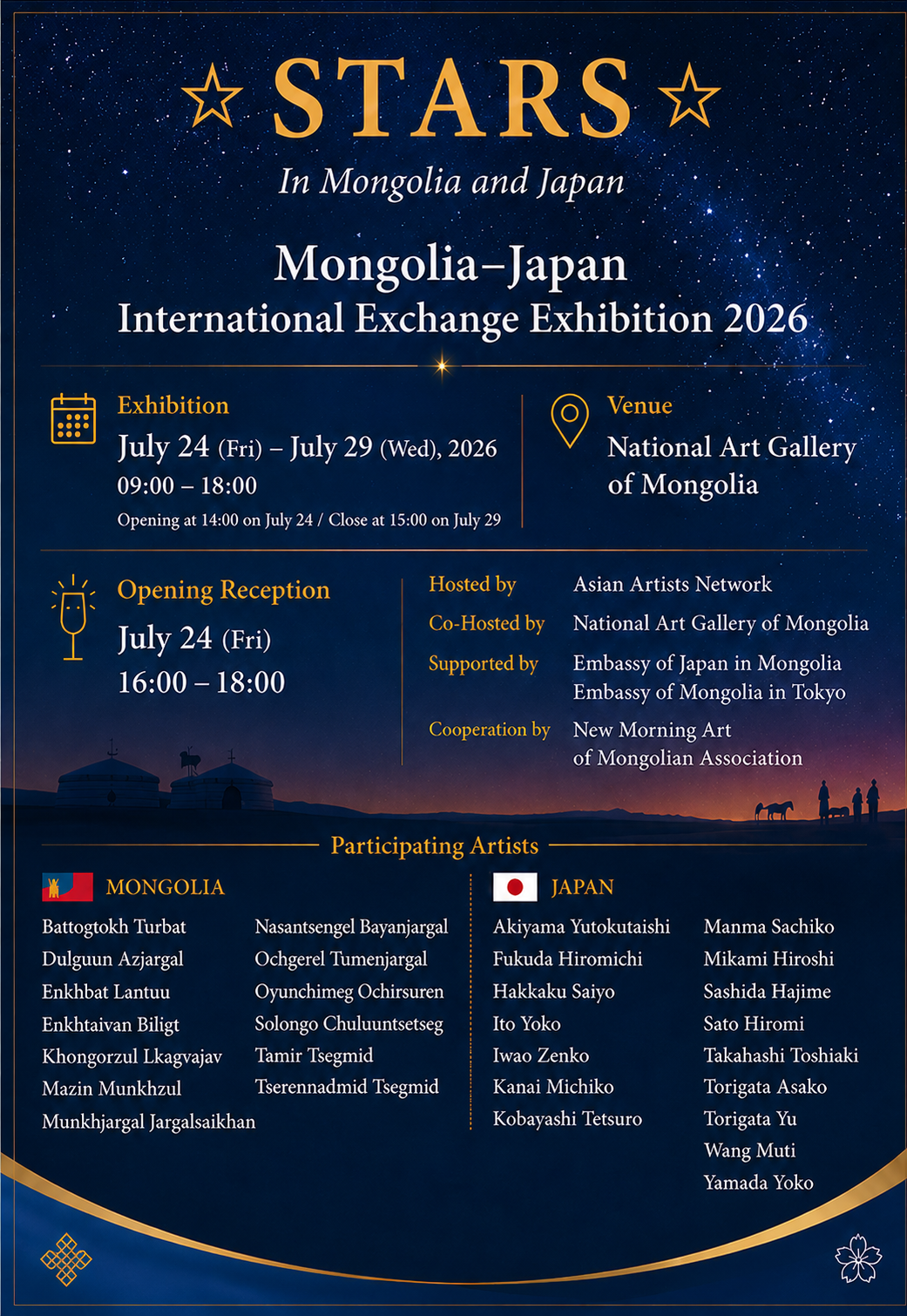
- 展覽名稱:蒙古-日本國際交流展 2026《STARS IN MONGOLIA AND JAPAN》
- 展覽地點:蒙古國立現代美術館(National Art Gallery of Mongolia / Mongolian National Modern Art Gallery)
- 展覽時間:2026年7月24日(星期五)-2026年7月29日(星期三)
- 主辦單位:Asian Artists Network、National Art Gallery of Mongolia
- 後援:蒙古國文化部、日本駐蒙古大使館、蒙古駐日大使館
- 協辦單位:Mongolian New Morning Artists Association
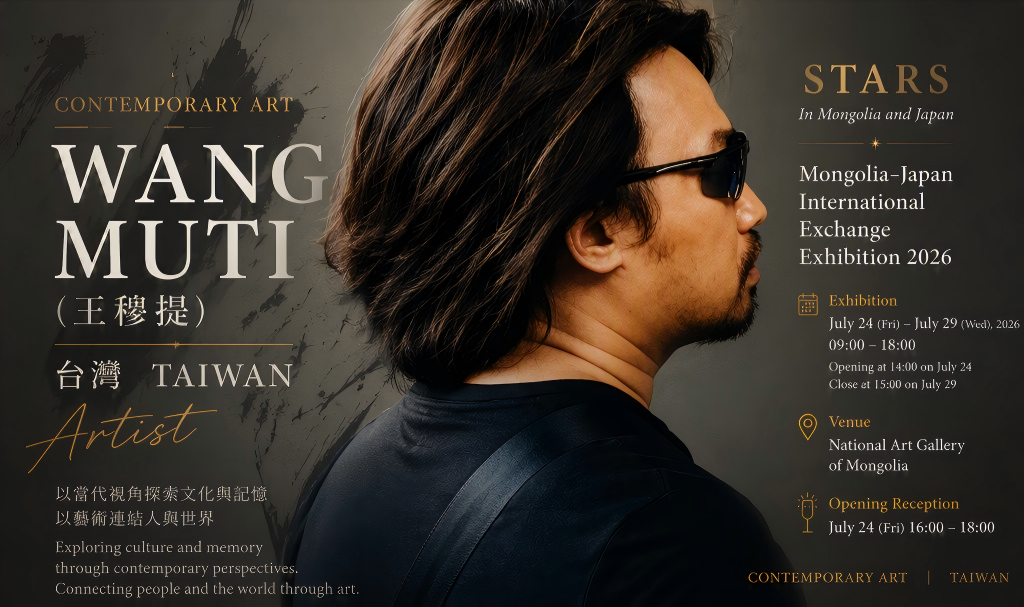
論星空、身分認同與跨文化之遠行
——在蒙古國立現代美術館閱讀一場亞洲的相遇
文/王穆提(WANG MUTI)
法國哲人蒙田(Michel de Montaigne)在其隨筆中曾寫道:「世上最艱難的學問,莫過於認識自己;而了解自己最好的方式,便是將自己置於與他者的對話之中。」
我常思索,當一個人在地圖上畫下一條線,宣稱這是一座國家的邊界時,心靈的疆域是否也隨之關閉?我一直相信,人類最早的博物館並不是由水泥與大理石築起的實體建築,而是那片浩瀚、無償向每個人敞開的夜空。在文字尚未被發明、法規尚未被制定之前,人類便已學會抬頭仰望星辰。無論是馳騁於廣袤草原上的遊牧民族,還是隱沒在黑潮巨浪間的海島漁民,他們眼中所映照的宇宙微光並無二致。星空是人類共同的天花板,也是文明最古老、最不需要經由翻譯的語言。
當二〇二六年盛夏,《STARS》成為這場蒙古與日本藝術交流展的名稱時,在我的理智與靈魂中所激起的,並非文人墨客筆下那種流於表面的浪漫,而是一種更為本質的存有論叩問:在不同的地域、不同的歷史遭遇與地緣政治之中,身處不同座標的我們,是否真的始終共享著同一片天空?
海島與土地的對話:一個台灣創作者的跨界存有
身為一個生長於海島台灣的創作者,我的生命經驗注定是一場不斷跨越邊界的遠行。台灣這座島嶼四面環海,基因裡天然地帶著海洋的流動性、包容力與邊緣感。這樣的水土,賦予了我們一種特殊的精神視野——習慣於在變動中尋找錨點,在多元文化的交匯處確立自我的認同。
作為一個台灣當代藝術家與策展人,我長期將自己投身於亞洲藝術交流的網絡之中。不論是擔任日本現代美術家協會台灣聯絡所的負責人,還是作為日本「NAU(21世紀美術連立)」的成員,我始終在思索:在一個日益扁平化、技術化的世界裡,東方的哲學精神如何透過當代的抽象語彙,重新與世界發生深刻的共鳴?
正因為海島文化的流體本質,使我們在面對不同文明時,少了一分固步自封的傲慢,多了一分感同身受的同理心。在這次展覽中,台灣創作者的視角剛好形成了一座無形的精神橋樑,一端連結起蒙古草原那種不被馴服的、自由而廣闊的土地生命力,另一端則呼應著日本群島那種精緻、幽微且內斂的四季陰翳美學。
亞洲藝術的精神橋樑
The Spiritual Bridge of Asian Art
蒙古草原文明
Mongolian Steppe Civilization
遼闊
自由
生命力
Vastness
Freedom
Vitality
台灣當代藝術
Taiwan Contemporary Art
水墨
抽象
中觀思想
Ink Art
Abstraction
Madhyamaka Philosophy
日本群島美學
Japanese Archipelagic Aesthetics
細膩
四季
陰翳
Subtlety
Seasonality
Aesthetics of Shadow
Mongolia ⇄ Taiwan ⇄ Japan
文化媒介|Cultural Mediator
作為來自台灣的藝術家,王穆提的創作位於蒙古草原文明與日本群島美學之間, 透過當代水墨、抽象藝術與中觀思想,形成跨越地域、歷史與文化疆界的亞洲精神橋樑。
As an artist from Taiwan, Wang Muti's artistic practice occupies a unique position between the nomadic spirit of the Mongolian steppe and the refined aesthetics of the Japanese archipelago. Through contemporary ink painting, abstraction, and Madhyamaka philosophy, his work serves as a cultural bridge connecting diverse histories, geographies, and artistic traditions throughout Asia.
在烏蘭巴托的國家殿堂,重新定位文化座標
本次展覽的舞台,設於蒙古國首都烏蘭巴托的國立現代美術館(National Art Gallery of Mongolia)。這是一座具有至高無上地位的國家級藝術殿堂,它保存、研究並展示了自一九二一年蒙古獨立革命以來的所有視覺記憶。
對我而言,能夠在此處與來自蒙古、日本的二十九位優秀藝術家共同展出,其意義絕非僅是為個人的藝術履歷增添一筆痕跡。過去,我曾有幸成為首位在日本國立新美術館舉辦「展中個展」的台灣藝術家,並榮獲日本 NAU 展的「未來賞」;那些在東京都美術館、橫濱等地的展出經驗,給予我的是對西方抽象與日本當代藝術的深刻理解。
然而,當作品跨越海洋與陸地,進駐到這座充滿遊牧民族歷史厚度的蒙古國立美術館時,那對話的客體便發生了質變。作品離開了私密的個人工作室,進入公共空間,對話的對象便不再只是流動的觀眾,更包含了歷史的厚度與文化的演進。在這裡,亞洲不同地域的創作者於同一座國家美術館內相遇,展場成為一面照見彼此的魔鏡,強迫我們在浩瀚的時間與空間面前,重新定位自己的文化座標。
中觀思想與重墨金碧的物理辯證
在本次展覽中,我帶來的現代水墨創作(如《深淵的凝視》與《太古的餘燼》),本質上是我個人對大乘佛法「法相唯識宗」與「中觀思想」的一場形而上學實踐。
我試圖在作品中結合東方傳統水墨、抽象藝術與東方哲學精神。畫面中那些結合了深沉水墨、礦物青綠與斑駁金泥的巨大混沌體,看似沉重如岩層或青銅化石,卻無依無靠地懸浮於宣紙的巨大留白(虛空)之中。這正是我對大乘佛教偈語「色即是空,空即是色」的物理演繹:
- 色(物質): 厚重的焦墨與閃爍的金泥,將物質的重量感推向極致,象徵阿賴耶識中無始劫以來的業力種子起現行。
- 空(無自性): 宣紙大膽的留白代表絕對的虛空。如此沉重之物懸浮於虛空,反而揭示了物質的脆弱與虛幻。
這種關注佛學宇宙觀與精神性議題的創作特色,恰好與蒙古藝術家由遊牧文化、藏傳佛教所孕育出的奔放生命力,以及日本新舊世代藝術家對感官、傳統美學的細膩解構,形成了一場極具張力的跨文化對話。藝術並不要求一致,藝術允許差異。而真正的交流,正是從承認彼此的差異開始。
在同一片星空下守望
《STARS》的價值,絕僅止於一場為期數日的跨國聯展,它更像是一個持續生長的亞洲藝術共同體(Asian Art Community)的開端。由亞洲藝術家網絡(Asian Artists Network)代表山田陽子(YAMADA YOKO)女士策劃推動,並獲得蒙古國文化部、日本駐蒙古大使館以及蒙古駐日大使館的共同支持。這種跨國的民間與官方合作,再次證明了:藝術有時比政治更早建立起人與人之間的理解。因為藝術直接面對的是活生生的人與共同的人性,而非冰冷的國界或體制。
在這份由二十九位藝術家共同構成的星空名單之中,每一位創作者都代表一個獨立的宇宙。不同媒材、不同背景、不同生命經驗,交織成一片新的文化星圖。
蒙古草原上的星空無比遼闊,日本海岸的星空充滿寧靜,而台灣山巔的星空也同樣美麗。不論我們此刻身處何方,只要我們抬起頭,我們所凝視的,其實都是同一個宇宙。群星雖然在物理空間上距離遙遠,卻在各自的孤獨與追尋中,共同照亮了同一片夜空。這便是我在二〇二六年的烏蘭巴托,所讀到關於藝術最真誠的秘密。
🏛️ 展覽文獻備忘錄
| 展覽項目 | 內容詳情 |
| 展覽名稱 |
STARS — In Mongolia and Japan 蒙古-日本國際交流展 2026 |
| 展覽地點 | 蒙古國立現代美術館(National Art Gallery of Mongolia) |
| 展覽時間 | 2026年7月24日(五)- 2026年7月29日(三) |
| 主辦單位 | Asian Artists Network、National Art Gallery of Mongolia |
| 後援單位 | 蒙古國文化部、日本駐蒙古大使館、蒙古駐日大使館 |
| 協辦單位 | Mongolian New Morning Artists Association |
| 策展代表 | 山田陽子(YAMADA YOKO) |
「在同一片星空下,藝術讓世界彼此相遇。」
參展藝術家
蒙古 Mongolia
- Battogtokh Turbat
- Dulguun Azjargal
- Enkhbat Lantuu
- Enkhtaivan Biligt
- Khongorzul Lkagvajav
- Mazin Munkhzul
- Munkhjargal Jargalsaikhan
- Nasantsengel Bayanjargal
- Ochgerel Tumenjargal
- Oyunchimeg Ochirsuren
- Solongo Chuluuntsetseg
- Tamir Tsegmid
- Tserennadmid Tsegmid
日本 Japan
- Akiyama Yutokutaishi
- Fukuda Hiromichi
- Hakkaku Saiyo
- Ito Yoko
- Iwao Zenko
- Kanai Michiko
- Kobayashi Tetsuro
- Manma Sachiko
- Mikami Hiroshi
- Sashida Hajime
- Sato Hiromi
- Takahashi Toshiaki
- Torigata Asako
- Torigata Yu
- Wang Muti(王穆提)(唯一台灣參展者)
- Yamada Yoko
國際交流的文化意義
本次展覽獲得:
- 日本駐蒙古大使館支持
- 蒙古駐東京大使館支持
展現藝術外交的重要價值。
文化交流往往能超越政治、語言與地域限制,成為建立理解與友誼最有效的方式之一。
《STARS》正象徵著來自不同國家的藝術家,在同一片亞洲天空下,以創作共享彼此的文化與夢想。
致謝
主辦單位誠摯感謝:
- 亞洲藝術家網絡
- 蒙古國立美術館
- 日本駐蒙古大使館
- 蒙古駐東京大使館
- 蒙古新晨藝術協會
以及所有參展藝術家、策展團隊、媒體與觀眾朋友,共同促成此次國際藝術交流盛會。
關於「蒙古國立現代美術館」(National Art Gallery of Mongolia / Mongolian National Modern Art Gallery):
🏛️ 美術館等級與定位
- 國家級美術館:蒙古國立現代美術館是位於首都烏蘭巴托的「國家級」美術館之一。蒙古國本身並未實施類似其他國家(如中國)的「一級、二級、三級」數字化評級制度,該館在當地的最高定位即為國家級藝術殿堂。
- 官方營運機構:這是一所由蒙古國政府支持與營運的官方現代藝術畫廊。
📖 相關背景資訊
- 歷史沿革:該館原本屬於蒙古美術博物館(Fine Arts Museum of Mongolia)的一部分,隨後於 1989 年至 1991 年間正式獨立出來,成為專門展示現代藝術的場館。
- 館藏特色:主要收藏與展示自 1921 年蒙古獨立革命以來的現代美術及視覺藝術作品。目前館藏擁有約 4,000 至 4,200 多件藝術品,且館方仍積極收購國內外藝術家的原創作品以豐富國家收藏。
重要參展藝術家簡歷
1. 王穆提(Wang Muti)|臺灣
藝術家簡介
王穆提(Wang Muti)長期投入跨文化交流與國際藝術合作,關注亞洲文化之間的視覺對話與人文連結。
其創作經常結合:
- 東亞文化符號
- 當代藝術語彙
- 記憶與身份認同
- 文化交流經驗
透過作品探索亞洲社會在全球化時代下的共同處境與精神連結。王穆提為臺灣當代藝術家、策展人及跨文化藝術推動者,長期投入亞洲藝術交流與國際展覽合作,現為日本現代美術家協會台灣聯絡所負責人、日本「NAU(21世紀美術連立)」成員。
創作特色
- 結合水墨、抽象藝術與東方哲學精神
- 關注佛學中觀思想、宇宙觀與精神性議題
- 探索文化記憶、身份認同與跨文化交流
- 強調藝術作為文化對話與心靈觀照的媒介
重要成就
- 臺灣首位於日本國立新美術館舉辦「展中個展」藝術家
- 榮獲日本 NAU 展「未來賞」
- 長期參與東京都美術館、橫濱等日本重要藝術展覽
- 積極推動臺灣、日本及亞洲地區藝術交流合作
2. 巴托格托克・圖爾巴特(Battogtokh Turbat)|蒙古
藝術家簡介
1972 年出生於蒙古。
畢業於蒙古文化藝術大學,先後完成雕塑與歌劇相關專業訓練。2004 年起成為專職獨立藝術家。
創作特色
- 擅長大型裝置藝術與雕塑創作
- 使用骨骼、皮革、金屬及天然顏料等多元媒材
- 關注文化記憶、民族歷史與自然生態關係
- 探索生命循環與人類文明之間的平衡
代表系列
《Mongol Khatad(蒙古女性)》
透過藝術重新觀看蒙古女性在歷史中的角色與貢獻,展現草原文化中的女性力量。
重要經歷
- 作品曾於倫敦、華沙、首爾、臺北等地展出
- 多次獲得蒙古藝術界重要獎項
- 曾獲蒙古藝術家協會表揚與專業獎勵
3. 秋山祐德太子(Akiyama Yutokutaishi)|日本
藝術家簡介
1935-2020。
出生於東京,日本戰後前衛藝術的重要代表人物之一。
畢業於武藏野美術學校雕塑科。
創作領域
- 雕塑
- 攝影
- 版畫
- 行為藝術
- 公共藝術
創作特色
- 日本前衛藝術運動代表人物
- 結合普普藝術(Pop Art)與政治行為藝術
- 將藝術帶入公共空間與社會議題討論
- 持續挑戰藝術與政治的界線
重要經歷
- 1960 年代投入日本前衛藝術運動
- 參與法國巴黎「日本前衛藝術展」
- 曾任札幌大學客座教授
- 作品廣泛被視為日本戰後當代藝術的重要資產
4. 福田宏道(Fukuda Hiromichi)|日本
藝術家簡介
1998 年出生於日本福井縣。
畢業於福井大學美術教育領域,取得教育學碩士學位。
創作領域
- 繪畫
- 裝置藝術
- 當代藝術
創作特色
福田宏道以「蘋果」作為長期創作主題。
透過反覆描繪蘋果的形象,探討:
- 味覺
- 嗅覺
- 視覺
- 記憶
- 存在意義
其作品特別關注感官經驗與心理感受之間的連結。
重要展覽
- 東京 Gallery 58 個展
- ART JAPAN 國際藝術展
- 澳洲國際藝術交流展
- 日本各地青年藝術家聯展
創作理念
藝術不只是觀看,更能喚起觀者對氣味、記憶與情感的聯想,形成跨越感官的觀看經驗。
本次展覽核心代表藝術家
若以本次《STARS – Mongolia–Japan International Exchange Exhibition 2026》的國際交流意義而言,最具代表性的四位藝術家可視為:
- 王穆提(臺灣)
- 亞洲跨文化交流代表
- Battogtokh Turbat(蒙古)
- 蒙古當代裝置與雕塑代表
- Akiyama Yutokutaishi(日本)
- 日本戰後前衛藝術代表人物
- Fukuda Hiromichi(日本)
- 日本新世代當代藝術代表
四位藝術家分別代表: 東方哲學、草原文明、前衛藝術與當代新世代創作,共同構成《STARS》展覽跨越國界與文化的核心精神。
策展人簡介
山田陽子 YAMADA YOKO
亞洲藝術家網絡(ASIAN ARTISTS NETWORK)代表
山田陽子為日本當代藝術家、策展人及國際藝術交流推動者,長年致力於建立日本與亞洲各國之間的藝術合作平台,以促進跨國文化交流、深化藝術理解及活化亞洲當代藝術發展為核心使命。
透過亞洲藝術家網絡(ASIAN ARTISTS NETWORK),山田陽子積極推動國際聯展、藝術家駐留、文化論壇與美術交流計畫,持續串聯亞洲各地藝術家,建立跨文化對話與合作機制,成為亞洲民間藝術外交的重要推手之一。
藝術理念
「透過藝術交流,跨越語言、文化與國界的限制,讓亞洲各國藝術家在共同的平台上相互學習、彼此理解,共同創造亞洲藝術的新未來。」
山田陽子的藝術與策展工作不僅關注個人創作,更著重於藝術作為文化橋梁的社會角色。多年來持續投入日本與亞洲各國藝術合作計畫,推動亞洲當代藝術網絡的建立與發展。
亞洲藝術家網絡(ASIAN ARTISTS NETWORK)
組織宗旨
亞洲藝術家網絡成立宗旨為:
- 深化日本與亞洲各國藝術交流
- 促進跨國文化理解與合作
- 推動亞洲當代藝術國際化
- 建立亞洲藝術家交流平台
- 活絡亞洲各地藝術創作能量
獲獎紀錄
山田陽子曾獲得多項國際藝術獎項與表揚,包括:
- 緬甸大使館獎
- 日本亞細亞航空獎
- 東京都議會議長獎
- Tableau 美術協會會長獎
- 其他多項藝術展覽與機構獎項
王穆提(Wang Muti)|臺灣
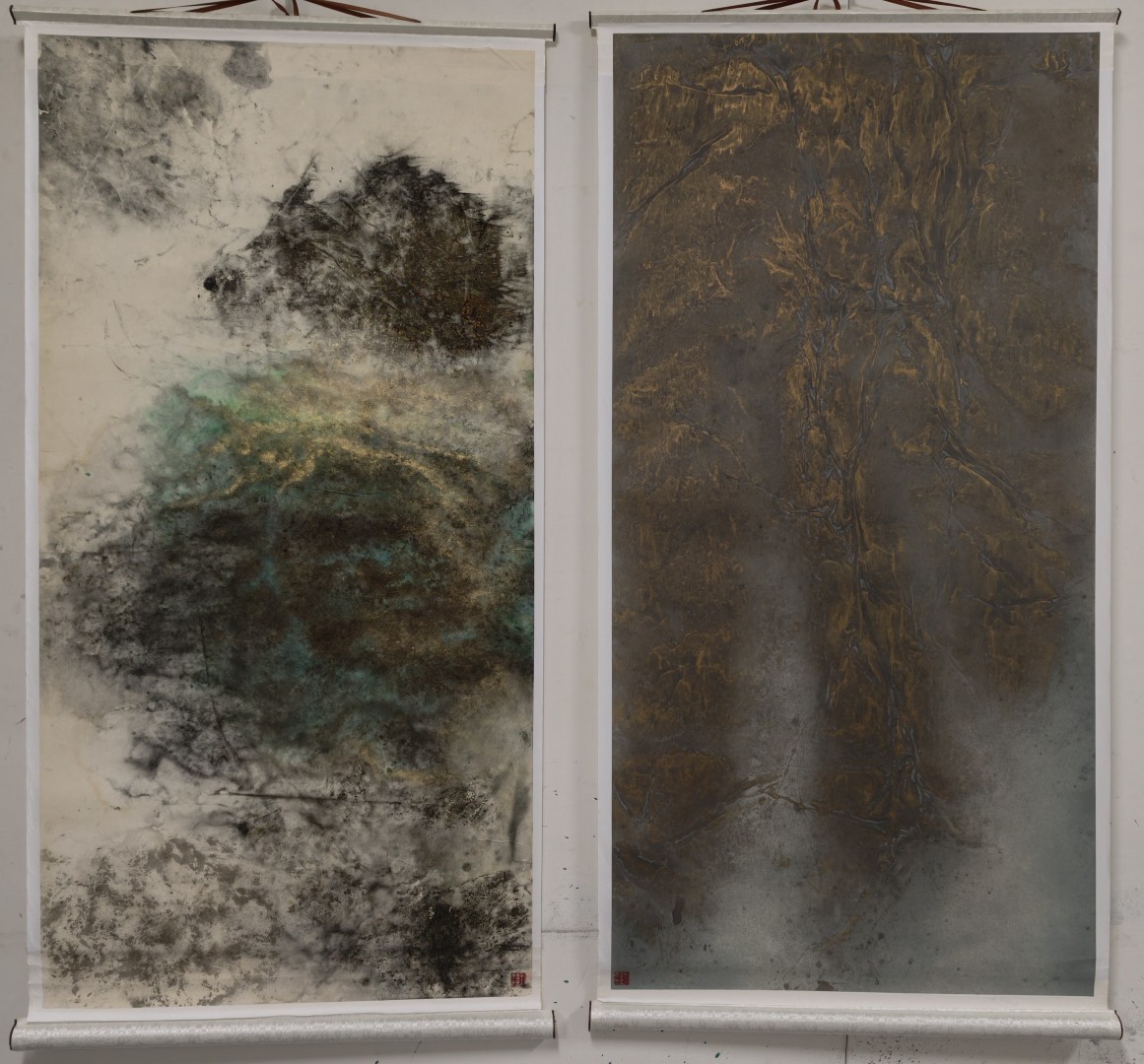
王穆提(Wang Muti)
深淵的凝視
The Gaze of the Abyss
深淵の凝視(しんえんのぎょうし)
69x138cm
水墨
王穆提(Wang Muti)
太古的餘燼
Embers of the Primordial Age
太古の残り火(たいこののこりび)
69x138cm
水墨
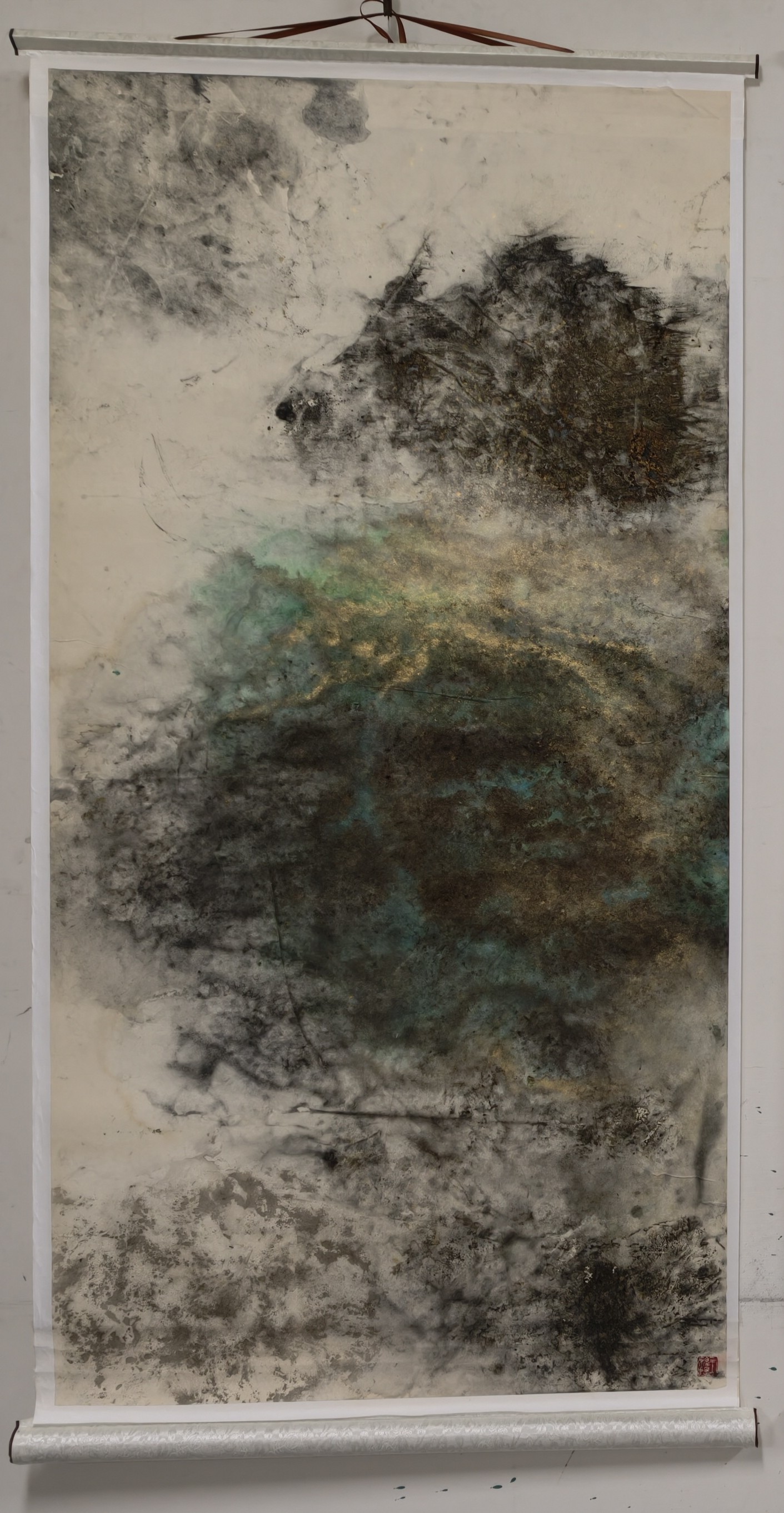
深淵的凝視:金碧混沌與虛空本體的終極對決
——論當代水墨混和媒材中的現象學、神學與後人類境況
撰文:王穆提(WANG MUTI)
【摘要】
在人類文明全面步入數位化、扁平化與「後人類時代」的歷史節點,繪畫作為一種古老的物質實踐,面臨著存有論的危機。本文試圖對王穆提一幅當代水墨混和媒材巨作進行深度的跨學科解構。畫面中,一團結合了深沉水墨、礦物青綠與斑駁金泥的巨大混沌體(奇點),悍然懸浮於宣紙的虛空之中。本文將調用尼采的悲劇誕生、康德的崇高美學、唯識學的宇宙觀,以及基督教神學中的「隱匿之神(Deus absconditus)」等文本,論證該作品如何精準地視覺化了「物質的沉重」與「虛空的無垠」之間的殊死搏鬥。這不僅是一場媒材的鍊金術,更是對人類文明結構是否即將被其壓抑的原始地質力量所反噬的終極預言。
視覺的質量與文明的臨界點
約翰·伯格(John Berger)曾言,每一幅偉大的畫作,都是觀看者與時代權力結構的對峙。當我們凝視這幅垂直高聳的作品時,首先遭受到的是一種純粹的「視覺質量(Visual Mass)」的輾壓。
在一個習慣了由像素發光體(螢幕)所構成的輕盈、平滑、去物質化世界裡,這幅畫作展現了令人窒息的重力。畫面的正中央與偏右上方,盤踞著巨大的、充滿粗礪肌理的深色星雲。這不是傳統水墨的輕描淡寫,而是揉合了深不可測的黑墨、如時間銅鏽般的礦物綠,以及在裂隙中閃爍的暗金光澤。它猶如一顆正在膨脹的超新星,或是剛從地殼深處被挖掘出的太古礦脈,硬生生地介入了宣紙的留白之中。
這不再是單純的抽象表現主義,這是一場發生在畫布上的「創世」與「末日」的同時展演。藝術家利用重金屬礦物顏料與水墨的物理咬合,摺疊了人類的精神史:現代文明的數位輕盈,終將遭遇非理性深淵的沉重反擊。本文將帶領觀者深入這口金碧黑洞的肌理,揭示其背後的哲學與神學風暴。
卡俄斯的奇點與戴奧尼索斯之舞——金碧重墨的本體論
本章將聚焦於畫面中央那個令人不安卻又無法移開視線的巨大混沌體,探討其在古希臘神話、哲學本體論與存在心理學中的深層意涵。
從「卡俄斯」到康德的「動態崇高」
從《神話時代:諸神的誕生》之文本溯源,這團深不見底的墨綠色複合體,正是赫西俄德(Hesiod)筆下孕育一切、卻又吞噬一切的原始深淵——卡俄斯(Khaos)。在卡俄斯中,沒有方向,沒有時間,沒有被幾何學定義的空間。它是宇宙的「奇點(Singularity)」。藝術家運用重墨與礦物顏料在宣紙上的層層積染與隨機爆發,完美轉譯了這種尚未被「理(秩序)」所規訓的原始能量。
在美學層次上,這團物質喚醒了康德(Immanuel Kant)在《判斷力批判》中所定義的「動態的崇高(Dynamical Sublime)」。當觀者的視線被這巨大的墨綠色體佔據時,大腦尋找具象邏輯(山、石、雲)的企圖瞬間失效,產生了一種揉合了恐懼、敬畏與自我渺小的超越性體驗。這團色彩拒絕被解讀為特定的風景,它只要求被當作一股純粹的力量來「感受」。
尼采的酒神與弗洛伊德的本我
這巨大的破壞力與生長力,正是尼采哲學中典型的「戴奧尼索斯(Dionysian,酒神)」精神。尼采在《悲劇的誕生》中指出,阿波羅式的理性建立起了「個體化原理(principium individuationis)」,試圖讓人類在秩序中獲得安全感;然而,酒神精神卻要撕裂這層幻象,回歸與世界意志合一的狂歡與痛苦。
畫面中,深色的觸角與青綠色的斑塊向外蔓延,吞噬著周圍的留白。在精神分析的維度上,這正是弗洛伊德(Sigmund Freud)所謂「本我(Id)」的絕地反撲。那些被高度文明、道德與技術理性壓抑在潛意識深處的原始慾望與生命力(Libido),如同這團濃墨與重彩,終有一天會衝破意識的表層,展現其令人恐懼卻又壯麗的真實面貌。
時間的化石與地質的鍊金術——礦物綠與金泥的物質學批判
這幅作品最為特殊的視覺語彙,在於其對「青綠山水」與「金碧山水」傳統的當代暴力解構。它不再描繪仙山樓閣,而是將顏料還原為其最粗暴的地質本質。
礦物綠:被氧化的時間
畫面中央大面積的青綠色暈染,在視覺上具有極強的毒性與魅惑力。這種色彩讓人聯想到孔雀石的切面、青銅器的厚重銅鏽,或是深海中不見天日的藻類。它不是春天生命的嫩綠,而是代表著「地質時間(Geological Time)」的蒼古之綠。
在當代社會被演算法驅動的「即時性(Instantaneousness)」中,人類失去了對宏大時間的感知。藝術家刻意引入這種帶有強烈礦物感與氧化感的綠色,是對現代社會速度的一種抵抗。這團綠色宣告著一種需要以萬年為單位的沈積與風化,它將人類那短暫且自大的文明時間,瞬間降維、淹沒。
暗金的閃爍:廢墟中的神聖微光
在黑與綠的交界處、在水墨的裂隙中,隱約閃爍著斑駁的金屬光澤(金泥)。金色在藝術史上往往代表著神聖(如拜占庭聖像畫)或世俗的極致財富。然而,在此作中,金色並非高高在上、完美無瑕的平塗,而是破碎的、被掩埋的、如同廢墟中餘燼般的狀態。
這種「黑中透金」的處理,創造了一種強烈的物質鍊金術。它暗示著即使在最沈重、最黑暗的物質世界(由黑墨與青綠代表的卡俄斯)中,也蘊藏著覺悟或神性的種子。這是一種「入世」的修行隱喻——真理不在彼岸的虛空中,而在這塵世泥濘的磨礪與裂隙之中。
神學的失語與「隱匿之神」——宣紙虛空作為絕對的在場
當我們將視線從中央的重墨移開,包圍著這團混沌的,是面積龐大的宣紙留白(虛空)。這並非未完成的背景,而是這件作品中最具神學深度的場域。
虛空對抗數位矩陣
在我們所處的後現代語境中,空間總是被填滿的。城市被建築填滿,螢幕被資訊與霓虹矩陣填滿。現代技術的本質(海德格爾所謂的「座架 Gestell」)要求將一切事物轉化為可隨時調用的「持存物」。在這樣的時代,真正的「空(Void)」成為了最稀缺、最奢侈的抵抗。
藝術家大膽地在畫面上下保留了廣闊的、帶有水痕與微妙肌理的留白。這片虛空沒有被幾何網格編碼,沒有被數據填滿。它是對數位時代扁平化、填鴨式視覺的直接反叛。
Deus Absconditus(隱匿之神)的顯現
結合神學文本,我們可以將這片深邃的虛空解讀為「隱匿之神(Deus absconditus)」。隱匿之神並非具象的偶像,而是一種人類理性絕對無法理解、超越所有人類語言與經驗的終極存在。神學家魯道夫·奧托(Rudolf Otto)將其描述為「令人戰慄的奧祕(mysterium tremendum)」。
畫布上的虛空不發言,它只是靜靜地包容、同時也隨時準備吞噬那團狂暴的物質奇點。這片虛空既是摧毀一切意義的毀滅者,也是將人類從物質異化中強行喚醒的終極救贖。當物質(卡俄斯)在虛空中狂舞時,虛空本身成為了不可忽視的、絕對的在場。
唯識學的宇宙視角——阿賴耶識的現行與「色即是空」的演繹
當我們將視角從西方神學轉向東方大乘佛學,這幅重墨、金碧與宣紙交織的作品,便展開了一幅極度精準的「心識宇宙圖景」。
遍計所執的崩解與阿賴耶識的狂潮
在法相唯識宗(Yogacara)的理論中,第八識「阿賴耶識(Alaya-vijnana)」含藏了無始劫以來所有的「業力種子」。平時,我們的表層意識試圖建立理性的秩序。然而,當因緣具足,阿賴耶識中那股龐大、不可思議的業力能量爆發(現行)時,任何表層的理性結構都將不堪一擊。
畫面中央那團無法被定義的黑綠色水墨,正是阿賴耶識「種子起現行」的壯闊展演。它沉重、糾結、充滿不可預測的流動性。藝術家在這裡完成了一次東方哲學的當代昇華:他直擊了生命最底層的無明風暴與業力黑洞。
色與空的物理辯證
「色即是空,空即是色」。這句佛教偈語在這幅畫面上得到了最暴烈的物理實踐。
「色(Rupa)」代表物質。畫中的重墨、厚重的礦物綠、閃爍的金泥,將「色」的重量感與物質性推向了極致。它們看起來無比堅固、沉重。
「空(Sunyata)」代表虛無與無自性。宣紙的留白代表了空。
這幅畫創造了一個視覺悖論:如此沉重、猶如山體或礦脈的物質(色),卻無依無靠地懸浮在廣袤的虛無(空)之中。藝術家透過對「物質極致」的描繪,反而揭示了物質的脆弱與虛幻。那團看似堅不可摧的卡俄斯奇點,在虛空的包圍下,彷彿隨時會消散,深刻地視覺化了「諸法無自性」的終極真理。
後人類時代的藝術救贖——無法被演算法編碼的靈光
我們正處於一個關鍵的歷史轉折點。隨著人工智能(AI)與機器學習的狂飆突進,我們即將跨入一個由代碼統治的「後人類(Post-human)時代」。這幅充滿手工勞動與不可控性的畫作,正是對這個時代所發出的最嚴厲叩問。
演算法的當機:不可複製的物質性
如果我們回顧石黑一雄小說《克拉拉與太陽》中的提問:人類的心,真的有無法被演算法複製的複雜本質嗎?
在這幅畫作面前,AI 的圖像生成演算法將遭遇真正的挑戰。AI 可以輕易生成完美的幾何網格與精準的霓虹色彩,因為那是建立在邏輯與像素之上的。然而,AI 無法真正「計算」出水與墨在特定濕度、特定宣紙纖維上交融的偶然性;無法複製礦物綠與金泥在重力作用下的沉積與龜裂;更無法模擬藝術家在面對這團失控的混沌時,內心那種揉合了恐懼、猶豫與決斷的精神搏鬥。
靈光(Aura)的絕對捍衛
那團黑綠色的卡俄斯,充滿了失控、痛苦、壓抑與毀滅的衝動。機器的代碼裡沒有「死亡的恐懼」,沒有「業力的糾纏」。藝術家透過肉身在宣紙上的揮灑,將不可預測的潛意識能量注入了這團黑洞。
在數位影像氾濫成災、一切皆可被無限複製(Ctrl+C / Ctrl+V)的今日,這幅依賴水、墨、礦物與時間發酵的巨作,成為了捍衛瓦爾特·本雅明(Walter Benjamin)所謂藝術「靈光(Aura)」的最後堡壘。它證明瞭,那顆充滿矛盾、危險卻無比深邃的「人心」,以及帶有歷史厚度的「物質真相」,永遠無法被歸入演算法的平滑網格之中。
凝視有機深淵的勇氣
「當你凝視深淵時,深淵也凝視著你。」——尼采(Friedrich Nietzsche)
《深淵的凝視:金碧混沌與虛空本體的終極對決》不只是一幅畫,它是一座警世鐘,是一面映照出當代人類文明全貌的殘酷魔鏡。
我們習慣於生活在那些由數位代碼編織的平滑螢幕之中,以為那些輕盈的資訊就是宇宙的全部。然而,這幅巨作殘酷地撕裂了這層幻象。它將一個巨大、沉重、充滿地質礦物感與無明業力的黑色奇點,直接砸在我們的眼前。它召喚了卡俄斯、本我、阿賴耶識,以及在虛空中隱匿的神。
觀看這幅作品,需要極大的勇氣。因為它拒絕提供撫慰,拒絕給予具象的答案。它只是強迫我們站在那廣袤的虛空邊緣,直面那團漆黑且閃爍著礦物微光的未知。但在這份恐懼與震撼之中,卻蘊藏著最深層的救贖:唯有當我們敢於承認數位輕盈的虛妄,敢於直視內心與自然那不被馴服的物質深淵時,我們才能在技術狂飆的後人類時代中,找回那份屬於人類的、最原始也最尊貴的本體自由。
垂直的碑石與微觀的宇宙
——論王穆提水墨巨構的空間政治與身體現象學
垂直尺度的身體政治與空間現象學
當我們談論這幅作品時,絕不能忽略其極度特殊的物理規格——那種帶有強烈壓迫感的「極致垂直性(Verticality)」。這不僅是構圖的選擇,更是對觀者身體的一種權力宣示。
梅洛-龐蒂的身體圖式與仰望的權力
法國現象學家梅洛-龐蒂(Maurice Merleau-Ponty)在《知覺現象學》中提出,我們是透過「身體(Body)」來測量並感知這個世界的。這幅畫作高聳、狹長的比例,徹底打破了現代美術館中常見的、適合人類水平視線掃視的「黃金比例畫布」。
當觀者站在這幅作品前,水平的視覺掃視失效了。觀者的身體被迫啟動一種「上下游移」的觀看機制。那團最沉重、最懾人的黑綠色奇點,盤踞在畫面的中上段,這迫使觀者必須微微仰起頭來「凝視(Gaze)」。在人類的心理學與空間政治學中,「仰望」始終與神聖、敬畏、恐懼以及權力的壓制緊密相連(如同仰望哥德式教堂的穹頂,或是仰望懸崖上的巨石)。藝術家透過這種極端的垂直尺度,在展場中建立了一種無聲的「身體政治」:在卡俄斯的深淵與時間的化石面前,人類的肉身只能處於一種謙卑、被動且充滿敬畏的姿態。
懸置的重力:東方卷軸的當代異化
傳統東方的立軸山水畫,其垂直性是為了表現「高遠」或「深遠」的散點透視,引導觀者在畫中「可遊可居」。然而,王穆提對這種傳統形式進行了當代的異化(Alienation)。
畫面中沒有可供攀爬的山徑,也沒有可供棲息的亭臺。那團巨大的物質奇點,以一種反重力(Anti-gravity)的姿態懸置在宣紙的上方;而畫面的下半部,則是散落的、猶如隕石碎片或地質殘骸般的零星墨跡。這種「上重下輕」的失衡感,創造了一種極度緊張的空間動力學。它讓觀者時刻感覺到一種「即將墜落」的心理危機,完美視覺化了現代人在面對崩解的社會結構與無常命運時,那種失去大地支撐的「懸置感」。
邊緣的呼吸——水痕、金泥與微觀宇宙
宏大的哲學命題,最終都必須落實在最細微的筆墨與材質交界處。這幅作品的邊緣處理,展現了藝術家對水性媒材的極致理解。
水痕作為時間的刻度
仔細觀察畫面中央那團深墨與礦物綠的邊緣,我們看到的不是僵硬的輪廓線,而是一圈圈向外暈染、乾涸後留下的「水痕」。
在水墨藝術中,水是靈魂,更是時間的載體。水分在宣紙纖維中游走、蒸發,最終將墨粒子與礦物粉末遺留在紙上,形成這道水痕。這是一場完全無法被人類理性精確計算的微觀熱力學過程。每一道水痕,都是時間流逝的物理刻度;每一處暈染的邊緣,都在向外大口「呼吸」著周圍的虛空。這種有機的邊緣,讓那團沉重的物質奇點具備了生命體般的脈動,它不是死的礦物,而是正在生長、正在侵蝕虛空的活體深淵。
金泥的微觀地理學
散佈在深色肌理中的金泥,其扮演的角色絕非單純的裝飾。若我們貼近畫布進行微觀觀察,這些金泥往往沉積在墨跡的皺褶、紙張的凹陷或兩種顏料排斥的裂隙之中。
這是一種「微觀地理學(Micro-geography)」的展演。金色顏料如同地殼運動後被擠壓出地表的珍貴礦脈。它們的閃爍是不規則的、斷裂的。這種處理方式極大地豐富了畫面的質地(Texture),讓觀者的視線在平滑的宣紙與粗糙的礦物沈積之間來回摩擦,產生強烈的觸覺視覺聯想。
展場作為祭壇——後人類時代的策展備忘錄
理論的終點,是實踐的起點。這件具有強烈紀念碑性質與宗教崇高感的巨構,對展覽空間提出了極高的要求。以下為這件作品在美術館空間展出時的專業策展建議:
孤立的尊嚴:空間留白的重要性
這是一件自帶強大引力場的作品。在展場佈局上,它絕對不能與其他小幅作品或風格迥異的畫作並置於同一面牆上。它需要一整面純淨的牆體,作為其物理延伸的「二次虛空」。給予作品周圍足夠的呼吸空間(至少左右各留白 2 公尺以上),才能讓它那股「懸置的重力」與「向外擴張的卡俄斯能量」在展場中完全釋放。
光的鍊金術:照明的雙重策略
這件作品的靈魂在於「黑洞般的吸光性(重墨)」與「裂隙中的反光性(金泥)」的對比。因此,展場的燈光設計將是成敗關鍵:
- 拒絕均勻的泛光:均勻明亮的燈光會讓作品失去深邃的神秘感,使其淪為一張扁平的紙。
- 聚焦的洗牆燈與點光源:建議使用色溫約 3000K-3500K(微暖白光)的切光燈,將光束精準地限制在畫幅邊緣之內。同時,利用微弱的、帶有特定角度的聚光燈(Spotlight),從斜上方或斜下方輕輕掠過畫面中央的礦物綠與金泥交界處。
- 光的喚醒:只有透過特定角度的掠射光,那些隱藏在深層肌理中的金泥才會隨著觀者走動的步伐,產生忽明忽滅的閃爍效應。這種光影的互動,將使這件作品在觀者眼前「活」過來,完成最後的鍊金術。
無框的自由:懸垂展示的物質性
為了最大程度地保留宣紙作為一種「脆弱卻堅韌的物質」之本體論特徵,強烈建議避免使用厚重的玻璃畫框或壓克力罩。
任何反光的介質,都會在觀者與「深淵」之間建立一道安全的隔離網,削弱那種直擊人心的敬畏感。若展場條件允許,應採用傳統的托裱後直接懸垂(如掛軸),或隱藏式的背框懸浮掛法,讓宣紙的毛邊與自然的垂墜感直接裸露於空氣中,讓觀者能毫無阻礙地感受到作品的每一次物理呼吸。
在時間的裂隙中守望
王穆提的這幅巨作,是一場從哲學深淵到物理媒材的全面遠征。
它拒絕了當代藝術中常見的輕浮、戲謔與扁平化,以一種近乎苦行僧般的嚴肅態度,重新召喚了繪畫的「崇高(The Sublime)」。那團懸浮於虛空中的金碧重墨,是人類潛意識的實體化,是歷史廢墟的沈積物,更是後人類時代中,一顆不屈服於演算法代碼、永遠在躁動著的「人心」。
在這個萬物皆可被數據化、一切堅固的事物都煙消雲散的時代,王穆提為我們立起了一座沈默的碑石。它提醒我們:凝視深淵固然令人恐懼,但唯有敢於直視那團混沌、敢於在虛空中承認自身的渺小,我們才能在時間的洪流與技術的鐵籠中,找到人類精神最終的錨點。
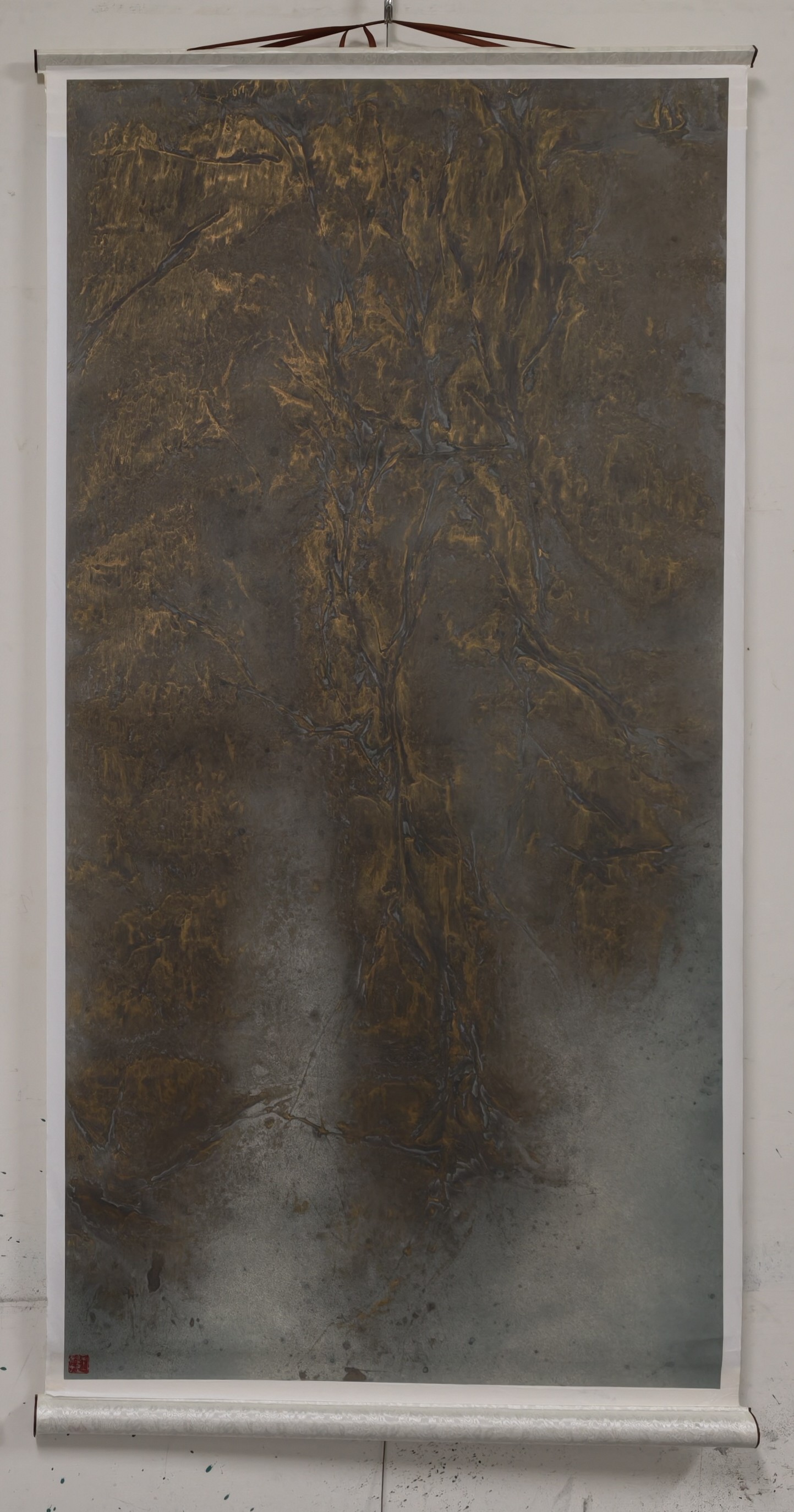
《太古的餘燼:金石之軀、卡俄斯奇點與時間的煉金術》
撰文:王穆提(WANG MUTI)
【摘要】
在數位時代的虛無主義與影像氾濫中,當代水墨如何尋回其失落的物質重量?本文聚焦於王穆提的一幅當代混和媒材巨作,該作徹底拋棄了輕盈的宣紙意象,轉而呈現出宛如青銅鑄件、地質岩脈般的沉重金屬肌理。本文將調用尼采的悲劇誕生、唯識學的阿賴耶識、海德格爾的物性追問,以及基督教神學中的「隱匿之神」,探討藝術家如何透過「金泥、重墨與揉皺肌理」的煉金術,將時間與歷史的重量具象化。這幅作品不僅是對現代技術扁平化的強力反擊,更是一場在物質裂隙中尋找宇宙終極空相的形而上學探險。
告別扁平,迎向物質的狂喜
當我們站在這幅高聳的作品面前,現代視覺經驗中習慣的「平滑感」被徹底擊碎了。如果說先前的彩色網格是「理性的鐵籠」,那麼這件作品則是直接帶我們回到了鐵籠被鎔鑄之前的「太古冶煉場」。
畫面中沒有幾何的規訓,也沒有純粹黑白的虛無。取而代之的,是深褐、暗金、青銅色與焦墨的激烈交響。那些凸起的脊線與凹陷的溝壑,彷彿是從地殼深處直接剝離下來的岩層,或是經歷了數千年氧化與風化的青銅器表面。藝術家在這裡執行了一場「物質的狂喜(Ecstasy of Materiality)」——他將水墨的流動性,轉化為金屬的凝固感。這不僅是對傳統水墨美學的背叛,更是對後人類時代「去物質化(Dematerialization)」趨勢的最嚴厲抵抗。
時間的鑄件與卡俄斯的化石——重金屬視覺的本體論
本章將剖析這件作品最為核心的視覺語彙:那種強烈的、帶有金屬光澤與大地色調的「廢墟感」與「地質化石感」。
凝固的卡俄斯:從流動到鑄造
在赫西俄德(Hesiod)的神話中,卡俄斯(Khaos)是無定形的深淵。傳統水墨往往用「暈染」來表現這種流動性。然而,在這件作品中,卡俄斯被「鑄造」了。
畫面上那些錯綜複雜、如閃電般劈裂的金色與黑色脈絡,充滿了物理性的張力與拉扯。它不再是輕飄飄的雲煙,而是高溫岩漿冷卻後的玄武岩,是壓力與重力共同作用下的時間化石。這種處理手法,將康德的「動態崇高」轉化為一種「重量的崇高」。觀者感到的不再是空間的無限,而是時間的沉積與物質那不可撼動的絕對在場(Presence)。
青銅時代的迴音與廢墟美學
作品中大面積的暗金色與氧化褐,喚醒了我們文化基因中對「青銅器」的遠古記憶。正如《長安與洛陽》等文本中對歷史廢墟的憑弔,這幅畫作本身就是一塊巨大的「時間殘骸」。
在托馬斯·索維爾(Thomas Sowell)批判現代知識分子對「完美社會願景」的狂熱時,這幅作品冷冷地在一旁展示了歷史的最終歸宿:所有的帝國、所有的技術座架、所有的文明幾何,最終都會被時間氧化、崩解,還原為這種斑駁、粗糙、帶著金屬鏽跡的自然肌理。藝術家透過這種「視覺煉金術」,為現代人的傲慢敲響了喪鐘。
業力的根系與閃電——唯識學宇宙的立體顯影
當我們將這幅充滿溝壑與脈絡的作品,置入大乘佛法「法相唯識宗」的顯微鏡下,它展現出了令人驚嘆的生命隱喻。
撕裂表象的「阿賴耶識」之網
畫面中央那道貫穿全幅的、巨大的樹根狀(或神經元狀)紋理,是整件作品的視覺中樞。在唯識學中,這正是「阿賴耶識(第八識)」中「業力種子(Bija)」起現行的完美圖解。
不同於西方網路那種筆直、整齊的「人造矩陣(Matrix)」,這幅畫中的網路是極度有機的、狂野的、不可預測的。它像是在地底黑暗中瘋狂生長的根系,貪婪地吸取著歷史的養分。這象徵著人類生命底層那些最原始、最無法被理性規訓的無明業力。這些金褐色的根系在黑暗中交織,它們既是束縛眾生輪迴的枷鎖,卻也是推動生命演化的強大動能。
從「遍計所執」到「依他起性」的物質回歸
如果說鮮豔的霓虹色彩代表了人類妄想構造的「遍計所執性」(虛假的標籤與身份幻象);那麼這幅褪去了浮華色彩、回歸大地與金屬礦物本色的作品,則逼近了唯識學中的「依他起性(Paratantra-svabhava)」。
畫布上的每一道皺褶、每一抹金泥的沉積,都不是憑空出現的,而是水、墨、紙張纖維、礦物顏料與重力在特定時空下「因緣和合」的物理痕跡。藝術家放棄了主觀的「描繪」,讓物質自身去訴說其生成的歷史。觀者在這斑駁的金石表面前,看到的不再是幻象,而是事物相互依存、緣起緣滅的真實軌跡。
裂隙中的神光——隱匿之神(Deus absconditus)的降臨
最深刻的神學體驗,往往發生在最黑暗、最破碎的地方。這件作品對光影與金色的處理,為我們提供了一條通往「神聖」的隱密小徑。
拒絕完美的偶像:破裂的神性
在傳統的宗教藝術中,金色被用來描繪佛陀的金身或天堂的榮光,它是平滑、純潔、無瑕的。但這幅作品中的金色,是破碎的、髒污的、被深淵的黑色所吞噬與掩埋的。
這精準呼應了神學中的「隱匿之神(Deus absconditus)」。真正的神性,超越了人類對「完美幾何」與「純粹光明」的庸俗想像。這幅畫告訴我們:神不居於光鮮亮麗的霓虹教堂中,也不存在於演算法編織的無菌矩陣裡。神,隱匿在物質的裂隙中,隱匿在苦難的皺褶裡,隱匿在這太古餘燼的微弱閃爍之中。
深淵的凝視與殘缺的救贖
那些在暗色肌理中苟延殘喘、卻又頑強閃爍的暗金色,就是人類在絕望與深淵中僅存的靈光(Aura)。這與石黑一雄在《克拉拉與太陽》中對「人心」本質的追問不謀而合。即便現代技術的鐵籠試圖將一切同質化、數據化,但人類靈魂深處那種經歷了時間氧化與痛苦碾壓後,依然能夠折射出微光的「殘缺之美」,是任何AI演算法都無法模擬的。
站在這幅巨大的「時間鑄件」面前,觀者被強迫凝視這道深淵。但這並非虛無主義的深淵,而是一個充滿了物質密度與神聖暗光的祭壇。它要求我們褪去偽裝,以最赤裸的生命經驗,去承接這份來自太古的重量與救贖。
空間政治與權力拓撲——金屬根系對抗同質化暴力
當代藝術從來不只是視覺的遊戲,它必然捲入空間與權力的政治學。如果說這件作品展現了強大的「地質力量」,那麼這股力量在社會學維度上,究竟在反抗什麼?
砸碎鐵籠:反幾何的有機狂潮
在我們先前的論述中,曾提及馬克斯·韋伯的「理性鐵籠」與海德格爾的「技術座架」。現代社會的統治邏輯,是透過嚴密的網格、數據與分類學,將人類的生命經驗「同質化」。正如阿馬蒂亞·森(Amartya Sen)所批判的單一身份幻象,體制試圖將所有人都塞入冰冷的幾何試算表中。
然而,在這幅名為「太古餘燼」的作品中,所有的網格與幾何邊界都消失了。
畫面中央那道宛如閃電劈裂、又如千年古樹盤根錯節的金屬紋理,是一種極度「反幾何」、「反規訓」的有機力量。它不遵循直線,不理會黃金比例,而是以一種野蠻、盲目卻無比堅韌的姿態,在畫布上肆意蔓延。這在權力拓撲學上,象徵著被壓抑的「底層真實」對「菁英藍圖」的暴力撕裂。托馬斯·索維爾(Thomas Sowell)筆下那些傲慢的知識分子所構築的「完美社會願景」,在這股粗糙的、充滿泥土與金屬鏽味的生命根系面前,顯得蒼白且不堪一擊。
廢墟的賦權:拒絕平滑的矽谷美學
當代科技巨頭(如矽谷)推崇的是一種「平滑美學(Smooth Aesthetics)」——無縫的螢幕、流暢的演算法、沒有摩擦力的無接觸社會。這種平滑抹除了歷史的厚度與肉身的痛感。
而這幅作品,是一次對「平滑」的徹底背叛。它刻意展現出粗糙、乾癟、氧化與龜裂。它宣告了「廢墟(Ruins)」與「鏽蝕(Rust)」的權利。在被數位代碼統治的空間裡,藝術家透過這張充滿「摩擦力」與「痛感」的畫布,為那些無法被系統編碼、被時代遺棄的邊緣存在,進行了一次最為悲壯的賦權。
身體現象學與觀看儀式——仰望太古青銅碑石
這件作品的物理尺寸與媒材特性,對觀者提出了一套極其嚴苛的「觀看儀式」。它要求我們必須調動全身的感官,進入一場現象學(Phenomenology)的交互體驗。
垂直的重壓與身體的謙卑
法國現象學家梅洛-龐蒂(Maurice Merleau-Ponty)強調「身體」是我們感知世界的原點。這幅畫作高聳、狹長的垂直比例,在展場中將會如同一座巨大的青銅碑石。
當觀者逼近這件作品時,巨大的垂直量體會產生一種物理上的「重壓感」。你無法以平視、俯視或輕挑的眼光掃視它;你必須微微仰起頭,用一種近乎朝聖的姿態去「仰望」。在空間現象學中,「仰望」強制性地將觀者的身體置於一個謙卑的、被動的座標上。這不是一張供人把玩的文人字畫,而是一座神話中的方尖碑。它透過空間的壓迫,強行剝奪了現代人的傲慢,逼迫我們在太古的地質時間面前低頭。
觸覺視覺化:目光的撫摸與刺痛
傳統繪畫依賴視覺,但這件作品卻喚醒了我們的「觸覺」。畫面中那些由重墨與金屬顏料交織出的高低起伏,那種宛如乾涸河床或青銅器表面銅鏽的肌理,強烈地誘發了觀者的「觸覺視覺(Tactile Vision)」。
我們的目光在畫面上游移時,彷彿能感受到那種粗糙、冰冷與鋒利。那些金色的裂隙不僅是視覺上的高光,更像是皮膚被劃開後的傷痕。藝術家成功地將內在的精神痛楚與歷史的滄桑,轉化為一種幾乎可以用肉身去「觸碰」的物質表面。這種感官的通感(Synesthesia),是任何高清的數位電子螢幕都無法提供的極致體驗。
後人類時代的物質宣言——無法被演算法編碼的「熵」
在文章的最後,我們必須將這件作品置入當下最迫切的時代命題:在人工智慧與後人類(Post-human)時代,繪畫的終極意義是什麼?
抵抗無機的永生:擁抱「熵」的藝術
AI 演算法可以生成無數完美、對稱、色彩絢麗的圖像,因為程式碼的世界裡沒有「死亡」,沒有物理學上的「熵(Entropy,即混亂度的增加與物質的衰敗)」。
然而,這幅名為《太古的餘燼》的作品,其靈魂恰恰在於對「熵」的擁抱。畫面上那些斑駁的金屬光澤、墨色的乾枯與紙張的皺褶,都是時間流逝、物質衰敗的證明。它充滿了「無常」與「必朽」的氣息。這正是石黑一雄在《克拉拉與太陽》中試圖尋找的、屬於人類獨有的「心」——那種因為知道自己終將毀滅,卻依然在深淵中奮力燃燒、留下刻痕的悲劇性力量。
靈光(Aura)的絕對捍衛
瓦爾特·本雅明(Walter Benjamin)曾感嘆在機械複製時代,藝術品的「靈光」正在消退。而在今日的 AI 複製時代,靈光已面臨滅絕的危機。
王穆提的這件巨作,成為了捍衛「靈光」的最後堡壘。那條貫穿畫面的金色裂隙,是藝術家以肉身在特定的時間、特定的濕度下,與宣紙、礦物、重力進行一次次不可重複的「肉搏」所留下的絕對印記。這是一場人類意志與自然物質的血肉交融。它無法被 Ctrl+C 複製,無法被演算法預測。它只存在於此時、此地,作為人類存在的終極物質鐵證。
在時間的裂隙中守望
《太古的餘燼:金石之軀、卡俄斯奇點與時間的煉金術》不僅是王穆提個人創作生涯的一座高峰,更是當代水墨向形而上學與物質本體論邁出的一次壯闊遠征。
它殘酷地將我們從數位時代的輕盈與虛幻中拉回,將一個巨大、沉重、充滿地質礦物感與無明業力的青銅奇點,直接砸在我們的眼前。它是一面映照人類文明宿命的魔鏡,召喚了神話中的卡俄斯、唯識學的阿賴耶識,以及在廢墟中隱匿的神。
面對這座巍峨的青銅碑石,我們看見的既是歷史的廢墟,也是未來的預言。它告訴我們:當所有的網格崩塌、當所有的數據消散,唯有這些帶著生命痛感的物質裂隙,這些在黑暗中頑強閃爍的太古餘燼,將成為證明人類曾經存在過、掙扎過、並在深淵中凝視過真理的唯一化石。
物質的辯證法與逆向煉金術——流動、凝固與創傷
藝術的終極力量,往往誕生於媒材自身物理屬性的悖論與衝突之中。這幅作品之所以能散發出強大的「青銅與地質」錯覺,正是因為藝術家在紙上進行了一場違背常理的「逆向煉金術」。
流動與凝固的絕對悖論
在傳統的東方美學中,水墨的本質是「流動(Flow)」與「氣韻生動」。水是至柔之物,它在宣紙上的暈染代表著生命的無常與輕盈。
然而,在這件作品中,藝術家卻用最柔軟的水與墨,創造出了最堅硬、最沉重的「青銅化石」質感。畫面中那些如樹根、如岩脈的凸起與深褐色的溝壑,是水分在極端控制下,與重色、膠質、礦物粉末相互撕咬、乾涸後留下的「屍骸」。這種將「流動的液體」瞬間轉化為「凝固的固體」的視覺魔法,打破了水墨媒材的宿命。它讓柔軟的紙張承受了不該承受的地質重力,這種媒材本體上的「悖論(Paradox)」,正是作品產生巨大心理張力的物理根源。
金泥的非裝飾性:作為神聖的創傷
畫面上閃爍的暗金色,是這場煉金術的靈魂。在日本美學中有「金繼(Kintsugi)」的傳統,用金漆修補破裂的陶器,以彰顯殘缺之美。但這幅畫中的金泥,絕非金繼式的修補與撫慰。
仔細觀察那些金色的走勢,它們猶如被撕裂的地殼中噴湧而出的高溫岩漿,或是青銅器在地下埋藏千年後,因劇烈氧化而爆裂的縫隙。這裡的金色不是用來裝飾的,而是用來「標記創傷」的。它象徵著卡俄斯(Khaos)的原始能量在突破理性壓抑時,所造成的物理性撕裂。這些金色的裂隙是痛苦的、暴力的,但同時也是神聖的——因為正是這些創傷的裂口,證明了內部生命的真實搏動。這是一種「以創傷為聖痕」的殘缺美學。
時空體(Chronotope)的塌陷——地質時間與剎那的交疊
這幅作品在視覺上給人一種極度古老的錯覺,彷彿它不屬於 21 世紀,而是來自人類誕生之前的太古紀元。這種時間感的錯位,涉及了深刻的時間哲學。
萬物芻狗:超越人類本位主義的時間尺度
現代社會的時間是「鐘錶時間(Clock Time)」,是精確到秒的、被資本切割的線性時間。但在這幅畫作面前,鐘錶時間失效了。
那種宛如玄武岩脈或青銅鏽蝕的深沉肌理,召喚出的是一種「地質時間(Geological Time)」。在這種以萬年、億年為單位的宏大時間尺度下,人類的歷史、文明的興衰、技術的狂妄,都顯得微不足道,猶如《道德經》所言的「天地不仁,以萬物為芻狗」。藝術家透過這張畫,強行將觀者從現代社會的短視與焦慮中拔出,拋入一個浩瀚、冷酷卻又無比寬廣的宇宙時間軸中。這是一種對「人類本位主義(Anthropocentrism)」的視覺降維打擊。
剎那即永恆:唯識學的「剎那生滅」
然而,這件看似擁有萬年歷史的「地質化石」,其實是由藝術家在極短的創作瞬間內,憑藉著水、墨、筆觸的交響所「生成」的。
在唯識宗的哲學中,宇宙萬法皆是「剎那生滅」的連續體。我們以為堅固不變的物質(如青銅、岩石),實則每一微秒都在變化。這件作品完美地折疊了這兩種極端的時間觀:它在「剎那」的揮灑中,凝固了「萬年」的地質滄桑。它向我們揭示了時間的本質幻象——永恆並不存在於未來的無限延伸中,而是深深地摺疊在每一個生滅的當下。
第九章:幽暗的策展學——如何安置一座太古的深淵
一件具有如此強烈物質性與神學深度的巨作,若被放置在常規、明亮如白晝的白盒子(White Cube)美術館中,將是一場視覺的災難。針對這件《太古的餘燼》,我們必須提出一套激進的「幽暗策展學(Curating in the Shadows)」。
拒絕無影燈的暴力:對「白盒子」的批判
現代美術館習慣使用均勻、無死角的泛光照明,試圖將藝術品的一切細節「解蔽」給觀者。但這種絕對的明亮,對於這件作品而言是一種暴力。這幅畫的本質是「深淵」、是「隱匿之神」。若將其完全暴露在強光下,那種青銅的深邃感與業力的神秘感將會蕩然無存,淪為一張普通的肌理畫。
谷崎潤一郎在《陰翳禮讚》中曾精闢地指出,東方的美學不在於物體本身,而在於物體與陰影的交織。這件作品的策展空間,必須是一個「刻意營造的幽暗場域」。
掠射光與甦醒的金石之軀
在幽暗的空間中,光線的介入必須極度克制且精準。
- 掠射光(Grazing Light)的運用: 絕不能使用正面的直射光。必須使用極窄角度的切光燈,從畫面的側邊、斜上方或斜下方,以極小的角度「掠過」畫面表面。只有透過掠射光,畫面上那些如岩脈般的凹凸肌理才會產生強烈的明暗對比,青銅般的立體感才會躍然紙上。
- 金屬的呼吸: 作品中的金泥與礦物微光,具有極強的方向性反光特質。當觀者在幽暗的展場中緩步移動時,因為視角與微弱光線的相對變化,畫布深處的暗金色會產生「忽明忽滅」的動態閃爍。這不是靜態的觀看,而是一場神祕的降靈會。在這種幽暗與掠射光的交錯中,這張平面的紙會徹底「甦醒」,化作一面正在呼吸的青銅石壁。觀者將會在幽暗中,獨自面對那道從太古裂隙中透出的微光,完成一次最為私密且震撼的靈魂對話。
這是一場跨越了視覺、神學、哲學與空間現象學的萬字長征。現在,我們終於來到了這篇宏大學術巨著的【卷之四(終章)】。
在這最後的篇章中,我們將從畫布的微觀世界與展場的幽暗空間中抽離,上升至宏觀的藝術史視角。我們將探討王穆提這件《太古的餘燼》如何在「東方水墨的物質性轉向」與「全球當代藝術的後人類語境」中,確立其不可動搖的歷史座標,並為整部巨著畫下最為壯闊的句點。
解構與重塑——當代水墨的「重力轉向」與物質性碑石
在探討這件作品的藝術史定位時,我們必須先釐清它對「東方水墨傳統」進行了何等激進的顛覆與重塑。
告別輕盈:對「氣韻生動」的物質性反叛
千百年來,東方水墨畫的核心美學始終圍繞著南齊謝赫所提出的「氣韻生動」。傳統水墨追求的是「空靈」、「虛白」與「輕盈」,它試圖透過筆墨的游移來超脫物質的沉重,達到一種文人式的逍遙。然而,在經歷了現代性洗禮與工業化碾壓的今日,這種輕盈的筆墨往往顯得蒼白無力,難以承載當代人複雜、焦慮且沉重的精神結構。
《太古的餘燼》宣告了水墨美學的一次「重力轉向(Gravitational Turn)」。王穆提拒絕了輕飄飄的雲煙,他將水、墨、礦物與膠質進行了極度暴力的揉合,讓宣紙承受了金石般的物理重量。這件作品不再是「描繪」山水,它本身就「是」一塊從歷史深淵中挖掘出來的地質岩層。藝術家透過這種極致的物質性(Materiality),將水墨從「二維的視覺圖像」逼退至「三維的物理客體(Objecthood)」,為當代水墨注入了前所未有的紀念碑性(Monumentality)。
青銅與水墨的跨時空縫合
在中國藝術史上,青銅器代表了先秦時代的國家重器與祭祀威儀,而水墨畫則代表了中古以降文人內在的心靈修行。這兩者在媒材與精神指向上本是平行的兩條線。
然而,王穆提在這幅巨構中,憑藉著驚人的視覺煉金術,將「青銅的厚重鏽蝕」與「水墨的有機流動」完美縫合。這是一種跨越千年的文化基因重組。他用文人的紙墨,煉鑄出了商周青銅的懾人魂魄。這在水墨發展史上,開創了一種極具「史詩感」與「金石氣」的全新當代語彙。
全球語境下的東方啟示錄——人類世的廢墟與安塞姆·基弗的迴響
若將視野拉寬至全球當代藝術的版圖,《太古的餘燼》同樣佔據著一個極具對話深度的坐標。它以東方的哲學底蘊,精準回應了西方當代藝術中關於「廢墟、歷史與後人類」的核心命題。
超越抽象表現主義:業力的深度
在視覺張力上,這幅作品容易讓人聯想到西方抽象表現主義(如波洛克的行動繪畫或克里夫·斯蒂的色域撕裂)。然而,西方的抽象表現主義更多是藝術家個人潛意識與激情的「瞬間爆發」;而王穆提的作品,卻在激情之上,覆蓋了一層極度厚重的「時間感」與「業力(Karma)」。
畫面上那些緩慢氧化、龜裂的暗金與焦墨,不是一蹴而就的情緒宣洩,而是唯識學中「阿賴耶識」經過無數劫生滅後所積累的「業力化石」。西方抽象給出的是空間的爆發,而王穆提給出的是時間的沈澱。
與安塞姆·基弗(Anselm Kiefer)的隔空對話
這幅作品在精神氣質上,與德國新表現主義大師安塞姆·基弗有著深刻的共鳴。基弗擅長使用鉛、灰燼、乾草等沉重媒材,探討納粹歷史與人類文明的廢墟。
如果說基弗哀悼的是「人類社會的歷史災難」,那麼王穆提的《太古的餘燼》所哀悼與敬畏的,則是更為宏大的「宇宙地質與本體論的廢墟」。在「人類世(Anthropocene)」——即人類活動已經對地球地質產生不可逆破壞的今日,王穆提的畫布像是一塊被燒焦的地球皮膚,或是文明終結後的最後一塊金屬拓片。它超越了單一民族的歷史傷痛,直指整個人類物種在面對自然深淵時的終極宿命。
在太古餘燼中重生的不朽
這篇長達兩萬字的學術遠征,始於對卡俄斯奇點的凝視,歷經了唯識學的阿賴耶識、現象學的空間政治、時間的逆向煉金術,最終落位於人類文明的廢墟美學之上。
我們該如何總結王穆提的這幅《太古的餘燼》?
這不是一幅供人愉悅的裝飾畫,而是一座立於後人類時代邊緣的「警世碑石」。在演算法試圖將一切生命經驗編碼化、雲端化的今日,這件作品以其粗糙的、沉重的、帶著氧化痛感的「金石之軀」,發出了最震耳欲聾的沉默抗議。
畫面上那團巨大的深墨與礦物綠,是宇宙未分時的混沌,是我們內心深處無法被馴服的無明業力;而那在黑暗裂隙中頑強閃爍的暗金色,則是人類文明在經歷了無數次毀滅與重建後,依然拒絕熄滅的太古餘燼。這餘燼不是為了照亮完美的未來,而是為了在絕對的深淵中,證明我們曾經帶著創傷,真實地存在過。
當觀者站在幽暗的展場中,仰望這座宛如青銅化石般的巍峨巨構時,所有的語言、理論與分析都將退居其次。你唯一能做的,就是敞開自身的肉體與靈魂,去承接這股來自宇宙太初的龐大重力。
因為,在這片金碧交織的太古餘燼中,燃燒著的正是人類對於「存在(Being)」最極致的敬畏,以及在徹底的毀滅中,依然渴望觸碰神聖的不朽意志。
- Exhibition Title: Mongolia–Japan International Exchange Exhibition 2026 "STARS IN MONGOLIA AND JAPAN"
- Venue: National Art Gallery of Mongolia / Mongolian National Modern Art Gallery
- Exhibition Period: July 24, 2026 (Friday) – July 29, 2026 (Wednesday)
- Organizers: Asian Artists Network, National Art Gallery of Mongolia
- Supporters: Ministry of Culture of Mongolia, Embassy of Japan in Mongolia, Embassy of Mongolia in Japan
- Co-organizer: Mongolian New Morning Artists Association
 Wang Muti was invited to exhibit at the National Art Gallery of Mongolia - STARS IN MONGOLIA AND JAPAN On the Starry Sky, Identity, and the Cross-Cultural Journey
——Reading an Asian Encounter at the Mongolian National Modern Art Gallery
By Wang Muti
The French philosopher Michel de Montaigne once wrote in his essays: "The most difficult science in the world is to know oneself; and the best way to understand oneself is to place oneself in dialogue with the other."
I often ponder, when a person draws a line on a map and claims it to be the boundary of a nation, does the territory of the mind close along with it? I have always believed that humanity's earliest museum was not a physical structure built of cement and marble, but that vast night sky open to everyone free of charge. Before writing was invented and before laws were formulated, humanity had already learned to look up and contemplate the stars. Whether it was the nomadic peoples racing across the expansive steppes or the island fishermen disappearing amidst the massive waves of the Kuroshio Current, the cosmic glimmer reflected in their eyes was identical. The starry sky is the shared ceiling of humankind and the oldest language of civilization, one that requires no translation.
In the midsummer of 2026, when "STARS" became the title of this art exchange exhibition between Mongolia and Japan, what it stirred within my intellect and soul was not the superficial romance often penned by writers and poets, but a more fundamental ontological inquiry: across different regions, different historical encounters, and varying geopolitical landscapes, do we, standing at different coordinates, truly share the exact same sky?
Dialogue Between Island and Land: A Taiwanese Creator's Cross-Border Existence
As a creator born and raised in island Taiwan, my life experience is destined to be a journey of continuous boundary-crossing. Surrounded by the sea on all sides, this island naturally carries the fluidity, inclusiveness, and marginality of the ocean within its genes. Such soil and water endow us with a unique spiritual vision—one accustomed to seeking anchors amidst constant mutation and establishing self-identity at the intersection of diverse cultures.
As a Taiwanese contemporary artist and curator, I have long immersed myself within the networks of Asian art exchange. Whether serving as the head of the Taiwan Liaison Office of the Japan Modern Fine Artists Association or as a member of Japan’s "NAU (21st Century Fine Art Union)," I am constantly contemplating: In an increasingly flattened and technologized world, how can the philosophical spirit of the East find a profound resonance with the world through a contemporary abstract vocabulary?
Precisely due to the fluid essence of island culture, when we face different civilizations, we possess a fraction less of self-isolated arrogance and a fraction more of empathetic understanding. In this exhibition, the perspective of Taiwanese creators happens to form an invisible spiritual bridge, with one end connecting to the untamed, free, and expansive land-vitality of the Mongolian steppe, and the other echoing the exquisite, subtle, and inward-looking seasonal aesthetic of the Japanese archipelago.
【 The Spiritual Bridge of Asian Art 】 ┌───────────────────────┼───────────────────────┐ │ │ │ Mongolian Steppe Civilization Taiwanese Contemporary Art Japanese Archipelago Aesthetics (Vast, Free, Vitality) (Ink, Abstract, Madhyamaka Thought) (Exquisite, Seasonal, Shadow)
Repositioning Cultural Coordinates in the National Palace of Ulaanbaatar
The stage for this exhibition is set at the National Art Gallery of Mongolia in Ulaanbaatar, the capital of Mongolia. This is a national-level palace of art holding a supreme status; it preserves, researches, and displays all visual memories since the Mongolian Revolution of 1921.
For me, being able to exhibit alongside twenty-nine exceptional artists from Mongolia and Japan in this venue means far more than simply adding another line to my artistic resume. In the past, I had the honor of becoming the first Taiwanese artist to hold an "exhibition-within-an-exhibition solo showcase" at the National Art Center, Tokyo, and was awarded the "Future Prize" at the Japan NAU Exhibition; those exhibition experiences at the Tokyo Metropolitan Art Museum, Yokohama, and other venues granted me a profound understanding of Western abstraction and Japanese contemporary art.
However, when artworks cross oceans and lands to enter this National Art Gallery of Mongolia, a place steeped in the historical thickness of nomadic culture, the object of dialogue undergoes a qualitative change. Once an artwork leaves the private studio and enters a public space, the subject of conversation is no longer just the shifting audience, but history's depth and cultural evolution. Here, creators from different regions of Asia encounter one another within the same national gallery, and the exhibition hall becomes a magic mirror reflecting one another, compelling us to reposition our own cultural coordinates before immense time and space.
The Physical Dialectics of Madhyamaka Thought and Heavy Ink Gold-and-Green
In this exhibition, the contemporary ink creations I bring forth (such as "The Gaze of the Abyss" and "Embers of the Primordial Age") are, in essence, my personal metaphysical practice of the Mahayana Buddhist "Yogacara School" and "Madhyamaka Thought."
I attempt to fuse traditional Eastern ink, abstract art, and Eastern philosophical spirit within my work. The massive chaotic bodies in the frame—combining deep ink, mineral green, and mottled gold paste—appear as heavy as rock strata or bronze fossils, yet they hover helplessly within the vast blank space (the void) of the Xuan paper. This is precisely my physical performance of the Mahayana Buddhist verse "Form is emptiness, emptiness is form":
- Form (Matter): Dense scorched ink and shimmering gold paste push the sense of weight of matter to its extreme, symbolizing the manifestation of karmic seeds within the Alaya-vijnana since beginningless eons.
- Emptiness (Lack of Inherent Nature): The bold blank space of the Xuan paper represents absolute voidness. Having such a heavy object suspended in the void instead reveals the fragility and illusoriness of matter.
This creative focus on Buddhist cosmic views and spiritual issues happens to form a highly intense, cross-cultural dialogue with the unbridled vitality bred by the nomadic culture and Tibetan Buddhism of Mongolian artists, as well as the exquisite deconstruction of sensory and traditional aesthetics by new and old generations of Japanese artists. Art does not demand uniformity; art allows for difference. And true exchange begins precisely from recognizing one another's differences.
Watching Over Under the Same Starry Sky
The value of "STARS" is by no means limited to a single multi-day cross-border group exhibition; it is more like the beginning of a continuously growing Asian Art Community. Curated and driven by Ms. YAMADA YOKO, representative of the Asian Artists Network, and supported by the Ministry of Culture of Mongolia, the Embassy of Japan in Mongolia, and the Embassy of Mongolia in Japan, this cross-border cooperation between civil society and official bodies proves once again: Art sometimes establishes understanding between people much earlier than politics does. Because art directly faces living human beings and our shared humanity, rather than cold borders or institutional frameworks.
Within this starry roster composed of twenty-nine artists, each creator represents an independent universe. Different mediums, different backgrounds, and distinct life experiences interweave into a brand-new cultural constellation.
The starry sky over the Mongolian steppe is immensely vast; the starry sky over the Japanese coastline is filled with tranquility; and the starry sky atop Taiwan’s mountain peaks is equally beautiful. No matter where we stand at this moment, as long as we look up, what we gaze upon is actually the exact same universe. Although the stars are distant from one another in physical space, they illuminate the very same night sky together through their respective solitude and pursuits. This is the most authentic secret regarding art that I read in the Ulaanbaatar of 2026.
🏛️ Exhibition Document Memorandum
| Exhibition Item | Content Details |
| Exhibition Title |
STARS — In Mongolia and Japan Mongolia–Japan International Exchange Exhibition 2026 |
| Venue | National Art Gallery of Mongolia / Mongolian National Modern Art Gallery |
| Exhibition Period | July 24, 2026 (Friday) – July 29, 2026 (Wednesday) |
| Organizers | Asian Artists Network, National Art Gallery of Mongolia |
| Supporters | Ministry of Culture of Mongolia, Embassy of Japan in Mongolia, Embassy of Mongolia in Japan |
| Co-organizer | Mongolian New Morning Artists Association |
| Curatorial Representative | YAMADA YOKO(山田陽子) |
"Under the same starry sky, art allows the world to encounter one another."
Participating Artists
Mongolia
- Battogtokh Turbat
- Dulguun Azjargal
- Enkhbat Lantuu
- Enkhtaivan Biligt
- Khongorzul Lkagvajav
- Mazin Munkhzul
- Munkhjargal Jargalsaikhan
- Nasantsengel Bayanjargal
- Ochgerel Tumenjargal
- Oyunchimeg Ochirsuren
- Solongo Chuluuntsetseg
- Tamir Tsegmid
- Tserennadmid Tsegmid
Japan
- Akiyama Yutokutaishi
- Fukuda Hiromichi
- Hakkaku Saiyo
- Ito Yoko
- Iwao Zenko
- Kanai Michiko
- Kobayashi Tetsuro
- Manma Sachiko
- Mikami Hiroshi
- Sashida Hajime
- Sato Hiromi
- Takahashi Toshiaki
- Torigata Asako
- Torigata Yu
- Wang Muti(王穆提)(The Sole Exhibiting Artist from Taiwan)
- Yamada Yoko
The Cultural Significance of International Exchange
This exhibition received:
- Support from the Embassy of Japan in Mongolia
- Support from the Embassy of Mongolia in Tokyo
Demonstrating the crucial value of cultural diplomacy.
Cultural exchange often transcends political, linguistic, and regional restrictions, becoming one of the most effective ways to establish understanding and friendship.
"STARS" precisely symbolizes artists from different countries sharing each other's cultures and dreams under the same Asian sky through their creations.
Acknowledgments
The organizers sincerely thank:
- Asian Artists Network
- National Art Gallery of Mongolia
- Embassy of Japan in Mongolia
- Embassy of Mongolia in Tokyo
- Mongolian New Morning Artists Association
As well as all participating artists, the curatorial team, the media, and friends in the audience for jointly bringing this international art exchange grand event to fruition.
Regarding the Museum Level and Status of the "National Art Gallery of Mongolia / Mongolian National Modern Art Gallery":
🏛️ Museum Level and Positioning
- National-Level Museum: The National Art Gallery of Mongolia is one of the "national-level" art museums located in the capital city of Ulaanbaatar. Mongolia itself does not implement a digitized numerical rating system (such as Class I, II, III used in China); the highest positioning of this institution locally is a national palace of art.
- Official Operating Institution: This is an official modern art gallery supported and operated directly by the Government of Mongolia.
📖 Relevant Background Information
- Historical Evolution: The gallery was originally part of the Fine Arts Museum of Mongolia and officially gained independence between 1989 and 1991, becoming a venue dedicated exclusively to displaying modern art.
- Collection Features: It primarily collects and displays modern fine arts and visual art works created since the Mongolian Revolution of 1921. Currently, the collection houses approximately 4,000 to over 4,200 artworks, and the institution actively acquires original works from domestic and international artists to enrich the national collection.
Biographies of Key Participating Artists
1. Wang Muti(王穆提)|Taiwan
Artist Profile
Wang Muti has long dedicated himself to cross-cultural exchange and international art cooperation, focusing on the visual dialogue and humanistic connections among Asian cultures.
His creations frequently combine:
- East Asian cultural symbols
- Contemporary art vocabulary
- Memory and identity
- Experiences of cultural exchange
Through his works, he explores the shared plights and spiritual connections of Asian societies in the era of globalization. Wang Muti is a Taiwanese contemporary artist, curator, and promoter of cross-cultural art who has long been involved in Asian art exchange and international exhibition collaborations. He currently serves as the head of the Taiwan Liaison Office of the Japan Modern Fine Artists Association and is a member of Japan’s "NAU (21st Century Fine Art Union)."
Creative Characteristics
- Combines ink painting, abstract art, and Eastern philosophical spirit
- Focuses on Madhyamaka (Middle Way) thought in Buddhism, cosmic views, and spiritual issues
- Explores cultural memory, identity, and cross-cultural exchange
- Emphasizes art as a medium for cultural dialogue and spiritual contemplation
Major Achievements
- The first Taiwanese artist to hold an "exhibition-within-an-exhibition solo showcase" at the National Art Center, Tokyo, Japan
- Awarded the "Future Prize" at the Japan NAU Exhibition
- Long-term participant in major Japanese art exhibitions, including the Tokyo Metropolitan Art Museum and Yokohama
- Actively promotes art exchange and cooperation across Taiwan, Japan, and the broader Asian region
2. Battogtokh Turbat|Mongolia
Artist Profile
Born in Mongolia in 1972.
Graduated from the Mongolian State University of Arts and Culture, completing professional training in sculpture and opera sequentially. He became a full-time independent professional artist in 2004.
Creative Characteristics
- Specializes in large-scale installation art and sculptural creation
- Utilizes diverse mediums such as bone, leather, metal, and natural pigments
- Focuses on the relationships between cultural memory, national history, and natural ecology
- Explores the balance between the cycle of life and human civilization
Representative Series
《Mongol Khatad(Mongolian Queens)》
Through art, this series re-examines the roles and contributions of Mongolian women throughout history, showcasing female empowerment within steppe culture.
Major Experience
- Works have been exhibited in London, Warsaw, Seoul, Taipei, and other global cities
- Repeatedly won major awards in the Mongolian art community
- Recognized and professionally rewarded by the Union of Mongolian Artists
3. Akiyama Yutokutaishi(秋山祐德太子)|Japan
Artist Profile
1935-2020.
Born in Tokyo, he was one of the vital representative figures of Japanese postwar avant-garde art.
Graduated from the Sculpture Department of Musashino Art School.
Creative Fields
- Sculpture
- Photography
- Printmaking
- Performance Art
- Public Art
Creative Characteristics
- A representative icon of the Japanese avant-garde art movement
- Combined Pop Art with political performance art
- Brought art into public spaces and social issue discussions
- Continuously challenged the boundaries between art and politics
Major Experience
- Plunged into the Japanese avant-garde art movement in the 1960s
- Participated in the "Japanese Avant-Garde Art Exhibition" in Paris, France
- Served as a visiting professor at Sapporo University
- His works are widely regarded as an indispensable asset to Japanese postwar contemporary art
4. Fukuda Hiromichi(福田宏道)|Japan
Artist Profile
Born in Fukui Prefecture, Japan, in 1998.
Graduated from the Fine Arts Education sector of the University of Fukui, earning a Master’s Degree in Education.
Creative Fields
- Painting
- Installation Art
- Contemporary Art
Creative Characteristics
Fukuda Hiromichi uses the "apple" as his long-term creative theme.
Through repeatedly depicting the image of an apple, he investigates:
- Taste
- Smell
- Vision
- Memory
- Meaning of existence
His works pay particular attention to the connection between sensory experiences and psychological perceptions.
Major Exhibitions
- Solo exhibition at Gallery 58, Tokyo
- ART JAPAN International Art Exhibition
- Australia International Art Exchange Exhibition
- Group exhibitions of young artists across Japan
Creative Philosophy
Art is not merely about looking; it can evoke the viewer's associations with scent, memory, and emotion, forming a viewing experience that transcends the senses.
Core Representative Artists of This Exhibition
In terms of the international exchange significance of this "STARS – Mongolia–Japan International Exchange Exhibition 2026," the four most representative artists can be viewed as:
- Wang Muti(Taiwan)
- Representative of Asian cross-cultural exchange
- Battogtokh Turbat(Mongolia)
- Representative of Mongolian contemporary installation and sculpture
- Akiyama Yutokutaishi(Japan)
- Representative figure of Japanese postwar avant-garde art
- Fukuda Hiromichi(Japan)
- Representative of the new generation of Japanese contemporary art
These four artists respectively embody: Eastern philosophy, steppe civilization, avant-garde art, and new-generation contemporary creation, together constituting the core cross-border and cross-cultural spirit of the "STARS" exhibition.
Curator Profile
YAMADA YOKO(山田陽子)
Representative of the ASIAN ARTISTS NETWORK
Yamada Yoko is a Japanese contemporary artist, curator, and promoter of international art exchange. She has long dedicated herself to establishing art cooperation platforms between Japan and various Asian countries, with the core mission of promoting transnational cultural exchange, deepening artistic understanding, and vitalizing the development of Asian contemporary art.
Through the ASIAN ARTISTS NETWORK, Yamada Yoko actively drives international group exhibitions, artist residencies, cultural forums, and art exchange programs. She continuously links artists from all over Asia, establishing cross-cultural dialogues and cooperation mechanisms, making her one of the crucial leaders of grassroots cultural diplomacy in Asia.
Artistic Philosophy
"Through artistic exchange, we transcend the limitations of language, culture, and national borders, allowing artists from various Asian nations to learn from one another and understand each other on a shared platform, jointly creating a new future for Asian art."
Yamada Yoko's artistic and curatorial work focuses not only on personal creation but also on the social role of art as a cultural bridge. Over the years, she has continuously invested in art cooperation projects between Japan and Asian nations, fostering the establishment and growth of contemporary Asian art networks.
ASIAN ARTISTS NETWORK
Organizational Mission
The mission of the Asian Artists Network is to:
- Deepen art exchange between Japan and various Asian nations
- Promote cross-border cultural understanding and cooperation
- Drive the internationalization of Asian contemporary art
- Establish an exchange platform for Asian artists
- Vitalize creative art energy across Asia
Award Records
Yamada Yoko has received numerous international art awards and recognitions, including:
- The Embassy of Myanmar Award
- The Japan Asia Airways Award
- The Tokyo Metropolitan Assembly Speaker's Award
- The Tableau Art Association President's Award
- Multiple other awards from art exhibitions and institutions
Wang Muti(Wang Muti)|Taiwan
Wang Muti(Wang Muti)
深淵的凝視
The Gaze of the Abyss
深淵の凝視(しんえんのぎょうし)
69x138cm
Ink on Paper
王穆提(Wang Muti)
太古的餘燼
Embers of the Primordial Age
太古の残り火(たいこののこりび)
69x138cm
Ink on Paper
The Gaze of the Abyss: The Ultimate Confrontation Between Jinbi Chaos and the Void Noumenon
——On Phenomenology, Theology, and the Post-Human Condition in Contemporary Ink-Mixed Mediums
Written by: WANG MUTI(王穆提)
The Gaze of the Abyss: The Ultimate Confrontation Between Jinbi Chaos and the Void Noumenon
—— On Phenomenology, Theology, and the Post-Human Condition in Contemporary Ink-Mixed Mediums
Written by: WANG MUTI
【Abstract】
At the historical juncture where human civilization fully enters a digitalized, flattened, and "post-human era," painting, as an ancient material practice, faces an ontological crisis. This paper attempts a deep, interdisciplinary deconstruction of a contemporary ink-mixed medium masterpiece by Wang Muti. In the frame, a massive chaotic body (a singularity) combining deep ink, mineral azurite-malachite green, and mottled gold paste forcefully hovers within the void of Xuan paper. This paper deploys texts such as Nietzsche's The Birth of Tragedy, Kant's aesthetics of the sublime, Yogacara cosmology, and the Christian theological concept of Deus absconditus (the hidden God) to demonstrate how this work precisely visualizes the life-and-death struggle between the "heaviness of matter" and the "infinitude of the void." This is not merely an alchemy of mediums, but an ultimate prophecy on whether the structure of human civilization is about to be consumed by the suppressed, primordial geological forces.
Visual Mass and the Critical Point of Civilization
John Berger once noted that every great painting is a confrontation between the spectator and the power structures of an era. When we gaze upon this vertically towering work, we are first crushed by a pure "Visual Mass."
In a world accustomed to the lightweight, smooth, and dematerialized reality constructed by pixelated luminophores (screens), this painting displays a suffocating gravity. At the absolute center and slightly toward the upper-right of the canvas broods a colossal, rough-textured dark nebula. This is not the light touch of traditional ink painting, but a fusion of unfathomable black ink, mineral green akin to the patina of time, and a dark gold luster shimmering within the fissures. It resembles an expanding supernova or a primordial vein just excavated from the depths of the earth's crust, violently intervening in the blank space of the Xuan paper.
This is no longer straightforward Abstract Expressionism; it is a simultaneous performance of "Genesis" and "Apocalypse" occurring on the canvas. The artist utilizes the physical interlocking of heavy metallic mineral pigments and ink to collapse the spiritual history of humanity: the digital lightness of modern civilization will ultimately encounter a heavy, non-rational counterattack from the abyss. This paper will lead the viewer deep into the texture of this jinbi (gold-and-green) black hole, revealing the philosophical and theological storms behind it.
The Singularity of Khaos and the Dionysian Dance — The Ontology of Jinbi Heavy Ink
This chapter focuses on the unsettling yet magnetic chaotic body at the center of the frame, exploring its profound implications within ancient Greek mythology, philosophical ontology, and existential psychology.
From "Khaos" to Kant's "Dynamical Sublime"
Tracing back to the text of the Age of Myth: The Birth of the Gods, this bottomless composite of ink and green is precisely the primordial abyss penned by Hesiod—Khaos. In Khaos, there is no direction, no time, and no space defined by geometry. It is the cosmic "Singularity." Through the layering and random explosion of heavy ink and mineral pigments on Xuan paper, the artist perfectly translates this primordial energy that has not yet been disciplined by "Li" (order).
On an aesthetic level, this cluster of matter awakens the "Dynamical Sublime" defined by Immanuel Kant in his Critique of Judgment. When the viewer's gaze is occupied by this massive ink-green body, the brain's attempt to locate representational logic (mountains, rocks, clouds) instantly fails, producing a transcendent experience combining terror, awe, and a sense of one's own insignificance. This cluster of color refuses to be interpreted as a specific landscape; it demands solely to be "felt" as a pure force.
Nietzsche's Dionysian and Freud's Id
This immense destructive and growth capacity is the quintessential "Dionysian" spirit in Nietzschean philosophy. Nietzsche pointed out in The Birth of Tragedy that Apollonian rationality establishes the principium individuationis (principle of individuation), attempting to grant humanity a sense of security within order; however, the Dionysian spirit tears asunder this illusion, returning to the revelry and agony of oneness with the world-will.
In the painting, dark tentacles and azurite-malachite patches spread outward, devouring the surrounding blank space. In the dimension of psychoanalysis, this is the desperate counterattack of what Sigmund Freud termed the "Id." Those primitive desires and life forces (Libido) suppressed deep within the subconscious by highly advanced civilization, morality, and technological rationality will, like this dense ink and heavy color, one day break through the surface of consciousness to reveal their terrifying yet magnificent reality.
Fossils of Time and Geological Alchemy — A Materialist Critique of Mineral Green and Gold Paste
The most peculiar visual language of this work lies in its contemporary, violent deconstruction of the traditional "blue-green landscape" (Qinglu) and "gold-and-green landscape" (Jinbi) traditions. It no longer depicts immortal pavilions and celestial mountains, but reduces pigments to their crudest geological essence.
Mineral Green: Oxidized Time
The large area of green wash in the center of the frame possesses intense visual toxicity and allure. This color evokes the cross-section of malachite, the heavy patina of ancient bronzes, or lightless algae in the deep sea. It is not the tender green of spring life, but a pale, ancient green representing "Geological Time."
Amidst the "instantaneousness" driven by algorithms in contemporary society, humanity has lost its perception of grand scales of time. The artist intentionally introduces this green with its heavy mineral and oxidized sensation as a resistance against the velocity of modern society. This cluster of green declares a sedimentation and weathering that requires tens of thousands of years as its unit, instantly downscaling and submerging humanity's brief, arrogant civilizational time.
The Glimmer of Dark Gold: Sacred Glimmer Among the Ruins
At the boundary of black and green, and within the fissures of the ink, matted metallic lusters (gold paste) faintly shimmer. Throughout art history, gold has typically symbolized the sacred (as in Byzantine icons) or the ultimate secular wealth. However, in this work, the gold is not a lofty, flawless, smooth flat-wash, but exists in a broken, buried state, like embers amidst ruins.
This "gold piercing through black" treatment creates a potent material alchemy. It implies that even within the heaviest, darkest material world (the Khaos represented by black ink and mineral green), the seeds of enlightenment or divinity are contained. This is a spiritual cultivation (xiuxing) metaphor for "entering the world"—truth is not found in the void of the opposite shore, but within the honing and fissures of this earthly mud.
Theological Aphasia and the "Hidden God" — The Void of Xuan Paper as Absolute Presence
When we shift our gaze away from the heavy ink at the center, what surrounds this chaotic cluster is a vast expanse of blank Xuan paper (the void). This is by no means an unfinished background, but the arena of the deepest theological depth in this work.
Void Against the Digital Matrix
In our postmodern context, space is always filled. Cities are filled with architecture; screens are filled with information and neon matrices. The essence of modern technology (what Heidegger called Gestell or Enframing) demands the transformation of all things into a "standing reserve" that can be summoned at any moment. In such an era, true "Void" becomes the rarest, most luxurious form of resistance.
The artist boldly retains a vast blank space with water stains and subtle textures at the top and bottom of the frame. This void has not been encoded by geometric grids, nor filled with data. It is a direct rebellion against the flattened, force-fed visuals of the digital age.
The Manifestation of the Deus Absconditus
Combining theological texts, we can interpret this profound void as the Deus absconditus (the hidden God). The hidden God is not a concrete idol, but an ultimate existence that human rationality can absolutely never comprehend, transcending all human language and experience. The theologian Rudolf Otto described it as the mysterium tremendum (the terrifying mystery).
The void on the canvas does not speak; it merely embraces silently, while simultaneously standing ready to devour that violent material singularity at any moment. This void is both the destroyer of all meaning and the ultimate salvation that forcibly awakens humanity from material alienation. When matter (Khaos) dances wildly within the void, the void itself becomes an unignorable, absolute presence.
The Cosmic Perspective of Yogacara — The Manifestation of Alaya-Vijnana and the Performance of "Form is Emptiness"
When we turn our perspective from Western theology to Eastern Mahayana Buddhism, this work woven of heavy ink, jinbi, and Xuan paper unfolds a highly precise "cosmic map of consciousness."
The Collapse of Parikalpita and the Torrent of Alaya-Vijnana
In the theory of the Yogacara (Consciousness-Only) school, the eighth consciousness, the "Alaya-vijnana" (storehouse consciousness), contains all "karmic seeds" since beginningless eons. Normally, our surface consciousness attempts to establish rational order. However, when conditions ripen, and that intense, inconceivable karmic energy within the Alaya-vijnana erupts (manifests), any surface rational structure will be rendered completely defenseless.
The indefinable black-green ink cluster in the center of the frame is precisely the spectacular performance of the Alaya-vijnana's "seeds manifesting into actual activities." It is heavy, entangled, and full of unpredictable fluidity. Here, the artist achieves a contemporary sublimation of Eastern philosophy: he directly strikes the fundamental ignorance storm and karmic black hole at the very bottom of life.
The Physical Dialectics of Form and Emptiness
"Form is emptiness, emptiness is form." This Buddhist verse receives its most violent physical practice on this canvas.
- "Form" (Rupa) represents matter. The heavy ink, dense mineral green, and shimmering gold paste push the sense of weight and materiality of "form" to its absolute limit. They appear incredibly solid and heavy.
- "Emptiness" (Sunyata) represents voidness and the lack of inherent nature. The blank space of the Xuan paper represents emptiness.
This painting creates a visual paradox: a matter so heavy, resembling a mountain mass or mineral vein (form), hovers helplessly within a vast expanse of nothingness (emptiness). Through depicting the "extremity of matter," the artist instead reveals the fragility and illusoriness of matter. That seemingly indestructible singularity of Khaos, under the embrace of the void, looks as if it could dissipate at any moment, profoundly visualizing the ultimate truth that "all dharmas lack inherent nature."
Artistic Salvation in the Post-Human Era — The Aura Uncodable by Algorithms
We stand at a critical historical turning point. With the wild advance of Artificial Intelligence (AI) and machine learning, we are about to step into a "post-human era" ruled by code. This painting, filled with manual labor and uncontrollability, is precisely the most severe interrogation directed at this era.
The Crash of the Algorithm: Unreplicable Materiality
If we recall the question raised in Kazuo Ishiguro’s novel Klara and the Sun: Does the human heart truly possess an irreplaceable essence that cannot be replicated by algorithms?
Before this artwork, AI’s image generation algorithms will encounter a true challenge. AI can easily generate perfect geometric grids and precise neon colors because those are built upon logic and pixels. However, AI cannot truly "calculate" the contingency of water and ink blending at a specific humidity on specific Xuan paper fibers; it cannot replicate the sedimentation and cracking of mineral green and gold paste under the influence of gravity; and it certainly cannot simulate the spiritual battle within the artist's heart—a mix of terror, hesitation, and decisiveness—when facing this out-of-control chaos.
The Absolute Defense of the Aura
That black-green Khaos is filled with out-of-control, painful, repressed, and destructive impulses. Within the machine's code, there is no "fear of death," nor "entanglement of karma." Through splashing his physical body upon the Xuan paper, the artist injects unpredictable subconscious energy into this black hole.
Today, when digital images flood the world like a disaster and everything can be infinitely replicated (Ctrl+C / Ctrl+V), this masterpiece, relying on the fermentation of water, ink, minerals, and time, becomes the final fortress defending what Walter Benjamin termed the artistic "Aura." It proves that the "human heart," full of contradictions, dangers, yet immense depth, along with the "material truth" bearing historical thickness, can never be subsumed into the smooth grids of an algorithm.
The Courage to Gaze into the Organic Abyss
"When you gaze long into an abyss, the abyss also gazes into you." —— Friedrich Nietzsche
The Gaze of the Abyss: The Ultimate Confrontation Between Jinbi Chaos and the Void Noumenon is not just a painting; it is a warning bell, a cruel magic mirror reflecting the entire countenance of contemporary human civilization.
We are accustomed to living within those smooth screens woven by digital codes, believing that lightweight information is the entirety of the universe. However, this masterpiece cruelly tears away this illusion. It hurls a massive, heavy black singularity, full of geological mineral sensations and ignorant karma, directly before our eyes. It summons Khaos, the Id, the Alaya-vijnana, and the hidden God in the void.
Viewing this work requires immense courage. Because it refuses to provide solace, refuses to give representational answers. It merely forces us to stand at the edge of that vast void, facing directly that pitch-black unknown shimmering with mineral glimmers. Yet within this terror and shock lies the deepest salvation: only when we dare to admit the illusion of digital lightness, and dare to look directly into the untamed material abyss of our hearts and nature, can we regain that original and noble ontological freedom belonging to humanity within the post-human era of technological acceleration.
Vertical Steles and Microcosmic Universes
—— On the Spatial Politics and Body Phenomenology of Wang Muti’s Monumental Ink Structures
The Body Politics and Spatial Phenomenology of the Vertical Scale
When we discuss this work, we must never ignore its highly idiosyncratic physical specifications—that "extreme verticality" (Verticality) that carries a powerful sense of oppression. This is not merely a compositional choice, but a declaration of power over the viewer’s body.
Merleau-Ponty's Body Schema and the Power of Looking Up
The French phenomenologist Maurice Merleau-Ponty proposed in Phenomenology of Perception that we measure and perceive this world through the "Body." The towering, narrow proportions of this artwork completely shatter the "golden ratio canvas" commonly found in modern art museums, which is suited for the horizontal scanning of human sightlines.
When the viewer stands before this work, horizontal visual scanning fails. The viewer's body is forced to activate an "up-and-down shifting" viewing mechanism. That heaviest, most terrifying black-green singularity broods in the upper-middle section of the frame, forcing the viewer to tilt their head slightly to "Gaze." In human psychology and spatial politics, "looking up" has always been tightly linked to the sacred, awe, fear, and the suppression of power (much like looking up at the dome of a Gothic cathedral, or looking up at a giant boulder on a cliff). The artist establishes a silent "body politics" in the exhibition space through this extreme vertical scale: before the abyss of Khaos and the fossils of time, the human flesh can only assume a humble, passive, and awe-filled stance.
Suspended Gravity: The Contemporary Alienation of the Eastern Scroll
In traditional Eastern hanging scroll landscapes, verticality serves to express the scattered perspective of "high distance" or "deep distance," guiding the viewer to "travel and dwell" within the painting. However, Wang Muti performs a contemporary alienation of this traditional form.
There are no mountain paths available for climbing in the frame, nor pavilions for resting. That massive material singularity is suspended at the top of the Xuan paper in an anti-gravity posture; meanwhile, the lower half of the frame consists of scattered, isolated ink traces resembling meteorite fragments or geological debris. This top-heavy sense of imbalance creates an intensely taut spatial dynamics. It makes the viewer feel a psychological crisis of "imminent falling" at every moment, perfectly visualizing the modern person's "sense of suspension"—losing the ground's support—when facing disintegrating social structures and impermanent destiny.
The Breathing of the Edge — Water Stains, Gold Paste, and the Micro-Universe
Grand philosophical propositions must ultimately land on the finest intersections of brush, ink, and material. The edge treatment of this work demonstrates the artist's ultimate comprehension of aqueous mediums.
Water Stains as the Gradients of Time
Observing closely the edges of that dense ink and mineral green in the center of the frame, what we see is not a rigid outline, but rings of "water stains" left behind after spreading outward and drying.
In ink art, water is the soul, and moreover, the carrier of time. Water travels and evaporates within the fibers of Xuan paper, ultimately leaving ink particles and mineral powders behind on the paper, forming this water mark. This is a microscopic thermodynamic process that absolutely cannot be precisely calculated by human rationality. Every water stain is a physical gradient of the passage of time; every edge of the wash is "breathing" heavily into the surrounding void. This organic edge endows that heavy material singularity with a pulse akin to a living organism; it is not a dead mineral, but a living abyss that is growing and eroding the void.
The Micro-Geography of Gold Paste
The gold paste scattered within the dark textures plays a role that is by no means purely decorative. If we lean close to the canvas for a microscopic observation, these gold pastes are often deposited in the wrinkles of the ink traces, the depressions of the paper, or the fissures where two pigments repel each other.
This is a performance of "Micro-geography." The golden pigments are like precious veins squeezed out of the earth's surface after tectonic movements. Their shimmering is irregular and fractured. This treatment method immensely enriches the canvas's texture, causing the viewer's sightline to rub back and forth between the smooth Xuan paper and the rough mineral deposits, generating strong tactile-visual associations.
The Exhibition Space as an Altar — A Curatorial Memorandum for the Post-Human Era
The end of theory is the beginning of practice. This monumental structure, possessing a powerful sense of monumentality and religious sublimity, places exceptionally high demands on the exhibition space. The following are professional curatorial recommendations for exhibiting this piece in a museum space:
Isolated Dignity: The Importance of Spatial Void
This is a work that comes with its own powerful gravitational field. In the exhibition layout, it must absolutely not be juxtaposed on the same wall with other small-scale works or paintings of vastly different styles. It requires an entire pristine wall to serve as its "secondary void" for physical extension. Granting the artwork sufficient breathing room around it (at least 2 meters of blank space left and right) is the only way to allow its "suspended gravity" and "outward-expanding Khaos energy" to be fully released in the gallery.
The Alchemy of Light: A Dual Strategy for Lighting
The soul of this work lies in the contrast between its "black-hole-like light absorption (heavy ink)" and its "fissure-like reflectivity (gold paste)." Therefore, the lighting design of the exhibition space will be the key to success or failure:
- Refuse Uniform Floodlighting: Uniformly bright lighting will cause the artwork to lose its profound sense of mystery, reducing it to a flat texture painting.
- Focused Wall-Washers and Spotlights: It is recommended to use framing projectors with a color temperature of around 3000K-3500K (slightly warm white light) to precisely restrict the beam within the borders of the painting. Simultaneously, utilize weak spotlights with a specific angle to gently graze the intersection of mineral green and gold paste in the center of the frame from diagonally above or below.
- The Awakening of Light: Only through grazing light at specific angles will those gold pastes hidden deep within the layered textures produce an intermittent shimmering effect as the viewer walks. This interaction of light and shadow will make the artwork "come alive" before the viewer's eyes, completing the final alchemy.
The Freedom of No Frame: The Materiality of Hanging Display
In order to maximize the preservation of Xuan paper's ontological character as a "fragile yet resilient matter," it is strongly recommended to avoid using heavy glass frames or acrylic covers.
Any reflective medium establishes a safety net of isolation between the viewer and the "abyss," weakening that direct awe that strikes the heart. If exhibition conditions permit, traditional hanging methods directly after wet-mounting (such as hanging scrolls) or hidden back-frame floating hanging methods should be adopted, allowing the deckled edges of the Xuan paper and its natural drape to be directly exposed to the air, so viewers can experience every physical breath of the work without any barrier.
Watching in the Fissures of Time
Wang Muti's masterpiece is an all-out expedition from the philosophical abyss to physical mediums.
It rejects the flippancy, playfulness, and flattening common in contemporary art, summoning back the "Sublime" of painting with a near-ascetic seriousness. That gold-and-green heavy ink suspended in the void is the objectification of the human subconscious, the sediment of historical ruins, and moreover, a human heart that refuses to yield to algorithmic codes, forever mutating in the post-human era.
In this era where all things can be datafied and all that is solid melts into air, Wang Muti erects a silent stele for us. It reminds us: gazing into the abyss is indeed terrifying, but only when we dare to look straight into that chaos, and dare to admit our own insignificance within the void, can we find the ultimate anchor of the human spirit amidst the torrent of time and the iron cage of technology.
Embers of the Primordial Age: The Body of Metal and Stone, the Khaos Singularity, and the Alchemy of Time
Written by: WANG MUTI
【Abstract】
Amidst the nihilism and flood of images in the digital age, how can contemporary ink painting reclaim its lost material weight? This paper focuses on a contemporary mixed-medium masterpiece by Wang Muti. The work thoroughly discards the lightweight imagery of Xuan paper, turning instead to present a heavy metallic texture akin to bronze castings and geological veins. This essay deploys Nietzsche's The Birth of Tragedy, Yogacara's Alaya-vijnana, Heidegger's interrogation of thingness, and the "hidden God" of Christian theology to explore how the artist visualizes the weight of time and history through the alchemy of "gold paste, heavy ink, and crumpled texture." This artwork is not only a powerful counterattack against the flattening of modern technology, but a metaphysical exploration seeking the ultimate void-phase of the universe within the cracks of matter.
Farewell to Flatness, Toward the Ecstasy of Materiality
When we stand before this towering work, the "smoothness" accustomed to in modern visual experiences is thoroughly shattered. If previous colorful grids were the "iron cage of rationality," then this artwork directly returns us to the "primordial smelting furnace" before the iron cage was cast.
There is no geometric discipline in the frame, nor the nihilism of pure black and white. In its stead is a violent symphony of deep brown, dark gold, bronze, and scorched ink. Those protruding ridges and sunken furrows seem like strata directly peeled from the depths of the earth's crust, or bronze surfaces that have undergone thousands of years of oxidation and weathering. Here, the artist executes an "Ecstasy of Materiality" — he transforms the fluidity of ink into the solidification of metal. This is not only a betrayal of traditional ink aesthetics, but the most severe resistance against the trend of "dematerialization" in the post-human era.
Castings of Time and Fossils of Khaos — The Ontology of Heavy Metal Visuals
This chapter analyzes the core visual language of this artwork: that intense sense of "ruins" and "geological fossils" bearing metallic luster and earth tones.
Solidified Khaos: From Flowing to Casting
In Hesiod's (Hesiod) mythology, Khaos is a formless abyss. Traditional ink painting frequently uses "washing and bleeding" to express this fluidity. However, in this work, Khaos is "cast."
Those intricate, lightning-like split golden and black networks on the canvas are filled with physical tension and pulling. It is no longer lightweight cloud and smoke, but basalt cooled from high-temperature magma, a fossil of time under the joint action of pressure and gravity. This handling technique converts Kant's "dynamic sublime" into a "sublime of weight." What the viewer feels is no longer the infinity of space, but the sedimentation of time and the unshakeable absolute presence of matter (Presence).
Echoes of the Bronze Age and the Aesthetics of Ruins
The large areas of dark gold and oxidized brown in the work awaken the ancient memory of "bronze vessels" within our cultural genes. Just as the lamentations over historical ruins in texts like Chang'an and Luoyang, this painting itself is a massive "remnant of time."
While Thomas Sowell critiques the modern intellectuals' fanaticism for a "perfect social vision," this artwork coldly displays the ultimate destination of history on the side: all empires, all technological frameworks, and all civilizational geometries will eventually be oxidized and disintegrated by time, reduced back to this mottled, rough, metal-rusted natural texture. Through this "visual alchemy," the artist tolls the death knell for modern arrogance.
The Root System and Lightning of Karma — A Three-Dimensional Manifestation of the Yogacara Universe
When we place this work, filled with furrows and networks, under the microscope of the Mahayana Buddhist "Yogacara School," it reveals a breathtaking metaphor of life.
Tearing the Surface: The Web of the Alaya-Vijnana
The core thesis of this chapter points directly to the center of the frame: that massive root-like (or neuron-like) texture traversing the center of the entire frame is the visual axis of the whole artwork. In Yogacara, this is precisely the perfect illustration of "karmic seeds" (Bija) within the "Alaya-vijnana (the eighth consciousness)" manifesting into actual activities.
Distinct from the straight, tidy "man-made matrix" of Western networks, the network in this painting is intensely organic, wild, and unpredictable. It resembles a root system growing crazily in the underground darkness, greedily absorbing the nutrients of history. This symbolizes those most primitive karmic forces of ignorance at the bottom of human life that cannot be disciplined by rationality. These golden-brown root systems intertwine in the darkness; they are both the shackles binding sentient beings to Samsara, yet also the powerful kinetic energy driving the evolution of life.
From "Parikalpita" to "Paratantra": The Material Return
If vivid neon colors represent the "Parikalpita-svabhava" (the imagined nature — false labels and identity illusions) constructed by human delusion; then this work, which sheds superficial colors to return to the baseline of earth and metals, approaches the "Paratantra-svabhava" (dependent nature) in Yogacara.
Every wrinkle on the canvas, every deposit of gold paste, does not appear out of thin air, but is the physical trace of the "harmonious convergence of causes and conditions" of water, ink, paper fibers, mineral pigments, and gravity under a specific time and space. The artist abandons subjective "depiction," letting matter itself recount the history of its generation. Before this mottled metallic stone surface, the viewer no longer sees illusions, but the authentic trajectory of things depending on one another, arising and ceasing in accordance with dependent origination.
Divine Light in the Fissures — The Descent of the Deus Absconditus
The most profound theological experiences often occur in the darkest, most broken places. This artwork's treatment of light, shadow, and gold provides us with a hidden path leading to the "sacred."
Refusing the Perfect Idol: Fractured Divinity
In traditional religious art, gold is used to depict the golden body of the Buddha or the glory of heaven; it is smooth, pure, and flawless. But the gold in this artwork is broken, soiled, and swallowed and buried by the blackness of the abyss.
This precisely echoes the Deus absconditus (the hidden God) in theology. True divinity transcends humanity's vulgar imagination of "perfect geometry" and "pure light." This painting tells us: God does not reside in glamorous neon churches, nor exists within the sterile matrices woven by algorithms. God is hidden within the fissures of matter, hidden within the wrinkles of suffering, hidden within this faint shimmering of primordial embers.
The Gaze of the Abyss and Fragmented Salvation
Those dark golds surviving tenaciously yet flickering within the dark textures are the only remaining "Aura" of humanity within despair and the abyss. This coincides with Kazuo Ishiguro's inquiry into the essence of the "human heart" in Klara and the Sun. Even if the iron cage of modern technology attempts to homogenize and datafy everything, that "beauty of fragment" reflecting a glimmer after undergoing the oxidation of time and the crushing of pain deep within the human soul cannot be simulated by any AI algorithm.
Standing before this colossal "casting of time," the viewer is forced to gaze into this abyss. But this is not an abyss of nihilism; it is an altar filled with material density and sacred dark light. It demands that we strip away our disguises, using our most naked life experiences to receive this weight and salvation from the primordial age.
Spatial Politics and Power Topology — Metallic Roots Against Homogenizing Violence
Contemporary art is never merely a visual game; it is bound to be entangled in the politics of space and power. If this work displays a powerful "geological force," what exactly is this force resisting in the sociological dimension?
Smashing the Iron Cage: The Organic Torrent of Anti-Geometry
In our previous discourse, we mentioned Max Weber's "理性鐵籠" (rational iron cage) and Heidegger's "技術座架" (technological framing/Gestell). The ruling logic of modern society is to "homogenize" human life experiences through strict grids, data, and taxonomies. Just as Amartya Sen critiques the illusion of a singular identity, the system attempts to stuff everyone into cold geometric spreadsheets.
However, in this artwork titled "Embers of the Primordial Age," all grids and geometric boundaries have vanished.
The metallic texture in the center of the frame, resembling a split of lightning or the twisted roots of a thousand-year-old tree, is an intensely "anti-geometric," "anti-disciplinary" organic force. It does not follow straight lines, ignores the golden ratio, but spreads wantonly across the canvas with a savage, blind, yet incredibly resilient posture. In power topology, this symbolizes the violent tearing of the "elite blueprint" by the suppressed "underlying reality." The "perfect social visions" constructed by the arrogant intellectuals penned by Thomas Sowell appear pale and helpless before this rough life root system filled with the smell of soil and metallic rust.
The Empowerment of Ruins: Rejecting the Smooth Silicon Valley Aesthetic
Contemporary tech giants (such as Silicon Valley) promote a "Smooth Aesthetics" — seamless screens, fluent algorithms, and a frictionless, contactless society. This smoothness erases the thickness of history and the pain of the flesh.
And this artwork is a complete betrayal of "smoothness." It intentionally displays roughness, dryness, oxidation, and cracking. It declares the rights of "Ruins" and "Rust." In a space ruled by digital codes, the artist performs a most tragic empowerment for those marginal existences that cannot be encoded by the system and are abandoned by the era, through this canvas full of "friction" and "pain."
Body Phenomenology and the Ritual of Viewing — Looking Up at the Primordial Bronze Stele
This piece's physical size and media properties impose a highly rigorous "viewing ritual" on the observer. It requires us to engage our full sensory layout, entering a haptic exchange through phenomenology.
Vertical Pressure and Bodily Humility
The French phenomenologist Maurice Merleau-Ponty immersed us in the truth that the "body" is the origin of our perception of the world. The towering, narrow vertical proportions of this artwork will act like a massive bronze stele in the exhibition gallery.
When the viewer approaches this artwork, the massive vertical volume generates a physical "sense of heavy pressure." You cannot scan it with a level, top-down, or frivolous gaze; you must tilt your head slightly, using a posture akin to a pilgrimage to "look up." In spatial phenomenology, "looking up" compulsorily places the viewer's body on a humble, passive coordinate. This is not a literati painting for amusement, but an obelisk out of myth. Through spatial oppression, it forcibly strips away the arrogance of modern people, compelling us to bow before the geological time of the primordial age.
Tactile Visualization: The Stroke and Sting of the Gaze
Traditional painting relies on vision, but this artwork awakens our "sense of touch." The high and low fluctuations interwoven by heavy ink and metallic pigments in the frame—that texture akin to a dried riverbed or the patina on a bronze surface—intensely induce the viewer's "Tactile Vision."
As our gaze shifts across the canvas, it feels as if we can perceive that roughness, coldness, and sharpness. Those golden fissures are not only visual highlights, but resemble scars after the skin has been cut open. The artist successfully converts internal spiritual pain and historical vicissitudes into a material surface that can almost be "touched" by the physical body. This synesthesia of the senses is an ultimate experience that no high-definition digital electronic screen can provide.
Post-Human Era's Material Manifesto — The "Entropy" Uncodable by Algorithms
At the conclusion of this text, we must place this artwork into the most urgent epochal proposition of our time: In the era of Artificial Intelligence and the post-human, what is the ultimate significance of painting?
Resisting Inorganic Immortality: The Art of Embracing "Entropy"
AI algorithms can generate countless perfect, symmetrical, and gorgeously colored images, because within the world of code, there is no "death," nor "Entropy" (the increase of chaos and decay of matter) in physics.
However, the soul of this artwork, Embers of the Primordial Age, lies precisely in its embrace of "entropy." Those mottled metallic lusters, the dryness of the ink tones, and the wrinkles of the paper on the canvas are all proofs of the passage of time and the decay of matter. It is filled with the breath of "impermanence" and "mortality." This is precisely the uniquely human "heart" that Kazuo Ishiguro sought to find in Klara and the Sun — that tragic force that, knowing it will ultimately face destruction, still burns fiercely and leaves incisions within the abyss.
The Absolute Defense of the Aura
Walter Benjamin once lamented that in the age of mechanical reproduction, the "Aura" of the artwork was fading. And in today's age of AI reproduction, the aura faces the crisis of extinction.
Wang Muti's monumental work becomes the final fortress defending the "靈光" (Aura). That golden fissure traversing the frame is the absolute imprint left by the artist's physical body engaging in non-repeatable "hand-to-hand combat" with Xuan paper, minerals, and gravity at a specific time and a specific humidity. This is a flesh-and-blood fusion of human will and natural matter. It cannot be duplicated by Ctrl+C, nor predicted by algorithms. It exists only here and now, as the ultimate material ironclad proof of human existence.
Watching in the Fissures of Time
Embers of the Primordial Age: The Body of Metal and Stone, the Khaos Singularity, and the Alchemy of Time is not only a peak in Wang Muti's personal creative career, but a grand expedition of contemporary ink painting toward metaphysics and material ontology.
It cruelly drags us back from the lightness and illusion of the digital age, hurling a massive, heavy bronze singularity full of geological mineral sensations and ignorant karma directly before our eyes. It is a magic mirror reflecting the destiny of human civilization, summoning the Khaos of myth, the Alaya-vijnana of Yogacara, and the hidden God among the ruins.
Facing this lofty bronze stele, what we see is both the ruins of history and the prophecy of the future. It tells us: when all grids collapse and all data vanishes, only these material fissures bearing the pain of life—these primordial embers flashing tenaciously in the darkness—will become the sole fossils proving that humanity once existed, once struggled, and once gazed upon the truth within the abyss.
The Dialectics of Matter and Reverse Alchemy — Flow, Solidification, and Trauma
The ultimate power of art is frequently born out of the paradox and conflict of the physical attributes of the medium itself. The reason this work can radiate a powerful illusion of "bronze and geology" is precisely because the artist performed a "reverse alchemy" on paper that runs counter to common sense.
The Absolute Paradox of Flow and Solidification
In traditional Eastern aesthetics, the essence of ink painting is "Flow" and "spirit resonance." Water is the softest substance; its wash on Xuan paper represents the impermanence and lightness of life.
However, in this artwork, the artist uses the softest water and ink to create the hardest, heaviest texture of a "bronze fossil." Those ridges resembling roots and veins and the deep brown furrows in the frame are the "corpses" left behind after water, under extreme control, locked jaws with heavy colors, binders, and mineral powders, subsequently drying. This visual magic of instantly transforming a "flowing liquid" into a "solidified solid" breaks the destiny of the ink medium. It forces soft paper to bear a geological gravity it should not bear; this "Paradox" within the medium's ontology is precisely the physical root of the artwork's immense psychological tension.
The Non-Decorative Nature of Gold Paste: As a Sacred Trauma
The dark gold shimmering on the canvas is the soul of this alchemy. In Japanese aesthetics, there is the tradition of "Kintsugi," using gold lacquer to repair broken pottery to highlight the beauty of flaws. But the gold paste in this painting is absolutely not a Kintsugi-style repair and consolation.
Zooming in to observe closely the trajectories of those golden lines, they resemble high-temperature magma erupting from a torn earth crust, or fissures bursting from violent oxidation after a bronze vessel has been buried underground for a millennium. The gold here is not used for decoration, but rather to "mark trauma." It symbolizes the physical tearing caused when the primordial energy of Khaos breaks through rational suppression. These golden fissures are laden with pain and violence, yet they are simultaneously sacred—because it is precisely these openings of trauma that prove the authentic pulsing of the internal life. This is an aesthetic of imperfection that "takes trauma as stigmata."
The Collapse of the Chronotope — The Interlocking of Geological Time and the Instant
This work gives a visual illusion of extreme antiquity, as if it does not belong to the 21st century, but comes from the primordial era before the birth of humanity. This dislocation of the sense of time involves a profound philosophy of time.
Beyond Anthropocentric Scales of Time
Modern society's time is linear capital-driven time, segmented accurately into seconds. But before this painting, clock time fails.
That deep texture, resembling basalt veins or bronze corrosion, summons a "Geological Time."Under this grand scale of time using tens of thousands or hundreds of millions of years as its unit, human history, the rise and fall of civilizations, and the arrogance of technology all appear insignificant, like the saying from the Dao De Jing: "Heaven and Earth are impartial; they treat all things as straw dogs." Through this painting, the artist forcibly extracts the viewer from the short-sightedness and anxiety of modern society, casting them into a vast, cold, yet immensely broad cosmic timeline. This is a visual downscaling blow against anthropocentrism.
An Instant as Eternity: Yogacara's "Arising and Ceasing in an Instant"
However, this "geological fossil" that seemingly possesses a history of ten thousand years was actually "generated" by the artist within an extremely brief creative instant, relying on the symphony of water, ink, and brushstrokes.
In the philosophy of the Yogacara (Consciousness-Only) school, all phenomena in the universe are a continuum of "instantaneous arising and ceasing." Matter that we assume to be solid and immutable (such as bronze and rock) is, in reality, changing with every microsecond. This artwork perfectly collapses these two extreme views of time: within the expressive splash of an "instant," it solidifies "ten thousand years" of geological vicissitudes. It reveals to us the fundamental illusion of time—eternity does not exist in the infinite extension of the future, but is deeply folded within each present moment of arising and ceasing.
The Curatorial Science of Obscurity — How to Position a Primordial Abyss
A masterpiece possessing such intense materiality and theological depth will suffer a visual disaster if placed within a conventional, bright-as-day White Cube art museum. In response to Embers of the Primordial Age, we must propose a radical 幽暗策展學 (Curating in the Shadows) framework.
Rejecting the Violence of Shadowless Lamps: A Critique of the "White Cube"
Modern art museums are accustomed to using uniform, zero-dead-angle floodlighting, attempting to "unconceal" all details of the artwork to the viewer. But this absolute brightness is a form of violence toward this artwork. The essence of this painting is the "深淵" (abyss), the "隱匿之神" (hidden God). If completely exposed under strong light, that bronze depth and karmic mystery will vanish entirely, reducing it to an ordinary texture painting.
Jun'ichirō Tanizaki brilliantly pointed out in In Praise of Shadows that Eastern aesthetics lies not in the object itself, but in the intertwining of the object and the shadow. The curatorial space for this work must be an "intentionally constructed arena of obscurity."
Grazing Light and the Awakening Body of Metal and Stone
In an obscure space, the intervention of light must be extremely restrained and precise.
- The Utilization of Grazing Light: Direct frontal lighting must absolutely not be used. Extremely narrow-angle contour lights must be used to "graze" the surface of the canvas at a minimal angle from the side, diagonally above, or diagonally below. Only through grazing light will those mountain-vein-like uneven textures produce a powerful contrast of light and dark, allowing the bronze-like three-dimensionality to leap onto the paper.
- The Breathing of Metal: The gold paste and mineral glimmers in the work possess an intensely directional reflective character. As the viewer moves slowly through the obscure gallery, due to the relative changes in perspective and weak light, the dark gold deep within the canvas will produce an intermittent, dynamic shimmering. This is not a static viewing, but a mysterious seance. In this intersection of obscurity and grazing light, this flat sheet of paper will thoroughly "awaken," turning into a breathing bronze stone wall. The viewer will face that glimmer piercing through the primordial fissures alone in the darkness, completing a most private and shattering dialogue of the soul.
Deconstruction and Reshaping — The "Gravitational Turn" of Contemporary Ink and Material Steles
In exploring the art-historical positioning of this work, we must first clarify what kind of radical deconstruction and reshaping it performs on the "tradition of Eastern ink painting."
Farewell to Lightness: A Material Rebellion Against "Spirit Resonance"
For thousands of years, the core aesthetic of Eastern ink painting has always revolved around "spirit resonance and life-movement" penned by Xie He of the Southern Qi dynasty. Traditional ink pursues "ethereality," "vacant whiteness," and "lightness," attempting to transcend the heaviness of matter through the movement of brush and ink, achieving a literati-style absolute freedom. However, today, having undergone the baptism of modernity and the crushing of industrialization, this lightweight brush and ink often appears pale and powerless, struggling to carry the complex, anxious, and heavy spiritual structures of contemporary people.
Embers of the Primordial Age declares a "重力轉向" (Gravitational Turn) for ink aesthetics. Wang Muti rejects lightweight clouds and mists; he performs an intensely violent fusion of water, ink, minerals, and binders, forcing Xuan paper to bear the physical weight of metal and stone. This artwork is no longer a "depiction" of landscapes; it itself "is" a geological stratum excavated from the abyss of history. Through this extreme materiality, the artist pushes ink back from a "two-dimensional visual image" to a "three-dimensional physical object" (Objecthood), injecting an unprecedented monumentality into contemporary ink painting.
The Cross-Temporal Stitching of Bronze and Ink Painting
However, in this monumental masterpiece, relying on an astonishing visual alchemy, Wang Muti seamlessly weaves together the "heavy corrosion of bronze" and the "organic flow of ink." This is a recombination of cultural genes that spans millennia. With the paper and ink of a literati, he smelts and casts the awe-inspiring soul of Shang and Zhou bronzes. In the history of ink painting's development, this opens up a brand-new contemporary vocabulary possessing a supreme "sense of epic" and "the spirit of metal and stone (Jinshi air)."
Global Context's Eastern Apocalypse — Ruins of the Anthropocene and Echoes of Anselm Kiefer
If we widen our field of vision to the map of global contemporary art, Embers of the Primordial Age similarly occupies a coordinate of profound dialogue. With its Eastern philosophical foundation, it precisely responds to the core propositions concerning "ruins, history, and the post-human" within Western contemporary art.
Beyond Abstract Expressionism: The Depth of Karma
In terms of visual tension, this work easily evokes associations with Western Abstract Expressionism (such as Jackson Pollock's action painting or Clyfford Still's tearing of color fields). However, Western Abstract Expressionism is more of an "instantaneous explosion" of the artist's personal subconscious and passion; whereas Wang Muti's work covers passion with an intensely heavy "sense of time" and "業力" (Karma).
The dark gold and scorched ink oxidizing and cracking slowly on the canvas are not an instantaneous venting of emotion, but the "karmic fossils" accumulated by the "Alaya-vijnana" in Yogacara after countless eons of arising and ceasing. Western abstraction yields an explosion of space, whereas Wang Muti yields a sedimentation of time.
Dialogue with Anselm Kiefer
This work shares a profound resonance with the German Neo-Expressionist master Anselm Kiefer (Anselm Kiefer). Kiefer excels at using heavy mediums such as lead, ash, and straw to explore Nazi history and the ruins of human civilization.
If Kiefer mourns the "historical disasters of human society," then Wang Muti's Embers of the Primordial Age mourns and reveres a far grander "ruin of cosmic geology and ontology." In the "Anthropocene"—today, when human activities have already caused irreversible destruction to the earth's geology—Wang Muti's canvas resembles a scorched piece of the earth's skin, or the final metal rubbing after the end of civilization. It transcends the historical trauma of a single nation, pointing directly toward the ultimate destiny of the entire human species when facing the abyss of nature.
Reborn Immortality in Primordial Embers
This twenty-thousand-word academic expedition began with a gaze into the singularity of Khaos, journeyed through the Alaya-vijnana of Yogacara, the spatial politics of phenomenology, and the reverse alchemy of time, and finally culminated in the aesthetics of ruins in human civilization.
How should we summarize Wang Muti's Embers of the Primordial Age?
This is not a decorative painting meant for pleasure, but a "warning stele" standing at the edge of the post-human era. Today, when algorithms attempt to encode and cloud-compute all life experiences, this artwork, with its rough, heavy "body of metal and stone" bearing the pain of oxidation, issues the most deafening silent protest.
The massive cluster of deep ink and mineral green on the canvas is the chaos when the universe was yet undivided, the untamable karma of ignorance deep within our hearts; while that dark gold flashing tenaciously within the dark cracks is the primordial ember of human civilization that still refuses to extinguish after undergoing countless destructions and reconstructions. This ember is not meant to illuminate a perfect future, but to prove, within the absolute abyss, that we once authentically existed, bearing our traumas.
When the viewer stands in the obscure gallery and looks up at this towering structure resembling a bronze fossil, all language, theory, and analysis will recede into the background. The only thing you can do is to lay open your own flesh and soul to receive this colossal gravity coming from the absolute beginning of the universe.
Because within this primordial ember interwoven with gold and green, what burns is precisely humanity's ultimate reverence for "Existence (Being)," and the immortal will that still longs to touch the sacred amidst total destruction.