繁花引禽,色彩成為生命的證詞
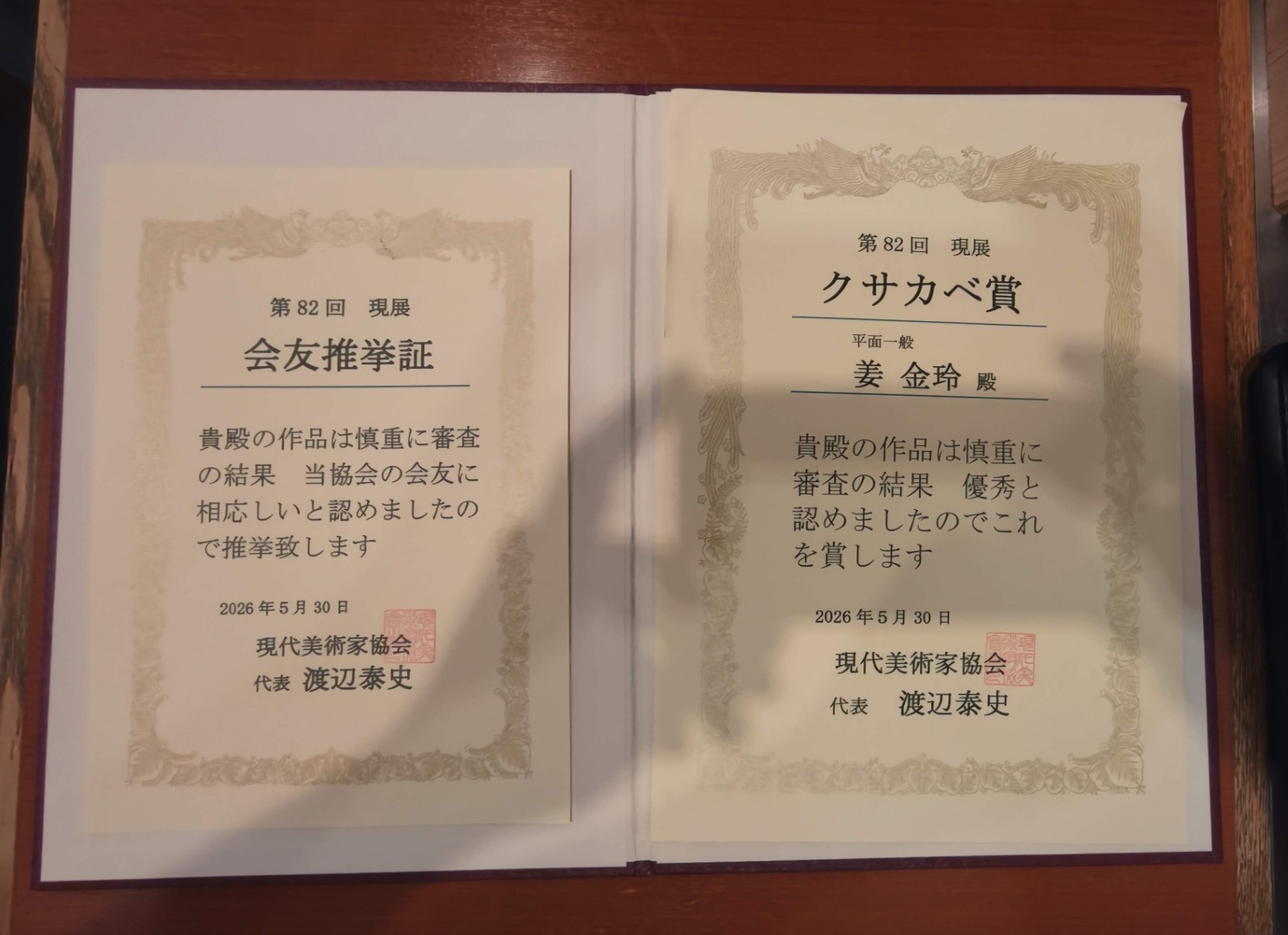
姜金玲《月桃盛開引禽來》於第82回現展獲「日下部獎」肯定
專題新聞報導
在日本國立新美術館、第82回日本現代美術家展「現展」展場中,姜金玲的作品《月桃盛開引禽來》以鮮烈飽滿的色彩、繁密交錯的植物形象與禽鳥動勢,構築出一座充滿生命能量的視覺花園,該作獲得日本企業贊助獎「日下部獎」(KUSAKABE 賞)肯定。
該獎名稱來自日本1928年創立的畫材製造商株式会社クサカベ(KUSAKABE)。KUSAKABE 產品涵蓋油畫顏料、AQYLA、水彩顏料、顏料粉、畫用液、畫筆與紙張等多元畫材,並以「透過顏料製作參與藝術文化創造」作為企業定位。
一幅花鳥畫,也是一場生命狂想
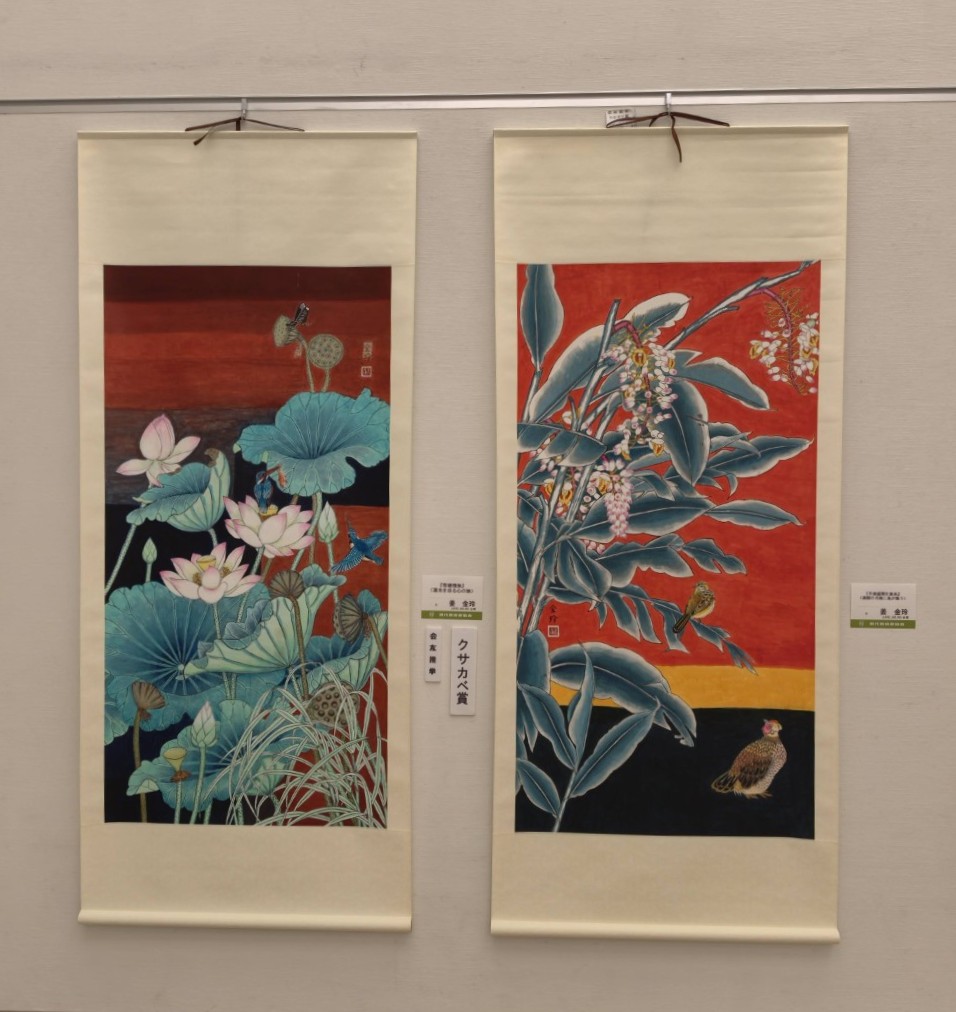
從展《月桃盛開引禽來》採掛軸式裝裱,畫面中央為垂直構圖。作品以深紅、暗紅與黑色構成背景,前景則鋪展大量青綠、藍綠色葉片,粉白花朵、蓮蓬狀植物形態與數隻飛禽穿插其中。
這件作品最引人注目的,不只是花鳥題材本身,而是畫面所呈現出的高張力生命感。植物並非安靜陳列,禽鳥也不是點景式的裝飾。葉片大幅伸展,花朵向外綻放,飛禽穿梭於枝葉與花影之間,整體畫面猶如一個正在呼吸、擴張、流動的自然劇場。
姜金玲以濃烈色彩與明確線條重組花鳥畫傳統,使作品不再停留於靜態觀賞,而更像是一場關於生長、吸引、飛翔與共生的視覺事件。
色彩的解放:從自然再現走向情感表達
《月桃盛開引禽來》的色彩語言具有強烈的現代繪畫特質。畫面背景大面積使用深紅與黑色,使前景的藍綠葉片、粉白花朵與藍色禽鳥更加突出。這種高飽和、高對比的配色方式,使作品具有接近野獸派美學的表現力:色彩不只是描寫自然物象,而是直接承載情緒、能量與感官強度。
傳統花鳥畫往往重視雅緻、留白與筆墨含蓄,但姜金玲在此選擇一種更為外放的語言。畫面中的紅色背景像是熱能場,黑色區塊則形成深沉的空間壓力;青綠葉片與粉白花朵在其間綻放,彷彿從幽暗中爆發出來。
這種視覺安排,使作品呈現出「繁花不是靜物,而是生命衝動」的特質。花朵不只是被觀看的對象,花朵本身像是在召喚禽鳥、召喚風、召喚觀者進入畫面。
生命衝動:植物與禽鳥共同構成一個有機網絡
若以斯賓諾莎所謂「生命衝動」(Conatus)觀看這件作品,畫中的每一個元素都像是在努力維持並擴張自身存在。葉片向四方張開,花朵層層開放,禽鳥振翅飛入,蓮蓬與草葉向上生長。整幅畫不是一個靜止場景,而是一個不斷生成的生命系統。
尤其值得注意的是,作品中的植物與禽鳥並未形成明確的主從關係。禽鳥不是植物之外的旁觀者,植物也不是禽鳥停留的背景。兩者在畫面中彼此牽引、互相穿插,共同形成一個充滿節奏的生態整體。
這也使《月桃盛開引禽來》超越了一般花鳥畫的敘事邏輯。作品標題中的「引禽來」不只描述禽鳥被花吸引而至,更暗示自然萬物之間存在著一種不可見的感應關係:花的盛開、鳥的飛翔、葉的伸展,都是同一股生命能量的不同顯現。
邊界的消融:花、鳥、葉與背景互相滲透
這件作品的另一個重要特徵,是「邊界」的相對化。畫面中雖然有清楚的線條勾勒,但視覺感受上,花、鳥、葉與背景並非完全分離。藍綠色葉片與藍色禽鳥在色彩上互相呼應;粉白花朵與明亮光感形成視線節點;紅黑背景則像一股深層能量,將所有生命形態包覆其中。
這種處理方式,使畫面帶有「物我交融」的意味。觀者在觀看時,不會只注意單一花朵或單一禽鳥,而會被引入整體節奏之中。花的開放、鳥的飛行、葉的舒展、背景的流動,彼此構成一個不可拆解的視覺整體。
若從約翰・杜威「作為經驗的藝術」角度理解,藝術不是孤立的物件,而是生命與環境互動後形成的完整經驗。《月桃盛開引禽來》正以畫面本身證明這一點:自然不是被冷靜描摹的對象,而是一種可以被身體感受、被色彩激發、被視線參與的經驗。
現展中的企業賞:畫材文化與藝術創作的交會
本次《月桃盛開引禽來》獲得「日下部獎」,也讓作品與日本畫材文化產生了更深層的連結。KUSAKABE 自1928年創業以來,以顏料與畫材製造為核心,產品線包含油畫顏料、AQYLA、水彩顏料等,並持續推動藝術材料與創作環境的發展。
對一件以色彩能量、植物形象與生命感為核心的作品而言,獲得畫材企業贊助獎具有特殊意義。這不只是展覽制度中的獎項肯定,也象徵作品在色彩運用、媒材掌握與當代表現力上獲得專業注目。
姜金玲的畫面語言,正與日下部獎背後所代表的畫材精神相互呼應:顏料不是被動材料,而是承載感官、技術與生命想像的媒介。
結語:給現代心靈的一座視覺花園
《月桃盛開引禽來》最動人的地方,在於它以繁花、禽鳥與濃烈色彩重新召喚觀者對自然生命的感受力。在一個日益被數位螢幕、數據秩序與城市節奏包圍的時代,這件作品以近乎狂想的方式提醒人們:生命從來不是冰冷的結構,而是不斷綻放、吸引、交會與流動的能量。
姜金玲不是單純描繪花與鳥,而是讓花與鳥成為生命共同體的象徵。花盛開,禽鳥來;禽鳥飛動,畫面活起來。於是,作品不只是一幅花鳥畫,而是一首寫給萬物共生的視覺讚美詩。
圖說: 姜金玲《月桃盛開引禽來》於第82回「現展」展出並獲「日下部獎」。作品以鮮明紅黑背景、青綠葉片、粉白花朵與飛禽構成繁密而充滿生命力的視覺場域,呈現自然萬物交融共生的當代表現。
其他關於現展:
82回現展-2026年日本國立新美術館展-日本東京〈第82回現代美術家展〉
【台日交流展】《現場直擊》日本國立新美術館展《日本第81回現展》
【台日交流展】日本國立新美術館展-第80回現代藝術家展《第80回現展》
【台日交流展】2026年 日本現代美術家協會(現展)會務運營構成表與年度展覽計畫
【台日交流展】2026年日本現代藝術家展《現展神奈川支部 卯月展》橫濱戶塚Sakura Plaza:日本在地文化與國際藝術的交匯場域
【台日交流展】與莫內、畢卡索館藏同輝!台灣藝術家王穆提、廖純沂榮登日本MOMAS埼玉近代美術館《第49回埼玉現展》展出首位
【台日交流展】《現場直擊》2025年日本第57回《神奈川現代藝術家展》 《神奈川現展》 -展場:橫濱第一座美術館 橫濱市民畫廊
【台日交流展】【現場直擊】2025年日本第十三回 《東京現展》-展場:日本國立東京都美術館
【台日交流展】《現場直擊》日本國立新美術館展《日本第81回現展》
【台日交流展】【現場直擊】2024日本《第56回神奈川現展》
【台日交流展】【展覽現場】日本國立東京都美術館展-〈日本第十二回東京現展〉
【台日交流展】日本東京銀座志門畫廊:日本現代美術家協会《現展》〈GENTEN新春アートフェア〉2024
Flowers Beckon Birds: Color as Testimony to Life
Jiang Jinling's Blooming Shell Ginger Attracts Birds Receives the Kusakabe Award at the 82nd Genten Exhibition
Feature Report
At the 82nd Genten Exhibition (Japan Contemporary Artists Exhibition), held at the National Art Center, Tokyo, Jiang Jinling's work Blooming Shell Ginger Attracts Birds stood out as a vibrant garden of life. Through richly saturated colors, densely interwoven botanical forms, and the dynamic movement of birds, the artist constructs a visual realm overflowing with vitality. The work was recognized with the Kusakabe Award, a corporate-sponsored prize.
The award is named after KUSAKABE Co., Ltd., a Japanese art materials manufacturer founded in 1928. KUSAKABE produces a wide range of artistic materials, including oil paints, AQYLA acrylic colors, watercolors, dry pigments, painting mediums, brushes, and paper. The company positions itself as a participant in the creation of artistic culture through the making of pigments and art materials.
A Flower-and-Bird Painting as a Rhapsody of Life
Presented in a hanging-scroll format, Blooming Shell Ginger Attracts Birds adopts a vertical composition. The background is constructed with deep crimson, dark red, and black, while the foreground unfolds with abundant blue-green and turquoise leaves. Pale pink and white blossoms, lotus-seed-pod-like botanical forms, and several birds weave throughout the composition.
What is most striking is not merely its flower-and-bird subject matter, but the heightened sense of vitality permeating the image. The plants are not quietly displayed, nor are the birds decorative accents. Leaves extend boldly outward, flowers burst into bloom, and birds move dynamically through branches and blossoms. The entire composition resembles a living natural theater—breathing, expanding, and flowing.
Through vivid colors and decisive lines, Jiang reconfigures the traditional flower-and-bird genre. The painting moves beyond static observation and becomes a visual event centered on growth, attraction, flight, and coexistence.
The Liberation of Color: From Natural Representation to Emotional Expression
The chromatic language of Blooming Shell Ginger Attracts Birds possesses a distinctly modern painterly character. Vast areas of deep red and black form the background, causing the blue-green foliage, pale blossoms, and blue birds in the foreground to emerge with heightened intensity.
This use of highly saturated, high-contrast color evokes an expressive power reminiscent of Fauvism. Color here does not merely describe natural objects; it directly carries emotion, energy, and sensory force.
Traditional flower-and-bird painting often emphasizes elegance, negative space, and restrained brushwork. Jiang instead adopts a far more outward and exuberant visual language. The red background functions like a field of heat and vitality, while the black areas generate a profound spatial tension. Blue-green leaves and pale blossoms appear to erupt from the darkness.
As a result, flowers are no longer passive objects for contemplation. They become active presences—calling to birds, summoning the wind, and inviting viewers into the painting itself.
Vital Impulse: Plants and Birds as an Organic Network
Viewed through the lens of Spinoza's concept of Conatus, the striving of every being to persevere and expand its existence, each element within the painting appears engaged in that very effort. Leaves unfold in all directions, flowers open layer by layer, birds arrive in flight, while seed pods and grasses continue their upward growth.
The painting is not a static scene but a constantly emerging system of life.
Particularly noteworthy is the absence of a clear hierarchy between plants and birds. Birds are not observers external to the botanical world, nor are plants merely the background upon which birds rest. Instead, they intertwine and respond to one another, creating a rhythmic ecological whole.
This allows Blooming Shell Ginger Attracts Birds to transcend the conventional narrative framework of flower-and-bird painting. The phrase "attracts birds" in the title describes more than birds being drawn to flowers; it suggests an invisible resonance that connects all forms of nature. Blossoming flowers, flying birds, and expanding leaves become different manifestations of the same life force.
Dissolving Boundaries: Flowers, Birds, Leaves, and Background in Mutual Permeation
Another important characteristic of the work is its relativization of boundaries. Although forms are clearly outlined, flowers, birds, leaves, and background do not remain visually separate.
Blue-green foliage echoes the blue plumage of the birds. Pale blossoms become luminous focal points within the composition. The red-and-black background functions as a deep reservoir of energy that envelops all living forms.
This treatment evokes a sense of unity between self and world. Viewers are not drawn to a single flower or bird but are absorbed into the rhythm of the entire composition. Blossoming flowers, flying birds, unfolding leaves, and flowing background energies merge into an indivisible visual whole.
From the perspective of John Dewey's concept of Art as Experience, art is not an isolated object but a complete experience arising from the interaction between life and environment. Blooming Shell Ginger Attracts Birds embodies this principle by demonstrating that nature is not something merely depicted from a distance; it is an experience that can be felt physically, activated through color, and entered through perception.
A Corporate Award at Genten: The Intersection of Art Materials and Artistic Creation
The awarding of the Kusakabe Award also establishes a deeper connection between the artwork and Japan's culture of artistic materials.
Since its founding in 1928, KUSAKABE has focused on the manufacture of pigments and painting supplies, producing oil paints, AQYLA acrylic colors, watercolors, and numerous other materials while continuously supporting artistic creation and the development of creative environments.
For a work whose central concerns are chromatic energy, botanical imagery, and vitality, receiving recognition from an art materials company carries special significance. The award not only affirms the work within the exhibition system but also acknowledges its sophisticated use of color, mastery of materials, and contemporary expressive power.
Jiang Jinling's visual language resonates strongly with the spirit embodied by the Kusakabe Award: pigments are not passive substances but media through which sensation, technique, and imaginative life are realized.
Conclusion: A Visual Garden for the Contemporary Spirit
The most moving aspect of Blooming Shell Ginger Attracts Birds lies in its ability to rekindle our sensitivity to natural life through flowers, birds, and exuberant color.
In an era increasingly dominated by digital screens, data-driven systems, and urban rhythms, the painting serves as a reminder that life is never a cold structure. Rather, it is a continual process of blossoming, attracting, encountering, and flowing.
Jiang Jinling does not merely depict flowers and birds; she transforms them into symbols of a shared community of life. Flowers bloom and birds arrive. Birds move, and the painting itself comes alive.
Thus, the work is not simply a flower-and-bird painting. It is a visual ode celebrating the coexistence of all living things.
花は鳥を招き、色彩は生命の証言となる
姜金玲《月桃盛開引禽來》が第82回現展にて「日下部賞」を受賞
特集記事
東京・国立新美術館で開催されている第82回日本現代美術家展「現展」において、姜金玲の作品《月桃盛開引禽來》は、鮮烈で豊かな色彩、密生し交錯する植物のイメージ、そして躍動する鳥たちによって、生命力に満ちた視覚の庭園を構築している。本作品は、日本の画材メーカーによる企業賞である**「日下部賞」**を受賞した。
この賞は、1928年創業の日本の画材メーカー 株式会社クサカベ(KUSAKABE) に由来する。クサカベは油絵具、AQYLA、水彩絵具、顔料、画用液、筆、紙など幅広い画材を製造し、「絵具づくりを通して芸術文化の創造に参加する」ことを企業理念としている。
花鳥画であり、生命の狂詩曲でもある
《月桃盛開引禽來》は掛軸形式で展示され、縦長の構図を採用している。画面中央には深紅、暗紅、黒による背景が広がり、その前景には青緑や藍緑の葉が幾重にも重なって展開する。さらに淡い桃色や白の花々、蓮の実を思わせる植物形態、そして数羽の鳥たちが画面を行き交う。
この作品の最も印象的な点は、花鳥という題材そのものではなく、画面全体にみなぎる生命の高揚感である。植物は静かに配置された存在ではなく、鳥もまた添景的な装飾ではない。葉は大きく広がり、花は外へ向かって咲き誇り、鳥たちは枝葉と花影の間を自在に飛び交う。画面全体はまるで呼吸し、拡張し、流動する自然の劇場のようである。
姜金玲は、濃密な色彩と明確な線によって花鳥画の伝統を再構成した。その結果、作品は静的な鑑賞対象にとどまらず、成長・誘引・飛翔・共生をめぐる視覚的出来事として立ち現れている。
色彩の解放――自然描写から感情表現へ
《月桃盛開引禽來》の色彩表現は、きわめて現代絵画的な性格を帯びている。画面の大部分を占める深紅と黒の背景は、前景の青緑の葉、淡色の花々、青い鳥たちを際立たせる。
この高彩度・高コントラストの配色は、フォーヴィスムを想起させる強い表現力を持つ。ここで色彩は自然物を描写するためだけのものではなく、感情、エネルギー、感覚の強度そのものを担っている。
伝統的な花鳥画が余白や筆墨の含蓄、美的な静謐さを重視してきたのに対し、姜金玲はより外向的で開放的な表現を選択している。赤い背景は熱を帯びたエネルギーの場のようであり、黒い領域は深い空間的緊張感を生み出す。その中から青緑の葉と淡い花々が爆発的に咲き出しているかのようである。
この視覚的構成によって、花は静物ではなく生命衝動そのものとなる。花はただ見られる存在ではなく、鳥を呼び寄せ、風を招き、鑑賞者を画面の内部へと誘う存在となっている。
生命の衝動――植物と鳥が織りなす有機的ネットワーク
スピノザのいう「コナトゥス(Conatus)」、すなわち存在を維持し拡張しようとする生命の衝動という観点から見るならば、この作品のすべての要素は、自らの存在を広げようとしているように見える。
葉は四方へ広がり、花は幾重にも開き、鳥は翼を広げて飛来する。蓮の実や草葉は上へ向かって伸び続ける。作品全体は静止した情景ではなく、絶えず生成し続ける生命システムなのである。
特に注目すべきは、植物と鳥の間に明確な主従関係が存在しないことである。鳥は植物の外側にいる観察者ではなく、植物もまた鳥のための背景ではない。両者は互いに呼応し、交差しながら、一つのリズミカルな生態系を形成している。
そのため《月桃盛開引禽來》は、一般的な花鳥画の物語構造を超越している。題名にある「引禽來(鳥を招く)」とは、単に花が鳥を呼び寄せることを意味するだけではない。そこには自然界の万物を結ぶ目に見えない共鳴関係が示唆されている。花の開花、鳥の飛翔、葉の伸展は、同じ生命エネルギーの異なる顕現なのである。
境界の融解――花・鳥・葉・背景の相互浸透
この作品のもう一つの重要な特徴は、「境界」の相対化である。
画面には明確な輪郭線が存在するものの、花、鳥、葉、背景は完全に分離された存在としては知覚されない。青緑の葉と青い鳥は色彩的に呼応し、淡い花々は光の結節点として視線を導く。そして赤と黒の背景は、すべての生命形態を包み込む深層のエネルギー場として機能している。
この表現によって、作品には「物我一体」の感覚が生み出されている。鑑賞者は一輪の花や一羽の鳥だけを見るのではなく、画面全体のリズムへと引き込まれる。花の開放、鳥の飛翔、葉の伸展、背景の流動が一体となり、分割不可能な視覚的全体を形成しているのである。
ジョン・デューイの『経験としての芸術』の視点から言えば、芸術とは孤立した物体ではなく、生命と環境との相互作用によって成立する総体的経験である。《月桃盛開引禽來》はまさにそのことを証明している。自然は冷静に描写される対象ではなく、身体で感じられ、色彩によって活性化され、視線によって参加される経験なのである。
現展における企業賞――画材文化と芸術創造の交差点
今回、《月桃盛開引禽來》が「日下部賞」を受賞したことは、作品と日本の画材文化との新たな結びつきを生み出した。
クサカベは1928年の創業以来、絵具や画材の製造を中心に事業を展開し、油絵具、AQYLA、水彩絵具などを通して創作環境の発展を支えてきた。
色彩のエネルギー、植物のイメージ、生命感を核とする本作品にとって、画材メーカーによる賞を受けることは特別な意味を持つ。それは単なる展覧会制度上の評価ではなく、色彩運用、素材の扱い、そして現代的表現力が専門的な視点から認められたことを意味している。
姜金玲の絵画言語は、日下部賞の背景にある画材精神とも深く響き合う。絵具とは受動的な素材ではなく、感覚、技術、そして生命への想像力を担う媒介なのである。
結語――現代の心に贈る視覚の庭園
《月桃盛開引禽來》の最も魅力的な点は、花々、鳥たち、そして濃密な色彩によって、鑑賞者の自然への感受性を呼び覚ますことにある。
デジタルスクリーン、データによる秩序、都市のリズムに囲まれた現代社会において、この作品はほとんど幻想曲のような力強さで語りかける。生命とは決して冷たい構造ではなく、絶えず咲き、引き寄せ合い、出会い、流動するエネルギーなのだと。
姜金玲は単に花や鳥を描いているのではない。花と鳥を生命共同体の象徴へと昇華させているのである。
花が咲き、鳥が訪れる。鳥が舞い、画面は生命を帯びる。
こうして本作品は、一枚の花鳥画を超え、万物共生への賛歌を奏でる視覚的な詩となっている。
更多相關內容:
82回現展-2026年日本國立新美術館展-日本東京〈第82回現代美術家展〉