《視覺的超新星:吳采恩與她的色彩創世紀》
—— 日本第24回 NAU 21世紀美術連立展:台灣藝術家吳采恩參展全紀錄與深度藝評
策劃・撰文 / 王 穆提(WANG MUTI)
六本木的視覺風暴 —— 當「野性」撞擊「白盒子」
2026 年初春,東京六本木的空氣中瀰漫著一種理性的寒意。由普立茲克獎級別建築大師 黑川紀章(Kisho Kurokawa) 設計的 國立新美術館(The National Art Center, Tokyo, NACT),以其標誌性的波浪狀玻璃帷幕,冷靜地反射著都會的天光。這座被譽為「亞洲最大藝術容器」的建築,向來以其巨大的空間尺度與嚴苛的展示條件聞名。
然而,當觀眾步入 《日本第24回 NAU21世紀美術連立展》 的展廳時,一股灼熱的視覺氣流打破了這份冷靜。
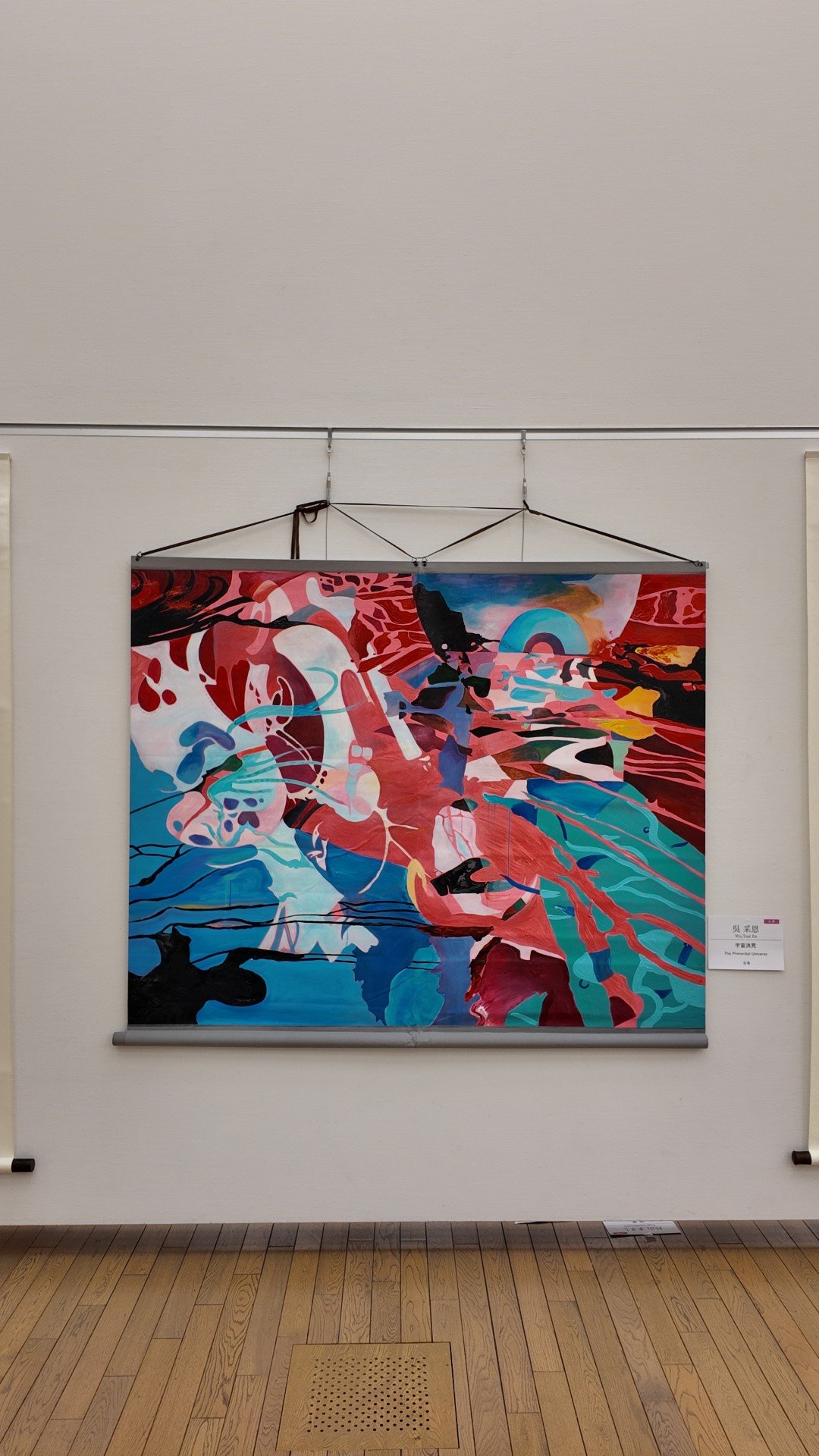
那是來自台灣藝術家 吳采恩(Wu, Tsai-En) 的百號鉅作 〈宇宙洪荒〉。
在周遭眾多探討結構、哲學或傳統媒材轉譯的作品中,吳采恩的作品像是一顆 「視覺的超新星(Supernova)」。她不與你談論深奧的經文,也不展示顯微鏡下的科學肌理;她直接用 高飽和度的色彩、狂野的流動性 以及 毫不妥協的尺幅,對觀眾的視網膜發起了一場愉悅的轟炸。
這不僅是一次參展,更是一次 「感官的入侵」。吳采恩代表了台灣新生代藝術家的一種典型特質:直覺、無畏,以及對「色彩能量」的絕對信仰。
場域的現象學
—— 在黑川紀章的光之容器中,尋找色彩的絕對座標
要評價吳采恩此次參展的成功,首先必須理解她所身處的「戰場」。
1. 白盒子的吞噬與反吞噬
國立新美術館的展示室擁有極高的天花板(約 5 公尺)與漫射的自然光。這種工業級別的「白盒子(White Cube)」空間,具有一種 「消解性」。中性色調、尺幅過小或張力不足的作品,往往會被空間的巨大虛空所吞噬,顯得單薄無力。
吳采恩的策略是 「以能量對抗空間」。
她帶來的 〈宇宙洪荒〉 為 100F (162 x 130 cm) 的大尺幅作品。這在物理體積上首先確立了存在的份量。更重要的是,她作品中那種 「向外擴張」 的構圖邏輯,使得畫面的心理邊界遠遠超出了物理邊框。當這幅畫懸掛在白牆上時,它不僅僅是一個掛件,而像是一個 「發光體」,強勢地定義了周圍的氣場。
2. 光線的共謀
黑川紀章的建築強調自然光與人工光的共生。在白天,陽光穿過玻璃帷幕灑入展廳;在夜晚,專業投射燈聚焦於作品。
吳采恩選用的 壓克力顏料(Acrylic) 具有獨特的反光特性與膠質感。在 NACT 的精準照明下,畫面中的 螢光粉紅 與 寶石藍 產生了如同教堂花窗玻璃般的 「透光感」。這與水墨畫的「吸光」特質截然不同。她的作品與美術館的光線達成了一種「共謀」,利用環境光來增強色彩的振動頻率,使得作品在幾十公尺外就能鎖定觀眾的目光。
作品深度解構
—— 〈宇宙洪荒〉的視覺修辭與液態構圖
作品: 〈宇宙洪荒〉 (The Primordial Universe)
規格: 100F (162 x 130 cm)
媒材: 壓克力顏料 (Acrylic on Canvas)
站在這幅畫作前,我們需要用一種 「動態」 的眼光來解讀。這不是靜止的風景,而是一個正在發生的「事件」。
1. 液態現代性(Liquid Modernity)的視覺化
社會學家齊格蒙·鮑曼(Zygmunt Bauman)曾提出「液態現代性」的概念,描述當代社會結構的流動與不確定。吳采恩的畫作,正是這種概念的視覺轉譯。
- 無邊界的色塊: 在畫面左側,巨大的 粉紅、洋紅與白色團塊 相互擠壓、融合。它們沒有堅硬的輪廓線,而是像熔岩或流體一樣漫延。
- 流動的視角: 觀者的視線無法停留在任何一個單一的焦點。從左上方的深紅漩渦,滑落至中央的藍色湍流,再被右側的層積岩狀色塊阻擋。這是一種 「全幅式(All-over)」 的流動,強迫觀眾的眼球不斷遊走,模擬了處於變動中的宇宙狀態。
2. 空間的拓撲學:多維度的摺疊
吳采恩打破了文藝復興以來的單點透視。
- 右上方 的半圓形結構(淺藍色虹橋/日出?),暗示了某種遠景或地平線。
- 左下方 的黑色有機剪影,則像是極近景的物體或觀察者的陰影。
- 中央 的藍綠色線條,如同數位的訊號線或神經網絡,穿越了不同的色塊層次。
- 她將遠景、近景、微觀、宏觀全部 「壓縮」 在同一個平面上。這種空間處理方式非常當代,它反映了網路時代我們在螢幕上同時開啟多個視窗、多個時空的視覺經驗。
3. 線條的「書寫性」與「雕塑性」
畫中的線條具有雙重性格。
- 有些線條是 「流淌(Drip)」 的,那是顏料受重力牽引的自然痕跡,帶有傑克遜·波洛克(Jackson Pollock)式的行動繪畫特徵。
- 有些線條則是 「堆疊」 的,利用壓克力顏料的厚度,在畫布上形成淺浮雕般的肌理。這些線條像是在切割空間,為混亂的色彩洪流建立了臨時的骨架。
色彩的暴力與歡愉
—— 螢光、壓克力與後數位時代的感官邏輯
吳采恩作品最強烈的標籤,無疑是 「色彩(Color)」。她對色彩的使用,已經超越了「再現自然」,進入了 「表現意志」 的層次。
1. 螢光色的政治學:拒絕憂鬱
在傳統的「洪荒」題材中,藝術家往往傾向使用混沌的灰、深沈的黑或土黃色(如德國新表現主義)。但吳采恩反其道而行。
她大量使用了 高明度、高彩度 的顏料:螢光粉(Fluorescent Pink)、青檸綠(Lime Green)、電光藍(Electric Blue)。
- 拒絕沈重: 這是一種新生代的宣言。她拒絕了歷史的沈重感與悲劇性。在她筆下,宇宙的誕生不是一場災難,而是一場 「狂歡(Carnival)」。
- 人工自然的混種: 這些顏色帶有強烈的「人工感」與「塑膠感」。這暗示了在 2026 年,我們對「自然」的想像已經無法脫離數位螢幕的濾鏡。她畫的不是原始的自然,而是被當代感官過濾後的 「後自然(Post-nature)」。
2. 色彩的觸感(Haptic Visuality)
德勒茲在論培根(Francis Bacon)時曾提到「觸覺視覺」。吳采恩的畫作也具有這種特質。
那濃稠的紅色壓克力顏料,堆疊得如同奶油或肌肉纖維;那平滑的藍色色塊,則如同冰面。觀眾看這幅畫時,不僅是用眼睛看,甚至會產生一種 「想要觸摸」 的衝動。她利用壓克力顏料的物質特性,喚起了觀眾身體的知覺。
哲學的迴響
—— 從中國神話的「混沌」到當代物理的「大爆炸」
儘管吳采恩的表現形式極度當代,但其作品標題 〈宇宙洪荒〉 卻指向了一個古老的東方哲學命題。
1. 莊子的「混沌」與吳采恩的「未分」
《莊子》中的「混沌」是七竅未開、渾然一體的狀態。吳采恩的畫作捕捉的正是這種 「未分化」 的時刻。
天地尚未分離,陰陽尚未定型。畫面中的紅與藍互相侵蝕,象徵著冷熱能量的交替;具象與抽象混雜,象徵著物質尚未被定義。她描繪的不是一個「已完成」的世界,而是一個 「正在生成(Becoming)」 的瞬間。
2. 科學的大爆炸(Big Bang)
若從現代科學角度解讀,這幅畫更像是一張 「宇宙微波背景輻射圖」 的藝術版。
那些爆炸性的放射線條、劇烈擴張的色塊,精準地對應了宇宙大爆炸理論中的 「暴脹(Inflation)」 階段。吳采恩或許沒有刻意去圖解科學,但她憑藉著藝術家的直覺,捕捉到了宇宙創生時那種 「高能、高熱、極速擴張」 的物理本質。
系譜的對話
—— 抽象表現主義的東方變體與新生代的直覺
將吳采恩置於藝術史的坐標中,我們可以看到她與前輩大師的對話與背離。
1. 與趙無極的跨時空對話
同樣描繪宇宙與氣韻,趙無極使用的是油畫,追求的是水墨般的氤氳與深邃的空間感(虛)。
吳采恩則使用壓克力,追求的是 「平滑」、「直接」 與 「撞擊」(實)。
如果說趙無極的宇宙是「氣」的流動,那麼吳采恩的宇宙就是 「光子」 的爆發。她是抽象表現主義在台灣新生代身上的一種 「波普化(Pop-inflected)」 或 「數位化」 的變體。
2. 與 NAU 前衛精神的契合
NAU 的歷史源流是「新達達」與反體制。吳采恩的畫作雖然不是現成物裝置,但其 「反審美(Anti-aesthetic)」 的用色策略(大膽使用俗豔的螢光色),以及對傳統構圖的破壞,深得前衛藝術的精髓。
她不討好觀眾的眼球,而是挑戰觀眾的視神經。這種 「野性(Wildness)」 正是 NAU 展覽中最渴望看到的生命力。
—— NAU「連立」精神下的個體突圍
在 第 24 回 NAU21世紀美術連立展 這個巨大的舞台上,吳采恩的成功突圍具有戰略意義。
1. 差異化的勝利
展場中有講究哲學結構的 王穆提(結構派),有鑽研生物肌理的 廖純沂(微觀派),還有探討物理秩序的 橋谷勇慈(理性派)。
在這些偏向理性、沈穩的聲音中,吳采恩扮演了 「感性的高音」。
她提供了展覽中稀缺的 「情感宣洩出口」。當觀眾看膩了黑白水墨或冷靜的幾何抽象後,走到〈宇宙洪荒〉面前,會被那種毫無保留的色彩能量所振奮。
2. 視覺記憶點的建立
在擁有數百件作品的大型公募展中,「被記住」 是最難的。
吳采恩利用 100F 的大尺幅 加上 高飽和度的粉紅色系,製造了一個強烈的 「視覺記憶點(Visual Hook)」。這就像是在一部黑白電影中突然出現了彩色的畫面,讓人無法忽視。
未來的一瞥 —— 台灣當代抽象藝術的新能量
文 / 王 穆提(WANG MUTI)
吳采恩在東京六本木的亮相,不僅僅是一次展覽紀錄,更是一個 「信號」。
它標誌著台灣當代藝術中,一股 「直覺系」 力量的崛起。這群新生代藝術家不再揹負沈重的歷史包袱,不再糾結於「水墨現代化」的沉重命題。他們像吳采恩一樣,熟練地使用現代工業媒材(壓克力),自在地挪用古今中外的符號(洪荒/大爆炸),並以一種 「遊戲(Play)」 與 「慶典」 的態度來面對創作。
〈宇宙洪荒〉 是一封寫給未來的邀請函。它邀請我們放下理性的分析,回歸感官的直覺。
在國立新美術館這座理性的玻璃巨塔中,吳采恩用最狂野的色彩,點燃了一把感性的火。這把火,照亮了台灣新生代藝術家通往國際舞台的道路,也讓我們看見了「後數位時代」繪畫最原始、也最動人的力量——那是生命本身,在畫布上毫無保留的燃燒。
【藝術家檔案 Data File】
- 藝術家: 吳采恩 (Wu, Tsai-En)
- 入選展覽: 日本第24回 NAU21世紀美術連立展 (The 24th NAU 21st Century Art Renritsu Exhibition)
- 展出地點: 日本東京・國立新美術館 (The National Art Center, Tokyo)
- 參展作品:
- 題名: 〈宇宙洪荒〉 (The Primordial Universe)
- 媒材: 壓克力、畫布 (Acrylic on Canvas)
- 尺寸: 100F (162 x 130 cm)
- 創作年份: 2025-2026
- 風格關鍵字: 抽象表現主義、色彩場域、流動性、有機抽象、高飽和度。
A Visual Supernova: Wu Tsai-En and Her Genesis of Color
The 24th NAU 21st Century Art Exhibition in Japan: A Complete Record and In-Depth Critical Review of Taiwanese Artist Wu Tsai-En’s Participation
Curated and Written by Wang Muti
A Visual Storm in Roppongi — When “Wildness” Collides with the “White Cube”
In early spring 2026, the air of Roppongi, Tokyo, was filled with a certain rational chill. The National Art Center, Tokyo (NACT), designed by Pritzker Prize–level master architect Kisho Kurokawa, calmly reflected the metropolitan daylight in its iconic undulating glass curtain wall. This building, celebrated as**“Asia’s largest container of art,”** has long been known for its immense spatial scale and exacting exhibition conditions.
Yet when viewers entered the galleries of The 24th NAU 21st Century Art Exhibition in Japan, a scorching current of visual energy shattered that composure.
It came from Taiwanese artist Wu Tsai-En’s large-scale 100F work, The Primordial Universe.
Among the many surrounding works that explored structure, philosophy, or the translation of traditional media, Wu Tsai-En’s painting appeared like a**“visual supernova.”** She does not speak to you through esoteric scriptures, nor does she display microscopic scientific textures; instead, she launches a joyful bombardment upon the viewer’s retina through high-saturation color, wild fluidity, and an uncompromising scale.
This was not merely an exhibition participation, but an invasion of the senses. Wu Tsai-En represents a defining trait of Taiwan’s younger generation of artists: intuition, fearlessness, and an absolute faith in the energy of color.
The Phenomenology of the Site
Seeking the Absolute Coordinates of Color Within Kisho Kurokawa’s Vessel of Light
To evaluate the success of Wu Tsai-En’s participation, one must first understand the “battlefield” in which she was situated.
1. The White Cube’s Devouring Power—and Its Reversal
The exhibition rooms of the National Art Center, Tokyo possess extremely high ceilings (approximately five meters) and diffused natural light. This industrial-scale white cube contains a kind of dissolving power. Works in neutral tones, insufficient scale, or lacking tension are often swallowed by the immense emptiness of the space, appearing thin and powerless.
Wu Tsai-En’s strategy is to combat space with energy.
Her The Primordial Universe is a large-scale 100F work (162 × 130 cm). On a physical level, this immediately establishes a substantial presence. More importantly, the compositional logic of outward expansion within the painting causes its psychological boundary to extend far beyond its physical frame. When hung upon the white wall, the work is not merely an object on display; it resembles a luminous body, forcefully defining the surrounding atmosphere.
2. The Conspiracy of Light
Kisho Kurokawa’s architecture emphasizes the symbiosis of natural and artificial light. During the day, sunlight pours into the galleries through the glass curtain wall; at night, professional spotlights focus on the works.
The acrylic paint chosen by Wu Tsai-En possesses unique reflective qualities and a gelatinous surface presence. Under the precision lighting of NACT, the fluorescent pinks and gem-like blues in the painting generate a kind of translucent radiance, like stained glass in a cathedral. This differs completely from the light-absorbing character of ink painting. Her work forms a kind of conspiracy with the museum’s light, using ambient illumination to intensify the vibrational frequency of color, making the painting capable of locking onto the viewer’s gaze from dozens of meters away.
A Deep Deconstruction of the Work
The Visual Rhetoric and Liquid Composition of The Primordial Universe
Work:The Primordial Universe
Size: 100F (162 × 130 cm)
Medium: Acrylic on Canvas
Standing before this painting, we must adopt a dynamic way of looking. This is not a static landscape, but an event in the process of unfolding.
1. The Visualization of Liquid Modernity
Sociologist Zygmunt Bauman once proposed the concept of liquid modernity to describe the flow and instability of contemporary social structures. Wu Tsai-En’s painting is a visual translation of this concept.
- Borderless masses of color: On the left side of the painting, great masses of pink, magenta, and white press against one another and fuse together. They possess no hard contour lines, but spread like lava or liquid matter.
- A fluid viewpoint: The viewer’s gaze cannot settle upon any single focal point. It slips from the dark red vortex in the upper left, falls toward the blue torrent in the center, and is then obstructed by stratified rock-like blocks of color on the right. This is an all-over flow, compelling the eye to wander constantly and simulating the condition of a universe in flux.
2. The Topology of Space: Multidimensional Folding
Wu Tsai-En breaks away from the single-point perspective that has governed painting since the Renaissance.
- The semicircular structure in the upper right (a pale blue rainbow bridge? a sunrise?) suggests some kind of distance or horizon.
- The black organic silhouette in the lower left resembles either an object in extreme close-up or the shadow of an observer.
- The turquoise lines in the center, like digital signal lines or neural networks, pass through multiple layers of color.
She compresses the distant and the near, the microscopic and the macroscopic, all into a single plane. This treatment of space is profoundly contemporary: it reflects our visual experience in the internet age, where multiple windows and multiple timespaces are opened simultaneously upon the screen.
3. The “Scripturality” and “Sculpturality” of Line
The lines in the painting possess a dual character.
- Some lines are drips, the natural traces left as paint is drawn downward by gravity, bearing the characteristics of Jackson Pollock–like action painting.
- Other lines are built up, using the thickness of acrylic paint to create low-relief textures upon the canvas. These lines seem to cut through space, establishing temporary skeletons within the flood of chaotic color.
The Violence and Delight of Color
Fluorescence, Acrylic, and the Logic of Sensation in the Post-Digital Age
The most powerful label attached to Wu Tsai-En’s work is undoubtedly color. Her use of color has moved beyond the level of “representing nature” and entered the domain of the expression of will.
1. The Politics of Fluorescent Color: Refusing Melancholy
In traditional treatments of the theme of the primordial or the chaotic beginning, artists often tend toward chaotic grays, deep blacks, or ochres (as in German Neo-Expressionism). Wu Tsai-En moves in the opposite direction.
She makes extensive use of pigments of high brightness and high saturation: Fluorescent Pink, Lime Green, and Electric Blue.
- A refusal of heaviness: This is a declaration of a new generation. She rejects the weight and tragedy of history. In her painting, the birth of the universe is not a disaster, but a carnival.
- A hybrid of the artificial and the natural: These colors possess a strong sense of artificiality and plasticity. This suggests that, in 2026, our imagination of “nature” can no longer be separated from the filter of digital screens. What she paints is not primal nature, but post-nature, filtered through contemporary sensation.
2. The Haptic Quality of Color
When discussing Francis Bacon, Deleuze referred to a kind of haptic visuality. Wu Tsai-En’s painting possesses this quality as well.
The thick red acrylic paint is piled up like cream or muscle fiber; the smooth blue fields resemble ice. When viewers look at this painting, they are not seeing with the eyes alone—they may even feel an impulse to touch. Through the material properties of acrylic, she awakens the bodily perception of the viewer.
Philosophical Echoes
From “Hundun” in Chinese Myth to the “Big Bang” of Contemporary Physics
Although Wu Tsai-En’s mode of expression is intensely contemporary, the title The Primordial Universe points toward an ancient Eastern philosophical proposition.
1. Zhuangzi’s “Hundun” and Wu Tsai-En’s “Undifferentiated State”
In the Zhuangzi, Hundun is the state before the seven apertures have opened, a condition of undivided unity. Wu Tsai-En’s painting captures precisely this undifferentiated moment.
Heaven and earth have not yet separated; yin and yang have not yet assumed fixed form. The red and blue in the painting erode one another, symbolizing the alternation of hot and cold energies; figuration and abstraction are mixed together, symbolizing matter before it has been defined. What she depicts is not a world already completed, but a moment of becoming.
2. The Scientific Big Bang
Read from the perspective of modern science, this painting resembles an artistic version of a cosmic microwave background map.
Those explosive radiating lines and violently expanding masses of color correspond strikingly to the inflationary stage of Big Bang theory. Wu Tsai-En may not have deliberately illustrated science, but through artistic intuition she has captured the physical essence of cosmic creation: high energy, high heat, and rapid expansion.
A Dialogue of Genealogies
An Eastern Variant of Abstract Expressionism and the Intuition of a New Generation
Placed within the coordinates of art history, Wu Tsai-En may be seen both in dialogue with and in departure from earlier masters.
1. A Transhistorical Dialogue with Zao Wou-Ki
Also concerned with the universe and the flow of qi, Zao Wou-Ki worked in oil painting, pursuing the atmospheric diffusion and profound spatial depth of ink painting—the realm of the void.
Wu Tsai-En, by contrast, works in acrylic, pursuing smoothness, directness, and impact—the realm of substance.
If Zao Wou-Ki’s universe is the flow of qi, then Wu Tsai-En’s universe is the explosion of photons. She is a kind of pop-inflected or digitized variant of Abstract Expressionism embodied in Taiwan’s younger generation.
2. Her Resonance with the Avant-Garde Spirit of NAU
The historical lineage of NAU is rooted in Neo-Dada and anti-establishment attitudes. Although Wu Tsai-En’s painting is not a ready-made installation, her anti-aesthetic strategy of color (the bold use of vulgar-bright fluorescent hues) and her destruction of traditional composition embody the true spirit of the avant-garde.
She does not flatter the eye of the viewer; she challenges the viewer’s optic nerve. This wildness is precisely the vitality that NAU most longs to encounter.
Breaking Through as an Individual Under the Spirit of NAU “Renritsu”
On the great stage of The 24th NAU 21st Century Art Exhibition, Wu Tsai-En’s breakthrough success carries strategic significance.
1. The Victory of Difference
Within the exhibition there are figures devoted to philosophical structure, such as Wang Muti (structuralist tendency); those who investigate biological textures, such as Liau Chun-Yi (microscopic tendency); and those who examine physical order, such as Hashitani Yūji (rationalist tendency).
Among these more rational and composed voices, Wu Tsai-En plays the role of a high emotional register.
She provides a rare outlet for emotional release within the exhibition. When viewers grow tired of black-and-white ink painting or cool geometric abstraction, they are invigorated by the unreserved energy of color when they stand before The Primordial Universe.
2. Establishing a Visual Memory Point
In a large open-call exhibition featuring hundreds of works, the hardest thing is to be remembered.
Wu Tsai-En uses the large 100F scale together with a high-saturation pink color scheme to create a powerful visual hook. It is like the sudden appearance of color in a black-and-white film—impossible to ignore.
A Glimpse of the Future — A New Energy in Taiwanese Contemporary Abstract Art
Text by Wang Muti
Wu Tsai-En’s appearance in Roppongi, Tokyo, is not merely an exhibition record, but a signal.
It marks the rise, within Taiwanese contemporary art, of a force grounded in intuition. This new generation of artists no longer bears the heavy burden of history, nor do they remain entangled in the weighty problem of “modernizing ink painting.” Like Wu Tsai-En, they skillfully use modern industrial media (acrylic), freely appropriate symbols from across time and culture (the primordial / the Big Bang), and face creation with an attitude of play and celebration.
The Primordial Universe is an invitation letter addressed to the future. It invites us to set aside rational analysis and return to sensory intuition.
Within the rational glass tower of the National Art Center, Tokyo, Wu Tsai-En ignited a fire of sensibility through the wildest of colors. This fire illuminates the path by which Taiwan’s younger artists advance onto the international stage, and allows us to glimpse the most primal and moving force of painting in the post-digital age—the force of life itself, burning upon the canvas without reserve.
Artist Data File
- Artist: Wu Tsai-En
- Selected Exhibition: The 24th NAU 21st Century Art Renritsu Exhibition in Japan
- Exhibition Venue: The National Art Center, Tokyo, Japan
- Exhibited Work:
- Title:The Primordial Universe
- Medium: Acrylic on Canvas
- Dimensions: 100F (162 × 130 cm)
- Year: 2025–2026
- Style Keywords: Abstract Expressionism, Color Field, Fluidity, Organic Abstraction, High Saturation
視覚の超新星――呉采恩とその色彩創世記
日本第24回 NAU21世紀美術連立展――台湾人アーティスト呉采恩の出品全記録と詳細芸術評論
企画・執筆 / 王 穆提(WANG MUTI)
六本木の視覚的嵐――「野性」が「ホワイトキューブ」に衝突するとき
2026年初春、東京・六本木の空気には、ある種の理性的な冷気が漂っていた。プリツカー賞級の建築巨匠 黒川紀章(Kisho Kurokawa) が設計した 国立新美術館(The National Art Center, Tokyo, NACT) は、その象徴的な波状のガラスカーテンウォールによって、都市の天光を冷静に反射していた。「アジア最大の芸術コンテナ」 とも称されるこの建築は、その巨大な空間スケールと厳格な展示条件によって知られている。
しかし、観客が**《日本第24回 NAU21世紀美術連立展》** の展示室に足を踏み入れたとき、その冷静さを打ち破る灼熱の視覚的気流が立ち上がった。
それが台湾人アーティスト 呉采恩(Wu, Tsai-En) による100号の大作**〈宇宙洪荒〉** である。
構造、哲学、あるいは伝統媒材の翻訳を主題とする周囲の多くの作品のなかで、呉采恩の作品はひとつの**「視覚の超新星(Supernova)」** のようであった。彼女は難解な経典を語るわけでもなく、顕微鏡下の科学的肌理を見せるわけでもない。ただ 高彩度の色彩、野性的な流動性、そして 一切妥協しないスケール感 によって、観客の網膜へと愉悦に満ちた爆撃を仕掛けるのである。
これは単なる出品ではなく、ひとつの**「感覚への侵入」** であった。呉采恩は、台湾の新世代アーティストに共通する典型的な特質――直感、無畏、そして「色彩エネルギー」への絶対的信念――を体現している。
場域の現象学
黒川紀章の光の器の中で、色彩の絶対座標を探す
呉采恩の今回の出品の成功を評価するには、まず彼女が立っていた**「戦場」** を理解しなければならない。
1. ホワイトキューブの吞み込みと、その逆転
国立新美術館の展示室は非常に高い天井(約5メートル)と拡散された自然光を持っている。この工業的スケールの ホワイトキューブ 空間には一種の**「消解性」** がある。中間色調で、サイズが小さく、あるいは緊張感に乏しい作品は、しばしば巨大な空虚に呑み込まれ、薄く無力に見えてしまう。
呉采恩の戦略は、「エネルギーによって空間に対抗する」 ことである。
彼女が持ち込んだ**〈宇宙洪荒〉** は 100F(162×130cm) の大画面作品である。これは物理的体積においてまず存在の重みを確立している。さらに重要なのは、作品のなかにある**「外へ向かって拡張する」** 構図論理が、画面の心理的境界を物理的フレームのはるか外へまで押し広げている点である。白い壁に掛けられたとき、この作品は単なる掛物ではなく、ひとつの**「発光体」** のように周囲の気場を強く定義する。
2. 光との共謀
黒川紀章の建築は、自然光と人工光の共生を強調している。昼にはガラスカーテンウォールを通して日光が展示室へと差し込み、夜には専門的な投光照明が作品へと集中する。
呉采恩が用いる アクリル絵具(Acrylic) は、独特の反射性と樹脂的な質感を備えている。NACTの精密な照明の下で、画面の 蛍光ピンク と 宝石のようなブルー は、まるで教会のステンドグラスのような**「透光感」** を生み出す。これは水墨画の持つ**「光を吸収する」** 性質とはまったく異なる。彼女の作品は美術館の光とある種の**「共謀関係」** を結び、環境光を利用して色彩の振動周波数を高め、数十メートル先からでも観客の視線を捉えるのである。
作品の深層解体
〈宇宙洪荒〉の視覚修辞と液体的構図
作品名:〈宇宙洪荒〉(The Primordial Universe)
**サイズ:**100F(162 × 130 cm)
**媒材:**アクリル絵具(Acrylic on Canvas)
この作品の前に立つとき、私たちは**「動態的」** なまなざしでそれを読まなければならない。これは静止した風景ではなく、まさに生起しつつある「事件」 なのである。
1. 液体的近代(Liquid Modernity)の視覚化
社会学者 ジグムント・バウマン は、現代社会の流動性と不確実性を語るために**「液体的近代」** という概念を提唱した。呉采恩の絵画は、この概念の視覚的翻訳である。
- 境界なき色塊: 画面左側では、巨大な ピンク、マゼンタ、白 の塊が互いに押し合い、融合している。それらには硬い輪郭線がなく、まるで溶岩や流体のように広がっている。
- 流動する視点: 観者の視線はどの一点にも留まることができない。左上の深紅の渦から中央の青い激流へと滑り落ち、さらに右側の地層のような色塊に遮られる。これは**「オールオーバー」** の流動であり、観客の目を絶えずさまよわせ、変動しつづける宇宙の状態を模倣している。
2. 空間のトポロジー――多次元の折りたたみ
呉采恩は、ルネサンス以降の単一点透視を破っている。
- 右上 の半円状の構造(淡い青の虹橋/日の出?)は、何らかの遠景あるいは地平線を暗示している。
- 左下 の黒い有機的シルエットは、極端な近景の物体、あるいは観察者の影のようにも見える。
- 中央 の青緑の線は、デジタル信号線や神経ネットワークのように、異なる色層を貫通している。
彼女は遠景・近景・微視・巨視のすべてを同一平面の上に**「圧縮」** している。この空間処理はきわめて現代的であり、インターネット時代に複数のウィンドウ、複数の時空を同時に画面上で開く私たちの視覚経験を反映している。
3. 線の「書写性」と「彫塑性」
画中の線は二重の性格を持っている。
- ある線は**「流れ落ちる(Drip)」** 線であり、絵具が重力に引かれて自然に残した痕跡で、ジャクソン・ポロック 的なアクション・ペインティングの特徴を帯びている。
- ある線は**「積み重ねられた」** 線であり、アクリル絵具の厚みによって、キャンバス上に浅いレリーフのような肌理を形成している。これらの線は空間を切断するかのように、混沌とした色彩の奔流の中に一時的な骨格を築いている。
色彩の暴力と歓び
蛍光色、アクリル、そしてポスト・デジタル時代の感覚論理
呉采恩の作品におけるもっとも強烈な標識は、疑いなく**「色彩(Color)」** である。彼女の色彩の使用はすでに**「自然の再現」** を超え、「意志の表現」 の次元へと達している。
1. 蛍光色の政治学――憂鬱の拒絶
伝統的な**「洪荒」** の主題では、芸術家はしばしば混沌とした灰色、深い黒、あるいは黄土色(たとえばドイツ新表現主義のように)を用いる傾向がある。しかし呉采恩は、それに逆行する。
彼女は 高明度・高彩度 の絵具――蛍光ピンク(Fluorescent Pink)、ライムグリーン(Lime Green)、エレクトリックブルー(Electric Blue)――を大量に用いる。
- 重さの拒絶: これは新世代の宣言である。彼女は歴史の重さや悲劇性を拒絶する。彼女の描く宇宙の誕生は、災厄ではなく一つの**「カーニバル(Carnival)」** なのである。
- 人工自然の混成: これらの色は強い 人工感 と プラスチック感 を帯びている。これは、2026年において、私たちの**「自然」** への想像がすでにデジタルスクリーンのフィルターから逃れられないことを示唆している。彼女が描くのは原初の自然ではなく、現代の感覚によって濾過された**「ポスト・ネイチャー(Post-nature)」** なのである。
2. 色彩の触覚性(Haptic Visuality)
ドゥルーズ は フランシス・ベーコン を論じる際に**「触覚的視覚」** を語った。呉采恩の絵画にもまた、この特質がある。
粘稠な赤いアクリル絵具は、クリームや筋繊維のように積み重ねられ、滑らかな青い色面は氷面のようである。観客はこの絵を見るとき、目だけで見ているのではなく、むしろ**「触れたい」** という衝動さえ覚える。彼女はアクリルの物質性を用いて、観者の身体感覚そのものを喚起しているのである。
哲学の余響
中国神話の「混沌」から現代物理の「ビッグバン」へ
呉采恩の表現形式は極めて現代的であるにもかかわらず、作品タイトル**〈宇宙洪荒〉** は、ひとつの古い東方哲学的命題を指し示している。
1. 荘子の「混沌」と呉采恩の「未分化」
『荘子』 における**「混沌」** とは、七竅が開かず、渾然一体となった状態である。呉采恩の絵画が捉えているのは、まさにこの**「未分化」** の瞬間である。
天地はいまだ分かたれず、陰陽はいまだ定まらない。画面の赤と青が互いを侵食し合うのは、冷熱のエネルギーの交替を象徴し、具象と抽象が混ざり合うのは、物質がいまだ定義されていない状態を象徴している。彼女が描くのは**「完成した」** 世界ではなく、「生成しつつある(Becoming)」 一瞬である。
2. 科学的ビッグバン
現代科学の視点から読むなら、この絵画はまるで**「宇宙マイクロ波背景放射図」** の芸術版のようでもある。
爆発的な放射線状の線と激しく膨張する色塊は、ビッグバン理論における**「インフレーション(暴脹)」** の段階に見事に対応している。呉采恩が意図的に科学を図解したのではないとしても、彼女は芸術家の直感によって、宇宙創生時の 高エネルギー・高熱・超高速膨張 という物理的本質を捉えているのである。
系譜の対話
抽象表現主義の東洋的変奏と新世代の直感
呉采恩を美術史の座標のなかに置くと、先達との対話と逸脱の両方が見えてくる。
1. 趙無極との時空を超えた対話
同じく宇宙と気韻を描いた 趙無極 は油彩を用い、水墨のような朦朧と深い空間感――すなわち**「虚」**――を追求した。
それに対して、呉采恩はアクリルを用い、「平滑さ」、「直接性」、「衝突性」――すなわち**「実」**――を追求している。
もし趙無極の宇宙が**「気」** の流動であるなら、呉采恩の宇宙は**「光子」** の爆発である。彼女は、台湾新世代の身体において現れた、抽象表現主義の ポップ化された/デジタル化された変奏 と言える。
2. NAU前衛精神との合致
NAUの歴史的源流は**「ネオ・ダダ」** と反体制精神にある。呉采恩の絵画はレディメイドのインスタレーションではないが、その**「反美学(Anti-aesthetic)」** 的な色彩戦略(俗っぽいほど鮮烈な蛍光色を大胆に用いること)と、伝統的構図の破壊は、まさに前衛芸術の精髄にかなっている。
彼女は観客の眼を喜ばせようとはしない。むしろ観客の視神経そのものを挑発するのである。この**「野性(Wildness)」** こそが、NAU展がもっとも渇望した生命力なのである。
NAU「連立」精神のもとでの個体的突破
第24回 NAU21世紀美術連立展 という巨大な舞台のなかで、呉采恩の成功した突破には戦略的な意味がある。
1. 差異化の勝利
展示空間には、哲学的構造を重視する 王穆提(構造派)、生物的肌理を探究する 廖純沂(微観派)、物理的秩序を探る 橋谷勇慈(理性派) といった声がある。
そうした理性的で沈着な声のなかで、呉采恩は**「感性的高音」** を担っている。
彼女は展覧会のなかで希少な**「感情解放の出口」** を提供した。観客が黒白の水墨や冷静な幾何学抽象に見飽きたとき、〈宇宙洪荒〉 の前に立つことで、その無条件な色彩エネルギーによって鼓舞されるのである。
2. 視覚的記憶点の確立
数百点もの作品が並ぶ大規模公募展のなかで、「記憶されること」 は何より難しい。
呉采恩は 100Fの大画面 と 高彩度のピンク系色彩 によって、強烈な**「視覚的フック(Visual Hook)」** を生み出した。それはまるで白黒映画の中に突然カラーの場面が出現したかのようで、見る者はそれを無視できない。
未来への一瞥――台湾現代抽象芸術の新たな力
文 / 王 穆提(WANG MUTI)
呉采恩の東京・六本木での登場は、単なる展覧会記録ではなく、一つの**「シグナル」** である。
それは台湾現代芸術のなかで、「直感系」 の力が台頭しつつあることを示している。この新世代のアーティストたちは、もはや重い歴史の荷を背負わず、「水墨の現代化」 という重い命題に苦しむこともない。彼らは呉采恩のように、現代工業的媒材(アクリル)を自在に使いこなし、古今東西の記号(洪荒/ビッグバン)を軽やかに横断し、「遊び(Play)」 と**「祝祭」** の態度で創作に向き合っている。
〈宇宙洪荒〉 は未来へ宛てた招待状である。そこでは理性的分析をいったん手放し、感覚の直感へと帰ることが求められる。
国立新美術館という理性的なガラスの巨塔の中で、呉采恩はもっとも野性的な色彩によって、ひとつの感性の火を灯した。この火は、台湾の新世代アーティストたちが国際舞台へと進む道を照らし出し、同時に私たちに、ポスト・デジタル時代の絵画 が持つもっとも原始的で、もっとも心を動かす力を見せてくれる――それは 生命そのものが、キャンバスの上で一切の留保なく燃焼している力 なのである。
【アーティスト・データファイル】
- アーティスト: 呉采恩(Wu, Tsai-En)
- 入選展覧会: 日本第24回 NAU21世紀美術連立展(The 24th NAU 21st Century Art Renritsu Exhibition)
- 展示会場: 日本東京・国立新美術館(The National Art Center, Tokyo)
- 出品作品:
- 題名:〈宇宙洪荒〉(The Primordial Universe)
- 媒材: アクリル、キャンバス(Acrylic on Canvas)
- 寸法: 100F(162 × 130 cm)
- 制作年: 2025–2026年
- スタイル・キーワード: 抽象表現主義、色彩場域、流動性、有機的抽象、高彩度