《熟宣上的分子詩學:廖純沂的微觀凝視與生命流變》
—— 日本第24回 NAU 21世紀美術連立展:台灣藝術家廖純沂參展全紀錄與深度藝評
策劃・撰文 / 王 穆提(WANG MUTI)
六本木的靜謐實驗室 —— 當科學家拿起畫筆
2026 年初春,東京六本木。由代謝派建築大師 黑川紀章 設計的 國立新美術館(NACT),以其標誌性的波浪狀玻璃帷幕,捕捉著城市的光影流動。在 《日本第24回 NAU21世紀美術連立展》 的巨大展廳中,充斥著各種前衛、躁動、甚至破壞性的當代藝術語言。
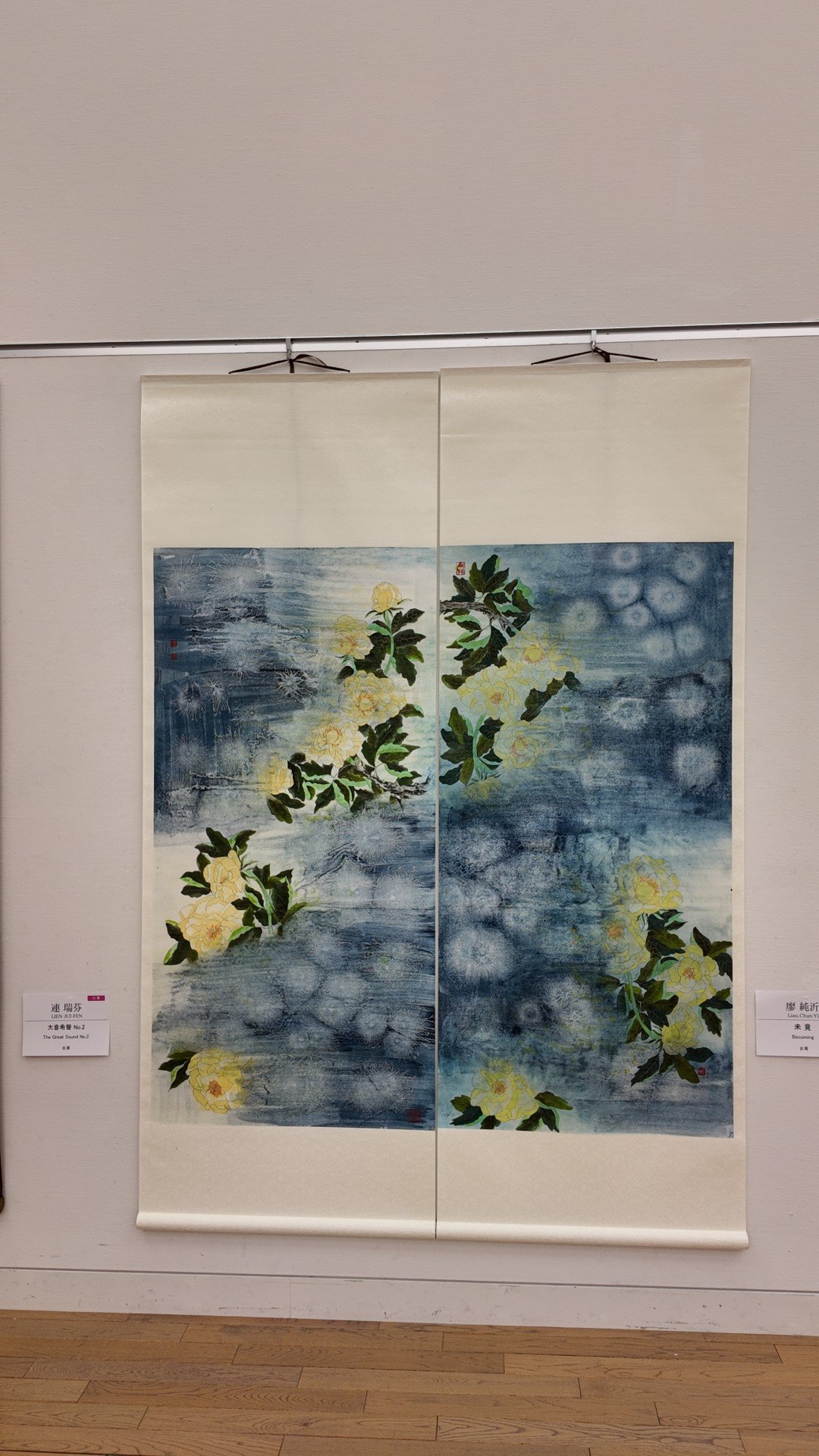
然而,在展場的一隅,台灣藝術家 廖純沂(Liau, Chun-Yi) 的雙拼鉅作 《未竟(Becoming)》,卻像是一座 「靜謐的實驗室」。
她不是一位普通的畫家,而是一位擁有 中山醫學大學醫學研究所博士 學位的研究者。她手中的畫筆,如同實驗室裡的移液管(Pipette);她選用的 熟宣紙,如同顯微鏡下的玻片。
不同於生宣的狂放潑灑,廖純沂利用 熟宣不吸水 的特性,進行了一場關於 「層次」 與 「物質」 的精準實驗。她將生物學對生命的微觀理解,轉化為宏觀的彩墨哲學,在東京的藝術殿堂中,展示了一種 「理性的詩意」。
場域的現象學
—— 在黑川紀章的玻璃巨塔中,構建「微觀宇宙」
國立新美術館 是一個強調「共生(Symbiosis)」的巨大容器。對於廖純沂而言,挑戰在於:如何在巨大的物理空間中,展現微觀世界的深度?
1. 對抗白盒子的「厚度」
NACT 的展牆高聳潔白,容易使平面作品顯得單薄。 廖純沂選擇了 熟宣(Sized Xuan) 結合 礦物顏料(岩彩)。
- 熟宣因經過膠礬加工,紙質較硬且不吸水,這使得顏料不是滲透進去,而是 「堆疊」 在紙面上。
- 這種堆疊創造了物理上的 「厚度」 與 「浮雕感」。在美術館的聚光燈下,礦物顏料的晶體會產生折射,使得畫面具有一種 「寶石般的物質感」,從而撐起了巨大的展示空間。
2. 視覺的引力場
廖純沂的作品是一個 「內吸」 的場域, 那深邃的藍色肌理,如同深海或宇宙黑洞,強迫觀眾走近,去凝視那些如同細胞分裂般的細節。她以 「精微」 對抗 「巨大」,在喧囂的六本木創造了一個精神的沈思點。
身分的雙重性
—— 醫學博士的研究視角:從培養皿到畫仙紙
要解讀《未竟》,必須先理解創作者的 「眼」。廖純沂的眼睛,是受過嚴格科學訓練的。
1. 非臨床,而是研究(Not Clinical, But Research)
她不是在病床邊診斷的醫生,而是在實驗室探索機制的 博士研究者。 這意味著她關注的不是「治癒」,而是 「原理」。
- 在她的畫中,牡丹花不是文人筆下的富貴象徵,而是 「生物能量的聚合體」。
- 背景的紋理不是寫意的雲煙,而是 「分子結構」 或 「有機組織」 的模擬。
2. 實驗精神的轉移
作為 台灣生物化學及分子生物學學會 的會員,她習慣於控制變因。 在創作中,她將這種精神帶入了 「材質實驗」。熟宣紙的膠礬濃度、礦物顏料的顆粒大小、水分蒸發的速度,都是她調控的參數。她像是在進行一場化學實驗,追求在 「控制(Control)」 與 「隨機(Chance)」 之間的完美平衡。
作品深度解構
—— 《未竟》的物質辯證與視覺修辭
作品: 《未竟》 (Becoming) 規格: 138 x 138 cm (雙拼 / 兩張4尺全開) 媒材: 熟宣紙、彩墨、礦物顏料
這是一件建立在 「熟宣特性」 之上的技術傑作。
一:熟宣的化學(不吸水的控制美學)
與生宣的「一筆定江山」不同,熟宣允許 「反覆渲染」 與 「清洗」。 廖純沂充分利用了這一點。
- 積染法(Layering): 畫面那深沈的藍色背景,並非一次塗抹而成,而是經過數十次的淡墨與花青 層層疊加。因為紙張不吸水,每一層顏料乾燥後都形成一個薄膜,光線穿透這些薄膜,產生了深邃的 「通透感(Transparency)」。
二:藍色的原生湯(細胞與虛空的隱喻)
背景中那些白色的、絮狀的、圓形的紋理,是整幅畫最迷人的地方。
- 技法推測: 這極可能是利用熟宣的特性,運用了 「撞水」 或 「撒鹽」 技法。在顏料未乾時滴入清水或化學溶劑,利用表面張力將顏料推開。
- 科學隱喻: 在醫學博士的眼中,這就像是顯微鏡下的 「細胞培養基(Culture Medium)」,或者是生命的 「原生湯(Primordial Soup)」。這是生命誕生前的混沌狀態,充滿了可能性。
三:礦岩的堆疊(黃色牡丹的能量實體)
前景的牡丹花使用了 黃色系的礦物顏料。廖純沂的作品基礎在於 「勾勒」。這種技法繼承自宋代工筆的精神,講究線條的韌性、起伏與轉折。
- 線條的厚度: 她的勾勒並非死板的「描邊」,而是具備書法美感的 「鐵線描」 或 「蘭葉描」 的變奏。這種線條賦予了物體物理上的重量感與穩定性,使畫面在視覺上產生了一種 「結構性的真實」。
- 理性的界定: 透過精準的勾勒,廖純沂在畫布上定義了虛與實、內與外的界限。這種界限感,是對當代氾濫的模糊影像的一種回應,展現了她對事物 「本質結構」 的尊重。
2. 小寫意的氣韻調節:流動的精神性
在嚴密的勾勒基礎之上,廖純沂引入了 小寫意 的渲染與隨意性。
- 筆墨的呼吸: 不同於大寫意的狂放,她的小寫意表現為在既定的輪廓內,進行微妙的水分控制與層次疊加。這種手法讓原本生硬的線條框架中,充盈著流動的空氣感與生命力。
- 偶然性的控制: 在色彩的暈染中,她容許墨色在勾勒的邊界內進行局部的流竄與碰撞。這種 「受控的偶然性(Controlled Contingency)」,讓她的作品在精緻中帶有文人畫的優雅與從容。
技法的煉金術
—— 「撞水撞粉」與「晶體沈澱」的實驗
廖純沂的創作過程,是一場 物理與化學的展演。
1. 液體的張力學
在熟宣上作畫,水分會浮在紙面上很長時間。廖純沂利用這段時間,讓不同比重的顏料(如重金屬礦物色與輕質植物色)在水中自然分離、沈澱。 這種 「沈澱紋理」 是生宣無法做到的。它模仿了地質沈積或生物組織的生成過程,賦予畫面一種 「自然演化」 的真實感。
2. 書法線條的隱性支撐
廖純沂的藝術成就,在於她勇敢地回歸了水墨最核心、也最困難的領地——「線條」。
她拒絕沒骨畫法那種容易流於甜美的軟弱,選擇以 工筆勾勒為基石,再輔以 小寫意的精神導向。這種 「剛柔並濟」 的策略,不僅保存了傳統繪畫的精髓,更賦予了水墨在當代視覺環境中一種 「清醒的、結構性的」 力量。
哲學的凝視
—— 「未竟」作為一種生物學的生成狀態
標題 《未竟(Becoming)》 是一個哲學與科學的雙重命題。
1. 生物學的動態平衡
在生物學中,生命體永遠處於 「代謝(Metabolism)」 之中。細胞不斷凋亡與再生,沒有一刻是靜止的「完成態」。 廖純沂描繪的正是這種狀態。畫面右上方的模糊光暈,與左下方的具象花朵,暗示了 「能量的聚散」。生命從藍色的虛空中「生成」,短暫綻放,然後又回歸虛空。
2. 德勒茲的生成論
這與哲學家德勒茲(Deleuze)的「生成」概念不謀而合。這幅畫不是對牡丹的再現(Representation),而是捕捉了牡丹 「正在成為牡丹」 的那個過程。
系譜的對話
—— 膠彩畫的細膩與當代水墨的氣韻
廖純沂的作品位於多種藝術傳統的交匯點。
1. 與膠彩畫(Nihonga)的對話
由於使用熟宣與礦物顏料,她的作品具有 日本膠彩畫 的細膩質感與裝飾性。這使得她在日本 NAU 展覽中,能夠迅速獲得當地觀眾的文化共鳴。
2. 與宋代院體畫的對話
熟宣是宋代工筆畫的主要載體。廖純沂繼承了宋畫 「格物致知」 的精神,但在形式上大膽革新,拋棄了傳統的寫實,走向了 「半抽象」 的心象風景。
—— NAU 展場中的「理性詩意」
在 第 24 回 NAU21世紀美術連立展 中,廖純沂的展覽位置非常獨特。
1. 智性的厚度
相比於許多憑直覺創作的藝術家,廖純沂的作品背後有強大的 「知識體系」 支撐。她的醫學博士背景,為作品提供了 「科學的敘事」,這在當代藝術圈是非常獨特且具說服力的賣點。
2. 跨文化的視覺語言
她避開了過於晦澀的東方典故,使用了 「細胞」、「宇宙」、「能量」 這些普世的視覺符號。這讓她的作品能夠跨越語言障礙,被國際觀眾所理解。
理性與感性的共生 —— 台灣「學者型藝術家」的新典範
文 / 王 穆提(WANG MUTI)
廖純沂在東京國立新美術館的展出,展現了 「跨域(Interdisciplinary)」 的強大力量。
她證明了,科學與藝術並非對立。
- 熟宣 是她的培養皿。
- 顏料 是她的試劑。
- 《未竟》 是她的研究報告。
這位 醫學博士研究者,用理性的大腦控制著繁複的堆疊技法,用感性的靈魂賦予了畫面深邃的詩意。在國立新美術館的光影中,廖純沂讓我們看見了:生命的奧秘,不僅存在於顯微鏡下,更存在於那一層層堆疊的礦岩與水墨之間。
【藝術家檔案 Data File】
- 藝術家: 廖純沂 (Liau, Chun-Yi)
- 身分:
- 中山醫學大學 醫學研究所 博士 (Ph.D., Institute of Medicine)
- 藝術家 / 書法家 / 研究者
- 入選展覽: 日本第24回 NAU21世紀美術連立展
- 展出地點: 日本東京・國立新美術館
- 參展作品:
- 題名: 《未竟》 (Becoming)
- 規格: 138 x 138 cm (雙拼 / Diptych)
- 媒材: 熟宣紙、彩墨、礦物顏料 (Sized Xuan Paper, Ink, Mineral Pigments)
- 風格關鍵字: 微觀美學、生物學視角、熟宣積染、工筆勾勒小寫意、學者型藝術。
Molecular Poetics on Sized Xuan Paper: Liau Chun-Yi’s Microscopic Gaze and the Flux of Life
The 24th NAU 21st Century Art Exhibition in Japan: A Complete Record and In-Depth Art Critique of Taiwanese Artist Liau Chun-Yi’s Participation
Curated and Written by Wang Muti
A Quiet Laboratory in Roppongi — When a Scientist Picks Up the Brush
Early spring, 2026. Roppongi, Tokyo.
The National Art Center, Tokyo (NACT), designed by Metabolist master architect Kisho Kurokawa, captures the movement of urban light and shadow in its iconic undulating glass curtain wall. Within the vast exhibition hall of The 24th NAU 21st Century Art Exhibition in Japan, the space is saturated with various avant-garde, restless, and even disruptive languages of contemporary art.
Yet in one corner of the venue, Taiwanese artist Liau Chun-Yi’s monumental diptych, Becoming, stood like a**“quiet laboratory.”**
She is not an ordinary painter, but a researcher holding a Ph.D. from the Institute of Medicine at Chung Shan Medical University. The brush in her hand resembles a pipette in a laboratory; the sized xuan paper she chooses functions like a glass slide under a microscope.
Unlike the free-flowing abandon associated with raw xuan paper, Liau makes use of the non-absorbent properties of sized xuan paper to conduct a precise experiment in**“layering”** and**“materiality.”** She transforms biology’s microscopic understanding of life into a macroscopic philosophy of color and ink, presenting in Tokyo’s temple of art a form of**“rational lyricism.”**
The Phenomenology of the Site
Constructing a “Microcosm” Inside Kisho Kurokawa’s Glass Tower
The National Art Center, Tokyo is a vast container that emphasizes symbiosis. For Liau Chun-Yi, the challenge was this: How can one reveal the depth of the microscopic world within such an immense physical space?
1. Resisting the “Flatness” of the White Cube with Thickness
NACT’s soaring white walls can easily make two-dimensional works appear visually thin. Liau therefore chose sized xuan paper combined with mineral pigments.
- Because sized xuan paper has been treated with alum and glue, it is firmer and does not readily absorb water. As a result, pigment does not seep deeply into the paper but instead accumulates on the surface in layers.
- This layering creates a physical sense of thickness and bas-relief-like dimensionality. Under the museum’s spotlights, the crystals in the mineral pigments refract light, lending the surface a gem-like material presence that is capable of holding its own within a monumental exhibition space.
2. A Visual Field of Gravity
Liau’s work creates a field that draws the gaze inward. Its profound blue textures—like the deep sea or the gravitational darkness of a black hole—compel viewers to step closer and scrutinize details that resemble cell division. She counters the vast with the minute, creating amid the clamor of Roppongi a point of spiritual contemplation.
The Duality of Identity
A Medical Ph.D.’s Research Perspective: From Petri Dish to Xuan Paper
To interpret Becoming, one must first understand the eye of its maker. Liau Chun-Yi’s eye has been shaped by rigorous scientific training.
1. Not Clinical, but Research-Oriented
She is not a physician diagnosing at the bedside, but a doctoral researcher investigating mechanisms in the laboratory. This means that what concerns her is not**“cure,”** but**“principle.”**
- In her paintings, the peony is not a traditional literati symbol of wealth and splendor, but rather an aggregate of biological energy.
- The background textures are not expressive clouds or mists, but simulations of molecular structures or organic tissues.
2. The Transference of an Experimental Spirit
As a member of the Biochemical Society of Taiwan / Taiwan Society for Biochemistry and Molecular Biology, she is accustomed to controlling variables. In her artistic practice, she brings this same spirit into material experimentation. The glue-and-alum concentration of the sized xuan paper, the particle size of the mineral pigments, and the speed of water evaporation all become parameters under her control. She works as though conducting a chemical experiment, seeking the perfect balance between control and chance.
A Deep Deconstruction of the Work
The Material Dialectics and Visual Rhetoric of Becoming
Work: Becoming
Dimensions: 138 × 138 cm (Diptych / two full 4-foot sheets)
Medium: Sized Xuan Paper, Ink, Mineral Pigments
This is a technical masterpiece founded upon the very properties of sized xuan paper.
I. The Chemistry of Sized Xuan
An Aesthetic of Control Through Non-Absorbency
Unlike raw xuan paper, where “one stroke determines everything,” sized xuan permits repeated washes, renderings, and corrections. Liau fully exploits this characteristic.
- Layered staining (layering): The painting’s deep blue background was not created in a single application, but built up through dozens of superimposed washes of diluted ink and blue pigment. Because the paper does not absorb water readily, each dried layer forms a thin film. Light penetrates these films and returns through them, producing a profound sense of transparency.
II. The Primordial Broth of Blue
A Metaphor of Cells and Void
The white, flocculent, circular textures in the background are among the most captivating aspects of the entire painting.
- Technical speculation: These effects were most likely created using methods such as water collision or salt-sprinkling, techniques made possible by the properties of sized xuan paper. Droplets of clean water or a chemical solvent are introduced before the pigment has dried, and surface tension pushes the pigment outward.
- Scientific metaphor: Through the eyes of a medical Ph.D., this resembles a cell culture medium, or the primordial soup of life itself—a chaotic precondition of life, filled with possibility.
III. The Stratification of Mineral Matter
The Yellow Peony as an Entity of Energy
The peony in the foreground is rendered with yellow-toned mineral pigments. The foundation of Liau’s work lies in outline drawing. This technique inherits the spirit of Song-dynasty gongbi painting, emphasizing the resilience, modulation, and turning of line.
- The thickness of line: Her outlining is not rigid contouring, but a variation on the calligraphically inflected modes of**“iron-wire line”** or**“orchid-leaf line.”** Such lines endow the depicted forms with a physical sense of weight and stability, creating a kind of structural realism in visual terms.
- Rational delineation: Through precise outlining, Liau defines the boundaries between void and substance, inside and outside. This sense of boundary responds to the overabundance of blurred imagery in contemporary visual culture, demonstrating her respect for the essential structure of things.
IV. The Breath-Regulation of Minor Freehand Expression
The Spirituality of Flow
Upon the strict foundation of meticulous outlining, Liau introduces the atmosphere and spontaneity of small-scale freehand expression (xiaoxieyi).
- The breathing of brush and ink: Unlike the expansiveness of bold freehand ink painting, her xiaoxieyi manifests as subtle control over moisture and layered tonal buildup within predetermined contours. This allows the otherwise firm linear framework to become filled with a sense of moving air and living vitality.
- Controlled contingency: In the diffusion of color, she permits ink and pigment to drift and collide locally within the boundaries established by the outlines. This controlled contingency allows her work to retain a literati elegance and composure within refinement.
The Alchemy of Technique
An Experiment in “Water Collision, Powder Collision,” and “Crystal Sedimentation”
Liau Chun-Yi’s creative process is a performance of physics and chemistry.
1. The Dynamics of Liquid Tension
When painting on sized xuan paper, water remains on the surface for a long time. Liau uses this window of time to allow pigments of different specific gravities—such as heavy mineral colors and lighter plant-based pigments—to separate and settle naturally in water. This kind of sedimentary texture is impossible with raw xuan paper. It imitates the processes of geological deposition or the formation of biological tissues, giving the surface an authentic sense of natural evolution.
2. The Invisible Support of Calligraphic Line
Liau’s artistic achievement lies in her courageous return to the most essential—and most difficult—territory of ink painting: line.
She rejects the soft weakness that can easily arise in the boneless method, choosing instead to build upon gongbi outlining as her foundation, supplemented by the spiritual orientation of small freehand expression. This strategy of combining strength and suppleness not only preserves the essence of traditional painting, but also grants ink art a lucid, structural force within the visual environment of the contemporary world.
A Philosophical Gaze
“Becoming” as a Biological State of Emergence
The title Becoming poses a dual proposition—both philosophical and scientific.
1. Biological Dynamic Equilibrium
In biology, life is always in a state of metabolism. Cells continuously undergo death and regeneration; at no moment do they exist in a static state of completion. What Liau depicts is precisely this condition. The hazy halo in the upper right of the painting and the more concrete flower in the lower left suggest the aggregation and dispersal of energy. Life emerges from the blue void, briefly blossoms, and then returns once more to emptiness.
2. Deleuzian Becoming
This resonates strikingly with philosopher Gilles Deleuze’s concept of becoming. The painting is not a representation of a peony; rather, it captures the process by which the peony is becoming peony.
A Dialogue of Genealogies
The Delicacy of Nihonga and the Resonance of Contemporary Ink
Liau Chun-Yi’s work stands at the intersection of multiple artistic traditions.
1. A Dialogue with Nihonga
Through her use of sized xuan paper and mineral pigments, her work possesses the delicate materiality and decorative refinement of Nihonga. This enabled her work to quickly generate cultural resonance among local audiences in Japan’s NAU exhibition.
2. A Dialogue with Song Academy Painting
Sized xuan paper was a principal support for Song-dynasty gongbi painting. Liau inherits the Song spirit of investigating things to extend knowledge, yet she boldly innovates in formal terms, abandoning traditional realism in favor of a semi-abstract inner landscape.
“Rational Lyricism” in the NAU Exhibition Space
Within The 24th NAU 21st Century Art Exhibition, Liau Chun-Yi occupied a highly distinctive position.
1. Intellectual Density
Compared to many artists who work primarily from intuition, Liau’s paintings are supported by a powerful system of knowledge. Her background as a medical Ph.D. provides the work with a scientific narrative, which is both rare and highly persuasive within the contemporary art world.
2. A Cross-Cultural Visual Language
She avoids overly obscure Eastern allusions and instead employs universal visual symbols such as cells, the cosmos, and energy. This allows her work to cross linguistic boundaries and be understood by international audiences.
The Symbiosis of Reason and Sensibility — A New Paradigm of the Taiwanese Scholar-Artist
Text by Wang Muti
Liau Chun-Yi’s exhibition at the National Art Center, Tokyo, demonstrates the immense power of the interdisciplinary.
She proves that science and art are not opposites.
- Sized xuan paper is her Petri dish.
- Pigment is her reagent.
- Becoming is her research report.
This doctoral researcher in medicine uses a rational mind to control a complex technique of layered accumulation, while investing the image with profound poetic depth through a sensitive soul. In the light and shadow of the National Art Center, Tokyo, Liau Chun-Yi reveals to us that the mysteries of life exist not only beneath the microscope, but also between those layered strata of mineral matter and ink.
Artist Data File
- Artist: Liau Chun-Yi
- Identity:
- Ph.D., Institute of Medicine, Chung Shan Medical University
- Artist / Calligrapher / Researcher
- Selected Exhibition: The 24th NAU 21st Century Art Exhibition in Japan
- Exhibition Venue: The National Art Center, Tokyo, Japan
- Exhibited Work:
- Title: Becoming
- Dimensions: 138 × 138 cm (Diptych)
- Medium: Sized Xuan Paper, Ink, Mineral Pigments
- Style Keywords: Microscopic Aesthetics, Biological Perspective, Layered Staining on Sized Xuan, Gongbi Outlining with Minor Freehand Expression, Scholar-Artist Practice
熟宣の上の分子詩学――廖純沂のミクロな凝視と生命の流転
日本第24回 NAU21世紀美術連立展――台湾人アーティスト・廖純沂の出品全記録と詳細芸術評論
企画・執筆/王 穆提(WANG MUTI)
六本木の静謐なる実験室――科学者が筆を取るとき
2026年初春、東京・六本木。
メタボリズム建築の巨匠 黒川紀章 が設計した 国立新美術館(NACT) は、その象徴的な波状のガラスカーテンウォールによって、都市の光と影の流れをすくい取っている。
「日本第24回 NAU21世紀美術連立展」 の広大な展示空間には、前衛的で、騒然として、ときに破壊的ですらある現代美術の言語が満ちていた。
しかし会場の一角に置かれた、台湾人アーティスト 廖純沂(Liau, Chun-Yi) の大作ディプティック**《未竟(Becoming)》** は、まるでひとつの**「静かな実験室」** のようであった。
彼女は単なる画家ではない。中山医学大学医学研究所博士 の学位を持つ研究者でもある。
彼女の手にある筆は、実験室の ピペット のようであり、彼女が選ぶ 熟宣紙 は、顕微鏡下の スライドガラス のようでもある。
生宣の奔放なにじみや飛沫とは異なり、廖純沂は 熟宣の吸水しにくい性質 を活かし、「層」 と**「物質」** をめぐる精密な実験を行っている。
彼女は、生物学が生命をミクロに理解する視点を、色彩と水墨のマクロな哲学へと変換し、東京の芸術の殿堂において**「理性的な詩情」** を提示したのである。
場の現象学
黒川紀章のガラスの巨塔の中に「微小宇宙」を構築する
国立新美術館 は、「共生(Symbiosis)」を強く意識した巨大な器である。
廖純沂にとっての課題はこうであった。この巨大な物理空間の中で、いかにミクロな世界の深みを可視化するか。
1. ホワイトキューブの「薄さ」に対抗する厚み
NACTの高く白い展示壁は、平面作品を視覚的に薄く見せやすい。そこで廖純沂は、熟宣紙 と 鉱物顔料(岩彩) を選んだ。
- 熟宣は膠と礬による加工が施されているため、紙質がやや硬く、水を吸い込みにくい。そのため顔料は紙の内部へ浸透するのではなく、紙面の上に**「層状に堆積」** していく。
- この堆積は、物理的な**「厚み」** と レリーフ的な感覚 を生み出す。美術館のスポットライトの下では、鉱物顔料の結晶が光を屈折させ、画面に 宝石のような物質感 を与え、巨大な展示空間にも十分に対抗しうる存在感を獲得する。
2. 視覚の重力場
廖純沂の作品は、視線を 内側へ吸い込む場 である。
その深い青の肌理は、深海あるいは宇宙のブラックホールのように、観者を近づかせ、細胞分裂を思わせる細部を凝視させる。
彼女は**「巨大」** に対して**「精微」** をもって応答し、喧騒の六本木の中にひとつの精神的沈思の地点を生み出している。
アイデンティティの二重性
医学博士の研究的視座――培養皿から宣紙へ
《未竟》を読み解くには、まず作者の**「見る眼」** を理解しなければならない。
廖純沂の眼は、厳格な科学訓練を受けた眼である。
1. 臨床ではなく、研究である
彼女は病床で診断を下す医師ではなく、実験室でメカニズムを探究する 博士研究者 である。
つまり彼女が注視するのは「治癒」ではなく、「原理」 なのだ。
- 彼女の絵において、牡丹は文人画的な富貴の象徴ではなく、「生物的エネルギーの凝集体」 である。
- 背景のテクスチャーも、写意的な雲煙ではなく、「分子構造」 や**「有機組織」** を模したものとして読むことができる。
2. 実験精神の移行
彼女は 台湾生物化学・分子生物学学会 の会員として、変数をコントロールすることに慣れている。
創作においても、その精神は 素材実験 として持ち込まれている。熟宣紙に施された膠礬の濃度、鉱物顔料の粒子の大きさ、水分蒸発の速度――それらはすべて彼女が調整するパラメータである。
彼女はあたかも一つの化学実験を行うように、「制御(Control)」 と**「偶然(Chance)」** のあいだに理想的な均衡を求めている。
作品の深層解体
《未竟》の物質弁証法と視覚修辞
作品名:《未竟》 (Becoming)
サイズ: 138 × 138 cm(ディプティック/全開4尺2枚)
素材: 熟宣紙、彩墨、鉱物顔料
これは、熟宣の特性 の上に築かれた技術的傑作である。
一、熟宣の化学
吸水しないことによる制御の美学
生宣における「一筆で決まる」性格とは異なり、熟宣は 反復的なぼかし、重ね塗り、洗い を可能にする。
廖純沂はこの点を最大限に活用している。
- 積染法(Layering): 画面の深い青の背景は、一度塗りでできたものではない。淡墨や花青を何十層にも重ねてつくられている。紙が水を吸い込まないため、各層の顔料は乾いたのちに薄膜を形成する。光はその薄膜を通過し、重層を介して戻ってくることで、深く澄んだ**「透過感(Transparency)」** を生み出す。
二、青の原生スープ
細胞と虚空のメタファー
背景に見える白く、綿状で、円形を帯びたテクスチャーは、この絵全体の中でもとりわけ魅力的な部分である。
- 技法の推測: これは熟宣の性質を利用した**「撞水」** や**「撒塩」** のような技法である可能性が高い。顔料が乾く前に清水や溶剤を落とし、表面張力によって顔料を押し広げるのである。
- 科学的メタファー: 医学博士の眼から見れば、これは顕微鏡下の**「細胞培養液(Culture Medium)」、あるいは生命の「原始スープ(Primordial Soup)」** にも見える。すなわち生命誕生以前の混沌であり、無数の可能性をはらんだ状態である。
三、鉱岩の堆積
黄色い牡丹というエネルギーの実体
前景の牡丹には、黄色系の鉱物顔料 が用いられている。
廖純沂の作品の基底にあるのは**「勾勒」** である。この技法は、宋代工筆画の精神を継承し、線の強靭さ、抑揚、転折を重視する。
- 線の厚み: 彼女の勾勒は、硬直した輪郭線ではない。そこには書法的な美感を備えた 鉄線描 や 蘭葉描 の変奏が見られる。このような線は、対象に物理的な重量感と安定感を与え、画面に 構造的なリアリティ を生み出す。
- 理性的な画定: 精確な勾勒を通して、彼女は虚と実、内と外の境界を画面上に定める。この境界意識は、現代にあふれる曖昧でぼやけたイメージへの応答でもあり、事物の 本質構造 への敬意を示している。
四、小写意による気韻の調整
流動する精神性
厳密な勾勒を基礎としながら、廖純沂はそこに 小写意 の滲みや自在性を導入している。
- 筆墨の呼吸: 大写意の奔放さとは異なり、彼女の小写意は、定められた輪郭の内側で、微妙な水分調整と層の重なりを行うこととして現れる。この手法により、もともと堅固な線の枠組みの中に、流動する空気感と生命感が満たされる。
- 偶然性の制御: 色彩のにじみにおいて、彼女は勾勒で定めた境界の内部に限って、墨や色が局所的に流れ、衝突することを許している。この**「制御された偶然性(Controlled Contingency)」** によって、作品は精緻でありながら、文人画的な優雅さとゆとりを帯びる。
技法の錬金術
「撞水撞粉」と「結晶沈殿」の実験
廖純沂の制作過程は、物理学と化学の上演 でもある。
1. 液体の張力学
熟宣の上では、水分が長時間紙面にとどまる。
廖純沂はこの時間を利用し、重い鉱物系の色 と 軽い植物系の色 といった比重の異なる顔料が、水の中で自然に分離・沈殿していく状態を導く。
この**「沈殿の肌理」** は、生宣では不可能なものである。
それは地質学的な堆積、あるいは生物組織の形成過程を模倣し、画面に 自然進化のリアリティ を付与する。
2. 書法的線条の見えない支え
廖純沂の芸術的達成は、水墨の最も核心的で、同時に最も困難な領域――「線」 に勇敢に立ち返った点にある。
彼女は、没骨画法がときに帯びがちな甘さや脆弱さを退け、工筆的勾勒 を基礎とし、その上に 小写意 の精神性を添える道を選んだ。
この 剛柔相済 の戦略は、伝統絵画の精髄を保持するだけでなく、現代視覚環境の中で水墨に**「醒めた、構造的な力」** を与えている。
哲学的凝視
「未竟」を生物学的生成状態として読む
題名**《未竟(Becoming)》** は、哲学と科学の二重の命題である。
1. 生物学における動的平衡
生物学において、生命体は常に 代謝(Metabolism) の状態にある。
細胞は絶えず死滅し、再生し続け、静止した「完成状態」にある瞬間は一度としてない。
廖純沂が描いているのは、まさにこの状態である。
画面右上のぼんやりとした光暈と、左下のより具象的な花の形は、エネルギーの集散 を暗示している。
生命は青い虚空から「生成」し、束の間に咲き、そして再び虚空へと帰っていく。
2. ドゥルーズの生成論
これは哲学者 ジル・ドゥルーズ の**「生成」** の概念とも見事に響き合う。
この絵は牡丹の**再現(Representation)**ではなく、牡丹が**「牡丹になりつつある」** その過程を捉えたものなのである。
系譜の対話
膠彩画の繊細さと現代水墨の気韻
廖純沂の作品は、複数の芸術伝統の交差点に位置している。
1. 膠彩画(Nihonga)との対話
熟宣と鉱物顔料を用いることにより、彼女の作品は 日本画(Nihonga) に通じる繊細な質感と装飾性を備えている。
そのため、日本のNAU展においても、現地の観客のあいだで迅速に文化的共鳴を得ることができた。
2. 宋代院体画との対話
熟宣は、宋代の工筆画における主要な支持体の一つであった。
廖純沂は、宋画の**「格物致知」** の精神を継承しつつ、形式面では大胆に革新し、伝統的な写実を離れて 半抽象的な心象風景 へと向かっている。
NAU展会場における「理性的詩情」
第24回 NAU21世紀美術連立展 において、廖純沂の展示位置はきわめて独特であった。
1. 知性的な厚み
直感に依拠して制作する多くのアーティストと比べると、廖純沂の作品の背後には強固な 知の体系 が存在する。
彼女の医学博士という背景は、作品に 科学のナラティブ を与えており、それは現代美術の領域において極めてユニークで、かつ説得力のある強みとなっている。
2. 越境的な視覚言語
彼女は過度に難解な東洋的典故を避け、「細胞」、「宇宙」、「エネルギー」 といった普遍的な視覚記号を用いている。
そのため彼女の作品は言語の壁を越え、国際的な観客にも理解されうる。
理性と感性の共生――台湾における「学者型アーティスト」の新たな典範
文/王 穆提(WANG MUTI)
廖純沂の東京・国立新美術館での展示は、学際性(Interdisciplinary) の持つ大きな力を示している。
彼女は、科学と芸術が対立するものではないことを証明した。
- 熟宣 は彼女の培養皿であり、
- 顔料 は彼女の試薬であり、
- 《未竟》 は彼女の研究報告である。
この 医学博士研究者 は、理性的な頭脳で複雑な重層技法を制御しつつ、感性的な魂によって画面に深い詩情を与えている。
国立新美術館の光と影の中で、廖純沂は私たちにこう示してみせた。
生命の神秘は、顕微鏡の下にだけ存在するのではない。幾重にも重なった鉱岩と水墨のあいだにも、確かに存在しているのだ。
【アーティスト・データファイル】
- アーティスト: 廖純沂(Liau, Chun-Yi)
- 肩書:
- 中山医学大学 医学研究所 博士(Ph.D., Institute of Medicine)
- アーティスト/書家/研究者
- 入選展覧会: 日本第24回 NAU21世紀美術連立展
- 展示会場: 日本・東京 国立新美術館
- 出品作品:
- 題名: 《未竟》 (Becoming)
- サイズ: 138 × 138 cm(ディプティック)
- 素材: 熟宣紙、彩墨、鉱物顔料
- スタイル・キーワード: ミクロ美学、生物学的視座、熟宣の積染、工筆勾勒と小写意、学者型アート